

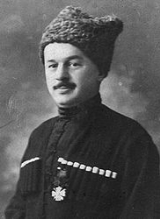
Tapa Tchermoeff

Encyclopedia
Abdul "Tapa" Midgit Bey Ortsa Tchermoeff (1882 – August 28, 1937) was the first and last Prime Minister
of the Mountainous Republic of the Northern Caucasus
. He was in office from May 11, 1918 until the entire government was forced into exile by the advancing Bolsheviks in 1921. His official title was General Tchermoeff, Prime Minister of the Mountainous Republic of the Northern Caucasus.
, Chechnya
, in 1882, Tapa was the eldest son of the well-known General Ortsou Tchermoeff. He was educated at the Vladikavkaz
secondary school
and at the Nicolayevsky Cavalry College in St. Petersburg. He graduated in 1901 and joined an elite military unit, His Majesty Tsar Nicholas II
's Own Life Guard Convoy.
Tapa Tchermoeff married Princess
Hava Hannum Hibrahimbekova of Persia in 1906. Although still a young man he was obliged to leave the army in 1908 when his father died. During this time he threw himself into economic and industrial activities. His family owned important parcels of oil-bearing land in the Grozny area. Tapa automatically became one of the most active and energetic pioneers of the Grozny oil industry.
World War I
interrupted Tapa's economic activity. He joined the famous native Savage Division
of the Imperial Russian Army
with the rank of Captain. In the war he proved himself a brilliant military leader and a fearless soldier. After the October Revolution
Tapa returned to his native land intent to stem the rise of Bolshevism in Chechnya
.
and then the minister for foreign affairs.
Early in March 1919, Tapa headed a delegation to Paris
in an attempt to take part in the Treaty of Versailles
. The object of the delegation was to secure the recognition of the independence of the Mountainous Republic of the Northern Caucasus. A year later the North Caucasus
were in the hands of the Bolsheviks and in January 1921 the Soviet Mountain Republic
of the Russian SFSR was established.
Prime minister
A prime minister is the most senior minister of cabinet in the executive branch of government in a parliamentary system. In many systems, the prime minister selects and may dismiss other members of the cabinet, and allocates posts to members within the government. In most systems, the prime...
of the Mountainous Republic of the Northern Caucasus
Mountainous Republic of the Northern Caucasus
The Mountainous Republic of the Northern Caucasus was a short-lived state situated in the Northern Caucasus...
. He was in office from May 11, 1918 until the entire government was forced into exile by the advancing Bolsheviks in 1921. His official title was General Tchermoeff, Prime Minister of the Mountainous Republic of the Northern Caucasus.
Early life
Born in GroznyGrozny
Grozny is the capital city of the Chechen Republic, Russia. The city lies on the Sunzha River. According to the preliminary results of the 2010 Census, the city had a population of 271,596; up from 210,720 recorded in the 2002 Census. but still only about two-thirds of 399,688 recorded in the 1989...
, Chechnya
Chechnya
The Chechen Republic , commonly referred to as Chechnya , also spelled Chechnia or Chechenia, sometimes referred to as Ichkeria , is a federal subject of Russia . It is located in the southeastern part of Europe in the Northern Caucasus mountains. The capital of the republic is the city of Grozny...
, in 1882, Tapa was the eldest son of the well-known General Ortsou Tchermoeff. He was educated at the Vladikavkaz
Vladikavkaz
-Notable structures:In Vladikavkaz, there is a guyed TV mast, tall, built in 1961, which has six crossbars with gangways in two levels running from the mast structure to the guys.-Twin towns/sister cities:...
secondary school
Secondary school
Secondary school is a term used to describe an educational institution where the final stage of schooling, known as secondary education and usually compulsory up to a specified age, takes place...
and at the Nicolayevsky Cavalry College in St. Petersburg. He graduated in 1901 and joined an elite military unit, His Majesty Tsar Nicholas II
Nicholas II of Russia
Nicholas II was the last Emperor of Russia, Grand Prince of Finland, and titular King of Poland. His official short title was Nicholas II, Emperor and Autocrat of All the Russias and he is known as Saint Nicholas the Passion-Bearer by the Russian Orthodox Church.Nicholas II ruled from 1894 until...
's Own Life Guard Convoy.
Tapa Tchermoeff married Princess
Princess
Princess is the feminine form of prince . Most often, the term has been used for the consort of a prince, or his daughters....
Hava Hannum Hibrahimbekova of Persia in 1906. Although still a young man he was obliged to leave the army in 1908 when his father died. During this time he threw himself into economic and industrial activities. His family owned important parcels of oil-bearing land in the Grozny area. Tapa automatically became one of the most active and energetic pioneers of the Grozny oil industry.
World War I
World War I
World War I , which was predominantly called the World War or the Great War from its occurrence until 1939, and the First World War or World War I thereafter, was a major war centred in Europe that began on 28 July 1914 and lasted until 11 November 1918...
interrupted Tapa's economic activity. He joined the famous native Savage Division
Savage Division
The Caucasian Native Mounted Division , or Savage Division was a cavalry division of the Imperial Russian Army, formed in 1914. It was composed of volunteers from Chechnia, Ingushetia, Daghestan, Karachay, Circassia, Kabarda and Azerbaijan...
of the Imperial Russian Army
Imperial Russian Army
The Imperial Russian Army was the land armed force of the Russian Empire, active from around 1721 to the Russian Revolution of 1917. In the early 1850s, the Russian army consisted of around 938,731 regular soldiers and 245,850 irregulars . Until the time of military reform of Dmitry Milyutin in...
with the rank of Captain. In the war he proved himself a brilliant military leader and a fearless soldier. After the October Revolution
October Revolution
The October Revolution , also known as the Great October Socialist Revolution , Red October, the October Uprising or the Bolshevik Revolution, was a political revolution and a part of the Russian Revolution of 1917...
Tapa returned to his native land intent to stem the rise of Bolshevism in Chechnya
Chechnya
The Chechen Republic , commonly referred to as Chechnya , also spelled Chechnia or Chechenia, sometimes referred to as Ichkeria , is a federal subject of Russia . It is located in the southeastern part of Europe in the Northern Caucasus mountains. The capital of the republic is the city of Grozny...
.
The Mountainous Republic of the Northern Caucasus
Tapa believed the unifying of all Caucasian highlanders to be the only way of saving the Northern Caucasus from the Bolsheviks. On his initiative and thanks to his unrelenting energy a convention of Caucasian highlanders took place on March, 1917. This meeting resolved to form an independent highland state. On 11 May 1918 The Mountainous Republic of the Northern Caucasus was officially established. Tapa was first the prime ministerPrime minister
A prime minister is the most senior minister of cabinet in the executive branch of government in a parliamentary system. In many systems, the prime minister selects and may dismiss other members of the cabinet, and allocates posts to members within the government. In most systems, the prime...
and then the minister for foreign affairs.
Early in March 1919, Tapa headed a delegation to Paris
Paris
Paris is the capital and largest city in France, situated on the river Seine, in northern France, at the heart of the Île-de-France region...
in an attempt to take part in the Treaty of Versailles
Treaty of Versailles
The Treaty of Versailles was one of the peace treaties at the end of World War I. It ended the state of war between Germany and the Allied Powers. It was signed on 28 June 1919, exactly five years after the assassination of Archduke Franz Ferdinand. The other Central Powers on the German side of...
. The object of the delegation was to secure the recognition of the independence of the Mountainous Republic of the Northern Caucasus. A year later the North Caucasus
North Caucasus
The North Caucasus is the northern part of the Caucasus region between the Black and Caspian Seas and within European Russia. The term is also used as a synonym for the North Caucasus economic region of Russia....
were in the hands of the Bolsheviks and in January 1921 the Soviet Mountain Republic
Soviet Mountain Republic
Mountain Autonomous Soviet Socialist Republic or Mountain ASSR was a short-lived autonomous republic within the Russian SFSR in the Northern Caucasus that existed from January 20, 1921 to July 7, 1924....
of the Russian SFSR was established.
External links
- Georgia (Republic). Records (microform): Guide., Harvard University Library
- Conflict in Chechnya: A Background Perspective
- Charlotte Aliston. The Suggested Basis for a Russian Federal Republic': Britain, Anti-Bolshevik Russia and the Border States at the Paris Peace Conference, 1919
- Madeline Grown Up by Mrs Robert Henrey, 1952