

Talbot Tagora

Encyclopedia
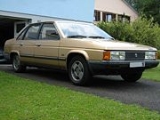
The Talbot Tagora is an executive car
that was developed by Chrysler Europe
and produced by Peugeot Société Anonyme
(PSA). The Tagora was marketed under the Talbot
marque after PSA took over Chrysler
's European operations in 1979. PSA presented the first production vehicle in 1980 and launched it commercially in 1981. The Tagora fell short of sales expectations, and PSA cancelled the model only two years later. Fewer than 20,000 Tagora models were ever built, all of them at the former Simca
factory in Poissy
, near Paris, France.
C9, with the goal of replacing the unsuccessful Chrysler 180
series. Following the same development pattern as with the Horizon
and Alpine
models, the responsibility for the Tagora's technical development remained in France, while the styling was devised at Chrysler's design centre in the United Kingdom. An early proposal for the name of the car was "Simca 2000".
. The British design team initially proposed some stylistic features inspired by the Citroën SM
, including a front glass panel between the headlights to accommodate the number plate
, round front wheelarches and rear spats
. However, Chrysler management in the United States deemed these features too extravagant, so the design of the C9 became more conventional: front and rear wheelarches were squared off and the spats lost, and the license plate was placed on the front bumper as on most cars. To better balance the tall silhouette, the beltline was raised. Over the course of development, the C9 also lost its vertical taillights in favour of more "fashionable" horizontal ones.
used by Chrysler Europe, and a six-cylinder
engine was generally expected. Consequently, the company had to seek a new engine for the Tagora. One candidate was a straight-six manufactured by Mitsubishi
, but it proved unsuitable for a car of this class. The other proposal was the Douvrin V6 engine
(the "PRV"), a joint development of PSA, Renault
and Volvo
. Since the Tagora would be in direct competition with PSA models that used the PRV, it seemed unlikely that Chrysler would be able to procure that engine.
 Chrysler Corporation approved the development of the model on the assumption that Chrysler Europe would sell 60,000 C9 models per year, which translated into a projected 5 percent share of the executive car market. This estimate seemed achievable because Chrysler had a 7 percent market share in Europe overall. The projected sales would have covered the car's tooling costs, with the development costs accounted for separately, as part of an independent annual budget.
, formed in 1976 after Peugeot
took over Citroën
. The deal was finalised in 1978, in which the buyer paid US$
1.00 for the entirety of Chrysler Europe and its obligations. The take-over was effective as of 1 January 1979.
While the C9 project was well advanced, PSA already had a crowded lineup in the large vehicle segment, including the legendary Citroën CX
, the slow-selling Peugeot 604
and the newly launched Peugeot 505
. Nevertheless, PSA decided to move forward with the C9 project, making a few significant changes that enabled the use of their own parts. The Simca double wishbone
front suspension gave way to MacPherson strut
s adopted from the Peugeot 505 and 604, and the rear axle
was replaced with that of the 505, much narrower than the one originally planned, as it was designed with respect to the 505 body width. The C9 front end was extended to accommodate the optional PRV engine: now that the model belonged to PSA, using the PRV presented no problems.
 Following the renaming of Chrysler Europe's models to the Talbot
marque, the C9 was christened the Talbot Tagora, and the first batch of cars rolled out of the former Simca plant in Poissy in 1980. The same year, PSA presented the Tagora at the Salon de l'Automobile
in Paris. Following a hands-on demonstration of the model to the press in Morocco in March 1981, the car went on sale in France in April and in the United Kingdom in May. The British billboard advertising campaign boasted "The new Talbot Tagora. Luxury and performance redefined."
The Tagora was priced to overlap with high-end Peugeot 505 and low-end Citroën CX models, while slotting in beneath the Peugeot 604. Its pricing was also comparable to the Renault 20/30
and Ford Granada
. The Tagora was in the 20,000–30,000 Deutschmark
bracket in Germany. The initial production run in 1981 (combined with some pre-production
runs from 1980) was only one quarter of Chrysler's initial projections. Sales proved insufficient even for this production level, and production continued to sharply decline throughout 1982 and 1983, prompting PSA to cancel the model altogether. By the time the Tagora was discontinued, only about 20,000 had been built; by comparison, over 116,000 Peugeot 505s and 74,000 Citroën CXs were made in 1981 alone.
In December 2010, Practical Classics reported that 99.09% of all UK registered Tagoras were no longer on the roads. While this is mostly due to scrapping, other factors such as transferral to other countries could also play a significant part.
s or an optional three-speed automatic
in the case of the four-cylinder engines.
The available models were:
designed by stylist Sunny Atri at the Talbot design studio
in Whitley, Coventry
. The concept was created to generate interest in employing high-end Tagoras as chauffeur-driven limousine
s by users such as business executives and government officials. The donor model for the Présidence was the 2.6 SX, which had an interior appointed with Connolly Leather
upholstery and brass
highlights, plus a host of electronics including a telephone, dictaphone
, text-message receiver, and television with VCR. Originally valued at £
25,000, the Présidence now resides at a car museum in Poissy.
, however, dealt a blow to the European automotive market: the large car segment contracted significantly, making Chrysler's initial sales projections unrealistic. The Tagora was ultimately launched under the Talbot brand, which was not established in the marketplace and had a questionable pedigree, which was an unfavourable trait in the executive car market ruled by established names like the Ford Granada
.
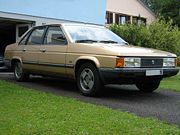
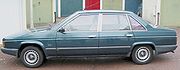
opined, the Tagora "has such a complete blandness of style as to disqualify it instantly in a market where character and status count for so much." The design of the Tagora was focused on practicality, providing exceptional cabin space at the expense of style. The steep windscreen formed a quite strange angle with the relatively short, wedge-shaped bonnet
. The car was wider and taller than most of its competitors, and buyers were unaccustomed to such proportions. The PSA-sourced axles had very narrow tracks relative to the width of the body, which provided an awkward look, especially at the rear. Nor did the plain, plastic dashboard
stir enthusiasm among reviewers and prospective customers.
Executive car
Executive car is a British term that refers to a car's size and is used to describe an automobile larger than a large family car. In official use, the term is adopted by EuroNCAP, a European organisation founded to test car safety.- History :...
that was developed by Chrysler Europe
Chrysler Europe
Chrysler Europe was a division of the Chrysler Corporation that operated between 1967 and 1979.-Formation:In the 1960s, Chrysler sought to become a world producer of automobiles. The company had never had much success outside North America, contrasting with Ford's worldwide reach and General...
and produced by Peugeot Société Anonyme
PSA Peugeot Citroën
PSA Peugeot Citroën is a French manufacturer of automobiles and motorcycles sold under the Peugeot and Citroën marques. Headquartered in the 16th arrondissement of Paris, PSA is the second largest automaker based in Europe and the number eight in the world.-History:In December 1974 Peugeot S.A....
(PSA). The Tagora was marketed under the Talbot
Talbot
Talbot was an automobile marque that existed from 1903 to 1986, with a hiatus from 1960 to 1978, under a number of different owners, latterly under Peugeot...
marque after PSA took over Chrysler
Chrysler
Chrysler Group LLC is a multinational automaker headquartered in Auburn Hills, Michigan, USA. Chrysler was first organized as the Chrysler Corporation in 1925....
's European operations in 1979. PSA presented the first production vehicle in 1980 and launched it commercially in 1981. The Tagora fell short of sales expectations, and PSA cancelled the model only two years later. Fewer than 20,000 Tagora models were ever built, all of them at the former Simca
Simca
Simca was a French automaker, founded in November 1934 by Fiat. It was directed from July 1935 to May 1963 by the Italian Henri Théodore Pigozzi...
factory in Poissy
Poissy
Poissy is a commune in the Yvelines department in the Île-de-France in north-central France. It is located in the western suburbs of Paris from the center.In 1561 it was the site of a fruitless Catholic-Huguenot conference, the Colloquy at Poissy...
, near Paris, France.
Development
Chrysler Europe began the development of the Tagora in 1976, under the code nameCode name
A code name or cryptonym is a word or name used clandestinely to refer to another name or word. Code names are often used for military purposes, or in espionage...
C9, with the goal of replacing the unsuccessful Chrysler 180
Chrysler 180
The Chrysler 180 was the base name for a series of large saloon cars produced by Chrysler Europe. Resulting from joining development efforts of Rootes Group and Simca, the car was produced from 1970 to 1975 in Poissy, France, and later in Chrysler's subsidiary Barreiros' factory in Spain...
series. Following the same development pattern as with the Horizon
Chrysler Horizon
The Horizon was a subcompact automobile developed by Chrysler Europe and was sold in Europe between 1977 and 1985 under the Chrysler, Simca and Talbot nameplates...
and Alpine
Simca 1307
The Simca 1307 was the name under which Chrysler Europe launched its new large family car in July 1975.A modern, front-wheel drive hatchback, it was one of the first such cars in that class, along with the Volkswagen Passat, and became the 1976 European Car of the Year...
models, the responsibility for the Tagora's technical development remained in France, while the styling was devised at Chrysler's design centre in the United Kingdom. An early proposal for the name of the car was "Simca 2000".
Design
The original C9 prototype was a modern-styled saloon with a low beltline and large interior dimensions made possible by the long-wheelbaseWheelbase
In both road and rail vehicles, the wheelbase is the distance between the centers of the front and rear wheels.- Road :In automobiles, the wheelbase is the horizontal distance between the center of the front wheel and the center of the rear wheel...
. The British design team initially proposed some stylistic features inspired by the Citroën SM
Citroën SM
The Citroën SM is a high-performance coupé produced by the French manufacturer Citroën from 1970 to 1975. The SM placed third in the 1971 European Car of the Year contest, trailing its stablemate Citroën GS, and won the 1972 Motor Trend Car of the Year award in the U.S. in 1972.-History:In 1961,...
, including a front glass panel between the headlights to accommodate the number plate
Vehicle registration plate
A vehicle registration plate is a metal or plastic plate attached to a motor vehicle or trailer for official identification purposes. The registration identifier is a numeric or alphanumeric code that uniquely identifies the vehicle within the issuing region's database...
, round front wheelarches and rear spats
Fender skirts
Fender skirts, known in Australia and the United Kingdom as spats, are pieces of bodywork on the fender that cover the upper portions of the rear tires of an automobile.-Functions:...
. However, Chrysler management in the United States deemed these features too extravagant, so the design of the C9 became more conventional: front and rear wheelarches were squared off and the spats lost, and the license plate was placed on the front bumper as on most cars. To better balance the tall silhouette, the beltline was raised. Over the course of development, the C9 also lost its vertical taillights in favour of more "fashionable" horizontal ones.
Engine dilemma
The main competitors in the executive vehicle market offered engines bigger than the biggest two-litre straight-4Straight-4
The inline-four engine or straight-four engine is an internal combustion engine with all four cylinders mounted in a straight line, or plane along the crankcase. The single bank of cylinders may be oriented in either a vertical or an inclined plane with all the pistons driving a common crankshaft....
used by Chrysler Europe, and a six-cylinder
Cylinder (engine)
A cylinder is the central working part of a reciprocating engine or pump, the space in which a piston travels. Multiple cylinders are commonly arranged side by side in a bank, or engine block, which is typically cast from aluminum or cast iron before receiving precision machine work...
engine was generally expected. Consequently, the company had to seek a new engine for the Tagora. One candidate was a straight-six manufactured by Mitsubishi
Mitsubishi Motors
is a multinational automaker headquartered in Minato, Tokyo. In 2009 it was the fifth-largest Japan-based automaker and the 17th-largest in the world measured by production...
, but it proved unsuitable for a car of this class. The other proposal was the Douvrin V6 engine
PRV engine
The PRV engine is an automobile petrol V6 engine that was developed jointly by Peugeot, Renault and Volvo Cars – and sold from 1974 to 1998. It was gradually replaced after 1994 by another joint PSA-Renault design, known as the ES engine at PSA and the L engine at Renault.-Corporate history:The...
(the "PRV"), a joint development of PSA, Renault
Renault
Renault S.A. is a French automaker producing cars, vans, and in the past, autorail vehicles, trucks, tractors, vans and also buses/coaches. Its alliance with Nissan makes it the world's third largest automaker...
and Volvo
Volvo Cars
Volvo Car Corporation, or Volvo Personvagnar AB, is a Swedish automobile manufacturer founded in 1927, in Gothenburg, Sweden. It is owned by Zhejiang Geely Holding Group. Volvo was originally formed as a subsidiary company to the ball bearing maker SKF. When Volvo AB was introduced on the Swedish...
. Since the Tagora would be in direct competition with PSA models that used the PRV, it seemed unlikely that Chrysler would be able to procure that engine.
Sales projections
PSA takeover
During the development of the C9, the management of the bankruptcy-threatened Chrysler Corporation decided to divest itself of its debt-ridden European operations. The buyer was the French PSA GroupPSA Peugeot Citroën
PSA Peugeot Citroën is a French manufacturer of automobiles and motorcycles sold under the Peugeot and Citroën marques. Headquartered in the 16th arrondissement of Paris, PSA is the second largest automaker based in Europe and the number eight in the world.-History:In December 1974 Peugeot S.A....
, formed in 1976 after Peugeot
Peugeot
Peugeot is a major French car brand, part of PSA Peugeot Citroën, the second largest carmaker based in Europe.The family business that precedes the current Peugeot company was founded in 1810, and manufactured coffee mills and bicycles. On 20 November 1858, Emile Peugeot applied for the lion...
took over Citroën
Citroën
Citroën is a major French automobile manufacturer, part of the PSA Peugeot Citroën group.Founded in 1919 by French industrialist André-Gustave Citroën , Citroën was the first mass-production car company outside the USA and pioneered the modern concept of creating a sales and services network that...
. The deal was finalised in 1978, in which the buyer paid US$
United States dollar
The United States dollar , also referred to as the American dollar, is the official currency of the United States of America. It is divided into 100 smaller units called cents or pennies....
1.00 for the entirety of Chrysler Europe and its obligations. The take-over was effective as of 1 January 1979.
While the C9 project was well advanced, PSA already had a crowded lineup in the large vehicle segment, including the legendary Citroën CX
Citroën CX
The Citroën CX is an automobile produced by the French automaker Citroën from 1974 to 1991. Citroën sold nearly 1.2 million CXs during its 16 years of production. The CX was voted European Car of the Year in 1975....
, the slow-selling Peugeot 604
Peugeot 604
The Peugeot 604 is an executive car produced by the French manufacturer Peugeot from 1975 to 1985. 153,252 examples of the 604 were sold during its 10-year production life. It was made in France and also by Kia in Korea....
and the newly launched Peugeot 505
Peugeot 505
The Peugeot 505 is a large family car produced by the French manufacturer Peugeot from 1979 to 1992 in Sochaux, France. The 505 was Peugeot's last rear-wheel drive car...
. Nevertheless, PSA decided to move forward with the C9 project, making a few significant changes that enabled the use of their own parts. The Simca double wishbone
Double wishbone suspension
In automobiles, a double wishbone suspension is an independent suspension design using two wishbone-shaped arms to locate the wheel. Each wishbone or arm has two mounting points to the chassis and one joint at the knuckle. The shock absorber and coil spring mount to the wishbones to control...
front suspension gave way to MacPherson strut
MacPherson strut
The MacPherson strut is a type of car suspension system which uses the axis of a telescopic damper as the upper steering pivot. It is widely used in modern vehicles and named after Earle S. MacPherson, who developed the design.-History:...
s adopted from the Peugeot 505 and 604, and the rear axle
Axle
An axle is a central shaft for a rotating wheel or gear. On wheeled vehicles, the axle may be fixed to the wheels, rotating with them, or fixed to its surroundings, with the wheels rotating around the axle. In the former case, bearings or bushings are provided at the mounting points where the axle...
was replaced with that of the 505, much narrower than the one originally planned, as it was designed with respect to the 505 body width. The C9 front end was extended to accommodate the optional PRV engine: now that the model belonged to PSA, using the PRV presented no problems.
Short market life
Talbot
Talbot was an automobile marque that existed from 1903 to 1986, with a hiatus from 1960 to 1978, under a number of different owners, latterly under Peugeot...
marque, the C9 was christened the Talbot Tagora, and the first batch of cars rolled out of the former Simca plant in Poissy in 1980. The same year, PSA presented the Tagora at the Salon de l'Automobile
Mondial de l'Automobile
The Paris Motor Show is a biennial auto show in Paris. Held around October, it is one of the most important auto shows, often with many new production automobile and concept car debuts. The show was the first motor show in the world, started in 1898 by industry pioneer, Albert de Dion. The show...
in Paris. Following a hands-on demonstration of the model to the press in Morocco in March 1981, the car went on sale in France in April and in the United Kingdom in May. The British billboard advertising campaign boasted "The new Talbot Tagora. Luxury and performance redefined."
The Tagora was priced to overlap with high-end Peugeot 505 and low-end Citroën CX models, while slotting in beneath the Peugeot 604. Its pricing was also comparable to the Renault 20/30
Renault 20/30
The Renault 20 and Renault 30 are two executive cars produced by the French automaker Renault between 1975 and 1984. The most upmarket and expensive Renaults of their time, the two cars were almost identical as regards sheet metal and mechanicals; the 30 was the larger engined and more expensive...
and Ford Granada
Ford Granada (Europe)
The March 1972 released Granada succeeded the British Ford Zephyr, and the German P7-series as Ford's European executive car offering. At first, lower models in the range were called the Ford Consul, but from 1975 on they were all called Granadas. The car soon became popular for taxi, fleet and...
. The Tagora was in the 20,000–30,000 Deutschmark
German mark
The Deutsche Mark |mark]], abbreviated "DM") was the official currency of West Germany and Germany until the adoption of the euro in 2002. It is commonly called the "Deutschmark" in English but not in German. Germans often say "Mark" or "D-Mark"...
bracket in Germany. The initial production run in 1981 (combined with some pre-production
Pre-production car
Pre-production cars are vehicles that allow the automaker to find problems before a new model goes on sale to the public. Pre-production cars come after prototypes, or development mules which themselves are preceded by concept cars...
runs from 1980) was only one quarter of Chrysler's initial projections. Sales proved insufficient even for this production level, and production continued to sharply decline throughout 1982 and 1983, prompting PSA to cancel the model altogether. By the time the Tagora was discontinued, only about 20,000 had been built; by comparison, over 116,000 Peugeot 505s and 74,000 Citroën CXs were made in 1981 alone.
In December 2010, Practical Classics reported that 99.09% of all UK registered Tagoras were no longer on the roads. While this is mostly due to scrapping, other factors such as transferral to other countries could also play a significant part.
Powertrains and models
As with most large cars of its time, the Tagora was a rear-wheel drive vehicle, with a longitudinally-mounted engine. There were three engine choices, mated to four- and five-speed manual transmissionManual transmission
A manual transmission, also known as a manual gearbox or standard transmission is a type of transmission used in motor vehicle applications...
s or an optional three-speed automatic
Automatic transmission
An automatic transmission is one type of motor vehicle transmission that can automatically change gear ratios as the vehicle moves, freeing the driver from having to shift gears manually...
in the case of the four-cylinder engines.
The available models were:
- 2.2 litre (2,155 cc) Type 180 OHC I4Straight-4The inline-four engine or straight-four engine is an internal combustion engine with all four cylinders mounted in a straight line, or plane along the crankcase. The single bank of cylinders may be oriented in either a vertical or an inclined plane with all the pistons driving a common crankshaft....
, double-barrel SolexSolexSolex was a French manufacturer of carburetors and the powered bicycle VéloSoleX.The Solex company was founded by Marcel Mennesson and Maurice Goudard to manufacture vehicle radiators...
carburettor, 115 PS, 184 newton metres (135.7 ft·lbf).
- The base engine was a version of the older Simca Type 180Simca Type 180The Type 180 is an automobile straight-4 engine produced in the 1970s. It was an OHC design.-1.6/1.8:These engines were used in the Chrysler 160/180, a car also sold under a multiplicity of other names.Applications:...
2.0 litre with increased displacement, as also featured in the Matra MurenaMatra MurenaThe Matra Murena was a 3-seat sports car produced from 1980 through 1983 by the French engineering group Matra.The Murena replaced the Matra Bagheera, a very similar vehicle resulting from previous Matra-Simca cooperation, and was largely based on its predecessor...
. It was unrelated to either the American Chrysler KChrysler K engineThe 2.2 and 2.5 are a family of inline-4 engines developed by Chrysler Corporation originally for the Chrysler K- and L-platforms cars and subsequently used in many other Chrysler vehicles...
or PSA DouvrinDouvrin engineThe Douvrin family was an all-aluminum straight-4 automobile engine designed in the early 1970s and produced from 1977 to 1996 by Compagnie Française de Mécanique, a joint-venture between Peugeot and Renault located in the town of Douvrin in northern France...
2.2 litre engines. Available trim levels were designated GL and GLS. The GL was the only model to feature the four-speed manual transmission, and have power steeringPower steeringPower steering helps drivers steer vehicles by augmenting steering effort of the steering wheel.Hydraulic or electric actuators add controlled energy to the steering mechanism, so the driver needs to provide only modest effort regardless of conditions. Power steering helps considerably when a...
as an option as opposed to standard. It was first to be dropped, for the 1983 model year.- 2.3 litre (2,304 cc) XD2S OHVOverhead valveAn overhead valve engine, also informally called pushrod engine or I-head engine, is a type of piston engine that places the camshaft within the cylinder block , and uses pushrods or rods to actuate rocker arms above the cylinder...
turbodieselTurbodieselTurbodiesel refers to any diesel engine with a turbocharger. Turbocharging is the norm rather than the exception in modern car and truck diesel engines...
I4Straight-4The inline-four engine or straight-four engine is an internal combustion engine with all four cylinders mounted in a straight line, or plane along the crankcase. The single bank of cylinders may be oriented in either a vertical or an inclined plane with all the pistons driving a common crankshaft....
, 80 PS, 188 newton metres (138.7 ft·lbf).
- 2.3 litre (2,304 cc) XD2S OHV
- This Peugeot-developed turbodiesel was primarily used in the Peugeot 505 and 604. The diesel-powered version of the Tagora was designated DT.
- 2.7 litre (2,664 cc) PRVPRV engineThe PRV engine is an automobile petrol V6 engine that was developed jointly by Peugeot, Renault and Volvo Cars – and sold from 1974 to 1998. It was gradually replaced after 1994 by another joint PSA-Renault design, known as the ES engine at PSA and the L engine at Renault.-Corporate history:The...
OHC V6V6 engineA V6 engine is a V engine with six cylinders mounted on the crankcase in two banks of three cylinders, usually set at either a right angle or an acute angle to each other, with all six pistons driving a common crankshaft...
, two triple-barrel WeberWeber carburetorWeber is an Italian company producing carburetors, currently owned by Magneti Marelli Powertrain S.p.A., in turn part of the Fiat Group.The company was established as...
carburettors, 166 PS, 234 newton metres (172.6 ft·lbf).
- 2.7 litre (2,664 cc) PRV
- The V6 model, which was actually badged "2.6", came in the top SX trim level, loaded with extras, but was not available with automatic transmissionAutomatic transmissionAn automatic transmission is one type of motor vehicle transmission that can automatically change gear ratios as the vehicle moves, freeing the driver from having to shift gears manually...
. The PRV engine used in the Tagora was different from the one used in contemporary Peugeot vehicles in that it was fitted with triple-barrel Weber carburettors rather than fuel injectionFuel injectionFuel injection is a system for admitting fuel into an internal combustion engine. It has become the primary fuel delivery system used in automotive petrol engines, having almost completely replaced carburetors in the late 1980s....
, resulting in a higher power-rating. This made it the most powerful French car of its time. Nevertheless, only 1,083 V6 Tagora models were made.
Tagora Présidence
The Tagora Présidence was a concept carConcept car
A concept vehicle or show vehicle is a car made to showcase new styling and or new technology. They are often shown at motor shows to gauge customer reaction to new and radical designs which may or may not have a chance of being produced....
designed by stylist Sunny Atri at the Talbot design studio
Whitley plant
The Whitley plant, situated in Whitley, Coventry in the West Midlands of England, is one of the engineering centres of Jaguar Land Rover and the headquarters of Jaguar Cars...
in Whitley, Coventry
Whitley, Coventry
Whitley is a suburb of southern Coventry in the West Midlands of England.-Industry and commerce:Whitley is the home of the Whitley plant, which is the Engineering Centre and Headquarters of Jaguar Cars Limited...
. The concept was created to generate interest in employing high-end Tagoras as chauffeur-driven limousine
Limousine
A limousine is a luxury sedan or saloon car, especially one with a lengthened wheelbase or driven by a chauffeur. The chassis of a limousine may have been extended by the manufacturer or by an independent coachbuilder. These are called "stretch" limousines and are traditionally black or white....
s by users such as business executives and government officials. The donor model for the Présidence was the 2.6 SX, which had an interior appointed with Connolly Leather
Connolly Leather
Connolly Leather was for over 125 years, a British company supplying highly finished leather primarily to car manufacturers. The term is also used to describe the particular brand of leather itself, when fitted in a car interior....
upholstery and brass
Brass
Brass is an alloy of copper and zinc; the proportions of zinc and copper can be varied to create a range of brasses with varying properties.In comparison, bronze is principally an alloy of copper and tin...
highlights, plus a host of electronics including a telephone, dictaphone
Dictaphone
Dictaphone was an American company, a producer of dictation machines—sound recording devices most commonly used to record speech for later playback or to be typed into print. The name "Dictaphone" is a trademark, but in some places it has also become a common way to refer to all such devices, and...
, text-message receiver, and television with VCR. Originally valued at £
Pound sterling
The pound sterling , commonly called the pound, is the official currency of the United Kingdom, its Crown Dependencies and the British Overseas Territories of South Georgia and the South Sandwich Islands, British Antarctic Territory and Tristan da Cunha. It is subdivided into 100 pence...
25,000, the Présidence now resides at a car museum in Poissy.
Market situation and image
In terms of engineering, the Tagora had no major flaws (except perhaps for the poor cabin ventilation). The 1979 energy crisis1979 energy crisis
The 1979 oil crisis in the United States occurred in the wake of the Iranian Revolution. Amid massive protests, the Shah of Iran, Mohammad Reza Pahlavi, fled his country in early 1979 and the Ayatollah Khomeini soon became the new leader of Iran. Protests severely disrupted the Iranian oil...
, however, dealt a blow to the European automotive market: the large car segment contracted significantly, making Chrysler's initial sales projections unrealistic. The Tagora was ultimately launched under the Talbot brand, which was not established in the marketplace and had a questionable pedigree, which was an unfavourable trait in the executive car market ruled by established names like the Ford Granada
Ford Granada (Europe)
The March 1972 released Granada succeeded the British Ford Zephyr, and the German P7-series as Ford's European executive car offering. At first, lower models in the range were called the Ford Consul, but from 1975 on they were all called Granadas. The car soon became popular for taxi, fleet and...
.
Design
As the British magazine What Car?What Car?
What Car? is a long-running UK monthly automobile magazine and website, currently edited by Steve Fowler and published by Haymarket Motoring. First published in 1973, it is intended primarily as a magazine for consumers rather than dedicated automobile enthusiasts...
opined, the Tagora "has such a complete blandness of style as to disqualify it instantly in a market where character and status count for so much." The design of the Tagora was focused on practicality, providing exceptional cabin space at the expense of style. The steep windscreen formed a quite strange angle with the relatively short, wedge-shaped bonnet
Hood (vehicle)
The hood or bonnet is the hinged cover over the engine of motor vehicles that allows access to the engine compartment for maintenance and repair. In British terminology, hood refers to a fabric cover over the passenger compartment of the car...
. The car was wider and taller than most of its competitors, and buyers were unaccustomed to such proportions. The PSA-sourced axles had very narrow tracks relative to the width of the body, which provided an awkward look, especially at the rear. Nor did the plain, plastic dashboard
Dashboard
A dashboard is a control panel placed in front of the driver of an automobile, housing instrumentation and controls for operation of the vehicle....
stir enthusiasm among reviewers and prospective customers.