

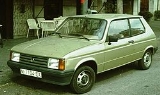
Talbot Samba

Encyclopedia
The Talbot Samba is a supermini car
manufactured by the PSA Group in the former Simca
factory in Poissy
, France
, and marketed under the short-lived modern-day Talbot
brand. Based on the Peugeot 104
, it was the only Talbot not inherited from Chrysler Europe
, engineered by PSA alone. It was also the last new Talbot to be launched, and the last in production. Its demise in 1986 was effectively the end of the Talbot brand for passenger cars. Launched initially as a three-door hatchback
, it was also for some time the only supermini available in a factory-ordered cabrio
body style, and the most economical car in Europe.
bought out its competitor, Citroën
, took over the former Chrysler Europe
in 1979; one its first decisions was to rebrand all of the models manufactured in the French and British
factories to Talbot
. Among the models inherited from Chrysler was the Scottish-built rear-wheel drive Talbot Sunbeam, the only supermini in the lineup.
The Sunbeam was originally conceived by Chrysler as a stopgap model, developed to keep the Linwood works running—it was based on the running gear of the earlier Avenger
made there—while helping the company to maintain a foothold in the growing supermini market. Aware that a more modern design was needed to compete with upcoming front-wheel drive
rivals, Chrysler undertook some development work on a shortened version of the Chrysler Horizon
(which had the development code C2), dubbed C2-short, but it was cut short by the company's financial problems and plans to divest Chrysler Europe.
PSA decided that the Linwood plant would be unprofitable to maintain and should be closed, which meant an end to both the Avenger and Sunbeam model lines, further emphasizing the need for a new supermini in the Talbot lineup. On the eve of the 1980s, PSA's supermini lineup consisted of models based on the veteran front-wheel drive 1972 Peugeot 104
, which came in a shorter three-door and longer five-door version. Citroën rebadged
the short-wheelbase 104 as the Citroën LN, and the long-wheelbase chassis formed the base of the five-door Citroën Visa
.
), the shorter version of the 104 platform was chosen. This made the projected model slot in size slightly below popular superminis such as the Ford Fiesta
, but above the smallest cars, including the about-to-be-launched Austin Metro.
in Whitley, Coventry
. The stylists were limited by the need to retain the entire body structure of the 104, and allegedly were given Peugeot's own proposal of a 104 facelift as a starting point. The resulting design was quite different from and more modern-looking than its progenitor; only the bonnet and tailgate were shared, and the car was given a distinctive front end in Chrysler/Talbot "international" style.
. The engine lineup included three versions of the four cylinder
PSA X engine
, which the Samba shared with its Peugeot and Citroën siblings, coupled with three trim levels. The base LS came with the 954 cc XV
, the GL with the 1124 cc XW
and the top-of-the-line GLS' with the largest 1360 cc XY
. The GL was rated as "Europe's most economical car" according to the official EEC fuel consumption figures, bettering the previously triumphant Renault 5
, but later lost the title to the Austin Metro.
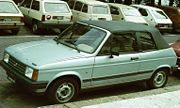
Pininfarina
, who had been building open-top Peugeots since the 1960s, it came only with the 1360 cc engine; two engine versions were offered, 53 or 59 kilowatts
(72 or 80 PS
)—the latter was dropped after 1984. At the time of its launch it was the only cabrio supermini available from the manufacturer, although other models subsequently entered the market segment created by the Samba, including PSA's own Citroën Visa Decapotable. Pininfarina built 13,062 Samba cabriolets.
successes of the Simca 1000
and the Talbot Sunbeam, PSA launched the Samba Rallye. Fitted with the 1219 cc XW
version of the X engine, delivering 66 kilowatt (90 PS), it came in either white or red, with a hood scoop
and side stripes. In 1985, a version with the 1360 cc unit producing 59 kilowatt (80 PS) was launched, without the stripes. A special rallye-only Group B
model, officially called the Peugeot Talbot Sport Samba Rallye preceded the later Peugeot 205 T16, with a 1285 cc, 96 kilowatt engine (130 PS).
, where they joined their former boss Roy Axe
. PSA had by then already started work on a replacement for the Samba, based on the Citroën AX
, a few prototypes of which—essentially rebadged AXs—were created in 1983/84. The Samba sold reasonably well throughout 1982 and 1983, after which sales began to suffer, partly because of the model's aging and partly because of competition from the very popular Peugeot 205
, which created powerful (and successful) internal competition within PSA for the little Talbot.
To sustain interest in the Samba towards the end of its life, PSA launched a few concept and special versions of the model. The Copacabana was a Samba-based concept car
, featuring body elements painted in garish colors. It was followed by the 1984 Samba Sympa production model, targeted at "young buyers", which came in silver metallic paint, with a choice of yellow, red or blue highlights and either a radio or a sunroof
. In 1985, the sunroof became standard and only yellow highlights were available. The Samba Bahia (marketed as the Samba Trio in the UK) was a 1985 model, also targeted at younger customers. It came with the 1.1 litre engine, denim
-covered seats, and a sunroof, and was painted in metallic blue. The Samba Style model was launched with both radio and sunroof as standard, but not the colorful highlights, essentially to facilitate the sales of the last Samba series.
The Samba was not the only Talbot model to see customer interest waning; as the 1980s progressed, all Talbots began to sell rather poorly and the range was gradually phased out. Peugeot had been working on developing a replacement for the Samba as late as 1984, which would have been based on the forthcoming Citroen AX, but this project was abandoned as Peugeot took the decision to phase out the Talbot brand.
The Citroën AX was launched without a twin in 1987, and the only other Talbot in development, the Arizona family hatchback, was launched instead as the Peugeot 309
at the end of 1985. Production of the Samba ended in May 1986, by which time 270,555 had been made, signalling the beginning of the end of the Talbot brand for passenger cars, the death knell finally sounding the following year when the last Horizon rolled off the production line in Finland
.
It was, however, retained until 1992 for the Talbot Express
, one of the Sevel Sud vans.
's 2009 DVD Duel, a 1984 Talbot Samba Cabriolet was destroyed via hurling it from a catapult into a wall, with a speed camera nearby showing that its speed was 164 mi/h before it hit the wall and exploded.
Supermini car
A supermini is a British term that describes automobiles larger than a city car but smaller than a small family car. This car class is also known as the B-segment across Europe, and as subcompact in North America....
manufactured by the PSA Group in the former Simca
Simca
Simca was a French automaker, founded in November 1934 by Fiat. It was directed from July 1935 to May 1963 by the Italian Henri Théodore Pigozzi...
factory in Poissy
Poissy
Poissy is a commune in the Yvelines department in the Île-de-France in north-central France. It is located in the western suburbs of Paris from the center.In 1561 it was the site of a fruitless Catholic-Huguenot conference, the Colloquy at Poissy...
, France
France
The French Republic , The French Republic , The French Republic , (commonly known as France , is a unitary semi-presidential republic in Western Europe with several overseas territories and islands located on other continents and in the Indian, Pacific, and Atlantic oceans. Metropolitan France...
, and marketed under the short-lived modern-day Talbot
Talbot
Talbot was an automobile marque that existed from 1903 to 1986, with a hiatus from 1960 to 1978, under a number of different owners, latterly under Peugeot...
brand. Based on the Peugeot 104
Peugeot 104
The Peugeot 104 is a supermini motor car designed by Paolo Martin and produced by the French car manufacturer Peugeot between 1972 and 1988.- Production history :Saloon launch 1972...
, it was the only Talbot not inherited from Chrysler Europe
Chrysler Europe
Chrysler Europe was a division of the Chrysler Corporation that operated between 1967 and 1979.-Formation:In the 1960s, Chrysler sought to become a world producer of automobiles. The company had never had much success outside North America, contrasting with Ford's worldwide reach and General...
, engineered by PSA alone. It was also the last new Talbot to be launched, and the last in production. Its demise in 1986 was effectively the end of the Talbot brand for passenger cars. Launched initially as a three-door hatchback
Hatchback
A Hatchback is a car body style incorporating a shared passenger and cargo volume, with rearmost accessibility via a rear third or fifth door, typically a top-hinged liftgate—and features such as fold-down rear seats to enable flexibility within the shared passenger/cargo volume. As a two-box...
, it was also for some time the only supermini available in a factory-ordered cabrio
Convertible
A convertible is a type of automobile in which the roof can retract and fold away having windows which wind-down inside the doors, converting it from an enclosed to an open-air vehicle...
body style, and the most economical car in Europe.
Background
The PSA Group, formed in 1976 when PeugeotPeugeot
Peugeot is a major French car brand, part of PSA Peugeot Citroën, the second largest carmaker based in Europe.The family business that precedes the current Peugeot company was founded in 1810, and manufactured coffee mills and bicycles. On 20 November 1858, Emile Peugeot applied for the lion...
bought out its competitor, Citroën
Citroën
Citroën is a major French automobile manufacturer, part of the PSA Peugeot Citroën group.Founded in 1919 by French industrialist André-Gustave Citroën , Citroën was the first mass-production car company outside the USA and pioneered the modern concept of creating a sales and services network that...
, took over the former Chrysler Europe
Chrysler Europe
Chrysler Europe was a division of the Chrysler Corporation that operated between 1967 and 1979.-Formation:In the 1960s, Chrysler sought to become a world producer of automobiles. The company had never had much success outside North America, contrasting with Ford's worldwide reach and General...
in 1979; one its first decisions was to rebrand all of the models manufactured in the French and British
Great Britain
Great Britain or Britain is an island situated to the northwest of Continental Europe. It is the ninth largest island in the world, and the largest European island, as well as the largest of the British Isles...
factories to Talbot
Talbot
Talbot was an automobile marque that existed from 1903 to 1986, with a hiatus from 1960 to 1978, under a number of different owners, latterly under Peugeot...
. Among the models inherited from Chrysler was the Scottish-built rear-wheel drive Talbot Sunbeam, the only supermini in the lineup.
The Sunbeam was originally conceived by Chrysler as a stopgap model, developed to keep the Linwood works running—it was based on the running gear of the earlier Avenger
Hillman Avenger
The Hillman Avenger was a rear-wheel drive small family car originally manufactured under the Hillman marque by the Rootes Group from 1970–1976, and made by Chrysler Europe from 1976–1981 as the Chrysler Avenger and finally the Talbot Avenger...
made there—while helping the company to maintain a foothold in the growing supermini market. Aware that a more modern design was needed to compete with upcoming front-wheel drive
Front-wheel drive
Front-wheel drive is a form of engine/transmission layout used in motor vehicles, where the engine drives the front wheels only. Most modern front-wheel drive vehicles feature a transverse engine, rather than the conventional longitudinal engine arrangement generally found in rear-wheel drive and...
rivals, Chrysler undertook some development work on a shortened version of the Chrysler Horizon
Chrysler Horizon
The Horizon was a subcompact automobile developed by Chrysler Europe and was sold in Europe between 1977 and 1985 under the Chrysler, Simca and Talbot nameplates...
(which had the development code C2), dubbed C2-short, but it was cut short by the company's financial problems and plans to divest Chrysler Europe.
PSA decided that the Linwood plant would be unprofitable to maintain and should be closed, which meant an end to both the Avenger and Sunbeam model lines, further emphasizing the need for a new supermini in the Talbot lineup. On the eve of the 1980s, PSA's supermini lineup consisted of models based on the veteran front-wheel drive 1972 Peugeot 104
Peugeot 104
The Peugeot 104 is a supermini motor car designed by Paolo Martin and produced by the French car manufacturer Peugeot between 1972 and 1988.- Production history :Saloon launch 1972...
, which came in a shorter three-door and longer five-door version. Citroën rebadged
Badge engineering
Badge engineering is an ironic term that describes the rebadging of one product as another...
the short-wheelbase 104 as the Citroën LN, and the long-wheelbase chassis formed the base of the five-door Citroën Visa
Citroën Visa
The Citroën Visa is a supermini that was produced by the French car marque Citroën from 1978 to 1988.-Development History:The Citroën Prototype Y to replace the 2CV based Citroën Ami that dated back to 1960 in the early seventies, was originally developed in co-operation with Fiat...
.
Decision
In 1979, PSA decided that their new small Talbot would also be based on the 104 rather than the Horizon. Keeping the common underpinnings allowed the new model, known internally as project C15 (later renamed to T15 to reflect the brand change from Chrysler to Talbot) to be launched in 1981, in time to replace the Sunbeam when Linwood would close. In order not to create too much internal competition with the Horizon and Peugeot's planned 104 replacement (which later became the Peugeot 205Peugeot 205
The Peugeot 205 is a supermini produced by the French car manufacturer Peugeot between 1983 and 1998. It was declared 'Car of the Decade' by CAR magazine in 1990. The 205 won 1984 What Car? car of the year.-History:...
), the shorter version of the 104 platform was chosen. This made the projected model slot in size slightly below popular superminis such as the Ford Fiesta
Ford Fiesta
The Ford Fiesta is a front wheel drive supermini/subcompact manufactured and marketed by Ford Motor Company and built in Europe, Brazil, Argentina, Mexico, Venezuela, China, India, Thailand and South Africa...
, but above the smallest cars, including the about-to-be-launched Austin Metro.
Styling
As with previous Talbot and Chrysler Europe models, styling of the T15 was the responsibility of the British design centreWhitley plant
The Whitley plant, situated in Whitley, Coventry in the West Midlands of England, is one of the engineering centres of Jaguar Land Rover and the headquarters of Jaguar Cars...
in Whitley, Coventry
Whitley, Coventry
Whitley is a suburb of southern Coventry in the West Midlands of England.-Industry and commerce:Whitley is the home of the Whitley plant, which is the Engineering Centre and Headquarters of Jaguar Cars Limited...
. The stylists were limited by the need to retain the entire body structure of the 104, and allegedly were given Peugeot's own proposal of a 104 facelift as a starting point. The resulting design was quite different from and more modern-looking than its progenitor; only the bonnet and tailgate were shared, and the car was given a distinctive front end in Chrysler/Talbot "international" style.
Launch
Production of the new car started in October 1981, and it was officially launched as the Talbot Samba in December. Unlike the Horizon, 1510/Alpine or Solara, which were made simultaneously in France and England, the model was assembled only in PoissyPoissy
Poissy is a commune in the Yvelines department in the Île-de-France in north-central France. It is located in the western suburbs of Paris from the center.In 1561 it was the site of a fruitless Catholic-Huguenot conference, the Colloquy at Poissy...
. The engine lineup included three versions of the four cylinder
Straight-4
The inline-four engine or straight-four engine is an internal combustion engine with all four cylinders mounted in a straight line, or plane along the crankcase. The single bank of cylinders may be oriented in either a vertical or an inclined plane with all the pistons driving a common crankshaft....
PSA X engine
PSA X engine
The PSA X engine is a family of internal combustion engines used in Citroën, Peugeot, Talbot and Renault automobiles. The X family was mainly used in superminis and the entry level models of midsize vehicles. It is commonly called the "Douvrin" engine....
, which the Samba shared with its Peugeot and Citroën siblings, coupled with three trim levels. The base LS came with the 954 cc XV
PSA X engine
The PSA X engine is a family of internal combustion engines used in Citroën, Peugeot, Talbot and Renault automobiles. The X family was mainly used in superminis and the entry level models of midsize vehicles. It is commonly called the "Douvrin" engine....
, the GL with the 1124 cc XW
PSA X engine
The PSA X engine is a family of internal combustion engines used in Citroën, Peugeot, Talbot and Renault automobiles. The X family was mainly used in superminis and the entry level models of midsize vehicles. It is commonly called the "Douvrin" engine....
and the top-of-the-line GLS' with the largest 1360 cc XY
PSA X engine
The PSA X engine is a family of internal combustion engines used in Citroën, Peugeot, Talbot and Renault automobiles. The X family was mainly used in superminis and the entry level models of midsize vehicles. It is commonly called the "Douvrin" engine....
. The GL was rated as "Europe's most economical car" according to the official EEC fuel consumption figures, bettering the previously triumphant Renault 5
Renault 5
The Renault 5 was first unveiled on 10 December 1971, being launched at the beginning of 1972.The Renault 5 was styled by Michel Boué, who died before the car's release, the R5 featured a steeply sloping rear hatchback and front dashboard...
, but later lost the title to the Austin Metro.
Cabrio
In an effort to make the vehicle stand out in the market against similar rivals, which included its own derivatives, Peugeot added a more glamorous two-door cabriolet to the standard three-door hatchback. Although announced at the hatchback's launch, the first models were not available until 1982. Designed and built by the Italian coachbuilderCoachbuilder
A coachbuilder is a manufacturer of bodies for carriages or automobiles.The trade dates back several centuries. Rippon was active in the time of Queen Elizabeth I, Barker founded in 1710 by an officer in Queen Anne's Guards, Brewster a relative newcomer , formed in 1810. Others in Britain included...
Pininfarina
Pininfarina
Pininfarina S.p.A. is an Italian car design firm and coachbuilder in Cambiano, Italy.Founded as Società anonima Carrozzeria Pinin Farina in 1930 by automobile designer and builder Battista "Pinin" Farina, Pininfarina has been employed by a wide variety of high-end automobile manufacturers,...
, who had been building open-top Peugeots since the 1960s, it came only with the 1360 cc engine; two engine versions were offered, 53 or 59 kilowatts
Watt
The watt is a derived unit of power in the International System of Units , named after the Scottish engineer James Watt . The unit, defined as one joule per second, measures the rate of energy conversion.-Definition:...
(72 or 80 PS
Horsepower
Horsepower is the name of several units of measurement of power. The most common definitions equal between 735.5 and 750 watts.Horsepower was originally defined to compare the output of steam engines with the power of draft horses in continuous operation. The unit was widely adopted to measure the...
)—the latter was dropped after 1984. At the time of its launch it was the only cabrio supermini available from the manufacturer, although other models subsequently entered the market segment created by the Samba, including PSA's own Citroën Visa Decapotable. Pininfarina built 13,062 Samba cabriolets.
Rallye
Following the rallyingRallying
Rallying, also known as rally racing, is a form of auto racing that takes place on public or private roads with modified production or specially built road-legal cars...
successes of the Simca 1000
Simca 1000
The Simca 1000 was a small, rear-engined, four-door saloon manufactured by the French automaker Simca from 1961 to 1978.-The launch:The car was inexpensive and, at the time of launch, quite modern, with a brand-new inline-4 watercooled engine of 944cc...
and the Talbot Sunbeam, PSA launched the Samba Rallye. Fitted with the 1219 cc XW
PSA X engine
The PSA X engine is a family of internal combustion engines used in Citroën, Peugeot, Talbot and Renault automobiles. The X family was mainly used in superminis and the entry level models of midsize vehicles. It is commonly called the "Douvrin" engine....
version of the X engine, delivering 66 kilowatt (90 PS), it came in either white or red, with a hood scoop
Hood scoop
A bonnet/hood scoop is an upraised component on the hood of an automobile that either allows a flow of air to directly enter the engine compartment, or appears to do so. It has only one opening and is closed on all other sides...
and side stripes. In 1985, a version with the 1360 cc unit producing 59 kilowatt (80 PS) was launched, without the stripes. A special rallye-only Group B
Group B
Group B was a set of regulations introduced in 1982 for competition vehicles in sportscar racing and rallying regulated by the FIA. The Group B regulations fostered some of the quickest, most powerful and sophisticated rally cars ever built. However, a series of major accidents, some fatal, were...
model, officially called the Peugeot Talbot Sport Samba Rallye preceded the later Peugeot 205 T16, with a 1285 cc, 96 kilowatt engine (130 PS).
Later developments
In 1982, the Talbot Group was merged into Peugeot within PSA, and responsibility for the model was devolved to France. The Whitley design studio was dissolved, and some of the designers crossed over to British LeylandBritish Leyland Motor Corporation
British Leyland was a vehicle manufacturing company formed in the United Kingdom in 1968 as British Leyland Motor Corporation Ltd . It was partly nationalised in 1975 with the government creating a new holding company called British Leyland Ltd which became BL Ltd in 1978...
, where they joined their former boss Roy Axe
Roy Axe
Royden Axe was a British car designer.-Career:Axe started his career in 1959 with the Rootes Group where he progressed first to "Chief stylist" and then to "Design director"...
. PSA had by then already started work on a replacement for the Samba, based on the Citroën AX
Citroën AX
The Citroën AX is a supermini built by the French manufacturer Citroën from 1986 to 1998. The AX was launched at the 1986 Paris Motor Show to replace the Citroën Visa and Citroën LNA.-Overview:...
, a few prototypes of which—essentially rebadged AXs—were created in 1983/84. The Samba sold reasonably well throughout 1982 and 1983, after which sales began to suffer, partly because of the model's aging and partly because of competition from the very popular Peugeot 205
Peugeot 205
The Peugeot 205 is a supermini produced by the French car manufacturer Peugeot between 1983 and 1998. It was declared 'Car of the Decade' by CAR magazine in 1990. The 205 won 1984 What Car? car of the year.-History:...
, which created powerful (and successful) internal competition within PSA for the little Talbot.
To sustain interest in the Samba towards the end of its life, PSA launched a few concept and special versions of the model. The Copacabana was a Samba-based concept car
Concept car
A concept vehicle or show vehicle is a car made to showcase new styling and or new technology. They are often shown at motor shows to gauge customer reaction to new and radical designs which may or may not have a chance of being produced....
, featuring body elements painted in garish colors. It was followed by the 1984 Samba Sympa production model, targeted at "young buyers", which came in silver metallic paint, with a choice of yellow, red or blue highlights and either a radio or a sunroof
Sunroof
An automotive sunroof is a fixed or operable opening in an automobile roof which allows light and/or fresh air to enter the passenger compartment. Sunroofs may be manually operated or motor driven, and are available in many shapes, sizes and styles...
. In 1985, the sunroof became standard and only yellow highlights were available. The Samba Bahia (marketed as the Samba Trio in the UK) was a 1985 model, also targeted at younger customers. It came with the 1.1 litre engine, denim
Denim
Denim is a rugged cotton twill textile, in which the weft passes under two or more warp threads. This produces the familiar diagonal ribbing identifiable on the reverse of the fabric, which distinguishes denim from cotton duck. Denim has been in American usage since the late 18th century...
-covered seats, and a sunroof, and was painted in metallic blue. The Samba Style model was launched with both radio and sunroof as standard, but not the colorful highlights, essentially to facilitate the sales of the last Samba series.
The Samba was not the only Talbot model to see customer interest waning; as the 1980s progressed, all Talbots began to sell rather poorly and the range was gradually phased out. Peugeot had been working on developing a replacement for the Samba as late as 1984, which would have been based on the forthcoming Citroen AX, but this project was abandoned as Peugeot took the decision to phase out the Talbot brand.
The Citroën AX was launched without a twin in 1987, and the only other Talbot in development, the Arizona family hatchback, was launched instead as the Peugeot 309
Peugeot 309
The Peugeot 309 was a small family car manufactured between 1985 and 1993 in England and France.The 309 was originally intended to be badged as a Talbot and, as development progressed, to be called the Talbot Arizona...
at the end of 1985. Production of the Samba ended in May 1986, by which time 270,555 had been made, signalling the beginning of the end of the Talbot brand for passenger cars, the death knell finally sounding the following year when the last Horizon rolled off the production line in Finland
Finland
Finland , officially the Republic of Finland, is a Nordic country situated in the Fennoscandian region of Northern Europe. It is bordered by Sweden in the west, Norway in the north and Russia in the east, while Estonia lies to its south across the Gulf of Finland.Around 5.4 million people reside...
.
It was, however, retained until 1992 for the Talbot Express
Talbot Express
The Talbot Express van was the last Talbot motor vehicle to be sold. Produced as part of the Sevel Sud joint venture between PSA Peugeot Citroën and Fiat, it was made in Italy alongside the Fiat Ducato, Peugeot J5 and Citroën C25. Production began in 1984 when the Talbot badge was withdrawn from...
, one of the Sevel Sud vans.
Jeremy Clarkson video
In Jeremy ClarksonJeremy Clarkson
Jeremy Charles Robert Clarkson is an English broadcaster, journalist and writer who specialises in motoring. He is best known for his role on the BBC TV show Top Gear along with co-presenters Richard Hammond and James May...
's 2009 DVD Duel, a 1984 Talbot Samba Cabriolet was destroyed via hurling it from a catapult into a wall, with a speed camera nearby showing that its speed was 164 mi/h before it hit the wall and exploded.