


Rallying

Encyclopedia
Auto racing
Auto racing is a motorsport involving the racing of cars for competition. It is one of the world's most watched televised sports.-The beginning of racing:...
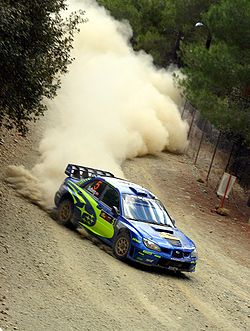
that takes place on public or private roads with modified production or specially built road-legal cars. This motorsport is distinguished by running not on a circuit
Race track
A race track is a purpose-built facility for racing of animals , automobiles, motorcycles or athletes. A race track may also feature grandstands or concourses. Some motorsport tracks are called speedways.A racetrack is a permanent facility or building...
, but instead in a point-to-point format in which participants and their co-drivers drive between set control points (special stages
Special stage (rallying)
Special stages are the competitive sections of a stage rally event where the goal is to cover a stretch of closed road in the shortest time. On a special stage cars are set off individually at set intervals to reduce the chances of being impeded by other competitors. Each special stage is a...
), leaving at regular intervals from one or more start points. Rallies may be won by pure speed within the stages or alternatively by driving to a predetermined ideal journey time within the stages.
Pre-war era
Motorsport
Motorsport or motorsports is the group of sports which primarily involve the use of motorized vehicles, whether for racing or non-racing competition...
, probably dates from the first Monte Carlo Rally
Monte Carlo Rally
The Monte Carlo Rally or Rally Monte Carlo is a rallying event organised each year by the Automobile Club de Monaco which also organises the Formula One Monaco Grand Prix and the Rallye Monte-Carlo Historique. The rally takes place along the French Riviera in the Principality of Monaco and...
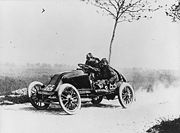
of January 1911. Until the late 1920s, few if any other events used the term. Rallying itself can be traced back to the 1894 Paris–Rouen
Rouen
Rouen , in northern France on the River Seine, is the capital of the Haute-Normandie region and the historic capital city of Normandy. Once one of the largest and most prosperous cities of medieval Europe , it was the seat of the Exchequer of Normandy in the Middle Ages...
Horseless Carriage Competition (Concours des Voitures sans Chevaux), sponsored by a Paris newspaper, Le Petit Journal
Le Petit Journal
Le Petit Journal was a daily Parisian newspaper published from 1863 to 1944. It was founded by Moïse Polydore Millaud. In its columns were published several serial novels of Émile Gaboriau and of Ponson du Terrail.- Publishing :...
, which attracted considerable public interest and entries from leading manufacturers. Prizes were awarded to the vehicles by a jury based on the reports of the observers who rode in each car; the joint winners were Panhard et Levassor and Peugeot
Peugeot
Peugeot is a major French car brand, part of PSA Peugeot Citroën, the second largest carmaker based in Europe.The family business that precedes the current Peugeot company was founded in 1810, and manufactured coffee mills and bicycles. On 20 November 1858, Emile Peugeot applied for the lion...
.
This event led directly to a period of city-to-city road races in France and other European countries, which introduced many of the features found in later rallies: individual start times with cars running against the clock rather than head to head; time controls at the entry and exit points of towns along the way; road books and route notes; and driving over long distances on ordinary, mainly gravel, roads, facing hazards such as dust, traffic, pedestrians and farm animals.
The first of these great races was the Paris–Bordeaux–Paris race of June 1895, won by Paul Koechlin in a Peugeot, despiting arriving 11 hours after Émile Levassor
Emile Levassor
Émile Levassor was a French engineer and a pioneer of the automobile industry and car racing in France.- Biography :...
in a Panhard et Levassor. Levassor's time for the 1178 km (732 mi) course, running virtually without a break, was 48 hours and 48 minutes, an average speed of 24 km/h (15 mph). Just eight years later, in the Paris–Madrid race of May 1903, the Mors
Mors (automobile)
The Mors automobile factory was an early French car manufacturer. It was one of the first to take part in automobile racing, beginning in 1897, due to the belief of the company founder, Émile Mors, in racing's technical and promotional benefits...
of Fernand Gabriel, running over the same roads, took just under five and a quarter hours for the 550 km (341.8 mi) to Bordeaux, an average of 105 km/h (65.3 mph). Speeds had now far outstripped the safe limits of dusty highways thronged with spectators and open to other traffic, people and animals; there were numerous crashes, many injuries and eight deaths. The French government stopped the race and banned this style of event. From then on, racing in Europe (apart from Italy) would be on closed circuits, initially on long loops of public highway and then, in 1907, on the first purpose-built track, England's Brooklands
Brooklands
Brooklands was a motor racing circuit and aerodrome built near Weybridge in Surrey, England. It opened in 1907, and was the world's first purpose-built motorsport venue, as well as one of Britain's first airfields...
. Racing was going its own separate way.
One of the earliest of road races, the Tour de France of 1899, was to have a long history, running 18 times as a reliability trial between 1906 and 1937, before being revived in 1951 by the Automobile-Club de Nice.
Italy had been running road competitions since 1895, when a reliability trial was run from Turin
Turin
Turin is a city and major business and cultural centre in northern Italy, capital of the Piedmont region, located mainly on the left bank of the Po River and surrounded by the Alpine arch. The population of the city proper is 909,193 while the population of the urban area is estimated by Eurostat...
to Asti
Asti
Asti is a city and comune of about 75,000 inhabitants located in the Piedmont region of northwestern Italy, about 55 kilometres east of Turin in the plain of the Tanaro River...
and back. The country's first true motor race was held in 1897 along the shore of Lake Maggiore, from Arona to Stresa and back. This led to a long and thriving tradition of road racing, including events like Sicily's Targa Florio
Targa Florio
The Targa Florio was an open road endurance automobile race held in the mountains of Sicily near Palermo. Founded in 1906, it was the oldest sports car racing event, part of the World Sportscar Championship between 1955 and 1973...
(from 1906) and Giro di Sicilia (Tour of Sicily, 1914), which went right round the island, both of which continued on and off until after World War II. The first Alpine event was held in 1898, the Austrian Touring Club's three-day Automobile Run through South Tyrol, which included the infamous Stelvio Pass
Stelvio Pass
The Stelvio Pass , located in Italy, at 2757 m is the highest paved mountain pass in the Eastern Alps, and the second highest in the Alps, slightly below the Col de l'Iseran .-Location:...
.
In Britain, the legal maximum speed of 12 mph (19.3 km/h) precluded road racing, but in April and May 1900, the Automobile Club of Great Britain (the forerunner of the Royal Automobile Club) organised the Thousand Mile Trial, a 15-day event linking Britain's major cities, in order to promote this novel form of transport. Seventy vehicles took part, the majority of them trade entries. They had to complete thirteen stages of route varying in length from 43 to 123 mi (69.2 to 197.9 km) at average speeds of up to the legal limit of 12 mi/h, and tackle six hillclimb or speed tests. On rest days and at lunch halts, the cars were shown to the public in exhibition halls. This was followed in 1901 by a five day trial based in Glasgow The Scottish Automobile Club organised an annual Glasgow–London non-stop trial from 1902 to 1904, then the Scottish Reliability Trial from 1905. The Motor Cycling Club allowed cars to enter its trials and runs from 1904 (London–Edinburgh
Edinburgh
Edinburgh is the capital city of Scotland, the second largest city in Scotland, and the eighth most populous in the United Kingdom. The City of Edinburgh Council governs one of Scotland's 32 local government council areas. The council area includes urban Edinburgh and a rural area...
, London–Land's End
Land's End
Land's End is a headland and small settlement in west Cornwall, England, within the United Kingdom. It is located on the Penwith peninsula approximately eight miles west-southwest of Penzance....
, London–Exeter
Exeter
Exeter is a historic city in Devon, England. It lies within the ceremonial county of Devon, of which it is the county town as well as the home of Devon County Council. Currently the administrative area has the status of a non-metropolitan district, and is therefore under the administration of the...
—all still in being as mud-plugging classic trials). In 1908 the Royal Automobile Club held its 2000 mi (3,218.7 km) International Touring Car Trial, and 1914 the important Light Car Trial for manufacturers of cars up to 1400 cc, to test comparative performances and improve the breed. In 1924, the exercise was repeated as the Small Car Trials.
In Germany, the Herkomer Trophy was first held in 1905, and again in 1906. This challenging five-day event attracted over 100 entrants to tackle its 1000 km (621.4 mi) road section, a hillclimb
Hillclimbing
Hillclimbing is a branch of motorsport in which drivers compete against the clock to complete an uphill course....
and a speed trial, but sadly it was marred by poor organisation and confusing regulations. One participant had been Prince Henry of Austria, who was inspired to do better, so he enlisted the aid of the Imperial Automobile Club of Germany to create the first Prinz Heinrich Fahrt (Prince Henry Trial) in 1908. Another trial was held in 1910. These were very successful, attracting top drivers and works cars from major teams – several manufacturers added "Prince Henry" models to their ranges. The first Alpine Trial was held in 1909, in Austria; by 1914, this was the toughest event of its kind, producing a star performance from Britain's James Radley in his Rolls-Royce Alpine Eagle
Rolls-Royce Limited
Rolls-Royce Limited was a renowned British car and, from 1914 on, aero-engine manufacturing company founded by Charles Stewart Rolls and Henry Royce on 15 March 1906 as the result of a partnership formed in 1904....
.
Then in 1911 came the first Monte Carlo Rally
Monte Carlo Rally
The Monte Carlo Rally or Rally Monte Carlo is a rallying event organised each year by the Automobile Club de Monaco which also organises the Formula One Monaco Grand Prix and the Rallye Monte-Carlo Historique. The rally takes place along the French Riviera in the Principality of Monaco and...
(later known colloquially as "the Monte"), organised by a group of wealthy locals who formed the "Sport Automobile Vélocipédique Monégasque" and bankrolled by the "Société des Bains de Mer" (the "sea bathing company"), the operators of the famous casino who were keen to attract wealthy sporting motorists. The competitive elements were slight, but getting to Monaco in winter was a challenge in itself. A second event was held in 1912.
Two ultra long distance challenges took place at this time. The Peking-Paris
Peking to Paris
The Peking to Paris motor race was a race held in 1907 for automobiles between Peking , China and Paris, France, a distance of 9,317 miles or 14,994 km....
of 1907 was not officially a competition, but a "raid", the French term for an expedition or collective endeavour whose promoters, the newspaper "Le Matin", rather optimistically expected participants to help each other; it was 'won' by Prince Scipione Borghese, Luigi Barzini, and Ettore Guizzardi in an Itala. The New York–Paris
1908 New York to Paris Race
The 1908 New York to Paris Race was an automobile competition consisting of drivers attempting to travel from New York to Paris. This was a notable challenge given the state of automobile technology and road infrastructure at the time. Only three of six contestants completed the course...
of the following year, which went via Japan and Siberia
Siberia
Siberia is an extensive region constituting almost all of Northern Asia. Comprising the central and eastern portion of the Russian Federation, it was part of the Soviet Union from its beginning, as its predecessor states, the Tsardom of Russia and the Russian Empire, conquered it during the 16th...
, was won by George Schuster and others in a Thomas Flyer
Thomas Motor Company
E. R. Thomas Motor Company was a manufacturer of motorized bicycles, motorized tricycles, motorcycles, and automobiles in Buffalo, New York between 1900 and 1919.-Motorized Bicycles, Tricycles, and Motorcycles:...
. Each event attracted only a handful of adventurous souls, but in both cases the successful drivers exhibited characteristics modern rally drivers would recognise: meticulous preparation, mechanical skill, resourcefulness, perseverance and a certain single-minded ruthlessness. The New York–Seattle race of 1909, if shorter, was no easier. Rather gentler (and more akin to modern rallying) was the Glidden Tour
Glidden Tour
The Glidden Tours were promotional events held during the automotive Brass Era by the American Automobile Association . The AAA, a proponent for safer roads, acceptance of the automobile and automotive-friendly legislation, started the tour to promote public acceptance and bring awareness of their...
, run by the American Automobile Association
American Automobile Association
AAA , formerly known as the American Automobile Association, is a federation of 51 independently operated motor clubs throughout North America. AAA is a not-for-profit member service organization with more than 51 million members. AAA provides services to its members such as travel, automotive,...
between 1902 and 1913, which had timed legs between control points and a marking system to determine the winners.
Interwar years
World Rally Championship
The World Rally Championship is a rallying series organised by the FIA, culminating with a champion driver and manufacturer. The driver's world championship and manufacturer's world championship are separate championships, but based on the same point system. The series currently consists of 13...
. In the 1930s, helped by the tough winters, it became the premier European rally, attracting 300 or more participants.
In the 1920s, numerous variations on the Alpine theme sprang up in Austria, Italy, France, Switzerland and Germany. The most important of these were Austria's Alpenfahrt, which continued into its 44th edition in 1973, Italy's Coppa delle Alpi, and the Coupe Internationale des Alpes (International Alpine Trial), organised jointly by the automobile clubs of Italy, Germany, Austria, Switzerland and, latterly, France. This last event, run from 1928 to 1936, attracted strong international fields vying for an individual Glacier Cup or a team Alpine Cup, including successful Talbot
Talbot
Talbot was an automobile marque that existed from 1903 to 1986, with a hiatus from 1960 to 1978, under a number of different owners, latterly under Peugeot...
, Riley
Riley (automobile)
Riley was a British motorcar and bicycle manufacturer from 1890. The company became part of the Nuffield Organisation in 1938 and was later merged into British Leyland: late in 1969 British Leyland announced their discontinuance of Riley production, although 1969 was a difficult year for the UK...
, MG
MG (car)
The MG Car Company is a former British sports car manufacturer founded in the 1920s by Cecil Kimber. Best known for its two-seat open sports cars, MG also produced saloons and coupés....
and Triumph
Triumph Motor Company
The Triumph Motor Company was a British car and motor manufacturing company. The Triumph marque is owned currently by BMW. The marque had its origins in 1885 when Siegfried Bettmann of Nuremberg initiated S. Bettmann & Co and started importing bicycles from Europe and selling them with his own...
teams from Britain and increasingly strong and well funded works representation from Adolf Hitler
Adolf Hitler
Adolf Hitler was an Austrian-born German politician and the leader of the National Socialist German Workers Party , commonly referred to as the Nazi Party). He was Chancellor of Germany from 1933 to 1945, and head of state from 1934 to 1945...
's Germany, keen to prove its engineering and sporting prowess with successful marques like Adler
Adler (automobile)
Adler was a German automobile and motorcycle manufacturer from 1900 until 1957. Adler is German for eagle.-History:The Adler factory produced bicycles, typewriters, and motorcycles in addition to cars...
, Wanderer
Wanderer (car)
Wanderer was a German manufacturer of bicycles, motorcycles, automobiles, vans and other machinery. Established as Winklhofer & Jaenicke in 1896, the company used the Wanderer brand name from 1911, making civilian automobiles until 1941 and military vehicles until 1945.-History:Winklhofer &...
and Trumpf.
The French started their own Rallye des Alpes Françaises in 1932, which continued after World War II as the Rallye International des Alpes, the name often shortened to Coupe des Alpes. Other important rallies started between the wars included Britain's RAC Rally (1932) and Belgium's Liège-Rome-Liège, officially called "Le Marathon de la Route" (1931), two events of radically different character; the former a gentle tour between cities from various start points, "rallying" at a seaside resort with a series of manoeuvrability and car control tests; the latter a thinly disguised road race over some of Europe's toughest mountain roads.
In Ireland, the first Ulster Motor Rally (1931) was run from multiple starting points. After several years in this format, it transitioned into the 1000 miles (1,609.3 km) Circuit of Ireland Rally
Circuit of Ireland Rally
The Circuit of Ireland International Rally is an annual automobile rally, which was first held in 1931 making it the second oldest rally in the world. The most recent event was held in 2010....
. In Italy, Benito Mussolini
Benito Mussolini
Benito Amilcare Andrea Mussolini was an Italian politician who led the National Fascist Party and is credited with being one of the key figures in the creation of Fascism....
's government encouraged motorsport of all kinds and facilitated road racing, so the sport quickly restarted after World War I, and in 1927 the Mille Miglia
Mille Miglia
The Mille Miglia was an open-road endurance race which took place in Italy twenty-four times from 1927 to 1957 ....
(Thousand Mile) was founded, run over a 1000 miles (1,609.3 km) loop of highways from Brescia
Brescia
Brescia is a city and comune in the region of Lombardy in northern Italy. It is situated at the foot of the Alps, between the Mella and the Naviglio, with a population of around 197,000. It is the second largest city in Lombardy, after the capital, Milan...
to Rome and back. It continued in this form until 1938.
The Liège of August 1939 was the last major event before World War II. Belgium's Ginet Trasenster (Bugatti
Bugatti
Automobiles E. Bugatti was a French car manufacturer founded in 1909 in Molsheim, Alsace, as a manufacturer of high-performance automobiles by Italian-born Ettore Bugatti....
) and France's Jean Trevoux (Hotchkiss) tied for first place, bravely denying the Swastika-bearing German works teams shortly before their countries were overrun. This was one of five Liège wins for Trasenster; Trevoux won four Montes between 1934 and 1951.
Post war years
Swedish Rally
The Uddeholm Swedish Rally , formerly the Swedish Rally, is an automobile rally competition held in Värmland, Sweden in early February. First held in 1950, when it was called the Rally to the Midnight Sun with start and finish at separate locations, seventeen years later both start and finish...
) the Rally of the 1000 Lakes (Finland, 1951 - now the Rally Finland
Rally Finland
The Neste Oil Rally Finland is a rally event driven in the Jyväskylä area in Central Finland. It is the biggest annually organised public event in the Nordic countries, gathering over 500,000 spectators every year....
), and the Acropolis Rally (Greece, 1956). The RAC Rally gained International status on its return in 1951, but for 10 years its emphasis on map-reading navigation and short manoevrability tests made it unpopular with foreign crews. The FIA
Fédération Internationale de l'Automobile
The Fédération Internationale de l'Automobile is a non-profit association established as the Association Internationale des Automobile Clubs Reconnus on 20 June 1904 to represent the interests of motoring organisations and motor car users...
created in 1953 a European Rally Championship
European Rally Championship
The European Rally Championship is the European continental championship series in rallying. It is organised by the Fédération Internationale de l'Automobile .-History:...
(at first called the "Touring Championship") of eleven events, won by Helmut Polensky of Germany. This was the premier international championship until 1973, when the Fédération Internationale de l'Automobile
Fédération Internationale de l'Automobile
The Fédération Internationale de l'Automobile is a non-profit association established as the Association Internationale des Automobile Clubs Reconnus on 20 June 1904 to represent the interests of motoring organisations and motor car users...
(FIA) created the World Rally Championship for Manufacturers, won in the first year by Alpine-Renault. Not until 1979 was there a World Rally Championship for Drivers, won that year by Björn Waldegård
Björn Waldegård
Björn Waldegård from Rimbo is a former Swedish rally driver, and the winner of the inaugural World Rally Championship for drivers in 1979...
.
Initially most of the major postwar rallies were fairly gentlemanly, but the organisers of the French Alpine and the Liège (which moved its turning point from Rome into Yugoslavia in 1956) straight away made no bones about setting difficult time schedules: the Automobile Club de Marseille et Provence laid on a long tough route over a succession of rugged passes, stated that cars would have to be driven flat out from start to finish, and gave a coveted Coupe des Alpes ("Alpine Cup") to anyone achieving an unpenalised run; while Belgium's Royal Motor Union made clear that no car was expected to finish the Liège unpenalised - when one did (1951 winner Johnny Claes
Johnny Claes
Octave John "Johnny" Claes was a racing driver from Belgium. Before his fame as a racing driver, Claes was also a jazz trumpeter and successful bandleader in Britain.-Early life and jazz career:...
in a Jaguar XK120
Jaguar XK120
The Jaguar XK120 is a sports car which was manufactured by Jaguar between 1948 and 1954. It was Jaguar's first sports car since the SS 100, which ceased production in 1940.-History:...
) they tightened the timing to make sure it never happened again. These two events became the ones for "the men" to do. But the Monte, because of its glamour, got the media coverage and the biggest entries (and in snowy years was also a genuine challenge); while the Acropolis took advantage of Greece's appalling roads to become a truly tough event. In 1956 came Corsica's Tour de Corse
Tour de Corse
The Tour de Corse - Rallye de France is a rally first held in 1956 on the island of Corsica. It was part of the World Rally Championship from the inaugural 1973 season to 2008. The name "Tour de Corse" refers to the fact that in the early days it was run around the island; nowadays it only features...
, 24 hours of virtually non-stop flat out driving on some of the narrowest and twistiest mountain roads on the planet – the first major rally to be won by a lady driver, Belgium's Gilberte Thirion, in a Renault Dauphine
Renault Dauphine
Renault Dauphine is a rear-engined economy car manufactured by Renault in one body style — a three-box, four-door sedan — as the successor to the Renault 4CV, with over two million examples marketed worldwide during its production from 1956-1967....
.
The Liège continued as uncompromisingly an open road event run to an impossible time schedule, and remained Europe's toughest rally until 1964, by which time it had turned to the wilds of Yugoslavia and Bulgaria to find traffic-free roads; but in the end the pressures were irresistible. The Coupe des Alpes struggled on until 1973 until it too succumbed, its demise no doubt hastened by the decision of the French motor sporting authorities to select the Tour de Corse as its representative event in international rally championships.
These events were road races in all but name, but in Italy such races were still allowed, and the Mille Miglia continued until a serious accident in 1957 caused it to be banned. Meanwhile in 1981, the Tour de France was revived by the Automobile-Club de Nice as a different kind of rally, based primarily on a series of races at circuits and hillclimbs around the country. It was successful for a while and continued until 1986. It spawned similar events in a few other countries, but none survive.
Rallying became very popular in Sweden and Finland in the 1950s, thanks in part to the invention there of the specialsträcka (Swedish) or erikoiskoe (Finnish), or special stage: shorter sections of route, usually on minor or private roads—predominantly gravel in these countries—away from habitation and traffic, which were separately timed. These at long last provided the solution to the conflict inherent in the notion of driving as fast as possible on ordinary roads. The idea spread to other countries, albeit more slowly to the most demanding events.
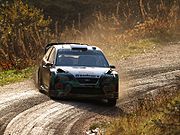
Forestry Commission
The Forestry Commission is a non-ministerial government department responsible for forestry in Great Britain. Its mission is to protect and expand Britain's forests and woodlands and increase their value to society and the environment....
to open their many hundreds of miles of well surfaced and sinuous gravel roads, and the event was transformed into one of the most demanding and popular in the calendar, by 1983 having over 600 miles (965.6 km) of stage. It is now called Rally GB
Rally GB
Wales Rally GB is the largest and most high profile motor rally in the United Kingdom. It is a round of the FIA World Rally Championship and was formerly a round of the MSA British Rally Championship and is based in and around the city of Cardiff in Wales...
.
Outside Europe
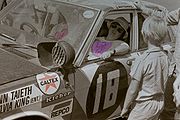
Buenos Aires
Buenos Aires is the capital and largest city of Argentina, and the second-largest metropolitan area in South America, after São Paulo. It is located on the western shore of the estuary of the Río de la Plata, on the southeastern coast of the South American continent...
to Lima
Lima
Lima is the capital and the largest city of Peru. It is located in the valleys of the Chillón, Rímac and Lurín rivers, in the central part of the country, on a desert coast overlooking the Pacific Ocean. Together with the seaport of Callao, it forms a contiguous urban area known as the Lima...
and back; it was won by Juan Manuel Fangio
Juan Manuel Fangio
Juan Manuel Fangio , nicknamed El Chueco or El Maestro , was a racing car driver from Argentina, who dominated the first decade of Formula One racing...
in a much modified Chevrolet
Chevrolet
Chevrolet , also known as Chevy , is a brand of vehicle produced by General Motors Company . Founded by Louis Chevrolet and ousted GM founder William C. Durant on November 3, 1911, General Motors acquired Chevrolet in 1918...
coupé
Coupé
A coupé or coupe is a closed car body style , the precise definition of which varies from manufacturer to manufacturer, and over time...
. This event was repeated in 1947, and in 1948 an even more ambitious one was held, the Gran Premio de la América del Sur from Buenos Aires
Buenos Aires
Buenos Aires is the capital and largest city of Argentina, and the second-largest metropolitan area in South America, after São Paulo. It is located on the western shore of the estuary of the Río de la Plata, on the southeastern coast of the South American continent...
to Caracas
Caracas
Caracas , officially Santiago de León de Caracas, is the capital and largest city of Venezuela; natives or residents are known as Caraquenians in English . It is located in the northern part of the country, following the contours of the narrow Caracas Valley on the Venezuelan coastal mountain range...
, Venezuela
Venezuela
Venezuela , officially called the Bolivarian Republic of Venezuela , is a tropical country on the northern coast of South America. It borders Colombia to the west, Guyana to the east, and Brazil to the south...
—Fangio had an accident in which his co-driver was killed. Then in 1950 came the fast and dangerous Carrera Panamericana
Carrera Panamericana
The Carrera Panamericana was a border-to-border sports car racing event on open roads in Mexico similar to the Mille Miglia and Targa Florio in Italy. Running for five consecutive years from 1950 to 1954, it was widely held by contemporaries to be the most dangerous race of any type in the world...
, a 1911 miles (3,075.4 km) road race in stages across Mexico to celebrate the opening of the asphalt highway between the Guatemala
Guatemala
Guatemala is a country in Central America bordered by Mexico to the north and west, the Pacific Ocean to the southwest, Belize to the northeast, the Caribbean to the east, and Honduras and El Salvador to the southeast...
and United States borders, which ran until 1954. All these events fell victim to the cost - financial, social and environmental - of putting them on in an increasingly complex and developed world, although smaller road races continued long after, and a few still do in countries like Bolivia
Bolivia
Bolivia officially known as Plurinational State of Bolivia , is a landlocked country in central South America. It is the poorest country in South America...
.
In Africa, 1950 saw the first French-run Méditerranée-le Cap, a 10000 miles (16,093.4 km) rally from the Mediterranean to South Africa
South Africa
The Republic of South Africa is a country in southern Africa. Located at the southern tip of Africa, it is divided into nine provinces, with of coastline on the Atlantic and Indian oceans...
; it was run on and off until 1961, when the new political situation hastened its demise. In 1953 East Africa saw the demanding Coronation Safari, which went on to become the Safari Rally
Safari Rally
The Safari Rally is considered by many to be the world's toughest rally. It was first held from 27 May to 1 June 1953 as the East African Coronation Safari in Kenya, Uganda and Tanganyika, as a celebration of the coronation of Queen Elizabeth II...
and a World Championship round, to be followed in due course by the Rallye du Maroc
Rallye du Maroc
The Rallye du Maroc was a marathon rally, similar to the Safari Rally. It was first run in 1934, and held intermittently until 1988. Established by the Royal Automobile Club of Morocco, it is one of the more difficult automotive rallies...
in Morocco
Morocco
Morocco , officially the Kingdom of Morocco , is a country located in North Africa. It has a population of more than 32 million and an area of 710,850 km², and also primarily administers the disputed region of the Western Sahara...
, and the Rallye Côte d'Ivoire
Rallye Côte d'Ivoire
The Rallye Côte d'Ivoire is a rally race held annually in Côte d'Ivoire in Africa. In common with other races on the continent, it is known for its arduous conditions and high attrition rate among competitors. It was part of the World Rally Championship for drivers and manufacturers from 1978 to...
in the Ivory Coast. Australia's Redex Round Australia Trial also dates from 1953, although this remained isolated from the rest of the rallying world.
Canada hosted one of the world's longest and most gruelling rallies during the 1960s, the Shell 4000 Rally. It was also the only one sanctioned by FIA
Fédération Internationale de l'Automobile
The Fédération Internationale de l'Automobile is a non-profit association established as the Association Internationale des Automobile Clubs Reconnus on 20 June 1904 to represent the interests of motoring organisations and motor car users...
in North America.http://shell-4000-rally.org/index.htm
Modern times
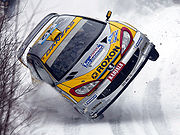
Since then, the nature of the events themselves has evolved relatively slowly. The increasing costs, both of organization and of competing, as well as safety concerns, have, over the last twenty years, brought progressively shorter rallies, shorter stages and the elimination of nighttime running, scornfully referred to as "office hours rallying" by older hands. Some of the older international events have gone, replaced by others from a much wider spread of countries around the world, until today rallying is truly a worldwide sport. At the same time, fields have shrunk dramatically, as the amateur in his near-standard car is squeezed out.
Gruelling long distance events continued to be run. In 1967, a group of American offroaders created the Mexican 1000 Rally, a tough 1,000 mile race for cars and motorcycles which ran the length of the Baja California peninsula, much of it initially over roadless desert, which quickly gained fame as the Baja 1000. "Baja" events now take place in a number of other countries worldwide.
1968 brought the first of a series of British-organised intercontinental rallies, the Daily Express
Daily Express
The Daily Express switched from broadsheet to tabloid in 1977 and was bought by the construction company Trafalgar House in the same year. Its publishing company, Beaverbrook Newspapers, was renamed Express Newspapers...
London-Sydney Marathon
London-Sydney Marathon
The London–Sydney Marathon was a car rally from the United Kingdom to Australia. It was first run in 1968, a second event was organised in 1977 and a third in 1993 to commemorate the 25th anniversary of the original. Two further rallies have subsequently been contested in 2000 and 2004.The original...
, which attracted over 100 crews including a number of works teams and top drivers; it was won by the Hillman Hunter of Andrew Cowan/Brian Coyle/Colin Malkin. Not to be outdone, the rival Daily Mirror sponsored in 1970 the London-Mexico World Cup Rally, linking the stadia of two successive football World Cups, on a route that crossed Europe to Bulgaria and back before shipping out from Lisbon to Rio de Janeiro, after looping around South America, and a run through some of the most frightening sections of Peru's road race, the Camino de los Incas, they wrap it up being shipped to Panama and a final run up Central America. The Ford Escort of Hannu Mikkola and Gunnar Palm won. These were followed in 1974 by the London-Sahara-Munich World Cup Rally, and in 1977 by the Singapore Airlines London-Sydney Rally.
In 1979, a young Frenchman, Thierry Sabine, founded an institution when he organised the first "rallye-raid" from Paris to Dakar, in Senegal, the event now called the Dakar Rally. From amateur beginnings it quickly became a massive commercial circus catering for cars, motorcycles and trucks, and spawned other similar events. Since 2008, it has been held in South America.
Rally car evolution
The main change over that period has been in the cars, and in the professionalisation and commercialisation of the sport. Manufacturers had entered works cars in rallies, and in their forerunner and cousin events, from the very beginning: the 1894 Paris-Rouen was mainly a competition between them, while the Thousand Mile Trial of 1900 had more trade than private entries.Although there had been exceptions like the outlandish Ford V8 specials created by the Romania
Romania
Romania is a country located at the crossroads of Central and Southeastern Europe, on the Lower Danube, within and outside the Carpathian arch, bordering on the Black Sea...
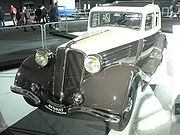
ns for the 1936 Monte Carlo Rally, rallies before World War II had tended to be for standard or near-standard production cars, a rule supported by manufacturers because it created a relatively even playing field. After the war, most competing cars were production saloons or sports car
Sports car
A sports car is a small, usually two seat, two door automobile designed for high speed driving and maneuverability....
s, with only minor modifications to improve performance, handling, braking and suspension. This kept costs down and allowed many more people to afford the sport using ordinary family cars, so entry lists grew into the hundreds.
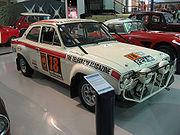
Automotive industry
The automotive industry designs, develops, manufactures, markets, and sells motor vehicles, and is one of the world's most important economic sectors by revenue....
started to introduce special models or variants for rallying, such as the British Motor Corporation
British Motor Corporation
The British Motor Corporation, or commonly known as BMC was a vehicle manufacturer from United Kingdom, formed by the merger of the Austin Motor Company and the Nuffield Organisation in 1952...
's highly successful Mini Cooper, introduced in 1962, and its successor the Mini Cooper S (1963), developed by the Cooper Car Company
Cooper Car Company
The Cooper Car Company was founded in 1946 by Charles Cooper and his son John Cooper. Together with John's boyhood friend, Eric Brandon, they began by building racing cars in Charles' small garage in Surbiton, Surrey, England in 1946...
. Shortly after, Ford of Britain
Ford of Britain
Ford of Britain is a British wholly owned subsidiary of Ford of Europe, a subsidiary of Ford Motor Company. Its business started in 1909 and has its registered office in Brentwood, Essex...
first hired Lotus
Lotus Cars
Lotus Cars is a British manufacturer of sports and racing cars based at the former site of RAF Hethel, a World War II airfield in Norfolk. The company designs and builds race and production automobiles of light weight and fine handling characteristics...
to create a high-performance version of their Cortina
Ford Cortina
As the 1960s dawned, BMC were revelling in the success of their new Mini – the first successful true minicar to be built in Britain in the postwar era...
family car, then in 1968 launched the Escort Twin Cam, one of the most successful rally cars of its era. Similarly, Abarth
Abarth
Abarth is an Italian racing car maker founded by Austrian-Italian Carlo Abarth and Italian Armando Scagliarini in Turin in 1949. Its logo depicts a stylized scorpion on a red and yellow background.- History :...
developed high performance versions of Fiat
Fiat
FIAT, an acronym for Fabbrica Italiana Automobili Torino , is an Italian automobile manufacturer, engine manufacturer, financial, and industrial group based in Turin in the Italian region of Piedmont. Fiat was founded in 1899 by a group of investors including Giovanni Agnelli...
s 124
Fiat 124
The Fiat 124 is a mid-sized family car produced by the Italian manufacturer Fiat between 1966 and 1974. It was the replacement of the Fiat 1300 and Fiat 1500...
roadster and 131
Fiat 131
The Fiat 131, additionally called "Mirafiori", is a small/medium family car produced by the Italian car manufacturer Fiat from 1974 to 1984. It was exhibited at 1974 Turin Motor Show....
saloon.
Other manufacturers were not content with modifying their 'bread-and-butter' cars. Renault
Renault
Renault S.A. is a French automaker producing cars, vans, and in the past, autorail vehicles, trucks, tractors, vans and also buses/coaches. Its alliance with Nissan makes it the world's third largest automaker...
bankrolled the small volume sports-car maker Alpine
Alpine (car)
Alpine was a French manufacturer of racing and sports cars that used rear-mounted Renault engines.Jean Rédélé , the founder of Alpine, was originally a Dieppe garage proprietor, who began to achieve considerable competition success in one of the few French cars produced just after World War...
to transform their little A110 Berlinette coupé
Alpine A110
The Alpine A110, also known as the "Berlinette", was a sports car produced by the French manufacturer Alpine from 1961 to 1977. The A110 was powered by various Renault engines....
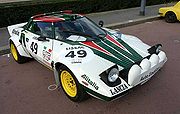
into a world-beating rally car, and hired a skilled team of drivers too; then in 1974 came the Lancia Stratos
Lancia Stratos
The Lancia Stratos HF, widely and more simply known as Lancia Stratos, is a car made by Italian car manufacturer Lancia. The HF stands for High Fidelity...
, the first car designed from scratch to win rallies, and the dominant asphalt rally car of its time. These makers overcame the rules of FISA (as the FIA was called at the time) by building the requisite number of these models for the road.
.jpg)
Audi
Audi AG is a German automobile manufacturer, from supermini to crossover SUVs in various body styles and price ranges that are marketed under the Audi brand , positioned as the premium brand within the Volkswagen Group....
, at that time not noted for their interest in rallying, introduced a rather large and heavy coupé version of their family saloon, installed a turbocharged
Turbocharger
A turbocharger, or turbo , from the Greek "τύρβη" is a centrifugal compressor powered by a turbine that is driven by an engine's exhaust gases. Its benefit lies with the compressor increasing the mass of air entering the engine , thereby resulting in greater performance...
2.1 litre
Litre
pic|200px|right|thumb|One litre is equivalent to this cubeEach side is 10 cm1 litre water = 1 kilogram water The litre is a metric system unit of volume equal to 1 cubic decimetre , to 1,000 cubic centimetres , and to 1/1,000 cubic metre...
five-cylinder engine, and fitted it with four-wheel drive
Four-wheel drive
Four-wheel drive, 4WD, or 4×4 is a four-wheeled vehicle with a drivetrain that allows all four wheels to receive torque from the engine simultaneously...
. Thus the Audi Quattro
Audi Quattro
The Audi Quattro is a road and rally car, produced by the German automobile manufacturer Audi, now part of the Volkswagen Group. It was first shown at the 1980 Geneva Motor Show on 3 March.The word quattro is derived from the Italian word for "four"...
was born. International regulations had prohibited four-wheel drive; but FISA accepted that this was a genuine production car, and changed the rules. The Quattro quickly became the car to beat on snow, ice or gravel; and in 1983 took Hannu Mikkola
Hannu Mikkola
Hannu Olavi Mikkola is a retired world champion rally driver. He was a seven time winner of the 1000 Lakes Rally in Finland and won the RAC Rally in Great Britain four times.- Career :...
to the World Rally Championship title. Other manufacturers had no production four-wheel drive car on which to base their response, so FISA was persuaded to change the rules, and open the Championship to cars in Group B
Group B
Group B was a set of regulations introduced in 1982 for competition vehicles in sportscar racing and rallying regulated by the FIA. The Group B regulations fostered some of the quickest, most powerful and sophisticated rally cars ever built. However, a series of major accidents, some fatal, were...
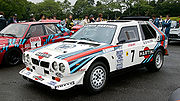
. This allowed cars to be much further removed from production models, and so was created a generation of rallying supercars, of which the most radical and impressive were the Peugeot 205 T16
Peugeot 205
The Peugeot 205 is a supermini produced by the French car manufacturer Peugeot between 1983 and 1998. It was declared 'Car of the Decade' by CAR magazine in 1990. The 205 won 1984 What Car? car of the year.-History:...
, Renault 5 Turbo
Renault 5 Turbo
The Renault 5 Turbo or R5 Turbo is a high-performance hatchback automobile launched by the French manufacturer Renault at the Brussels Motor Show in January 1980...
and the Lancia Delta S4
Lancia Delta S4
The Lancia Delta S4 is a Group B rally car that competed in the World Rally Championship in 1985 and 1986, until Group B cars were banned from competition by the FIA. The car replaced and was an evolution of the Lancia 037 Monte Carlo. The S4 took full advantage of the Group B regulations, and...
, with flimsy fibreglass bodies roughly the shape of the standard car tacked on to lightweight spaceframe chassis, four-wheel drive, and power outputs reportedly as high as 600 hp. Further Group B cars were developed by Ford (the RS200
Ford RS200
The Ford RS200 is a mid-engined, four-wheel drive sports car produced by Ford from 1984 to 1986. The road-going RS200 was based on Ford's Group B rally car and was designed to comply with FIA homologation regulations, which required 200 road legal versions be built...
), British Leyland (the Metro 6R4
Rover Metro
The Metro is a supermini car that was produced by the Austin Rover Group division of British Leyland and its successors. It was launched in 1980 as the Austin miniMetro. It was intended to complement the Mini, and was developed under the codename LC8....
) and many others, but these were less successful.
This particular era was not to last. On the 1986 Rallye de Portugal, four spectators were killed; then in May, on the Tour de Corse
Tour de Corse
The Tour de Corse - Rallye de France is a rally first held in 1956 on the island of Corsica. It was part of the World Rally Championship from the inaugural 1973 season to 2008. The name "Tour de Corse" refers to the fact that in the early days it was run around the island; nowadays it only features...
, Henri Toivonen
Henri Toivonen
Henri Pauli Toivonen was a Finnish rally driver born in Jyväskylä, the home of Rally Finland. His father, Pauli Toivonen, was the 1968 European Rally Champion for Porsche and his brother, Harri Toivonen, became a professional circuit racer.Toivonen's first World Rally Championship victory came...
went over the edge of a mountain road and was incinerated in the fireball that followed. FISA immediately changed the rules again: rallying after 1987 would be in Group A
Group A
In relation to motorsport governed by the FIA, Group A referred to a set of regulations providing production-derived vehicles for outright competition. In contrast to the short-lived Group B and Group C, the Group A referred to production-derived vehicles limited in terms of power, weight, allowed...
cars, closer to the production model. One notably successful car during this period was the Lancia Delta Integrale, dominating world rallying during 1987, 1988, 1989, 1990, 1991 and 1992 – winning six consecutive world rally championships, a feat yet unbeaten.
Drivers
Erik Carlsson
Erik Carlsson, aka "Carlsson på taket" , was born March 5, 1929 in Trollhättan, Sweden and was a rally driver for Saab. Because of his public relations work for Saab, he is also known as Mr. Saab....
, driving for Saab
Saab
Saab AB is a Swedish aerospace and defence company, founded in 1937. From 1947 to 1990 it was the parent company of automobile manufacturer Saab Automobile, and between 1968 and 1995 the company was in a merger with commercial vehicle manufacturer Scania, known as Saab-Scania.-History:"Svenska...
.
In the 1960s, the competitions manager of BMC, Stuart Turner, hired a series of brave and gifted young Finns
Finland
Finland , officially the Republic of Finland, is a Nordic country situated in the Fennoscandian region of Northern Europe. It is bordered by Sweden in the west, Norway in the north and Russia in the east, while Estonia lies to its south across the Gulf of Finland.Around 5.4 million people reside...
, skills honed on their country's highly competitive gravel or snow rallies, and the modern professional driver was born. As special stage rallying spread around the world Scandinavian drivers were challenged by drivers from Italy, Germany, Britain, Spain and elsewhere. Today, a World Champion may be of any nationality.
The World Rally Championship
World Rally Championship
The World Rally Championship is a rallying series organised by the FIA, culminating with a champion driver and manufacturer. The driver's world championship and manufacturer's world championship are separate championships, but based on the same point system. The series currently consists of 13...
now visits nearly all continents, taking its stylish sideways driving style and specialized cars to a vast global market, estimated by some to be second only to the Formula One
Formula One
Formula One, also known as Formula 1 or F1 and referred to officially as the FIA Formula One World Championship, is the highest class of single seater auto racing sanctioned by the Fédération Internationale de l'Automobile . The "formula" designation in the name refers to a set of rules with which...
juggernaut. This has produced unprecedented levels of visibility in recent years, but in many ways removed the motorsport from its grassroots past. For better or worse, rally has become a lucrative business.
Rally types
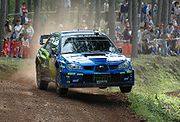
The entertaining and unpredictable nature of the stages, and the fact that the vehicles are in some cases closely related to road cars, means that the bigger events draw massive spectator interest, especially in Europe, Asia and Oceania.
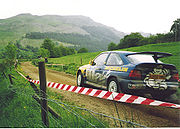
Road rally
A road rally is a car rally that takes place on the public road. It is a popular sport in the United Kingdom, especially Wales, and has traditionally been the core of the "grass roots" of club-based amateur motorsport. However it has declined in popularity since the 1980s and now stage rallies are...
are the original form, held on highways open to normal traffic, where the emphasis is not on outright speed but on accurate timekeeping and navigation and on vehicle reliability, often on difficult roads and over long distances. They are now primarily amateur events. There are several types of road rallies testing accuracy, navigation or problem solving. Some common types are: Regularity rally
Regularity rally
Regularity rallying, also known as TSD rallying , is a form of motor sport usually conducted on public roads but sometimes including off-road and track sections. The object of these rallies is to maintain precise times and precise average speeds on various segments of a predefined route...
or a Time-Speed-Distance rally (also TSD rally, testing ability to stay on track and on time), others are Monte-Carlo styles (Monte Carlo, Pan Am, Pan Carlo, Continental) rally (testing navigation and timing), and various Gimmick rally types (testing logic and observation).
Many early rallies were called trials, and a few still are, although this term is now mainly applied to the specialist form of motor sport of climbing as far as you can up steep and slippery hills. And many meets or assemblies of car enthusiasts and their vehicles are still called rallies, even if they involve merely the task of getting there (often on a trailer).
Rallying is a very popular sport at the "grass roots" of motorsport—that is, motor clubs. Individuals interested in becoming involved in rallying are encouraged to join their local automotive clubs. Club rallies (e.g. road rallies or regularity rallies
Regularity rally
Regularity rallying, also known as TSD rallying , is a form of motor sport usually conducted on public roads but sometimes including off-road and track sections. The object of these rallies is to maintain precise times and precise average speeds on various segments of a predefined route...
) are usually run on public roads with an emphasis on navigation and teamwork. These skills are important fundamentals required for anyone who wishes to progress to higher-level events. (See Categories of rallies
Categories of rallies
Rallying makes up the majority of the "grassroots" of amateur motorsport, especially in the United Kingdom. Motor Clubs will usually run one or more rallies each year. Rallies fall into many categories each with different rules and aimed at different skill levels...
.) Short special stage practice events on public roads are in some countries organized by the local clubs, with a permission of the local police, the community normally using the road, and the road authority. The public road is closed during these by the organisers or the police.
Rally courses
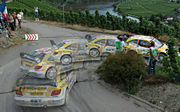
Asphalt
Asphalt or , also known as bitumen, is a sticky, black and highly viscous liquid or semi-solid that is present in most crude petroleums and in some natural deposits, it is a substance classed as a pitch...
(tarmac), gravel
Gravel
Gravel is composed of unconsolidated rock fragments that have a general particle size range and include size classes from granule- to boulder-sized fragments. Gravel can be sub-categorized into granule and cobble...
, or snow and ice, sometimes more than one in a single rally, depending on the course and event. Rallies are also run every month of the year, in every climate, bitter cold to monsoon rain. This contributes to the notion of top rally drivers as some of the best car control experts in the world. As a result of the drivers not knowing exactly what lies ahead, the lower traction available on dirt roads, and the driving characteristics of small cars, the drivers are much less visibly smooth than circuit racers, regularly sending the car literally flying over bumps, and sliding the cars out of corners.
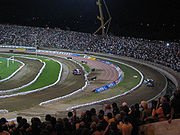
Special stage (rallying)
Special stages are the competitive sections of a stage rally event where the goal is to cover a stretch of closed road in the shortest time. On a special stage cars are set off individually at set intervals to reduce the chances of being impeded by other competitors. Each special stage is a...
" where the actual competition takes place, and untimed "transport stages" where the rally cars must be driven under their own power to the next competitive stage within a generous time limit. Rally cars are thus unlike virtually any other top-line racing cars in that they retain the ability to run at normal driving speeds, and indeed are registered for street travel. Some events contain "super special stages" where two competing cars set off on two parallel tracks (often small enough to fit in a football stadium), giving the illusion they are circuit racing head to head. These stages, ridiculed by many purists, seem increasingly popular with event organizers. Run over a day, a weekend, or more, the winner of the event has the lowest combined special and super special stage times. Given the short distances of super special stages compared to the regular special stages and consequent near-identical times for the frontrunning cars, it is very rare for these spectator-oriented stages to decide rally results, though it is a well-known axiom that a team can't win the rally at the super special, but they can certainly lose it.
Pacenotes and reconnaissance
PacenotesPacenotes
In rallying, pacenotes are a commonly used method of accurately describing the route to be driven in extreme detail. As well as dictating the general route to be taken, in terms of turnings, junctions, etc, all notable features of the route which might affect the way it is driven at speed are...
are a unique and major tool in modern rallying. Television spectators will occasionally notice the voice of a co-driver in mid-race reading the pacenotes over the car's internal intercom. These pacenotes provide a detailed description of the course and allow the driver to predict conditions ahead and prepare for various course conditions such as turns and jumps.
In many rallies, including those of the World Rally Championship
World Rally Championship
The World Rally Championship is a rallying series organised by the FIA, culminating with a champion driver and manufacturer. The driver's world championship and manufacturer's world championship are separate championships, but based on the same point system. The series currently consists of 13...
(WRC), drivers are allowed to run on the stages of the course before competition and create their own pacenotes. This process is called reconnaissance or recce. During reconnaissance, the co-driver writes down shorthand notes (the pacenotes) on how to best drive the stage. Usually the drivers call out the turns and road conditions for the co-drivers to write down. These pacenotes are read aloud through an internal intercom system during the actual race, allowing the driver to anticipate the upcoming terrain and thus take the course as fast as possible.
Other rallies provide organizer-created "route notes" also referred to as "stage notes" and disallow reconnaissance and use of other pacenotes. These notes are usually created using a predetermined pacenote format, from which a co-driver can optionally add comments or transpose into other pacenote notations. Many North American rallies do not conduct reconnaissance but provide stage notes through the use of the Jemba Inertia Notes System
Jemba Inertia Notes System
The Jemba Inertia Notes System is a computer software program used in rallying that automatically prints out stage notes for competitors to use. The purpose of the system is to allow organizers to create a consistent set of pace notes for all the competitors without having them take to additional...
, due to time and budget constraints.
In the past, most rally courses were not allowed to be scanned prior to the race, and the co-drivers used only maps supplied by the organization. The exact route of the rally often remained secret until race day. Modern rallies have mostly converted to using organizer-supplied notes or allowing full reconnaissance, as opposed to racing the stages blindly. This change has been brought on in large part due to competitor demand.
Historic rallying
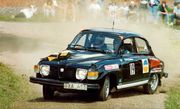
Classic rally
Classic rallying, or historic rallying, is a type of road rally suitable for most standard classic cars, with no special equipment needed . These rallies are more about enjoyment than speed, and can be a good introduction to historic motorsport...
ing), in which older cars compete under older rules. This is a popular sport and even attracts some previous drivers back into the sport. Many who enter, however, have started their competition careers in historic rallying.
Rally driving techniques
- Handbrake turnHandbrake turnThe handbrake turn is a driving technique used to deliberately slide a car sideways, either for the purpose of negotiating a very tight bend quickly, or for turning around well within the vehicle's own turning circle....
- Heel-and-toeHeel-and-toeHeel-and-toe is a driving technique used mostly in performance driving, although some drivers use it on the road in everyday conditions in the interest of effectiveness. It involves operating the throttle and brake pedals simultaneously with the right foot, while facilitating normal activation of...
- Hill jumping
- Left-foot brakingLeft-foot brakingLeft-foot braking is the technique of using the left foot to operate the brake pedal in an automobile, leaving the right foot dedicated to the throttle pedal...
- Scandinavian flickScandinavian flickThe Scandinavian flick, Finnish flick, Manji Drifting, or Pendulum turn, is a technique used in rallying. While approaching the turn the driver applies a slight steering input to the opposite direction of the turn, then steering into the turn, while sharply lifting off the throttle and lightly...
See also
- Andros TrophyAndros TrophyThe Andros Trophy is the French national Ice Racing championship.-History:The idea of an Ice Racing series first became an idea when professional racer Max Mamers and the owner of the Andros company , Frédéric Gervoson met as rugby fans in 1985...
- Australian Rally ChampionshipAustralian Rally ChampionshipThe Australian Rally Championship is a 6 Round National motorsport Championship run in forested countryside throughout Australia.-Current Competition:...
- Canadian Rally ChampionshipCanadian Rally ChampionshipThe Canadian Rally Championship is an automobile rallying tournament sanctioned by the Canadian Association of RallySport .-Canadian rallying history:...
- Classic rallyClassic rallyClassic rallying, or historic rallying, is a type of road rally suitable for most standard classic cars, with no special equipment needed . These rallies are more about enjoyment than speed, and can be a good introduction to historic motorsport...
- Dakar RallyDakar RallyThe Dakar Rally is an annual rally raid type of off-road automobile race, organised by the Amaury Sport Organisation...
- Intercontinental Rally ChallengeIntercontinental Rally ChallengeThe Intercontinental Rally Challenge is a rallying series organised by SRW Ltd and sanctioned by the FIA, aiming to "give new opportunities to young or amateur rally drivers competing in recognised regional and international rallies, while offering organisers an innovative TV format concept,...
- Rally raidRally raidRally raid, also known as cross country rallying is a form of long distance off-road racing that takes place over several days. Each day may require traveling up to . The length of the event can be 3–15 days...
- RallycrossRallycrossRallycross is a form of sprint style automobile racing, held on a closed mixed-surface racing circuit, with modified production or specially built road cars, similar to the World Rally Cars, although usually with about stronger engines, due to e.g. their 45 mm turbo restrictor plates. It is...
- Road rallyRoad rallyA road rally is a car rally that takes place on the public road. It is a popular sport in the United Kingdom, especially Wales, and has traditionally been the core of the "grass roots" of club-based amateur motorsport. However it has declined in popularity since the 1980s and now stage rallies are...
- SCCA RallyCrossSCCA RallyCrossRallyCross, also known as RallyX, is a type of car competition in the U.S.A. and Canada, sanctioned by Sports Car Club of America , National Auto Sport Association , and in Canada...
- World Rally ChampionshipWorld Rally ChampionshipThe World Rally Championship is a rallying series organised by the FIA, culminating with a champion driver and manufacturer. The driver's world championship and manufacturer's world championship are separate championships, but based on the same point system. The series currently consists of 13...
External links
- FIA - Sanctioning body for the WRC
- World Rally Championship - WRC official website
- NASA Rally Sport - US sanctioning body
- Rally America - US sanctioning body
- United States Rally Championship - race series
- National Rallying Committee of Mexico - Mexican sanctioning body