

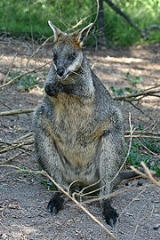
Swamp Wallaby

Encyclopedia
The Swamp Wallaby is a small macropod marsupial
of eastern Australia
. This wallaby
is also commonly known as the Black Wallaby, with other names including Black-tailed Wallaby, Fern Wallaby, Black Pademelon
, Stinker (in Queensland
), and Black Stinker (in New South Wales
). The Swamp Wallaby is the only living member of the genus Wallabia.
in Queensland
, down the entire east coast and around to south-western Victoria
. It was formerly found through to south-eastern South Australia
, but is now rare or absent from that region.
It inhabits thick undergrowth in forest
s and woodland
s, or shelter during the day in thick grass
or fern
s, emerging at night to feed. Brigalow scrub
in Queensland is a particularly favoured habitat
.
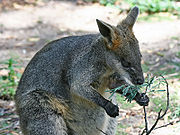 The species name bicolor comes from the distinct colouring variation, with the typical grey coat of the macropods varied with a dark brown to black region on the back, and light yellow to rufous orange on the chest. A light coloured cheek stripe is usually present, and extremities of the body generally show a darker colouring, except for the tip of the tail
, which is often white.
The gait differs from other wallabies, with the Swamp Wallaby carrying its head low and tail out straight.
The average length is 76 cm (30 in) for males, and 70 cm (27.5 in) for females (excluding the tail). The tail in both sexes is approximately equal in length to the rest of the body. Average weight for males is 17 kg (37 lb), females averaging 13 kg (29 lb).
is from 33-38 days, leading to a single young. The young is carried in the pouch
from 8-9 months, but will continue to suckle
until about 15 months. The Swamp Wallaby exhibits an unusual form of embryonic diapause
, differing from other marsupials in having its gestation period longer than its oestrous cycle
.
animal, but often aggregates into groups when feeding. It will eat a wide range of food
plant
s, depending on availability, including shrub
s, pasture
, agricultural
crop
s, and native
and exotic
vegetation
. It appears to be able to tolerate a variety of plants poisonous to many other animals, including bracken
s, hemlock
and Lantana
.
The ideal diet appears to involve browsing
shrub
s and bushes, rather than grazing
grasses. This is unusual in wallabies and other macropods, which typically prefer grazing
. Tooth
structure reflects this preference for browsing, with the shape of the molar
s differing from other wallabies. The fourth premolar
is retained through life, and is shaped for cutting through coarse plant material.
According to Aboriginal people
of the Bundjalung Nation, the Swamp Wallaby was considered inedible, due to its smell and taste after cooking. Commercial shooter
s also find it undesirable due to its small size and coarse fur.
), so perhaps should be placed in the genus Macropus
.
Marsupial
Marsupials are an infraclass of mammals, characterized by giving birth to relatively undeveloped young. Close to 70% of the 334 extant species occur in Australia, New Guinea, and nearby islands, with the remaining 100 found in the Americas, primarily in South America, but with thirteen in Central...
of eastern Australia
Australia
Australia , officially the Commonwealth of Australia, is a country in the Southern Hemisphere comprising the mainland of the Australian continent, the island of Tasmania, and numerous smaller islands in the Indian and Pacific Oceans. It is the world's sixth-largest country by total area...
. This wallaby
Wallaby
A wallaby is any of about thirty species of macropod . It is an informal designation generally used for any macropod that is smaller than a kangaroo or wallaroo that has not been given some other name.-Overview:...
is also commonly known as the Black Wallaby, with other names including Black-tailed Wallaby, Fern Wallaby, Black Pademelon
Pademelon
Pademelons are small marsupials of the genus Thylogale. They are usually found in forests. Pademelons are the smallest of the macropods...
, Stinker (in Queensland
Queensland
Queensland is a state of Australia, occupying the north-eastern section of the mainland continent. It is bordered by the Northern Territory, South Australia and New South Wales to the west, south-west and south respectively. To the east, Queensland is bordered by the Coral Sea and Pacific Ocean...
), and Black Stinker (in New South Wales
New South Wales
New South Wales is a state of :Australia, located in the east of the country. It is bordered by Queensland, Victoria and South Australia to the north, south and west respectively. To the east, the state is bordered by the Tasman Sea, which forms part of the Pacific Ocean. New South Wales...
). The Swamp Wallaby is the only living member of the genus Wallabia.
Habitat and distribution
The Swamp Wallaby is found from the northernmost areas of Cape YorkCape York Peninsula
Cape York Peninsula is a large remote peninsula located in Far North Queensland at the tip of the state of Queensland, Australia, the largest unspoilt wilderness in northern Australia and one of the last remaining wilderness areas on Earth...
in Queensland
Queensland
Queensland is a state of Australia, occupying the north-eastern section of the mainland continent. It is bordered by the Northern Territory, South Australia and New South Wales to the west, south-west and south respectively. To the east, Queensland is bordered by the Coral Sea and Pacific Ocean...
, down the entire east coast and around to south-western Victoria
Victoria (Australia)
Victoria is the second most populous state in Australia. Geographically the smallest mainland state, Victoria is bordered by New South Wales, South Australia, and Tasmania on Boundary Islet to the north, west and south respectively....
. It was formerly found through to south-eastern South Australia
South Australia
South Australia is a state of Australia in the southern central part of the country. It covers some of the most arid parts of the continent; with a total land area of , it is the fourth largest of Australia's six states and two territories.South Australia shares borders with all of the mainland...
, but is now rare or absent from that region.
It inhabits thick undergrowth in forest
Forest
A forest, also referred to as a wood or the woods, is an area with a high density of trees. As with cities, depending where you are in the world, what is considered a forest may vary significantly in size and have various classification according to how and what of the forest is composed...
s and woodland
Woodland
Ecologically, a woodland is a low-density forest forming open habitats with plenty of sunlight and limited shade. Woodlands may support an understory of shrubs and herbaceous plants including grasses. Woodland may form a transition to shrubland under drier conditions or during early stages of...
s, or shelter during the day in thick grass
Grass
Grasses, or more technically graminoids, are monocotyledonous, usually herbaceous plants with narrow leaves growing from the base. They include the "true grasses", of the Poaceae family, as well as the sedges and the rushes . The true grasses include cereals, bamboo and the grasses of lawns ...
or fern
Fern
A fern is any one of a group of about 12,000 species of plants belonging to the botanical group known as Pteridophyta. Unlike mosses, they have xylem and phloem . They have stems, leaves, and roots like other vascular plants...
s, emerging at night to feed. Brigalow scrub
Acacia harpophylla
Acacia harpophylla, commonly known as the Brigalow , Brigalow Spearwood or Orkor is an endemic tree of Australia. It is found in central and coastal Queensland to northern New South Wales. It can reach up to 25 meters tall and forms extensive open-forest communities on clay soils.Two species,...
in Queensland is a particularly favoured habitat
Habitat
* Habitat , a place where a species lives and grows*Human habitat, a place where humans live, work or play** Space habitat, a space station intended as a permanent settlement...
.
Description
Tail
The tail is the section at the rear end of an animal's body; in general, the term refers to a distinct, flexible appendage to the torso. It is the part of the body that corresponds roughly to the sacrum and coccyx in mammals, reptiles, and birds...
, which is often white.
The gait differs from other wallabies, with the Swamp Wallaby carrying its head low and tail out straight.
The average length is 76 cm (30 in) for males, and 70 cm (27.5 in) for females (excluding the tail). The tail in both sexes is approximately equal in length to the rest of the body. Average weight for males is 17 kg (37 lb), females averaging 13 kg (29 lb).
Reproduction
The Swamp Wallaby becomes reproductively viable from 15-18 months of age, and can breed throughout the year. GestationGestation
Gestation is the carrying of an embryo or fetus inside a female viviparous animal. Mammals during pregnancy can have one or more gestations at the same time ....
is from 33-38 days, leading to a single young. The young is carried in the pouch
Pouch (marsupial)
The pouch is a distinguishing feature of female marsupials ; the name marsupial is derived from the Latin marsupium, meaning "pouch". Marsupials give birth to a live but relatively undeveloped fetus called a joey. When the joey is born it crawls from inside the mother to the pouch...
from 8-9 months, but will continue to suckle
Breastfeeding
Breastfeeding is the feeding of an infant or young child with breast milk directly from female human breasts rather than from a baby bottle or other container. Babies have a sucking reflex that enables them to suck and swallow milk. It is recommended that mothers breastfeed for six months or...
until about 15 months. The Swamp Wallaby exhibits an unusual form of embryonic diapause
Embryonic diapause
Delayed Implantation or Embryonic Diapause is a reproductive strategy used by approximately 100 different mammals in seven or eight different orders. In embryonic diapause, the embryo does not immediately implant in the uterus, but is maintained in a state of dormancy. Little to no development...
, differing from other marsupials in having its gestation period longer than its oestrous cycle
Estrous cycle
The estrous cycle comprises the recurring physiologic changes that are induced by reproductive hormones in most mammalian placental females. Estrous cycles start after puberty in sexually mature females and are interrupted by anestrous phases or pregnancies...
.
Nutrition
The Swamp Wallaby is typically a solitaryWiktionary
Wiktionary is a multilingual, web-based project to create a free content dictionary, available in 158 languages...
animal, but often aggregates into groups when feeding. It will eat a wide range of food
Food
Food is any substance consumed to provide nutritional support for the body. It is usually of plant or animal origin, and contains essential nutrients, such as carbohydrates, fats, proteins, vitamins, or minerals...
plant
Plant
Plants are living organisms belonging to the kingdom Plantae. Precise definitions of the kingdom vary, but as the term is used here, plants include familiar organisms such as trees, flowers, herbs, bushes, grasses, vines, ferns, mosses, and green algae. The group is also called green plants or...
s, depending on availability, including shrub
Shrub
A shrub or bush is distinguished from a tree by its multiple stems and shorter height, usually under 5–6 m tall. A large number of plants may become either shrubs or trees, depending on the growing conditions they experience...
s, pasture
Pasture
Pasture is land used for grazing. Pasture lands in the narrow sense are enclosed tracts of farmland, grazed by domesticated livestock, such as horses, cattle, sheep or swine. The vegetation of tended pasture, forage, consists mainly of grasses, with an interspersion of legumes and other forbs...
, agricultural
Agriculture
Agriculture is the cultivation of animals, plants, fungi and other life forms for food, fiber, and other products used to sustain life. Agriculture was the key implement in the rise of sedentary human civilization, whereby farming of domesticated species created food surpluses that nurtured the...
crop
Crop (agriculture)
A crop is a non-animal species or variety that is grown to be harvested as food, livestock fodder, fuel or for any other economic purpose. Major world crops include maize , wheat, rice, soybeans, hay, potatoes and cotton. While the term "crop" most commonly refers to plants, it can also include...
s, and native
Indigenous (ecology)
In biogeography, a species is defined as native to a given region or ecosystem if its presence in that region is the result of only natural processes, with no human intervention. Every natural organism has its own natural range of distribution in which it is regarded as native...
and exotic
Introduced species
An introduced species — or neozoon, alien, exotic, non-indigenous, or non-native species, or simply an introduction, is a species living outside its indigenous or native distributional range, and has arrived in an ecosystem or plant community by human activity, either deliberate or accidental...
vegetation
Vegetation
Vegetation is a general term for the plant life of a region; it refers to the ground cover provided by plants. It is a general term, without specific reference to particular taxa, life forms, structure, spatial extent, or any other specific botanical or geographic characteristics. It is broader...
. It appears to be able to tolerate a variety of plants poisonous to many other animals, including bracken
Bracken
Bracken are several species of large, coarse ferns of the genus Pteridium. Ferns are vascular plants that have alternating generations, large plants that produce spores and small plants that produce sex cells . Brackens are in the family Dennstaedtiaceae, which are noted for their large, highly...
s, hemlock
Conium
Conium is a genus of two species of highly poisonous perennial herbaceous flowering plants in the family Apiaceae, native to Europe and the Mediterranean region as Conium maculatum, and to southern Africa as Conium chaerophylloides....
and Lantana
Lantana
Lantana is a genus of about 150 species of perennial flowering plants in the verbena family, Verbenaceae. They are native to tropical regions of the Americas and Africa but exist as an introduced species in numerous areas, especially in the Australian-Pacific region. The genus includes both...
.
The ideal diet appears to involve browsing
Browsing (predation)
Browsing is a type of herbivory in which an herbivore feeds on leaves, soft shoots, or fruits of high growing, generally woody, plants such as shrubs. This is contrasted with grazing, usually associated with animals feeding on grass or other low vegetation...
shrub
Shrub
A shrub or bush is distinguished from a tree by its multiple stems and shorter height, usually under 5–6 m tall. A large number of plants may become either shrubs or trees, depending on the growing conditions they experience...
s and bushes, rather than grazing
Grazing
Grazing generally describes a type of feeding, in which a herbivore feeds on plants , and also on other multicellular autotrophs...
grasses. This is unusual in wallabies and other macropods, which typically prefer grazing
Grazing
Grazing generally describes a type of feeding, in which a herbivore feeds on plants , and also on other multicellular autotrophs...
. Tooth
Tooth
Teeth are small, calcified, whitish structures found in the jaws of many vertebrates that are used to break down food. Some animals, particularly carnivores, also use teeth for hunting or for defensive purposes. The roots of teeth are embedded in the Mandible bone or the Maxillary bone and are...
structure reflects this preference for browsing, with the shape of the molar
Molar (tooth)
Molars are the rearmost and most complicated kind of tooth in most mammals. In many mammals they grind food; hence the Latin name mola, "millstone"....
s differing from other wallabies. The fourth premolar
Premolar
The premolar teeth or bicuspids are transitional teeth located between the canine and molar teeth. In humans, there are two premolars per quadrant, making eight premolars total in the mouth. They have at least two cusps. Premolars can be considered as a 'transitional tooth' during chewing, or...
is retained through life, and is shaped for cutting through coarse plant material.
According to Aboriginal people
Indigenous Australians
Indigenous Australians are the original inhabitants of the Australian continent and nearby islands. The Aboriginal Indigenous Australians migrated from the Indian continent around 75,000 to 100,000 years ago....
of the Bundjalung Nation, the Swamp Wallaby was considered inedible, due to its smell and taste after cooking. Commercial shooter
Shooting
Shooting is the act or process of firing rifles, shotguns or other projectile weapons such as bows or crossbows. Even the firing of artillery, rockets and missiles can be called shooting. A person who specializes in shooting is a marksman...
s also find it undesirable due to its small size and coarse fur.
Taxonomic debate
Several physical and behavioral characteristics make the Swamp Wallaby different enough from other wallabies that many authors place it apart in its own genus, Wallabia. Others however point out swamp wallabies can hybridize with Macropus agilis (the Agile WallabyAgile Wallaby
The Agile Wallaby , also known as the Sandy Wallaby, is a species of wallaby found in northern Australia and New Guinea. It is the most common wallaby in Australia's north....
), so perhaps should be placed in the genus Macropus
Macropus
Macropus is a marsupial genus that belongs to the family Macropodidae, it has 14 species which are further divided into 3 subgenera. The genus includes all terrestrial kangaroos, wallaroos and several species of wallaby. The term itself is derived from the Ancient Greek makros "long" and pous...
.