

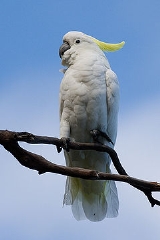
Sulphur-crested Cockatoo

Encyclopedia
The Sulphur-crested Cockatoo, Cacatua galerita, is a relatively large white cockatoo
found in wooded habitats in Australia
and New Guinea
. They can be locally very numerous, leading to them sometimes being considered pests. They are well known in aviculture
, although they can be demanding pets.
, but avoiding arid inland areas with few trees. They are numerous in suburb
an habitats in cities such as Adelaide
, Canberra
, Sydney
and Brisbane
. Except for highland areas, they occur throughout most of New Guinea
and on nearby smaller islands such as Waigeo
, Misool
and Aru
, and various islands in the Cenderawasih Bay
and Milne Bay
.
There are four recognised subspecies; C. g. triton (Temminck, 1849) is found in New Guinea
and the surrounding islands, C. g. elenora
(Finsch, 1867) is restricted to the Aru Islands
between Australia and New Guinea, C. g. fitzroyi (Mathews, 1912) in northern Australia from West Australia to the Gulf of Carpentaria
and the nominate subspecies which is found from Cape York
to Tasmania.
to Perth
, which is far outside the natural range. Outside Australia, they have been introduced to Singapore
, where their numbers have been estimated to be between 500 and 2000. They have also been introduced to Palau
and New Zealand. In New Zealand
the introduced populations may number less than 1000. This species has also been recorded from various islands in Wallacea
(e.g. Kai Islands
and Ambon
), but it is unclear if it has managed to become established there.
is overall white, while the underwing and -tail are tinged yellow. The expressive crest is yellow. The bill is black, the legs are grey, and the eye-ring is whitish. Males typically have almost black eyes, whereas the females have a more red or brown eye, but this require optimum viewing conditions to be seen. The differences between the subspecies are subtle. C. g. fitzroyi is similar to the nominate race but lacks the yellow on the ear tufts and slightly blueish skin around the eye. C. g. eleonora is similar to C. g. fitzroyi but is smaller and has broader feathers in the crest, and C. g. triton is similar to C. g. eleonora except it has a smaller bill.
It is similar in appearance to the three species of corellas found in Australia. However, corellas are smaller, lack the prominent yellow crest and have pale bills. In captivity, the Sulphur-crested Cockatoo is easily confused with the smaller Yellow-crested Cockatoo
or the Blue-eyed Cockatoo
with a differently shaped crest and a darker blue eye-ring.
These birds are very long-lived, and can live upwards of 70 years in captivity, although they only live to about 20–40 years in the wild. They have been known to engage in geophagy
, the process of eating clay to detoxify their food. These birds produce a very fine powder to waterproof themselves instead of oil as many other creatures do.
The Sulphur-crested Cockatoo is a seasonal breeder in Australia, little is known about its breeding behaviour in New Guinea. In southern Australia the breeding season is from August to January, whereas in northern Australia the season is from May to September. The nest is a bed of wood chips in a hollow in a tree. Like many other parrots it competes with others of its species and with other species on nesting sites. Two to three eggs are laid and incubation
lasts between 25–27 days. Both parents incubate the eggs and raise the nestlings. The nestling period is between 9 to 12 weeks, and the young fledgelings remain with their parents for a number of months after fledging.
A 2009 study involving an Eleonora Cockatoo
(the subspecies Cacatua galerita eleonora) named Snowball
found that Sulphur-crested Cockatoos are capable of synchronising movements to a musical beat.
Species that feed on the ground are very vulnerable to predator attack. The Cockatoo has evolved a behavioural adaptation to protect against this: whenever there is a flock on the ground, there is at least one high up in a tree (usually a dead tree), keeping guard. This is so well-known that it has even entered Australian slang: a person keeping guard for sudden police raids on illegal gambling gatherings is referred to as a Cockatoo or Cocky for short.
and fruit
crops. They can also be destructive to timber
structures such as house planking, garden furniture and trees.
Consequently, they are sometimes shot or poison
ed as pests. Government permit is required, as they are a protected species under the Australian Commonwealth Law.
as a result of the Wild Bird Conservation Act. However, they have been bred in captivity. They are demanding pets, being very loud and having a natural desire to chew wood and other hard and organic materials.
Cocky Bennett of Tom Ugly's Point
in Sydney was a celebrated Sulphur-crested Cockatoo who reached an age of 100 years or more. He had lost his feathers and was naked for much of his life, and died in the early years of the twentieth century. His body was stuffed and preserved after death. Another 'Cocky', born in 1921 and residing in Arncliffe with his owner Charlie Knighton, was 76 years old in the late 1990s.
Sulphur-crested Cockatoos, along with many other parrots, are susceptible to Psittacine Beak and Feather Disease
, a viral disease, which causes birds to lose their feathers and grow grotesquely shaped beaks. The disease occurs naturally in the wild, and in captivity.
Cockatoo
A cockatoo is any of the 21 species belonging to the bird family Cacatuidae. Along with the Psittacidae and the Strigopidae , they make up the parrot order Psittaciformes . Placement of the cockatoos as a separate family is fairly undisputed, although many aspects of the other living lineages of...
found in wooded habitats in Australia
Australia
Australia , officially the Commonwealth of Australia, is a country in the Southern Hemisphere comprising the mainland of the Australian continent, the island of Tasmania, and numerous smaller islands in the Indian and Pacific Oceans. It is the world's sixth-largest country by total area...
and New Guinea
New Guinea
New Guinea is the world's second largest island, after Greenland, covering a land area of 786,000 km2. Located in the southwest Pacific Ocean, it lies geographically to the east of the Malay Archipelago, with which it is sometimes included as part of a greater Indo-Australian Archipelago...
. They can be locally very numerous, leading to them sometimes being considered pests. They are well known in aviculture
Aviculture
Aviculture is the practice of keeping and breeding birds and the culture that forms around it. Aviculture is generally focused on not only the raising and breeding of birds, but also on preserving avian habitat, and public awareness campaigns....
, although they can be demanding pets.
Distribution
In Australia, Sulphur-crested Cockatoos can be found widely in the north and east, ranging as far south as TasmaniaTasmania
Tasmania is an Australian island and state. It is south of the continent, separated by Bass Strait. The state includes the island of Tasmania—the 26th largest island in the world—and the surrounding islands. The state has a population of 507,626 , of whom almost half reside in the greater Hobart...
, but avoiding arid inland areas with few trees. They are numerous in suburb
Suburb
The word suburb mostly refers to a residential area, either existing as part of a city or as a separate residential community within commuting distance of a city . Some suburbs have a degree of administrative autonomy, and most have lower population density than inner city neighborhoods...
an habitats in cities such as Adelaide
Adelaide
Adelaide is the capital city of South Australia and the fifth-largest city in Australia. Adelaide has an estimated population of more than 1.2 million...
, Canberra
Canberra
Canberra is the capital city of Australia. With a population of over 345,000, it is Australia's largest inland city and the eighth-largest city overall. The city is located at the northern end of the Australian Capital Territory , south-west of Sydney, and north-east of Melbourne...
, Sydney
Sydney
Sydney is the most populous city in Australia and the state capital of New South Wales. Sydney is located on Australia's south-east coast of the Tasman Sea. As of June 2010, the greater metropolitan area had an approximate population of 4.6 million people...
and Brisbane
Brisbane
Brisbane is the capital and most populous city in the Australian state of Queensland and the third most populous city in Australia. Brisbane's metropolitan area has a population of over 2 million, and the South East Queensland urban conurbation, centred around Brisbane, encompasses a population of...
. Except for highland areas, they occur throughout most of New Guinea
New Guinea
New Guinea is the world's second largest island, after Greenland, covering a land area of 786,000 km2. Located in the southwest Pacific Ocean, it lies geographically to the east of the Malay Archipelago, with which it is sometimes included as part of a greater Indo-Australian Archipelago...
and on nearby smaller islands such as Waigeo
Waigeo
Waigeo is an island in West Papua province of eastern Indonesia. The island is also known as Amberi, or Waigiu. It is the largest of the four main islands in the Raja Ampat Islands archipelago, between Halmahera and about 65 km to the northwest coast of New Guinea...
, Misool
Misool
Misool is one of the four major islands in the Raja Ampat Islands in West Papua , Indonesia. Its area is 2034 km². The highest point is 535 m and the main town is Waigama, on the island's northern coast, and Lilinta....
and Aru
Aru Islands
The Aru Islands are a group of about ninety-five low-lying islands in the Maluku province of eastern Indonesia. They also form a regency of Indonesia.-Geography:...
, and various islands in the Cenderawasih Bay
Cenderawasih Bay
Cenderawasih Bay , also Teluk Sarera , formerly Geelvink Bay is a large bay in northern Province of Papua and West Papua, New Guinea, Indonesia, at . The Dutch name comes after a Dutch ship and family called Geelvinck...
and Milne Bay
Milne Bay Province
Milne Bay is a province of Papua New Guinea. Its capital is Alotau. The province covers 14,000 km² of land and 252,990 km² of sea, within the province there are more than 600 islands, about 160 of which are inhabited...
.
There are four recognised subspecies; C. g. triton (Temminck, 1849) is found in New Guinea
New Guinea
New Guinea is the world's second largest island, after Greenland, covering a land area of 786,000 km2. Located in the southwest Pacific Ocean, it lies geographically to the east of the Malay Archipelago, with which it is sometimes included as part of a greater Indo-Australian Archipelago...
and the surrounding islands, C. g. elenora
Eleonora Cockatoo
The Eleonora Cockatoo, Cacatua galerita eleonora, also known as Medium Sulphur-crested Cockatoo, is similar in appearance to other subspecies of the Sulphur-crested Cockatoo. It is found in the Aru and Kai Islands of Indonesia, where it was introduced and is common in aviculture.It is the smallest...
(Finsch, 1867) is restricted to the Aru Islands
Aru Islands
The Aru Islands are a group of about ninety-five low-lying islands in the Maluku province of eastern Indonesia. They also form a regency of Indonesia.-Geography:...
between Australia and New Guinea, C. g. fitzroyi (Mathews, 1912) in northern Australia from West Australia to the Gulf of Carpentaria
Gulf of Carpentaria
The Gulf of Carpentaria is a large, shallow sea enclosed on three sides by northern Australia and bounded on the north by the Arafura Sea...
and the nominate subspecies which is found from Cape York
Cape York Peninsula
Cape York Peninsula is a large remote peninsula located in Far North Queensland at the tip of the state of Queensland, Australia, the largest unspoilt wilderness in northern Australia and one of the last remaining wilderness areas on Earth...
to Tasmania.
Introduced species
Within Australia, Sulphur-crested Cockatoos of the nominate race have also been introducedIntroduced species
An introduced species — or neozoon, alien, exotic, non-indigenous, or non-native species, or simply an introduction, is a species living outside its indigenous or native distributional range, and has arrived in an ecosystem or plant community by human activity, either deliberate or accidental...
to Perth
Perth, Western Australia
Perth is the capital and largest city of the Australian state of Western Australia and the fourth most populous city in Australia. The Perth metropolitan area has an estimated population of almost 1,700,000....
, which is far outside the natural range. Outside Australia, they have been introduced to Singapore
Singapore
Singapore , officially the Republic of Singapore, is a Southeast Asian city-state off the southern tip of the Malay Peninsula, north of the equator. An island country made up of 63 islands, it is separated from Malaysia by the Straits of Johor to its north and from Indonesia's Riau Islands by the...
, where their numbers have been estimated to be between 500 and 2000. They have also been introduced to Palau
Palau
Palau , officially the Republic of Palau , is an island nation in the Pacific Ocean, east of the Philippines and south of Tokyo. In 1978, after three decades as being part of the United Nations trusteeship, Palau chose independence instead of becoming part of the Federated States of Micronesia, a...
and New Zealand. In New Zealand
New Zealand
New Zealand is an island country in the south-western Pacific Ocean comprising two main landmasses and numerous smaller islands. The country is situated some east of Australia across the Tasman Sea, and roughly south of the Pacific island nations of New Caledonia, Fiji, and Tonga...
the introduced populations may number less than 1000. This species has also been recorded from various islands in Wallacea
Wallacea
Wallacea is a biogeographical designation for a group of Indonesian islands separated by deep water straits from the Asian and Australian continental shelves. Wallacea includes Sulawesi, the largest island in the group, as well as Lombok, Sumbawa, Flores, Sumba, Timor, Halmahera, Buru, Seram, and...
(e.g. Kai Islands
Kai Islands
The Kai Islands of Indonesia are in the south-eastern part of the Maluku Islands, in Maluku Province.-Geography:...
and Ambon
Ambon Island
Ambon Island is part of the Maluku Islands of Indonesia. The island has an area of , and is mountainous, well watered, and fertile. Ambon Island consists of 2 territories: The main city and seaport is Ambon , which is also the capital of Maluku province and Maluku Tengah Ambon Island is part of the...
), but it is unclear if it has managed to become established there.
Description
It has a total length of 45–55 cm (18–22 in), with the Australian subspecies larger than subspecies from New Guinea and nearby islands. The plumagePlumage
Plumage refers both to the layer of feathers that cover a bird and the pattern, colour, and arrangement of those feathers. The pattern and colours of plumage vary between species and subspecies and can also vary between different age classes, sexes, and season. Within species there can also be a...
is overall white, while the underwing and -tail are tinged yellow. The expressive crest is yellow. The bill is black, the legs are grey, and the eye-ring is whitish. Males typically have almost black eyes, whereas the females have a more red or brown eye, but this require optimum viewing conditions to be seen. The differences between the subspecies are subtle. C. g. fitzroyi is similar to the nominate race but lacks the yellow on the ear tufts and slightly blueish skin around the eye. C. g. eleonora is similar to C. g. fitzroyi but is smaller and has broader feathers in the crest, and C. g. triton is similar to C. g. eleonora except it has a smaller bill.
It is similar in appearance to the three species of corellas found in Australia. However, corellas are smaller, lack the prominent yellow crest and have pale bills. In captivity, the Sulphur-crested Cockatoo is easily confused with the smaller Yellow-crested Cockatoo
Yellow-crested Cockatoo
The Yellow-crested Cockatoo, Cacatua sulphurea, also known as the Lesser Sulphur-crested Cockatoo, is a medium-sized cockatoo with white plumage, bluish-white bare orbital skin, grey feet, a black bill, and a retractile yellow crest. The sexes are similar...
or the Blue-eyed Cockatoo
Blue-eyed Cockatoo
The Blue-eyed Cockatoo, Cacatua ophthalmica, is a large, approximately 50 cm long, mainly white cockatoo with a mobile crest, a black beak, and a light blue rim of featherless skin around each eye, that gives this species its name....
with a differently shaped crest and a darker blue eye-ring.
Behaviour
Their distinctive raucous call can be very loud; it is adapted to travel through the forest environments in which they live, including tropical and subtropical rainforests. These birds are naturally curious, as well as very intelligent. They have adapted very well to European settlement in Australia and live in many urban areas.These birds are very long-lived, and can live upwards of 70 years in captivity, although they only live to about 20–40 years in the wild. They have been known to engage in geophagy
Geophagy
Geophagy is the practice of eating earthy or soil-like substances such as clay, and chalk. It exists in animals in the wild and also in humans, most often in rural or preindustrial societies among children and pregnant women...
, the process of eating clay to detoxify their food. These birds produce a very fine powder to waterproof themselves instead of oil as many other creatures do.
The Sulphur-crested Cockatoo is a seasonal breeder in Australia, little is known about its breeding behaviour in New Guinea. In southern Australia the breeding season is from August to January, whereas in northern Australia the season is from May to September. The nest is a bed of wood chips in a hollow in a tree. Like many other parrots it competes with others of its species and with other species on nesting sites. Two to three eggs are laid and incubation
Avian incubation
Incubation refers to the process by which certain oviparous animals hatch their eggs, and to the development of the embryo within the egg. The most vital factor of incubation is the constant temperature required for its development over a specific period. Especially in domestic fowl, the act of...
lasts between 25–27 days. Both parents incubate the eggs and raise the nestlings. The nestling period is between 9 to 12 weeks, and the young fledgelings remain with their parents for a number of months after fledging.
A 2009 study involving an Eleonora Cockatoo
Eleonora Cockatoo
The Eleonora Cockatoo, Cacatua galerita eleonora, also known as Medium Sulphur-crested Cockatoo, is similar in appearance to other subspecies of the Sulphur-crested Cockatoo. It is found in the Aru and Kai Islands of Indonesia, where it was introduced and is common in aviculture.It is the smallest...
(the subspecies Cacatua galerita eleonora) named Snowball
Snowball (Cockatoo)
Snowball is a male Eleonora Cockatoo, noted as being the first non-human animal conclusively demonstrated to be capable of beat induction — perceiving music and synchronizing his body movements to the beat .-Background:...
found that Sulphur-crested Cockatoos are capable of synchronising movements to a musical beat.
Species that feed on the ground are very vulnerable to predator attack. The Cockatoo has evolved a behavioural adaptation to protect against this: whenever there is a flock on the ground, there is at least one high up in a tree (usually a dead tree), keeping guard. This is so well-known that it has even entered Australian slang: a person keeping guard for sudden police raids on illegal gambling gatherings is referred to as a Cockatoo or Cocky for short.
Pest status
In some parts of Australia, the Sulphur-crested Cockatoo can be very numerous, and may cause damage to cerealCereal
Cereals are grasses cultivated for the edible components of their grain , composed of the endosperm, germ, and bran...
and fruit
Fruit
In broad terms, a fruit is a structure of a plant that contains its seeds.The term has different meanings dependent on context. In non-technical usage, such as food preparation, fruit normally means the fleshy seed-associated structures of certain plants that are sweet and edible in the raw state,...
crops. They can also be destructive to timber
Timber
Timber may refer to:* Timber, a term common in the United Kingdom and Australia for wood materials * Timber, Oregon, an unincorporated community in the U.S...
structures such as house planking, garden furniture and trees.
Consequently, they are sometimes shot or poison
Poison
In the context of biology, poisons are substances that can cause disturbances to organisms, usually by chemical reaction or other activity on the molecular scale, when a sufficient quantity is absorbed by an organism....
ed as pests. Government permit is required, as they are a protected species under the Australian Commonwealth Law.
Aviculture
Sulphur-crested Cockatoos may no longer be imported into the United StatesUnited States
The United States of America is a federal constitutional republic comprising fifty states and a federal district...
as a result of the Wild Bird Conservation Act. However, they have been bred in captivity. They are demanding pets, being very loud and having a natural desire to chew wood and other hard and organic materials.
Cocky Bennett of Tom Ugly's Point
Blakehurst, New South Wales
Blakehurst is a suburb in southern Sydney, in the state of New South Wales, Australia. Blakehurst is located 18 kilometres south of the Sydney central business district, in the local government area of the Municipality of Kogarah and is part of the St George area.Blakehurst is connected to...
in Sydney was a celebrated Sulphur-crested Cockatoo who reached an age of 100 years or more. He had lost his feathers and was naked for much of his life, and died in the early years of the twentieth century. His body was stuffed and preserved after death. Another 'Cocky', born in 1921 and residing in Arncliffe with his owner Charlie Knighton, was 76 years old in the late 1990s.
Sulphur-crested Cockatoos, along with many other parrots, are susceptible to Psittacine Beak and Feather Disease
Psittacine beak and feather disease
Psittacine beak and feather disease is a viral disease affecting all Old World and New World Parrots . The virus belongs to the family Circoviridae. The virus attacks the feather follicles and the beak and claws-growing cells of the bird, causing progressive feather malformation and necrosis...
, a viral disease, which causes birds to lose their feathers and grow grotesquely shaped beaks. The disease occurs naturally in the wild, and in captivity.
External links
- ParrotScience - cockatoo heavy information site. Video of geophagy in Australia
- mytoos.com - information on cockatoos in captivity
- Sulphur-crested Cockatoo videos, photos & sounds on the Internet Bird Collection
- Photograph of "Cocky" Bennett, 115 years old in this photo
- A tale of two cockies A heartwarming photo-story of an injured female and the devoted male that opened her cage
- Photo of a group of very noisy sulphur-crested cockatoos in Double Bay (Sydney), New South Wales, Australia
