

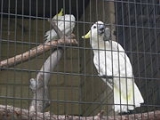
Eleonora Cockatoo

Encyclopedia
The Eleonora Cockatoo, Cacatua galerita eleonora, also known as Medium Sulphur-crested Cockatoo, is similar in appearance to other subspecies
of the Sulphur-crested Cockatoo
. It is found in the Aru
and Kai Islands
of Indonesia
, where it was introduced
and is common in aviculture
.
It is the smallest of the four subspecies of Cacatua galerita, at approx. 44 cm long and weighing in at between 404–602 grammes. Apart from the size difference, the Eleonora differs from the Greater Sulphur Crested in that it doesn't have as prominent white eyerings, the crest of an Eleonora is often less curved and it doesn't have the certain pointy upper mandible, which is only found in Cacatua galerita galerita.
The Eleonora Cockatoo was named by Dr. Otto Finsch
. He discovered the subspecies in Amsterdam
's Artis
zoo and named it after Maria Eleonora van der Schroef, the wife of the then director of the zoo.
, a bird recently demonstrated to be capable of beat induction - in other words, that the bird is capable of perceiving a musical beat and dancing to it.
Subspecies
Subspecies in biological classification, is either a taxonomic rank subordinate to species, ora taxonomic unit in that rank . A subspecies cannot be recognized in isolation: a species will either be recognized as having no subspecies at all or two or more, never just one...
of the Sulphur-crested Cockatoo
Sulphur-crested Cockatoo
The Sulphur-crested Cockatoo, Cacatua galerita, is a relatively large white cockatoo found in wooded habitats in Australia and New Guinea. They can be locally very numerous, leading to them sometimes being considered pests...
. It is found in the Aru
Aru Islands
The Aru Islands are a group of about ninety-five low-lying islands in the Maluku province of eastern Indonesia. They also form a regency of Indonesia.-Geography:...
and Kai Islands
Kai Islands
The Kai Islands of Indonesia are in the south-eastern part of the Maluku Islands, in Maluku Province.-Geography:...
of Indonesia
Indonesia
Indonesia , officially the Republic of Indonesia , is a country in Southeast Asia and Oceania. Indonesia is an archipelago comprising approximately 13,000 islands. It has 33 provinces with over 238 million people, and is the world's fourth most populous country. Indonesia is a republic, with an...
, where it was introduced
Introduced species
An introduced species — or neozoon, alien, exotic, non-indigenous, or non-native species, or simply an introduction, is a species living outside its indigenous or native distributional range, and has arrived in an ecosystem or plant community by human activity, either deliberate or accidental...
and is common in aviculture
Aviculture
Aviculture is the practice of keeping and breeding birds and the culture that forms around it. Aviculture is generally focused on not only the raising and breeding of birds, but also on preserving avian habitat, and public awareness campaigns....
.
It is the smallest of the four subspecies of Cacatua galerita, at approx. 44 cm long and weighing in at between 404–602 grammes. Apart from the size difference, the Eleonora differs from the Greater Sulphur Crested in that it doesn't have as prominent white eyerings, the crest of an Eleonora is often less curved and it doesn't have the certain pointy upper mandible, which is only found in Cacatua galerita galerita.
The Eleonora Cockatoo was named by Dr. Otto Finsch
Otto Finsch
Friedrich Hermann Otto Finsch was a German ethnographer, naturalist and colonial explorer.-Biography:...
. He discovered the subspecies in Amsterdam
Amsterdam
Amsterdam is the largest city and the capital of the Netherlands. The current position of Amsterdam as capital city of the Kingdom of the Netherlands is governed by the constitution of August 24, 1815 and its successors. Amsterdam has a population of 783,364 within city limits, an urban population...
's Artis
Artis
Artis, short for Natura Artis Magistra , is a zoo in the centre of Amsterdam. It is the oldest zoo in the Netherlands...
zoo and named it after Maria Eleonora van der Schroef, the wife of the then director of the zoo.
Diet and habitat
In the wild, the Eleonora Cockatoo is found in open woodlands, forests, and semi-arid forested areas, as well as partially cleared forest areas. It feeds on nuts, berries, flower buds, flowers, seeds and insects.Reproduction
The breeding season of this cockatoo is mainly from September to January. The birds build their nests in a tree hollow or rock crevice. The female lays 2-3 white oval eggs, which hatch after a period of 30 days. Both parents incubate the eggs and in turn provide for the chicks. The young fledge after about 75 days.Intelligence and beat perception
One notable Eleonora Cockatoo is SnowballSnowball (Cockatoo)
Snowball is a male Eleonora Cockatoo, noted as being the first non-human animal conclusively demonstrated to be capable of beat induction — perceiving music and synchronizing his body movements to the beat .-Background:...
, a bird recently demonstrated to be capable of beat induction - in other words, that the bird is capable of perceiving a musical beat and dancing to it.