

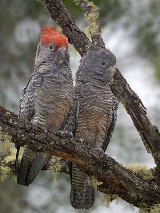
Cockatoo

Encyclopedia
A cockatoo is any of the 21 species
belonging to the bird
family
Cacatuidae. Along with the Psittacidae (true parrots
) and the Strigopidae (large New Zealand parrots), they make up the parrot order
Psittaciformes (parrot
s). Placement of the cockatoos as a separate family is fairly undisputed, although many aspects of the other living lineages of parrots are unresolved. The family has a mainly Australasia
n distribution, ranging from the Philippines
and the eastern Indonesia
n islands of Wallacea
to New Guinea
, the Solomon Islands
and Australia
. The name cockatoo originated from the Malay
name for these birds, kaka(k)tua (either from kaka "parrot" + tuwah, or "older sister" from kakak "sister" + tua "old").
Cockatoos are instantly recognisable by their showy crests and curved bills
. Their plumage
is generally less colourful than that of other parrots, being mainly white, grey, or black, and often with coloured features in the crest, cheeks, or tail. On average they are larger than other parrot
s; however, the Cockatiel
, the smallest cockatoo species, is a small bird. The phylogenetic position of the Cockatiel remains unresolved, other than that it is one of the earliest offshoots of the cockatoo lineage. The remaining species are in two main clades. The five large black coloured cockatoos of the genus Calyptorhynchus
form one branch. The second and largest branch is formed by the genus Cacatua
, comprising 11 species of white-plumaged cockatoos, and four monotypic genera that branched off earlier, namely the pink and white Major Mitchell's Cockatoo
, the pink and grey Galah
, the mainly grey Gang-gang Cockatoo
, and the large black-plumaged Palm Cockatoo
.
Cockatoos prefer to eat seeds, tubers, corms, fruit, flowers and insects. They often feed in large flocks, particularly when ground-feeding. Cockatoos are monogamous
and nest in tree hollow
s. Some cockatoo species have been adversely affected by habitat loss, particularly from a shortage suitable nesting hollows after large mature trees are cleared; conversely, some species have adapted well to human changes and are considered agricultural pests.
Cockatoos are popular birds in aviculture
, but their needs are difficult to cater for. The Cockatiel is the cockatoo species that is easiest to care for and is by far the most frequently kept in captivity. White cockatoos are more commonly found in captivity than black cockatoos. Illegal trade in wild-caught birds contributes to the decline of some cockatoo species in the wild.
name for these birds, "Kakatuwah" (meaning "vice" or "grip", from its strong beak, or from the call of the white cockatoo itself), via the Dutch kaketoe; the word cock possibly influencing. Seventeenth-century variants include cacato, cockatoon and crockadore, and cokato, cocatore and cocatoo were used in the eighteenth century. The derivation has also been used for the family
and generic
names Cacatuidae and Cacatua respectively.
In Australian slang or vernacular speech, a person who is assigned to keep watch while others undertake clandestine or illegal activities, particularly gambling, may be referred to as a "cockatoo". Proprietors of small agricultural undertakings are often jocularly or slightly disparagingly referred to as "cocky farmers".
family Psittacidae by the English naturalist George Robert Gray
in 1840, with Cacatua the first listed and type genus. This group has alternately been considered as either a full or subfamily by different authorities. The American ornithologist James Lee Peters
in his 1937 Check-list of Birds of the World, and Sibley
and Monroe
in 1990 maintained it as a subfamily, while parrot expert Joseph Forshaw
classified it as a family in 1973. Subsequent molecular studies indicate that the earliest offshoot from the original parrot ancestors were the New Zealand parrots of the family Strigopidae, and following this the cockatoos, now a well-defined group or clade
, split off from the remaining parrots, which then radiated across the southern hemisphere and diversified into the many species of parrots, parakeets, macaws, lories, lorikeets, lovebirds, and other true parrots of the family Psittacidae.
The relationships between various cockatoo genera is largely resolved, although the placement of the Cockatiel
(Nymphicus hollandicus) at the base of the cockatoos remains uncertain. The Cockatiel is alternatively placed basal to all other cockatoo species, as the sister taxon to the black cockatoo species of the genus Calyptorhynchus or as the sister taxon to clade consisting of the white and pink cockatoo genera as well as the Palm Cockatoo. The remaining species are within two main clades, the first consisting out of the black species of the genus Calyptorhynchus while the second clade contains the remaining species. The first species in this second clade is the majestic black Palm Cockatoo
, followed first by a small clade consisting of the gray and reddish Galah
and the Gang-gang Cockatoo
and then the pinkish Major Mitchell's Cockatoo
. The remaining species are mainly white or slightly pinkish and all belong to he genus Cacatua. The genus Cacatua is further subdivided into the subgenera
Licmetis, commonly known as corellas, and Cacatua, referred to as white cockatoos. The genera Eolophus, Lophochroa and Cacatua are hypomelanistic and do not show sexual dimorphism
. Confusingly, the term "white cockatoo" has also been applied to the whole genus, and even the whole clade. The five cockatoo species of the genus Calyptorhynchus are commonly known as black cockatoos, and are divided into two subgenera—Calyptorhynchus and Zanda. The former group are sexually dichromatic, with the females having prominently barred plumage. The two are also distinguished by differences in the food begging calls of juveniles.
The fossil
record of cockatoos is even more limited than that of parrots in general, with only one truly ancient cockatoo fossil known: a species of Cacatua, most probably subgenus Licmetis, found in Early Miocene
(16–23 million years ago) deposits of Riversleigh
, Australia. Although fragmentary, the remains are similar to the Western Corella
and the Galah. In Melanesia
, subfossil
bones of Cacatua species which apparently did not survive early human settlement have been found on New Caledonia
and New Ireland
. The bearing of these fossils on cockatoo evolution and phylogeny is fairly limited, although the Riversleigh fossil does allow tentative dating of the divergence of subfamilies.

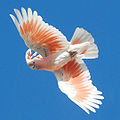
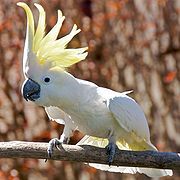 The cockatoos are generally medium to large parrot
s of stocky build, which range from 30 – in length and 300 – in weight; however, one species, the Cockatiel, is considerably smaller and slimmer than the other species, being 32 cm (12.6 in) long (including its long pointed tail feathers) and 80–100 g (2.8–3.5 oz) in weight. The movable headcrest, which is present in all cockatoos, is spectacular in many species; it is raised when the bird lands from flying, or when it is aroused. Cockatoos share many features with other parrots, including the characteristic curved beak shape and a zygodactyl foot, with the two middle toes forward and the two outer toes backward. They differ, however in a number of characteristics, including the presence of a gall bladder and some other anatomical details, and their lack of the Dyck texture feather composition which causes the bright blues and greens seen in true parrots.
Like other parrots, cockatoos have short legs, strong claws, and a waddling gait, and often use their strong bill as a third limb when climbing through branches. They generally have long broad wings used in rapid flight, with speeds up to 70 km/h (43.5 mph) being recorded for galahs. The members of the genus Calyptorhynchus and larger white cockatoos, such as the Sulphur-crested Cockatoo
and Major Mitchell's Cockatoo
, have shorter, rounder wings and a more leisurely flight.
_-nsw_-australia-8.jpg) Cockatoos have a large bill, which is kept sharp by rasping the two mandibles together when resting. The bill is complemented by a large muscular tongue which helps manipulate seeds inside the bill so that they can be de-husked before eating. During the de-husking the lower mandible applies the pressure, the tongue holds the seed in place and the upper mandible acts as an anvil. The eye region of the skull is reinforced to support muscles which move the mandibles sideways. The bills of male cockatoos are generally slightly larger than those of their female counterparts, but this size difference is quite marked in the Palm Cockatoo.
Cockatoos have a large bill, which is kept sharp by rasping the two mandibles together when resting. The bill is complemented by a large muscular tongue which helps manipulate seeds inside the bill so that they can be de-husked before eating. During the de-husking the lower mandible applies the pressure, the tongue holds the seed in place and the upper mandible acts as an anvil. The eye region of the skull is reinforced to support muscles which move the mandibles sideways. The bills of male cockatoos are generally slightly larger than those of their female counterparts, but this size difference is quite marked in the Palm Cockatoo.
The plumage
of the cockatoos is less brightly coloured than that of the other parrots, with species generally being either black, grey or white. Many species have smaller areas of colour on their plumage, often yellow, pink and red, and usually on the crest or tail. The Galah and Major Mitchell's Cockatoo are more broadly coloured in pink tones. Several species have a brightly coloured bare area around the eye and face known as a periophthalmic ring; the large red patch of bare skin of the Palm Cockatoo is the most extensive, and covers some of the face, while it is more restricted in some other species of white cockatoo, notably the corellas and Blue-eyed Cockatoo
. The plumage of males and females is similar in most species. The plumage of the female Cockatiel is duller than the male, but the most marked sexual dimorphism
occurs in the Gang-gang Cockatoo and the two species of black cockatoos in the subgenus Calyptorhynchus, namely the Red-tailed
and Glossy Black Cockatoos. The iris
colour differs in a few species, being pink or red in the female Galah and Major Mitchell's Cockatoo, and red-brown in some other female white cockatoo species. The males all have dark brown irises.
Cockatoos maintain their plumage with frequent preen
ing throughout the day. They remove dirt and oil and realign feather barbs by nibbling their feathers. They also preen other birds' feathers that are otherwise hard to get at. Cockatoos produce preen-oil from a gland
on their lower back and apply it by wiping their plumage with their heads or already oiled feathers. Powder-down
is produced by specialised feathers in the lumbar region, and distributed by the preening cockatoo all over the plumage.
Moulting is very slow and complex. Black cockatoos appear to replace their flight feather
s one at a time, their moult taking two years to complete. This process is much shorter in other species, such as the Galah and Long-billed Corella
, which each take around six months to replace all their flight feathers.
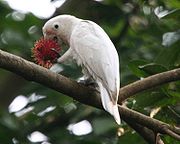 Cockatoos have a much more restricted range than the true parrots, occurring naturally only in Australasia
. Eleven of the 21 species exist in the wild only in Australia, while seven species occur only in the islands of the Philippines
, Indonesia
, Papua New Guinea
and the Solomon Islands
. Interestingly, no cockatoo species are found in Borneo
(despite their presence on nearby Palawan
and Sulawesi
) or many Pacific islands, although fossil remains have been recorded from New Caledonia
.
Three species occur in both New Guinea and Australia. Some species have widespread distributions, with the Galah, for example, occurring over most of Australia, whereas other species have tiny distributions, confined to a small part of the continent, such as the Long-billed Black Cockatoo of Western Australia, or to a small island group, such as the Tanimbar Corella, which is restricted to the Tanimbar Islands
of Indonesia. Some cockatoos have been introduced accidentally to areas outside their natural range such as New Zealand
, Singapore
, Hong Kong
and Palau
, while two Australian corella species have been introduced to parts of the continent where they are not native.
Cockatoos occupy a wide range of habitats from forests in subalpine regions to mangroves. However, no species is found in all types of habitat. The most widespread species, such as the Galah and Cockatiel, are open-country specialists that feed on grass seeds. They are often highly mobile fast flyers, and are nomadic. Flocks of birds move across large areas of the inland, locating and feeding on seed and other food sources. Drought may force flocks from more arid areas to move further into farming areas. Other cockatoo species, such as the Glossy Black Cockatoo, inhabit woodlands, rainforests, shrublands and even alpine forests. The Red-vented Cockatoo
inhabits mangroves, and its absence from northern Luzon
may be related to the lack of mangrove forests there. Forest-dwelling cockatoos are generally sedentary, as the food supply is more stable and predictable. Several species have adapted well to human modified habitats, and are found in agricultural areas and even busy cities.
. These vary in size depending on availability of food; in times of plenty, flocks are small and number a hundred birds or less, while in droughts or other times of adversity, they may swell up to contain thousands or even tens of thousands of birds; one record from the Kimberley noted a flock of 32,000 Little Corella
s. Species that inhabit open country form larger flocks than those of forested areas.
All species require roosting sites that are located near drinking sites, although many species may travel great distances between the roosting sites and feeding sites. Cockatoos have several characteristic methods of bathing; they may hang upside down or fly about in the rain, or flutter in wet leaves in the canopy.
and Long-billed Corellas have elongated bills to excavate tubers and roots, and the Major Mitchell's Cockatoo walks in a circle around the doublegree (Emex australis
) to twist out and remove the underground parts.
Many species forage for food in the canopy of trees, taking advantage of serotiny
(the storage of a large supply of seed in cones or gumnuts by plant genera such as Eucalyptus
, Banksia
and Hakea
), a natural feature of the Australian landscape in dryer regions. These woody fruiting bodies are inaccessible to many species, and harvested in the main by parrots and cockatoos, and rodents in more tropical regions. The larger cones can be opened by the large bills of cockatoos, but are too strong for smaller animals. Many nuts and fruits lie on the end of small branches which are unable to support the weight of the foraging cockatoo, which instead bends the branch towards itself and holds it with its foot.
While some cockatoos are generalists taking a wide range of foods, others are specialists. The Glossy Black Cockatoo specialises in the cones of trees of the genus Allocasuarina
, preferring a single species, A. verticillata
. It holds the cones in its foot and shreds them with its powerful bill before removing the seeds with its tongue. Some species take large numbers of insects, particularly when breeding; in fact the bulk of the Yellow-tailed Black Cockatoo
's diet is made up of insects. The large bill is used in order to extract grubs and larvae from rotting wood. The amount of time cockatoos have to spend foraging varies with the season. During times of plenty, they may only need to feed for a few hours in the day, in the morning and evening, and spend the rest of the day roosting or preening in trees, but during the winter most of the day may be spent foraging. The birds have increased nutritional requirements during the breeding season, so they spend more time foraging for food during this time. Cockatoos have large crops
, which allow them to store and digest food for some time after retiring to a tree. During hard times the cockatoos also display versatility in their diet, travelling widely in order to find food, feeding on more green plant material and in some species using their large bills to dig up corm
s.
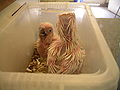 Cockatoos are monogamous
breeders, with pair bond
s that can last many years. Many birds pair up in flocks before they reach sexual maturity, and delay breeding for a year at least. Females breed for the first time anywhere from three to seven years of age, and males are often older. Sexual maturity is delayed so birds can develop the skills for raising and parenting young, which is prolonged compared with other birds; the young of some species remain with their parents for up to a year. Cockatoos may also display site fidelity
, returning to the same nesting sites in consecutive years. Courtship is generally simple, particularly for established pairs, with the black cockatoos alone engaging in courtship feeding. Established pairs do engage in preening each other
, but all forms of courtship drop off after incubation
begins, possibly due to the strength of the pair-bond.
Like most parrots, the cockatoos are cavity nesters
, nesting in holes in trees, which they are unable to excavate themselves. These hollows are formed from decay or destruction of wood by branches breaking off, fungi or insects such as termites, or even woodpecker
s where their ranges overlap. In many places these holes are scarce and the source of competition, both with other members of the same species and with other species and types of animal. In general, cockatoos choose hollows only a little larger than themselves, hence different-sized species nest in holes of corresponding (and different) sizes. If given the opportunity, cockatoos prefer nesting over 7 or 8 metres (20–25 ft) above the ground and close to water and food.
The nesting hollows are lined with sticks, wood chips and branches with leaves. The eggs of cockatoos are oval and initially white as their location makes camouflage unnecessary. However, they do become discoloured over the course of incubation. They range in size from 55 by 37 mm (2.2 by 1.5 in) in the Palm and Red-tailed Black Cockatoos, to 26 by 19 mm (1 by 0.748031496062992 in) in the Cockatiel. Clutch
size varies within the family, with the Palm Cockatoo and some other larger cockatoos laying only a single egg, and the smaller species laying anywhere between two and eight eggs. Food supply also plays a role in clutch size. Some species can lay a second clutch if the first fails. Around 20% of eggs laid are infertile. The cockatoos' incubation and brooding responsibilities may either be undertaken by the female alone in the case of the black cockatoos, or shared amongst the sexes as happens in the other species. In the case of the black cockatoos, the female is provisioned by the male several times a day. The young of all species are born covered in yellowish down, bar the Palm Cockatoo, whose young are born naked. Cockatoo incubation times are dependent on species size, with the smaller Cockatiels having a period of around 20 days and the larger Short-billed Black Cockatoo incubating its eggs for up to 29 days.
The nestling period also varies by species size, with larger species having longer nestling periods. It is also affected by season and environmental factors, and by competition with siblings in species with clutch sizes greater than one. Much of what is known about the nestling period of some species is dependent on aviary studies – aviary Cockatiels can fledge
after 5 weeks and the large Palm Cockatoos after 11 weeks. During this period, the young become covered in juvenile plumage while remaining in the hollow. Wings and tail feathers are slow to grow initially, but more rapid as the primary feathers appear. Nestlings quickly reach about 80–90% of adult weight about two thirds of the time through this period, plateauing before they leave the hollow; they fledge at this weight with wing and tail feathers still to grow a little before reaching adult dimensions. Growth rate of the young, as well as numbers fledged, are adversely impacted by reduced food supply and poor weather conditions.
and Little Eagle
have been reported taking Galahs, and the Wedge-tailed Eagle
has been observed killing a Sulphur-crested Cockatoo. Eggs and nestlings are vulnerable to many hazards. Various species of monitor lizard (Varanus) are able to climb trees and enter hollows; other predators recorded include the Spotted Wood Owl on Rasa Island in the Philippines, rodents including the Giant White-tailed Rat
, Amethystine Python and Black Butcherbird
in Cape York, and Brushtail Possum
on Kangaroo Island. Furthermore, Galahs and Little Corellas competing for nesting space with the Glossy Black Cockatoo on Kangaroo Island have been recorded killing nestlings of the latter species there. Severe storms may also flood hollows and drown young, and termite or borer activity may lead to the internal collapse of nests.
Like other parrots, cockatoos can be afflicted by psittacine beak and feather disease
(PBFD). The viral infection causes feather loss and beak malformation, and reduces the bird's overall immunity. Particularly prevalent in Sulphur-crested Cockatoos, Little Corellas, and Galahs, it has been recorded in 14 species of cockatoo to date. Although unlikely to significantly impact on large, healthy populations of birds in the wild, PBFD may pose a high risk to smaller stressed populations.
A White Cockatoo and a Sulphur-crested Cockatoo were found to be infected with the protozoon Haemoproteus
, and another Sulphur-crested Cockatoo had the malaria
parasite Plasmodium
on analysis of faecal samples at Almuñecar ornithological garden in Granada
in Spain. Like amazon parrots and macaws, cockatoos frequently develop cloacal papilloma
s. The relationship with malignancy is unknown, as is the cause, although a parrot papilloma virus
has been isolated from an African Grey Parrot
with the condition.
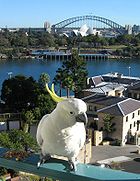 Human activities have had positive effects on some species of cockatoo and negative effects on others. Many species of open country have benefited greatly from anthropogenic changes to the landscape, with the great increase in reliable seed food sources and available water, and have also adapted well to a diet including foreign foodstuffs. This benefit appears to be restricted to Australian species, as cockatoos favouring open country outside Australia have not become more abundant. Predominantly forest-dwelling species have suffered greatly from habitat destruction
; in the main, they appear to have a more specialised diet and have not been able to incorporate exotic food into their diet. A notable exception is the Yellow-tailed Black Cockatoo in eastern Australia.
by shooting
, poison
ing or capture followed by gassing
. Non-lethal damage mitigation methods used include scaring, habitat manipulation and the provision of decoy food dumps or sacrifice crops to distract them from the main crop. They can be a nuisance in urban areas due to destruction of property. They maintain their bills in the wild by chewing on wood, but in suburbia, they may chew outdoor furniture, door and window frames; soft decorative timbers such as Western Red Cedar are readily demolished. Birds may also target external wiring and fixtures such as solar water heaters, television antennae and satellite dishes. A business in central Melbourne suffered as Sulphur-crested Cockatoos repeatedly stripped the silicone sealant from the plate glass windows. Galahs and Red-tailed Black Cockatoos have stripped electrical cabling in rural areas, and tarpaulin is targeted elsewhere. Outside Australia, the Tanimbar Corella is a pest on Yamdena Island where it raids maize crops.
In 1995 the Government of the state of Victoria published a report on problems caused by Long-billed Corellas, Sulphur-crested Cockatoos and Galahs, three species which, along with the Little Corella, have large and growing populations, having benefited from anthropogenic changes to the landscape. Subsequent to the findings and publication of the report, these three species were declared unprotected by a Governor in Council Order, under certain conditions, and are allowed to be destroyed where serious damage is being caused by them to trees, vineyards, orchards, recreational reserves and commercial crops. Damage covered by the report included not only that to cereal crops, fruit and nut orchards and some kinds of vegetable crops, but also to houses and communications equipment. The Little Corella is a declared pest of agriculture in Western Australia, where it is an aviculturally introduced species. The birds damage sorghum
, maize
, sunflower
, chickpea
s and other crops. They also defoliate amenity trees in parks and gardens, dig for edible roots and corm
s on sports grounds
and race track
s, as well as chew wiring and household fittings. In South Australia, where flocks can number several thousand birds and the species is listed as unprotected, they are accused of defoliating Red Gums and other native or ornamental trees used for roosting, damaging tarpaulin
s on grain bunkers, wiring and flashing on buildings, taking grain from newly seeded paddocks
, and creating a noise nuisance
.
Several rare species and subspecies, too, have been recorded as causing problems. The Short-billed Black Cockatoo, a threatened Western Australian endemic, has been considered a pest in pine plantation
s where the birds chew off the leading shoots of growing pine trees, resulting in bent trunks and reduced timber value. They are also known to damage nut and fruit crops, and have learnt to exploit Canola
crops. The Long-billed Black Cockatoo, also endemic to the south-west of Western Australia, can be a pest in apple
and pear
orchard
s where it destroys the fruit to extract the seeds. Muir's Corella
, the nominate subspecies of the Western Corella, is also a declared pest of agriculture in Western Australia, as well as being nationally vulnerable
and listed under state legislation as being "rare or likely to become extinct".
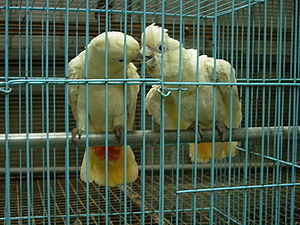 According to the IUCN and BirdLife International
, seven species of cockatoo are considered to be vulnerable
or worse, and one is considered to be near threatened
. Of these, two species—the Red-vented Cockatoo and the Yellow-crested Cockatoo
—are considered to be critically endangered
.
The principal threats to cockatoos are habitat loss and the wildlife trade
. All cockatoos are dependent on trees for nesting and are vulnerable to their loss; in addition many species have specialised habitat requirements or live on small islands and have naturally small ranges, making them vulnerable to the loss of these habitats. Cockatoos are popular as pets, and the capture and trade has threatened some species; between 1983 and 1990, 66,654 recorded Salmon-crested Cockatoos were exported from Indonesia
, a figure that does not include the number of birds caught for the domestic trade or that were exported illegally. The capture of many species has subsequently been banned, but the trade continues illegally. Birds are put in crates or bamboo tubing and conveyed on boats out of Indonesia and the Philippines. Not only are the rare species smuggled out of Indonesia, but also common and rare cockatoos alike are smuggled out of Australia; birds are sedated, covered in nylon stockings and packed into PVC tubing which is then placed in unaccompanied luggage on international flights. Mortality is significant (30%) and eggs, more easily hidden on the bodies of smugglers on flights, are increasingly smuggled instead. Trafficking is thought to be run by organised gangs, who also trade Australian species for overseas species such as macaws coming the other way.
All species of cockatoo except the Cockatiel are protected by the Convention on International Trade in Endangered Species of Wild Fauna and Flora (CITES), which restricts import and export of wild-caught parrots to special licensed purposes. Five cockatoo species (including all subspecies)—the Tanimbar Corella (Cacatua goffiniana), Red-vented Cockatoo (Cacatua haematuropygia), Moluccan Cockatoo (Cacatua moluccensis), Yellow-crested Cockatoo (Cacatua sulphurea), and Palm Cockatoo (Probosciger aterrimus)—are protected on the CITES Appendix I list. With the exception of the Cockatiel, all remaining cockatoo species are protected on the CITES Appendix II list.
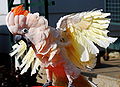 Kept for their appearance, their intelligence, and engaging personalities, cockatoos can nonetheless be problematic pets or companion parrot
s. Generally, they are not good at mimicking human speech
, although the Little Corella is a renowned talker. As social animals, wild cockatoos have been known to learn human speech from ex-captive birds that have integrated into a flock. Their care is best provided by those experienced in keeping parrots. Cockatoos are social animals and their social needs are difficult to cater for, and they can suffer if kept in a cage on their own for long periods of time.
The Cockatiel is by far the cockatoo species most frequently kept in captivity. Among U.S. bird keepers that participated in a survey by APPMA
in 2003/04, 39% had Cockatiels, as opposed to only 3% that had (other) cockatoo species. The white cockatoos are more often encountered in aviculture than the black cockatoos. Black cockatoos are rarely seen in European zoos due to export restrictions on Australian wildlife, but birds seized by governments have been loaned.
Cockatoos are often very affectionate with their owner and at times other people, but can demand a great deal of attention. Furthermore, their intense curiosity means they must be given a steady supply of objects to tinker with, chew, dismantle and destroy. Parrots in captivity may suffer from boredom, which can lead to stereotypic behaviour patterns
, such as feather-plucking
. Feather plucking is likely to stem from psychological rather than physical causes. Other major drawbacks include their painful bites, and their piercing screeches. The Salmon-crested and White Cockatoo species are particular offenders. All cockatoos have a fine powder on their feathers, which may induce allergies
in certain people. In general, the smaller cockatoo species such as Goffin's and quiter Galah's Cockatoos are much easier to keep as pets. The Cockatiel is one of the most popular and easiest parrots to keep as a pet, and many colour mutations
are available in aviculture.
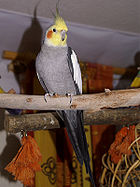 The larger cockatoos can live 30–70 years depending on the species or occasionally longer, and Cockatiels can live for about 20 years. As pets they require a long term commitment from their owners. Their longevity is considered a positive trait as it reduces instances of the loss of a pet. The oldest cockatoo in captivity is a Major Mitchell's Cockatoo named 'Cookie
', residing at Brookfield Zoo
in Chicago, which was 78 years old in 2011. A Salmon-crested Cockatoo named 'King Tut' who resided at San Diego Zoo
was nearly 69 when he died in 1990, and a Palm Cockatoo reached 56 in London Zoo
in 2000. However, anecdotal reports describe birds of much greater ages. 'Cocky Bennett' of Tom Ugly's Point
in Sydney was a celebrated Sulphur-crested Cockatoo who was reported to have reached an age of 100 years or more. He had lost his feathers and was naked for much of his life. A Palm Cockatoo was reported to have reached 80 or 90 years of age in an Australian zoo, and a Little Corella that was removed from a nest in central Australia in 1904 was reported still alive in the late 1970s. In February 2010, a White Cockatoo named 'Arthur' was claimed to be 90 years old; he had lived with a family for generations in Dalaguete, Cebu
, before being taken to Cebu City
Zoo.
Trained cockatoos are sometimes seen in bird shows in zoos. They are generally less motivated by food than other birds; some may more respond to petting or praise than food. Cockatoos can often be taught to wear a parrot harness
, enabling their owners to take them outdoors. Cockatoos have been used in animal-assisted therapy
, generally in nursing homes.
Cockatoos often have pronounced responses to musical sounds, and numerous videos exist showing the birds dancing to popular music. Research conducted in 2008 with an Eleonora Cockatoo
named Snowball
had indicated that this particular individual is indeed capable of beat induction—perceiving human-created music and synchronizing his body movements to the beat.
(1660–1724), who resided in Amsterdam from 1683 and then England, and appeared with numerous other birds in the bird pieces of the Dutch painter Melchior d'Hondecoeter
(1636–1695). A cockatoo is the unlucky subject in An Experiment on a Bird in the Air Pump
by English artist Joseph Wright of Derby
, its fate unclear in the painting. Cockatoos were among the many Australian plants and animals which featured in decorative motifs in Federation architecture
of the early 20th century. A visit to a Camden Town pet shop in 1958 inspired English painter William Roberts to paint The Cockatoos, on display in the Tate Gallery. American artist and sculptor Joseph Cornell
was known for placing cutout paper cockatoos in his works.
The ACT Government adopted the Gang-gang Cockatoo as its official faunal emblem on 27 February 1997. The short-lived budget airline Impulse Airlines
featured a Sulphur-crested Cockatoo on its corporate livery (and aeroplanes). The Palm Cockatoo, which has a unique beak and face colouration, is used as a symbol by the World Parrot Trust
.
Two 1970s police dramas featured protagonists with pet cockatoos. In the 1973 film Serpico
, Al Pacino had a pet White Cockatoo, and the TV show Baretta
saw Robert Blake with Fred the Triton Cockatoo. The popularity of the latter show saw a corresponding rise in popularity of cockatoos as pets in the late 1970s. Cockatoos have been used frequently in advertising; a cockatoo appeared in a 'cheeky' (and later toned down) 2008 advertising campaign for Cockatoo Ridge Wineries.
A Sulphur-crested Cockatoo
named Nigel was the main villain of the film Rio
.
Species
In biology, a species is one of the basic units of biological classification and a taxonomic rank. A species is often defined as a group of organisms capable of interbreeding and producing fertile offspring. While in many cases this definition is adequate, more precise or differing measures are...
belonging to the bird
Bird
Birds are feathered, winged, bipedal, endothermic , egg-laying, vertebrate animals. Around 10,000 living species and 188 families makes them the most speciose class of tetrapod vertebrates. They inhabit ecosystems across the globe, from the Arctic to the Antarctic. Extant birds range in size from...
family
Family (biology)
In biological classification, family is* a taxonomic rank. Other well-known ranks are life, domain, kingdom, phylum, class, order, genus, and species, with family fitting between order and genus. As for the other well-known ranks, there is the option of an immediately lower rank, indicated by the...
Cacatuidae. Along with the Psittacidae (true parrots
True parrots
The true parrots are about 330 species of bird belonging to the Psittacidae family, one of the two "traditional" families in the biological order Psittaciformes . The other family is the Cacatuidae which are also parrots, but not classified as true parrots...
) and the Strigopidae (large New Zealand parrots), they make up the parrot order
Order (biology)
In scientific classification used in biology, the order is# a taxonomic rank used in the classification of organisms. Other well-known ranks are life, domain, kingdom, phylum, class, family, genus, and species, with order fitting in between class and family...
Psittaciformes (parrot
Parrot
Parrots, also known as psittacines , are birds of the roughly 372 species in 86 genera that make up the order Psittaciformes, found in most tropical and subtropical regions. The order is subdivided into three families: the Psittacidae , the Cacatuidae and the Strigopidae...
s). Placement of the cockatoos as a separate family is fairly undisputed, although many aspects of the other living lineages of parrots are unresolved. The family has a mainly Australasia
Australasia
Australasia is a region of Oceania comprising Australia, New Zealand, the island of New Guinea, and neighbouring islands in the Pacific Ocean. The term was coined by Charles de Brosses in Histoire des navigations aux terres australes...
n distribution, ranging from the Philippines
Philippines
The Philippines , officially known as the Republic of the Philippines , is a country in Southeast Asia in the western Pacific Ocean. To its north across the Luzon Strait lies Taiwan. West across the South China Sea sits Vietnam...
and the eastern Indonesia
Indonesia
Indonesia , officially the Republic of Indonesia , is a country in Southeast Asia and Oceania. Indonesia is an archipelago comprising approximately 13,000 islands. It has 33 provinces with over 238 million people, and is the world's fourth most populous country. Indonesia is a republic, with an...
n islands of Wallacea
Wallacea
Wallacea is a biogeographical designation for a group of Indonesian islands separated by deep water straits from the Asian and Australian continental shelves. Wallacea includes Sulawesi, the largest island in the group, as well as Lombok, Sumbawa, Flores, Sumba, Timor, Halmahera, Buru, Seram, and...
to New Guinea
New Guinea
New Guinea is the world's second largest island, after Greenland, covering a land area of 786,000 km2. Located in the southwest Pacific Ocean, it lies geographically to the east of the Malay Archipelago, with which it is sometimes included as part of a greater Indo-Australian Archipelago...
, the Solomon Islands
Solomon Islands
Solomon Islands is a sovereign state in Oceania, east of Papua New Guinea, consisting of nearly one thousand islands. It covers a land mass of . The capital, Honiara, is located on the island of Guadalcanal...
and Australia
Australia
Australia , officially the Commonwealth of Australia, is a country in the Southern Hemisphere comprising the mainland of the Australian continent, the island of Tasmania, and numerous smaller islands in the Indian and Pacific Oceans. It is the world's sixth-largest country by total area...
. The name cockatoo originated from the Malay
Malay language
Malay is a major language of the Austronesian family. It is the official language of Malaysia , Indonesia , Brunei and Singapore...
name for these birds, kaka(k)tua (either from kaka "parrot" + tuwah, or "older sister" from kakak "sister" + tua "old").
Cockatoos are instantly recognisable by their showy crests and curved bills
Beak
The beak, bill or rostrum is an external anatomical structure of birds which is used for eating and for grooming, manipulating objects, killing prey, fighting, probing for food, courtship and feeding young...
. Their plumage
Plumage
Plumage refers both to the layer of feathers that cover a bird and the pattern, colour, and arrangement of those feathers. The pattern and colours of plumage vary between species and subspecies and can also vary between different age classes, sexes, and season. Within species there can also be a...
is generally less colourful than that of other parrots, being mainly white, grey, or black, and often with coloured features in the crest, cheeks, or tail. On average they are larger than other parrot
Parrot
Parrots, also known as psittacines , are birds of the roughly 372 species in 86 genera that make up the order Psittaciformes, found in most tropical and subtropical regions. The order is subdivided into three families: the Psittacidae , the Cacatuidae and the Strigopidae...
s; however, the Cockatiel
Cockatiel
The Cockatiel , also known as the Quarrion and the Weiro, is the smallest cockatoo endemic to Australia. They are prized as a household pet and companion parrot throughout the world and are relatively easy to breed...
, the smallest cockatoo species, is a small bird. The phylogenetic position of the Cockatiel remains unresolved, other than that it is one of the earliest offshoots of the cockatoo lineage. The remaining species are in two main clades. The five large black coloured cockatoos of the genus Calyptorhynchus
Calyptorhynchus
Described by French naturalist Anselme Gaëtan Desmarest in 1826, the genus Calyptorhynchus has five species. They are all mostly black in colour, and the taxa may be differentiated partly by size and partly by small areas of red, grey and yellow plumage especially in the tail feathers...
form one branch. The second and largest branch is formed by the genus Cacatua
Cacatua
Cacatua is a genus of cockatoos found from the Philippines and Wallacea east to the Solomon Islands and south to Australia. They have a primarily white plumage , an expressive crest, and a black or pale bill...
, comprising 11 species of white-plumaged cockatoos, and four monotypic genera that branched off earlier, namely the pink and white Major Mitchell's Cockatoo
Major Mitchell's Cockatoo
The Major Mitchell's Cockatoo also known as Leadbeater's Cockatoo or Pink Cockatoo, is a medium-sized cockatoo restricted to arid and semi-arid inland areas of Australia...
, the pink and grey Galah
Galah
The Galah , Eolophus roseicapilla, also known as the Rose-breasted Cockatoo, Galah Cockatoo, Roseate Cockatoo or Pink and Grey, is one of the most common and widespread cockatoos, and it can be found in open country in almost all parts of mainland Australia.It is endemic on the mainland and was...
, the mainly grey Gang-gang Cockatoo
Gang-gang Cockatoo
The Gang-gang Cockatoo, Callocephalon fimbriatum, is found in the cooler and wetter forests and woodlands of Australia, particularly alpine bushland. Mostly mild grey in colour with some lighter scalloping the male has a red head and crest, while the female has a small fluffy grey crest...
, and the large black-plumaged Palm Cockatoo
Palm Cockatoo
The Palm Cockatoo , also known as the Goliath Cockatoo, is a large smoky-grey or black parrot of the cockatoo family. It is the only member in subfamily Microglossinae and the only member of the monotypic genus, Probosciger...
.
Cockatoos prefer to eat seeds, tubers, corms, fruit, flowers and insects. They often feed in large flocks, particularly when ground-feeding. Cockatoos are monogamous
Monogamy
Monogamy /Gr. μονός+γάμος - one+marriage/ a form of marriage in which an individual has only one spouse at any one time. In current usage monogamy often refers to having one sexual partner irrespective of marriage or reproduction...
and nest in tree hollow
Tree hollow
A tree hollow or tree hole is a semi-enclosed cavity which has naturally formed in the trunk or branch of a tree. These are predominantly found in old trees, whether living or not...
s. Some cockatoo species have been adversely affected by habitat loss, particularly from a shortage suitable nesting hollows after large mature trees are cleared; conversely, some species have adapted well to human changes and are considered agricultural pests.
Cockatoos are popular birds in aviculture
Aviculture
Aviculture is the practice of keeping and breeding birds and the culture that forms around it. Aviculture is generally focused on not only the raising and breeding of birds, but also on preserving avian habitat, and public awareness campaigns....
, but their needs are difficult to cater for. The Cockatiel is the cockatoo species that is easiest to care for and is by far the most frequently kept in captivity. White cockatoos are more commonly found in captivity than black cockatoos. Illegal trade in wild-caught birds contributes to the decline of some cockatoo species in the wild.
Etymology
The word cockatoo dates from the 17th century, and is a derivation from the MalayMalay language
Malay is a major language of the Austronesian family. It is the official language of Malaysia , Indonesia , Brunei and Singapore...
name for these birds, "Kakatuwah" (meaning "vice" or "grip", from its strong beak, or from the call of the white cockatoo itself), via the Dutch kaketoe; the word cock possibly influencing. Seventeenth-century variants include cacato, cockatoon and crockadore, and cokato, cocatore and cocatoo were used in the eighteenth century. The derivation has also been used for the family
Family
In human context, a family is a group of people affiliated by consanguinity, affinity, or co-residence. In most societies it is the principal institution for the socialization of children...
and generic
Genus
In biology, a genus is a low-level taxonomic rank used in the biological classification of living and fossil organisms, which is an example of definition by genus and differentia...
names Cacatuidae and Cacatua respectively.
In Australian slang or vernacular speech, a person who is assigned to keep watch while others undertake clandestine or illegal activities, particularly gambling, may be referred to as a "cockatoo". Proprietors of small agricultural undertakings are often jocularly or slightly disparagingly referred to as "cocky farmers".
Taxonomy
The cockatoos were first defined as a subfamily Cacatuinae within the parrotParrot
Parrots, also known as psittacines , are birds of the roughly 372 species in 86 genera that make up the order Psittaciformes, found in most tropical and subtropical regions. The order is subdivided into three families: the Psittacidae , the Cacatuidae and the Strigopidae...
family Psittacidae by the English naturalist George Robert Gray
George Robert Gray
George Robert Gray FRS was an English zoologist and author, and head of the ornithological section of the British Museum, now the Natural History Museum, in London for forty-one years...
in 1840, with Cacatua the first listed and type genus. This group has alternately been considered as either a full or subfamily by different authorities. The American ornithologist James Lee Peters
James Lee Peters
James Lee Peters was an American ornithologist.Peters was Curator of Birds at the Museum of Comparative Zoology, at Harvard University...
in his 1937 Check-list of Birds of the World, and Sibley
Charles Sibley
Charles Gald Sibley was an American ornithologist and molecular biologist. He had an immense influence on the scientific classification of birds, and the work that Sibley initiated has substantially altered our understanding of the evolutionary history of modern birds.Sibley's taxonomy has been a...
and Monroe
Burt Monroe
Burt Leavelle Monroe, Jr was an American ornithologist, a member of the American Ornithologists' Union since 1953, as Director of the Commission of classification and nomenclature and president from 1990 to 1992.- His studies :Burt L...
in 1990 maintained it as a subfamily, while parrot expert Joseph Forshaw
Joseph Forshaw
Joseph Michael Forshaw is an Australian ornithologist, and the world's foremost expert on parrots. He was the former head of wildlife conservation for the Australian National Parks and Wildlife Service.-References:...
classified it as a family in 1973. Subsequent molecular studies indicate that the earliest offshoot from the original parrot ancestors were the New Zealand parrots of the family Strigopidae, and following this the cockatoos, now a well-defined group or clade
Clade
A clade is a group consisting of a species and all its descendants. In the terms of biological systematics, a clade is a single "branch" on the "tree of life". The idea that such a "natural group" of organisms should be grouped together and given a taxonomic name is central to biological...
, split off from the remaining parrots, which then radiated across the southern hemisphere and diversified into the many species of parrots, parakeets, macaws, lories, lorikeets, lovebirds, and other true parrots of the family Psittacidae.
The relationships between various cockatoo genera is largely resolved, although the placement of the Cockatiel
Cockatiel
The Cockatiel , also known as the Quarrion and the Weiro, is the smallest cockatoo endemic to Australia. They are prized as a household pet and companion parrot throughout the world and are relatively easy to breed...
(Nymphicus hollandicus) at the base of the cockatoos remains uncertain. The Cockatiel is alternatively placed basal to all other cockatoo species, as the sister taxon to the black cockatoo species of the genus Calyptorhynchus or as the sister taxon to clade consisting of the white and pink cockatoo genera as well as the Palm Cockatoo. The remaining species are within two main clades, the first consisting out of the black species of the genus Calyptorhynchus while the second clade contains the remaining species. The first species in this second clade is the majestic black Palm Cockatoo
Palm Cockatoo
The Palm Cockatoo , also known as the Goliath Cockatoo, is a large smoky-grey or black parrot of the cockatoo family. It is the only member in subfamily Microglossinae and the only member of the monotypic genus, Probosciger...
, followed first by a small clade consisting of the gray and reddish Galah
Galah
The Galah , Eolophus roseicapilla, also known as the Rose-breasted Cockatoo, Galah Cockatoo, Roseate Cockatoo or Pink and Grey, is one of the most common and widespread cockatoos, and it can be found in open country in almost all parts of mainland Australia.It is endemic on the mainland and was...
and the Gang-gang Cockatoo
Gang-gang Cockatoo
The Gang-gang Cockatoo, Callocephalon fimbriatum, is found in the cooler and wetter forests and woodlands of Australia, particularly alpine bushland. Mostly mild grey in colour with some lighter scalloping the male has a red head and crest, while the female has a small fluffy grey crest...
and then the pinkish Major Mitchell's Cockatoo
Major Mitchell's Cockatoo
The Major Mitchell's Cockatoo also known as Leadbeater's Cockatoo or Pink Cockatoo, is a medium-sized cockatoo restricted to arid and semi-arid inland areas of Australia...
. The remaining species are mainly white or slightly pinkish and all belong to he genus Cacatua. The genus Cacatua is further subdivided into the subgenera
Subgenus
In biology, a subgenus is a taxonomic rank directly below genus.In zoology, a subgeneric name can be used independently or included in a species name, in parentheses, placed between the generic name and the specific epithet: e.g. the Tiger Cowry of the Indo-Pacific, Cypraea tigris Linnaeus, which...
Licmetis, commonly known as corellas, and Cacatua, referred to as white cockatoos. The genera Eolophus, Lophochroa and Cacatua are hypomelanistic and do not show sexual dimorphism
Sexual dimorphism
Sexual dimorphism is a phenotypic difference between males and females of the same species. Examples of such differences include differences in morphology, ornamentation, and behavior.-Examples:-Ornamentation / coloration:...
. Confusingly, the term "white cockatoo" has also been applied to the whole genus, and even the whole clade. The five cockatoo species of the genus Calyptorhynchus are commonly known as black cockatoos, and are divided into two subgenera—Calyptorhynchus and Zanda. The former group are sexually dichromatic, with the females having prominently barred plumage. The two are also distinguished by differences in the food begging calls of juveniles.
The fossil
Fossil
Fossils are the preserved remains or traces of animals , plants, and other organisms from the remote past...
record of cockatoos is even more limited than that of parrots in general, with only one truly ancient cockatoo fossil known: a species of Cacatua, most probably subgenus Licmetis, found in Early Miocene
Miocene
The Miocene is a geological epoch of the Neogene Period and extends from about . The Miocene was named by Sir Charles Lyell. Its name comes from the Greek words and and means "less recent" because it has 18% fewer modern sea invertebrates than the Pliocene. The Miocene follows the Oligocene...
(16–23 million years ago) deposits of Riversleigh
Riversleigh
Riversleigh, in North West Queensland, is Australia's most famous fossil site. The 100 km² area has fossil remains of ancient mammals, birds and reptiles of Oligocene and Miocene age...
, Australia. Although fragmentary, the remains are similar to the Western Corella
Western Corella
The Western Corella formerly known as the Western Long-billed Corella, is a species of white cockatoo endemic to south-western Western Australia.-Taxonomy:...
and the Galah. In Melanesia
Melanesia
Melanesia is a subregion of Oceania extending from the western end of the Pacific Ocean to the Arafura Sea, and eastward to Fiji. The region comprises most of the islands immediately north and northeast of Australia...
, subfossil
Subfossil
Subfossil refers to remains whose fossilization process is not complete, either for lack of time or because the conditions in which they were buried were not optimal for fossilization....
bones of Cacatua species which apparently did not survive early human settlement have been found on New Caledonia
New Caledonia
New Caledonia is a special collectivity of France located in the southwest Pacific Ocean, east of Australia and about from Metropolitan France. The archipelago, part of the Melanesia subregion, includes the main island of Grande Terre, the Loyalty Islands, the Belep archipelago, the Isle of...
and New Ireland
New Ireland (island)
New Ireland is a large island in Papua New Guinea, approximately 7,404 km² in area. It is the largest island of the New Ireland Province, lying northeast of the island of New Britain. Both islands are part of the Bismarck Archipelago, named after Otto von Bismarck, and they are separated by...
. The bearing of these fossils on cockatoo evolution and phylogeny is fairly limited, although the Riversleigh fossil does allow tentative dating of the divergence of subfamilies.
Species and subspecies
Parentheses around authority name indicate originally in a different genus, parenthesized names after generic names indicate subgenera.- Genus Nymphicus
- CockatielCockatielThe Cockatiel , also known as the Quarrion and the Weiro, is the smallest cockatoo endemic to Australia. They are prized as a household pet and companion parrot throughout the world and are relatively easy to breed...
, Nymphicus hollandicus (KerrRobert Kerr (writer)Robert Kerr FRS was a scientific writer and translator from Scotland.Kerr was born in Roxburghshire as the son of a jeweller. He studied medicine at the University of Edinburgh and practised at the Edinburgh Foundling Hospital as a surgeon...
, 1792)
- Cockatiel
- Genus CalyptorhynchusCalyptorhynchusDescribed by French naturalist Anselme Gaëtan Desmarest in 1826, the genus Calyptorhynchus has five species. They are all mostly black in colour, and the taxa may be differentiated partly by size and partly by small areas of red, grey and yellow plumage especially in the tail feathers...
- Subgenus Calyptorhynchus – black-and-red cockatoos
- Red-tailed Black CockatooRed-tailed Black CockatooThe Red-tailed Black Cockatoo , also known as Banksian- or Banks' Black Cockatoo, is a large cockatoo native to Australia. This species was known as Calyptorhynchus magnificus for many decades until the current scientific name was officially conserved in 1994. It is more common in the drier parts...
, Calyptorhynchus (Calyptorhynchus) banksii (LathamJohn Latham (ornithologist)John Latham was an English physician, naturalist and author. He was born at Eltham in Kent, and was the eldest son of John Latham, a surgeon there, and his mother was a descendant of the Sothebys, in Yorkshire....
, 1790) - Glossy Black Cockatoo, Calyptorhynchus (Calyptorhynchus) lathami (TemminckCoenraad Jacob TemminckCoenraad Jacob Temminck was a Dutch aristocrat and zoologist.Temminck was the first director of the National Natural History Museum at Leiden from 1820 until his death. His Manuel d'ornithologie, ou Tableau systematique des oiseaux qui se trouvent en Europe was the standard work on European birds...
, 1807)
- Red-tailed Black Cockatoo
- Subgenus ZandaCalyptorhynchusDescribed by French naturalist Anselme Gaëtan Desmarest in 1826, the genus Calyptorhynchus has five species. They are all mostly black in colour, and the taxa may be differentiated partly by size and partly by small areas of red, grey and yellow plumage especially in the tail feathers...
– black-and-yellow/white cockatoos- Yellow-tailed Black CockatooYellow-tailed Black CockatooThe Yellow-tailed Black Cockatoo is a large cockatoo native to the south-east of Australia measuring 55–65 cm in length. It has a short crest on the top of its head. Its plumage is mostly brownish black and it has prominent yellow cheek patches and a yellow tail band...
, Calyptorhynchus (Zanda) funereus (ShawGeorge ShawGeorge Shaw was an English botanist and zoologist.Shaw was born at Bierton, Buckinghamshire and was educated at Magdalen Hall, Oxford, receiving his M.A. in 1772. He took up the profession of medical practitioner. In 1786 he became the assistant lecturer in botany at Oxford University...
, 1794) - Short-billed Black Cockatoo, Calyptorhynchus (Zanda) latirostris Carnaby, 1948
- Long-billed Black Cockatoo, Calyptorhynchus (Zanda) baudinii LearEdward LearEdward Lear was an English artist, illustrator, author, and poet, renowned today primarily for his literary nonsense, in poetry and prose, and especially his limericks, a form that he popularised.-Biography:...
, 1832
- Yellow-tailed Black Cockatoo
- Subgenus Calyptorhynchus – black-and-red cockatoos
- Genus Probosciger
- Palm CockatooPalm CockatooThe Palm Cockatoo , also known as the Goliath Cockatoo, is a large smoky-grey or black parrot of the cockatoo family. It is the only member in subfamily Microglossinae and the only member of the monotypic genus, Probosciger...
, Probosciger aterrimus (GmelinJohann Friedrich GmelinJohann Friedrich Gmelin was a German naturalist, botanist, entomologist, herpetologist and malacologist.- Education :Johann Friedrich Gmelin was born as the eldest son of Philipp Friedrich Gmelin in 1748 in Tübingen...
, 1788)
- Palm Cockatoo
- Genus Callocephalon
- Gang-gang CockatooGang-gang CockatooThe Gang-gang Cockatoo, Callocephalon fimbriatum, is found in the cooler and wetter forests and woodlands of Australia, particularly alpine bushland. Mostly mild grey in colour with some lighter scalloping the male has a red head and crest, while the female has a small fluffy grey crest...
, Callocephalon fimbriatum (GrantJames Grant (navigator)James Grant was a British Royal Navy officer and navigator in the early nineteenth century. He made several voyages to Australia and Tasmania, and was the first to map parts of the south coast of Australia.-Early life:...
, 1803)
- Gang-gang Cockatoo
- Genus Eolophus
- GalahGalahThe Galah , Eolophus roseicapilla, also known as the Rose-breasted Cockatoo, Galah Cockatoo, Roseate Cockatoo or Pink and Grey, is one of the most common and widespread cockatoos, and it can be found in open country in almost all parts of mainland Australia.It is endemic on the mainland and was...
, Eolophus roseicapilla (VieillotLouis Jean Pierre VieillotLouis Jean Pierre Vieillot was a French ornithologist.Vieillot described a large number of birds for the first time, especially those he encountered during the time he spent in the West Indies and North America, and 26 genera established by him are still in use...
, 1817)
- Galah
- Genus Lophochroa
- Major Mitchell's CockatooMajor Mitchell's CockatooThe Major Mitchell's Cockatoo also known as Leadbeater's Cockatoo or Pink Cockatoo, is a medium-sized cockatoo restricted to arid and semi-arid inland areas of Australia...
(also Leadbeater's Cockatoo), Lophochroa leadbeateri (VigorsNicholas Aylward VigorsNicholas Aylward Vigors was an Irish zoologist and politician.Vigors was born at Old Leighlin, County Carlow. He studied at Trinity College, Oxford. He served in the army during the Peninsular War from 1809 to 1811. He then returned to Oxford, graduating with a B.A. in 1815 and in 1817 with an...
, 1831)- Major Mitchell's Cockatoo, Lophochroa leadbeateri leadbeateri (VigorsNicholas Aylward VigorsNicholas Aylward Vigors was an Irish zoologist and politician.Vigors was born at Old Leighlin, County Carlow. He studied at Trinity College, Oxford. He served in the army during the Peninsular War from 1809 to 1811. He then returned to Oxford, graduating with a B.A. in 1815 and in 1817 with an...
, 1831) - Western Major Mitchell's Cockatoo, Lophochroa leadbeateri mollis (MathewsGregory MathewsGregory Macalister Mathews CBE was an Australian amateur ornithologist.Mathews made his fortune in mining shares, and moved to England around 1900....
, 1912)
- Major Mitchell's Cockatoo, Lophochroa leadbeateri leadbeateri (Vigors
- Major Mitchell's Cockatoo
- Genus CacatuaCacatuaCacatua is a genus of cockatoos found from the Philippines and Wallacea east to the Solomon Islands and south to Australia. They have a primarily white plumage , an expressive crest, and a black or pale bill...
- Subgenus CacatuaCacatua (subgenus)Cacatua is a subgenus of the white cockatoos . They are found in wooded habitats from Wallacea east to the Bismarck Archipelago and south to Australia. With the exception of the Yellow-crested Cockatoo, all are relatively large cockatoos with a total length of 45–55 cm...
– true white cockatoos- Yellow-crested CockatooYellow-crested CockatooThe Yellow-crested Cockatoo, Cacatua sulphurea, also known as the Lesser Sulphur-crested Cockatoo, is a medium-sized cockatoo with white plumage, bluish-white bare orbital skin, grey feet, a black bill, and a retractile yellow crest. The sexes are similar...
(also Lesser Sulphur-crested Cockatoo), Cacatua (Cacatua) sulphurea (GmelinJohann Friedrich GmelinJohann Friedrich Gmelin was a German naturalist, botanist, entomologist, herpetologist and malacologist.- Education :Johann Friedrich Gmelin was born as the eldest son of Philipp Friedrich Gmelin in 1748 in Tübingen...
, 1788)
- Yellow-crested Cockatoo
- Subgenus Cacatua
-
-
-
- Abbott's Cockatoo, Cacatua (Cacatua) sulphurea abbotti (OberholserHarry Church OberholserHarry Church Oberholser was an American ornithologist.Oberholser worked for the United States Bureau of Biological Survey from 1895 to 1941, first as an ornithologist, later as a biologist, and finally as an editor. He was the author of a number of books and articles...
, 1917) - Timor Cockatoo, Cacatua (Cacatua) sulphurea parvula (BonaparteCharles Lucien BonaparteCharles Lucien Jules Laurent Bonaparte, 2nd Prince of Canino and Musignano was a French naturalist and ornithologist.-Biography:...
, 1850) - Citron-crested CockatooCitron-crested CockatooThe Citron-crested Cockatoo, Cacatua sulphurea citrinocristata is a medium-sized cockatoo with an orange crest, dark grey beak, pale orange ear patches, and strong feet and claws. The underside of the larger wing and tail feathers have a pale yellow colour. The eye colour ranges from brown through...
, Cacatua (Cacatua) sulphurea citrinocristata (FraserLouis FraserLouis Fraser was a British zoologist and collector. In his early years Fraser was Curator of the Museum of the Zoological Society of London. He participated in the Niger River Expedition as the African Civilization Society's scientist on Allen and Thomson's 1841–1842 Expedition. Upon his return he...
, 1844)
- Abbott's Cockatoo, Cacatua (Cacatua) sulphurea abbotti (Oberholser
- Sulphur-crested CockatooSulphur-crested CockatooThe Sulphur-crested Cockatoo, Cacatua galerita, is a relatively large white cockatoo found in wooded habitats in Australia and New Guinea. They can be locally very numerous, leading to them sometimes being considered pests...
, Cacatua (Cacatua) galerita (LathamJohn Latham (ornithologist)John Latham was an English physician, naturalist and author. He was born at Eltham in Kent, and was the eldest son of John Latham, a surgeon there, and his mother was a descendant of the Sothebys, in Yorkshire....
, 1790)- Triton Cockatoo, Cacatua (Cacatua) galerita triton TemminckCoenraad Jacob TemminckCoenraad Jacob Temminck was a Dutch aristocrat and zoologist.Temminck was the first director of the National Natural History Museum at Leiden from 1820 until his death. His Manuel d'ornithologie, ou Tableau systematique des oiseaux qui se trouvent en Europe was the standard work on European birds...
, 1849 - Eleonora CockatooEleonora CockatooThe Eleonora Cockatoo, Cacatua galerita eleonora, also known as Medium Sulphur-crested Cockatoo, is similar in appearance to other subspecies of the Sulphur-crested Cockatoo. It is found in the Aru and Kai Islands of Indonesia, where it was introduced and is common in aviculture.It is the smallest...
, Cacatua (Cacatua) galerita eleonora (FinschOtto FinschFriedrich Hermann Otto Finsch was a German ethnographer, naturalist and colonial explorer.-Biography:...
, 1863) - Fitzroy Cockatoo, Cacatua (Cacatua) galerita fitzroyi (MathewsGregory MathewsGregory Macalister Mathews CBE was an Australian amateur ornithologist.Mathews made his fortune in mining shares, and moved to England around 1900....
, 1912) - Greater Sulphur-crested Cockatoo, Cacatua (Cacatua) galerita galerita (LathamJohn Latham (ornithologist)John Latham was an English physician, naturalist and author. He was born at Eltham in Kent, and was the eldest son of John Latham, a surgeon there, and his mother was a descendant of the Sothebys, in Yorkshire....
, 1790)
- Triton Cockatoo, Cacatua (Cacatua) galerita triton Temminck
- Blue-eyed CockatooBlue-eyed CockatooThe Blue-eyed Cockatoo, Cacatua ophthalmica, is a large, approximately 50 cm long, mainly white cockatoo with a mobile crest, a black beak, and a light blue rim of featherless skin around each eye, that gives this species its name....
, Cacatua (Cacatua) ophthalmica SclaterPhilip SclaterPhilip Lutley Sclater was an English lawyer and zoologist. In zoology, he was an expert ornithologist, and identified the main zoogeographic regions of the world...
, 1864 - White Cockatoo, Cacatua (Cacatua) alba (MüllerPhilipp Ludwig Statius MüllerPhilipp Ludwig Statius Muller was a German zoologist.Statius Muller was born in Esens, and was Professor of Natural Science at Erlangen. Between 1773 and 1776, he published a German translation of Linnaeus's Natursystem...
, 1776) - Salmon-crested Cockatoo, Cacatua (Cacatua) moluccensis (GmelinJohann Friedrich GmelinJohann Friedrich Gmelin was a German naturalist, botanist, entomologist, herpetologist and malacologist.- Education :Johann Friedrich Gmelin was born as the eldest son of Philipp Friedrich Gmelin in 1748 in Tübingen...
, 1788)
-
- Subgenus LicmetisLicmetisLicmetis is a subgenus of the white cockatoos . They are collectively known as corellas in Australia. Three of the six species are primarily - or only - found in Australia, while the Philippines, Indonesia, and the Solomons each have an endemic species...
– corellas- Long-billed CorellaLong-billed CorellaThe Long-billed Corella, Cacatua tenuirostris, is a cockatoo native to Australia, which is similar in appearance to the Little Corella and Sulphur-crested Cockatoo. This species is mostly white, with a reddish-pink face and forehead, and has a long pale beak, which is used to dig for roots and seeds...
, Cacatua (Licmetis) tenuirostris (KuhlHeinrich KuhlHeinrich Kuhl was a German naturalist and zoologist.Kuhl was born in Hanau. He became assistant to Coenraad Jacob Temminck at the Leiden museum. In 1817 he published a monograph on bats and in 1819 he published Conspectus psittacorum...
, 1820) - Western CorellaWestern CorellaThe Western Corella formerly known as the Western Long-billed Corella, is a species of white cockatoo endemic to south-western Western Australia.-Taxonomy:...
, Cacatua (Licmetis) pastinator (GouldJohn GouldJohn Gould was an English ornithologist and bird artist. The Gould League in Australia was named after him. His identification of the birds now nicknamed "Darwin's finches" played a role in the inception of Darwin's theory of evolution by natural selection...
, 1841)- Muir's CorellaMuir's CorellaMuir's Corella is a stocky, medium-sized white cockatoo endemic to Western Australia. It is the threatened nominate subspecies of the Western Corella.-Description:...
, Cacatua (Licmetis) pastinator pastinator (GouldJohn GouldJohn Gould was an English ornithologist and bird artist. The Gould League in Australia was named after him. His identification of the birds now nicknamed "Darwin's finches" played a role in the inception of Darwin's theory of evolution by natural selection...
, 1841) - Butler's CorellaButler's CorellaButler's Corella is a medium-sized white cockatoo endemic to Western Australia. It is one of two subspecies of the Western Corella.-Description:...
, Cacatua (Licmetis) pastinator butleri Ford, J.Julian Ralph FordDr Julian Ralph Ford was an Australian chemist and ornithologist. He was born in Perth and graduated in chemistry from the University of Western Australia in 1955...
, 1987
- Muir's Corella
- Little CorellaLittle CorellaThe Little Corella, Cacatua sanguinea, also known as the Bare-eyed Cockatoo, is a white cockatoo native to Australia and southern New Guinea....
, Cacatua (Licmetis) sanguinea GouldJohn GouldJohn Gould was an English ornithologist and bird artist. The Gould League in Australia was named after him. His identification of the birds now nicknamed "Darwin's finches" played a role in the inception of Darwin's theory of evolution by natural selection...
, 1843 - Tanimbar Corella (also Goffin's Cockatoo), Cacatua (Licmetis) goffiniana Roselaar and Michels, 2004
- Solomons Cockatoo, Cacatua (Licmetis) ducorpsii PucheranJacques PucheranJacques Pucheran was a French zoologist.Pucheran accompanied the expedition on the Astrolabe between 1837 and 1840, under the command of Jules Dumont d'Urville, with fellow-naturalists Jacques Bernard Hombron and Honoré Jacquinot...
, 1853 - Red-vented CockatooRed-vented CockatooThe Red-vented Cockatoo, Cacatua haematuropygia, sometimes called the Philippine Cockatoo or Kalangay, is a critically endangered species of cockatoo that is endemic to the Philippines...
, Cacatua (Licmetis) haematuropygia (MüllerPhilipp Ludwig Statius MüllerPhilipp Ludwig Statius Muller was a German zoologist.Statius Muller was born in Esens, and was Professor of Natural Science at Erlangen. Between 1773 and 1776, he published a German translation of Linnaeus's Natursystem...
, 1776)
- Long-billed Corella
-
Morphology
Parrot
Parrots, also known as psittacines , are birds of the roughly 372 species in 86 genera that make up the order Psittaciformes, found in most tropical and subtropical regions. The order is subdivided into three families: the Psittacidae , the Cacatuidae and the Strigopidae...
s of stocky build, which range from 30 – in length and 300 – in weight; however, one species, the Cockatiel, is considerably smaller and slimmer than the other species, being 32 cm (12.6 in) long (including its long pointed tail feathers) and 80–100 g (2.8–3.5 oz) in weight. The movable headcrest, which is present in all cockatoos, is spectacular in many species; it is raised when the bird lands from flying, or when it is aroused. Cockatoos share many features with other parrots, including the characteristic curved beak shape and a zygodactyl foot, with the two middle toes forward and the two outer toes backward. They differ, however in a number of characteristics, including the presence of a gall bladder and some other anatomical details, and their lack of the Dyck texture feather composition which causes the bright blues and greens seen in true parrots.
Like other parrots, cockatoos have short legs, strong claws, and a waddling gait, and often use their strong bill as a third limb when climbing through branches. They generally have long broad wings used in rapid flight, with speeds up to 70 km/h (43.5 mph) being recorded for galahs. The members of the genus Calyptorhynchus and larger white cockatoos, such as the Sulphur-crested Cockatoo
Sulphur-crested Cockatoo
The Sulphur-crested Cockatoo, Cacatua galerita, is a relatively large white cockatoo found in wooded habitats in Australia and New Guinea. They can be locally very numerous, leading to them sometimes being considered pests...
and Major Mitchell's Cockatoo
Major Mitchell's Cockatoo
The Major Mitchell's Cockatoo also known as Leadbeater's Cockatoo or Pink Cockatoo, is a medium-sized cockatoo restricted to arid and semi-arid inland areas of Australia...
, have shorter, rounder wings and a more leisurely flight.
The plumage
Plumage
Plumage refers both to the layer of feathers that cover a bird and the pattern, colour, and arrangement of those feathers. The pattern and colours of plumage vary between species and subspecies and can also vary between different age classes, sexes, and season. Within species there can also be a...
of the cockatoos is less brightly coloured than that of the other parrots, with species generally being either black, grey or white. Many species have smaller areas of colour on their plumage, often yellow, pink and red, and usually on the crest or tail. The Galah and Major Mitchell's Cockatoo are more broadly coloured in pink tones. Several species have a brightly coloured bare area around the eye and face known as a periophthalmic ring; the large red patch of bare skin of the Palm Cockatoo is the most extensive, and covers some of the face, while it is more restricted in some other species of white cockatoo, notably the corellas and Blue-eyed Cockatoo
Blue-eyed Cockatoo
The Blue-eyed Cockatoo, Cacatua ophthalmica, is a large, approximately 50 cm long, mainly white cockatoo with a mobile crest, a black beak, and a light blue rim of featherless skin around each eye, that gives this species its name....
. The plumage of males and females is similar in most species. The plumage of the female Cockatiel is duller than the male, but the most marked sexual dimorphism
Sexual dimorphism
Sexual dimorphism is a phenotypic difference between males and females of the same species. Examples of such differences include differences in morphology, ornamentation, and behavior.-Examples:-Ornamentation / coloration:...
occurs in the Gang-gang Cockatoo and the two species of black cockatoos in the subgenus Calyptorhynchus, namely the Red-tailed
Red-tailed Black Cockatoo
The Red-tailed Black Cockatoo , also known as Banksian- or Banks' Black Cockatoo, is a large cockatoo native to Australia. This species was known as Calyptorhynchus magnificus for many decades until the current scientific name was officially conserved in 1994. It is more common in the drier parts...
and Glossy Black Cockatoos. The iris
Iris (anatomy)
The iris is a thin, circular structure in the eye, responsible for controlling the diameter and size of the pupils and thus the amount of light reaching the retina. "Eye color" is the color of the iris, which can be green, blue, or brown. In some cases it can be hazel , grey, violet, or even pink...
colour differs in a few species, being pink or red in the female Galah and Major Mitchell's Cockatoo, and red-brown in some other female white cockatoo species. The males all have dark brown irises.
Cockatoos maintain their plumage with frequent preen
Preen
- Birds :*Preen, personal grooming of a bird's feathers especially by using its beak*Preen gland, also called the uropygial gland, an oil gland found in many bird species*Preen oil, an oil made by the uropygial gland found in many bird species...
ing throughout the day. They remove dirt and oil and realign feather barbs by nibbling their feathers. They also preen other birds' feathers that are otherwise hard to get at. Cockatoos produce preen-oil from a gland
Uropygial gland
The uropygial gland, informally known as the preen gland, is a gland found in the large majority of birds that secretes an oil that birds use for preening. The chief compounds of preen oil are diester waxes called uropygiols....
on their lower back and apply it by wiping their plumage with their heads or already oiled feathers. Powder-down
Down feather
The down of birds is a layer of fine feathers found under the tougher exterior feathers. Very young birds are clad only in down. Powder down is a specialized type of down found only in a few groups of birds. Down is a fine thermal insulator and padding, used in goods such as jackets, bedding,...
is produced by specialised feathers in the lumbar region, and distributed by the preening cockatoo all over the plumage.
Moulting is very slow and complex. Black cockatoos appear to replace their flight feather
Flight feather
Flight feathers are the long, stiff, asymmetrically shaped, but symmetrically paired feathers on the wings or tail of a bird; those on the wings are called remiges while those on the tail are called rectrices . Their primary function is to aid in the generation of both thrust and lift, thereby...
s one at a time, their moult taking two years to complete. This process is much shorter in other species, such as the Galah and Long-billed Corella
Long-billed Corella
The Long-billed Corella, Cacatua tenuirostris, is a cockatoo native to Australia, which is similar in appearance to the Little Corella and Sulphur-crested Cockatoo. This species is mostly white, with a reddish-pink face and forehead, and has a long pale beak, which is used to dig for roots and seeds...
, which each take around six months to replace all their flight feathers.
Voice
The vocalisations of cockatoos are loud and harsh. They serve a number of functions, including allowing individuals to recognise one another, alerting others of predators, indicating individual moods, maintaining the cohesion of a flock and as warnings when defending nests. The use of calls and number of specific calls varies by species; the Short-billed Black Cockatoo has as many as 15 different calls, whereas others, such as Major Mitchell's Cockatoo, have fewer. Some, like the Gang-gang Cockatoo, are comparatively quiet, but do have softer growling calls when feeding. In addition to vocalisations, Palm Cockatoos communicate over large distances by drumming on a dead branch with a stick. Cockatoo species also make a characteristic hissing sound when threatened.Distribution and habitat
Australasia
Australasia is a region of Oceania comprising Australia, New Zealand, the island of New Guinea, and neighbouring islands in the Pacific Ocean. The term was coined by Charles de Brosses in Histoire des navigations aux terres australes...
. Eleven of the 21 species exist in the wild only in Australia, while seven species occur only in the islands of the Philippines
Philippines
The Philippines , officially known as the Republic of the Philippines , is a country in Southeast Asia in the western Pacific Ocean. To its north across the Luzon Strait lies Taiwan. West across the South China Sea sits Vietnam...
, Indonesia
Indonesia
Indonesia , officially the Republic of Indonesia , is a country in Southeast Asia and Oceania. Indonesia is an archipelago comprising approximately 13,000 islands. It has 33 provinces with over 238 million people, and is the world's fourth most populous country. Indonesia is a republic, with an...
, Papua New Guinea
Papua New Guinea
Papua New Guinea , officially the Independent State of Papua New Guinea, is a country in Oceania, occupying the eastern half of the island of New Guinea and numerous offshore islands...
and the Solomon Islands
Solomon Islands
Solomon Islands is a sovereign state in Oceania, east of Papua New Guinea, consisting of nearly one thousand islands. It covers a land mass of . The capital, Honiara, is located on the island of Guadalcanal...
. Interestingly, no cockatoo species are found in Borneo
Borneo
Borneo is the third largest island in the world and is located north of Java Island, Indonesia, at the geographic centre of Maritime Southeast Asia....
(despite their presence on nearby Palawan
Palawan
Palawan is an island province of the Philippines located in the MIMAROPA region or Region 4. Its capital is Puerto Princesa City, and it is the largest province in the country in terms of total area of jurisdiction. The islands of Palawan stretch from Mindoro in the northeast to Borneo in the...
and Sulawesi
Sulawesi
Sulawesi is one of the four larger Sunda Islands of Indonesia and is situated between Borneo and the Maluku Islands. In Indonesia, only Sumatra, Borneo, and Papua are larger in territory, and only Java and Sumatra have larger Indonesian populations.- Etymology :The Portuguese were the first to...
) or many Pacific islands, although fossil remains have been recorded from New Caledonia
New Caledonia
New Caledonia is a special collectivity of France located in the southwest Pacific Ocean, east of Australia and about from Metropolitan France. The archipelago, part of the Melanesia subregion, includes the main island of Grande Terre, the Loyalty Islands, the Belep archipelago, the Isle of...
.
Three species occur in both New Guinea and Australia. Some species have widespread distributions, with the Galah, for example, occurring over most of Australia, whereas other species have tiny distributions, confined to a small part of the continent, such as the Long-billed Black Cockatoo of Western Australia, or to a small island group, such as the Tanimbar Corella, which is restricted to the Tanimbar Islands
Tanimbar Islands
The Tanimbar Islands, also called Timor Laut, are a group of about 65 islands in the Maluku province of Indonesia, including Fordata, Larat, Maru, Molu, Nuswotar, Selaru, Selu, Seira, Wotap, Wuliaru and Yamdena.-Geography:...
of Indonesia. Some cockatoos have been introduced accidentally to areas outside their natural range such as New Zealand
New Zealand
New Zealand is an island country in the south-western Pacific Ocean comprising two main landmasses and numerous smaller islands. The country is situated some east of Australia across the Tasman Sea, and roughly south of the Pacific island nations of New Caledonia, Fiji, and Tonga...
, Singapore
Singapore
Singapore , officially the Republic of Singapore, is a Southeast Asian city-state off the southern tip of the Malay Peninsula, north of the equator. An island country made up of 63 islands, it is separated from Malaysia by the Straits of Johor to its north and from Indonesia's Riau Islands by the...
, Hong Kong
Hong Kong
Hong Kong is one of two Special Administrative Regions of the People's Republic of China , the other being Macau. A city-state situated on China's south coast and enclosed by the Pearl River Delta and South China Sea, it is renowned for its expansive skyline and deep natural harbour...
and Palau
Palau
Palau , officially the Republic of Palau , is an island nation in the Pacific Ocean, east of the Philippines and south of Tokyo. In 1978, after three decades as being part of the United Nations trusteeship, Palau chose independence instead of becoming part of the Federated States of Micronesia, a...
, while two Australian corella species have been introduced to parts of the continent where they are not native.
Cockatoos occupy a wide range of habitats from forests in subalpine regions to mangroves. However, no species is found in all types of habitat. The most widespread species, such as the Galah and Cockatiel, are open-country specialists that feed on grass seeds. They are often highly mobile fast flyers, and are nomadic. Flocks of birds move across large areas of the inland, locating and feeding on seed and other food sources. Drought may force flocks from more arid areas to move further into farming areas. Other cockatoo species, such as the Glossy Black Cockatoo, inhabit woodlands, rainforests, shrublands and even alpine forests. The Red-vented Cockatoo
Red-vented Cockatoo
The Red-vented Cockatoo, Cacatua haematuropygia, sometimes called the Philippine Cockatoo or Kalangay, is a critically endangered species of cockatoo that is endemic to the Philippines...
inhabits mangroves, and its absence from northern Luzon
Luzon
Luzon is the largest island in the Philippines. It is located in the northernmost region of the archipelago, and is also the name for one of the three primary island groups in the country centered on the Island of Luzon...
may be related to the lack of mangrove forests there. Forest-dwelling cockatoos are generally sedentary, as the food supply is more stable and predictable. Several species have adapted well to human modified habitats, and are found in agricultural areas and even busy cities.
Behaviour
Cockatoos are diurnal, and require daylight to find their food. They are not early risers, instead waiting until the sun has warmed their roosting sites before feeding. All species are generally highly social, and roost, forage and travel in colourful and noisy flocksFlock (birds)
A flock is a group of birds conducting flocking behavior in flight, or while foraging. The term is akin to the herd amongst mammals. The benefits of aggregating in flocks are varied and flocks will form explicitly for specific purposes...
. These vary in size depending on availability of food; in times of plenty, flocks are small and number a hundred birds or less, while in droughts or other times of adversity, they may swell up to contain thousands or even tens of thousands of birds; one record from the Kimberley noted a flock of 32,000 Little Corella
Little Corella
The Little Corella, Cacatua sanguinea, also known as the Bare-eyed Cockatoo, is a white cockatoo native to Australia and southern New Guinea....
s. Species that inhabit open country form larger flocks than those of forested areas.
All species require roosting sites that are located near drinking sites, although many species may travel great distances between the roosting sites and feeding sites. Cockatoos have several characteristic methods of bathing; they may hang upside down or fly about in the rain, or flutter in wet leaves in the canopy.
Diet and feeding
Cockatoos are versatile feeders and consume a range of mainly vegetable food items. Seeds form a large part of the diet of all species; these are opened with their large and powerful bills. The Galahs, corellas and some of the black cockatoos feed primarily on the ground; others feed mostly in trees. The ground-feeding species tend to forage in flocks, which form tight, squabbling groups where seeds are concentrated, and dispersed lines where food is more sparsely distributed; they also prefer open areas where visibility is good. The WesternWestern Corella
The Western Corella formerly known as the Western Long-billed Corella, is a species of white cockatoo endemic to south-western Western Australia.-Taxonomy:...
and Long-billed Corellas have elongated bills to excavate tubers and roots, and the Major Mitchell's Cockatoo walks in a circle around the doublegree (Emex australis
Emex australis
Emex australis, commonly known as doublegee or three-cornered jack, is a herbaceous plant of the Polygonaceae. It is a weed in South Africa and Australia.-External links:***...
) to twist out and remove the underground parts.
Many species forage for food in the canopy of trees, taking advantage of serotiny
Serotiny
Serotiny is an ecological adaptation exhibited by some seed plants, in which seed release occurs in response to an environmental trigger, rather than spontaneously at seed maturation. The most common and best studied trigger is fire, and the term serotiny is often used to refer to this specific case...
(the storage of a large supply of seed in cones or gumnuts by plant genera such as Eucalyptus
Eucalyptus
Eucalyptus is a diverse genus of flowering trees in the myrtle family, Myrtaceae. Members of the genus dominate the tree flora of Australia...
, Banksia
Banksia
Banksia is a genus of around 170 species in the plant family Proteaceae. These Australian wildflowers and popular garden plants are easily recognised by their characteristic flower spikes and fruiting "cones" and heads. When it comes to size, banksias range from prostrate woody shrubs to trees up...
and Hakea
Hakea
Hakea is a genus of 149 species of shrubs and small trees in the Proteaceae, native to Australia. They are found throughout the country, with the highest species diversity being found in the south west of Western Australia....
), a natural feature of the Australian landscape in dryer regions. These woody fruiting bodies are inaccessible to many species, and harvested in the main by parrots and cockatoos, and rodents in more tropical regions. The larger cones can be opened by the large bills of cockatoos, but are too strong for smaller animals. Many nuts and fruits lie on the end of small branches which are unable to support the weight of the foraging cockatoo, which instead bends the branch towards itself and holds it with its foot.
While some cockatoos are generalists taking a wide range of foods, others are specialists. The Glossy Black Cockatoo specialises in the cones of trees of the genus Allocasuarina
Allocasuarina
Allocasuarina is a genus of trees in the flowering plant family Casuarinaceae. They are endemic to Australia, occurring primarily in the south. Like the closely related genus Casuarina, they are commonly called sheoaks or she-oaks, they are notable for their long, segmented branchlets that...
, preferring a single species, A. verticillata
Allocasuarina verticillata
Allocasuarina verticillata or drooping sheoak is a nitrogen fixing native tree of southeastern Australia. Originally collected in Tasmania and described as Casuarina verticillata by French naturalist Jean-Baptiste Lamarck in 1786, it was moved to its current genus in 1982 by Australian botanist...
. It holds the cones in its foot and shreds them with its powerful bill before removing the seeds with its tongue. Some species take large numbers of insects, particularly when breeding; in fact the bulk of the Yellow-tailed Black Cockatoo
Yellow-tailed Black Cockatoo
The Yellow-tailed Black Cockatoo is a large cockatoo native to the south-east of Australia measuring 55–65 cm in length. It has a short crest on the top of its head. Its plumage is mostly brownish black and it has prominent yellow cheek patches and a yellow tail band...
's diet is made up of insects. The large bill is used in order to extract grubs and larvae from rotting wood. The amount of time cockatoos have to spend foraging varies with the season. During times of plenty, they may only need to feed for a few hours in the day, in the morning and evening, and spend the rest of the day roosting or preening in trees, but during the winter most of the day may be spent foraging. The birds have increased nutritional requirements during the breeding season, so they spend more time foraging for food during this time. Cockatoos have large crops
Crop (anatomy)
A crop is a thin-walled expanded portion of the alimentary tract used for the storage of food prior to digestion that is found in many animals, including gastropods, earthworms, leeches, insects, birds, and even some dinosaurs.- Bees :Cropping is used by bees to temporarily store nectar of flowers...
, which allow them to store and digest food for some time after retiring to a tree. During hard times the cockatoos also display versatility in their diet, travelling widely in order to find food, feeding on more green plant material and in some species using their large bills to dig up corm
Corm
A corm is a short, vertical, swollen underground plant stem that serves as a storage organ used by some plants to survive winter or other adverse conditions such as summer drought and heat ....
s.
Breeding
Monogamy
Monogamy /Gr. μονός+γάμος - one+marriage/ a form of marriage in which an individual has only one spouse at any one time. In current usage monogamy often refers to having one sexual partner irrespective of marriage or reproduction...
breeders, with pair bond
Pair bond
In biology, a pair bond is the strong affinity that develops in some species between the males and females in a pair, potentially leading to breeding. Pair-bonding is a term coined in the 1940s that is frequently used in sociobiology and evolutionary psychology circles...
s that can last many years. Many birds pair up in flocks before they reach sexual maturity, and delay breeding for a year at least. Females breed for the first time anywhere from three to seven years of age, and males are often older. Sexual maturity is delayed so birds can develop the skills for raising and parenting young, which is prolonged compared with other birds; the young of some species remain with their parents for up to a year. Cockatoos may also display site fidelity
Philopatry
Broadly, philopatry is the behaviour of remaining in, or returning to, an individual's birthplace. More specifically, in ecology philopatry is the behaviour of elder offspring sharing the parental burden in the upbringing of their siblings, a classic example of kin selection...
, returning to the same nesting sites in consecutive years. Courtship is generally simple, particularly for established pairs, with the black cockatoos alone engaging in courtship feeding. Established pairs do engage in preening each other
Social grooming
In social animals, including humans, social grooming or allogrooming is an activity in which individuals in a group clean or maintain one another's body or appearance. It is a major social activity, and a means by which animals who live in proximity can bond and reinforce social structures, family...
, but all forms of courtship drop off after incubation
Avian incubation
Incubation refers to the process by which certain oviparous animals hatch their eggs, and to the development of the embryo within the egg. The most vital factor of incubation is the constant temperature required for its development over a specific period. Especially in domestic fowl, the act of...
begins, possibly due to the strength of the pair-bond.
Like most parrots, the cockatoos are cavity nesters
Bird nest
A bird nest is the spot in which a bird lays and incubates its eggs and raises its young. Although the term popularly refers to a specific structure made by the bird itself—such as the grassy cup nest of the American Robin or Eurasian Blackbird, or the elaborately woven hanging nest of the...
, nesting in holes in trees, which they are unable to excavate themselves. These hollows are formed from decay or destruction of wood by branches breaking off, fungi or insects such as termites, or even woodpecker
Woodpecker
Woodpeckers are near passerine birds of the order Piciformes. They are one subfamily in the family Picidae, which also includes the piculets and wrynecks. They are found worldwide and include about 180 species....
s where their ranges overlap. In many places these holes are scarce and the source of competition, both with other members of the same species and with other species and types of animal. In general, cockatoos choose hollows only a little larger than themselves, hence different-sized species nest in holes of corresponding (and different) sizes. If given the opportunity, cockatoos prefer nesting over 7 or 8 metres (20–25 ft) above the ground and close to water and food.
The nesting hollows are lined with sticks, wood chips and branches with leaves. The eggs of cockatoos are oval and initially white as their location makes camouflage unnecessary. However, they do become discoloured over the course of incubation. They range in size from 55 by 37 mm (2.2 by 1.5 in) in the Palm and Red-tailed Black Cockatoos, to 26 by 19 mm (1 by 0.748031496062992 in) in the Cockatiel. Clutch
Clutch (eggs)
A clutch of eggs refers to all the eggs produced by birds or reptiles, often at a single time, particularly those laid in a nest.In birds, destruction of a clutch by predators, , results in double-clutching...
size varies within the family, with the Palm Cockatoo and some other larger cockatoos laying only a single egg, and the smaller species laying anywhere between two and eight eggs. Food supply also plays a role in clutch size. Some species can lay a second clutch if the first fails. Around 20% of eggs laid are infertile. The cockatoos' incubation and brooding responsibilities may either be undertaken by the female alone in the case of the black cockatoos, or shared amongst the sexes as happens in the other species. In the case of the black cockatoos, the female is provisioned by the male several times a day. The young of all species are born covered in yellowish down, bar the Palm Cockatoo, whose young are born naked. Cockatoo incubation times are dependent on species size, with the smaller Cockatiels having a period of around 20 days and the larger Short-billed Black Cockatoo incubating its eggs for up to 29 days.
The nestling period also varies by species size, with larger species having longer nestling periods. It is also affected by season and environmental factors, and by competition with siblings in species with clutch sizes greater than one. Much of what is known about the nestling period of some species is dependent on aviary studies – aviary Cockatiels can fledge
Fledge
Fledge is the stage in a young bird's life when the feathers and wing muscles are sufficiently developed for flight. It also describes the act of a chick's parents raising it to a fully grown state...
after 5 weeks and the large Palm Cockatoos after 11 weeks. During this period, the young become covered in juvenile plumage while remaining in the hollow. Wings and tail feathers are slow to grow initially, but more rapid as the primary feathers appear. Nestlings quickly reach about 80–90% of adult weight about two thirds of the time through this period, plateauing before they leave the hollow; they fledge at this weight with wing and tail feathers still to grow a little before reaching adult dimensions. Growth rate of the young, as well as numbers fledged, are adversely impacted by reduced food supply and poor weather conditions.
Predators and threats
The Peregrine FalconPeregrine Falcon
The Peregrine Falcon , also known as the Peregrine, and historically as the Duck Hawk in North America, is a widespread bird of prey in the family Falconidae. A large, crow-sized falcon, it has a blue-gray back, barred white underparts, and a black head and "moustache"...
and Little Eagle
Little Eagle
The Little Eagle is a very small eagle native to Australasia, measuring 45–55 cm in length and weighing 815 g – roughly the size of a Peregrine Falcon. It tends to inhabit open woodland, grassland and arid regions, shunning dense forest...
have been reported taking Galahs, and the Wedge-tailed Eagle
Wedge-tailed Eagle
The Wedge-tailed Eagle , sometimes known as the Eaglehawk in its native range, is the largest bird of prey in Australia, but it is also found in southern New Guinea. It has long, fairly broad wings, fully feathered legs, and an unmistakable wedge-shaped tail...
has been observed killing a Sulphur-crested Cockatoo. Eggs and nestlings are vulnerable to many hazards. Various species of monitor lizard (Varanus) are able to climb trees and enter hollows; other predators recorded include the Spotted Wood Owl on Rasa Island in the Philippines, rodents including the Giant White-tailed Rat
Giant White-tailed Rat
The Giant White-tailed Rat is an Australian rodent native to tropical rainforest of north Queensland , with subspecies occurring in New Guinea and the Aru Islands...
, Amethystine Python and Black Butcherbird
Black Butcherbird
The Black Butcherbird is a species of bird in the Cracticidae family.It is found in Australia, Indonesia, and Papua New Guinea....
in Cape York, and Brushtail Possum
Common Brushtail Possum
The Common Brushtail Possum is a nocturnal, semi-arboreal marsupial of the family Phalangeridae, it is native to Australia, and the largest of the possums.Like most possums, the Common Brushtail is nocturnal...
on Kangaroo Island. Furthermore, Galahs and Little Corellas competing for nesting space with the Glossy Black Cockatoo on Kangaroo Island have been recorded killing nestlings of the latter species there. Severe storms may also flood hollows and drown young, and termite or borer activity may lead to the internal collapse of nests.
Like other parrots, cockatoos can be afflicted by psittacine beak and feather disease
Psittacine beak and feather disease
Psittacine beak and feather disease is a viral disease affecting all Old World and New World Parrots . The virus belongs to the family Circoviridae. The virus attacks the feather follicles and the beak and claws-growing cells of the bird, causing progressive feather malformation and necrosis...
(PBFD). The viral infection causes feather loss and beak malformation, and reduces the bird's overall immunity. Particularly prevalent in Sulphur-crested Cockatoos, Little Corellas, and Galahs, it has been recorded in 14 species of cockatoo to date. Although unlikely to significantly impact on large, healthy populations of birds in the wild, PBFD may pose a high risk to smaller stressed populations.
A White Cockatoo and a Sulphur-crested Cockatoo were found to be infected with the protozoon Haemoproteus
Haemoproteus
Haemoproteus is a genus of protozoa that are parasitic in birds, reptiles and amphibians. Its name is derived from Greek: Haima - blood and Proteus - a sea god who had the power of assuming different shapes. The name Haemoproteus was first used in the description of Haemoproteus columbae in the...
, and another Sulphur-crested Cockatoo had the malaria
Malaria
Malaria is a mosquito-borne infectious disease of humans and other animals caused by eukaryotic protists of the genus Plasmodium. The disease results from the multiplication of Plasmodium parasites within red blood cells, causing symptoms that typically include fever and headache, in severe cases...
parasite Plasmodium
Plasmodium
Plasmodium is a genus of parasitic protists. Infection by these organisms is known as malaria. The genus Plasmodium was described in 1885 by Ettore Marchiafava and Angelo Celli. Currently over 200 species of this genus are recognized and new species continue to be described.Of the over 200 known...
on analysis of faecal samples at Almuñecar ornithological garden in Granada
Granada
Granada is a city and the capital of the province of Granada, in the autonomous community of Andalusia, Spain. Granada is located at the foot of the Sierra Nevada mountains, at the confluence of three rivers, the Beiro, the Darro and the Genil. It sits at an elevation of 738 metres above sea...
in Spain. Like amazon parrots and macaws, cockatoos frequently develop cloacal papilloma
Papilloma
Papilloma refers to a benign epithelial tumor growing exophytically in finger-like fronds. In this context papilla refers to the projection created by the tumor, not a tumor on an already existing papilla . When used without context, it frequently refers to infections caused by human...
s. The relationship with malignancy is unknown, as is the cause, although a parrot papilloma virus
Papillomaviridae
Papillomaviridae is an ancient taxonomic family of non-enveloped DNA viruses, collectively known as papillomaviruses. Several hundred species of papillomaviruses, traditionally referred to as "types", have been identified infecting all carefully inspected birds and mammals, but also a small number...
has been isolated from an African Grey Parrot
African Grey Parrot
The African Grey Parrot , also known as the Grey Parrot, is a medium-sized parrot found in the primary and secondary rainforest of West and Central Africa. Experts regard it as one of the most intelligent birds. They feed primarily on palm nuts, seeds, fruits, leafy matter, but have been observed...
with the condition.
Relationship with humans
Habitat destruction
Habitat destruction is the process in which natural habitat is rendered functionally unable to support the species present. In this process, the organisms that previously used the site are displaced or destroyed, reducing biodiversity. Habitat destruction by human activity mainly for the purpose of...
; in the main, they appear to have a more specialised diet and have not been able to incorporate exotic food into their diet. A notable exception is the Yellow-tailed Black Cockatoo in eastern Australia.
Pests
Several species of cockatoo can be serious agricultural pests. They are sometimes controlledPest control
Pest control refers to the regulation or management of a species defined as a pest, usually because it is perceived to be detrimental to a person's health, the ecology or the economy.-History:...
by shooting
Shooting
Shooting is the act or process of firing rifles, shotguns or other projectile weapons such as bows or crossbows. Even the firing of artillery, rockets and missiles can be called shooting. A person who specializes in shooting is a marksman...
, poison
Poison
In the context of biology, poisons are substances that can cause disturbances to organisms, usually by chemical reaction or other activity on the molecular scale, when a sufficient quantity is absorbed by an organism....
ing or capture followed by gassing
Gas chamber
A gas chamber is an apparatus for killing humans or animals with gas, consisting of a sealed chamber into which a poisonous or asphyxiant gas is introduced. The most commonly used poisonous agent is hydrogen cyanide; carbon dioxide and carbon monoxide have also been used...
. Non-lethal damage mitigation methods used include scaring, habitat manipulation and the provision of decoy food dumps or sacrifice crops to distract them from the main crop. They can be a nuisance in urban areas due to destruction of property. They maintain their bills in the wild by chewing on wood, but in suburbia, they may chew outdoor furniture, door and window frames; soft decorative timbers such as Western Red Cedar are readily demolished. Birds may also target external wiring and fixtures such as solar water heaters, television antennae and satellite dishes. A business in central Melbourne suffered as Sulphur-crested Cockatoos repeatedly stripped the silicone sealant from the plate glass windows. Galahs and Red-tailed Black Cockatoos have stripped electrical cabling in rural areas, and tarpaulin is targeted elsewhere. Outside Australia, the Tanimbar Corella is a pest on Yamdena Island where it raids maize crops.
In 1995 the Government of the state of Victoria published a report on problems caused by Long-billed Corellas, Sulphur-crested Cockatoos and Galahs, three species which, along with the Little Corella, have large and growing populations, having benefited from anthropogenic changes to the landscape. Subsequent to the findings and publication of the report, these three species were declared unprotected by a Governor in Council Order, under certain conditions, and are allowed to be destroyed where serious damage is being caused by them to trees, vineyards, orchards, recreational reserves and commercial crops. Damage covered by the report included not only that to cereal crops, fruit and nut orchards and some kinds of vegetable crops, but also to houses and communications equipment. The Little Corella is a declared pest of agriculture in Western Australia, where it is an aviculturally introduced species. The birds damage sorghum
Sorghum
Sorghum is a genus of numerous species of grasses, one of which is raised for grain and many of which are used as fodder plants either cultivated or as part of pasture. The plants are cultivated in warmer climates worldwide. Species are native to tropical and subtropical regions of all continents...
, maize
Maize
Maize known in many English-speaking countries as corn or mielie/mealie, is a grain domesticated by indigenous peoples in Mesoamerica in prehistoric times. The leafy stalk produces ears which contain seeds called kernels. Though technically a grain, maize kernels are used in cooking as a vegetable...
, sunflower
Sunflower
Sunflower is an annual plant native to the Americas. It possesses a large inflorescence . The sunflower got its name from its huge, fiery blooms, whose shape and image is often used to depict the sun. The sunflower has a rough, hairy stem, broad, coarsely toothed, rough leaves and circular heads...
, chickpea
Chickpea
The chickpea is a legume of the family Fabaceae, subfamily Faboideae...
s and other crops. They also defoliate amenity trees in parks and gardens, dig for edible roots and corm
Corm
A corm is a short, vertical, swollen underground plant stem that serves as a storage organ used by some plants to survive winter or other adverse conditions such as summer drought and heat ....
s on sports grounds
Playing field
A playing field is a field used for playing sports or games. They are generally outdoors, but many large structures exist to enclose playing fields from bad weather. Generally, playing fields are wide expanses of grass, dirt or sand without many obstructions...
and race track
Race track
A race track is a purpose-built facility for racing of animals , automobiles, motorcycles or athletes. A race track may also feature grandstands or concourses. Some motorsport tracks are called speedways.A racetrack is a permanent facility or building...
s, as well as chew wiring and household fittings. In South Australia, where flocks can number several thousand birds and the species is listed as unprotected, they are accused of defoliating Red Gums and other native or ornamental trees used for roosting, damaging tarpaulin
Tarpaulin
A tarpaulin, colloquially tarp, is a large sheet of strong, flexible, water-resistant or waterproof material, often cloth such as canvas or polyester coated with urethane, or made of plastics such as polyethylene. In some places such as Australia, and in military slang, a tarp may be known as a...
s on grain bunkers, wiring and flashing on buildings, taking grain from newly seeded paddocks
Field (agriculture)
In agriculture, the word field refers generally to an area of land enclosed or otherwise and used for agricultural purposes such as:* Cultivating crops* Usage as a paddock or, generally, an enclosure of livestock...
, and creating a noise nuisance
Noise pollution
Noise pollution is excessive, displeasing human, animal or machine-created environmental noise that disrupts the activity or balance of human or animal life...
.
Several rare species and subspecies, too, have been recorded as causing problems. The Short-billed Black Cockatoo, a threatened Western Australian endemic, has been considered a pest in pine plantation
Plantation
A plantation is a long artificially established forest, farm or estate, where crops are grown for sale, often in distant markets rather than for local on-site consumption...
s where the birds chew off the leading shoots of growing pine trees, resulting in bent trunks and reduced timber value. They are also known to damage nut and fruit crops, and have learnt to exploit Canola
Canola
Canola refers to a cultivar of either Rapeseed or Field Mustard . Its seeds are used to produce edible oil suitable for consumption by humans and livestock. The oil is also suitable for use as biodiesel.Originally, Canola was bred naturally from rapeseed in Canada by Keith Downey and Baldur R...
crops. The Long-billed Black Cockatoo, also endemic to the south-west of Western Australia, can be a pest in apple
Apple
The apple is the pomaceous fruit of the apple tree, species Malus domestica in the rose family . It is one of the most widely cultivated tree fruits, and the most widely known of the many members of genus Malus that are used by humans. Apple grow on small, deciduous trees that blossom in the spring...
and pear
Pear
The pear is any of several tree species of genus Pyrus and also the name of the pomaceous fruit of these trees. Several species of pear are valued by humans for their edible fruit, but the fruit of other species is small, hard, and astringent....
orchard
Orchard
An orchard is an intentional planting of trees or shrubs that is maintained for food production. Orchards comprise fruit or nut-producing trees which are grown for commercial production. Orchards are also sometimes a feature of large gardens, where they serve an aesthetic as well as a productive...
s where it destroys the fruit to extract the seeds. Muir's Corella
Muir's Corella
Muir's Corella is a stocky, medium-sized white cockatoo endemic to Western Australia. It is the threatened nominate subspecies of the Western Corella.-Description:...
, the nominate subspecies of the Western Corella, is also a declared pest of agriculture in Western Australia, as well as being nationally vulnerable
Vulnerable species
On 30 January 2010, the IUCN Red List of Threatened Species identified 9694 Vulnerable species, subspecies and varieties, stocks and sub-populations.-References:...
and listed under state legislation as being "rare or likely to become extinct".
Status and conservation
BirdLife International
BirdLife International is a global Partnership of conservation organisations that strives to conserve birds, their habitats and global biodiversity, working with people towards sustainability in the use of natural resources...
, seven species of cockatoo are considered to be vulnerable
Vulnerable species
On 30 January 2010, the IUCN Red List of Threatened Species identified 9694 Vulnerable species, subspecies and varieties, stocks and sub-populations.-References:...
or worse, and one is considered to be near threatened
Near Threatened
Near Threatened is a conservation status assigned to species or lower taxa that may be considered threatened with extinction in the near future, although it does not currently qualify for the threatened status...
. Of these, two species—the Red-vented Cockatoo and the Yellow-crested Cockatoo
Yellow-crested Cockatoo
The Yellow-crested Cockatoo, Cacatua sulphurea, also known as the Lesser Sulphur-crested Cockatoo, is a medium-sized cockatoo with white plumage, bluish-white bare orbital skin, grey feet, a black bill, and a retractile yellow crest. The sexes are similar...
—are considered to be critically endangered
Critically endangered
Version 2010.3 of the IUCN Red List of Threatened Species identified 3744 Critically Endangered species, subspecies and varieties, stocks and subpopulations.Critically Endangered by kingdom:*1993 Animalia*2 Fungi*1745 Plantae*4 Protista-References:...
.
The principal threats to cockatoos are habitat loss and the wildlife trade
Wildlife trade
The international wildlife trade is a serious conservation problem, addressed by the United Nations' Convention of International Trade in Endangered Species of Wild Fauna and Flora CITES, which currently has 175 member countries called Parties. The 15th meeting of the Parties took place in Doha,...
. All cockatoos are dependent on trees for nesting and are vulnerable to their loss; in addition many species have specialised habitat requirements or live on small islands and have naturally small ranges, making them vulnerable to the loss of these habitats. Cockatoos are popular as pets, and the capture and trade has threatened some species; between 1983 and 1990, 66,654 recorded Salmon-crested Cockatoos were exported from Indonesia
Indonesia
Indonesia , officially the Republic of Indonesia , is a country in Southeast Asia and Oceania. Indonesia is an archipelago comprising approximately 13,000 islands. It has 33 provinces with over 238 million people, and is the world's fourth most populous country. Indonesia is a republic, with an...
, a figure that does not include the number of birds caught for the domestic trade or that were exported illegally. The capture of many species has subsequently been banned, but the trade continues illegally. Birds are put in crates or bamboo tubing and conveyed on boats out of Indonesia and the Philippines. Not only are the rare species smuggled out of Indonesia, but also common and rare cockatoos alike are smuggled out of Australia; birds are sedated, covered in nylon stockings and packed into PVC tubing which is then placed in unaccompanied luggage on international flights. Mortality is significant (30%) and eggs, more easily hidden on the bodies of smugglers on flights, are increasingly smuggled instead. Trafficking is thought to be run by organised gangs, who also trade Australian species for overseas species such as macaws coming the other way.
All species of cockatoo except the Cockatiel are protected by the Convention on International Trade in Endangered Species of Wild Fauna and Flora (CITES), which restricts import and export of wild-caught parrots to special licensed purposes. Five cockatoo species (including all subspecies)—the Tanimbar Corella (Cacatua goffiniana), Red-vented Cockatoo (Cacatua haematuropygia), Moluccan Cockatoo (Cacatua moluccensis), Yellow-crested Cockatoo (Cacatua sulphurea), and Palm Cockatoo (Probosciger aterrimus)—are protected on the CITES Appendix I list. With the exception of the Cockatiel, all remaining cockatoo species are protected on the CITES Appendix II list.
Aviculture
Companion parrot
Companion parrot is a general term used for any parrot kept as a pet that interacts abundantly with its human counterpart. Generally, most species of parrot can make good companions....
s. Generally, they are not good at mimicking human speech
Talking bird
Talking birds are birds that can mimic human speech. Talking birds have varying degrees of intelligence and communication capabilities: some, like the crow, a highly intelligent bird, are only able to mimic a few words and phrases, whilst some budgerigars have been observed to have a vocabulary of...
, although the Little Corella is a renowned talker. As social animals, wild cockatoos have been known to learn human speech from ex-captive birds that have integrated into a flock. Their care is best provided by those experienced in keeping parrots. Cockatoos are social animals and their social needs are difficult to cater for, and they can suffer if kept in a cage on their own for long periods of time.
The Cockatiel is by far the cockatoo species most frequently kept in captivity. Among U.S. bird keepers that participated in a survey by APPMA
American Pet Products Manufacturers Association
The American Pet Products Association ' was founded in 1958 and was incorporated as a not for profit corporation in Greenwich . APPMA is a not-for-profit trade association made up of over 1000 pet product manufacturers, their representatives, importers and livestock suppliers...
in 2003/04, 39% had Cockatiels, as opposed to only 3% that had (other) cockatoo species. The white cockatoos are more often encountered in aviculture than the black cockatoos. Black cockatoos are rarely seen in European zoos due to export restrictions on Australian wildlife, but birds seized by governments have been loaned.
Cockatoos are often very affectionate with their owner and at times other people, but can demand a great deal of attention. Furthermore, their intense curiosity means they must be given a steady supply of objects to tinker with, chew, dismantle and destroy. Parrots in captivity may suffer from boredom, which can lead to stereotypic behaviour patterns
Stereotypy
A stereotypy is a repetitive or ritualistic movement, posture, or utterance, found in people with mental retardation, autism spectrum disorders, tardive dyskinesia and stereotypic movement disorder. Stereotypies may be simple movements such as body rocking, or complex, such as self-caressing,...
, such as feather-plucking
Feather-plucking
Feather-plucking, sometimes termed feather-picking, feather damaging behaviour or pterotillomania, is a maladaptive, behavioural disorder commonly seen in captive birds which chew, bite or pluck their own feathers with their beak, resulting in damage to the feathers and occasionally the skin...
. Feather plucking is likely to stem from psychological rather than physical causes. Other major drawbacks include their painful bites, and their piercing screeches. The Salmon-crested and White Cockatoo species are particular offenders. All cockatoos have a fine powder on their feathers, which may induce allergies
Allergy
An Allergy is a hypersensitivity disorder of the immune system. Allergic reactions occur when a person's immune system reacts to normally harmless substances in the environment. A substance that causes a reaction is called an allergen. These reactions are acquired, predictable, and rapid...
in certain people. In general, the smaller cockatoo species such as Goffin's and quiter Galah's Cockatoos are much easier to keep as pets. The Cockatiel is one of the most popular and easiest parrots to keep as a pet, and many colour mutations
Cockatiel colour genetics
The science of Cockatiel colour genetics deals with the heredity of colour variation in the feathers of the bird species commonly known as the Cockatiel,...
are available in aviculture.
Cookie (cockatoo)
Cookie is a male Major Mitchell's Cockatoo residing at Brookfield Zoo, near Chicago, Illinois, USA. He is believed to be the oldest member of his species alive in captivity, at the age of 78 in June 2011, having significantly exceeded the average lifespan for his kind and is one of the...
', residing at Brookfield Zoo
Brookfield Zoo
The Brookfield Zoo is zoo located in the Chicago suburb of Brookfield, Illinois. The zoo covers an area of and houses around 450 species of animals....
in Chicago, which was 78 years old in 2011. A Salmon-crested Cockatoo named 'King Tut' who resided at San Diego Zoo
San Diego Zoo
The San Diego Zoo in Balboa Park, San Diego, California, is one of the most progressive zoos in the world, with over 4,000 animals of more than 800 species...
was nearly 69 when he died in 1990, and a Palm Cockatoo reached 56 in London Zoo
London Zoo
London Zoo is the world's oldest scientific zoo. It was opened in London on 27 April 1828, and was originally intended to be used as a collection for scientific study. It was eventually opened to the public in 1847...
in 2000. However, anecdotal reports describe birds of much greater ages. 'Cocky Bennett' of Tom Ugly's Point
Blakehurst, New South Wales
Blakehurst is a suburb in southern Sydney, in the state of New South Wales, Australia. Blakehurst is located 18 kilometres south of the Sydney central business district, in the local government area of the Municipality of Kogarah and is part of the St George area.Blakehurst is connected to...
in Sydney was a celebrated Sulphur-crested Cockatoo who was reported to have reached an age of 100 years or more. He had lost his feathers and was naked for much of his life. A Palm Cockatoo was reported to have reached 80 or 90 years of age in an Australian zoo, and a Little Corella that was removed from a nest in central Australia in 1904 was reported still alive in the late 1970s. In February 2010, a White Cockatoo named 'Arthur' was claimed to be 90 years old; he had lived with a family for generations in Dalaguete, Cebu
Dalaguete, Cebu
Dalaguete is a 1st class municipality in the province of Cebu, Philippines. According to the 2007 census, it has a population of 61,405 people.-Barangays:Dalaguete is administratively subdivided into 33 barangays:* Ablayan* Babayongan* Balud* Banhigan...
, before being taken to Cebu City
Cebu City
The City of Cebu is the capital city of Cebu and is the second largest city in the Philippines, the second most significant metropolitan centre in the Philippines and known as the oldest settlement established by the Spaniards in the country.The city is located on the eastern shore of Cebu and was...
Zoo.
Trained cockatoos are sometimes seen in bird shows in zoos. They are generally less motivated by food than other birds; some may more respond to petting or praise than food. Cockatoos can often be taught to wear a parrot harness
Parrot harness
A parrot harness or bird flight harness may enable a tame pet or companion parrot to be taken outdoors, but some parrots may dislike wearing a harness and bite at it. Parrots that are harness trained from a very young age may accept them willingly, but more often, parrots must be very carefully...
, enabling their owners to take them outdoors. Cockatoos have been used in animal-assisted therapy
Animal-Assisted Therapy
Animal-assisted therapy is a relatively new field of study, although the human-animal bond has existed for thousands of years. AAT is a type of therapy that involves animals as a form of treatment. The goal of AAT is to improve a patient’s social, emotional, or cognitive functioning...
, generally in nursing homes.
Cockatoos often have pronounced responses to musical sounds, and numerous videos exist showing the birds dancing to popular music. Research conducted in 2008 with an Eleonora Cockatoo
Eleonora Cockatoo
The Eleonora Cockatoo, Cacatua galerita eleonora, also known as Medium Sulphur-crested Cockatoo, is similar in appearance to other subspecies of the Sulphur-crested Cockatoo. It is found in the Aru and Kai Islands of Indonesia, where it was introduced and is common in aviculture.It is the smallest...
named Snowball
Snowball (Cockatoo)
Snowball is a male Eleonora Cockatoo, noted as being the first non-human animal conclusively demonstrated to be capable of beat induction — perceiving music and synchronizing his body movements to the beat .-Background:...
had indicated that this particular individual is indeed capable of beat induction—perceiving human-created music and synchronizing his body movements to the beat.
Culture
Cockatoos were painted by Hungarian artist Jakob BogdaniJakob Bogdani
Jakob Bogdani , whose names are sometimes spelt Jacob and Bogdany, was a Hungarian and British artist well known for his still life and exotic bird paintings.-Biography:...
(1660–1724), who resided in Amsterdam from 1683 and then England, and appeared with numerous other birds in the bird pieces of the Dutch painter Melchior d'Hondecoeter
Melchior d'Hondecoeter
Melchior d'Hondecoeter , Dutch animalier painter, was born in Utrecht and died in Amsterdam. After the start of his career, he painted virtually exclusively bird subjects, usually exotic or game, in park-like landscapes...
(1636–1695). A cockatoo is the unlucky subject in An Experiment on a Bird in the Air Pump
An Experiment on a Bird in the Air Pump
An Experiment on a Bird in the Air Pump is a 1768 oil-on-canvas painting by Joseph Wright of Derby, one of a number of candlelit scenes that Wright painted during the 1760s. The painting departed from convention of the time by depicting a scientific subject in the reverential manner formerly...
by English artist Joseph Wright of Derby
Joseph Wright of Derby
Joseph Wright , styled Wright of Derby, was an English landscape and portrait painter. He has been acclaimed as "the first professional painter to express the spirit of the Industrial Revolution"....
, its fate unclear in the painting. Cockatoos were among the many Australian plants and animals which featured in decorative motifs in Federation architecture
Federation architecture
Federation architecture refers to the architectural style in Australia, which was prevalent from around 1890 to 1920. The period refers to the Federation of Australia on 1 January 1901, when the Australian colonies collectively became the Commonwealth of Australia...
of the early 20th century. A visit to a Camden Town pet shop in 1958 inspired English painter William Roberts to paint The Cockatoos, on display in the Tate Gallery. American artist and sculptor Joseph Cornell
Joseph Cornell
Joseph Cornell was an American artist and sculptor, one of the pioneers and most celebrated exponents of assemblage...
was known for placing cutout paper cockatoos in his works.
The ACT Government adopted the Gang-gang Cockatoo as its official faunal emblem on 27 February 1997. The short-lived budget airline Impulse Airlines
Impulse Airlines
Impulse Airlines was an independent airline in Australia which operated regional and low cost trunk services between 1994 and 2001. It was acquired by Qantas in 2001 and later formed the basis of Qantas' low-cost airline Jetstar...
featured a Sulphur-crested Cockatoo on its corporate livery (and aeroplanes). The Palm Cockatoo, which has a unique beak and face colouration, is used as a symbol by the World Parrot Trust
World Parrot Trust
-History:When the Trust was founded in 1989 at Paradise Park in Cornwall, UK, it was decided that the main objective was to promote the survival of all parrot species and the welfare of individual birds...
.
Two 1970s police dramas featured protagonists with pet cockatoos. In the 1973 film Serpico
Serpico
Serpico is a 1973 American crime film directed by Sidney Lumet. It is based on the true story of New York City policeman Frank Serpico, who went undercover to expose the corruption of his fellow officers, after being pushed to the brink at first by their distrust and later by the threats and...
, Al Pacino had a pet White Cockatoo, and the TV show Baretta
Baretta
Baretta is an American detective television series which ran on ABC from 1975 to 1978. The show was a milder version of a successful 1973–74 ABC series, Toma, starring Tony Musante as chameleon-like, real-life New Jersey police officer David Toma...
saw Robert Blake with Fred the Triton Cockatoo. The popularity of the latter show saw a corresponding rise in popularity of cockatoos as pets in the late 1970s. Cockatoos have been used frequently in advertising; a cockatoo appeared in a 'cheeky' (and later toned down) 2008 advertising campaign for Cockatoo Ridge Wineries.
A Sulphur-crested Cockatoo
Sulphur-crested Cockatoo
The Sulphur-crested Cockatoo, Cacatua galerita, is a relatively large white cockatoo found in wooded habitats in Australia and New Guinea. They can be locally very numerous, leading to them sometimes being considered pests...
named Nigel was the main villain of the film Rio
Rio (film)
Rio, often promoted as Rio: The Movie, is a 2011 American 3D computer-animated musical comedy film produced by Blue Sky Studios and directed by Carlos Saldanha. The title refers to the Brazilian city of Rio de Janeiro, in which the film is set. The film features the voices of Jesse Eisenberg, Anne...
.
External links
- Australian Faunal Directory
- Cockatoos of Hong Kong
- MyToos.com – site explaining many of the responsibilities of cockatoo ownership
- Cockatoo videos on the Internet Bird Collection