


Submarine warfare

Encyclopedia
Naval warfare
Naval warfare
Naval warfare is combat in and on seas, oceans, or any other major bodies of water such as large lakes and wide rivers.-History:Mankind has fought battles on the sea for more than 3,000 years. Land warfare would seem, initially, to be irrelevant and entirely removed from warfare on the open ocean,...
is divided into three operational areas: surface warfare
Surface warfare
Modern naval warfare is divided into three operational areas: surface warfare, air warfare and submarine warfare. Each area comprises specialized platforms and strategies used to exploit tactical advantages unique and inherent to that area....
, air warfare and underwater warfare. The latter may be subdivided into submarine warfare and anti-submarine warfare
Anti-submarine warfare
Anti-submarine warfare is a branch of naval warfare that uses surface warships, aircraft, or other submarines to find, track and deter, damage or destroy enemy submarines....
as well as mine warfare and mine countermeasures. Each area comprises specialized platforms and strategies used to exploit tactical advantages unique and inherent to that area.
Modern submarine warfare consists primarily of diesel
Diesel engine
A diesel engine is an internal combustion engine that uses the heat of compression to initiate ignition to burn the fuel, which is injected into the combustion chamber...
and nuclear submarine
Nuclear submarine
A nuclear submarine is a submarine powered by a nuclear reactor . The performance advantages of nuclear submarines over "conventional" submarines are considerable: nuclear propulsion, being completely independent of air, frees the submarine from the need to surface frequently, as is necessary for...
s using weapons (like torpedo
Torpedo
The modern torpedo is a self-propelled missile weapon with an explosive warhead, launched above or below the water surface, propelled underwater towards a target, and designed to detonate either on contact with it or in proximity to it.The term torpedo was originally employed for...
es, missiles or nuclear weapon
Nuclear weapon
A nuclear weapon is an explosive device that derives its destructive force from nuclear reactions, either fission or a combination of fission and fusion. Both reactions release vast quantities of energy from relatively small amounts of matter. The first fission bomb test released the same amount...
s), as well as advanced sensing equipment, to attack other submarines, ships, or land targets. Submarines may also be used for reconnaissance and landing of special forces as well as deterrence. In some navies they may be used for task force screening. The effectiveness of submarine warfare partly depends on the anti-submarine warfare
Anti-submarine warfare
Anti-submarine warfare is a branch of naval warfare that uses surface warships, aircraft, or other submarines to find, track and deter, damage or destroy enemy submarines....
carried out in response.
American Civil War
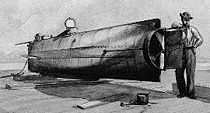
The age of submarine warfare began during the American Civil WarAmerican Civil War
The American Civil War was a civil war fought in the United States of America. In response to the election of Abraham Lincoln as President of the United States, 11 southern slave states declared their secession from the United States and formed the Confederate States of America ; the other 25...
. The 1860s was a time of many turning points in terms of how naval warfare was fought. Many new types of warships were being developed for use in the United States
United States
The United States of America is a federal constitutional republic comprising fifty states and a federal district...
and Confederate States Navies
Navy
A navy is the branch of a nation's armed forces principally designated for naval and amphibious warfare; namely, lake- or ocean-borne combat operations and related functions...
. Submarine watercraft were among the newly created vessels. The first sinking of an enemy ship with a submarine came at the Action of 17 February 1864
Action of 17 February 1864
The Sinking of USS Housatonic on February 17, 1864 during the American Civil War was an important turning point in naval warfare. On this night the Confederate States Navy submarine, H.L. Hunley made her first and only attack on a Union Navy warship...
, when the Confederate submarine CSS H.L. Hunley sank USS Housatonic
USS Housatonic (1861)
The first USS Housatonic was a screw sloop-of-war of the United States Navy, named for the Housatonic River of New England which rises in Berkshire County, Massachusetts, and flows southward into Connecticut before emptying into Long Island Sound a little east of Bridgeport, Connecticut...
in Charleston Harbor
Charleston Harbor
The Charleston Harbor is an inlet of the Atlantic Ocean at Charleston, South Carolina. The inlet is formed by the junction of Ashley and Cooper rivers at . Morris and Sullivan's Island, shelter the entrance...
, South Carolina
South Carolina
South Carolina is a state in the Deep South of the United States that borders Georgia to the south, North Carolina to the north, and the Atlantic Ocean to the east. Originally part of the Province of Carolina, the Province of South Carolina was one of the 13 colonies that declared independence...
.
World War I
Submarine warfare in World War I was partly a fight between German U-Boats and Atlantic supply convoys bound for Great Britain. British and Allied submarines conducted widespread operations in the Baltic, North Sea, Atlantic, Mediterranean and Black Seas. Only a few actions occurred outside of the wider European-Atlantic theatre. German submarine attacks on allied merchant ships gave a direct cause for Americans to enter the war in April 1917.All participants were supposed to abide by the Hague Conventions of 1899 and 1907 but this was found to be impracticable for submarines. Initially German submarines did attempt to comply with the Prize Rules but then went to unrestricted submarine warfare
Unrestricted submarine warfare
Unrestricted submarine warfare is a type of naval warfare in which submarines sink merchantmen without warning, as opposed to attacks per prize rules...
. American diplomatic pressure forced the Germans to stop this for a while, but in January 1917 Germany declared a War Zone around the British Isles and sank up to a quarter of shipping entering it, until escorted convoys were introduced.
The sinking of the Pathfinder
HMS Pathfinder (1904)
HMS Pathfinder was the lead ship of the Pathfinder class scout cruisers, and was the first ship ever to be sunk by a torpedo fired by submarine . She was built by Cammell Laird, Birkenhead, launched on 16 July 1904, and commissioned on 18 July 1905...
was the first combat victory of a modern submarine, and the exploits of U-9, which sank three British cruisers in under an hour, establishing the submarine as an important new component of naval warfare.
German submarines were used to lay mines and to attack iron ore shipping in the Baltic. The British submarine flotilla in the Baltic
British submarine flotilla in the Baltic
A British submarine flotilla operated in the Baltic Sea for three years during the First World War. The squadron of nine submarines was attached to the Russian Baltic Fleet. The main task of the flotilla was to prevent the import of iron ore from Sweden to Imperial Germany...
operated in support of the Russians until the Russian-German Pact.
During the war, the British invested efforts in developing a submarine that could operate in conjunction with a battleship fleet - the "Fleet Submarine". To achieve the necessary 20 knots (surfaced) the K class submarine
British K class submarine
The K class submarines were a class of steam-propelled submarines of the Royal Navy designed in 1913. Intended as large, fast vessels which had the endurance and speed to operate with the battle fleet, they gained notoriety, and the nickname of Kalamity class, for being involved in many accidents....
s were steam powered. In practice the K class were a constant problem and could not operate effectively with a fleet.
Interwar period
Between the wars, navies experimented with submarine cruisers (France, SurcoufSurcouf (N N 3)
Surcouf was a French submarine ordered to be built in December 1927, launched on 18 October 1929, and commissioned in May 1934. Surcouf—named after the French privateer Robert Surcouf—was the largest submarine ever built until surpassed by the Japanese I-400s. Her short wartime career was marked...
), submarines armed with battleship calibre guns (UK, HMS M1
HMS M1
HMS M1 was a submarine of the British Royal Navy, one of four vessels of her class ordered towards the end of the First World War. She sank with the loss of her entire crew in 1925....
) and submarines capable of carrying small aircraft for reconnaissance (HMS M2
HMS M2
HMS M2 was a Royal Navy aircraft-carrying submarine shipwrecked in Lyme Bay, Dorset, Britain, on 26 January 1932. She was one of three M-class boats completed.Four M-class submarines replaced the order for the last four K-class, K17-K21...
and the Surcouf).
Germany was denied submarines by the terms of the Treaty of Versailles
Treaty of Versailles
The Treaty of Versailles was one of the peace treaties at the end of World War I. It ended the state of war between Germany and the Allied Powers. It was signed on 28 June 1919, exactly five years after the assassination of Archduke Franz Ferdinand. The other Central Powers on the German side of...
and secret production was not legitimized until the Anglo-German Naval Agreement
Anglo-German Naval Agreement
The Anglo-German Naval Agreement of June 18, 1935 was a bilateral agreement between the United Kingdom and German Reich regulating the size of the Kriegsmarine in relation to the Royal Navy. The A.G.N.A fixed a ratio whereby the total tonnage of the Kriegsmarine was to be 35% of the total tonnage...
of 1935 under which the UK accepted German parity in submarine numbers with the Royal Navy.
World War II
In World War II, submarine warfare was split into two main areas - the Atlantic and the Pacific. Although the war still waged in Africa, the Mediterranean Sea was also a very active area for submarine operations. This was particularly true for the British and French as well as the Germans. The Italians were also involved but achieved their greatest success using midget submarines and human torpedoes.Atlantic ocean
In the Atlantic, where German submarines again acted against Allied convoys, this part of the war was very reminiscent of the latter part of World War I. Many British submarines were active as well, particularly in the Mediterranean and off Norway, against Axis warships, submarines and merchant shipping.Initially Hitler ordered his submarines to abide by the Prize Rules but this restriction was withdrawn in December 1939. Although mass attacks by submarine had been carried out in the First World War, the "wolf pack" was mainly a tactic of the Second World War U-boats. The main steps in this tactic were as follows:
- A number of U-boats were dispersed across possible paths of a convoy.
- A boat sighting the convoys would signal its course, speed and composition to German Naval Command.
- The submarine continues to shadow the convoy, reporting any changes.
- The rest of the pack is then ordered to close to the first boat's position.
- When the pack is formed a coordinated attack is made on the surface at night.
- At dawn the pack withdraws leaving a shadower, and resumes the attack at dusk.
With the later increase in warship and aircraft escorts the U-boat losses became unacceptable. Many boats were lost, and the earlier "aces" with them.
Pacific ocean
In the Pacific, the situation was reversed, with US submarines hunting Japanese shipping. By war's end, U.S. submarines had destroyed over half of all Japanese merchant ships, totaling well over five million tons of shipping. British and Dutch submarines also took part in attacks on Japanese shipping, mostly in coastal waters. Japanese submarines were often ineffectual, and by doctrine concentrated on attacking warships, rather than more-vulnerable merchantmen. Italian submarines and one German submarine operated in the Pacific Ocean, but never enough to be an important factor, inhibited by distance and difficult relations with their Japanese ally.Indian Ocean
Japanese submarines operated in the Indian Ocean, forcing the British surface fleet to withdraw to the east coast of Africa. Some German and Italian submarines operated in the Indian Ocean, but never enough to be an important factor. See Monsun GruppeMonsun Gruppe
The Monsun Gruppe or Monsoon Group was a force of German U-boats that operated in the Pacific and Indian Oceans during World War II...
.
Post World War II
The advent of the nuclear submarine in the 1950s brought about a major change in submarine warfare. These boats could operate faster, deeper and had much longer endurance. They could be larger and so became missile launching platforms. In response to this the attack submarine became important. The US also used nuclear submarines as radar pickets for a while. Diesel-electric submarines continued to be used as they were better in coastal waters and less expensive, while also much quieter than earlier nuclear subs. There have also been major advances in sensors and weapons.Since the Second World War, several wars, such as the Korean War
Korean War
The Korean War was a conventional war between South Korea, supported by the United Nations, and North Korea, supported by the People's Republic of China , with military material aid from the Soviet Union...
, Indo-Pakistani War of 1971
Indo-Pakistani War of 1971
The Indo-Pakistani War of 1971 was a military conflict between India and Pakistan. Indian, Bangladeshi and international sources consider the beginning of the war to be Operation Chengiz Khan, Pakistan's December 3, 1971 pre-emptive strike on 11 Indian airbases...
and the Falklands War
Falklands War
The Falklands War , also called the Falklands Conflict or Falklands Crisis, was fought in 1982 between Argentina and the United Kingdom over the disputed Falkland Islands and South Georgia and the South Sandwich Islands...
, have involved the use of submarines. However, the importance of the submarine has shifted to an even more strategic role than the disruption of merchant shipping, with the advent of the nuclear submarine
Nuclear submarine
A nuclear submarine is a submarine powered by a nuclear reactor . The performance advantages of nuclear submarines over "conventional" submarines are considerable: nuclear propulsion, being completely independent of air, frees the submarine from the need to surface frequently, as is necessary for...
carrying nuclear weapon
Nuclear weapon
A nuclear weapon is an explosive device that derives its destructive force from nuclear reactions, either fission or a combination of fission and fusion. Both reactions release vast quantities of energy from relatively small amounts of matter. The first fission bomb test released the same amount...
s to provide second-strike capability. To counter the threat of these submarines, hunter submarines were developed in turn. Later submarine-launched land-attack missiles were employed against Iraq and Afghanistan. The role of the submarine has extended with the use of submarine-launched autonomous unmanned vehicles. The development of new air independent propulsion methods has meant that the submarine's need to surface, making it vulnerable, has been reduced.
At the end of his naval warfare book The Price of Admiralty, military historian John Keegan
John Keegan
Sir John Keegan OBE FRSL is a British military historian, lecturer, writer and journalist. He has published many works on the nature of combat between the 14th and 21st centuries concerning land, air, maritime, and intelligence warfare, as well as the psychology of battle.-Life and career:John...
postulates that eventually, almost all roles of surface warships will be taken over by submarines, as they will be the only naval units capable of evading the increasing intelligence capabilities (space satellites, airplanes etc.) that a fight between evenly matched modern states could bring to bear on them.
Modern submarine missions
A modern submarine is a multi-role platform. It can conduct both overt and covert operations. In peacetime it can act as a deterrent as well as for surveillance operations and information gathering.In wartime a submarine can carry out a number of missions including:
- Surveillance and information gathering
- Communication of data
- Landing of special operations forces
- Attack of land targets
- Protection of task forces and merchant shipping
- Denial of sea areas to an enemy
Some theorists such as military historian John Keegan have argued that the extreme vulnerability of surface ships (when facing nations of a similar technological level) to aerial and ship-ship missile attacks will eventually lead to a trend for all types of naval vessels to receive submarine versions.
While the United State Navy says that "Submarines require no vulnerable underway logistics chain nor depend on mutual defense from other platforms for survivability."
See also
- Unrestricted submarine warfareUnrestricted submarine warfareUnrestricted submarine warfare is a type of naval warfare in which submarines sink merchantmen without warning, as opposed to attacks per prize rules...
- Intensified submarine warfareIntensified submarine warfareIntensified submarine warfare is the English-language term used to describe the form of submarine warfare practiced by Germany in the first months of 1916...
- U-boatU-boatU-boat is the anglicized version of the German word U-Boot , itself an abbreviation of Unterseeboot , and refers to military submarines operated by Germany, particularly in World War I and World War II...
- TorpedoTorpedoThe modern torpedo is a self-propelled missile weapon with an explosive warhead, launched above or below the water surface, propelled underwater towards a target, and designed to detonate either on contact with it or in proximity to it.The term torpedo was originally employed for...
- Naval mineNaval mineA naval mine is a self-contained explosive device placed in water to destroy surface ships or submarines. Unlike depth charges, mines are deposited and left to wait until they are triggered by the approach of, or contact with, an enemy vessel...
Further reading
- Hackmann, Willem. Seek & Strike: Sonar, anti-submarine warfare and the Royal Navy 1914-54. London: Her Majesty's Stationery Office, 1984. ISBN 0112904238