

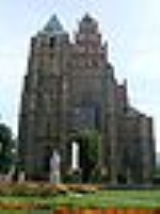
Strzegom

Encyclopedia
Strzegom ' is a town in Świdnica County
, Lower Silesian Voivodeship
, in south-western Poland
. It is the seat of the administrative district (gmina
) called Gmina Strzegom
. It lies approximately 15 kilometres (9 mi) north-west of Świdnica
, and 52 kilometres (32 mi) west of the regional capital Wrocław. As at 2006, the town had a population of 16,782.
period have been found. In the Middle Ages
it was a fortified settlement under the rule of a castellan
, part of Piast Poland
, first mentioned in a deed issued by Pope Hadrian IV in 1155, confirming the boundaries of the Wrocław diocese. At the same time the building of the St. Peter and Paul parish church began, from 1203 under the patronage of the Order of Saint John
. About 1242 Strzegom received town privileges
by Anne of Bohemia, widow of the Silesian
duke Henry II the Pious
. In 1248 it fell to the Silesian Duchy of Legnica
under Henry's son Bolesław II the Bald, contested by his nephew Henryk IV Probus
, who, imprisoned by his uncle at Jelcz
, finally had to renounce Strzegom in 1277.
From the late 13th century the town of Striegau belonged to the Duchy of Jawor and Świdnica
under Bolko I the Strict
, and until 1392 was ruled by his descendants of the Silesian Piasts
. Though they initially withstood the vassalisation attempts by King John of Bohemia, Striegau subsequently shared the political fortunes of Silesia
, and passed from Polish to Imperial
Bohemian
and in 1526 to Austrian Habsburg
sovereignty. During the Thirty Years' War
the city suffered almost complete destruction.
In 1742 Striegau became part of Prussia
. On June 4, 1745 the Battle of Hohenfriedberg
, an important victory for King Frederick II
during the War of the Austrian Succession
, took place near the town. In the 19th century considerable industrial expansion took place, with granite
quarries playing a particularly important role in the town's economy. The first rail link to the town was opened in 1856. In 1905 the town of Striegau had 13,427 inhabitants. During World War II, Nazi Germany used an area close to the town as a subcamp of the nearby Gross-Rosen concentration camp
. As a result of the Potsdam Conference
in 1945, Striegau became a part of Poland
, and its German inhabitants were expelled
. The town was renamed Strzegom by the People's Republic of Poland
.
Swidnica County
Świdnica County is a unit of territorial administration and local government in Lower Silesian Voivodeship, south-western Poland. It came into being on January 1, 1999, as a result of the Polish local government reforms passed in 1998. The county covers an area of...
, Lower Silesian Voivodeship
Lower Silesian Voivodeship
Lower Silesian Voivodeship, or Lower Silesia Province , is one of the 16 voivodeships into which Poland is currently divided. It lies in southwestern Poland...
, in south-western Poland
Poland
Poland , officially the Republic of Poland , is a country in Central Europe bordered by Germany to the west; the Czech Republic and Slovakia to the south; Ukraine, Belarus and Lithuania to the east; and the Baltic Sea and Kaliningrad Oblast, a Russian exclave, to the north...
. It is the seat of the administrative district (gmina
Gmina
The gmina is the principal unit of administrative division of Poland at its lowest uniform level. It is often translated as "commune" or "municipality." As of 2010 there were 2,479 gminas throughout the country...
) called Gmina Strzegom
Gmina Strzegom
Gmina Strzegom is an urban-rural gmina in Świdnica County, Lower Silesian Voivodeship, in south-western Poland. Its seat is the town of Strzegom, which lies approximately north-west of Świdnica, and west of the regional capital Wrocław.The gmina covers an area of , and as of 2006 its total...
. It lies approximately 15 kilometres (9 mi) north-west of Świdnica
Swidnica
Świdnica is a city in south-western Poland in the region of Silesia. It has a population of 60,317 according to 2006 figures. It lies in Lower Silesian Voivodeship, being the seventh largest town in that voivodeship. From 1975–98 it was in the former Wałbrzych Voivodeship...
, and 52 kilometres (32 mi) west of the regional capital Wrocław. As at 2006, the town had a population of 16,782.
History
Traces of settlement on the site during the Roman EmpireRoman Empire
The Roman Empire was the post-Republican period of the ancient Roman civilization, characterised by an autocratic form of government and large territorial holdings in Europe and around the Mediterranean....
period have been found. In the Middle Ages
Middle Ages
The Middle Ages is a periodization of European history from the 5th century to the 15th century. The Middle Ages follows the fall of the Western Roman Empire in 476 and precedes the Early Modern Era. It is the middle period of a three-period division of Western history: Classic, Medieval and Modern...
it was a fortified settlement under the rule of a castellan
Castellan
A castellan was the governor or captain of a castle. The word stems from the Latin Castellanus, derived from castellum "castle". Also known as a constable.-Duties:...
, part of Piast Poland
Poland during the Piast dynasty
History of Poland during the Piast dynasty is the first major stage in the history of Poland from the 10th to the 14th century when Poland was established as a state and a nation during the medieval period of European history. The history of the Polish state begins with the founding of the Piast...
, first mentioned in a deed issued by Pope Hadrian IV in 1155, confirming the boundaries of the Wrocław diocese. At the same time the building of the St. Peter and Paul parish church began, from 1203 under the patronage of the Order of Saint John
Knights Hospitaller
The Sovereign Military Hospitaller Order of Saint John of Jerusalem of Rhodes and of Malta , also known as the Sovereign Military Order of Malta , Order of Malta or Knights of Malta, is a Roman Catholic lay religious order, traditionally of military, chivalrous, noble nature. It is the world's...
. About 1242 Strzegom received town privileges
Town privileges
Town privileges or city rights were important features of European towns during most of the second millennium.Judicially, a town was distinguished from the surrounding land by means of a charter from the ruling monarch that defined its privileges and laws. Common privileges were related to trading...
by Anne of Bohemia, widow of the Silesian
Duchy of Silesia
The Duchy of Silesia with its capital at Wrocław was a medieval duchy located in the historic Silesian region of Poland. Soon after it was formed under the Piast dynasty in 1138, it fragmented into various Duchies of Silesia. In 1327 the remaining Duchy of Wrocław as well as most other duchies...
duke Henry II the Pious
Henry II the Pious
Henry II the Pious , of the Silesian line of the Piast dynasty was Duke of Silesia at Wrocław and Duke of Kraków and thus High Duke of all Poland as well as Duke of Southern Greater Poland from 1238 until his death. During 1238–1239 he also served as a regent of two other Piast duchies: Sandomierz...
. In 1248 it fell to the Silesian Duchy of Legnica
Duchy of Legnica
The Duchy of Legnica or Duchy of Liegnitz was one of the Duchies of Silesia. Its capital was Legnica in Lower Silesia....
under Henry's son Bolesław II the Bald, contested by his nephew Henryk IV Probus
Henryk IV Probus
Henryk IV Probus was a member of the Silesian branch of the royal Polish Piast dynasty...
, who, imprisoned by his uncle at Jelcz
Jelcz-Laskowice
Jelcz-Laskowice is a town in Oława County, Lower Silesian Voivodeship, in south-western Poland. It is the seat of the administrative district called Gmina Jelcz-Laskowice. It lies on the Odra river, approximately north of Oława, and south-east of the regional capital Wrocław...
, finally had to renounce Strzegom in 1277.
From the late 13th century the town of Striegau belonged to the Duchy of Jawor and Świdnica
Duchy of Jawor
Duchy of Jawor was one of the Duchies of Silesia, with a capital in Jawor. It was created in 1274 as a subdivision of the Duchy of Legnica in Lower Silesia under the rule of Henry V the Fat, the eldest son of Duke Bolesław II the Bald...
under Bolko I the Strict
Bolko I the Strict
Bolko I the Strict also known as the Raw or of Jawor , was a Duke of Lwówek during 1278-81 and Jawor since 1278 , sole Duke of Lwówek since 1286, Duke of Świdnica-Ziębice since 1291.He was the second son of Bolesław II the Bald, Duke of Legnica by his first wife Hedwig, daughter of...
, and until 1392 was ruled by his descendants of the Silesian Piasts
Silesian Piasts
The Silesian Piasts were the oldest line of the Piast dynasty beginning with Władysław II the Exile, son of Bolesław III Wrymouth, Duke of Poland...
. Though they initially withstood the vassalisation attempts by King John of Bohemia, Striegau subsequently shared the political fortunes of Silesia
Silesia
Silesia is a historical region of Central Europe located mostly in Poland, with smaller parts also in the Czech Republic, and Germany.Silesia is rich in mineral and natural resources, and includes several important industrial areas. Silesia's largest city and historical capital is Wrocław...
, and passed from Polish to Imperial
Holy Roman Empire
The Holy Roman Empire was a realm that existed from 962 to 1806 in Central Europe.It was ruled by the Holy Roman Emperor. Its character changed during the Middle Ages and the Early Modern period, when the power of the emperor gradually weakened in favour of the princes...
Bohemian
Kingdom of Bohemia
The Kingdom of Bohemia was a country located in the region of Bohemia in Central Europe, most of whose territory is currently located in the modern-day Czech Republic. The King was Elector of Holy Roman Empire until its dissolution in 1806, whereupon it became part of the Austrian Empire, and...
and in 1526 to Austrian Habsburg
Habsburg Monarchy
The Habsburg Monarchy covered the territories ruled by the junior Austrian branch of the House of Habsburg , and then by the successor House of Habsburg-Lorraine , between 1526 and 1867/1918. The Imperial capital was Vienna, except from 1583 to 1611, when it was moved to Prague...
sovereignty. During the Thirty Years' War
Thirty Years' War
The Thirty Years' War was fought primarily in what is now Germany, and at various points involved most countries in Europe. It was one of the most destructive conflicts in European history....
the city suffered almost complete destruction.
In 1742 Striegau became part of Prussia
Kingdom of Prussia
The Kingdom of Prussia was a German kingdom from 1701 to 1918. Until the defeat of Germany in World War I, it comprised almost two-thirds of the area of the German Empire...
. On June 4, 1745 the Battle of Hohenfriedberg
Battle of Hohenfriedberg
The Battle of Hohenfriedberg or Hohenfriedeberg, also known as the battle of Striegau, now Dobromierz, was one of the crowning achievements of Frederick the Great...
, an important victory for King Frederick II
Frederick II of Prussia
Frederick II was a King in Prussia and a King of Prussia from the Hohenzollern dynasty. In his role as a prince-elector of the Holy Roman Empire, he was also Elector of Brandenburg. He was in personal union the sovereign prince of the Principality of Neuchâtel...
during the War of the Austrian Succession
War of the Austrian Succession
The War of the Austrian Succession – including King George's War in North America, the Anglo-Spanish War of Jenkins' Ear, and two of the three Silesian wars – involved most of the powers of Europe over the question of Maria Theresa's succession to the realms of the House of Habsburg.The...
, took place near the town. In the 19th century considerable industrial expansion took place, with granite
Granite
Granite is a common and widely occurring type of intrusive, felsic, igneous rock. Granite usually has a medium- to coarse-grained texture. Occasionally some individual crystals are larger than the groundmass, in which case the texture is known as porphyritic. A granitic rock with a porphyritic...
quarries playing a particularly important role in the town's economy. The first rail link to the town was opened in 1856. In 1905 the town of Striegau had 13,427 inhabitants. During World War II, Nazi Germany used an area close to the town as a subcamp of the nearby Gross-Rosen concentration camp
Gross-Rosen concentration camp
KL Gross-Rosen was a German concentration camp, located in Gross-Rosen, Lower Silesia . It was located directly on the rail line between Jauer and Striegau .-The camp:...
. As a result of the Potsdam Conference
Potsdam Conference
The Potsdam Conference was held at Cecilienhof, the home of Crown Prince Wilhelm Hohenzollern, in Potsdam, occupied Germany, from 16 July to 2 August 1945. Participants were the Soviet Union, the United Kingdom, and the United States...
in 1945, Striegau became a part of Poland
Poland
Poland , officially the Republic of Poland , is a country in Central Europe bordered by Germany to the west; the Czech Republic and Slovakia to the south; Ukraine, Belarus and Lithuania to the east; and the Baltic Sea and Kaliningrad Oblast, a Russian exclave, to the north...
, and its German inhabitants were expelled
Expulsion of Germans after World War II
The later stages of World War II, and the period after the end of that war, saw the forced migration of millions of German nationals and ethnic Germans from various European states and territories, mostly into the areas which would become post-war Germany and post-war Austria...
. The town was renamed Strzegom by the People's Republic of Poland
People's Republic of Poland
The People's Republic of Poland was the official name of Poland from 1952 to 1990. Although the Soviet Union took control of the country immediately after the liberation from Nazi Germany in 1944, the name of the state was not changed until eight years later...
.
Notable residents
- Johann Christian GüntherJohann Christian GüntherJohann Christian Günther was a German poet from Striegau in Lower Silesia. After attending the gymnasium at Schweidnitz, he was sent in 1715 by his father, a country doctor, to study medicine at Wittenberg; but he was idle and dissipated, had no taste for the profession chosen for him, and came to...
(1695-1723), Baroque poet - Paul SlowinskiPaul SlowinskiPaul "The Sting" Slowinski is a Polish-Australian kickboxer, a four-time WMC Muay Thai World champion and two-time K-1 World GP 2006 in Auckland and K-1 World GP 2007 in Amsterdam champion...
, Polish-Australian kickboxer