

Messier 82

Encyclopedia
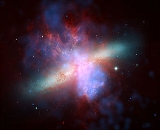
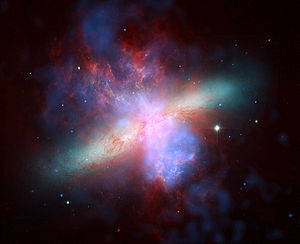
Messier 82 is the prototype nearby starburst galaxy
about 12 million light-year
s away in the constellation
Ursa Major
. The starburst galaxy is five times as bright as the whole Milky Way
and one hundred times as bright as our galaxy's center.
In 2005, the Hubble Space Telescope
revealed 197 young massive clusters in the starburst core. The average mass of these clusters is around 2 M⊙, hence the starburst core is a very energetic and high-density environment. Throughout the galaxy's center, young stars are being born 10 times faster than they are inside our entire Milky Way Galaxy.
 M82 was previously believed to be an irregular galaxy
. However, in 2005, two symmetric spiral arms were discovered in the near-infrared (NIR) images of M82. The arms were detected by subtracting an axisymmetric exponential disk from the NIR images. These arms emanate from the ends of the NIR bar
and can be followed for the length of 3 disc
scales. Even though the arms were detected in the NIR images, they are bluer than the disk. Assuming that the northern part of M82 is nearer to us, which most literature assumes, the observed sense of rotation implies trailing arms. Due to M82's high disk surface brightness
, nearly edge-on orientation (~80°) with respect to us, and the presence of a complex network of dusty filaments in optical images, the arms were not previously detected.
, infrared
, and radio frequencies. Consequently, they are thought to be the least obscured starburst clusters from our vantage point. M82's unique bipolar outflow (or 'superwind') appears to be concentrated on clumps A and C and fueled by the energy injected by supernova
that occur about once every ten years.
The Chandra X-ray Observatory
detected fluctuating X-ray
emissions from a location approximately 600 light-years away from the center of M82. Astronomers have postulated that this fluctuating emission comes from the first known intermediate-mass black hole
, of roughly 200 to 5000 solar mass
es. M82, like most galaxies, hosts a supermassive black hole at its center with a mass of approximately 3 x 10⁷ solar masses as measured from stellar dynamics.
There have been several theories about the nature of this unknown object, but currently no theory entirely fits the observed data. It has been suggested that the object could be a "micro quasar", having very high luminosity, and being fairly stable. However, microquasars also produce large quantities of X-rays, whereas no X-rays have been seen from the mystery object. The object is located at several arcseconds from the center of M82. It has an apparent superluminal motion of 4 times the speed of light relative to the galaxy center.
.jpg) Forming a striking pair in small telescope
Forming a striking pair in small telescope
s with nearby spiral
M81
, M82 is being physically affected by its larger neighbor. Tidal forces caused by gravity have deformed this galaxy
, a process that started about 100 million years ago. This interaction has caused star formation to increase tenfold compared to "normal" galaxies.
Recently, M82 has undergone at least one tidal encounter with M81 resulting in a large amount of gas being funneled into the galaxy's core over the last 200 Myr. The most recent such encounter is thought to have happened around 2–5 years ago and resulted in a concentrated starburst together with a corresponding marked peak in the cluster age distribution. This starburst ran for up to ~50 Myr at a rate of ~10 M⊙ per year. Two subsequent starbursts followed, the last (~4–6 Myr ago) of which may have formed the core clusters, both super star clusters (SSCs) and their lighter counterparts.
Ignoring any difference in their respective distances from us, the centers of M81 and M82 are visually separated by about 130,000 light-years. The actual separation is 300 kly.
Starburst galaxy
A starburst galaxy is a galaxy in the process of an exceptionally high rate of star formation, compared to the usual star formation rate seen in most galaxies. Galaxies are often observed to have a burst of star formation after a collision or close encounter between two galaxies...
about 12 million light-year
Light-year
A light-year, also light year or lightyear is a unit of length, equal to just under 10 trillion kilometres...
s away in the constellation
Constellation
In modern astronomy, a constellation is an internationally defined area of the celestial sphere. These areas are grouped around asterisms, patterns formed by prominent stars within apparent proximity to one another on Earth's night sky....
Ursa Major
Ursa Major
Ursa Major , also known as the Great Bear, is a constellation visible throughout the year in most of the northern hemisphere. It can best be seen in April...
. The starburst galaxy is five times as bright as the whole Milky Way
Milky Way
The Milky Way is the galaxy that contains the Solar System. This name derives from its appearance as a dim un-resolved "milky" glowing band arching across the night sky...
and one hundred times as bright as our galaxy's center.
In 2005, the Hubble Space Telescope
Hubble Space Telescope
The Hubble Space Telescope is a space telescope that was carried into orbit by a Space Shuttle in 1990 and remains in operation. A 2.4 meter aperture telescope in low Earth orbit, Hubble's four main instruments observe in the near ultraviolet, visible, and near infrared...
revealed 197 young massive clusters in the starburst core. The average mass of these clusters is around 2 M⊙, hence the starburst core is a very energetic and high-density environment. Throughout the galaxy's center, young stars are being born 10 times faster than they are inside our entire Milky Way Galaxy.
Structure
Irregular galaxy
An irregular galaxy is a galaxy that does not have a distinct regular shape, like a spiral or an elliptical galaxy. The shape of an irregular galaxy is uncommon – they do not fall into any of the regular classes of the Hubble sequence, and they are often chaotic in appearance, with neither a...
. However, in 2005, two symmetric spiral arms were discovered in the near-infrared (NIR) images of M82. The arms were detected by subtracting an axisymmetric exponential disk from the NIR images. These arms emanate from the ends of the NIR bar
Barred spiral galaxy
A barred spiral galaxy is a spiral galaxy with a central bar-shaped structure composed of stars. Bars are found in approximately two-thirds of all spiral galaxies...
and can be followed for the length of 3 disc
Disc (galaxy)
A disc is a component of disc galaxies, such as spiral galaxies, or lenticular galaxies.The galactic disc is the plane in which the spirals, bars and discs of disc galaxies exist. Galaxy discs tend to have more gas and dust, and younger stars than galactic bulges, or galactic haloes.The galactic...
scales. Even though the arms were detected in the NIR images, they are bluer than the disk. Assuming that the northern part of M82 is nearer to us, which most literature assumes, the observed sense of rotation implies trailing arms. Due to M82's high disk surface brightness
Surface brightness
The overall brightness of an extended astronomical object such as a galaxy, star cluster, or nebula, can be measured by its total magnitude, integrated magnitude or integrated visual magnitude; a related concept is surface brightness, which specifies the brightness of a standard-sized piece of an...
, nearly edge-on orientation (~80°) with respect to us, and the presence of a complex network of dusty filaments in optical images, the arms were not previously detected.
Starburst region
In the core of M82, the active starburst region spans a diameter of 500 pc. In optical, there are four high surface brightness regions or clumps (designated A, C, D, and E). These clumps correspond to known sources at X-rayX-ray
X-radiation is a form of electromagnetic radiation. X-rays have a wavelength in the range of 0.01 to 10 nanometers, corresponding to frequencies in the range 30 petahertz to 30 exahertz and energies in the range 120 eV to 120 keV. They are shorter in wavelength than UV rays and longer than gamma...
, infrared
Infrared
Infrared light is electromagnetic radiation with a wavelength longer than that of visible light, measured from the nominal edge of visible red light at 0.74 micrometres , and extending conventionally to 300 µm...
, and radio frequencies. Consequently, they are thought to be the least obscured starburst clusters from our vantage point. M82's unique bipolar outflow (or 'superwind') appears to be concentrated on clumps A and C and fueled by the energy injected by supernova
Supernova
A supernova is a stellar explosion that is more energetic than a nova. It is pronounced with the plural supernovae or supernovas. Supernovae are extremely luminous and cause a burst of radiation that often briefly outshines an entire galaxy, before fading from view over several weeks or months...
that occur about once every ten years.
The Chandra X-ray Observatory
Chandra X-ray Observatory
The Chandra X-ray Observatory is a satellite launched on STS-93 by NASA on July 23, 1999. It was named in honor of Indian-American physicist Subrahmanyan Chandrasekhar who is known for determining the maximum mass for white dwarfs. "Chandra" also means "moon" or "luminous" in Sanskrit.Chandra...
detected fluctuating X-ray
X-ray
X-radiation is a form of electromagnetic radiation. X-rays have a wavelength in the range of 0.01 to 10 nanometers, corresponding to frequencies in the range 30 petahertz to 30 exahertz and energies in the range 120 eV to 120 keV. They are shorter in wavelength than UV rays and longer than gamma...
emissions from a location approximately 600 light-years away from the center of M82. Astronomers have postulated that this fluctuating emission comes from the first known intermediate-mass black hole
Intermediate-mass black hole
An Intermediate-mass black hole is a black hole whose mass is significantly more than stellar black holes yet far less than supermassive black holes...
, of roughly 200 to 5000 solar mass
Solar mass
The solar mass , , is a standard unit of mass in astronomy, used to indicate the masses of other stars and galaxies...
es. M82, like most galaxies, hosts a supermassive black hole at its center with a mass of approximately 3 x 10⁷ solar masses as measured from stellar dynamics.
Unknown Object
In April 2010, radio astronomers working at the Jodrell Bank Observatory of the University of Manchester reported an unknown object in M82. The object has started sending out radio waves, and the emission does not look like anything seen anywhere in the universe before.There have been several theories about the nature of this unknown object, but currently no theory entirely fits the observed data. It has been suggested that the object could be a "micro quasar", having very high luminosity, and being fairly stable. However, microquasars also produce large quantities of X-rays, whereas no X-rays have been seen from the mystery object. The object is located at several arcseconds from the center of M82. It has an apparent superluminal motion of 4 times the speed of light relative to the galaxy center.
Messier 81 triggering starburst
Telescope
A telescope is an instrument that aids in the observation of remote objects by collecting electromagnetic radiation . The first known practical telescopes were invented in the Netherlands at the beginning of the 1600s , using glass lenses...
s with nearby spiral
Spiral galaxy
A spiral galaxy is a certain kind of galaxy originally described by Edwin Hubble in his 1936 work The Realm of the Nebulae and, as such, forms part of the Hubble sequence. Spiral galaxies consist of a flat, rotating disk containing stars, gas and dust, and a central concentration of stars known as...
M81
Messier 81
Messier 81 is a spiral galaxy about 12 million light-years away in the constellation Ursa Major. Due to its proximity to Earth, large size and active galactic nucleus Messier 81 (also known as NGC 3031 or Bode's Galaxy) is a spiral galaxy about 12 million light-years away in the constellation Ursa...
, M82 is being physically affected by its larger neighbor. Tidal forces caused by gravity have deformed this galaxy
Galaxy
A galaxy is a massive, gravitationally bound system that consists of stars and stellar remnants, an interstellar medium of gas and dust, and an important but poorly understood component tentatively dubbed dark matter. The word galaxy is derived from the Greek galaxias , literally "milky", a...
, a process that started about 100 million years ago. This interaction has caused star formation to increase tenfold compared to "normal" galaxies.
Recently, M82 has undergone at least one tidal encounter with M81 resulting in a large amount of gas being funneled into the galaxy's core over the last 200 Myr. The most recent such encounter is thought to have happened around 2–5 years ago and resulted in a concentrated starburst together with a corresponding marked peak in the cluster age distribution. This starburst ran for up to ~50 Myr at a rate of ~10 M⊙ per year. Two subsequent starbursts followed, the last (~4–6 Myr ago) of which may have formed the core clusters, both super star clusters (SSCs) and their lighter counterparts.
Ignoring any difference in their respective distances from us, the centers of M81 and M82 are visually separated by about 130,000 light-years. The actual separation is 300 kly.