


Storage silo

Encyclopedia
A silo is a structure for storing bulk materials
. Silos are used in agriculture
to store grain
(see grain elevator
s) or fermented feed known as silage
. Silos are more commonly used for bulk storage of grain, coal
, cement
, carbon black
, woodchips
, food products and sawdust
. Three types of silos are in widespread use today - tower silos, bunker silos and bag silos. Missile silos are used for the storage and launching of ballistic missiles.
). The low-level silos are fully mobile with capacities from 10 to 75 tons. They are simple to transport and are easy to set up on site. These mobile silos generally come equipped with an electronic weighing system with digital display and printer. This allows any quantity of cement or powder discharged from the silo to be controlled and also provides an accurate indication of what remains inside the silo. The static upright silos have capacities from 20 to 80 tons. These are considered a low-maintenance option for the storage of cement or other powders. Cement silos can be used in conjunction with bin-fed batching plants.
 Storage silos are cylindrical structures, typically 10 to 90 ft (4 to 30 m) in diameter and 30 to 275 ft (10 to 84 m) in height with the slipform and Jumpform concrete silos being the larger diameter and taller silos. They can be made of many materials. Wood staves, concrete staves, cast concrete, and steel panels have all been used, and have varying cost, durability, and airtightness tradeoffs. Silos storing grain, cement and woodchips are typically unloaded with air slides or augers. Silos can be unloaded into rail cars, trucks or conveyors.
Tower silos containing silage are usually unloaded from the top of the pile, originally by hand using a silage fork, which has many more tines than the common pitchfork, 12 vs 4, in modern times using mechanical unloaders. Bottom silo unloaders are utilized at times but have problems with difficulty of repair.
An advantage of tower silos is that the silage tends to pack well due to its own weight, except in the top few feet. However, this may be a disadvantage for items like chopped wood. The tower silo was invented by Franklin Hiram King
.
In Australia
and the United States, many country towns or the larger farmers in grain-growing areas have groups of concrete tower silos, known as grain elevator
s, to collect grain from the surrounding towns and store and protect the grain for transport by train, truck or barge to a processor or to an export port. The transport system simply can not handle the peak load due of the harvest needs which depend upon the weather. In bumper crop times, the excess grain is stored in piles without silos or bins, causing considerable losses.
Concrete stave silos are constructed from small precast concrete blocks with ridged grooves along each edge that lock them together into a high strength shell. Much of concrete's strength comes from its high compressibility, so the silo is held together by steel hoops encircling the tower and compressing the staves into a tight ring. The vertical stacks are held together by intermeshing of the ends of the staves by a short distance around the perimeter of each layer, and hoops which are tightened directly across the stave edges.
The static pressure of the material inside the silo pressing outward on the staves increases towards the bottom of the silo, so the hoops can be spaced wide apart near the top but become progressively more closely spaced towards the bottom to prevent seams from opening and the contents leaking out.
Concrete stave silos are built from common components designed with high strength and long life. They have the flexibility to have their height increased according to the needs of the farm and purchasing power of the farmer, or to be completely disassembled and reinstalled somewhere else if no longer needed.
It would be expensive to design a such a large structure that is immune to atmospheric pressure changes over time. Instead, the silo structure is open to the atmosphere but outside air is separated from internal air by large impermeable bags sealed to the silo breather openings. In the warmth of the day when the silo is heated by the sun, the gas trapped inside the silo expands and the bags "breathe out" and collapse. At night the silo cools, the air inside contracts and the bags "breathe in" and expand again.
While the iconic blue Harvestore low-oxygen silos were once very common, the speed of its unloader mechanism was not able to match the output rates of modern bunker silos and this type of silo went into decline. Unloader repair expenses also severely hurt the Harvestore reputation, because the unloader feed mechanism is located in the bottom of the silo under tons of silage. In the event of cutter chain breakage, it can cost up to US$10,000 to perform repairs. The silo may need to be partially or completely emptied by alternate means, to unbury the broken unloader retrieve broken components lost in the silage at the bottom of the structure.
In 2005 the Harvestore company recognized these issues and worked to develop new unloaders with double the flow rate of previous models to stay competitive with bunkers, and with far greater unloader chain strength. They are now also using load sensing soft-start variable frequency drive
motor controllers to reduce the likelihood of mechanism breakage, and to control the feeder sweep arm movement.
While the sight of multiple tall silos may look impressive, many have been abandoned for silage use, or converted to hold grain. Ground-level bunker silos carry none of the hazards outlined above, and need only a standard tractor/loader to feed out with, and no specialized machinery.
. The bag is discarded in sections as it is torn off. Bag silos require little capital investment. They can be used as a temporary measure when growth or harvest conditions require more space, though some farms use them every year.
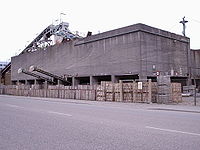 A bin is typically much shorter than a silo, and is typically used for holding dry matter such as concrete or grain. Bins may be round or square, but round bins tend to empty more easily due to a lack of corners for the stored material to become wedged and encrusted.
The stored material may be powdered, as seed kernels, or as cob corn. Due to the dry nature of the stored material, it tends to be lighter than silage and can be more easily handled by under-floor grain unloaders. To facilitate drying after harvesting, some grain bins contain a hollow perforated or screened central shaft to permit easier air infiltration into the stored grain.
, namely in Canada
and the United States
.
, was invented and built in 1873 by Henry Hatch of McHenry County, Illinois
, USA.
which may either be self-propelled with an engine and driver's cab, or towed behind a tractor
that supplies power through a PTO
.
The harvester contains a drum-shaped series of cutting knives which shear the fibrous plant material into small pieces no more than an inch long, to facilitate mechanized blowing and transport via augers. The finely chopped plant material is then blown by the harvester into a forage wagon which contains an automatic unloading system.
and is pushed into the blower using a spinning spiral auger
.
There is commonly a water connection on the blower to add moisture to the plant matter being blown into the silo. The blower may be driven by an electric motor but it is more common to use a spare tractor
instead.
A large slow-moving conveyor chain underneath the silage in the forage wagon moves the pile towards the front, where rows of rotating teeth break up the pile and drop it onto a high-speed transverse conveyor that pours the silage out the side of the wagon into the blower hopper.
The bag is loaded using the same forage harvesting methods as the tower, but the forage wagon must be moved progressively forward with the bag loader. The loader uses an array of rotating cam-shaped spiraled teeth associated with a large comb
-shaped tines to push forage into the bag. The forage is pushed in through a large opening, and as the teeth rotate back out, they pass between the comb tines. The cam-shaped auger teeth essentially wipe the forage off using the steel tines, keeping the forage in the bag.
Before filling begins, the entire bag is placed onto the loader as a bunched-up tube folded back on itself in many layers to form a thick pile of plastic. Because the plastic is minimally elastic, the loader mechanism filling chute is slightly smaller than the final size of the bag, to accommodate this stack of plastic around the mouth of the loader. The plastic slowly unfurls itself around the edges of the loader as the tube is filled.
The contents of the silo bag are under pressure as it is filled, with the pressure controlled by a large brake shoe pressure regulator, holding back two large winch drums on either side of the loader. Cables from the drum extend to the rear of the bag where a large mesh basket holds the rear end of the bag shut.
To prevent molding and to assure an airtight seal during fermentation, the ends of the silo bag tube are gathered, folded, and tied shut to prevent oxygen from entering the bag. Removal of the bag loader can be hazardous to bystanders since the pressure must be released and the rear end allowed to collapse onto the ground.
A silo unloader specifically refers to a special cylindrical rotating forage
pickup device used inside a single tower silo.
The main operating component of the silo unloader is suspended in the silo from a steel cable on a pulley
that is mounted in the top-center of the roof of the silo. The vertical positioning of the unloader is controlled by an electric winch
on the exterior of the silo.
For the summer filling of a tower silo, the unloader is winched as high as possible to the top of the silo and put into a parking position. The silo is filled with a silo blower, which is literally a very large fan that blows a large volume of pressurized air up a 10-inch tube on the side of the silo. A small amount of water is introduced into the air stream during filling to help lubricate the filling tube. A small adjustable nozzle at the top, controlled by a handle at the base of the silo directs the silage to fall into the silo on the near, middle, or far side, to facilitate evenly layered loading. Once completely filled, the top of the exposed silage pile is covered with a large heavy sheet of silo plastic which seals out oxygen and permits the entire pile to begin to ferment
in the autumn.
In the winter when animals must be kept indoors, the silo plastic is removed, the unloader is lowered down onto the top of the silage pile, and a hinged door is opened on the side of the silo to permit the silage to be blown out. There is an array of these access doors arranged vertically up the side of the silo, with an unloading tube next to the doors that has a series of removable covers down the side of the tube. The unloader tube and access doors are normally covered with a large U-shaped shield mounted on the silo, to protect the farmer from wind, snow, and rain while working on the silo.
The silo unloader mechanism consists of a pair of counter-rotating toothed augers which rip up the surface of the silage and pull it towards the center of the unloader. The toothed augers rotate in a circle around the center hub, evenly chewing the silage off the surface of the pile. In the center, a large blower assembly picks up the silage and blows it out the silo door, where the silage falls by gravity down the unloader tube to the bottom of the silo, typically into an automated conveyor system.
The unloader is typically lowered only a half-inch or so at a time by the operator, and the unloader picks up only a small amount of material until the winch cable has become taut and the unloader is not picking up any more material. The operator then lowers the unloader another half-inch or so and the process repeats. If lowered too far, the unloader can pull up much more material than it can handle, which can overflow and plug up the blower, outlet spout, and the unloader tube, resulting in a time-wasting process of having to climb up the silo to clear the blockages.
Once silage has entered the conveyor system, it can be handled by either manual or automatic distribution systems. The simplest manual distribution system uses a sliding metal platform under the pickup channel. When slid open, the forage drops through the open hole and down a chute into a wagon, wheelbarrow, or open pile. When closed, the forage continues past the opening and onward to other parts of the conveyor. Computer automation and a conveyor running the length of a feeding stall can permit the silage to be automatically dropped from above by each animal, with the amount dispensed customized for each location.
Preparation for filling a silo requires winching the unloader to the top, and any remaining forage at the base that the unloader could not pick up must be removed from the floor of the silo. This job requires that the farmer work directly underneath a machine weighing several tons suspended fifty feet or more overhead from a small steel cable. If the unloader were to fall, the farmer would likely be killed instantly.
Unloading also poses its own special hazards, due to the requirement that the farmer regularly climb the silo to close an upper door and open a lower door, moving the unloader chute from door to door in the process. The fermentation of the silage produces methane gas which over time will outgas and displace the oxygen in the top of the silo. A farmer directly entering a silo without any other precautions can be asphyxiated by the methane, knocked unconscious, and silently suffocate to death before anyone else knows what has happened. It is either necessary to leave the silo blower attached to the silo at all times to use it when necessary to ventilate the silo with fresh air, or to have a dedicated electric fan system to blow fresh air into the silo, before anyone attempts to enter it.
In the event that the unloader mechanism becomes plugged, the farmer must climb the silo and directly stand on the unloader, reaching into the blower spout to dig out the soft silage. After clearing a plug, the forage needs to be forked out into an even layer around the unloader so that the unloader does not immediately dig into the pile and plug itself again. All during this process the farmer is standing on or near a machine that could easily kill them in seconds if it were to accidentally start up. This can happen if someone in the barn were to unknowingly switch on the unloading mechanism while someone is in the silo working on the unloader.
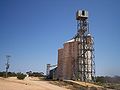 Silos are hazardous, and people die every year in the process of filling and maintaining them. The machinery used is dangerous and with tower silos workers can fall from the silo's ladder or work platform. Several fires have occurred over the years.
There have also been many cases of silos and the associated ducts and buildings exploding. If the air inside becomes laden with finely granulated particles, such as grain dust, a spark can trigger an explosion powerful enough to blow a concrete silo and adjacent buildings apart, usually setting the adjacent grain and building on fire. Sparks are often caused by (metal) rubbing against metal ducts; or due to static electricity produced by dust moving along the ducts when extra dry.
The two main problems which will necessitate cleaning in dry-matter silos and bins are Bridging and Rat-holing. Bridging occurs when the material interlaces over the unloading mechanism at the base of the silo and blocks the flow of stored material by gravity into the unloading system. Rat-holing occurs when the material starts to adhere to the side of the silo. This will reduce the operating capacity of a silo as well as leading to cross-contamination of newer material with older material. There are a number of ways to clean a silo
and many of these carry their own risks. However since the early 1990s acoustic cleaners have become available. These are non-invasive, have minimum risk, and can offer a very cost-effective way to keep a small particle silo clean.

Bulk material handling
Bulk material handling is an engineering field that is centered around the design of equipment used for the handling of dry materials such as ores, coal, cereals, wood chips, sand, gravel and stone in loose bulk form...
. Silos are used in agriculture
Agriculture
Agriculture is the cultivation of animals, plants, fungi and other life forms for food, fiber, and other products used to sustain life. Agriculture was the key implement in the rise of sedentary human civilization, whereby farming of domesticated species created food surpluses that nurtured the...
to store grain
Cereal
Cereals are grasses cultivated for the edible components of their grain , composed of the endosperm, germ, and bran...
(see grain elevator
Grain elevator
A grain elevator is a tower containing a bucket elevator, which scoops up, elevates, and then uses gravity to deposit grain in a silo or other storage facility...
s) or fermented feed known as silage
Silage
Silage is fermented, high-moisture fodder that can be fed to ruminants or used as a biofuel feedstock for anaerobic digesters. It is fermented and stored in a process called ensiling or silaging, and is usually made from grass crops, including corn , sorghum or other cereals, using the entire...
. Silos are more commonly used for bulk storage of grain, coal
Coal
Coal is a combustible black or brownish-black sedimentary rock usually occurring in rock strata in layers or veins called coal beds or coal seams. The harder forms, such as anthracite coal, can be regarded as metamorphic rock because of later exposure to elevated temperature and pressure...
, cement
Cement
In the most general sense of the word, a cement is a binder, a substance that sets and hardens independently, and can bind other materials together. The word "cement" traces to the Romans, who used the term opus caementicium to describe masonry resembling modern concrete that was made from crushed...
, carbon black
Carbon black
Carbon black is a material produced by the incomplete combustion of heavy petroleum products such as FCC tar, coal tar, ethylene cracking tar, and a small amount from vegetable oil. Carbon black is a form of amorphous carbon that has a high surface-area-to-volume ratio, although its...
, woodchips
Woodchips
Woodchips are a medium-sized solid material made by cutting, or chipping, larger pieces of wood. Woodchips may be used as a biomass solid fuel. They may also be used as an organic mulch in gardening, landscaping, restoration ecology and mushroom cultivation...
, food products and sawdust
Sawdust
Sawdust is a by-product of cutting lumber with a saw, composed of fine particles of wood. It can present a hazard in manufacturing industries, especially in terms of its flammability....
. Three types of silos are in widespread use today - tower silos, bunker silos and bag silos. Missile silos are used for the storage and launching of ballistic missiles.
Cement storage silos
There are different types of cement silos such as the low-level mobile silo and the static upright cement silo, which are used to hold and discharge cement and other powder materials such as PFA (Pulverised Fuel AshPulverised Fuel Ash
Pulverised fuel ash , is a by product of pulverised fuel fired power stations. The fuel is pulverised into a fine powder, mixed with heated air and burned. Approximately 18% of the fuel forms fine glass spheres, the lighter of which are borne aloft by the combustion process...
). The low-level silos are fully mobile with capacities from 10 to 75 tons. They are simple to transport and are easy to set up on site. These mobile silos generally come equipped with an electronic weighing system with digital display and printer. This allows any quantity of cement or powder discharged from the silo to be controlled and also provides an accurate indication of what remains inside the silo. The static upright silos have capacities from 20 to 80 tons. These are considered a low-maintenance option for the storage of cement or other powders. Cement silos can be used in conjunction with bin-fed batching plants.
Tower silo
Tower silos containing silage are usually unloaded from the top of the pile, originally by hand using a silage fork, which has many more tines than the common pitchfork, 12 vs 4, in modern times using mechanical unloaders. Bottom silo unloaders are utilized at times but have problems with difficulty of repair.
An advantage of tower silos is that the silage tends to pack well due to its own weight, except in the top few feet. However, this may be a disadvantage for items like chopped wood. The tower silo was invented by Franklin Hiram King
Franklin Hiram King
Franklin Hiram King was an American agricultural scientist who was born on a farm near Whitewater, Wisconsin, attended country schools, and received his professional training first at Whitewater State Normal School and then at Cornell University.King served as a professor of agricultural physics...
.
In Australia
Australia
Australia , officially the Commonwealth of Australia, is a country in the Southern Hemisphere comprising the mainland of the Australian continent, the island of Tasmania, and numerous smaller islands in the Indian and Pacific Oceans. It is the world's sixth-largest country by total area...
and the United States, many country towns or the larger farmers in grain-growing areas have groups of concrete tower silos, known as grain elevator
Grain elevator
A grain elevator is a tower containing a bucket elevator, which scoops up, elevates, and then uses gravity to deposit grain in a silo or other storage facility...
s, to collect grain from the surrounding towns and store and protect the grain for transport by train, truck or barge to a processor or to an export port. The transport system simply can not handle the peak load due of the harvest needs which depend upon the weather. In bumper crop times, the excess grain is stored in piles without silos or bins, causing considerable losses.
Concrete stave silos
 |
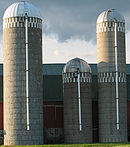 |
Concrete stave silos are constructed from small precast concrete blocks with ridged grooves along each edge that lock them together into a high strength shell. Much of concrete's strength comes from its high compressibility, so the silo is held together by steel hoops encircling the tower and compressing the staves into a tight ring. The vertical stacks are held together by intermeshing of the ends of the staves by a short distance around the perimeter of each layer, and hoops which are tightened directly across the stave edges.
The static pressure of the material inside the silo pressing outward on the staves increases towards the bottom of the silo, so the hoops can be spaced wide apart near the top but become progressively more closely spaced towards the bottom to prevent seams from opening and the contents leaking out.
Concrete stave silos are built from common components designed with high strength and long life. They have the flexibility to have their height increased according to the needs of the farm and purchasing power of the farmer, or to be completely disassembled and reinstalled somewhere else if no longer needed.
Low-oxygen tower silos
Low-oxygen silos (commonly seen as blue Harvestore farm silos) are designed to keep the contents in a low-oxygen atmosphere at all times to keep the fermented contents in a high quality state and to prevent mold and decay, as may occur in the top layers of a stave silo or bunker. These silos are only opened directly to the atmosphere during the initial forage loading, and even the unloader chute is sealed.It would be expensive to design a such a large structure that is immune to atmospheric pressure changes over time. Instead, the silo structure is open to the atmosphere but outside air is separated from internal air by large impermeable bags sealed to the silo breather openings. In the warmth of the day when the silo is heated by the sun, the gas trapped inside the silo expands and the bags "breathe out" and collapse. At night the silo cools, the air inside contracts and the bags "breathe in" and expand again.
While the iconic blue Harvestore low-oxygen silos were once very common, the speed of its unloader mechanism was not able to match the output rates of modern bunker silos and this type of silo went into decline. Unloader repair expenses also severely hurt the Harvestore reputation, because the unloader feed mechanism is located in the bottom of the silo under tons of silage. In the event of cutter chain breakage, it can cost up to US$10,000 to perform repairs. The silo may need to be partially or completely emptied by alternate means, to unbury the broken unloader retrieve broken components lost in the silage at the bottom of the structure.
In 2005 the Harvestore company recognized these issues and worked to develop new unloaders with double the flow rate of previous models to stay competitive with bunkers, and with far greater unloader chain strength. They are now also using load sensing soft-start variable frequency drive
Variable frequency drive
A variable-frequency drive is a system for controlling the rotational speed of an alternating current electric motor by controlling the frequency of the electrical power supplied to the motor. A variable frequency drive is a specific type of adjustable-speed drive...
motor controllers to reduce the likelihood of mechanism breakage, and to control the feeder sweep arm movement.
While the sight of multiple tall silos may look impressive, many have been abandoned for silage use, or converted to hold grain. Ground-level bunker silos carry none of the hazards outlined above, and need only a standard tractor/loader to feed out with, and no specialized machinery.
Bunker silos
Bunker silos are trenches, usually with concrete walls, that are filled and packed with tractors and loaders. The filled trench is covered with a plastic tarp to make it airtight. These silos are usually unloaded with a tractor and loader. They are inexpensive and especially well suited to very large operations.Bag silos
Bag silos are heavyweight plastic tubes, usually around 8 to 12 ft in diameter, and of variable length as required for the amount of material to be stored. They are packed using a machine made for the purpose, and sealed on both ends. They are unloaded using a tractor and loader or skid-steer loaderSkid loader
A skid loader or skid steer loader is a small rigid frame, engine-powered machine with lift arms used to attach a wide variety of labor-saving tools or attachments. Though sometimes they are equipped with tracks, skid-steer loaders are typically four-wheel drive vehicles with the left-side drive...
. The bag is discarded in sections as it is torn off. Bag silos require little capital investment. They can be used as a temporary measure when growth or harvest conditions require more space, though some farms use them every year.
Bins
The stored material may be powdered, as seed kernels, or as cob corn. Due to the dry nature of the stored material, it tends to be lighter than silage and can be more easily handled by under-floor grain unloaders. To facilitate drying after harvesting, some grain bins contain a hollow perforated or screened central shaft to permit easier air infiltration into the stored grain.
Sand and Salt Silos
Sand and salt for winter road maintenance are stored in conical dome shaped silos. These are more common in North AmericaNorth America
North America is a continent wholly within the Northern Hemisphere and almost wholly within the Western Hemisphere. It is also considered a northern subcontinent of the Americas...
, namely in Canada
Canada
Canada is a North American country consisting of ten provinces and three territories. Located in the northern part of the continent, it extends from the Atlantic Ocean in the east to the Pacific Ocean in the west, and northward into the Arctic Ocean...
and the United States
United States
The United States of America is a federal constitutional republic comprising fifty states and a federal district...
.
History
The first silo, a wooden and upright one filled with grainGRAIN
GRAIN is a small international non-profit organisation that works to support small farmers and social movements in their struggles for community-controlled and biodiversity-based food systems. Our support takes the form of independent research and analysis, networking at local, regional and...
, was invented and built in 1873 by Henry Hatch of McHenry County, Illinois
McHenry County, Illinois
McHenry County is a county located in the U.S. state of Illinois. According to the 2010 census, it has a population of 308,760, which is an increase of 18.7% from 260,077 in 2000. Its county seat is Woodstock. This county is part of the Chicago metropolitan area. It is the sixth largest county, in...
, USA.
Forage harvesting
Forage silo filling is performed using a forage harvesterForage harvester
A forage harvester is a farm implement that harvests forage plants to make silage. Silage is grass, corn or other plant that has been chopped into small pieces, and compacted together in a storage silo, silage bunker, or in silage bags. The silage is then fermented to provide feed for livestock...
which may either be self-propelled with an engine and driver's cab, or towed behind a tractor
Tractor
A tractor is a vehicle specifically designed to deliver a high tractive effort at slow speeds, for the purposes of hauling a trailer or machinery used in agriculture or construction...
that supplies power through a PTO
PTO
PTO is an abbreviation for:* United States Patent and Trademark Office or any other Patent and Trademark Office * Parent Teacher Organization - organization that consists of parents, teachers and school staff...
.
The harvester contains a drum-shaped series of cutting knives which shear the fibrous plant material into small pieces no more than an inch long, to facilitate mechanized blowing and transport via augers. The finely chopped plant material is then blown by the harvester into a forage wagon which contains an automatic unloading system.
Tower filling
Tower forage filling is typically performed with a silo blower which is a very large fan with paddle-shaped blades. Material is fed into a vibrating hopperHopper
Hopper may refer to:-Mechanical parts:* A general term for a chute with additional width and depth for temporary storage* Hopper , a large container used for dust collection* Part of a combine harvester...
and is pushed into the blower using a spinning spiral auger
Auger
An auger is a drilling device, or drill bit, that usually includes a rotating helical screw blade called a "flighting" to act as a screw conveyor to remove the drilled out material...
.
There is commonly a water connection on the blower to add moisture to the plant matter being blown into the silo. The blower may be driven by an electric motor but it is more common to use a spare tractor
Tractor
A tractor is a vehicle specifically designed to deliver a high tractive effort at slow speeds, for the purposes of hauling a trailer or machinery used in agriculture or construction...
instead.
A large slow-moving conveyor chain underneath the silage in the forage wagon moves the pile towards the front, where rows of rotating teeth break up the pile and drop it onto a high-speed transverse conveyor that pours the silage out the side of the wagon into the blower hopper.
Bag filling
Silo bags are filled using a traveling sled driven from the PTO of a tractor left in neutral and which is gradually pushed forward as the bag is filled. The steering of the tractor controls the direction of bag placement as it fills, but bags are normally laid in a straight line.The bag is loaded using the same forage harvesting methods as the tower, but the forage wagon must be moved progressively forward with the bag loader. The loader uses an array of rotating cam-shaped spiraled teeth associated with a large comb
Comb
A comb is a toothed device used in hair care for straightening and cleaning hair or other fibres. Combs are among the oldest tools found by archaeologists...
-shaped tines to push forage into the bag. The forage is pushed in through a large opening, and as the teeth rotate back out, they pass between the comb tines. The cam-shaped auger teeth essentially wipe the forage off using the steel tines, keeping the forage in the bag.
Before filling begins, the entire bag is placed onto the loader as a bunched-up tube folded back on itself in many layers to form a thick pile of plastic. Because the plastic is minimally elastic, the loader mechanism filling chute is slightly smaller than the final size of the bag, to accommodate this stack of plastic around the mouth of the loader. The plastic slowly unfurls itself around the edges of the loader as the tube is filled.
The contents of the silo bag are under pressure as it is filled, with the pressure controlled by a large brake shoe pressure regulator, holding back two large winch drums on either side of the loader. Cables from the drum extend to the rear of the bag where a large mesh basket holds the rear end of the bag shut.
To prevent molding and to assure an airtight seal during fermentation, the ends of the silo bag tube are gathered, folded, and tied shut to prevent oxygen from entering the bag. Removal of the bag loader can be hazardous to bystanders since the pressure must be released and the rear end allowed to collapse onto the ground.
Tower unloading
 |
 |
 |
 |
 |
 |
A silo unloader specifically refers to a special cylindrical rotating forage
Forage
Forage is plant material eaten by grazing livestock.Historically the term forage has meant only plants eaten by the animals directly as pasture, crop residue, or immature cereal crops, but it is also used more loosely to include similar plants cut for fodder and carried to the animals, especially...
pickup device used inside a single tower silo.
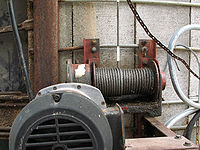
The main operating component of the silo unloader is suspended in the silo from a steel cable on a pulley
Pulley
A pulley, also called a sheave or a drum, is a mechanism composed of a wheel on an axle or shaft that may have a groove between two flanges around its circumference. A rope, cable, belt, or chain usually runs over the wheel and inside the groove, if present...
that is mounted in the top-center of the roof of the silo. The vertical positioning of the unloader is controlled by an electric winch
Winch
A winch is a mechanical device that is used to pull in or let out or otherwise adjust the "tension" of a rope or wire rope . In its simplest form it consists of a spool and attached hand crank. In larger forms, winches stand at the heart of machines as diverse as tow trucks, steam shovels and...
on the exterior of the silo.
For the summer filling of a tower silo, the unloader is winched as high as possible to the top of the silo and put into a parking position. The silo is filled with a silo blower, which is literally a very large fan that blows a large volume of pressurized air up a 10-inch tube on the side of the silo. A small amount of water is introduced into the air stream during filling to help lubricate the filling tube. A small adjustable nozzle at the top, controlled by a handle at the base of the silo directs the silage to fall into the silo on the near, middle, or far side, to facilitate evenly layered loading. Once completely filled, the top of the exposed silage pile is covered with a large heavy sheet of silo plastic which seals out oxygen and permits the entire pile to begin to ferment
Fermentation (biochemistry)
Fermentation is the process of extracting energy from the oxidation of organic compounds, such as carbohydrates, using an endogenous electron acceptor, which is usually an organic compound. In contrast, respiration is where electrons are donated to an exogenous electron acceptor, such as oxygen,...
in the autumn.
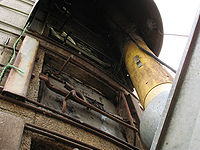
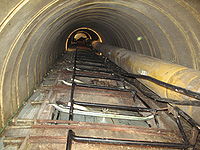
In the winter when animals must be kept indoors, the silo plastic is removed, the unloader is lowered down onto the top of the silage pile, and a hinged door is opened on the side of the silo to permit the silage to be blown out. There is an array of these access doors arranged vertically up the side of the silo, with an unloading tube next to the doors that has a series of removable covers down the side of the tube. The unloader tube and access doors are normally covered with a large U-shaped shield mounted on the silo, to protect the farmer from wind, snow, and rain while working on the silo.
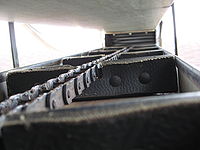
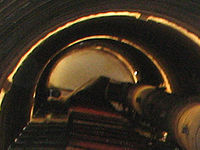
The silo unloader mechanism consists of a pair of counter-rotating toothed augers which rip up the surface of the silage and pull it towards the center of the unloader. The toothed augers rotate in a circle around the center hub, evenly chewing the silage off the surface of the pile. In the center, a large blower assembly picks up the silage and blows it out the silo door, where the silage falls by gravity down the unloader tube to the bottom of the silo, typically into an automated conveyor system.
The unloader is typically lowered only a half-inch or so at a time by the operator, and the unloader picks up only a small amount of material until the winch cable has become taut and the unloader is not picking up any more material. The operator then lowers the unloader another half-inch or so and the process repeats. If lowered too far, the unloader can pull up much more material than it can handle, which can overflow and plug up the blower, outlet spout, and the unloader tube, resulting in a time-wasting process of having to climb up the silo to clear the blockages.
Once silage has entered the conveyor system, it can be handled by either manual or automatic distribution systems. The simplest manual distribution system uses a sliding metal platform under the pickup channel. When slid open, the forage drops through the open hole and down a chute into a wagon, wheelbarrow, or open pile. When closed, the forage continues past the opening and onward to other parts of the conveyor. Computer automation and a conveyor running the length of a feeding stall can permit the silage to be automatically dropped from above by each animal, with the amount dispensed customized for each location.
Tower forage silo hazards
There are also many opportunities for a farmer to be injured, maimed, or killed by the various mechanical systems of the silo loading and unloading process. Filling a silo requires parking two tractors very close to each other, both running at full power and with live PTO shafts, one powering the silo blower and the other powering a forage wagon unloading fresh-cut forage into the blower. The farmer must continually move around in this highly hazardous environment of spinning shafts and high-speed conveyors to check material flows and adjust speeds, and to start and stop all the equipment between loads.Preparation for filling a silo requires winching the unloader to the top, and any remaining forage at the base that the unloader could not pick up must be removed from the floor of the silo. This job requires that the farmer work directly underneath a machine weighing several tons suspended fifty feet or more overhead from a small steel cable. If the unloader were to fall, the farmer would likely be killed instantly.
Unloading also poses its own special hazards, due to the requirement that the farmer regularly climb the silo to close an upper door and open a lower door, moving the unloader chute from door to door in the process. The fermentation of the silage produces methane gas which over time will outgas and displace the oxygen in the top of the silo. A farmer directly entering a silo without any other precautions can be asphyxiated by the methane, knocked unconscious, and silently suffocate to death before anyone else knows what has happened. It is either necessary to leave the silo blower attached to the silo at all times to use it when necessary to ventilate the silo with fresh air, or to have a dedicated electric fan system to blow fresh air into the silo, before anyone attempts to enter it.
In the event that the unloader mechanism becomes plugged, the farmer must climb the silo and directly stand on the unloader, reaching into the blower spout to dig out the soft silage. After clearing a plug, the forage needs to be forked out into an even layer around the unloader so that the unloader does not immediately dig into the pile and plug itself again. All during this process the farmer is standing on or near a machine that could easily kill them in seconds if it were to accidentally start up. This can happen if someone in the barn were to unknowingly switch on the unloading mechanism while someone is in the silo working on the unloader.
Dry-material / bin hazards
There have also been many cases of silos and the associated ducts and buildings exploding. If the air inside becomes laden with finely granulated particles, such as grain dust, a spark can trigger an explosion powerful enough to blow a concrete silo and adjacent buildings apart, usually setting the adjacent grain and building on fire. Sparks are often caused by (metal) rubbing against metal ducts; or due to static electricity produced by dust moving along the ducts when extra dry.
The two main problems which will necessitate cleaning in dry-matter silos and bins are Bridging and Rat-holing. Bridging occurs when the material interlaces over the unloading mechanism at the base of the silo and blocks the flow of stored material by gravity into the unloading system. Rat-holing occurs when the material starts to adhere to the side of the silo. This will reduce the operating capacity of a silo as well as leading to cross-contamination of newer material with older material. There are a number of ways to clean a silo
Silo cleaning
Silo cleaning is a process to maximize the efficiency of storage silos that hold bulk powders or granules. In silos, material is fed through the top and removed from the bottom...
and many of these carry their own risks. However since the early 1990s acoustic cleaners have become available. These are non-invasive, have minimum risk, and can offer a very cost-effective way to keep a small particle silo clean.
Notable silos
- Schapfen-Mill-Tower, UlmUlmUlm is a city in the federal German state of Baden-Württemberg, situated on the River Danube. The city, whose population is estimated at 120,000 , forms an urban district of its own and is the administrative seat of the Alb-Donau district. Ulm, founded around 850, is rich in history and...
, GermanyGermanyGermany , officially the Federal Republic of Germany , is a federal parliamentary republic in Europe. The country consists of 16 states while the capital and largest city is Berlin. Germany covers an area of 357,021 km2 and has a largely temperate seasonal climate...
, height: 130 metres - Henninger TurmHenninger TurmThe Henninger-Turm is a grain storage silo located in the Frankfurt district of Sachsenhausen. It was built by the Henninger Brewery and has a storage capacity of 16,000 tons of barley. The , 33-story high tower was designed by Karl Lieser and was built from 1959 to 1961...
, FrankfurtFrankfurtFrankfurt am Main , commonly known simply as Frankfurt, is the largest city in the German state of Hesse and the fifth-largest city in Germany, with a 2010 population of 688,249. The urban area had an estimated population of 2,300,000 in 2010...
, GermanyGermanyGermany , officially the Federal Republic of Germany , is a federal parliamentary republic in Europe. The country consists of 16 states while the capital and largest city is Berlin. Germany covers an area of 357,021 km2 and has a largely temperate seasonal climate...
, has an observation deck and 2 revolving restaurants, height: 120 metres - Silo Tower BaselSilo Tower BaselThe Silo Tower of Basel is located in the Swiss city of Basel, in the Rhine harbour of Kleinhueningen, near the Dreilaenderecks. The silo tower was built in 1923 by a Swiss shipping company. Its viewing platform stands at a height of 52 metres , which offers a view of the Rhine, the Rhine...
, BaselBaselBasel or Basle In the national languages of Switzerland the city is also known as Bâle , Basilea and Basilea is Switzerland's third most populous city with about 166,000 inhabitants. Located where the Swiss, French and German borders meet, Basel also has suburbs in France and Germany...
, SwitzerlandSwitzerlandSwitzerland name of one of the Swiss cantons. ; ; ; or ), in its full name the Swiss Confederation , is a federal republic consisting of 26 cantons, with Bern as the seat of the federal authorities. The country is situated in Western Europe,Or Central Europe depending on the definition....
, has an observation deck, height: 52 metres - Quaker SquareQuaker SquareQuaker Square is a mall located in downtown Akron, Ohio, which is the result of the renovation of the Quaker Oats mill, silos, and factory which originally operated there. The complex is currently a hotel and a dormitory for the University of Akron.-History:...
, Akron, OhioAkron, OhioAkron , is the fifth largest city in the U.S. state of Ohio and the county seat of Summit County. It is located in the Great Lakes region approximately south of Lake Erie along the Little Cuyahoga River. As of the 2010 census, the city had a population of 199,110. The Akron Metropolitan...
, United StatesUnited StatesThe United States of America is a federal constitutional republic comprising fifty states and a federal district...
, is a former set of tower silos that is now a hotel, restaurants and shops - Dagon, HaifaHaifaHaifa is the largest city in northern Israel, and the third-largest city in the country, with a population of over 268,000. Another 300,000 people live in towns directly adjacent to the city including the cities of the Krayot, as well as, Tirat Carmel, Daliyat al-Karmel and Nesher...
, Israel - transformed into a museum of agriculture, a prominent local feature.
External links
- International Silo Association
- What To Do In Case Of Grain Bin Entrapment, from the U.S. National Agricultural Safety Database