

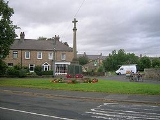
Wylam

Encyclopedia
Wylam is a small village about 10 miles (16.1 km) west of Newcastle upon Tyne
Newcastle upon Tyne
Newcastle upon Tyne is a city and metropolitan borough of Tyne and Wear, in North East England. Historically a part of Northumberland, it is situated on the north bank of the River Tyne...
. It is located in the county of Northumberland
Northumberland
Northumberland is the northernmost ceremonial county and a unitary district in North East England. For Eurostat purposes Northumberland is a NUTS 3 region and is one of three boroughs or unitary districts that comprise the "Northumberland and Tyne and Wear" NUTS 2 region...
.
It is famous for the being the birthplace of George Stephenson
George Stephenson
George Stephenson was an English civil engineer and mechanical engineer who built the first public railway line in the world to use steam locomotives...
, one of the early rail pioneers. George Stephenson's Birthplace
George Stephenson's Birthplace
George Stephenson's Birthplace is the 18th-century stone cottage home of rail pioneer George Stephenson. Located along the north bank of the River Tyne in the village of Wylam, Northumberland, the cottage is owned by the National Trust and is open to the public as a historic house museum...
is his cottage that can be found on the north bank of the Tyne
River Tyne
The River Tyne is a river in North East England in Great Britain. It is formed by the confluence of two rivers: the North Tyne and the South Tyne. These two rivers converge at Warden Rock near Hexham in Northumberland at a place dubbed 'The Meeting of the Waters'.The North Tyne rises on the...
three quarters of a mile (1.2 km) east of the village centre. It is owned by the National Trust
National Trust for Places of Historic Interest or Natural Beauty
The National Trust for Places of Historic Interest or Natural Beauty, usually known as the National Trust, is a conservation organisation in England, Wales and Northern Ireland...
and is open to the public.
Wylam has further connections with the early rail pioneers. The steam locomotive engineer Timothy Hackworth
Timothy Hackworth
Timothy Hackworth was a steam locomotive engineer who lived in Shildon, County Durham, England and was the first locomotive superintendent of the Stockton and Darlington Railway.- Youth and early work :...
, who worked with Stephenson, was also born here. William Hedley
William Hedley
William Hedley was one of the leading industrial engineers of the early 19th century, and was very instrumental in several major innovations in early railway development...
who was born in the nearby village of Newburn
Newburn
Newburn is a semi rural village, parish, electoral ward and former urban district in western Tyne and Wear, North East England. Situated on the banks of the River Tyne, it is built rising up the valley from the river...
attended the village school. He later went on to design and manufacture Puffing Billy
Puffing Billy (locomotive)
Puffing Billy is an early railway steam locomotive, constructed in 1813-1814 by engineer William Hedley, enginewright Jonathan Forster and blacksmith Timothy Hackworth for Christopher Blackett, the owner of Wylam Colliery near Newcastle upon Tyne, in the United Kingdom. It is the world's oldest...
in 1813, two years before George Stephenson produced his first locomotive Blücher
Blücher (locomotive)
Blücher was an early railway locomotive built in 1814 by George Stephenson for Killingworth Colliery. It was the first of a series of locomotives that he designed in the period 1814-16 which established his reputation as an engine designer and laid the foundations for his subsequent pivotal role in...
.
History
Once an industrial workplace with collieries and an ironworks, it is now a commuting village for Newcastle upon TyneNewcastle upon Tyne
Newcastle upon Tyne is a city and metropolitan borough of Tyne and Wear, in North East England. Historically a part of Northumberland, it is situated on the north bank of the River Tyne...
and Hexham
Hexham
Hexham is a market town and civil parish in Northumberland, England, located south of the River Tyne, and was the administrative centre for the Tynedale district from 1974 to 2009. The three major towns in Tynedale were Hexham, Prudhoe and Haltwhistle, although in terms of population, Prudhoe was...
, served by the Newcastle and Carlisle Railway
Newcastle and Carlisle Railway
The Newcastle and Carlisle Railway, occasionally referred to as the Tyne Valley Line, is a railway line in northern England. The line was built in the 1830s, and links the city of Newcastle upon Tyne in Tyne and Wear with in Cumbria. Formal opening took place on 18 June 1838.The line follows the...
.
The earliest reference to Wylam is in a record of 1158 that records that the settlement belonged to the Priory at Tynemouth
Tynemouth
Tynemouth is a town and a historic borough in Tyne and Wear, England, at the mouth of the River Tyne, between North Shields and Cullercoats . It is administered as part of the borough of North Tyneside, but until 1974 was an independent county borough in its own right...
. It is thought that Guy de Balliol, Lord of Bywell, gave Wylam to the Priory in 1085. The Priors of Tynemouth held lands in the village until the dissolution of the monasteries in the 16th century.
The Blackett family
Blackett of Wylam
The Blacketts of Wylam were a branch of the ancient family of Blackett of Hoppyland, County Durham, England and were related to the Blackett Baronets....
have had a long association with the village. In 1659 Christopher Blackett acquired the Lordship of the Manor of Wylam on the death of his wife's father, Thomas Fenwick. Following Christopher's death, his second son, John Blackett, took over the estate and purchased additional land in the area, including two farms at Wylam bought in 1685. These farms formed a modest estate and residence for the Blackett family until the third quarter of the twentieth century. The Lordship also included mineral rights within the township. This allowed the family to develop the colliery and further increase their prosperity.
An article in The Newcastle Courant of 17 January 1874 entitled "Our Colliery Villages" paints an unattractive image of the village - 'Wylam is the very worst colliery village that we have yet beheld …'. The colliery has an important place in the history of the development of the locomotive. It is thought that the Wylam waggonway was opened in 1748 and was therefore one of the earliest waggonways in the north of England. The waggonway linked the colliery to the staiths
Wharf
A wharf or quay is a structure on the shore of a harbor where ships may dock to load and unload cargo or passengers.Such a structure includes one or more berths , and may also include piers, warehouses, or other facilities necessary for handling the ships.A wharf commonly comprises a fixed...
at Lemington from where the coal was taken down The River Tyne
River Tyne
The River Tyne is a river in North East England in Great Britain. It is formed by the confluence of two rivers: the North Tyne and the South Tyne. These two rivers converge at Warden Rock near Hexham in Northumberland at a place dubbed 'The Meeting of the Waters'.The North Tyne rises on the...
on flat bottomed boats called keels to be loaded on the large coal ships further down the river.
Several famous engineers have also had links with the village. George Stephenson
George Stephenson
George Stephenson was an English civil engineer and mechanical engineer who built the first public railway line in the world to use steam locomotives...
was born at a small cottage at Wylam in June 1781. Timothy Hackworth
Timothy Hackworth
Timothy Hackworth was a steam locomotive engineer who lived in Shildon, County Durham, England and was the first locomotive superintendent of the Stockton and Darlington Railway.- Youth and early work :...
's father was foreman blacksmith at the colliery and his son was born in the village in December 1786. Hackworth together with William Hedley
William Hedley
William Hedley was one of the leading industrial engineers of the early 19th century, and was very instrumental in several major innovations in early railway development...
and Jonathan Forster were involved in the development of the locomotive engine at the colliery. Perhaps the most famous of the engines to be developed was The Puffing Billy
Puffing Billy (locomotive)
Puffing Billy is an early railway steam locomotive, constructed in 1813-1814 by engineer William Hedley, enginewright Jonathan Forster and blacksmith Timothy Hackworth for Christopher Blackett, the owner of Wylam Colliery near Newcastle upon Tyne, in the United Kingdom. It is the world's oldest...
, which is now housed at The Science Museum in London.
The late eighteenth century was a period of prosperity for the village - the colliery was thriving and an ironworks, a leadshot manufactury and a brewery were all established in the village. In 1864 the ironworks closed. Four years later the colliery was closed. The brewery ceased to operate sometime in the 1870s. This decline in the industry led to a change in the character of the village. By the 20th century the village was almost entirely a residential settlement. http://communities.northumberland.gov.uk/Wylam.htm
Wylam has approximately 800 households, with a population of 2,100.http://www.northumberland.gov.uk/vg/wylam.htm
Governance
is in the parliamentary constituency of HexhamHexham (UK Parliament constituency)
- Elections in the 2000s :- Elections in the 1990s :- Elections in the 1980s :- Elections in the 1970s :-Notes and references:...
.
Landmarks
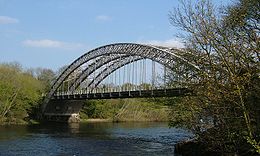
Wylam Railway Bridge
Wylam Railway Bridge, also known locally as Points Bridge, Half-moon Bridge, Hagg Bank Bridge, Bird Cage Bridge, or The Tin Bridge, is a footbridge and former railway bridge crossing the River Tyne at Hagg Bank, approximately west of Wylam in Northumberland, England.- History :The bridge was...
(also known as Points Bridge and the Half Moon bridge) is located at Hagg Bank, approximately 1 miles (1.6 km) west of the town. It is a wrought iron
Wrought iron
thumb|The [[Eiffel tower]] is constructed from [[puddle iron]], a form of wrought ironWrought iron is an iron alloy with a very low carbon...
bridge built by the Scotswood Newburn and Wylam Railway Company in 1876 to link the North Wylam Loop with the Newcastle and Carlisle Railway
Newcastle and Carlisle Railway
The Newcastle and Carlisle Railway, occasionally referred to as the Tyne Valley Line, is a railway line in northern England. The line was built in the 1830s, and links the city of Newcastle upon Tyne in Tyne and Wear with in Cumbria. Formal opening took place on 18 June 1838.The line follows the...
.
The original plan had been to build a bridge with four spans resting on three piers on the river bed. This was rejected by the local coal companies who feared that the construction of the piers on the river bed would disturb the shallow mine workings below, which already suffered from flooding.
The designers found the solution in designing a single span bridge carrying a double track, without the need for piers. The bridge consists of three parallel wrought iron arches resting on abutments on each bank, with the twin rail decks suspended by 14 wrought iron drop bars. It cost £16,000 to build. The bridge paved the way for new developments in bridge building - Newcastle's Tyne Bridge
Tyne Bridge
The Tyne Bridge is a through arch bridge over the River Tyne in North East England, linking Newcastle upon Tyne and Gateshead. It was designed by the engineering firm Mott, Hay and Anderson, who later designed the Forth Road Bridge, and was built by Dorman Long and Co. of Middlesbrough. At the time...
in 1928, and Sydney Harbour Bridge
Sydney Harbour Bridge
The Sydney Harbour Bridge is a steel through arch bridge across Sydney Harbour that carries rail, vehicular, bicycle and pedestrian traffic between the Sydney central business district and the North Shore. The dramatic view of the bridge, the harbour, and the nearby Sydney Opera House is an iconic...
in 1932, being direct descendants of the design and construction of Hagg's Bridge.
Many of the trains which used the bridge carried coal from the collieries at Newburn
Newburn
Newburn is a semi rural village, parish, electoral ward and former urban district in western Tyne and Wear, North East England. Situated on the banks of the River Tyne, it is built rising up the valley from the river...
and Walbottle
Walbottle
Walbottle is a village in Tyne and Wear. It is a western suburb of Newcastle upon Tyne. The village name, recorded in 1176 as "Walbotl", is derived from the Old English botl on the Roman Wall...
westwards to Carlisle.
The line was closed in 1968 and the bridge later purchased by Northumberland County Council
Northumberland County Council
Northumberland County Council is a unitary authority in North East England. It was originally formed in 1889 as the council for the administrative county of Northumberland and reformed in 1974 to cover a the newly formed non-metropolitan county of Northumberland...
. It was restored in 1997 with help from the Heritage Lottery Fund
Heritage Lottery Fund
The Heritage Lottery Fund is a fund established in the United Kingdom under the National Lottery etc. Act 1993. The Fund opened for applications in 1994. It uses money raised through the National Lottery to transform and sustain the UK’s heritage...
. All the old lead based paint was removed requiring the bridge to be wrapped in plastic to prevent polluting the river.http://www.cycle-routes.org/hadrianscycleway/crossings/hagg_bank.html
The War Memorial, which is a cross about 8 metres (26 ft) in height, stands by the roadside just to the north of Wylam bridge. The inscriptions and names on the War Memorial have been transcribed and published by the North East War Memorials Project.
Transport
RailwayThe village is served by Wylam railway station
Wylam railway station
Wylam railway station is a railway station serving Wylam in Northumberland, England. It is located on the Newcastle and Carlisle Railway, west of Newcastle on the route to Carlisle. It was formerly one of two stations in Wylam, the other being North Wylam Station on the Scotswood, Newburn & Wylam...
on the Newcastle and Carlisle Railway
Newcastle and Carlisle Railway
The Newcastle and Carlisle Railway, occasionally referred to as the Tyne Valley Line, is a railway line in northern England. The line was built in the 1830s, and links the city of Newcastle upon Tyne in Tyne and Wear with in Cumbria. Formal opening took place on 18 June 1838.The line follows the...
, also known as the Tyne Valley Line. The line was opened in 1838, and links the city of Newcastle upon Tyne
Newcastle upon Tyne
Newcastle upon Tyne is a city and metropolitan borough of Tyne and Wear, in North East England. Historically a part of Northumberland, it is situated on the north bank of the River Tyne...
in Tyne and Wear
Tyne and Wear
Tyne and Wear is a metropolitan county in north east England around the mouths of the Rivers Tyne and Wear. It came into existence as a metropolitan county in 1974 after the passage of the Local Government Act 1972...
with Carlisle
Carlisle railway station
Carlisle railway station, also known as Carlisle Citadel station, is a railway station whichserves the Cumbrian City of Carlisle, England, and is a major station on the West Coast Main Line, lying south of Glasgow Central, and north of London Euston...
in Cumbria
Cumbria
Cumbria , is a non-metropolitan county in North West England. The county and Cumbria County Council, its local authority, came into existence in 1974 after the passage of the Local Government Act 1972. Cumbria's largest settlement and county town is Carlisle. It consists of six districts, and in...
. The line follows the course of the River Tyne
River Tyne
The River Tyne is a river in North East England in Great Britain. It is formed by the confluence of two rivers: the North Tyne and the South Tyne. These two rivers converge at Warden Rock near Hexham in Northumberland at a place dubbed 'The Meeting of the Waters'.The North Tyne rises on the...
through Northumberland
Northumberland
Northumberland is the northernmost ceremonial county and a unitary district in North East England. For Eurostat purposes Northumberland is a NUTS 3 region and is one of three boroughs or unitary districts that comprise the "Northumberland and Tyne and Wear" NUTS 2 region...
. Passenger services on the line are operated by Northern Rail
Northern Rail
Northern Rail is a British train operating company that has operated local passenger services in Northern England since 2004. Northern Rail's owner, Serco-Abellio, is a consortium formed of Abellio and Serco, an international operator of public transport systems...
and First ScotRail
First ScotRail
ScotRail Railways Ltd. is the FirstGroup-owned train operating company running domestic passenger trains within Scotland, northern England and the cross-border Caledonian Sleeper service to London using the brand ScotRail which is the property of the Scottish Government...
. The line is also heavily used for freight.
The railway station is on the south bank of the River Tyne
River Tyne
The River Tyne is a river in North East England in Great Britain. It is formed by the confluence of two rivers: the North Tyne and the South Tyne. These two rivers converge at Warden Rock near Hexham in Northumberland at a place dubbed 'The Meeting of the Waters'.The North Tyne rises on the...
. There used to be another railway station in Wylam on the north bank of the river, which was part of the Scotswood, Newburn and Wylam Railway. The line has now closed and the tracks removed, with the North Wylam station area now being used as a car park.
Bus
The bus service to and from Wylam is poor and many services have been discontinued over recent years.
Cyclepath
After the Scotswood, Newburn and Wylam Railway Line was closed the trackwork was removed and the trackbed later converted into a cyclepath. That cyclepath forms part of National Cycle Network
National Cycle Network
The National Cycle Network is a network of cycle routes in the United Kingdom.The National Cycle Network was created by the charity Sustrans , and aided by a £42.5 million National Lottery grant. In 2005 it was used for over 230 million trips.Many routes hope to minimise contact with motor...
Route 72 and starts at Tyne Riverside Country Park at Low Prudhoe. After Wylam it keeps to the north side of the River Tyne, linking Wylam with Newcastle upon Tyne
Newcastle upon Tyne
Newcastle upon Tyne is a city and metropolitan borough of Tyne and Wear, in North East England. Historically a part of Northumberland, it is situated on the north bank of the River Tyne...
and the coast at Tynemouth
Tynemouth
Tynemouth is a town and a historic borough in Tyne and Wear, England, at the mouth of the River Tyne, between North Shields and Cullercoats . It is administered as part of the borough of North Tyneside, but until 1974 was an independent county borough in its own right...
. There is another cyclepath on the south side of the river which starts in the car park at Wylam railway station and links Wylam to Gateshead
Gateshead
Gateshead is a town in Tyne and Wear, England and is the main settlement in the Metropolitan Borough of Gateshead. Historically a part of County Durham, it lies on the southern bank of the River Tyne opposite Newcastle upon Tyne and together they form the urban core of Tyneside...
and the coast at South Shields
South Shields
South Shields is a coastal town in Tyne and Wear, England, located at the mouth of the River Tyne to Tyne Dock, and about downstream from Newcastle upon Tyne...
.
Religious sites
Wylam's parish church was built in 1886 and is dedicated to St. OswinOswine of Deira
Oswine was a King of Deira in northern England. He succeeded King Oswald of Northumbria, probably around the year 644, after Oswald's death at the Battle of Maserfield. Oswine was the son of Osric....
, a Northumbrian saint. Wylam St. Oswin's has a regular Sunday and weekday services. Pre-1886 the villagers of Wylam had to walk to nearby Ovingham
Ovingham
Ovingham is a civil parish and village in the Tyne Valley of south Northumberland, England. It lies on the River Tyne east of Hexham with neighbours Prudhoe, Ovington, Wylam and Stocksfield....
to attend church, George and William Hedley, sons of Frances and William, the railway engineer, contributed most of the money needed to build the church so the Anglicans of Wylam could have their own place of Worship. The Church has six bells with regular sunday ringing and a practice night on mondays.
Wylam also has a Methodist Chapel, located on Chapel Lane. The Chapel was extended in the 1990s to extend the worship and meeting areas, and to also include a kitchen.
Churches in and around Wylam, notably Horsley
Horsley
Horsley may refer to:* Horsley , a surname* Hawker Horsley, a 1920s bomber aircraft produced by Hawker Aircraftplaces in Australia*Horsley, New South Wales, a suburb in Wollongong, New South Wales, Australia...
and Crawcrook
Crawcrook
Crawcrook is a semi-rural village close to the western border of the metropolitan county of Tyne and Wear in England. Traditionally an independent village in County Durham it has since been incorporated into the Metropolitan Borough of Gateshead.-Location:...
, of different denominations
Christian denomination
A Christian denomination is an identifiable religious body under a common name, structure, and doctrine within Christianity. In the Orthodox tradition, Churches are divided often along ethnic and linguistic lines, into separate churches and traditions. Technically, divisions between one group and...
have a covenant to work together in the community, to share in youth work and some special services such as Harvest
Harvest
Harvest is the process of gathering mature crops from the fields. Reaping is the cutting of grain or pulse for harvest, typically using a scythe, sickle, or reaper...
, Remembrance Day
Remembrance Day
Remembrance Day is a memorial day observed in Commonwealth countries since the end of World War I to remember the members of their armed forces who have died in the line of duty. This day, or alternative dates, are also recognized as special days for war remembrances in many non-Commonwealth...
and some Christmas
Christmas
Christmas or Christmas Day is an annual holiday generally celebrated on December 25 by billions of people around the world. It is a Christian feast that commemorates the birth of Jesus Christ, liturgically closing the Advent season and initiating the season of Christmastide, which lasts twelve days...
and Easter
Easter
Easter is the central feast in the Christian liturgical year. According to the Canonical gospels, Jesus rose from the dead on the third day after his crucifixion. His resurrection is celebrated on Easter Day or Easter Sunday...
Services.
Notable residents
- Basil BuntingBasil BuntingBasil Cheesman Bunting was a significant British modernist poet whose reputation was established with the publication of Briggflatts in 1966. He had a lifelong interest in music that led him to emphasise the sonic qualities of poetry, particularly the importance of reading poetry aloud...
- poet - Antonia ByattA. S. ByattDame Antonia Susan Duffy, DBE is an English novelist, poet and Booker Prize winner...
- novelist - Margaret Drabble - novelist
- Archibald Matthias DunnArchibald Matthias DunnArchibald Matthias Dunn FRIBA, JP, born in Wylam in Northumberland, was with his partner Edward Joseph Hansom, among the foremost Catholic architects in North East England during the Victorian era.-Biography:...
- Victorian architect - Greg DykeGreg DykeGregory "Greg" Dyke is a British media executive, journalist and broadcaster. Since the 1960s, Dyke has a long career in the UK in print and then broadcast journalism. He is credited with introducing 'tabloid' television to British broadcasting, and reviving the ratings of TV-am...
- broadcaster - Timothy HackworthTimothy HackworthTimothy Hackworth was a steam locomotive engineer who lived in Shildon, County Durham, England and was the first locomotive superintendent of the Stockton and Darlington Railway.- Youth and early work :...
- railway pioneer - William HedleyWilliam HedleyWilliam Hedley was one of the leading industrial engineers of the early 19th century, and was very instrumental in several major innovations in early railway development...
- railway pioneer - George StephensonGeorge StephensonGeorge Stephenson was an English civil engineer and mechanical engineer who built the first public railway line in the world to use steam locomotives...
- 'Father of the Railway' - Charles Algernon ParsonsCharles Algernon ParsonsSir Charles Algernon Parsons OM KCB FRS was an Anglo-Irish engineer, best known for his invention of the steam turbine. He worked as an engineer on dynamo and turbine design, and power generation, with great influence on the naval and electrical engineering fields...
- inventor of the steam turbine - John CallenderJohn Callender (footballer)John Callender was an English footballer.-Playing career:Callender played for Walker Celtic, Brighton & Hove Albion, Chesterfield, Ashington and Lincoln City before joining Port Vale in May 1938. He was unable to himself in the first team and after four games and one goal he was given a free...
(1903–1980), English footballer, born at West Wylam
External links
- Wylam Parish Council Homepage
- Map of Wylam, Northumberland
- Wylam Homepage
- Photographs of Wylam
- Northumberland Communities (accessed: 11 December 2008)