


Spintronics

Encyclopedia
Spintronics also known as magnetoelectronics, is an emerging technology that exploits both the intrinsic spin
of the electron
and its associated magnetic moment
, in addition to its fundamental electronic charge, in solid-state devices
.
An additional effect occurs when a spin-polarized current is induced. In these cases, the electron spin is quantized in the direction perpendicular to both the plane normal and the two-dimensional wave vector, thus splitting the energy band. This is called the Rashba effect
.
et al. and Peter Grünberg
et al. (1988). The origins of spintronics can be traced back even further to the ferromagnet/superconductor tunneling experiments pioneered by Meservey and Tedrow, and initial experiments on magnetic tunnel junctions by Julliere in the 1970s. The use of semiconductors for spintronics can be traced back at least as far as the theoretical proposal of a spin field-effect-transistor by Datta
and Das in 1990.
The total magnetic moment of an electron is equal to the sum of its spin moment (on account of its spin about its own axis) and the orbital (on account of its orbit around nucleus of an atom).
where:
It is found that the spin moment given by is twice as strong as the orbital moment.
The spin moment S is quantized and can be obtained from:
where
 is the spin angular momentum quantum number.
So the magnitude of the spin moment is always:
The orientation of the vector magnitude S is also restricted. Specifically, it’s projection onto a given axis is given by the spin projection quantum number:
where
To make a spintronic device, the primary requirements are, first, a system that can generate a current of spin-polarized electrons comprising more of one spin species—up or down—than the other (called a spin injector), and, secondly, a separate system sensitive to the spin polarization of the electrons (spin detector). Manipulation of the electron spin during transport between injector and detector (especially in semiconductors) via spin precession
can be accomplished using real external magnetic fields or effective fields caused by spin-orbit interaction
.
Spin polarization in non-magnetic materials can be achieved either through the Zeeman effect
in large magnetic fields and low temperatures, or by non-equilibrium methods. In the latter case, the non-equilibrium polarization will decay over a timescale called the "spin lifetime". Spin lifetimes of conduction electrons in metals are relatively short (typically less than 1 nanosecond
). However in semiconductors the lifetimes can be very long (microsecond
s at low temperatures), especially when the electrons are isolated in local trapping potentials (for instance, at impurities, where lifetimes can be millisecond
s).
(GMR) device. A typical GMR device consists of at least two layers of ferromagnetic materials separated by a spacer layer. When the two magnetization vectors of the ferromagnetic layers are aligned, the electrical resistance will be lower (so a higher current flows at constant voltage) than if the ferromagnetic layers are anti-aligned. This constitutes a magnetic field sensor.
Two variants of GMR have been applied in devices: (1) current-in-plane (CIP), where the electric current flows parallel to the layers and (2) current-perpendicular-to-plane (CPP), where the electric current flows in a direction perpendicular to the layers.
Other metals-based spintronics devices:
of modern hard drives are based on the GMR or TMR effect.
Motorola has developed a 1st generation 256 kb MRAM
based on a single magnetic tunnel junction and a single transistor and which has a read/write cycle of under 50 nanoseconds (Everspin
, Motorola's spin-off, has since developed a 4 Mbit version). There are two 2nd generation MRAM techniques currently in development: Thermal Assisted Switching
(TAS) which is being developed by Crocus Technology
, and Spin Torque Transfer
(STT) on which Crocus
, Hynix
, IBM
, and several other companies are working.
Another design in development, called Racetrack memory
, encodes information in the direction of magnetization between domain walls of a ferromagnetic metal wire.
There are Magnetic sensor
s using the GMR effect.
), increase the interface resistance with a tunnel barrier, or using hot-electron injection.
Spin detection in semiconductors is another challenge, which has been met with the following techniques:
The latter technique was used to overcome the lack of spin-orbit interaction and materials issues to achieve spin transport in silicon
, the most important semiconductor for electronics.
Because external magnetic fields (and stray fields from magnetic contacts) can cause large Hall effect
s and magnetoresistance
in semiconductors (which mimic spin-valve effects), the only conclusive evidence of spin transport in semiconductors is demonstration of spin precession
and dephasing
in a magnetic field non-collinear to the injected spin orientation. This is called the Hanle
effect.
having advantages over MOSFET
devices such as steeper sub-threshold slope.
Magnetic Tunnel Transistor: The magnetic tunnel transistor with a single base layer, by van Dijken et al. and Jiang et al., has the following terminals:
The magnetocurrent (MC) is given as:
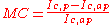
And the transfer ratio (TR) is

MTT promises a highly spin-polarized electron source at room temperature.
Spin (physics)
In quantum mechanics and particle physics, spin is a fundamental characteristic property of elementary particles, composite particles , and atomic nuclei.It is worth noting that the intrinsic property of subatomic particles called spin and discussed in this article, is related in some small ways,...
of the electron
Electron
The electron is a subatomic particle with a negative elementary electric charge. It has no known components or substructure; in other words, it is generally thought to be an elementary particle. An electron has a mass that is approximately 1/1836 that of the proton...
and its associated magnetic moment
Magnetic moment
The magnetic moment of a magnet is a quantity that determines the force that the magnet can exert on electric currents and the torque that a magnetic field will exert on it...
, in addition to its fundamental electronic charge, in solid-state devices
Solid state (electronics)
Solid-state electronics are those circuits or devices built entirely from solid materials and in which the electrons, or other charge carriers, are confined entirely within the solid material...
.
An additional effect occurs when a spin-polarized current is induced. In these cases, the electron spin is quantized in the direction perpendicular to both the plane normal and the two-dimensional wave vector, thus splitting the energy band. This is called the Rashba effect
Rashba effect
Rashba effect — splitting by spin in solids by strong spin-orbit interaction. Named in honour of Emmanuel Rashba, co-worker of National Academy of Sciences of USSR who discovered it....
.
History
Spintronics emerged from discoveries in the 1980s concerning spin-dependent electron transport phenomena in solid-state devices. This includes the observation of spin-polarized electron injection from a ferromagnetic metal to a normal metal by Johnson and Silsbee (1985), and the discovery of giant magnetoresistance independently by Albert FertAlbert Fert
Albert Fert is a French physicist and one of the discoverers of giant magnetoresistance which brought about a breakthrough in gigabyte hard disks...
et al. and Peter Grünberg
Peter Grünberg
Peter Andreas Grünberg is a German physicist, and Nobel Prize in Physics laureate for his discovery with Albert Fert of giant magnetoresistance which brought about a breakthrough in gigabyte hard disk drives.-Biography:...
et al. (1988). The origins of spintronics can be traced back even further to the ferromagnet/superconductor tunneling experiments pioneered by Meservey and Tedrow, and initial experiments on magnetic tunnel junctions by Julliere in the 1970s. The use of semiconductors for spintronics can be traced back at least as far as the theoretical proposal of a spin field-effect-transistor by Datta
Supriyo Datta
Supriyo Datta is an Indian born American researcher and author. He is currently the Thomas Duncan Distinguished professor at the School of Electrical Engineeirng at Purdue University...
and Das in 1990.
Theory
Electrons are spin-1/2 fermions, i.e. particles that obey Fermi–Dirac statistics and have half-integer spin.The total magnetic moment of an electron is equal to the sum of its spin moment (on account of its spin about its own axis) and the orbital (on account of its orbit around nucleus of an atom).

where:

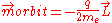
It is found that the spin moment given by
is twice as strong as the orbital moment.The spin moment S is quantized and can be obtained from:

where
is the spin angular momentum quantum number.So the magnitude of the spin moment is always:

The orientation of the vector magnitude S is also restricted. Specifically, it’s projection onto a given axis is given by the spin projection quantum number:

where


To make a spintronic device, the primary requirements are, first, a system that can generate a current of spin-polarized electrons comprising more of one spin species—up or down—than the other (called a spin injector), and, secondly, a separate system sensitive to the spin polarization of the electrons (spin detector). Manipulation of the electron spin during transport between injector and detector (especially in semiconductors) via spin precession
Precession
Precession is a change in the orientation of the rotation axis of a rotating body. It can be defined as a change in direction of the rotation axis in which the second Euler angle is constant...
can be accomplished using real external magnetic fields or effective fields caused by spin-orbit interaction
Spin-orbit interaction
In quantum physics, the spin-orbit interaction is any interaction of a particle's spin with its motion. The first and best known example of this is that spin-orbit interaction causes shifts in an electron's atomic energy levels due to electromagnetic interaction between the electron's spin and...
.
Spin polarization in non-magnetic materials can be achieved either through the Zeeman effect
Zeeman effect
The Zeeman effect is the splitting of a spectral line into several components in the presence of a static magnetic field. It is analogous to the Stark effect, the splitting of a spectral line into several components in the presence of an electric field...
in large magnetic fields and low temperatures, or by non-equilibrium methods. In the latter case, the non-equilibrium polarization will decay over a timescale called the "spin lifetime". Spin lifetimes of conduction electrons in metals are relatively short (typically less than 1 nanosecond
Nanosecond
A nanosecond is one billionth of a second . One nanosecond is to one second as one second is to 31.7 years.The word nanosecond is formed by the prefix nano and the unit second. Its symbol is ns....
). However in semiconductors the lifetimes can be very long (microsecond
Microsecond
A microsecond is an SI unit of time equal to one millionth of a second. Its symbol is µs.A microsecond is equal to 1000 nanoseconds or 1/1000 millisecond...
s at low temperatures), especially when the electrons are isolated in local trapping potentials (for instance, at impurities, where lifetimes can be millisecond
Millisecond
A millisecond is a thousandth of a second.10 milliseconds are called a centisecond....
s).
Metal-based spintronic devices
The simplest method of generating a spin-polarised current in a metal is to pass the current through a ferromagnetic material. The most common application of this effect is a giant magnetoresistanceGiant magnetoresistive effect
Giant magnetoresistance is a quantum mechanical magnetoresistance effect observed in thin-film structures composed of alternating ferromagnetic and non-magnetic layers...
(GMR) device. A typical GMR device consists of at least two layers of ferromagnetic materials separated by a spacer layer. When the two magnetization vectors of the ferromagnetic layers are aligned, the electrical resistance will be lower (so a higher current flows at constant voltage) than if the ferromagnetic layers are anti-aligned. This constitutes a magnetic field sensor.
Two variants of GMR have been applied in devices: (1) current-in-plane (CIP), where the electric current flows parallel to the layers and (2) current-perpendicular-to-plane (CPP), where the electric current flows in a direction perpendicular to the layers.
Other metals-based spintronics devices:
- Tunnel MagnetoresistanceTunnel magnetoresistanceThe Tunnel magnetoresistance is a magnetoresistive effect that occurs in magnetic tunnel junctions . This is a component consisting of two ferromagnets separated by a thin insulator. If the insulating layer is thin enough , electrons can tunnel from one ferromagnet into the other...
(TMR), where CPP transport is achieved by using quantum-mechanical tunneling of electrons through a thin insulator separating ferromagnetic layers. - Spin Torque TransferSpin Torque TransferSpin-transfer torque is an effect in which the orientation of a magnetic layer in a tunnel magnetoresistance or spin valve can be modified using a spin-polarized current....
, where a current of spin-polarized electrons is used to control the magnetization direction of ferromagnetic electrodes in the device.
Applications
Read headsDisk read-and-write head
Disk read/write heads are the small parts of a disk drive, that move above the disk platter and transform platter's magnetic field into electrical current or vice versa – transform electrical current into magnetic field...
of modern hard drives are based on the GMR or TMR effect.
Motorola has developed a 1st generation 256 kb MRAM
MRAM
Magnetoresistive Random-Access Memory is a non-volatile computer memory technology that has been under development since the 1990s. Continued increases in density of existing memory technologies – notably flash RAM and DRAM – kept it in a niche role in the market, but its proponents...
based on a single magnetic tunnel junction and a single transistor and which has a read/write cycle of under 50 nanoseconds (Everspin
Freescale Semiconductor
Freescale Semiconductor, Inc. is a producer and designer of embedded hardware, with 17 billion semiconductor chips in use around the world. The company focuses on the automotive, consumer, industrial and networking markets with its product portfolio including microprocessors, microcontrollers,...
, Motorola's spin-off, has since developed a 4 Mbit version). There are two 2nd generation MRAM techniques currently in development: Thermal Assisted Switching
Thermal Assisted Switching
Thermal Assisted Switching, or TAS, is one of the new 2nd generation approaches to MRAM currently being developed. A few different designs have been proposed, but all rely on the idea of reducing the required switching fields by heating...
(TAS) which is being developed by Crocus Technology
Crocus Technology
Crocus Technology, founded in 2004, is a venture-capital-backed semiconductor startup company developing next generation magnetoresistive random access memory technology. The company's products originated in a Grenoble-based Spintec laboratory...
, and Spin Torque Transfer
Spin Torque Transfer
Spin-transfer torque is an effect in which the orientation of a magnetic layer in a tunnel magnetoresistance or spin valve can be modified using a spin-polarized current....
(STT) on which Crocus
Crocus Technology
Crocus Technology, founded in 2004, is a venture-capital-backed semiconductor startup company developing next generation magnetoresistive random access memory technology. The company's products originated in a Grenoble-based Spintec laboratory...
, Hynix
Hynix
Hynix Semiconductor Inc. chips and flash memory chips. Founded in 1983, Hynix is the world's second-largest memory chipmaker, the largest being Samsung Electronics. Formerly known as Hyundai Electronics, the company has manufacturing sites in Korea, the U.S., China and Taiwan...
, IBM
IBM
International Business Machines Corporation or IBM is an American multinational technology and consulting corporation headquartered in Armonk, New York, United States. IBM manufactures and sells computer hardware and software, and it offers infrastructure, hosting and consulting services in areas...
, and several other companies are working.
Another design in development, called Racetrack memory
Racetrack memory
Racetrack memory is an experimental non-volatile memory device under development at IBM's Almaden Research Center by a team led by Stuart Parkin. In early 2008, a 3-bit version was successfully demonstrated...
, encodes information in the direction of magnetization between domain walls of a ferromagnetic metal wire.
There are Magnetic sensor
Sensor
A sensor is a device that measures a physical quantity and converts it into a signal which can be read by an observer or by an instrument. For example, a mercury-in-glass thermometer converts the measured temperature into expansion and contraction of a liquid which can be read on a calibrated...
s using the GMR effect.
Semiconductor-based spintronic devices
Ferromagnetic semiconductor sources (like manganese-doped gallium arsenide GaMnAsGaMnAs
Gallium manganese arsenide is a magnetic semiconductor. It is based on the world's second favorite semiconductor, GaAs, and as such is readily compatible with existing semiconductor technologies...
), increase the interface resistance with a tunnel barrier, or using hot-electron injection.
Spin detection in semiconductors is another challenge, which has been met with the following techniques:
- Faraday/Kerr rotation of transmitted/reflected photons
- Circular polarization analysis of electroluminescence
- Nonlocal spin valve (adapted from Johnson and Silsbee's work with metals)
- Ballistic spin filtering
The latter technique was used to overcome the lack of spin-orbit interaction and materials issues to achieve spin transport in silicon
Silicon
Silicon is a chemical element with the symbol Si and atomic number 14. A tetravalent metalloid, it is less reactive than its chemical analog carbon, the nonmetal directly above it in the periodic table, but more reactive than germanium, the metalloid directly below it in the table...
, the most important semiconductor for electronics.
Because external magnetic fields (and stray fields from magnetic contacts) can cause large Hall effect
Hall effect
The Hall effect is the production of a voltage difference across an electrical conductor, transverse to an electric current in the conductor and a magnetic field perpendicular to the current...
s and magnetoresistance
Magnetoresistance
Magnetoresistance is the property of a material to change the value of its electrical resistance when an external magnetic field is applied to it. The effect was first discovered by William Thomson in 1856, but he was unable to lower the electrical resistance of anything by more than 5%. This...
in semiconductors (which mimic spin-valve effects), the only conclusive evidence of spin transport in semiconductors is demonstration of spin precession
Precession
Precession is a change in the orientation of the rotation axis of a rotating body. It can be defined as a change in direction of the rotation axis in which the second Euler angle is constant...
and dephasing
Dephasing
Dephasing is a name for the mechanism that recovers classical behavior from a quantum system. It is an important effect in condensed matter physics, particularly in the study of mesoscopic devices...
in a magnetic field non-collinear to the injected spin orientation. This is called the Hanle
Wilhelm Hanle
Wilhelm Hanle was a German experimental physicist. He is known for the Hanle effect. During World War II, he made contributions to the German nuclear energy project, also known as the Uranium Club...
effect.
Applications
Applications such as semiconductor lasers using spin-polarized electrical injection have shown threshold current reduction and controllable circularly polarized coherent light output. Future applications may include a spin-based transistorTransistor
A transistor is a semiconductor device used to amplify and switch electronic signals and power. It is composed of a semiconductor material with at least three terminals for connection to an external circuit. A voltage or current applied to one pair of the transistor's terminals changes the current...
having advantages over MOSFET
MOSFET
The metal–oxide–semiconductor field-effect transistor is a transistor used for amplifying or switching electronic signals. The basic principle of this kind of transistor was first patented by Julius Edgar Lilienfeld in 1925...
devices such as steeper sub-threshold slope.
Magnetic Tunnel Transistor: The magnetic tunnel transistor with a single base layer, by van Dijken et al. and Jiang et al., has the following terminals:
- Emiter (FM1): It injects spin-polarized hot electrons into the base.
- Base (FM2): Spin-dependent scattering takes place in the base. It also serves as a spin filter.
- Collector (GaAs): A Schottky barrierSchottky barrierA Schottky barrier, named after Walter H. Schottky, is a potential barrier formed at a metal–semiconductor junction which has rectifying characteristics, suitable for use as a diode...
is formed at the interface. This collector regions only collects electrons when they have enough energy to overcome the Schottky barrier, and when there are states available in the semiconductor.
The magnetocurrent (MC) is given as:
And the transfer ratio (TR) is
MTT promises a highly spin-polarized electron source at room temperature.
See also
- Spin pumpingSpin pumpingSpin pumping is a method of generating a spin current, the spintronic analog of a battery in conventional electronics.In order to make a spintronic device, the primary requirement is to have a system that can generate a current of spin-polarized electrons, as well as a system that is sensitive to...
- Spin transfer
- Spinhenge@HomeSpinhenge@HomeSpinhenge@home is a distributed computing project for the BOINC client, which performs extensive numerical simulations concerning the physical characteristics of magnetic molecules...
- SpinplasmonicsSpinplasmonicsSpinplasmonics is a field nanotechnology combining spintronics and plasmonics. The field was pioneered by Professor Abdulhakem Elezzabi at the University of Alberta in Canada. In a simple spinplasmonic device, light waves couple to electron spin states in a metallic structure...
- List of emerging technologies
Further reading
- "Introduction to Spintronics". Marc Cahay, Supriyo Bandyopadhyay, CRC Press, ISBN 0-8493-3133-1
- Ultrafast Manipulation of Electron Spin Coherence. J. A. Gupta, R. Knobel, N. Samarth and D. D. Awschalom in Science, Vol. 292, pages 2458-2461; June 29, 2001.
- Spintronics: A Spin-Based Electronics Vision for the Future. S. A. Wolf et al., Science 294, 1488-1495 (2001)
- How to Create a Spin Current. P. Sharma, Science 307, 531-533 (2005)
- Search Google Scholar for highly cited articles with query: spintronics OR magnetoelectronics OR "spin based electronics"
- "Electron Manipulation and Spin Current". D. Grinevich. 3rd Edition, 2003.*
- Semiconductor Spintronics. J. Fabian, A. Matos-Abiague, C. Ertler, P. Stano, and I. Žutić, Acta Phys. Slovaca 57, 565-907 (2007)
- Spintronics: Fundamentals and Applications. I. Žutić, J. Fabian, and S. Das Sarma, Rev. Mod. Phys. 76, 323-410 (2004)
External links
- Spintronics portal with news and resources
- RaceTrack:InformationWeek (April 11, 2008)
- http://www.eetimes.com/news/semi/showArticle.jhtml?articleID=191504070Spintronics research targets GaAsGaasGaas is a commune in the Landes department in Aquitaine in south-western France....
.] - Spintronics at SUNY Albany's College of Nanoscale Science and Engineering
- IBM to use 'spintronics' to increase computer memory capacity (April 12, 2008)
- Semiconductor spintronics lab at University of Maryland
- Spintronics Tutorial
- Lecture on Spin transport by S. Datta (from Datta Das transistor) -Part 1 and Part 2