

Software bug

Encyclopedia
A software bug is the common term used to describe an error, flaw, mistake, failure
, or fault
in a computer program or system
that produces an incorrect or unexpected result, or causes it to behave in unintended ways. Most bugs arise from mistakes and errors made by people in either a program's source code
or its design
, and a few are caused by compiler
s producing incorrect code. A program that contains a large number of bugs, and/or bugs that seriously interfere with its functionality, is said to be buggy. Reports detailing bugs in a program are commonly known as bug reports, fault reports, problem reports, trouble reports, change requests, and so forth.
that can in turn have a wide variety of ripple effects, with varying levels of inconvenience to the user of the program. Some bugs have only a subtle effect on the program's functionality, and may thus lie undetected for a long time. More serious bugs may cause the program to crash
or freeze leading to a denial of service. Others qualify as security bugs and might for example enable a malicious user to bypass access controls in order to obtain unauthorized privileges.
The results of bugs may be extremely serious. Bugs in the code controlling the Therac-25
radiation therapy
machine were directly responsible for some patient deaths in the 1980s. In 1996, the European Space Agency
's US$1 billion prototype Ariane 5
rocket was destroyed less than a minute after launch, due to a bug in the on-board guidance computer program. In June 1994, a Royal Air Force Chinook
crashed into the Mull of Kintyre
, killing 29. This was initially dismissed as pilot error, but an investigation by Computer Weekly
uncovered sufficient evidence to convince a House of Lords
inquiry that it may have been caused by a software bug in the aircraft's engine control computer
.
In 2002, a study commissioned by the US Department of Commerce' National Institute of Standards and Technology
concluded that software bugs, or errors, are so prevalent and so detrimental that they cost the US economy an estimated $59 billion annually, or about 0.6 percent of the gross domestic product.
's Analytical engine
:
Use of the term "bug" to describe inexplicable defects has been a part of engineering jargon for many decades and predates computers and computer software; it may have originally been used in hardware engineering to describe mechanical malfunctions. For instance, Thomas Edison
wrote the following words in a letter to an associate in 1878:
Baffle Ball, the first mechanical pinball game, was advertised as being "free of bugs" in 1931. Problems with military gear during World War II were referred to as bugs (or glitch
es).
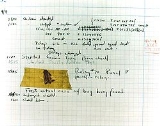
 The invention of the term "bug" is often erroneously attributed to Grace Hopper
, who publicized the cause of a malfunction in an early electromechanical computer. A typical version of the story is given by this quote:
Hopper was not actually the one who found the insect, as she readily acknowledged. The date in the log book was 9 September 1947, although sometimes erroneously reported as 1945. The operators who did find it, including William "Bill" Burke, later of the Naval Weapons Laboratory, Dahlgren, Virginia, were familiar with the engineering term and, amused, kept the insect with the notation "First actual case of bug being found." Hopper loved to recount the story. This log book is on display in the Smithsonian National Museum of American History
, complete with moth attached.
While it is certain that the Harvard Mark II operators did not coin the term "bug", it has been suggested that they did coin the related term, "debug". Even this is unlikely, since the Oxford English Dictionary
entry for "debug" contains a use of "debugging" in the context of air-plane engines in 1945. See: debugging
.
. Perhaps, when converting the abstract design into the chosen programming language, one might inadvertently create an off-by-one error
and fail to sort the last word in the list. Finally, when typing the resulting program into the computer, one might accidentally type a '<' where a '>' was intended, perhaps resulting in the words being sorted into reverse alphabetical order. More complex bugs can arise from unintended interactions between different parts of a computer program. This frequently occurs because computer programs can be complex—millions of lines long in some cases—often having been programmed by many people over a great length of time, so that programmers are unable to mentally track every possible way in which parts can interact. Another category of bug called a race condition
comes about either when a process is running in more than one thread
or two or more processes run simultaneously, and the exact order of execution of the critical sequences of code have not been properly synchronized.
The software industry has put much effort into finding methods for preventing programmers from inadvertently introducing bugs while writing software. These include:
Programming style: While typos in the program code are often caught by the compiler, a bug usually appears when the programmer makes a logic error. Various innovations in programming style
and defensive programming
are designed to make these bugs less likely, or easier to spot. In some programming languages, so-called typos, especially of symbols or logical/mathematical operators, actually represent logic errors, since the mistyped constructs are accepted by the compiler with a meaning other than that which the programmer intended.
Programming techniques: Bugs often create inconsistencies in the internal data of a running program. Programs can be written to check the consistency of their own internal data while running. If an inconsistency is encountered, the program can immediately halt, so that the bug can be located and fixed. Alternatively, the program can simply inform the user, attempt to correct the inconsistency, and continue running.
Development methodologies: There are several schemes for managing programmer activity, so that fewer bugs are produced. Many of these fall under the discipline of software engineering
(which addresses software design issues as well). For example, formal program specifications are used to state the exact behavior of programs, so that design bugs can be eliminated. Unfortunately, formal specifications are impractical or impossible for anything but the shortest programs, because of problems of combinatorial explosion
and indeterminacy
.
Programming language support: Programming language
s often include features which help programmers prevent bugs, such as static type system
s, restricted name spaces
and modular programming, among others. For example, when a programmer writes (pseudocode)
or at run-time. In addition, many recently-invented languages have deliberately excluded features which can easily lead to bugs, at the expense of making code slower than it need be: the general principle being that, because of Moore's law
, computers get faster and software engineers get slower; it is almost always better to write simpler, slower code than "clever", inscrutable code, especially considering that maintenance cost is considerable. For example, the Java programming language
does not support pointer arithmetic; implementations of some languages such as Pascal
and scripting language
s often have runtime bounds checking
of arrays, at least in a debugging build.
Code analysis: Tools for code analysis
help developers by inspecting the program text beyond the compiler's capabilities to spot potential problems. Although in general the problem of finding all programming errors given a specification is not solvable (see halting problem
), these tools exploit the fact that human programmers tend to make the same kinds of mistakes when writing software.
Instrumentation
: Tools to monitor the performance of the software as it is running, either specifically to find problems such as bottlenecks or to give assurance as to correct working, may be embedded in the code explicitly (perhaps as simple as a statement saying
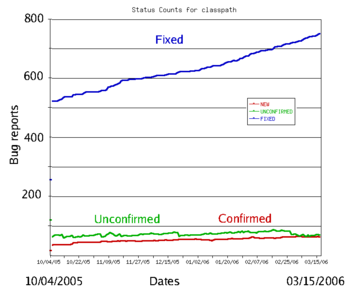 Finding and fixing bugs, or "debugging", has always been a major part of computer programming
. Maurice Wilkes, an early computing pioneer, described his realization in the late 1940s that much of the rest of his life would be spent finding mistakes in his own programs. As computer programs grow more complex, bugs become more common and difficult to fix. Often programmers spend more time and effort finding and fixing bugs than writing new code. Software testers are professionals whose primary task is to find bugs, or write code to support testing. On some projects, more resources can be spent on testing than in developing the program.
Usually, the most difficult part of debugging is finding the bug in the source code
. Once it is found, correcting it is usually relatively easy. Programs known as debugger
s exist to help programmers locate bugs by executing code line by line, watching variable values, and other features to observe program behavior. Without a debugger, code can be added so that messages or values can be written to a console (for example with printf in the C programming language) or to a window or log file to trace program execution or show values.
However, even with the aid of a debugger, locating bugs is something of an art. It is not uncommon for a bug in one section of a program to cause failures in a completely different section, thus making it especially difficult to track (for example, an error in a graphics rendering
routine causing a file I/O
routine to fail), in an apparently unrelated part of the system.
Sometimes, a bug is not an isolated flaw, but represents an error of thinking or planning on the part of the programmer. Such logic error
s require a section of the program to be overhauled or rewritten. As a part of Code review
, stepping through the code modelling the execution process in one's head or on paper can often find these errors without ever needing to reproduce the bug as such, if it can be shown there is some faulty logic in its implementation.
But more typically, the first step in locating a bug is to reproduce it reliably. Once the bug is reproduced, the programmer can use a debugger or some other tool to monitor the execution of the program in the faulty region, and find the point at which the program went astray.
It is not always easy to reproduce bugs. Some are triggered by inputs to the program which may be difficult for the programmer to re-create. One cause of the Therac-25
radiation machine deaths was a bug (specifically, a race condition
) that occurred only when the machine operator very rapidly entered a treatment plan; it took days of practice to become able to do this, so the bug did not manifest in testing or when the manufacturer attempted to duplicate it. Other bugs may disappear when the program is run with a debugger; these are heisenbugs (humorously named after the Heisenberg uncertainty principle
.)
Debugging is still a tedious task requiring considerable effort. Since the 1990s, particularly following the Ariane 5 Flight 501
disaster, there has been a renewed interest in the development of effective automated aids to debugging. For instance, methods of static code analysis
by abstract interpretation
have already made significant achievements, while still remaining much of a work in progress.
As with any creative act, sometimes a flash of inspiration will show a solution, but this is rare and, by definition, cannot be relied on.
There are also classes of bugs that have nothing to do with the code itself. If, for example, one relies on faulty documentation or hardware, the code may be written perfectly properly to what the documentation says, but the bug truly lies in the documentation or hardware, not the code. However, it is common to change the code instead of the other parts of the system, as the cost and time to change it is generally less. Embedded system
s frequently have workaround
s for hardware bugs, since to make a new version of a ROM
is much cheaper than remanufacturing the hardware, especially if they are commodity items.
There are various reasons for not fixing bugs:
Given the above, it is often considered impossible to write completely bug-free software of any real complexity. So bugs are categorized by severity, and low-severity non-critical bugs are tolerated, as they do not affect the proper operation of the system for most users. NASA's SATC managed to reduce the number of errors to fewer than 0.1 per 1000 lines of code (SLOC
) but this was not felt to be feasible for any real world projects.
The severity of a bug is not the same as its importance for fixing, and the two should be measured and managed separately. On a Microsoft Windows
system a blue screen of death
is rather severe, but if it only occurs in extreme circumstances, especially if they are well diagnosed and avoidable, it may be less important to fix than an icon not representing its function well, which though purely aesthetic may confuse thousands of users every single day. This balance, of course, depends on many factors; expert users have different expectations from novices, a niche market is different from a general consumer market, and so on. To better achieve this balance, some software developers use a formalized bug triage process (borrowing the medical term
), in which each new bug is assigned a priority based on its severity, frequency, risk, and other predetermined factors.
A school of thought popularized by Eric S. Raymond
as Linus's Law
says that popular open-source software
has more chance of having few or no bugs than other software, because "given enough eyeballs, all bugs are shallow". This assertion has been disputed, however: computer security specialist Elias Levy
wrote that "it is easy to hide vulnerabilities in complex, little understood and undocumented source code," because, "even if people are reviewing the code, that doesn't mean they're qualified to do so."
Like any other part of engineering management, bug management must be conducted carefully and intelligently because "what gets measured gets done"
and managing purely by bug counts can have unintended consequences. If, for example, developers are rewarded by the number of bugs they fix, they will naturally fix the easiest bugs first— leaving the hardest, and probably most risky or critical, to the last possible moment ("I only have one bug on my list but it says 'Make sun rise in West'"). If the management ethos is to reward the number of bugs fixed, then some developers may quickly write sloppy code knowing they can fix the bugs later and be rewarded for it, whereas careful, perhaps "slower" developers do not get rewarded for the bugs that were never there.
may attempt to exploit known vulnerabilities in a system — which may or may not be bugs. Viruses are not bugs in themselves — they are typically programs that are doing precisely what they were designed to do. However, viruses are occasionally referred to as such in the popular press.
, also known as the Y2K bug, in which it was feared that worldwide economic collapse would happen at the start of the year 2000 as a result of computers thinking it was 1900. (In the end, no major problems occurred.)
Failure
Failure refers to the state or condition of not meeting a desirable or intended objective, and may be viewed as the opposite of success. Product failure ranges from failure to sell the product to fracture of the product, in the worst cases leading to personal injury, the province of forensic...
, or fault
Fault (technology)
In document ISO/CD 10303-226, a fault is defined as an abnormal condition or defect at the component, equipment, or sub-system level which may lead to a failure....
in a computer program or system
Software system
A software system is a system based on software forming part of a computer system . The term "software system" is often used as a synonym of computer program or software; is related to the application of systems theory approaches in software engineering context and are used to study large and...
that produces an incorrect or unexpected result, or causes it to behave in unintended ways. Most bugs arise from mistakes and errors made by people in either a program's source code
Source code
In computer science, source code is text written using the format and syntax of the programming language that it is being written in. Such a language is specially designed to facilitate the work of computer programmers, who specify the actions to be performed by a computer mostly by writing source...
or its design
Software architecture
The software architecture of a system is the set of structures needed to reason about the system, which comprise software elements, relations among them, and properties of both...
, and a few are caused by compiler
Compiler
A compiler is a computer program that transforms source code written in a programming language into another computer language...
s producing incorrect code. A program that contains a large number of bugs, and/or bugs that seriously interfere with its functionality, is said to be buggy. Reports detailing bugs in a program are commonly known as bug reports, fault reports, problem reports, trouble reports, change requests, and so forth.
Effects
Bugs trigger Type I and type II errorsType I and type II errors
In statistical test theory the notion of statistical error is an integral part of hypothesis testing. The test requires an unambiguous statement of a null hypothesis, which usually corresponds to a default "state of nature", for example "this person is healthy", "this accused is not guilty" or...
that can in turn have a wide variety of ripple effects, with varying levels of inconvenience to the user of the program. Some bugs have only a subtle effect on the program's functionality, and may thus lie undetected for a long time. More serious bugs may cause the program to crash
Crash (computing)
A crash in computing is a condition where a computer or a program, either an application or part of the operating system, ceases to function properly, often exiting after encountering errors. Often the offending program may appear to freeze or hang until a crash reporting service documents...
or freeze leading to a denial of service. Others qualify as security bugs and might for example enable a malicious user to bypass access controls in order to obtain unauthorized privileges.
The results of bugs may be extremely serious. Bugs in the code controlling the Therac-25
Therac-25
The Therac-25 was a radiation therapy machine produced by Atomic Energy of Canada Limited after the Therac-6 and Therac-20 units ....
radiation therapy
Radiation therapy
Radiation therapy , radiation oncology, or radiotherapy , sometimes abbreviated to XRT or DXT, is the medical use of ionizing radiation, generally as part of cancer treatment to control malignant cells.Radiation therapy is commonly applied to the cancerous tumor because of its ability to control...
machine were directly responsible for some patient deaths in the 1980s. In 1996, the European Space Agency
European Space Agency
The European Space Agency , established in 1975, is an intergovernmental organisation dedicated to the exploration of space, currently with 18 member states...
's US$1 billion prototype Ariane 5
Ariane 5
Ariane 5 is, as a part of Ariane rocket family, an expendable launch system used to deliver payloads into geostationary transfer orbit or low Earth orbit . Ariane 5 rockets are manufactured under the authority of the European Space Agency and the Centre National d'Etudes Spatiales...
rocket was destroyed less than a minute after launch, due to a bug in the on-board guidance computer program. In June 1994, a Royal Air Force Chinook
CH-47 Chinook
The Boeing CH-47 Chinook is an American twin-engine, tandem rotor heavy-lift helicopter. Its top speed of 170 knots is faster than contemporary utility and attack helicopters of the 1960s...
crashed into the Mull of Kintyre
Mull of Kintyre
The Mull of Kintyre is the southwesternmost tip of the Kintyre Peninsula in southwest Scotland. From here, the Antrim coast is visible and an historic lighthouse, the second commissioned in Scotland, guides shipping in the intervening North Channel...
, killing 29. This was initially dismissed as pilot error, but an investigation by Computer Weekly
Computer Weekly
ComputerWeekly was a weekly magazine for IT professionals which was published by Reed Business Information for over 40 years. The magazine was available free to IT professionals who met the circulation requirements...
uncovered sufficient evidence to convince a House of Lords
House of Lords
The House of Lords is the upper house of the Parliament of the United Kingdom. Like the House of Commons, it meets in the Palace of Westminster....
inquiry that it may have been caused by a software bug in the aircraft's engine control computer
FADEC
Full Authority Digital Engine Control is a system consisting of a digital computer, called an electronic engine controller or engine control unit , and its related accessories that control all aspects of aircraft engine performance...
.
In 2002, a study commissioned by the US Department of Commerce' National Institute of Standards and Technology
National Institute of Standards and Technology
The National Institute of Standards and Technology , known between 1901 and 1988 as the National Bureau of Standards , is a measurement standards laboratory, otherwise known as a National Metrological Institute , which is a non-regulatory agency of the United States Department of Commerce...
concluded that software bugs, or errors, are so prevalent and so detrimental that they cost the US economy an estimated $59 billion annually, or about 0.6 percent of the gross domestic product.
Etymology
The concept that software might contain errors dates back to 1843 in Ada Byron's notes on the analytical engine in which she speaks of the difficulty of preparing program 'cards' for Charles BabbageCharles Babbage
Charles Babbage, FRS was an English mathematician, philosopher, inventor and mechanical engineer who originated the concept of a programmable computer...
's Analytical engine
Analytical engine
The Analytical Engine was a proposed mechanical general-purpose computer designed by English mathematician Charles Babbage. It was first described in 1837 as the successor to Babbage's difference engine, a design for a mechanical calculator...
:
Use of the term "bug" to describe inexplicable defects has been a part of engineering jargon for many decades and predates computers and computer software; it may have originally been used in hardware engineering to describe mechanical malfunctions. For instance, Thomas Edison
Thomas Edison
Thomas Alva Edison was an American inventor and businessman. He developed many devices that greatly influenced life around the world, including the phonograph, the motion picture camera, and a long-lasting, practical electric light bulb. In addition, he created the world’s first industrial...
wrote the following words in a letter to an associate in 1878:
Baffle Ball, the first mechanical pinball game, was advertised as being "free of bugs" in 1931. Problems with military gear during World War II were referred to as bugs (or glitch
Glitch
A glitch is a short-lived fault in a system. It is often used to describe a transient fault that corrects itself, and is therefore difficult to troubleshoot...
es).
Grace Hopper
Rear Admiral Grace Murray Hopper was an American computer scientist and United States Navy officer. A pioneer in the field, she was one of the first programmers of the Harvard Mark I computer, and developed the first compiler for a computer programming language...
, who publicized the cause of a malfunction in an early electromechanical computer. A typical version of the story is given by this quote:
Hopper was not actually the one who found the insect, as she readily acknowledged. The date in the log book was 9 September 1947, although sometimes erroneously reported as 1945. The operators who did find it, including William "Bill" Burke, later of the Naval Weapons Laboratory, Dahlgren, Virginia, were familiar with the engineering term and, amused, kept the insect with the notation "First actual case of bug being found." Hopper loved to recount the story. This log book is on display in the Smithsonian National Museum of American History
National Museum of American History
The National Museum of American History: Kenneth E. Behring Center collects, preserves and displays the heritage of the United States in the areas of social, political, cultural, scientific and military history. Among the items on display are the original Star-Spangled Banner and Archie Bunker's...
, complete with moth attached.
While it is certain that the Harvard Mark II operators did not coin the term "bug", it has been suggested that they did coin the related term, "debug". Even this is unlikely, since the Oxford English Dictionary
Oxford English Dictionary
The Oxford English Dictionary , published by the Oxford University Press, is the self-styled premier dictionary of the English language. Two fully bound print editions of the OED have been published under its current name, in 1928 and 1989. The first edition was published in twelve volumes , and...
entry for "debug" contains a use of "debugging" in the context of air-plane engines in 1945. See: debugging
Debugging
Debugging is a methodical process of finding and reducing the number of bugs, or defects, in a computer program or a piece of electronic hardware, thus making it behave as expected. Debugging tends to be harder when various subsystems are tightly coupled, as changes in one may cause bugs to emerge...
.
Prevention
Bugs are a consequence of the nature of human factors in the programming task. They arise from oversights or mutual misunderstandings made by a software team during specification, design, coding, data entry and documentation. For example: In creating a relatively simple program to sort a list of words into alphabetical order, one's design might fail to consider what should happen when a word contains a hyphenHyphen
The hyphen is a punctuation mark used to join words and to separate syllables of a single word. The use of hyphens is called hyphenation. The hyphen should not be confused with dashes , which are longer and have different uses, or with the minus sign which is also longer...
. Perhaps, when converting the abstract design into the chosen programming language, one might inadvertently create an off-by-one error
Off-by-one error
An off-by-one error is a logical error involving the discrete equivalent of a boundary condition. It often occurs in computer programming when an iterative loop iterates one time too many or too few...
and fail to sort the last word in the list. Finally, when typing the resulting program into the computer, one might accidentally type a '<' where a '>' was intended, perhaps resulting in the words being sorted into reverse alphabetical order. More complex bugs can arise from unintended interactions between different parts of a computer program. This frequently occurs because computer programs can be complex—millions of lines long in some cases—often having been programmed by many people over a great length of time, so that programmers are unable to mentally track every possible way in which parts can interact. Another category of bug called a race condition
Race condition
A race condition or race hazard is a flaw in an electronic system or process whereby the output or result of the process is unexpectedly and critically dependent on the sequence or timing of other events...
comes about either when a process is running in more than one thread
Thread (computer science)
In computer science, a thread of execution is the smallest unit of processing that can be scheduled by an operating system. The implementation of threads and processes differs from one operating system to another, but in most cases, a thread is contained inside a process...
or two or more processes run simultaneously, and the exact order of execution of the critical sequences of code have not been properly synchronized.
The software industry has put much effort into finding methods for preventing programmers from inadvertently introducing bugs while writing software. These include:
Programming style: While typos in the program code are often caught by the compiler, a bug usually appears when the programmer makes a logic error. Various innovations in programming style
Programming style
Programming style is a set of rules or guidelines used when writing the source code for a computer program. It is often claimed that following a particular programming style will help programmers to read and understand source code conforming to the style, and help to avoid introducing errors.A...
and defensive programming
Defensive programming
Defensive programming is a form of defensive design intended to ensure the continuing function of a piece of software in spite of unforeseeable usage of said software. The idea can be viewed as reducing or eliminating the prospect of Murphy's Law having effect...
are designed to make these bugs less likely, or easier to spot. In some programming languages, so-called typos, especially of symbols or logical/mathematical operators, actually represent logic errors, since the mistyped constructs are accepted by the compiler with a meaning other than that which the programmer intended.
Programming techniques: Bugs often create inconsistencies in the internal data of a running program. Programs can be written to check the consistency of their own internal data while running. If an inconsistency is encountered, the program can immediately halt, so that the bug can be located and fixed. Alternatively, the program can simply inform the user, attempt to correct the inconsistency, and continue running.
Development methodologies: There are several schemes for managing programmer activity, so that fewer bugs are produced. Many of these fall under the discipline of software engineering
Software engineering
Software Engineering is the application of a systematic, disciplined, quantifiable approach to the development, operation, and maintenance of software, and the study of these approaches; that is, the application of engineering to software...
(which addresses software design issues as well). For example, formal program specifications are used to state the exact behavior of programs, so that design bugs can be eliminated. Unfortunately, formal specifications are impractical or impossible for anything but the shortest programs, because of problems of combinatorial explosion
Combinatorial explosion
In administration and computing, a combinatorial explosion is the rapidly accelerating increase in lines of communication as organizations are added in a process...
and indeterminacy
Indeterminacy in computation
Indeterminacy in concurrent computation is concerned with the effects of indeterminacy in concurrent computation.Computation is an area in which indeterminacy is becoming increasingly important because of the massive increase in concurrency due to networking and the advent of many-core computer...
.
Programming language support: Programming language
Programming language
A programming language is an artificial language designed to communicate instructions to a machine, particularly a computer. Programming languages can be used to create programs that control the behavior of a machine and/or to express algorithms precisely....
s often include features which help programmers prevent bugs, such as static type system
Type system
A type system associates a type with each computed value. By examining the flow of these values, a type system attempts to ensure or prove that no type errors can occur...
s, restricted name spaces
Namespace (computer science)
A namespace is an abstract container or environment created to hold a logical grouping of unique identifiers or symbols . An identifier defined in a namespace is associated only with that namespace. The same identifier can be independently defined in multiple namespaces...
and modular programming, among others. For example, when a programmer writes (pseudocode)
LET REAL_VALUE PI = "THREE AND A BIT", although this may be syntactically correct, the code fails a type check. Depending on the language and implementation, this may be caught by the compilerCompiler
A compiler is a computer program that transforms source code written in a programming language into another computer language...
or at run-time. In addition, many recently-invented languages have deliberately excluded features which can easily lead to bugs, at the expense of making code slower than it need be: the general principle being that, because of Moore's law
Moore's Law
Moore's law describes a long-term trend in the history of computing hardware: the number of transistors that can be placed inexpensively on an integrated circuit doubles approximately every two years....
, computers get faster and software engineers get slower; it is almost always better to write simpler, slower code than "clever", inscrutable code, especially considering that maintenance cost is considerable. For example, the Java programming language
Java (programming language)
Java is a programming language originally developed by James Gosling at Sun Microsystems and released in 1995 as a core component of Sun Microsystems' Java platform. The language derives much of its syntax from C and C++ but has a simpler object model and fewer low-level facilities...
does not support pointer arithmetic; implementations of some languages such as Pascal
Pascal (programming language)
Pascal is an influential imperative and procedural programming language, designed in 1968/9 and published in 1970 by Niklaus Wirth as a small and efficient language intended to encourage good programming practices using structured programming and data structuring.A derivative known as Object Pascal...
and scripting language
Scripting language
A scripting language, script language, or extension language is a programming language that allows control of one or more applications. "Scripts" are distinct from the core code of the application, as they are usually written in a different language and are often created or at least modified by the...
s often have runtime bounds checking
Bounds checking
In computer programming, bounds checking is any method of detecting whether a variable is within some bounds before its use. It is particularly relevant to a variable used as an index into an array to ensure its value lies within the bounds of the array...
of arrays, at least in a debugging build.
Code analysis: Tools for code analysis
Static code analysis
Static program analysis is the analysis of computer software that is performed without actually executing programs built from that software In most cases the analysis is performed on some version of the source code and in the other cases some form of the object code...
help developers by inspecting the program text beyond the compiler's capabilities to spot potential problems. Although in general the problem of finding all programming errors given a specification is not solvable (see halting problem
Halting problem
In computability theory, the halting problem can be stated as follows: Given a description of a computer program, decide whether the program finishes running or continues to run forever...
), these tools exploit the fact that human programmers tend to make the same kinds of mistakes when writing software.
Instrumentation
Instrumentation
Instrumentation is defined as the art and science of measurement and control of process variables within a production, or manufacturing area....
: Tools to monitor the performance of the software as it is running, either specifically to find problems such as bottlenecks or to give assurance as to correct working, may be embedded in the code explicitly (perhaps as simple as a statement saying
PRINT "I AM HERE"), or provided as tools. It is often a surprise to find where most of the time is taken by a piece of code, and this removal of assumptions might cause the code to be rewritten.Debugging
Computer programming
Computer programming is the process of designing, writing, testing, debugging, and maintaining the source code of computer programs. This source code is written in one or more programming languages. The purpose of programming is to create a program that performs specific operations or exhibits a...
. Maurice Wilkes, an early computing pioneer, described his realization in the late 1940s that much of the rest of his life would be spent finding mistakes in his own programs. As computer programs grow more complex, bugs become more common and difficult to fix. Often programmers spend more time and effort finding and fixing bugs than writing new code. Software testers are professionals whose primary task is to find bugs, or write code to support testing. On some projects, more resources can be spent on testing than in developing the program.
Usually, the most difficult part of debugging is finding the bug in the source code
Source code
In computer science, source code is text written using the format and syntax of the programming language that it is being written in. Such a language is specially designed to facilitate the work of computer programmers, who specify the actions to be performed by a computer mostly by writing source...
. Once it is found, correcting it is usually relatively easy. Programs known as debugger
Debugger
A debugger or debugging tool is a computer program that is used to test and debug other programs . The code to be examined might alternatively be running on an instruction set simulator , a technique that allows great power in its ability to halt when specific conditions are encountered but which...
s exist to help programmers locate bugs by executing code line by line, watching variable values, and other features to observe program behavior. Without a debugger, code can be added so that messages or values can be written to a console (for example with printf in the C programming language) or to a window or log file to trace program execution or show values.
However, even with the aid of a debugger, locating bugs is something of an art. It is not uncommon for a bug in one section of a program to cause failures in a completely different section, thus making it especially difficult to track (for example, an error in a graphics rendering
Rendering (computer graphics)
Rendering is the process of generating an image from a model , by means of computer programs. A scene file contains objects in a strictly defined language or data structure; it would contain geometry, viewpoint, texture, lighting, and shading information as a description of the virtual scene...
routine causing a file I/O
Input/output
In computing, input/output, or I/O, refers to the communication between an information processing system , and the outside world, possibly a human, or another information processing system. Inputs are the signals or data received by the system, and outputs are the signals or data sent from it...
routine to fail), in an apparently unrelated part of the system.
Sometimes, a bug is not an isolated flaw, but represents an error of thinking or planning on the part of the programmer. Such logic error
Logic error
In computer programming, a logic error is a bug in a program that causes it to operate incorrectly, but not to terminate abnormally . A logic error produces unintended or undesired output or other behavior, although it may not immediately be recognized as such.Logic errors occur in both compiled...
s require a section of the program to be overhauled or rewritten. As a part of Code review
Code review
Code review is systematic examination of computer source code. It is intended to find and fix mistakes overlooked in the initial development phase, improving both the overall quality of software and the developers' skills...
, stepping through the code modelling the execution process in one's head or on paper can often find these errors without ever needing to reproduce the bug as such, if it can be shown there is some faulty logic in its implementation.
But more typically, the first step in locating a bug is to reproduce it reliably. Once the bug is reproduced, the programmer can use a debugger or some other tool to monitor the execution of the program in the faulty region, and find the point at which the program went astray.
It is not always easy to reproduce bugs. Some are triggered by inputs to the program which may be difficult for the programmer to re-create. One cause of the Therac-25
Therac-25
The Therac-25 was a radiation therapy machine produced by Atomic Energy of Canada Limited after the Therac-6 and Therac-20 units ....
radiation machine deaths was a bug (specifically, a race condition
Race condition
A race condition or race hazard is a flaw in an electronic system or process whereby the output or result of the process is unexpectedly and critically dependent on the sequence or timing of other events...
) that occurred only when the machine operator very rapidly entered a treatment plan; it took days of practice to become able to do this, so the bug did not manifest in testing or when the manufacturer attempted to duplicate it. Other bugs may disappear when the program is run with a debugger; these are heisenbugs (humorously named after the Heisenberg uncertainty principle
Uncertainty principle
In quantum mechanics, the Heisenberg uncertainty principle states a fundamental limit on the accuracy with which certain pairs of physical properties of a particle, such as position and momentum, can be simultaneously known...
.)
Debugging is still a tedious task requiring considerable effort. Since the 1990s, particularly following the Ariane 5 Flight 501
Ariane 5 Flight 501
Cluster was a constellation of four European Space Agency spacecraft which were launched on the maiden flight of the Ariane 5 rocket, Flight 501, and subsequently lost when that rocket failed to achieve orbit. The launch, which took place on Tuesday, June 4, 1996, ended in failure due to an error...
disaster, there has been a renewed interest in the development of effective automated aids to debugging. For instance, methods of static code analysis
Static code analysis
Static program analysis is the analysis of computer software that is performed without actually executing programs built from that software In most cases the analysis is performed on some version of the source code and in the other cases some form of the object code...
by abstract interpretation
Abstract interpretation
In computer science, abstract interpretation is a theory of sound approximation of the semantics of computer programs, based on monotonic functions over ordered sets, especially lattices. It can be viewed as a partial execution of a computer program which gains information about its semantics In...
have already made significant achievements, while still remaining much of a work in progress.
As with any creative act, sometimes a flash of inspiration will show a solution, but this is rare and, by definition, cannot be relied on.
There are also classes of bugs that have nothing to do with the code itself. If, for example, one relies on faulty documentation or hardware, the code may be written perfectly properly to what the documentation says, but the bug truly lies in the documentation or hardware, not the code. However, it is common to change the code instead of the other parts of the system, as the cost and time to change it is generally less. Embedded system
Embedded system
An embedded system is a computer system designed for specific control functions within a larger system. often with real-time computing constraints. It is embedded as part of a complete device often including hardware and mechanical parts. By contrast, a general-purpose computer, such as a personal...
s frequently have workaround
Workaround
A workaround is a bypass of a recognized problem in a system. A workaround is typically a temporary fix that implies that a genuine solution to the problem is needed...
s for hardware bugs, since to make a new version of a ROM
Read-only memory
Read-only memory is a class of storage medium used in computers and other electronic devices. Data stored in ROM cannot be modified, or can be modified only slowly or with difficulty, so it is mainly used to distribute firmware .In its strictest sense, ROM refers only...
is much cheaper than remanufacturing the hardware, especially if they are commodity items.
Bug management
It is common practice for software to be released with known bugs that are considered non-critical, that is, that do not affect most users' main experience with the product. While software products may, by definition, contain any number of unknown bugs, measurements during testing can provide an estimate of the number of likely bugs remaining; this becomes more reliable the longer a product is tested and developed ("if we had 200 bugs last week, we should have 100 this week"). Most big software projects maintain two lists of "known bugs"— those known to the software team, and those to be told to users. This is not dissimulation, but users are not concerned with the internal workings of the product. The second list informs users about bugs that are not fixed in the current release, or not fixed at all, and a workaround may be offered.There are various reasons for not fixing bugs:
- The developers often don't have time or it is not economical to fix all non-severe bugs.
- The bug could be fixed in a new version or patchPatch (computing)A patch is a piece of software designed to fix problems with, or update a computer program or its supporting data. This includes fixing security vulnerabilities and other bugs, and improving the usability or performance...
that is not yet released. - The changes to the code required to fix the bug could be large, expensive, or delay finishing the project.
- Even seemingly simple fixes bring the chance of introducing new unknown bugs into the system. At the end of a test/fix cycle some managers may only allow the most critical bugs to be fixed.
- Users may be relying on the undocumented, buggy behavior, especially if scripts or macros rely on a behavior; it may introduce a breaking change.
- It's "not a bug". A misunderstanding has arisen between expected and provided behavior
Given the above, it is often considered impossible to write completely bug-free software of any real complexity. So bugs are categorized by severity, and low-severity non-critical bugs are tolerated, as they do not affect the proper operation of the system for most users. NASA's SATC managed to reduce the number of errors to fewer than 0.1 per 1000 lines of code (SLOC
Source lines of code
Source lines of code is a software metric used to measure the size of a software program by counting the number of lines in the text of the program's source code...
) but this was not felt to be feasible for any real world projects.
The severity of a bug is not the same as its importance for fixing, and the two should be measured and managed separately. On a Microsoft Windows
Microsoft Windows
Microsoft Windows is a series of operating systems produced by Microsoft.Microsoft introduced an operating environment named Windows on November 20, 1985 as an add-on to MS-DOS in response to the growing interest in graphical user interfaces . Microsoft Windows came to dominate the world's personal...
system a blue screen of death
Blue Screen of Death
To forse a BSOD Open regedit.exe,Then search: HKLM\SYSTEM\CurrentControlSet\services\i8042prt\ParametersThen make a new DWORD called "CrashOnCtrlScroll" And set the value to 1....
is rather severe, but if it only occurs in extreme circumstances, especially if they are well diagnosed and avoidable, it may be less important to fix than an icon not representing its function well, which though purely aesthetic may confuse thousands of users every single day. This balance, of course, depends on many factors; expert users have different expectations from novices, a niche market is different from a general consumer market, and so on. To better achieve this balance, some software developers use a formalized bug triage process (borrowing the medical term
Triage
Triage or ) is the process of determining the priority of patients' treatments based on the severity of their condition. This rations patient treatment efficiently when resources are insufficient for all to be treated immediately. The term comes from the French verb trier, meaning to separate,...
), in which each new bug is assigned a priority based on its severity, frequency, risk, and other predetermined factors.
A school of thought popularized by Eric S. Raymond
Eric S. Raymond
Eric Steven Raymond , often referred to as ESR, is an American computer programmer, author and open source software advocate. After the 1997 publication of The Cathedral and the Bazaar, Raymond was for a number of years frequently quoted as an unofficial spokesman for the open source movement...
as Linus's Law
Linus's Law
There are two statements named Linus's Law: one by Eric S. Raymond concerning software bug detection by a community, and the other by Linus Torvalds about the motivations of programmers.- By Eric Raymond :...
says that popular open-source software
Open-source software
Open-source software is computer software that is available in source code form: the source code and certain other rights normally reserved for copyright holders are provided under a software license that permits users to study, change, improve and at times also to distribute the software.Open...
has more chance of having few or no bugs than other software, because "given enough eyeballs, all bugs are shallow". This assertion has been disputed, however: computer security specialist Elias Levy
Elias Levy
Elias Levy , was the moderator of the full disclosure vulnerability mailing list Bugtraq from May 14, 1996, until he stepped down on October 15, 2001. He was the CTO and co-founder of the computer security company SecurityFocus, which was acquired by Symantec on August 6, 2002...
wrote that "it is easy to hide vulnerabilities in complex, little understood and undocumented source code," because, "even if people are reviewing the code, that doesn't mean they're qualified to do so."
Like any other part of engineering management, bug management must be conducted carefully and intelligently because "what gets measured gets done"
and managing purely by bug counts can have unintended consequences. If, for example, developers are rewarded by the number of bugs they fix, they will naturally fix the easiest bugs first— leaving the hardest, and probably most risky or critical, to the last possible moment ("I only have one bug on my list but it says 'Make sun rise in West'"). If the management ethos is to reward the number of bugs fixed, then some developers may quickly write sloppy code knowing they can fix the bugs later and be rewarded for it, whereas careful, perhaps "slower" developers do not get rewarded for the bugs that were never there.
Security vulnerabilities
Malicious softwareMalware
Malware, short for malicious software, consists of programming that is designed to disrupt or deny operation, gather information that leads to loss of privacy or exploitation, or gain unauthorized access to system resources, or that otherwise exhibits abusive behavior...
may attempt to exploit known vulnerabilities in a system — which may or may not be bugs. Viruses are not bugs in themselves — they are typically programs that are doing precisely what they were designed to do. However, viruses are occasionally referred to as such in the popular press.
Common types of computer bugs
- Conceptual error (code is syntactically correct, but the programmer or designer intended it to do something else)
Arithmetic bugs
- Division by zero
- Arithmetic overflowArithmetic overflowThe term arithmetic overflow or simply overflow has the following meanings.# In a computer, the condition that occurs when a calculation produces a result that is greater in magnitude than that which a given register or storage location can store or represent.# In a computer, the amount by which a...
or underflowArithmetic underflowThe term arithmetic underflow is a condition in a computer program that can occur when the true result of afloating point operation is smaller in magnitude... - Loss of arithmetic precision due to roundingRoundingRounding a numerical value means replacing it by another value that is approximately equal but has a shorter, simpler, or more explicit representation; for example, replacing $23.4476 with $23.45, or the fraction 312/937 with 1/3, or the expression √2 with 1.414.Rounding is often done on purpose to...
or numerically unstableNumerical stabilityIn the mathematical subfield of numerical analysis, numerical stability is a desirable property of numerical algorithms. The precise definition of stability depends on the context, but it is related to the accuracy of the algorithm....
algorithms
Logic bugs
- Infinite loopInfinite loopAn infinite loop is a sequence of instructions in a computer program which loops endlessly, either due to the loop having no terminating condition, having one that can never be met, or one that causes the loop to start over...
s and infinite recursionRecursion (computer science)Recursion in computer science is a method where the solution to a problem depends on solutions to smaller instances of the same problem. The approach can be applied to many types of problems, and is one of the central ideas of computer science.... - Off by one error, counting one too many or too few when looping
Syntax bugs
- Use of the wrong operator, such as performing assignment instead of equality test. In simple cases often warned by the compiler; in many languages, deliberately guarded against by language syntax
Resource bugs
- Null pointer dereference
- Using an uninitialized variableUninitialized variableIn computing, an uninitialized variable is a variable that is declared but is not set to a definite known value before it is used. It will have some value, but not a predictable one. As such it is a programming error and a common source of bugs in software....
- Using an otherwise valid instruction on the wrong data typeData typeIn computer programming, a data type is a classification identifying one of various types of data, such as floating-point, integer, or Boolean, that determines the possible values for that type; the operations that can be done on values of that type; the meaning of the data; and the way values of...
(see packed decimal/binary coded decimal) - Access violations
- Resource leaks, where a finite system resource such as memoryMemory leakA memory leak, in computer science , occurs when a computer program consumes memory but is unable to release it back to the operating system. In object-oriented programming, a memory leak happens when an object is stored in memory but cannot be accessed by the running code...
or file handlesHandle leakA handle leak is a type of software bug that occurs when a computer program asks for a handle to a resource but does not free the handle when it is no longer used. If this occurs frequently or repeatedly over an extended period of time, a large number of handles may be marked in-use and thus...
are exhausted by repeated allocation without release. - Buffer overflowBuffer overflowIn computer security and programming, a buffer overflow, or buffer overrun, is an anomaly where a program, while writing data to a buffer, overruns the buffer's boundary and overwrites adjacent memory. This is a special case of violation of memory safety....
, in which a program tries to store data past the end of allocated storage. This may or may not lead to an access violation or storage violationStorage violationA storage violation occurs when a task modifies, or attempts to modify, computer storage that it does not own.-Types of storage violation:Storage violation can, for instance, consist of writing to or freeing storage not owned by the task....
. These bugs can form a security vulnerability. - Excessive recursion which though logically valid causes stack overflowStack overflowIn software, a stack overflow occurs when too much memory is used on the call stack. The call stack contains a limited amount of memory, often determined at the start of the program. The size of the call stack depends on many factors, including the programming language, machine architecture,...
Multi-threading programming bugs
- DeadlockDeadlockA deadlock is a situation where in two or more competing actions are each waiting for the other to finish, and thus neither ever does. It is often seen in a paradox like the "chicken or the egg"...
- Race conditionRace conditionA race condition or race hazard is a flaw in an electronic system or process whereby the output or result of the process is unexpectedly and critically dependent on the sequence or timing of other events...
- Concurrency errors in critical sectionCritical sectionIn concurrent programming a critical section is a piece of code that accesses a shared resource that must not be concurrently accessed by more than one thread of execution. A critical section will usually terminate in fixed time, and a thread, task or process will have to wait a fixed time to...
s, mutual exclusionMutual exclusionMutual exclusion algorithms are used in concurrent programming to avoid the simultaneous use of a common resource, such as a global variable, by pieces of computer code called critical sections. A critical section is a piece of code in which a process or thread accesses a common resource...
s and other features of concurrent processing. Time-of-check-to-time-of-useTime-of-check-to-time-of-useIn software development, time-of-check-to-time-of-use is a class of software bug caused by changes in a system between the checking of a condition and the use of the results of that check...
(TOCTOU) is a form of unprotected critical section.
Interfacing bugs
- Incorrect API usage
- Incorrect protocol implementation
- Incorrect hardware handling
Performance bugs
- Too high computational complexityComputational ComplexityComputational Complexity may refer to:*Computational complexity theory*Computational Complexity...
of algorithm - Random disk or memory access
Teamworking bugs
- Unpropagated updates; e.g. programmer changes "myAdd" but forgets to change "mySubtract", which uses the same algorithm. These errors are mitigated by the Don't Repeat YourselfDon't repeat yourselfIn software engineering, Don't Repeat Yourself is a principle of software development aimed at reducing repetition of information of all kinds, especially useful in multi-tier architectures...
philosophy. - Comments out of date or incorrect: many programmers assume the comments accurately describe the code
- Differences between documentation and the actual product
Well-known bugs
A number of software bugs have become well-known, usually due to their severity: examples include various space and military aircraft crashes. Possibly the most famous bug is the Year 2000 problemYear 2000 problem
The Year 2000 problem was a problem for both digital and non-digital documentation and data storage situations which resulted from the practice of abbreviating a four-digit year to two digits.In computer programs, the practice of representing the year with two...
, also known as the Y2K bug, in which it was feared that worldwide economic collapse would happen at the start of the year 2000 as a result of computers thinking it was 1900. (In the end, no major problems occurred.)
In popular culture
- In Robert A. HeinleinRobert A. HeinleinRobert Anson Heinlein was an American science fiction writer. Often called the "dean of science fiction writers", he was one of the most influential and controversial authors of the genre. He set a standard for science and engineering plausibility and helped to raise the genre's standards of...
's 1966 novel The Moon Is a Harsh MistressThe Moon Is a Harsh MistressThe Moon Is a Harsh Mistress is a 1966 science fiction novel by American writer Robert A. Heinlein, about a lunar colony's revolt against rule from Earth....
, computer technician Manuel Davis blames a real bug for a (non-existent) failure of supercomputer Mike, presenting a dead fly as evidence. - In the 1968 novel 2001: A Space Odyssey2001: A Space Odyssey (novel)2001: A Space Odyssey is a science fiction novel by Arthur C. Clarke. It was developed concurrently with Stanley Kubrick's film version and published after the release of the film...
(and the corresponding 1968 film2001: A Space Odyssey (film)2001: A Space Odyssey is a 1968 epic science fiction film produced and directed by Stanley Kubrick, and co-written by Kubrick and Arthur C. Clarke, partially inspired by Clarke's short story The Sentinel...
), a spaceship's onboard computer, HAL 9000HAL 9000HAL 9000 is the antagonist in Arthur C. Clarke's science fiction Space Odyssey saga. HAL is an artificial intelligence that interacts with the astronaut crew of the Discovery One spacecraft, usually represented as a red television-camera eye found throughout the ship...
, attempts to kill all its crew members. In the followup 1982 novel, 2010: Odyssey Two2010: Odyssey Two2010: Odyssey Two is a 1982 best-selling science fiction novel by Arthur C. Clarke. It is the sequel to the 1968 novel 2001: A Space Odyssey, but continues the story of Stanley Kubrick's film adaptation with the same title and not Clarke's original novel. The book is a part of Clarke's...
, and the accompanying 1984 film, 2010, it is revealed that this action was caused by the computer having been programmed with two conflicting objectives: to fully disclose all its information, and to keep the true purpose of the flight secret from the crew; this conflict caused HAL to become paranoid and eventually homicidal. - In the 1984 song "99 Red Balloons" (though not in the original German version), "bugs in the software" lead to a computer mistaking a group of balloons for a nuclear missile and starting a nuclear warNuclear warfareNuclear warfare, or atomic warfare, is a military conflict or political strategy in which nuclear weaponry is detonated on an opponent. Compared to conventional warfare, nuclear warfare can be vastly more destructive in range and extent of damage...
. - The 2004 novel The Bug, by Ellen UllmanEllen UllmanEllen Ullman is an American computer programmer and author. She has written novels as well as articles for various publications, including Harper's, Wired, the New York Times and Salon. Her essays and novels analyze the human side of the world of computer programming.Ullman earned a B.A. in...
, is about a programmer's attempt to find an elusive bug in a database application. - The 2008 Canadian film Control Alt DeleteControl Alt Delete (film)Control Alt Delete is a 2008 comedy film set in an information technology firm just before the year 2000. Lead programmer Lewis Henderson is in charge of solving various Y2K bugs, but finds himself increasingly distracted by his computer-mediated sexual yearnings...
is about a computer programmer at the end of 1999 struggling to fix bugs at his company related to the year 2000 problem.
See also
- Anti-patternAnti-patternIn software engineering, an anti-pattern is a pattern that may be commonly used but is ineffective and/or counterproductive in practice.The term was coined in 1995 by Andrew Koenig,...
- Bit rotBit rotBit rot, also known as bit decay, data rot, or data decay, is a colloquial computing term used to describe either a gradual decay of storage media or the degradation of a software program over time. The latter use of the term implies that software can wear out or rust like a physical tool...
- Bug tracking systemBug tracking systemA bug tracking system is a software application that is designed to help quality assurance and programmers keep track of reported software bugs in their work. It may be regarded as a type of issue tracking system....
- ISO/IEC 9126, which classifies a bug as either a defect or a nonconformity
- One-line fix
- Racetrack problemRacetrack problemA racetrack problem is a specific instance of a type of race condition. A racetrack problem is a flaw in a system or process whereby the output and/or result of the process is unexpectedly and critically dependent on the sequence or timing of other events that run in a circular pattern...
- Software defect indicatorSoftware defect indicatorA Software Defect Indicator is a pattern that can be found in source code that is strongly correlated with a software defect, an error or omission in the source code of a computer program that may cause it to malfunction...
- Software regressionSoftware regressionA software regression is a software bug which makes a feature stop functioning as intended after a certain event...
- Unusual software bugUnusual software bugUnusual software bugs are a class of software bugs that are considered exceptionally difficult to understand and repair. There are several kinds, mostly named after scientists who discovered counterintuitive things.-Bohrbug:...
s (schroedinbug, heisenbug, Bohr bug, and mandelbug)
Further reading
- Allen, Mitch, May/Jun 2002 "Bug Tracking Basics: A beginner’s guide to reporting and tracking defects" The Software Testing & Quality Engineering Magazine. Vol. 4, Issue 3, pp. 20–24.
External links
- Collection of Software Bugs (Thomas Huckle, TU München)
- Computer-Related Incidents with Commercial Aircraft (Peter B. Ladkin et al., Universität Bielefeld)
- An Investigation of the Therac-25 Accidents (Nancy LevesonNancy LevesonNancy G. Leveson is a leading American expert in system and software safety. She is Professor of Aeronautics and Astronautics at MIT, United States....
, University of Washington and Clark S. Turner, University of California at Irvine) - Fatal Dose: Radiation Deaths linked to AECL Computer Errors (Barbara Wade Rose, Canadian Coalition for Nuclear Responsibility)
- Software Horror Stories (Nachum Dershowitz)
- Picture of the "first computer bug" The error of this term is elaborated above. (Naval Historical Center)
- Page from 1947 log book with "first actual case of bug being found" (moth) (National Museum of American HistoryNational Museum of American HistoryThe National Museum of American History: Kenneth E. Behring Center collects, preserves and displays the heritage of the United States in the areas of social, political, cultural, scientific and military history. Among the items on display are the original Star-Spangled Banner and Archie Bunker's...
) - The First Computer Bug! An email from 1981 about Adm. Hopper's bug
- How to Report Bugs Effectively (Simon G. TathamSimon TathamSimon Tatham is an English programmer known primarily for creating and maintaining PuTTY, a free software implementation of Telnet and SSH clients for Unix and Windows API platforms, along with an xterm terminal emulator...
) - Rates of Design Failure
- History's Worst Software Bugs
- Open source bug search engine
- Bug Isolation Project - This project is to track bugs of popular open source software. (Packages for Fedora available)