

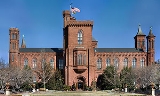
Smithsonian Institution Building

Encyclopedia
The Smithsonian Castle, located on the National Mall
in Washington, D.C.
behind the National Museum of African Art
, houses the Smithsonian Institution
's administrative offices and information center. The building is constructed of red Seneca sandstone
in the faux Norman
style (a 12th-century combination of late Romanesque
and early Gothic
motifs) and is appropriately nicknamed The Castle. It was designated a National Historic Landmark
in 1965.
, whose other works include St. Patrick's Cathedral
in New York City
and the Smithsonian's Renwick Gallery
, also in Washington D.C. Renwick was selected by a unanimous vote following a design competition in 1846. A cardboard model of Renwick's successful design survives. Renwick was assisted by Robert Mills
, particularly in the internal arrangement of the building.
 Initially intended to be built in white marble, then in yellow sandstone, the architect and committee finally settled on red Seneca sandstone from the vicinity of Seneca Creek in Montgomery County, Maryland
. The sandstone was substantially less expensive than granite or marble, and while initially easy to work, was found to harden to a satisfactory degree on exposure to the elements. The East Wing was completed in 1849 and occupied by Secretary Joseph Henry
and his family. The West Wing was completed later the same year. A structural collapse of partly completed work in 1850 raised questions of workmanship and resulted in a change to fireproof construction. The exterior was completed in 1851. By 1852 Renwick's work was completed and he withdrew from further participation. Gilbert Cameron took over responsibility for interior work, and all work was finally completed in 1855.
Despite the upgraded construction, a fire in 1865 caused extensive damage, destroying the correspondence of James Smithson
, Henry's files, two hundred oil paintings of American Indians by John Mix Stanley
, and the contents of the public libraries of Alexandria, Virginia
and Beaufort, South Carolina
, confiscated by Union forces during the American Civil War
. The ensuing renovation was undertaken by local Washington architect Adolph Cluss in 1865-67. Further fireproofing work ensued in 1883, also by Cluss, who by this time had designed the neighboring Arts and Industries Building
. A third and fourth floor were added to the East Wing, and a third floor to the West Wing. Electric lighting was installed in 1895.
Around 1900 the wooden floor of the Great Hall was replaced with terrazzo
and a Children's Museum was installed near the south entrance. A tunnel connected to the Arts and Industries Building. A general renovation took place in 1968-70 to install modern electrical systems, elevators and heating, ventilation and air conditioning systems.
's Denkmäler der deutschen Baukunst. Renwick originally intended to detail the building with entirely American sculptural flora in the manner of Benjamin Henry Latrobe's work at the United States Capitol
, but the final work used conventional pattern-book designs.
The building is completed in the Gothic Revival style with Romanesque
motifs. This style was chosen to evoke the Collegiate Gothic in England and the idea of knowledge and wisdom. The façade is built with red sandstone from the Seneca quarry
in Seneca, Maryland
in contrast to the marble and granite from the other major buildings in Washington DC.
The building comprises a central section, two extensions or ranges, and two wings. Four towers contain occupiable space, while five smaller towers are primarily decorative, although some contain stairs. As constructed, the central section contained the main entry and museum space (now the Great Hall), with a basement beneath and a large lecture room above. Two galleries on the second floor were used to display artifacts and art. This area is now the Visitor’s Information and Associates’ Reception area. The East Range contained laboratory space on the first floor and research space on the second. The East Wing contained storage space on the first floor and a suite of rooms on the second as an apartment for the Secretary of the Smithsonian. This space is currently used as administrative offices and archives. The West Range was one story and used as a reading room. The West Wing, known as the chapel, was used as a library. The West Wing and Range are now used as a quiet room for visitors to go.
On the exterior, the principal tower on the south side is 91 feet (27.7 m) high and 37 feet (11.3 m) square. On the north side there are two towers, the taller on 145 feet (44.2 m) tall. A campanile
at the northeast corner is 17 feet (5.2 m) square and 117 feet (35.7 m) tall.
The plan allowed for expansion at either end, a major reason for the informal medievally-inspired design, which would not suffer if asymmetrically developed.
.
National Mall
The National Mall is an open-area national park in downtown Washington, D.C., the capital of the United States. The National Mall is a unit of the National Park Service , and is administered by the National Mall and Memorial Parks unit...
in Washington, D.C.
Washington, D.C.
Washington, D.C., formally the District of Columbia and commonly referred to as Washington, "the District", or simply D.C., is the capital of the United States. On July 16, 1790, the United States Congress approved the creation of a permanent national capital as permitted by the U.S. Constitution....
behind the National Museum of African Art
National Museum of African Art
The National Museum of African Art is a museum that is part of the Smithsonian Institution in Washington, D.C.. Located on the National Mall, the museum specializes in African art and culture...
, houses the Smithsonian Institution
Smithsonian Institution
The Smithsonian Institution is an educational and research institute and associated museum complex, administered and funded by the government of the United States and by funds from its endowment, contributions, and profits from its retail operations, concessions, licensing activities, and magazines...
's administrative offices and information center. The building is constructed of red Seneca sandstone
Sandstone
Sandstone is a sedimentary rock composed mainly of sand-sized minerals or rock grains.Most sandstone is composed of quartz and/or feldspar because these are the most common minerals in the Earth's crust. Like sand, sandstone may be any colour, but the most common colours are tan, brown, yellow,...
in the faux Norman
Norman architecture
About|Romanesque architecture, primarily English|other buildings in Normandy|Architecture of Normandy.File:Durham Cathedral. Nave by James Valentine c.1890.jpg|thumb|200px|The nave of Durham Cathedral demonstrates the characteristic round arched style, though use of shallow pointed arches above the...
style (a 12th-century combination of late Romanesque
Romanesque architecture
Romanesque architecture is an architectural style of Medieval Europe characterised by semi-circular arches. There is no consensus for the beginning date of the Romanesque architecture, with proposals ranging from the 6th to the 10th century. It developed in the 12th century into the Gothic style,...
and early Gothic
Gothic architecture
Gothic architecture is a style of architecture that flourished during the high and late medieval period. It evolved from Romanesque architecture and was succeeded by Renaissance architecture....
motifs) and is appropriately nicknamed The Castle. It was designated a National Historic Landmark
National Historic Landmark
A National Historic Landmark is a building, site, structure, object, or district, that is officially recognized by the United States government for its historical significance...
in 1965.
History
The Castle was the first Smithsonian building, begun in 1847 by architect James Renwick, Jr.James Renwick, Jr.
James Renwick, Jr. , was a prominent American architect in the 19th-century. The Encyclopedia of American Architecture calls him "one of the most successful American architects of his time".-Life and work:Renwick was born into a wealthy and well-educated family...
, whose other works include St. Patrick's Cathedral
St. Patrick's Cathedral, New York
The Cathedral of St. Patrick is a decorated Neo-Gothic-style Roman Catholic cathedral church in the United States...
in New York City
New York City
New York is the most populous city in the United States and the center of the New York Metropolitan Area, one of the most populous metropolitan areas in the world. New York exerts a significant impact upon global commerce, finance, media, art, fashion, research, technology, education, and...
and the Smithsonian's Renwick Gallery
Renwick Gallery
The Renwick Gallery is a branch of the Smithsonian American Art Museum, located in Washington, D.C., and focuses on American craft and decorative arts from the 19th century to the 21st century...
, also in Washington D.C. Renwick was selected by a unanimous vote following a design competition in 1846. A cardboard model of Renwick's successful design survives. Renwick was assisted by Robert Mills
Robert Mills (architect)
Robert Mills , most famously known for designing the Washington Monument, is sometimes called the first native born American to become a professional architect, though Charles Bulfinch perhaps has a clearer claim to this honor...
, particularly in the internal arrangement of the building.
Montgomery County, Maryland
Montgomery County is a county in the U.S. state of Maryland, situated just to the north of Washington, D.C., and southwest of the city of Baltimore. It is one of the most affluent counties in the United States, and has the highest percentage of residents over 25 years of age who hold post-graduate...
. The sandstone was substantially less expensive than granite or marble, and while initially easy to work, was found to harden to a satisfactory degree on exposure to the elements. The East Wing was completed in 1849 and occupied by Secretary Joseph Henry
Joseph Henry
Joseph Henry was an American scientist who served as the first Secretary of the Smithsonian Institution, as well as a founding member of the National Institute for the Promotion of Science, a precursor of the Smithsonian Institution. During his lifetime, he was highly regarded...
and his family. The West Wing was completed later the same year. A structural collapse of partly completed work in 1850 raised questions of workmanship and resulted in a change to fireproof construction. The exterior was completed in 1851. By 1852 Renwick's work was completed and he withdrew from further participation. Gilbert Cameron took over responsibility for interior work, and all work was finally completed in 1855.
Despite the upgraded construction, a fire in 1865 caused extensive damage, destroying the correspondence of James Smithson
James Smithson
James Smithson, FRS, M.A. was a British mineralogist and chemist noted for having left a bequest in his will to the United States of America, to create "an establishment for the increase and diffusion of knowledge among men" to be called the Smithsonian Institution.-Biography:Not much is known...
, Henry's files, two hundred oil paintings of American Indians by John Mix Stanley
John Mix Stanley
John Mix Stanley was an artist-explorer, an American painter of landscapes, and Native American portraits and tribal life. Born in the Finger Lakes region of New York, he started painting signs and portraits as a young man, but in 1842 traveled to the American West to paint Native American life...
, and the contents of the public libraries of Alexandria, Virginia
Alexandria, Virginia
Alexandria is an independent city in the Commonwealth of Virginia. As of 2009, the city had a total population of 139,966. Located along the Western bank of the Potomac River, Alexandria is approximately six miles south of downtown Washington, D.C.Like the rest of northern Virginia, as well as...
and Beaufort, South Carolina
Beaufort, South Carolina
Beaufort is a city in and the county seat of Beaufort County, South Carolina, United States. Chartered in 1711, it is the second-oldest city in South Carolina, behind Charleston. The city's population was 12,361 in the 2010 census. It is located in the Hilton Head Island-Beaufort Micropolitan...
, confiscated by Union forces during the American Civil War
American Civil War
The American Civil War was a civil war fought in the United States of America. In response to the election of Abraham Lincoln as President of the United States, 11 southern slave states declared their secession from the United States and formed the Confederate States of America ; the other 25...
. The ensuing renovation was undertaken by local Washington architect Adolph Cluss in 1865-67. Further fireproofing work ensued in 1883, also by Cluss, who by this time had designed the neighboring Arts and Industries Building
Arts and Industries Building
The Arts and Industries Building is the second oldest of the Smithsonian museums on the National Mall in Washington, D.C. Initially named the National Museum, it was built to provide the Smithsonian with its first proper facility for public display of its growing collections.The building, designed...
. A third and fourth floor were added to the East Wing, and a third floor to the West Wing. Electric lighting was installed in 1895.
Around 1900 the wooden floor of the Great Hall was replaced with terrazzo
Terrazzo
Terrazzo is a composite material poured in place or precast, which is used for floor and wall treatments. It consists of marble, quartz, granite, glass or other suitable chips, sprinkled or unsprinkled, and poured with a binder that is cementitious, chemical or a combination of both...
and a Children's Museum was installed near the south entrance. A tunnel connected to the Arts and Industries Building. A general renovation took place in 1968-70 to install modern electrical systems, elevators and heating, ventilation and air conditioning systems.
Description
The Castle was designed by Renwick as the focal point of a picturesque landscape on the Mall, using elements from Georg MollerGeorg Moller
Georg Moller was an architect and a town planner who worked in the South of Germany, mostly in the region today known as Hessen.- Life and family background :...
's Denkmäler der deutschen Baukunst. Renwick originally intended to detail the building with entirely American sculptural flora in the manner of Benjamin Henry Latrobe's work at the United States Capitol
United States Capitol
The United States Capitol is the meeting place of the United States Congress, the legislature of the federal government of the United States. Located in Washington, D.C., it sits atop Capitol Hill at the eastern end of the National Mall...
, but the final work used conventional pattern-book designs.
The building is completed in the Gothic Revival style with Romanesque
Romanesque architecture
Romanesque architecture is an architectural style of Medieval Europe characterised by semi-circular arches. There is no consensus for the beginning date of the Romanesque architecture, with proposals ranging from the 6th to the 10th century. It developed in the 12th century into the Gothic style,...
motifs. This style was chosen to evoke the Collegiate Gothic in England and the idea of knowledge and wisdom. The façade is built with red sandstone from the Seneca quarry
Seneca Quarry
The Seneca Quarry is a historic site located at Seneca, Montgomery County, Maryland. It is located on the Chesapeake and Ohio Canal and the east bank of the Potomac River...
in Seneca, Maryland
Seneca, Maryland
Seneca is an unincorporated community in Montgomery County, Maryland, United States.-References:...
in contrast to the marble and granite from the other major buildings in Washington DC.
The building comprises a central section, two extensions or ranges, and two wings. Four towers contain occupiable space, while five smaller towers are primarily decorative, although some contain stairs. As constructed, the central section contained the main entry and museum space (now the Great Hall), with a basement beneath and a large lecture room above. Two galleries on the second floor were used to display artifacts and art. This area is now the Visitor’s Information and Associates’ Reception area. The East Range contained laboratory space on the first floor and research space on the second. The East Wing contained storage space on the first floor and a suite of rooms on the second as an apartment for the Secretary of the Smithsonian. This space is currently used as administrative offices and archives. The West Range was one story and used as a reading room. The West Wing, known as the chapel, was used as a library. The West Wing and Range are now used as a quiet room for visitors to go.
On the exterior, the principal tower on the south side is 91 feet (27.7 m) high and 37 feet (11.3 m) square. On the north side there are two towers, the taller on 145 feet (44.2 m) tall. A campanile
Campanile
Campanile is an Italian word meaning "bell tower" . The term applies to bell towers which are either part of a larger building or free-standing, although in American English, the latter meaning has become prevalent.The most famous campanile is probably the Leaning Tower of Pisa...
at the northeast corner is 17 feet (5.2 m) square and 117 feet (35.7 m) tall.
The plan allowed for expansion at either end, a major reason for the informal medievally-inspired design, which would not suffer if asymmetrically developed.
Current use
The Smithsonian Castle houses all the administrative offices of the Smithsonian. The main Smithsonian visitor center is also located here, with interactive displays and maps. Computers electronically answer most common questions. A crypt just inside the north entrance houses the tomb of James SmithsonJames Smithson
James Smithson, FRS, M.A. was a British mineralogist and chemist noted for having left a bequest in his will to the United States of America, to create "an establishment for the increase and diffusion of knowledge among men" to be called the Smithsonian Institution.-Biography:Not much is known...
.
See also
- Seneca QuarrySeneca QuarryThe Seneca Quarry is a historic site located at Seneca, Montgomery County, Maryland. It is located on the Chesapeake and Ohio Canal and the east bank of the Potomac River...
, the source of Seneca sandstone in Maryland, listed on the National Register of Historic PlacesNational Register of Historic PlacesThe National Register of Historic Places is the United States government's official list of districts, sites, buildings, structures, and objects deemed worthy of preservation...