

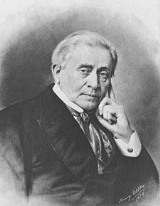
Joseph Henry

Encyclopedia
Joseph Henry was an American
scientist who served as the first Secretary of the Smithsonian Institution
, as well as a founding member of the National Institute for the Promotion of Science
, a precursor of the Smithsonian Institution. During his lifetime, he was highly regarded. While building electromagnets, Henry discovered the electromagnetic
phenomenon of self-inductance
. He also discovered mutual inductance independently of Michael Faraday
, though Faraday was the first to publish his results. The SI
unit of inductance
, the henry, is named in his honor. Henry's work on the electromagnetic relay was the basis of the electrical telegraph
, invented by Samuel Morse and Charles Wheatstone
separately.
to Scottish immigrants Ann Alexander Henry and William Henry. His parents were poor, and Henry's father died while he was still young. For the rest of his childhood, Henry lived with his grandmother in Galway, New York
. He attended a school which would later be named the "Joseph Henry Elementary School" in his honor. After school, he worked at a general store, and at the age of thirteen became an apprentice watchmaker
and silversmith
. Joseph's first love was theater and he came close to becoming a professional actor. His interest in science was sparked at the age of sixteen by a book of lectures on scientific topics titled Popular Lectures on Experimental Philosophy. In 1819 he entered The Albany Academy
, where he was given free tuition. He was so poor, even with free tuition, that he had to support himself with teaching and private tutoring positions. He intended to go into the field of medicine, but in 1824 he was appointed an assistant engineer for the survey
of the State road being constructed between the Hudson River
and Lake Erie
. From then on, he was inspired to a career in either civil
or mechanical engineering
.
Henry excelled at his studies (so much so, that he would often be helping his teachers teach science) that in 1826 he was appointed Professor of Mathematics and Natural Philosophy at The Albany Academy
by Principal T. Romeyn Beck. Some of his most important research was conducted in this new position. His curiosity about terrestrial magnetism led him to experiment with magnetism
in general. He was the first to coil insulated wire tightly around an iron core in order to make a more powerful electromagnet
, improving on William Sturgeon
's electromagnet which used loosely coiled uninsulated wire. Using this technique, he built the strongest electromagnet at the time for Yale
. He also showed that, when making an electromagnet using just two electrode
s attached to a battery, it is best to wind several coils of wire in parallel, but when using a set-up with multiple batteries, there should be only one single long coil. The latter made the telegraph
feasible.
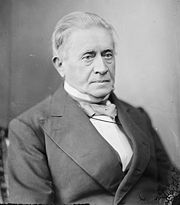 Using his newly-developed electromagnetic principle, Henry in 1831 created one of the first machines to use electromagnetism for motion. This was the earliest ancestor of modern DC motor
. It did not make use of rotating motion, but was merely an electromagnet perched on a pole, rocking back and forth. The rocking motion was caused by one of the two leads on both ends of the magnet rocker touching one of the two battery cells, causing a polarity change, and rocking the opposite direction until the other two leads hit the other battery.
This apparatus allowed Henry to recognize the property of self inductance
. British scientist Michael Faraday
also recognized this property around the same time; since Faraday published his results first, he became the officially recognized discoverer of the phenomenon.
In 1848 Henry worked in conjunction with Professor Stephen Alexander
to determine the relative temperatures for different parts of the solar disk. They used a thermopile
to determine that sunspot
s were cooler than the surrounding regions. This work was shown to the astronomer Angelo Secchi
who extended it, but with some question as to whether Henry was given proper credit for his earlier work.
, a balloonist from New Hampshire who had taken interest in the phenomenon of lighter-than-air gases, and exploits into meteorology, in particular, the high winds which we call the Jet stream
today. It was Lowe's intent to make a transatlantic crossing by utilizing an enormous gas-inflated aerostat. Henry took a great interest in Lowe's endeavors, promoting him among some of the more prominent scientists and institutions of the day.
In June 1860, Lowe had made a successful test flight with his gigantic balloon, first named the City of New York and later renamed The Great Western, flying from Philadelphia
to Medford, New York
. Lowe would not be able to attempt a transatlantic flight until late Spring of the 1861, so Henry convinced him to take his balloon to a point more West and fly the balloon back to the eastern seaboard, an exercise that would keep his investors interested.
Lowe took several smaller balloons to Cincinnati, Ohio
in March 1861. On 19 April, he launched on a fateful flight that landed him in Confederate South Carolina
. With the Southern States seceding from the union, and the onset of civil war, Lowe abandoned further attempts at a transatlantic crossing and, with Henry's endorsement, went to Washington to offer his services as an aeronaut to the Federal government. Henry submitted a letter to Secretary of War Simon Cameron
which carried Henry's endorsement:
On Henry's recommendation Lowe went on to form the Union Army Balloon Corps
and served two years with the Army of the Potomac as a Civil War Aeronaut.
phenomena we now call direct sound, early reflections, and reverberation. He demonstrated the early sound integration period and laid the groundwork for further fundamental research on early reflections that was not followed up until the work at Göttingen University in the 1950–1960s. He brought a robust scientific approach to the subject of acoustics.
Henry devised a simple experiment to demonstrate the integration of direct and early sound. A listener, standing in an open space 100 feet from a wall, claps his hands and hears an echo. He gradually approaches the wall, clapping, until no echo is perceived, at a distance of 30 feet—the "Henry Distance"—equating to an early sound integration time of 60 ms.
 As a famous scientist and director of the Smithsonian Institution, Henry received visits from other scientists and inventors who sought his advice. Henry was patient, kindly, self-controlled, and gently humorous. One such visitor was Alexander Graham Bell
, who on 1 March 1875 carried a letter of introduction to Henry. Henry showed an interest in seeing Bell's experimental apparatus, and Bell returned the following day. After the demonstration, Bell mentioned his untested theory on how to transmit human speech electrically by means of a "harp apparatus" which would have several steel reeds tuned to different frequencies to cover the voice spectrum. Henry said Bell had "the germ of a great invention". Henry advised Bell not to publish his ideas until he had perfected the invention. When Bell objected that he lacked the necessary knowledge, Henry firmly advised: "Get it!"
On 25 June 1876, Bell's experimental telephone (using a different design) was demonstrated at the Centennial Exhibition in Philadelphia where Henry was one of the judges for electrical exhibits. On 13 January 1877, Bell demonstrated his instruments to Henry at the Smithsonian Institution and Henry invited Bell to demonstrate them again that night at the Washington Philosophical Society. Henry praised "the value and astonishing character of Mr. Bell's discovery and invention."
Henry died on 13 May 1878, and was buried in Oak Hill Cemetery in the Georgetown
section of northwest Washington, D.C.
honored Henry for his work on lighthouses and fog signal acoustics by naming a cutter after him. The Joseph Henry, usually referred to as the Joe Henry, was launched in 1880 and was active until 1904.
In 1915 Henry was inducted into the Hall of Fame for Great Americans
in the Bronx, New York.
At Princeton
, the Joseph Henry Laboratories and the Joseph Henry House
are named for him.

United States
The United States of America is a federal constitutional republic comprising fifty states and a federal district...
scientist who served as the first Secretary of the Smithsonian Institution
Smithsonian Institution
The Smithsonian Institution is an educational and research institute and associated museum complex, administered and funded by the government of the United States and by funds from its endowment, contributions, and profits from its retail operations, concessions, licensing activities, and magazines...
, as well as a founding member of the National Institute for the Promotion of Science
National Institute for the Promotion of Science
The National Institution for the Promotion of Science organization was established in Washington, D.C. in May, 1840, and was heir to the mantle of the earlier Columbian Institute for the Promotion of Arts and Sciences...
, a precursor of the Smithsonian Institution. During his lifetime, he was highly regarded. While building electromagnets, Henry discovered the electromagnetic
Electromagnetism
Electromagnetism is one of the four fundamental interactions in nature. The other three are the strong interaction, the weak interaction and gravitation...
phenomenon of self-inductance
Inductance
In electromagnetism and electronics, inductance is the ability of an inductor to store energy in a magnetic field. Inductors generate an opposing voltage proportional to the rate of change in current in a circuit...
. He also discovered mutual inductance independently of Michael Faraday
Michael Faraday
Michael Faraday, FRS was an English chemist and physicist who contributed to the fields of electromagnetism and electrochemistry....
, though Faraday was the first to publish his results. The SI
Si
Si, si, or SI may refer to :- Measurement, mathematics and science :* International System of Units , the modern international standard version of the metric system...
unit of inductance
Inductance
In electromagnetism and electronics, inductance is the ability of an inductor to store energy in a magnetic field. Inductors generate an opposing voltage proportional to the rate of change in current in a circuit...
, the henry, is named in his honor. Henry's work on the electromagnetic relay was the basis of the electrical telegraph
Electrical telegraph
An electrical telegraph is a telegraph that uses electrical signals, usually conveyed via telecommunication lines or radio. The electromagnetic telegraph is a device for human-to-human transmission of coded text messages....
, invented by Samuel Morse and Charles Wheatstone
Charles Wheatstone
Sir Charles Wheatstone FRS , was an English scientist and inventor of many scientific breakthroughs of the Victorian era, including the English concertina, the stereoscope , and the Playfair cipher...
separately.
Biography
Henry was born in Albany, New YorkAlbany, New York
Albany is the capital city of the U.S. state of New York, the seat of Albany County, and the central city of New York's Capital District. Roughly north of New York City, Albany sits on the west bank of the Hudson River, about south of its confluence with the Mohawk River...
to Scottish immigrants Ann Alexander Henry and William Henry. His parents were poor, and Henry's father died while he was still young. For the rest of his childhood, Henry lived with his grandmother in Galway, New York
Galway (village), New York
Galway is a village in the town of Galway in Saratoga County, New York, USA. The population was 214 at the 2000 census. The village is north of Schenectady. Galway Lake, a vacation area, is west of the village.- History :...
. He attended a school which would later be named the "Joseph Henry Elementary School" in his honor. After school, he worked at a general store, and at the age of thirteen became an apprentice watchmaker
Watchmaker
A watchmaker is an artisan who makes and repairs watches. Since virtually all watches are now factory made, most modern watchmakers solely repair watches. However, originally they were master craftsmen who built watches, including all their parts, by hand...
and silversmith
Silversmith
A silversmith is a craftsperson who makes objects from silver or gold. The terms 'silversmith' and 'goldsmith' are not synonyms as the techniques, training, history, and guilds are or were largely the same but the end product varies greatly as does the scale of objects created.Silversmithing is the...
. Joseph's first love was theater and he came close to becoming a professional actor. His interest in science was sparked at the age of sixteen by a book of lectures on scientific topics titled Popular Lectures on Experimental Philosophy. In 1819 he entered The Albany Academy
The Albany Academy
The Albany Academy is an independent college preparatory day school for boys in Albany, New York, USA, enrolling students from Preschool to Grade 12. It was established in 1813 by a charter signed by Mayor Philip Schuyler Van Rensselaer and the city council of Albany...
, where he was given free tuition. He was so poor, even with free tuition, that he had to support himself with teaching and private tutoring positions. He intended to go into the field of medicine, but in 1824 he was appointed an assistant engineer for the survey
Surveying
See Also: Public Land Survey SystemSurveying or land surveying is the technique, profession, and science of accurately determining the terrestrial or three-dimensional position of points and the distances and angles between them...
of the State road being constructed between the Hudson River
Hudson River
The Hudson is a river that flows from north to south through eastern New York. The highest official source is at Lake Tear of the Clouds, on the slopes of Mount Marcy in the Adirondack Mountains. The river itself officially begins in Henderson Lake in Newcomb, New York...
and Lake Erie
Lake Erie
Lake Erie is the fourth largest lake of the five Great Lakes in North America, and the tenth largest globally. It is the southernmost, shallowest, and smallest by volume of the Great Lakes and therefore also has the shortest average water residence time. It is bounded on the north by the...
. From then on, he was inspired to a career in either civil
Civil engineering
Civil engineering is a professional engineering discipline that deals with the design, construction, and maintenance of the physical and naturally built environment, including works like roads, bridges, canals, dams, and buildings...
or mechanical engineering
Mechanical engineering
Mechanical engineering is a discipline of engineering that applies the principles of physics and materials science for analysis, design, manufacturing, and maintenance of mechanical systems. It is the branch of engineering that involves the production and usage of heat and mechanical power for the...
.
Henry excelled at his studies (so much so, that he would often be helping his teachers teach science) that in 1826 he was appointed Professor of Mathematics and Natural Philosophy at The Albany Academy
The Albany Academy
The Albany Academy is an independent college preparatory day school for boys in Albany, New York, USA, enrolling students from Preschool to Grade 12. It was established in 1813 by a charter signed by Mayor Philip Schuyler Van Rensselaer and the city council of Albany...
by Principal T. Romeyn Beck. Some of his most important research was conducted in this new position. His curiosity about terrestrial magnetism led him to experiment with magnetism
Magnetism
Magnetism is a property of materials that respond at an atomic or subatomic level to an applied magnetic field. Ferromagnetism is the strongest and most familiar type of magnetism. It is responsible for the behavior of permanent magnets, which produce their own persistent magnetic fields, as well...
in general. He was the first to coil insulated wire tightly around an iron core in order to make a more powerful electromagnet
Electromagnet
An electromagnet is a type of magnet in which the magnetic field is produced by the flow of electric current. The magnetic field disappears when the current is turned off...
, improving on William Sturgeon
William Sturgeon
William Sturgeon was an English physicist and inventor who made the first electromagnets, and invented the first practical English electric motor.-Early Life :...
's electromagnet which used loosely coiled uninsulated wire. Using this technique, he built the strongest electromagnet at the time for Yale
Yale University
Yale University is a private, Ivy League university located in New Haven, Connecticut, United States. Founded in 1701 in the Colony of Connecticut, the university is the third-oldest institution of higher education in the United States...
. He also showed that, when making an electromagnet using just two electrode
Electrode
An electrode is an electrical conductor used to make contact with a nonmetallic part of a circuit...
s attached to a battery, it is best to wind several coils of wire in parallel, but when using a set-up with multiple batteries, there should be only one single long coil. The latter made the telegraph
Electrical telegraph
An electrical telegraph is a telegraph that uses electrical signals, usually conveyed via telecommunication lines or radio. The electromagnetic telegraph is a device for human-to-human transmission of coded text messages....
feasible.
Electric motor
An electric motor converts electrical energy into mechanical energy.Most electric motors operate through the interaction of magnetic fields and current-carrying conductors to generate force...
. It did not make use of rotating motion, but was merely an electromagnet perched on a pole, rocking back and forth. The rocking motion was caused by one of the two leads on both ends of the magnet rocker touching one of the two battery cells, causing a polarity change, and rocking the opposite direction until the other two leads hit the other battery.
This apparatus allowed Henry to recognize the property of self inductance
Inductance
In electromagnetism and electronics, inductance is the ability of an inductor to store energy in a magnetic field. Inductors generate an opposing voltage proportional to the rate of change in current in a circuit...
. British scientist Michael Faraday
Michael Faraday
Michael Faraday, FRS was an English chemist and physicist who contributed to the fields of electromagnetism and electrochemistry....
also recognized this property around the same time; since Faraday published his results first, he became the officially recognized discoverer of the phenomenon.
In 1848 Henry worked in conjunction with Professor Stephen Alexander
Stephen Alexander (astronomer)
Stephen Alexander was a noted astronomer and educator. He was born in Schenectady, New York.He graduated from Union College in 1824. He became a tutor in mathematics at Princeton University in 1832, where he would later become professor of astronomy and mathematics...
to determine the relative temperatures for different parts of the solar disk. They used a thermopile
Thermopile
A thermopile is an electronic device that converts thermal energy into electrical energy. It is composed of several thermocouples connected usually in series or, less commonly, in parallel....
to determine that sunspot
Sunspot
Sunspots are temporary phenomena on the photosphere of the Sun that appear visibly as dark spots compared to surrounding regions. They are caused by intense magnetic activity, which inhibits convection by an effect comparable to the eddy current brake, forming areas of reduced surface temperature....
s were cooler than the surrounding regions. This work was shown to the astronomer Angelo Secchi
Angelo Secchi
-External links:...
who extended it, but with some question as to whether Henry was given proper credit for his earlier work.
Influences in aeronautics
Prof. Henry was introduced to Prof. Thaddeus LoweThaddeus S. C. Lowe
Thaddeus Sobieski Coulincourt Lowe , also known as Professor T. S. C. Lowe, was an American Civil War aeronaut, scientist and inventor, mostly self-educated in the fields of chemistry, meteorology, and aeronautics, and the father of military aerial reconnaissance in the United States...
, a balloonist from New Hampshire who had taken interest in the phenomenon of lighter-than-air gases, and exploits into meteorology, in particular, the high winds which we call the Jet stream
Jet stream
Jet streams are fast flowing, narrow air currents found in the atmospheres of some planets, including Earth. The main jet streams are located near the tropopause, the transition between the troposphere and the stratosphere . The major jet streams on Earth are westerly winds...
today. It was Lowe's intent to make a transatlantic crossing by utilizing an enormous gas-inflated aerostat. Henry took a great interest in Lowe's endeavors, promoting him among some of the more prominent scientists and institutions of the day.
In June 1860, Lowe had made a successful test flight with his gigantic balloon, first named the City of New York and later renamed The Great Western, flying from Philadelphia
Philadelphia, Pennsylvania
Philadelphia is the largest city in the Commonwealth of Pennsylvania and the county seat of Philadelphia County, with which it is coterminous. The city is located in the Northeastern United States along the Delaware and Schuylkill rivers. It is the fifth-most-populous city in the United States,...
to Medford, New York
Medford, New York
Medford is a hamlet in Suffolk County, New York, United States. The population was 21,985 at the 2000 census.Medford is a community in the southwest part of the Town of Brookhaven...
. Lowe would not be able to attempt a transatlantic flight until late Spring of the 1861, so Henry convinced him to take his balloon to a point more West and fly the balloon back to the eastern seaboard, an exercise that would keep his investors interested.
Lowe took several smaller balloons to Cincinnati, Ohio
Cincinnati, Ohio
Cincinnati is a city in the U.S. state of Ohio. Cincinnati is the county seat of Hamilton County. Settled in 1788, the city is located to north of the Ohio River at the Ohio-Kentucky border, near Indiana. The population within city limits is 296,943 according to the 2010 census, making it Ohio's...
in March 1861. On 19 April, he launched on a fateful flight that landed him in Confederate South Carolina
Confederate States of America
The Confederate States of America was a government set up from 1861 to 1865 by 11 Southern slave states of the United States of America that had declared their secession from the U.S...
. With the Southern States seceding from the union, and the onset of civil war, Lowe abandoned further attempts at a transatlantic crossing and, with Henry's endorsement, went to Washington to offer his services as an aeronaut to the Federal government. Henry submitted a letter to Secretary of War Simon Cameron
Simon Cameron
Simon Cameron was an American politician who served as United States Secretary of War for Abraham Lincoln at the start of the American Civil War. After making his fortune in railways and banking, he turned to a life of politics. He became a U.S. senator in 1845 for the state of Pennsylvania,...
which carried Henry's endorsement:
- Hon. SIMON CAMERON:
-
- DEAR SIR: In accordance with your request made to me orally on the morning of the 6th of June, I have examined the apparatus and witnessed the balloon experiments of Mr. Lowe, and have come to the following conclusions:
-
- 1st. The balloon prepared by Mr. Lowe, inflated with ordinary street gas, will retain its charge for several days.
-
- 2d. In an inflated condition it can be towed by a few men along an ordinary road, or over fields, in ordinarily calm weather, from the places where it is galled [i.e. swelled or inflated] to another, twenty or more miles distant.
-
- 3d. It can be let up into the air by means of a rope in a calm day to a height sufficient to observe the country for twenty miles around and more, according to the degree of clearness of the atmosphere. The ascent may also be made at night and the camp lights of the enemy observed.
-
- 4th. From experiments made here for the first time it is conclusively proved that telegrams can be sent with ease and certainty between the balloon and the quarters of the commanding officer.
-
- 5th. I feel assured, although I have not witnessed the experiment, that when the surface wind is from the east, as it was for several days last week, an observer in the balloon can be made to float nearly to the enemy's camp (as it is now situated to the west of us), or even to float over it, and then return eastward by rising to a higher elevation. This assumption is based on the fact that the upper strata of wind in this latitude is always flowing eastward. Mr. Lowe informs me, and I do not doubt his statement, that he will on any day which is favorable make an excursion of the kind above mentioned.
-
- 6th. From all the facts I have observed and the information I have gathered I am sure that important information may be obtained in regard to the topography of the country and to the position and movements of an enemy by means of the balloon now, and that Mr. Lowe is well qualified to render service in this way by the balloon now in his possession.
-
- 7th. The balloon which Mr. Lowe now has in Washington can only be inflated in a city where street gas is to be obtained. If an exploration is required at a point too distant for the transportation of the inflated balloon, an additional apparatus for the generation of hydrogen gas will be required. The necessity of generating the gas renders the use of the balloon more expensive, but this, where important results are required, is of comparatively small importance.
-
- For these preliminary experiments, as you may recollect, a sum not to exceed $200 or $250 was to be appropriated, and in accordance with this Mr. Lowe has presented me with the inclosed statement of items, which I think are reasonable, since nothing is charged for labor and time of the aeronaut.
-
- I have the honor to remain, very respectfully, your obedient servant,
- JOSEPH HENRY,
- Secretary Smithsonian Institution.
- I have the honor to remain, very respectfully, your obedient servant,
On Henry's recommendation Lowe went on to form the Union Army Balloon Corps
Union Army Balloon Corps
The Union Army Balloon Corps was a branch of the Union Army during the American Civil War, established by presidential appointee Thaddeus S. C. Lowe...
and served two years with the Army of the Potomac as a Civil War Aeronaut.
Influences in room acoustics
Over 150 years ago, Henry identified the room acousticsRoom acoustics
Room acoustics describes how sound behaves in an enclosed space.The way that sound behaves in a room can be broken up into roughly four different frequency zones:...
phenomena we now call direct sound, early reflections, and reverberation. He demonstrated the early sound integration period and laid the groundwork for further fundamental research on early reflections that was not followed up until the work at Göttingen University in the 1950–1960s. He brought a robust scientific approach to the subject of acoustics.
Henry devised a simple experiment to demonstrate the integration of direct and early sound. A listener, standing in an open space 100 feet from a wall, claps his hands and hears an echo. He gradually approaches the wall, clapping, until no echo is perceived, at a distance of 30 feet—the "Henry Distance"—equating to an early sound integration time of 60 ms.
Later years
Alexander Graham Bell
Alexander Graham Bell was an eminent scientist, inventor, engineer and innovator who is credited with inventing the first practical telephone....
, who on 1 March 1875 carried a letter of introduction to Henry. Henry showed an interest in seeing Bell's experimental apparatus, and Bell returned the following day. After the demonstration, Bell mentioned his untested theory on how to transmit human speech electrically by means of a "harp apparatus" which would have several steel reeds tuned to different frequencies to cover the voice spectrum. Henry said Bell had "the germ of a great invention". Henry advised Bell not to publish his ideas until he had perfected the invention. When Bell objected that he lacked the necessary knowledge, Henry firmly advised: "Get it!"
On 25 June 1876, Bell's experimental telephone (using a different design) was demonstrated at the Centennial Exhibition in Philadelphia where Henry was one of the judges for electrical exhibits. On 13 January 1877, Bell demonstrated his instruments to Henry at the Smithsonian Institution and Henry invited Bell to demonstrate them again that night at the Washington Philosophical Society. Henry praised "the value and astonishing character of Mr. Bell's discovery and invention."
Henry died on 13 May 1878, and was buried in Oak Hill Cemetery in the Georgetown
Georgetown, Washington, D.C.
Georgetown is a neighborhood located in northwest Washington, D.C., situated along the Potomac River. Founded in 1751, the port of Georgetown predated the establishment of the federal district and the City of Washington by 40 years...
section of northwest Washington, D.C.
Legacy
Henry was a member of the Lighthouse Board from 1852 until his death. He was appointed chairman in 1871 and served in that position the remainder of his life. He was the only civilian to serve as chairman. The United States Coast GuardUnited States Coast Guard
The United States Coast Guard is a branch of the United States Armed Forces and one of the seven U.S. uniformed services. The Coast Guard is a maritime, military, multi-mission service unique among the military branches for having a maritime law enforcement mission and a federal regulatory agency...
honored Henry for his work on lighthouses and fog signal acoustics by naming a cutter after him. The Joseph Henry, usually referred to as the Joe Henry, was launched in 1880 and was active until 1904.
In 1915 Henry was inducted into the Hall of Fame for Great Americans
Hall of Fame for Great Americans
The Hall of Fame for Great Americans is the original hall of fame in the United States. "Fame" here means "renown"...
in the Bronx, New York.
At Princeton
Princeton University
Princeton University is a private research university located in Princeton, New Jersey, United States. The school is one of the eight universities of the Ivy League, and is one of the nine Colonial Colleges founded before the American Revolution....
, the Joseph Henry Laboratories and the Joseph Henry House
Joseph Henry House
The Joseph Henry House is a building located on the campus of Princeton University. Joseph Henry, American physicist, who worked in electromagnetics, constructed an early electric motor and discovered self-inductance, lived here from 1832 to 1846 while teaching at what was then known as The College...
are named for him.
Curriculum vitae
- 1826 – Professor of Mathematics and Natural Philosophy at The Albany AcademyThe Albany AcademyThe Albany Academy is an independent college preparatory day school for boys in Albany, New York, USA, enrolling students from Preschool to Grade 12. It was established in 1813 by a charter signed by Mayor Philip Schuyler Van Rensselaer and the city council of Albany...
, New York. - 1832 – Professor at Princeton.
- 1835 – Invented the electromechanical relayRelayA relay is an electrically operated switch. Many relays use an electromagnet to operate a switching mechanism mechanically, but other operating principles are also used. Relays are used where it is necessary to control a circuit by a low-power signal , or where several circuits must be controlled...
. - 1846 – First secretary of the Smithsonian InstitutionSmithsonian InstitutionThe Smithsonian Institution is an educational and research institute and associated museum complex, administered and funded by the government of the United States and by funds from its endowment, contributions, and profits from its retail operations, concessions, licensing activities, and magazines...
until 1878 - 1848 – Edited Ephraim G. SquierE. G. SquierEphraim George Squier was an American archaeologist and newspaper editor.-Biography:He was born in Bethlehem, New York, the son of a minister of English heritage and his Palatine German wife. In early youth he worked on a farm, attended and taught school, studied engineering, and became interested...
and Edwin H. Davis' Ancient Monuments of the Mississippi ValleyAncient Monuments of the Mississippi ValleyAncient Monuments of the Mississippi Valley by Americans Ephraim George Squier and Edwin Hamilton Davis is a landmark in American scientific research, the study of the prehistoric Mound builders of North America, and the early development of archaeology...
, the Institution's first publication. - 1852 – Appointed to the Lighthouse Board
- 1871 – Appointed chairman of the Lighthouse Board
See also
- ElectromagnetismElectromagnetismElectromagnetism is one of the four fundamental interactions in nature. The other three are the strong interaction, the weak interaction and gravitation...
- Henry (unit)
- Multiple coil magnet
- Timeline of historic inventions
- Timeline of communication technologyTimeline of communication technologyTimeline of communication technology* Prior to 3500BC - Communication was carried out through paintings of indigenous tribes.* 3500s BC - The Sumerians develop cuneiform writing and the Egyptians develop hieroglyphic writing...
- American Philosophical SocietyAmerican Philosophical SocietyThe American Philosophical Society, founded in 1743, and located in Philadelphia, Pa., is an eminent scholarly organization of international reputation, that promotes useful knowledge in the sciences and humanities through excellence in scholarly research, professional meetings, publications,...
- History of Albany, New YorkHistory of Albany, New YorkThe history of Albany, New York, begins with the first interaction with native Indian tribes that originally inhabited the area. The area was originally inhabited by Algonquian Indian tribes, namely the Mohican and the Iroquois....
Further reading
- Ames, Joseph Sweetman (Ed.), The discovery of induced electric currents, Vol. 1. Memoirs, by Joseph Henry. New York, Cincinnati [etc.] American book company [c1900] LCCN 00005889
- Coulson, Thomas, Joseph Henry: His Life and Work, Princeton, Princeton University Press, 1950
- Dorman, Kathleen W., and Sarah J. Shoenfeld (comps.), The Papers of Joseph Henry. Volume 12: Cumulative Index, Science History Publications, 2008
- Henry, Joseph, Scientific Writings of Joseph Henry. Volumes 1 and 2, Smithsonian Institution, 1886
- Moyer, Albert E., Joseph Henry: The Rise of an American Scientist, Washington, Smithsonian Institution Press, 1997. ISBN 1-56098-776-6
- Reingold, Nathan, et al., (eds.), The Papers of Joseph Henry. Volumes 1-5, Washington, Smithsonian Institution Press, 1972–1988
- Rothenberg, Marc, et al., (eds.), The Papers of Joseph Henry. Volumes 6-8, Washington, Smithsonian Institution Press, 1992–1998, and Volumes 9-11, Science History Publications, 2002–2007
External links
- The Joseph Henry Papers Project
- Finding Aid to the Joseph Henry Collection
- Biographical details — Proceedings of the National Academy of Sciences (1967), 58(1), pages 1–10.
- Dedication ceremony for the Henry statue (1883)
- Published physics papers — On the Production of Currents and Sparks of Electricity from Magnetism and On Electro-Dynamic Induction (extract)