

Seigneurial system of New France

Encyclopedia
Feudalism
Feudalism was a set of legal and military customs in medieval Europe that flourished between the 9th and 15th centuries, which, broadly defined, was a system for ordering society around relationships derived from the holding of land in exchange for service or labour.Although derived from the...
system of land distribution used in the North American colonies
French colonial empire
The French colonial empire was the set of territories outside Europe that were under French rule primarily from the 17th century to the late 1960s. In the 19th and 20th centuries, the colonial empire of France was the second-largest in the world behind the British Empire. The French colonial empire...
of New France
New France
New France was the area colonized by France in North America during a period beginning with the exploration of the Saint Lawrence River by Jacques Cartier in 1534 and ending with the cession of New France to Spain and Great Britain in 1763...
.
Introduction to New France
The seigneurial system was introduced to New FranceNew France
New France was the area colonized by France in North America during a period beginning with the exploration of the Saint Lawrence River by Jacques Cartier in 1534 and ending with the cession of New France to Spain and Great Britain in 1763...
in 1627 by Cardinal Richelieu. Under this system, the lands were arranged in long narrow strips, called seigneuries, along the banks of the St. Lawrence River. Each piece of land belonged to the king of France and was maintained by the landlord, or seigneur.
The seigneurial system was introduced because the St. Lawrence River was something like the "Highway of New France". The river provided water and a means of transportation, which enabled settlers with land along the St. Lawrence to be successful. Land along the river, therefore, was much in demand.
The seigneur divided the land further among his tenants, known as censitaires or habitants
Habitants
Habitants is the name used to refer to both the French settlers and the inhabitants of French origin who farmed the land along the two shores of the St. Lawrence Gulf and River in what is the present-day Province of Quebec in Canada...
, who cleared the land, built houses and other buildings, and farmed the land. The habitants paid taxes to the seigneur called cens and another inheritance tax called lods and ventes, and were usually required to work for their seigneur for three days per year, often building roads The habitants would also divide their land for their children once they had families of their own.
Unlike the French feudalism from which it was derived, the lord of the manor was not granted the "haut" or "bas" jurisdiction to impose fines and penalties as in Europe
Europe
Europe is, by convention, one of the world's seven continents. Comprising the westernmost peninsula of Eurasia, Europe is generally 'divided' from Asia to its east by the watershed divides of the Ural and Caucasus Mountains, the Ural River, the Caspian and Black Seas, and the waterways connecting...
; those powers were given to the Intendant of New France
Intendant of New France
New France was governed by three rulers: the governor, the bishop and the intendant, all appointed by the King, and sent from France. The intendant was responsible for finance, economic development, and the administration of justice . He also presided over the Sovereign Council of New France...
, a commissioner sent by the King.
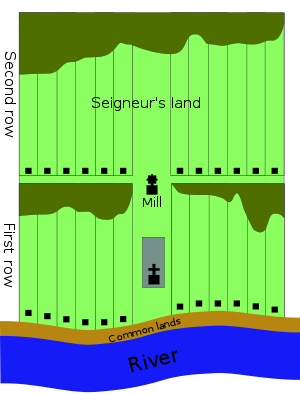
Seigneuries were often divided into a number of areas. There was a common area on the shore of the St. Lawrence river, behind which was the best land and the seigneur's estate itself. There were also one or more sets of farmland, not adjacent to the river, immediately behind the first set.
In France, seigneurs were vassal
Vassal
A vassal or feudatory is a person who has entered into a mutual obligation to a lord or monarch in the context of the feudal system in medieval Europe. The obligations often included military support and mutual protection, in exchange for certain privileges, usually including the grant of land held...
s to the king, who granted them the deeds to the seigneuries. The seigneurial system differed somewhat from its counterpart in France; the seigneurs of New France were not always nobles. Seigneuries in North America were granted to military officers, some were owned by the Catholic clergy and even by unions of local inhabitants. In 1663, half of the seigneuries of New France were managed by women. This situation came to be because a woman could inherit her husband's property after his death. In New France, the king was represented by his intendant
Intendant
The title of intendant has been used in several countries through history. Traditionally, it refers to the holder of a public administrative office...
; the first intendant of New France was Jean Talon
Jean Talon
Jean Talon, Comte d'Orsainville was a French colonial administrator who was the first and most highly regarded Intendant of New France under King Louis XIV...
, who made it a requirement that seigneurs actually live on their estates. It also allowed for increased control over settlement by a central authority.
The seigneurs were never the real owners of their lands; the lands were concessions by the King in exchange for services. The seigneurs were responsible for building a mill, chapel and roads for the censitaires, who were then responsible for working a number of days per year for the seigneur.
After the British conquest
After the Battle of the Plains of AbrahamBattle of the Plains of Abraham
The Battle of the Plains of Abraham, also known as the Battle of Quebec, was a pivotal battle in the Seven Years' War...
and the conquest of Quebec by the British
Kingdom of Great Britain
The former Kingdom of Great Britain, sometimes described as the 'United Kingdom of Great Britain', That the Two Kingdoms of Scotland and England, shall upon the 1st May next ensuing the date hereof, and forever after, be United into One Kingdom by the Name of GREAT BRITAIN. was a sovereign...
during the Seven Years' War
Seven Years' War
The Seven Years' War was a global military war between 1756 and 1763, involving most of the great powers of the time and affecting Europe, North America, Central America, the West African coast, India, and the Philippines...
, the system became an obstacle to colonization by British settlers. The Quebec Act
Quebec Act
The Quebec Act of 1774 was an Act of the Parliament of Great Britain setting procedures of governance in the Province of Quebec...
of 1774 retained French civil law and therefore the seigneurial system.
It remained relatively intact for almost a century. This was the prime land; also many Englishmen and Scotsmen purchased seigneuries; others were divided equally between male and female offspring; some were run by the widows of seigneurs as their children grew to adulthood. Over time land became subdivided among the owners' offspring and descendants, resulting in increasingly narrow plots of land.
When Quebec was divided in December 1791 between Lower Canada
Lower Canada
The Province of Lower Canada was a British colony on the lower Saint Lawrence River and the shores of the Gulf of Saint Lawrence...
(today's Quebec
Quebec
Quebec or is a province in east-central Canada. It is the only Canadian province with a predominantly French-speaking population and the only one whose sole official language is French at the provincial level....
) and Upper Canada
Upper Canada
The Province of Upper Canada was a political division in British Canada established in 1791 by the British Empire to govern the central third of the lands in British North America and to accommodate Loyalist refugees from the United States of America after the American Revolution...
(today's Ontario
Ontario
Ontario is a province of Canada, located in east-central Canada. It is Canada's most populous province and second largest in total area. It is home to the nation's most populous city, Toronto, and the nation's capital, Ottawa....
), a 45.7 km (28.4 mi) segment of the colonial boundary was drawn at the west edge of the westernmost seigneuries along the St. Lawrence and Ottawa rivers, accounting for the small triangle of land at Vaudreuil-Soulanges
Vaudreuil-Soulanges Regional County Municipality, Quebec
-References:...
that belongs to Quebec rather than Ontario.
Abolition
The seigneurial system was formally abolished by the Legislative Assembly of the Province of CanadaLegislative Assembly of the Province of Canada
The Legislative Assembly of the Province of Canada was the lower house of the legislature for the Province of Canada, which consisted of the former provinces of Lower Canada, then known as Canada East and later the province of Quebec, and Upper Canada, then known as Canada West and later the...
and assented to by Governor
Governor
A governor is a governing official, usually the executive of a non-sovereign level of government, ranking under the head of state...
Lord Elgin
James Bruce, 8th Earl of Elgin
Sir James Bruce, 8th Earl of Elgin and 12th Earl of Kincardine, KT, GCB, PC , was a British colonial administrator and diplomat...
on 22 June 1854 in An Act for the Abolition of Feudal Rights and Duties in Lower Canada which was brought into effect on 18 December of that year.
The act called for the creation of a special Seigneurial Court composed of all the justices of Lower Canada, which was presented a series of questions concerning the various economic and property rights that abolition would change.
Some of the vestiges of this system of landowning continued into the 20th century as some of the feudal rents continued to be collected. The system was finally abolished when the last residual rents were repurchased through a system of Quebec provincial bonds.
Historical evidence
Ribbon farm
Ribbon farms are long, narrow land divisions, usually lined up along a waterway. In some instances, they line a road.-Description:...
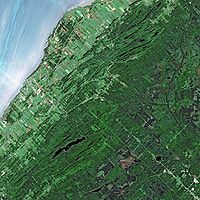
land system still forming the basic shape of current farm fields and clearings, as well as being reflected in the historic county boundaries along the St. Lawrence River. This form of land use can also be seen in such images of Louisiana
Louisiana
Louisiana is a state located in the southern region of the United States of America. Its capital is Baton Rouge and largest city is New Orleans. Louisiana is the only state in the U.S. with political subdivisions termed parishes, which are local governments equivalent to counties...
, which also was founded as a French colony with somewhat similar agricultural patterns.
A comparable seigneurial system was the patroon
Patroon
In the United States, a patroon was a landholder with manorial rights to large tracts of land in the 17th century Dutch colony of New Netherland in North America...
system of heritable land that was established by the Dutch West India Company
Dutch West India Company
Dutch West India Company was a chartered company of Dutch merchants. Among its founding fathers was Willem Usselincx...
. The Company granted seigneurial powers to the "patrons" who paid for the transport of settlers in New Netherlands. The system was not abolished by the British when they took possession of the Dutch holdings.
External links
- "Daily Life in New France", in History of Canada Online (through Archive.org)
- The Seigneurs of Old Canada, A Chronicle of New World Feudalism, in Project Gutenberg