

Scinde Dawk

Encyclopedia
Scinde Dawk was a very old postal system
of runners that served the Indus Valley of Sindh
, an area of present-day Pakistan
. The term also refers to the first postage stamp
s in Asia
, the forerunners
of the adhesive stamps used throughout India
, Burma, the Straits Settlements
and other areas controlled by the British East India Company
. The name derives from the words “Scinde”, the British spelling of the name of the province of Sindh, and “Dawk”, the anglicised spelling of the Hindustani
word “Dak” or Post.
after their conquest of Sindh.
of the East India Company became the Chief Commissioner of Sindh in 1850. Following the English example set by Rowland Hill
, Frere improved upon the postal system of Sindh by introducing a cheap and uniform rate for postage, independent of distance travelled. In 1851 the runners were replaced with an efficient system using horses and camels, following routes through Scinde province, generally along the valley of the Indus river
. The mail was carried quickly and efficiently, connecting government offices and post offices from Karachi
through Kotri
and Hyderabad up to Shikkur in the north.
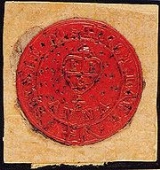
, a basic feature of the new system. These stamps bore the Merchants' Mark
of the British East India Company in a design embossed on wafers of red sealing wax
impressed on paper. Because they cracked and disintegrated, they were soon replaced by a colourless
design embossed on white paper which was hard to see in a dim light. The last stamps were a blue embossing on white paper. All of these had a value of only one-half anna
each, but today they rank among the rare classics of philately
.
of these rare stamps are plentiful. The most easily detected fakes are not embossed on paper. Other crude fakes show a misalignment of the second letter 'A' of ANNA with the 'K' of DAWK; and in other fakes the '1/2' is not separated from the central heartshaped emblem.
. This, and several other essays, were never printed because Forbes could not ensure an adequate supply with the limited machinery at hand. Soon after, new, lithographed
stamps printed by the Survey Office appeared in several denominations valid for use throughout British India
as part of sweeping postal reforms.
The British East India Company's posts are important, because the "Great Company" held sway over so much of the world's commerce in those days, extending across Asia and East Africa
. It had its own armies, coinage and postal service; constructed railways and public works; and acted like an imperial force long before the Empire was established.
Mail
Mail, or post, is a system for transporting letters and other tangible objects: written documents, typically enclosed in envelopes, and also small packages are delivered to destinations around the world. Anything sent through the postal system is called mail or post.In principle, a postal service...
of runners that served the Indus Valley of Sindh
Sindh
Sindh historically referred to as Ba'ab-ul-Islam , is one of the four provinces of Pakistan and historically is home to the Sindhi people. It is also locally known as the "Mehran". Though Muslims form the largest religious group in Sindh, a good number of Christians, Zoroastrians and Hindus can...
, an area of present-day Pakistan
Pakistan
Pakistan , officially the Islamic Republic of Pakistan is a sovereign state in South Asia. It has a coastline along the Arabian Sea and the Gulf of Oman in the south and is bordered by Afghanistan and Iran in the west, India in the east and China in the far northeast. In the north, Tajikistan...
. The term also refers to the first postage stamp
Postage stamp
A postage stamp is a small piece of paper that is purchased and displayed on an item of mail as evidence of payment of postage. Typically, stamps are made from special paper, with a national designation and denomination on the face, and a gum adhesive on the reverse side...
s in Asia
Asia
Asia is the world's largest and most populous continent, located primarily in the eastern and northern hemispheres. It covers 8.7% of the Earth's total surface area and with approximately 3.879 billion people, it hosts 60% of the world's current human population...
, the forerunners
Forerunner (stamp)
In philately, a forerunner is a postage stamp used before a region or territory issued stamps of its own. The term also includes stamps of the political predecessors of a country...
of the adhesive stamps used throughout India
India
India , officially the Republic of India , is a country in South Asia. It is the seventh-largest country by geographical area, the second-most populous country with over 1.2 billion people, and the most populous democracy in the world...
, Burma, the Straits Settlements
Straits Settlements
The Straits Settlements were a group of British territories located in Southeast Asia.Originally established in 1826 as part of the territories controlled by the British East India Company, the Straits Settlements came under direct British control as a crown colony on 1 April 1867...
and other areas controlled by the British East India Company
British East India Company
The East India Company was an early English joint-stock company that was formed initially for pursuing trade with the East Indies, but that ended up trading mainly with the Indian subcontinent and China...
. The name derives from the words “Scinde”, the British spelling of the name of the province of Sindh, and “Dawk”, the anglicised spelling of the Hindustani
Hindustani language
Hindi-Urdu is an Indo-Aryan language and the lingua franca of North India and Pakistan. It is also known as Hindustani , and historically, as Hindavi or Rekhta...
word “Dak” or Post.
Origins
The Dawk, or Dak, was a very old postal system of runners. The runners were paid according to their distance of travel and the weight of their letters. This was a local Indus Valley system, inefficient and inadequate for the military and commercial needs of the British East India CompanyBritish East India Company
The East India Company was an early English joint-stock company that was formed initially for pursuing trade with the East Indies, but that ended up trading mainly with the Indian subcontinent and China...
after their conquest of Sindh.
Reform of the postal system
Sir Bartle FrereHenry Bartle Frere
Sir Henry Bartle Edward Frere, 1st Baronet, GCB, GCSI, was a British colonial administrator.-Early life:Frere was born at Clydach House, Clydach, Monmouthshire, the son of Edward Frere, manager of Clydach Ironworks...
of the East India Company became the Chief Commissioner of Sindh in 1850. Following the English example set by Rowland Hill
Rowland Hill (postal reformer)
Sir Rowland Hill KCB, FRS was an English teacher, inventor and social reformer. He campaigned for a comprehensive reform of the postal system, based on the concept of penny postage and his solution of prepayment, facilitating the safe, speedy and cheap transfer of letters...
, Frere improved upon the postal system of Sindh by introducing a cheap and uniform rate for postage, independent of distance travelled. In 1851 the runners were replaced with an efficient system using horses and camels, following routes through Scinde province, generally along the valley of the Indus river
Indus River
The Indus River is a major river which flows through Pakistan. It also has courses through China and India.Originating in the Tibetan plateau of western China in the vicinity of Lake Mansarovar in Tibet Autonomous Region, the river runs a course through the Ladakh district of Jammu and Kashmir and...
. The mail was carried quickly and efficiently, connecting government offices and post offices from Karachi
Karachi
Karachi is the largest city, main seaport and the main financial centre of Pakistan, as well as the capital of the province of Sindh. The city has an estimated population of 13 to 15 million, while the total metropolitan area has a population of over 18 million...
through Kotri
Kotri
Kotri , a large town, is the headquarters station of the Kotri Taluka, or administrative district...
and Hyderabad up to Shikkur in the north.
The stamps
Stamps were required for the prepayment of postageRowland Hill (postal reformer)
Sir Rowland Hill KCB, FRS was an English teacher, inventor and social reformer. He campaigned for a comprehensive reform of the postal system, based on the concept of penny postage and his solution of prepayment, facilitating the safe, speedy and cheap transfer of letters...
, a basic feature of the new system. These stamps bore the Merchants' Mark
Merchant's mark
Merchants' marks are as old as the sealings of the third millennium BCE found in Sumer that originated in the Indus Valley. Impressions of cloth, strings and other packing material on the reverse of tags with seal impressions indicate...
of the British East India Company in a design embossed on wafers of red sealing wax
Sealing wax
Sealing wax is a wax material of a seal which, after melting, quickly hardens forming a bond that is difficult to separate without noticeable tampering. Wax is used to verify something such as a document is unopened, to verify the sender's identity, for example with a signet ring, and as decoration...
impressed on paper. Because they cracked and disintegrated, they were soon replaced by a colourless
Color
Color or colour is the visual perceptual property corresponding in humans to the categories called red, green, blue and others. Color derives from the spectrum of light interacting in the eye with the spectral sensitivities of the light receptors...
design embossed on white paper which was hard to see in a dim light. The last stamps were a blue embossing on white paper. All of these had a value of only one-half anna
Indian anna
An Anna was a currency unit formerly used in India, equal to 1/16 rupee. It was subdivided into 4 Paise or 12 Pies . The term belonged to the Muslim monetary system...
each, but today they rank among the rare classics of philately
Philately
Philately is the study of stamps and postal history and other related items. Philately involves more than just stamp collecting, which does not necessarily involve the study of stamps. It is possible to be a philatelist without owning any stamps...
.
Forgeries
ForgeriesPhilatelic fakes and forgeries
In general, philatelic fakes and forgeries refers to labels that look like postage stamps but are not. Most have been produced to deceive or defraud...
of these rare stamps are plentiful. The most easily detected fakes are not embossed on paper. Other crude fakes show a misalignment of the second letter 'A' of ANNA with the 'K' of DAWK; and in other fakes the '1/2' is not separated from the central heartshaped emblem.
Later developments
After the Scinde Dawk, Colonel Forbes of the Calcutta Mint came up with an essay for a postage stamp depicting a lion] and palm treeArecaceae
Arecaceae or Palmae , are a family of flowering plants, the only family in the monocot order Arecales. There are roughly 202 currently known genera with around 2600 species, most of which are restricted to tropical, subtropical, and warm temperate climates...
. This, and several other essays, were never printed because Forbes could not ensure an adequate supply with the limited machinery at hand. Soon after, new, lithographed
Lithography
Lithography is a method for printing using a stone or a metal plate with a completely smooth surface...
stamps printed by the Survey Office appeared in several denominations valid for use throughout British India
British Raj
British Raj was the British rule in the Indian subcontinent between 1858 and 1947; The term can also refer to the period of dominion...
as part of sweeping postal reforms.
The British East India Company's posts are important, because the "Great Company" held sway over so much of the world's commerce in those days, extending across Asia and East Africa
East Africa
East Africa or Eastern Africa is the easterly region of the African continent, variably defined by geography or geopolitics. In the UN scheme of geographic regions, 19 territories constitute Eastern Africa:...
. It had its own armies, coinage and postal service; constructed railways and public works; and acted like an imperial force long before the Empire was established.
Literature
- Robson LoweRobson LoweJohn Harry Robson Lowe , Robbie to his friends, was an English professional philatelist, stamp dealer and stamp auctioneer.- Life and career :...
, Encyclopaedia of British Empire Postage Stamps, v.III, 1951: The Sind District Dawk, pp. 149–152. - H.D.S. Haverbeck, "The Sind District Dawk," The Collectors Club Philatelist v. 44 no. 2 (March, 1965) pp. 79–85.
- Mohini Lal Mazumdar, The Imperial Post Offices of British India. Calcutta, Phila Publications, 1990.
- B. B. Misra, "Postal Communications in India, 1773-1834," reprinted from The Central Administration of the East India Company 1773-1834, pp. 415–449. Robson Lowe, Manchester University Press, 1939.
See also
- List of notable postage stamps
- Postage stamps and postal history of IndiaPostage stamps and postal history of IndiaThis is a survey of the postage stamps and postal history of India.Indian postal systems for efficient military and governmental communications had developed long before the arrival of Europeans. When the Portuguese, Dutch, French, Danish and British displaced the Mughals, their postal systems...