

Saint-Chamas

Encyclopedia
Saint-Chamas is a commune
in the department of Bouches-du-Rhône
in the Provence-Alpes-Côte d'Azur
region
in southern France
.
, 15 km south of Salon-de-Provence
and 50 km north-west of Marseille
, in a part of the region that has not been industrialised. The highest point of the town is Le Verdon at an altitude of 121 metres.
investigation of rock shelters has proved that the site of Saint-Chamas was already occupied in the Paleolithic
era. During the Iron Age
, the site was used by the Ligures
, who constructed an oppidum
(a fortified village), and then by the Celts. The Romans
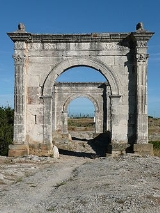
built the Pont Flavien
in the 1st century BC, a triumphal
bridge which crosses the River Touloubre
.
Saint-Chamas owes its name to Sanctus Amantius (Saint Amans, by tradition the first bishop of Rodez), in whose honour a chapel was built in the 7th century. The settlement was initially constructed on the Baou, a chalk hill which overlooks the Étang de Berre, a site that was easy to defend and from which the surrounding region could be surveyed. In 1564, the castle was sufficiently comfortable to accommodate the king Charles IX
and the regent Catherine de' Medici
.
The 17th century saw the construction of the modern town. The old village on the Baou, now felt to be too cramped, was abandoned as soon as the new quarters of Perthuis and au Delà were built. A town hall was erected and the port laid out. The parish church of Saint-Léger was built between 1660 and 1668, but the bell tower
was not finished until 1740. The church now contains the Saint-Anne reredos
which dates from the sixteenth century. In 1690, construction was initiated by Louis XIV
on the royal black powder mill, La Poudrerie; this remained for a long time the town's principal industry until it shut down in 1974.
For several years during the French Revolution
the town was renamed Port-Chamas. The two main quarters, one of which developed around the town hall, the other in proximity to the port, were linked by a tunnel called la Goule which collapsed in 1863. Today Saint-Chamas has become a residential and tourist town which has preserved its heritage and its appearance of a Provençal village.
Communes of France
The commune is the lowest level of administrative division in the French Republic. French communes are roughly equivalent to incorporated municipalities or villages in the United States or Gemeinden in Germany...
in the department of Bouches-du-Rhône
Bouches-du-Rhône
Bouches-du-Rhône is a department in the south of France named after the mouth of the Rhône River. It is the most populous department of the Provence-Alpes-Côte d'Azur region. Its INSEE and postal code is 13.-History of the department:...
in the Provence-Alpes-Côte d'Azur
Provence-Alpes-Côte d'Azur
Provence-Alpes-Côte d'Azur or PACA is one of the 27 regions of France.It is made up of:* the former French province of Provence* the former papal territory of Avignon, known as Comtat Venaissin...
region
Régions of France
France is divided into 27 administrative regions , 22 of which are in Metropolitan France, and five of which are overseas. Corsica is a territorial collectivity , but is considered a region in mainstream usage, and is even shown as such on the INSEE website...
in southern France
France
The French Republic , The French Republic , The French Republic , (commonly known as France , is a unitary semi-presidential republic in Western Europe with several overseas territories and islands located on other continents and in the Indian, Pacific, and Atlantic oceans. Metropolitan France...
.
Geography
Saint-Chamas is situated on the shore of the Étang de BerreÉtang de Berre
The Étang de Berre is a body of water adjacent to the Mediterranean, about 25km north-west of Marseille.-Geography:Created by the rise in water levels at the end of the last ice age, this small inland sea is composed of...
, 15 km south of Salon-de-Provence
Salon-de-Provence
Salon-de-Provence is a commune in the Bouches-du-Rhône department in southern France. It is the location of an important air base.-History:Salon was a Gallo-Roman oppidum well positioned on the salt trade routes between Adriatic, Atlantic and Mediterranean seas, hence its name...
and 50 km north-west of Marseille
Marseille
Marseille , known in antiquity as Massalia , is the second largest city in France, after Paris, with a population of 852,395 within its administrative limits on a land area of . The urban area of Marseille extends beyond the city limits with a population of over 1,420,000 on an area of...
, in a part of the region that has not been industrialised. The highest point of the town is Le Verdon at an altitude of 121 metres.
Population
Inhabitants are called Saint-Chamasséens.History
ArchaeologicalArchaeology
Archaeology, or archeology , is the study of human society, primarily through the recovery and analysis of the material culture and environmental data that they have left behind, which includes artifacts, architecture, biofacts and cultural landscapes...
investigation of rock shelters has proved that the site of Saint-Chamas was already occupied in the Paleolithic
Paleolithic
The Paleolithic Age, Era or Period, is a prehistoric period of human history distinguished by the development of the most primitive stone tools discovered , and covers roughly 99% of human technological prehistory...
era. During the Iron Age
Iron Age
The Iron Age is the archaeological period generally occurring after the Bronze Age, marked by the prevalent use of iron. The early period of the age is characterized by the widespread use of iron or steel. The adoption of such material coincided with other changes in society, including differing...
, the site was used by the Ligures
Ligures
The Ligures were an ancient people who gave their name to Liguria, a region of north-western Italy.-Classical sources:...
, who constructed an oppidum
Oppidum
Oppidum is a Latin word meaning the main settlement in any administrative area of ancient Rome. The word is derived from the earlier Latin ob-pedum, "enclosed space," possibly from the Proto-Indo-European *pedóm-, "occupied space" or "footprint."Julius Caesar described the larger Celtic Iron Age...
(a fortified village), and then by the Celts. The Romans
Ancient Rome
Ancient Rome was a thriving civilization that grew on the Italian Peninsula as early as the 8th century BC. Located along the Mediterranean Sea and centered on the city of Rome, it expanded to one of the largest empires in the ancient world....
built the Pont Flavien
Pont Flavien
The Pont Flavien is a Roman bridge across the River Touloubre in Saint-Chamas, Bouches-du-Rhône department, southern France. The single arch bridge is noted for its fine triumphal arches standing at each entrance....
in the 1st century BC, a triumphal
Roman triumph
The Roman triumph was a civil ceremony and religious rite of ancient Rome, held to publicly celebrate and sanctify the military achievement of an army commander who had won great military successes, or originally and traditionally, one who had successfully completed a foreign war. In Republican...
bridge which crosses the River Touloubre
Touloubre
The Touloubre is a river in the southeast of France. It runs from Venelles to the Étang de Berre, over 59 kilometers. Other places along its course are Pélissanne, Salon-de-Provence, Grans and Saint-Chamas. It flows into the Étang de Berre, which is connected to the Mediterranean Sea, near...
.
Saint-Chamas owes its name to Sanctus Amantius (Saint Amans, by tradition the first bishop of Rodez), in whose honour a chapel was built in the 7th century. The settlement was initially constructed on the Baou, a chalk hill which overlooks the Étang de Berre, a site that was easy to defend and from which the surrounding region could be surveyed. In 1564, the castle was sufficiently comfortable to accommodate the king Charles IX
Charles IX of France
Charles IX was King of France, ruling from 1560 until his death. His reign was dominated by the Wars of Religion. He is best known as king at the time of the St. Bartholomew's Day Massacre.-Childhood:...
and the regent Catherine de' Medici
Catherine de' Medici
Catherine de' Medici was an Italian noblewoman who was Queen consort of France from 1547 until 1559, as the wife of King Henry II of France....
.
The 17th century saw the construction of the modern town. The old village on the Baou, now felt to be too cramped, was abandoned as soon as the new quarters of Perthuis and au Delà were built. A town hall was erected and the port laid out. The parish church of Saint-Léger was built between 1660 and 1668, but the bell tower
Bell tower
A bell tower is a tower which contains one or more bells, or which is designed to hold bells, even if it has none. In the European tradition, such a tower most commonly serves as part of a church and contains church bells. When attached to a city hall or other civic building, especially in...
was not finished until 1740. The church now contains the Saint-Anne reredos
Reredos
thumb|300px|right|An altar and reredos from [[St. Josaphat's Roman Catholic Church|St. Josaphat Catholic Church]] in [[Detroit]], [[Michigan]]. This would be called a [[retable]] in many other languages and countries....
which dates from the sixteenth century. In 1690, construction was initiated by Louis XIV
Louis XIV of France
Louis XIV , known as Louis the Great or the Sun King , was a Bourbon monarch who ruled as King of France and Navarre. His reign, from 1643 to his death in 1715, began at the age of four and lasted seventy-two years, three months, and eighteen days...
on the royal black powder mill, La Poudrerie; this remained for a long time the town's principal industry until it shut down in 1974.
For several years during the French Revolution
French Revolution
The French Revolution , sometimes distinguished as the 'Great French Revolution' , was a period of radical social and political upheaval in France and Europe. The absolute monarchy that had ruled France for centuries collapsed in three years...
the town was renamed Port-Chamas. The two main quarters, one of which developed around the town hall, the other in proximity to the port, were linked by a tunnel called la Goule which collapsed in 1863. Today Saint-Chamas has become a residential and tourist town which has preserved its heritage and its appearance of a Provençal village.