

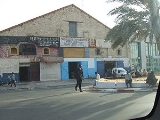
Rufisque

Encyclopedia
Rufisque is a city in the Dakar
region of western Senegal
, at the base of the Cap-Vert
Peninsula
. It has a population of 179,797 (2002 census). In the past it was an important port city in its own right, but is now a suburb of Dakar.
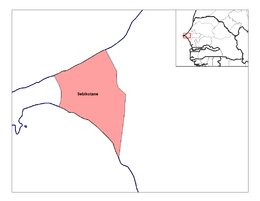
Rufisque is also the capital of the department
of the same name
.
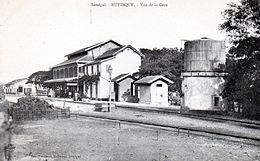 Originally a Lebou
fishing village called Tenguedj , Rufisque became important in the 16th century as the principal port of the kingdom of Cayor
, being frequented by Portuguese (who named it Rio Fresco or “Freshwater River”), Dutch, French
and English
traders. A Euro-African Creole
, or Métis
, community of merchants grew up there, in close contact with similar communities in Saint Louis
, Gorée
and other places along the Petite Côte (Portudal, Joal) south to the Gambia River
.
 In 1840 a couple of Saint Louis merchants built warehouses on the waterfront to stock peanuts
. Gorée merchants followed suit. There followed a period of commercial expansion as peanut production in Cayor boomed. In 1859 a fort was built by the French and Rufisque was annexed to the Colony of Senegal
. The "Escale" commercial and administrative neighborhood along the waterfront was laid out in 1862---the African inhabitants being pushed out in the process. Rufisque became a “commune” in 1880 and its port was connected to the Dakar-Saint Louis railroad in 1885. In 1909 Galandou Diouf (died 1941) was elected to represent Rufisque in the General Council of the colony in Saint Louis, being the first African elected to that position.
was Mayor from 1987 to 2002, and he remains the town's Honorary Mayor.
Dakar
Dakar is the capital city and largest city of Senegal. It is located on the Cap-Vert Peninsula on the Atlantic coast and is the westernmost city on the African mainland...
region of western Senegal
Senegal
Senegal , officially the Republic of Senegal , is a country in western Africa. It owes its name to the Sénégal River that borders it to the east and north...
, at the base of the Cap-Vert
Cap-Vert
Cap-Vert is a peninsula in Senegal, and the westernmost point of the continent of Africa and of the Old World mainland. Originally called Cabo Verde or "Cape Green" by Portuguese explorers, it is not to be confused with the Cape Verde islands, which are some further west...
Peninsula
Peninsula
A peninsula is a piece of land that is bordered by water on three sides but connected to mainland. In many Germanic and Celtic languages and also in Baltic, Slavic and Hungarian, peninsulas are called "half-islands"....
. It has a population of 179,797 (2002 census). In the past it was an important port city in its own right, but is now a suburb of Dakar.
Rufisque is also the capital of the department
Departments of Senegal
The 14 Regions of Senegal are subdivided into 45 departments and 103 arrondissements and by collectivités locales which elect administrative officers.In 2006, the new department of Koungheul was created as a division of Kaolack Department...
of the same name
Rufisque Department
Rufisque Department is one of the departments of Senegal, located in the Dakar Region....
.
History
Lebou
The Lebou are an ethnic group of Senegal, West Africa, living on the peninsula of Cap-Vert. The Lebou are primarily a fishing community, but they have a substantial business in construction supplies. They speak Wolof. Their political and spiritual capital is at Yoff, just north of Dakar...
fishing village called Tenguedj , Rufisque became important in the 16th century as the principal port of the kingdom of Cayor
Cayor
The Kingdom of Cayor was the largest and most powerful kingdom that split off from the Empire of Jolof , in what is now Senegal. Cayor was located in north and central Senegal, southeast of Waalo, west of the kingdom of Jolof and north of Baol and the Kingdom of Sine.In 1549, the king, or...
, being frequented by Portuguese (who named it Rio Fresco or “Freshwater River”), Dutch, French
France
The French Republic , The French Republic , The French Republic , (commonly known as France , is a unitary semi-presidential republic in Western Europe with several overseas territories and islands located on other continents and in the Indian, Pacific, and Atlantic oceans. Metropolitan France...
and English
England
England is a country that is part of the United Kingdom. It shares land borders with Scotland to the north and Wales to the west; the Irish Sea is to the north west, the Celtic Sea to the south west, with the North Sea to the east and the English Channel to the south separating it from continental...
traders. A Euro-African Creole
Creole peoples
The term Creole and its cognates in other languages — such as crioulo, criollo, créole, kriolu, criol, kreyol, kreol, kriulo, kriol, krio, etc. — have been applied to people in different countries and epochs, with rather different meanings...
, or Métis
Métis
A Métis is a person born to parents who belong to different groups defined by visible physical differences, regarded as racial, or the descendant of such persons. The term is of French origin, and also is a cognate of mestizo in Spanish, mestiço in Portuguese, and mestee in English...
, community of merchants grew up there, in close contact with similar communities in Saint Louis
Saint-Louis, Senegal
Saint-Louis, or Ndar as it is called in Wolof, is the capital of Senegal's Saint-Louis Region. Located in the northwest of Senegal, near the mouth of the Senegal River, and 320 km north of Senegal's capital city Dakar, it has a population officially estimated at 176,000 in 2005. Saint-Louis...
, Gorée
Gorée
Île de Gorée Île de Gorée Île de Gorée (i.e. "Gorée Island"; is one of the 19 communes d'arrondissement (i.e. "commune of arrondissement") of the city of Dakar, Senegal. It is a island located at sea from the main harbor of Dakar ....
and other places along the Petite Côte (Portudal, Joal) south to the Gambia River
Gambia River
The Gambia River is a major river in West Africa, running from the Fouta Djallon plateau in north Guinea westward through Senegal and The Gambia to the Atlantic Ocean at the city of Banjul...
.
Peanuts
Peanuts is a syndicated daily and Sunday American comic strip written and illustrated by Charles M. Schulz, which ran from October 2, 1950, to February 13, 2000, continuing in reruns afterward...
. Gorée merchants followed suit. There followed a period of commercial expansion as peanut production in Cayor boomed. In 1859 a fort was built by the French and Rufisque was annexed to the Colony of Senegal
French West Africa
French West Africa was a federation of eight French colonial territories in Africa: Mauritania, Senegal, French Sudan , French Guinea , Côte d'Ivoire , Upper Volta , Dahomey and Niger...
. The "Escale" commercial and administrative neighborhood along the waterfront was laid out in 1862---the African inhabitants being pushed out in the process. Rufisque became a “commune” in 1880 and its port was connected to the Dakar-Saint Louis railroad in 1885. In 1909 Galandou Diouf (died 1941) was elected to represent Rufisque in the General Council of the colony in Saint Louis, being the first African elected to that position.
Decline of Port
Early in the 20th century the growth of neighboring Dakar, with its superior port facilities, signaled the decline of Rufisque. No longer an active port, Rufisque has experienced steep decline of industrial activities and is certainly the most neglected of Senegal’s four historic “communes”, with no tourism sector and a chronic lack of investment in public infrastructureAdministration
Ndiawar Touré has been Mayor of Rufisque since 8 June 2002. Previously, Mbaye-Jacques DiopMbaye-Jacques Diop
Mbaye-Jacques Diop is a Senegalese political figure. He served as a Deputy in the National Assembly of Senegal from 1983 to 2004, as Mayor of Rufisque from 1987 to 2002, and as President of the Council of the Republic for Economic and Social Affairs from 2004 to 2007...
was Mayor from 1987 to 2002, and he remains the town's Honorary Mayor.
External links
- Rufisque News, online version of Rufisque based newspaper.
- Portions of this article were translated from French language Wikipedia's :fr:Rufisque.