

Rubus phoenicolasius

Encyclopedia
Rubus phoenicolasius (Japanese Wineberry, Wineberry, or Wine Raspberry) is a species of raspberry
(Rubus
subgenus Idaeobatus) native to northern China
, Japan
, and Korea
. The species was introduced to Europe
and North America
as an ornamental plant
and for its potential in breeding hybrid raspberries. It has subsequently escaped from cultivation and become naturalised
and sometimes invasive
in parts of Europe and eastern North America.
which bears biennial
stems ("canes") from the perennial root system. In its first year, a new stem grows vigorously to its full height of 1-3 m, unbranched, and bearing large pinnate leaves
with three or five leaflets; normally it does not produce any flowers. In its second year, the stem does not grow taller, but produces several side shoots, which bear smaller leaves always with three leaflets; the leaves are white underneath.
The flower
s are produced in late spring on short, very bristly raceme
s on the tips of these side shoots, each flower 6–10 mm diameter with five purplish red to pink petal
s and a bristly calyx. The fruit
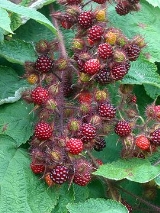
is orange or red, about 1 cm diameter, edible, produced in summer or early autumn; in botanical
terminology, it is not a berry
at all, but an aggregate fruit of numerous drupe
lets around a central core. Ripening occurs from early summer. The canes have fine, red thorns, which appear much like red hair.
In addition to seed propagation, new plants are formed from the tips of existing canes touching the ground. They enjoy moist soil and grow near and within wooded areas.
As a fruit develops, it is surrounded by a protective calyx covered in hairs that exude tiny drops of sticky fluid. A 2009 study by Sina Pohl at the University of Vienna
showed that plants do not get nutrients from insects caught in the sap: the sticky mucilage contains no digestive enzymes; surrounding tissues cannot absorb nutrients; and there are no protein-storage tissues. Also, unlike carnivorous plant
s, wineberry grows in nutrient-rich soil, so it has no need for insect nutrients.
Raspberry
The raspberry or hindberry is the edible fruit of a multitude of plant species in the genus Rubus, most of which are in the subgenus Idaeobatus; the name also applies to these plants themselves...
(Rubus
Rubus
Rubus is a large genus of flowering plants in the rose family, Rosaceae, subfamily Rosoideae. Raspberries, blackberries, and dewberries are common, widely distributed members of the genus. Most of these plants have woody stems with prickles like roses; spines, bristles, and gland-tipped hairs are...
subgenus Idaeobatus) native to northern China
China
Chinese civilization may refer to:* China for more general discussion of the country.* Chinese culture* Greater China, the transnational community of ethnic Chinese.* History of China* Sinosphere, the area historically affected by Chinese culture...
, Japan
Japan
Japan is an island nation in East Asia. Located in the Pacific Ocean, it lies to the east of the Sea of Japan, China, North Korea, South Korea and Russia, stretching from the Sea of Okhotsk in the north to the East China Sea and Taiwan in the south...
, and Korea
Korea
Korea ) is an East Asian geographic region that is currently divided into two separate sovereign states — North Korea and South Korea. Located on the Korean Peninsula, Korea is bordered by the People's Republic of China to the northwest, Russia to the northeast, and is separated from Japan to the...
. The species was introduced to Europe
Europe
Europe is, by convention, one of the world's seven continents. Comprising the westernmost peninsula of Eurasia, Europe is generally 'divided' from Asia to its east by the watershed divides of the Ural and Caucasus Mountains, the Ural River, the Caspian and Black Seas, and the waterways connecting...
and North America
North America
North America is a continent wholly within the Northern Hemisphere and almost wholly within the Western Hemisphere. It is also considered a northern subcontinent of the Americas...
as an ornamental plant
Ornamental plant
Ornamental plants are plants that are grown for decorative purposes in gardens and landscape design projects, as house plants, for cut flowers and specimen display...
and for its potential in breeding hybrid raspberries. It has subsequently escaped from cultivation and become naturalised
Naturalisation (biology)
In biology, naturalisation is any process by which a non-native organism spreads into the wild and its reproduction is sufficient to maintain its population. Such populations are said to be naturalised....
and sometimes invasive
Invasive species
"Invasive species", or invasive exotics, is a nomenclature term and categorization phrase used for flora and fauna, and for specific restoration-preservation processes in native habitats, with several definitions....
in parts of Europe and eastern North America.
Characteristics
The species is a perennial plantPerennial plant
A perennial plant or simply perennial is a plant that lives for more than two years. The term is often used to differentiate a plant from shorter lived annuals and biennials. The term is sometimes misused by commercial gardeners or horticulturalists to describe only herbaceous perennials...
which bears biennial
Biennial plant
A biennial plant is a flowering plant that takes two years to complete its biological lifecycle. In the first year the plant grows leaves, stems, and roots , then it enters a period of dormancy over the colder months. Usually the stem remains very short and the leaves are low to the ground, forming...
stems ("canes") from the perennial root system. In its first year, a new stem grows vigorously to its full height of 1-3 m, unbranched, and bearing large pinnate leaves
Leaf
A leaf is an organ of a vascular plant, as defined in botanical terms, and in particular in plant morphology. Foliage is a mass noun that refers to leaves as a feature of plants....
with three or five leaflets; normally it does not produce any flowers. In its second year, the stem does not grow taller, but produces several side shoots, which bear smaller leaves always with three leaflets; the leaves are white underneath.
The flower
Flower
A flower, sometimes known as a bloom or blossom, is the reproductive structure found in flowering plants . The biological function of a flower is to effect reproduction, usually by providing a mechanism for the union of sperm with eggs...
s are produced in late spring on short, very bristly raceme
Raceme
A raceme is a type of inflorescence that is unbranched and indeterminate and bears pedicellate flowers — flowers having short floral stalks called pedicels — along the axis. In botany, axis means a shoot, in this case one bearing the flowers. In a raceme, the oldest flowers are borne...
s on the tips of these side shoots, each flower 6–10 mm diameter with five purplish red to pink petal
Petal
Petals are modified leaves that surround the reproductive parts of flowers. They often are brightly colored or unusually shaped to attract pollinators. Together, all of the petals of a flower are called a corolla. Petals are usually accompanied by another set of special leaves called sepals lying...
s and a bristly calyx. The fruit
Fruit
In broad terms, a fruit is a structure of a plant that contains its seeds.The term has different meanings dependent on context. In non-technical usage, such as food preparation, fruit normally means the fleshy seed-associated structures of certain plants that are sweet and edible in the raw state,...
is orange or red, about 1 cm diameter, edible, produced in summer or early autumn; in botanical
Botany
Botany, plant science, or plant biology is a branch of biology that involves the scientific study of plant life. Traditionally, botany also included the study of fungi, algae and viruses...
terminology, it is not a berry
Berry
The botanical definition of a berry is a fleshy fruit produced from a single ovary. Grapes are an example. The berry is the most common type of fleshy fruit in which the entire ovary wall ripens into an edible pericarp. They may have one or more carpels with a thin covering and fleshy interiors....
at all, but an aggregate fruit of numerous drupe
Drupe
In botany, a drupe is a fruit in which an outer fleshy part surrounds a shell of hardened endocarp with a seed inside. These fruits develop from a single carpel, and mostly from flowers with superior ovaries...
lets around a central core. Ripening occurs from early summer. The canes have fine, red thorns, which appear much like red hair.
In addition to seed propagation, new plants are formed from the tips of existing canes touching the ground. They enjoy moist soil and grow near and within wooded areas.
As a fruit develops, it is surrounded by a protective calyx covered in hairs that exude tiny drops of sticky fluid. A 2009 study by Sina Pohl at the University of Vienna
University of Vienna
The University of Vienna is a public university located in Vienna, Austria. It was founded by Duke Rudolph IV in 1365 and is the oldest university in the German-speaking world...
showed that plants do not get nutrients from insects caught in the sap: the sticky mucilage contains no digestive enzymes; surrounding tissues cannot absorb nutrients; and there are no protein-storage tissues. Also, unlike carnivorous plant
Carnivorous plant
Carnivorous plants are plants that derive some or most of their nutrients from trapping and consuming animals or protozoans, typically insects and other arthropods. Carnivorous plants appear adapted to grow in places where the soil is thin or poor in nutrients, especially nitrogen, such as acidic...
s, wineberry grows in nutrient-rich soil, so it has no need for insect nutrients.