

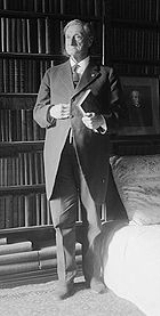
Roger Atkinson Pryor

Encyclopedia
Roger Atkinson Pryor was both an American
politician and a Confederate
politician serving as a congressman on both sides. He was also a jurist
, serving in the New York Supreme Court
, a lawyer, and newspaper editor. Pryor is also known for being a Confederate
Brigadier General during the American Civil War
.
to Theodorick Pryor, a grandson of Richard Bland
, and Lucy Atkinson. He graduated from Hampden-Sydney College
in 1845 and from the law school of the University of Virginia
in 1848. The following year, he was admitted to the bar
, but abandoned law on account of ill health. Pryor was married on November 8, 1848 to Sara Agnes Rice with whom he would have seven children. He then devoted himself for a few years to journalism
. Pryor served on the editorial staff of the Washington Union in 1852 and the Richmond Enquirer in 1854. He got involved in politics and was appointed special by Franklin Pierce
as a diplomat to Greece
in 1854. Upon his return to Virginia, he established The South in 1857. He was a fiery and eloquent advocate of slavery, states' rights, and secession.
In 1859, he was elected as a Democrat
to the U.S. House of Representatives to fill the vacancy in Virginia's 4th District caused by the death of William O. Goode
. He served from December 7, 1859 to March 3, 1861. In the House, Pryor became a particular enemy of Representative Thaddeus Stevens
, a Republican
abolitionist.
During his term, he got into a verbal altercation with John F. Potter
, a representative from Wisconsin, and challenged Potter to a duel. Potter, having the choice of weapons, chose bowie knives. Pryor backed out saying that bowie knives were not a civilized weapon. The incident found widespread publication in the Northern press which saw the refusal as a coup for the North — the humiliation of a Southern “fire eater”.
in Virginia, but the state convention did not act. Frustrated, Pryor
went to Charleston
in April, to urge immediate attack on Fort Sumter
. (Pryor asserted this would cause Virginia to secede.) On April 12, he accompanied the last Confederate party to the fort before the bombardment (but stayed in the boat). Afterward, while waiting at Fort Johnson
, he was offered the opportunity to fire the first shot. But despite his earlier rhetoric, he declined, saying "I could not fire the first gun of the war."
In 1861, Pryor was re-elected to his Congressional seat, but owing to the secession of Virginia, he of course did not sit in the U.S. Congress. (In this period, several states including Virginia elected U.S. Representatives in the early part of odd years. This was possible because Congress almost always met late in the year.) Instead he served in the provisional Confederate Congress in 1861, and also in the first regular Congress
(1862) under the Confederate Constitution.
He entered the Confederate States Army
as Colonel
of the 3rd Virginia Infantry
. He was promoted to brigadier general on April 16, 1862. His brigade, consisting of regiment
s from Virginia, Alabama
, and Florida
, fought in the Peninsula Campaign
, and at Second Manassas
, where it became detached in the swirling fighting and temporarily operated under Stonewall Jackson
. At Antietam
on September 17, 1862, he assumed command of Anderson's Division in Longstreet
's Corps when Maj. Gen.
Richard H. Anderson
was wounded.
Due to a disagreement with Confederate President Jefferson Davis
over his desire for permanent higher field command, Pryor resigned his commission in 1863 and his brigade was dismantled. In August of that year, he enlisted as a private and scout in a Virginia cavalry
regiment under General Fitzhugh Lee
. Pryor was captured on November 28, 1864, and confined in Fort Lafayette
as a suspected spy. He was released on parole by order of President
Lincoln
and returned to Virginia.

, where he established a profitable law firm with a partner. This is when his so called "conversion" began. The partner that Pryor had in the law firm was Benjamin F. Butler
, one of the most hated Union generals in the South. He was a delegate to the Democratic National Convention in 1876. He served as judge of the New York Court of Common Pleas
from 1890 to 1894, and justice of the New York Supreme Court
from 1894 to 1899. He was appointed official referee by the appellate division of the state Supreme Court on April 10, 1912, and served until his death in New York City. He was buried in Princeton Cemetery
, in Princeton, New Jersey
.
His wife, Sara Agnes (Rice) Pryor (b. 1830), published The Mother of Washington and her Times (1903), Reminiscences of Peace and War (1904), The Birth of the Nation: Jamestown, 1607 (1907), and My Day: Reminiscences of a Long Life (1909).
, Richard Bland I
, Theodorick Bland of Westover, and Governor Richard Bennett
United States
The United States of America is a federal constitutional republic comprising fifty states and a federal district...
politician and a Confederate
Confederate States of America
The Confederate States of America was a government set up from 1861 to 1865 by 11 Southern slave states of the United States of America that had declared their secession from the U.S...
politician serving as a congressman on both sides. He was also a jurist
Jurist
A jurist or jurisconsult is a professional who studies, develops, applies, or otherwise deals with the law. The term is widely used in American English, but in the United Kingdom and many Commonwealth countries it has only historical and specialist usage...
, serving in the New York Supreme Court
New York Supreme Court
The Supreme Court of the State of New York is the trial-level court of general jurisdiction in thestate court system of New York, United States. There is a supreme court in each of New York State's 62 counties, although some smaller counties share judges with neighboring counties...
, a lawyer, and newspaper editor. Pryor is also known for being a Confederate
Confederate States Army
The Confederate States Army was the army of the Confederate States of America while the Confederacy existed during the American Civil War. On February 8, 1861, delegates from the seven Deep South states which had already declared their secession from the United States of America adopted the...
Brigadier General during the American Civil War
American Civil War
The American Civil War was a civil war fought in the United States of America. In response to the election of Abraham Lincoln as President of the United States, 11 southern slave states declared their secession from the United States and formed the Confederate States of America ; the other 25...
.
Early life and career
Pryor was born near Petersburg, VirginiaPetersburg, Virginia
Petersburg is an independent city in Virginia, United States located on the Appomattox River and south of the state capital city of Richmond. The city's population was 32,420 as of 2010, predominantly of African-American ethnicity...
to Theodorick Pryor, a grandson of Richard Bland
Richard Bland
Richard Bland , sometimes referred to as Richard Bland II or Richard Bland of Jordan's Point, was an American planter and statesman from Virginia...
, and Lucy Atkinson. He graduated from Hampden-Sydney College
Hampden-Sydney College
Hampden–Sydney College is a liberal arts college for men located in Hampden Sydney, Virginia, United States. Founded in 1775, Hampden–Sydney is the oldest private charter college in the Southern U.S., the last college founded before the American Revolution, and one of only three four-year,...
in 1845 and from the law school of the University of Virginia
University of Virginia
The University of Virginia is a public research university located in Charlottesville, Virginia, United States, founded by Thomas Jefferson...
in 1848. The following year, he was admitted to the bar
Bar (law)
Bar in a legal context has three possible meanings: the division of a courtroom between its working and public areas; the process of qualifying to practice law; and the legal profession.-Courtroom division:...
, but abandoned law on account of ill health. Pryor was married on November 8, 1848 to Sara Agnes Rice with whom he would have seven children. He then devoted himself for a few years to journalism
Journalism
Journalism is the practice of investigation and reporting of events, issues and trends to a broad audience in a timely fashion. Though there are many variations of journalism, the ideal is to inform the intended audience. Along with covering organizations and institutions such as government and...
. Pryor served on the editorial staff of the Washington Union in 1852 and the Richmond Enquirer in 1854. He got involved in politics and was appointed special by Franklin Pierce
Franklin Pierce
Franklin Pierce was the 14th President of the United States and is the only President from New Hampshire. Pierce was a Democrat and a "doughface" who served in the U.S. House of Representatives and the Senate. Pierce took part in the Mexican-American War and became a brigadier general in the Army...
as a diplomat to Greece
Greece
Greece , officially the Hellenic Republic , and historically Hellas or the Republic of Greece in English, is a country in southeastern Europe....
in 1854. Upon his return to Virginia, he established The South in 1857. He was a fiery and eloquent advocate of slavery, states' rights, and secession.
In 1859, he was elected as a Democrat
Democratic Party (United States)
The Democratic Party is one of two major contemporary political parties in the United States, along with the Republican Party. The party's socially liberal and progressive platform is largely considered center-left in the U.S. political spectrum. The party has the lengthiest record of continuous...
to the U.S. House of Representatives to fill the vacancy in Virginia's 4th District caused by the death of William O. Goode
William Goode
William Osborne Goode was a nineteenth century American politician and lawyer from Virginia.-Personal life:...
. He served from December 7, 1859 to March 3, 1861. In the House, Pryor became a particular enemy of Representative Thaddeus Stevens
Thaddeus Stevens
Thaddeus Stevens , of Pennsylvania, was a Republican leader and one of the most powerful members of the United States House of Representatives...
, a Republican
Republican Party (United States)
The Republican Party is one of the two major contemporary political parties in the United States, along with the Democratic Party. Founded by anti-slavery expansion activists in 1854, it is often called the GOP . The party's platform generally reflects American conservatism in the U.S...
abolitionist.
During his term, he got into a verbal altercation with John F. Potter
John F. Potter
John Fox Potter nicknamed "Bowie Knife Potter" was a nineteenth century politician, lawyer and judge from Wisconsin.-Biography:...
, a representative from Wisconsin, and challenged Potter to a duel. Potter, having the choice of weapons, chose bowie knives. Pryor backed out saying that bowie knives were not a civilized weapon. The incident found widespread publication in the Northern press which saw the refusal as a coup for the North — the humiliation of a Southern “fire eater”.
Civil War service
In early 1861, Pryor agitated for immediate secessionSecession
Secession is the act of withdrawing from an organization, union, or especially a political entity. Threats of secession also can be a strategy for achieving more limited goals.-Secession theory:...
in Virginia, but the state convention did not act. Frustrated, Pryor
Pryor
Pryor is a surname, which can refer to:*Anduele Pryor, Dutch football player*Arthur Pryor, American trombonist and bandleader*Cactus Pryor, Texan humorist and broadcaster*David Pryor, former U.S...
went to Charleston
Charleston, South Carolina
Charleston is the second largest city in the U.S. state of South Carolina. It was made the county seat of Charleston County in 1901 when Charleston County was founded. The city's original name was Charles Towne in 1670, and it moved to its present location from a location on the west bank of the...
in April, to urge immediate attack on Fort Sumter
Fort Sumter
Fort Sumter is a Third System masonry coastal fortification located in Charleston Harbor, South Carolina. The fort is best known as the site upon which the shots initiating the American Civil War were fired, at the Battle of Fort Sumter.- Construction :...
. (Pryor asserted this would cause Virginia to secede.) On April 12, he accompanied the last Confederate party to the fort before the bombardment (but stayed in the boat). Afterward, while waiting at Fort Johnson
Fort Johnson
This article is about the War of 1812 fortification:*For the community in New York, see Fort Johnson, New York*For the Revolutionary War British garrison named Fort Johnson see Wilmington, North Carolina...
, he was offered the opportunity to fire the first shot. But despite his earlier rhetoric, he declined, saying "I could not fire the first gun of the war."
In 1861, Pryor was re-elected to his Congressional seat, but owing to the secession of Virginia, he of course did not sit in the U.S. Congress. (In this period, several states including Virginia elected U.S. Representatives in the early part of odd years. This was possible because Congress almost always met late in the year.) Instead he served in the provisional Confederate Congress in 1861, and also in the first regular Congress
First Confederate Congress
The First Confederate Congress was the first regular term of the legislature of the Confederate States of America. Members of the First Confederate Congress were chosen in elections mostly held on 6 November 1861.-Sessions:...
(1862) under the Confederate Constitution.
He entered the Confederate States Army
Confederate States Army
The Confederate States Army was the army of the Confederate States of America while the Confederacy existed during the American Civil War. On February 8, 1861, delegates from the seven Deep South states which had already declared their secession from the United States of America adopted the...
as Colonel
Colonel (United States)
In the United States Army, Air Force, and Marine Corps, colonel is a senior field grade military officer rank just above the rank of lieutenant colonel and just below the rank of brigadier general...
of the 3rd Virginia Infantry
Infantry
Infantrymen are soldiers who are specifically trained for the role of fighting on foot to engage the enemy face to face and have historically borne the brunt of the casualties of combat in wars. As the oldest branch of combat arms, they are the backbone of armies...
. He was promoted to brigadier general on April 16, 1862. His brigade, consisting of regiment
Regiment
A regiment is a major tactical military unit, composed of variable numbers of batteries, squadrons or battalions, commanded by a colonel or lieutenant colonel...
s from Virginia, Alabama
Alabama
Alabama is a state located in the southeastern region of the United States. It is bordered by Tennessee to the north, Georgia to the east, Florida and the Gulf of Mexico to the south, and Mississippi to the west. Alabama ranks 30th in total land area and ranks second in the size of its inland...
, and Florida
Florida
Florida is a state in the southeastern United States, located on the nation's Atlantic and Gulf coasts. It is bordered to the west by the Gulf of Mexico, to the north by Alabama and Georgia and to the east by the Atlantic Ocean. With a population of 18,801,310 as measured by the 2010 census, it...
, fought in the Peninsula Campaign
Peninsula Campaign
The Peninsula Campaign of the American Civil War was a major Union operation launched in southeastern Virginia from March through July 1862, the first large-scale offensive in the Eastern Theater. The operation, commanded by Maj. Gen. George B...
, and at Second Manassas
Second Battle of Bull Run
The Second Battle of Bull Run or Second Manassas was fought August 28–30, 1862, as part of the American Civil War. It was the culmination of an offensive campaign waged by Confederate Gen. Robert E. Lee's Army of Northern Virginia against Union Maj. Gen...
, where it became detached in the swirling fighting and temporarily operated under Stonewall Jackson
Stonewall Jackson
ຄຽשת״ׇׂׂׂׂ֣|birth_place= Clarksburg, Virginia |death_place=Guinea Station, Virginia|placeofburial=Stonewall Jackson Memorial CemeteryLexington, Virginia|placeofburial_label= Place of burial|image=...
. At Antietam
Battle of Antietam
The Battle of Antietam , fought on September 17, 1862, near Sharpsburg, Maryland, and Antietam Creek, as part of the Maryland Campaign, was the first major battle in the American Civil War to take place on Northern soil. It was the bloodiest single-day battle in American history, with about 23,000...
on September 17, 1862, he assumed command of Anderson's Division in Longstreet
James Longstreet
James Longstreet was one of the foremost Confederate generals of the American Civil War and the principal subordinate to General Robert E. Lee, who called him his "Old War Horse." He served under Lee as a corps commander for many of the famous battles fought by the Army of Northern Virginia in the...
's Corps when Maj. Gen.
Major General
Major general or major-general is a military rank used in many countries. It is derived from the older rank of sergeant major general. A major general is a high-ranking officer, normally subordinate to the rank of lieutenant general and senior to the ranks of brigadier and brigadier general...
Richard H. Anderson
Richard H. Anderson
Richard Heron Anderson was a career U.S. Army officer, fighting with distinction in the Mexican-American War. He also served as a Confederate general during the American Civil War, fighting in the Eastern Theater of the conflict and most notably during the 1864 Battle of Spotsylvania Court House...
was wounded.
Due to a disagreement with Confederate President Jefferson Davis
Jefferson Davis
Jefferson Finis Davis , also known as Jeff Davis, was an American statesman and leader of the Confederacy during the American Civil War, serving as President for its entire history. He was born in Kentucky to Samuel and Jane Davis...
over his desire for permanent higher field command, Pryor resigned his commission in 1863 and his brigade was dismantled. In August of that year, he enlisted as a private and scout in a Virginia cavalry
Cavalry
Cavalry or horsemen were soldiers or warriors who fought mounted on horseback. Cavalry were historically the third oldest and the most mobile of the combat arms...
regiment under General Fitzhugh Lee
Fitzhugh Lee
Fitzhugh Lee , nephew of Robert E. Lee, was a Confederate cavalry general in the American Civil War, the 40th Governor of Virginia, diplomat, and United States Army general in the Spanish-American War.-Early life:...
. Pryor was captured on November 28, 1864, and confined in Fort Lafayette
Fort Lafayette
Fort Lafayette was an island coastal fortification in the Narrows of New York Harbor, built offshore from Fort Hamilton at the southern tip of what is now Bay Ridge in the New York City borough of Brooklyn...
as a suspected spy. He was released on parole by order of President
President of the United States
The President of the United States of America is the head of state and head of government of the United States. The president leads the executive branch of the federal government and is the commander-in-chief of the United States Armed Forces....
Lincoln
Abraham Lincoln
Abraham Lincoln was the 16th President of the United States, serving from March 1861 until his assassination in April 1865. He successfully led his country through a great constitutional, military and moral crisis – the American Civil War – preserving the Union, while ending slavery, and...
and returned to Virginia.
Postbellum activities
In 1865, an impoverished Pryor moved his family to New York CityNew York City
New York is the most populous city in the United States and the center of the New York Metropolitan Area, one of the most populous metropolitan areas in the world. New York exerts a significant impact upon global commerce, finance, media, art, fashion, research, technology, education, and...
, where he established a profitable law firm with a partner. This is when his so called "conversion" began. The partner that Pryor had in the law firm was Benjamin F. Butler
Benjamin Franklin Butler (politician)
Benjamin Franklin Butler was an American lawyer and politician who represented Massachusetts in the United States House of Representatives and later served as the 33rd Governor of Massachusetts....
, one of the most hated Union generals in the South. He was a delegate to the Democratic National Convention in 1876. He served as judge of the New York Court of Common Pleas
New York Court of Common Pleas
The New York Court of Common Pleas was a state court in New York. Established in New Netherland in 1686, the Court remained in existence in the Province of New York and, after the American Revolution, in the U.S...
from 1890 to 1894, and justice of the New York Supreme Court
New York Supreme Court
The Supreme Court of the State of New York is the trial-level court of general jurisdiction in thestate court system of New York, United States. There is a supreme court in each of New York State's 62 counties, although some smaller counties share judges with neighboring counties...
from 1894 to 1899. He was appointed official referee by the appellate division of the state Supreme Court on April 10, 1912, and served until his death in New York City. He was buried in Princeton Cemetery
Princeton Cemetery
Princeton Cemetery is located in Borough of Princeton, New Jersey. It is owned by the Nassau Presbyterian Church. John F. Hageman in his 1878 history of Princeton, New Jersey refers to the cemetery as: "The Westminster Abbey of the United States."...
, in Princeton, New Jersey
Princeton, New Jersey
Princeton is a community located in Mercer County, New Jersey, United States. It is best known as the location of Princeton University, which has been sited in the community since 1756...
.
His wife, Sara Agnes (Rice) Pryor (b. 1830), published The Mother of Washington and her Times (1903), Reminiscences of Peace and War (1904), The Birth of the Nation: Jamestown, 1607 (1907), and My Day: Reminiscences of a Long Life (1909).
Ancestry
Pryor was a descendant of Richard Bland IIRichard Bland
Richard Bland , sometimes referred to as Richard Bland II or Richard Bland of Jordan's Point, was an American planter and statesman from Virginia...
, Richard Bland I
Richard Bland (burgess)
Richard Bland , sometimes known as Richard Bland of Jordan's Point, was a member of the Virginia House of Burgesses, the father of Richard Bland, the son of Theodorick Bland of Westover, and the grandson of Richard Bennett, an English Governor of the Colony of Virginia...
, Theodorick Bland of Westover, and Governor Richard Bennett
Richard Bennett (Governor)
Richard Bennett was an English Governor of the Colony of Virginia.Born in Wiveliscombe, Somerset, Bennett served as governor from 30 April 1652, until 2 March 1655...
See also
- List of American Civil War generals