

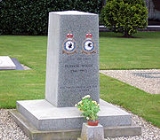
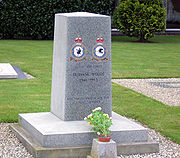
RAF Elsham Wolds

Encyclopedia
Royal Air Force
The Royal Air Force is the aerial warfare service branch of the British Armed Forces. Formed on 1 April 1918, it is the oldest independent air force in the world...
station
RAF station
A Royal Air Force station is a permanent Royal Air Force operations location. Many RAF stations are aerodromes, or airbases, being the home to one or more flying squadrons. Other RAF stations are training units, administrative units, headquarters , or carry out ground-based operational tasks...
in England, which operated in World War I
World War I
World War I , which was predominantly called the World War or the Great War from its occurrence until 1939, and the First World War or World War I thereafter, was a major war centred in Europe that began on 28 July 1914 and lasted until 11 November 1918...
and World War II
World War II
World War II, or the Second World War , was a global conflict lasting from 1939 to 1945, involving most of the world's nations—including all of the great powers—eventually forming two opposing military alliances: the Allies and the Axis...
. It is located just to the north east of the village of Elsham in north Lincolnshire
Lincolnshire
Lincolnshire is a county in the east of England. It borders Norfolk to the south east, Cambridgeshire to the south, Rutland to the south west, Leicestershire and Nottinghamshire to the west, South Yorkshire to the north west, and the East Riding of Yorkshire to the north. It also borders...
.
World War I
An airfield was established at Elsham as early as December 1916 and used by C Flight of 33 squadron of the Royal Flying CorpsRoyal Flying Corps
The Royal Flying Corps was the over-land air arm of the British military during most of the First World War. During the early part of the war, the RFC's responsibilities were centred on support of the British Army, via artillery co-operation and photographic reconnaissance...
, initially operating F.E.2
Royal Aircraft Factory F.E.2
The Royal Aircraft Factory F.E.2 was a two-seat pusher biplane that was operated as a day and night bomber and as a fighter aircraft by the Royal Flying Corps during the First World War...
and later Avro 504
Avro 504
The Avro 504 was a World War I biplane aircraft made by the Avro aircraft company and under licence by others. Production during the War totalled 8,970 and continued for almost 20 years, making it the most-produced aircraft of any kind that served in World War I, in any military capacity, during...
and Bristol F.2 Fighter
Bristol F.2 Fighter
The Bristol F.2 Fighter was a British two-seat biplane fighter and reconnaissance aircraft of the First World War flown by the Royal Flying Corps. It is often simply called the Bristol Fighter or popularly the "Brisfit" or "Biff". Despite being a two-seater, the F.2B proved to be an agile aircraft...
biplanes. From June 1918 to June 1919 it was also the squadron's headquarters, taking over from Gainsborough
Gainsborough, Lincolnshire
Gainsborough is a town 15 miles north-west of Lincoln on the River Trent within the West Lindsey district of Lincolnshire, England. At one time it served as an important port with trade downstream to Hull, and was the most inland in England, being more than 55 miles from the North...
.
The site was the most northerly of three airfields, along with RAF Kirton in Lindsey
RAF Kirton in Lindsey
RAF Kirton in Lindsey is a Royal Air Force airfield in Lincolnshire. The field is located 15 miles north of Lincoln.It hosts No.1 Air Control Centre , the RAF’s only deployable ground-based early warning and air control radar unit, parented by RAF Scampton.-First World War:The Royal Flying Corps...
(B Flight) and RAF Scampton
RAF Scampton
Royal Air Force Station Scampton is a Royal Air Force station situated north of Lincoln in England, near the village of Scampton, on the site of an old First World War landing field.-First World War:...
(A Flight), equally spaced between the cities of Hull
Kingston upon Hull
Kingston upon Hull , usually referred to as Hull, is a city and unitary authority area in the ceremonial county of the East Riding of Yorkshire, England. It stands on the River Hull at its junction with the Humber estuary, 25 miles inland from the North Sea. Hull has a resident population of...
and Lincoln
Lincoln, Lincolnshire
Lincoln is a cathedral city and county town of Lincolnshire, England.The non-metropolitan district of Lincoln has a population of 85,595; the 2001 census gave the entire area of Lincoln a population of 120,779....
for countering Zeppelin
Zeppelin
A Zeppelin is a type of rigid airship pioneered by the German Count Ferdinand von Zeppelin in the early 20th century. It was based on designs he had outlined in 1874 and detailed in 1893. His plans were reviewed by committee in 1894 and patented in the United States on 14 March 1899...
night raids. C Flight also acted as observers for the artillery batteries
Coastal artillery
Coastal artillery is the branch of armed forces concerned with operating anti-ship artillery or fixed gun batteries in coastal fortifications....
located at Spurn Head and Kilnsea
Kilnsea
Kilnsea is a hamlet in the East Riding of Yorkshire, England, in an area known as Holderness. It is situated approximately south of the village of Easington, on the north bank of the Humber Estuary.It forms part of the civil parish of Easington....
.
The flight stayed at Elsham until June 1918, the wooden huts and a small aircraft shed that had been erected were demolished by 1919 when the station was abandoned back to agriculture at the end of World War I
World War I
World War I , which was predominantly called the World War or the Great War from its occurrence until 1939, and the First World War or World War I thereafter, was a major war centred in Europe that began on 28 July 1914 and lasted until 11 November 1918...
.
World War II
In the late 1930s with a new war on the horizon, extra airfields were again needed to accommodate an expansion of the RAF. Former World War I stations were surveyed for suitability, and an area just to the west of the original Elsham site was deemed to be better suited.Work began in the winter of 1939-1940, and the station opened with the arrival in July 1941 of 103 Squadron
No. 103 Squadron RAF
No. 103 Squadron was a Royal Air Force bomber squadron during World War I, World War II and the Cold War, switching to helicopters in the late 1950s until it was disbanded for the last time in 1975.-Formation in World War I:...
. The station was equipped with a main runway
Runway
According to ICAO a runway is a "defined rectangular area on a land aerodrome prepared for the landing and take-off of aircraft." Runways may be a man-made surface or a natural surface .- Orientation and dimensions :Runways are named by a number between 01 and 36, which is generally one tenth...
2,000 yards long, and two subsidiaries of 1,600 yards and 1,400 yards. Three hangar
Hangar
A hangar is a closed structure to hold aircraft or spacecraft in protective storage. Most hangars are built of metal, but other materials such as wood and concrete are also sometimes used...
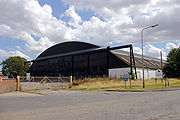
s (two T-2's and one J-Type) and 27 aircraft hardstands (later increased to 36) were built. Three more T-2 hangars were built in 1944. Accommodation for around 2,500 personnel was dispersed in the nearby farmland.
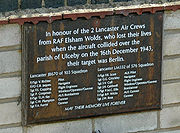
No. 103 is credited with more operational sorties than any other 1 Group squadron, and consequently suffered the group's highest losses. Of the 248 bombers lost on operations flying from Elsham Wolds, 198 were from No. 103 Squadron. By type, losses were 28 Vickers Wellington
Vickers Wellington
The Vickers Wellington was a British twin-engine, long range medium bomber designed in the mid-1930s at Brooklands in Weybridge, Surrey, by Vickers-Armstrongs' Chief Designer, R. K. Pierson. It was widely used as a night bomber in the early years of the Second World War, before being displaced as a...
s, 12 Halifaxes
Handley Page Halifax
The Handley Page Halifax was one of the British front-line, four-engined heavy bombers of the Royal Air Force during the Second World War. A contemporary of the famous Avro Lancaster, the Halifax remained in service until the end of the war, performing a variety of duties in addition to bombing...
and 208 Lancasters
Avro Lancaster
The Avro Lancaster is a British four-engined Second World War heavy bomber made initially by Avro for the Royal Air Force . It first saw active service in 1942, and together with the Handley Page Halifax it was one of the main heavy bombers of the RAF, the RCAF, and squadrons from other...
. One Elsham Wolds Lancaster, Lancaster III ED888 M2 (Mike Squared) which served with both Nos. 103 and 576, held the Bomber Command record for operational sorties, having completed 140 between May 1943 and December 1944. A total of 974 operational hours.
Post war
RAF Elsham Wolds closed in 1947 and shortly afterwards DP's (Displaced Persons), Poles and Ukrainians started to squat in the buildings whilst working at the Scunthorpe Steelworks. Some contemplated transit to the US or Canada, others to set roots, mostly in Scunthorpe.Colloquially, it started to be known as "Warsaw Hamlet" and the Post Office delivered letters using that address. By the late 1952 early '53 the DP's had moved on and once again the site reverted to first agriculture use and later as the site of an industrial estate. The history of the site is reflected in the road names on the estate which include Halifax Approach and Wellington Way. In the 1970s the site was bisected by the A15 road that was built to link the M180 motorway
M180 motorway
The M180 motorway is a short but major motorway in England from junction 5 on the M18 motorway in the Metropolitan Borough of Doncaster to a point close to Humberside Airport some from the ports of Immingham and Grimsby and the east coast and provides access for major routes to Cleethorpes,...
to the Humber Bridge
Humber Bridge
The Humber Bridge, near Kingston upon Hull, England, is a 2,220 m single-span suspension bridge, which opened to traffic on 24 June 1981. It is the fifth-largest of its type in the world...
. The control tower lasted into the 1980s and was used as a house for a time, which it was said to be haunted. The J-Type hangar is still standing.
Squadrons
| Squadron | Aircraft | Date arrived | Date departed |
|---|---|---|---|
| 33 No. 33 Squadron RAF No. 33 Squadron of the Royal Air Force operates the Puma HC.1 from RAF Benson, Oxfordshire.-Current role:The squadron is part of the RAF Support Helicopter force, which reports into the Joint Helicopter Command.... C Flight |
F.E.2 Royal Aircraft Factory F.E.2 The Royal Aircraft Factory F.E.2 was a two-seat pusher biplane that was operated as a day and night bomber and as a fighter aircraft by the Royal Flying Corps during the First World War... |
December 1916 | June 1918 |
| Bristol F.2 Fighter Bristol F.2 Fighter The Bristol F.2 Fighter was a British two-seat biplane fighter and reconnaissance aircraft of the First World War flown by the Royal Flying Corps. It is often simply called the Bristol Fighter or popularly the "Brisfit" or "Biff". Despite being a two-seater, the F.2B proved to be an agile aircraft... |
June 1918 | August 1918 | |
| Avro 504 Avro 504 The Avro 504 was a World War I biplane aircraft made by the Avro aircraft company and under licence by others. Production during the War totalled 8,970 and continued for almost 20 years, making it the most-produced aircraft of any kind that served in World War I, in any military capacity, during... |
August 1918 | June 1919 | |
| 103 No. 103 Squadron RAF No. 103 Squadron was a Royal Air Force bomber squadron during World War I, World War II and the Cold War, switching to helicopters in the late 1950s until it was disbanded for the last time in 1975.-Formation in World War I:... re-numbered 57 No. 57 Squadron RAF -History:57 Squadron of the Royal Flying Corps was formed on 8 June 1916 at Copmanthorpe, Yorkshire. In December 1916 the squadron was posted to France equipped with the FE2d. The squadron re-equipped with Airco DH4s in May 1917 and commenced long range bombing and reconnaissance operations near... November 1945 |
Wellington IC Vickers Wellington The Vickers Wellington was a British twin-engine, long range medium bomber designed in the mid-1930s at Brooklands in Weybridge, Surrey, by Vickers-Armstrongs' Chief Designer, R. K. Pierson. It was widely used as a night bomber in the early years of the Second World War, before being displaced as a... |
October 1940 | July 1942 |
| Halifax II Handley Page Halifax The Handley Page Halifax was one of the British front-line, four-engined heavy bombers of the Royal Air Force during the Second World War. A contemporary of the famous Avro Lancaster, the Halifax remained in service until the end of the war, performing a variety of duties in addition to bombing... |
July 1942 | October 1942 | |
| Lancaster B I and B III Avro Lancaster The Avro Lancaster is a British four-engined Second World War heavy bomber made initially by Avro for the Royal Air Force . It first saw active service in 1942, and together with the Handley Page Halifax it was one of the main heavy bombers of the RAF, the RCAF, and squadrons from other... |
October 1942 | December 1945 | |
| 576 No. 576 Squadron RAF -History:No. 576 Squadron was formed on 25 November 1943 from 'C' Flight of 103 squadron at RAF Elsham Wolds in Lincolnshire. They started operations beginning in the night of 2 to 3 December 1943, when seven Avro Lancasters were send out to bomb Berlin. Eleven months later 576 Squadron moved to... |
Lancaster B I and B III | November 1943 | October 1944 |
| 100 No. 100 Squadron RAF No. 100 Squadron of the Royal Air Force is based at RAF Leeming in North Yorkshire, UK, and operates the Hawker-Siddeley Hawk.-World War I:No. 100 was established on 23 February 1917 at Hingham in Norfolk as the Royal Flying Corps' first squadron formed specifically as a night bombing unit and... |
Lancaster B I and B III | April 1945 | December 1945 |
| 1656 HCU | Halifax | April 1942 | October 1942 |
| 1662 HCU | Halifax I, II, III, V | January 1945 | April 1945 |
| 21 HGCU | Halifax | February 1945 | December 1946 |
| Albemarle Armstrong Whitworth Albemarle The Armstrong Whitworth A.W.41 Albemarle was a British twin-engine transport aircraft that entered service during the Second World War.Originally designed as a medium bomber that could be built by non-aviation companies without using light alloys, the Albemarle never served in that role, instead... |