

Quest for Glory

Encyclopedia
Quest for Glory is a series of hybrid role-playing
/adventure
computer games designed by Corey and Lori Ann Cole
. The series combined humor, puzzle
elements, themes and characters borrowed from various legends, pun
s, and memorable characters, creating a 5-part series of the Sierra
stable.
Although the series was originally titled Hero's Quest, Sierra
failed to trademark
the name. Milton Bradley
successfully trademarked an electronic version of their unrelated joint Games Workshop
board game
, HeroQuest
, which forced Sierra to change the series' title to Quest for Glory. This decision caused all future games in the series (as well as newer releases of Hero's Quest I) to switch over to the new name.
by completing non-linear quests.
The game also was revolutionary in its character import system, which allowed you to import your individual character, including the skills and wealth he had acquired, from one game to the next.
Hybrids by their gameplay and themes, the games feature serious stories leavened by humor throughout. There are real dangers to face, and true heroic feats to perform, but silly details and overtones creep in (when the drama of adventuring does not force them out). Cheap word play
is particularly frequent, to the point that the second game's ending refers to itself as the hero's "latest set of adventures and miserable pun
s."
The games also have some memorable easter eggs, including a number of allusions to other Sierra games. For example if one types "pick nose" in the first game, (or click the lockpick icon on the player in the new version), if his lock-picking skill was high enough, the game would respond "Success! You now have an open nose"; If the skill was too low, the player would insert the lock pick too far, killing himself. Another example is Dr. Cranium, an allusion to The Castle of Dr. Brain
, in the fourth game.
Each game drew its inspiration from a different culture and mythology (in order, Germanic/fairy tale
; Middle Eastern/Arabian Nights; Egyptian
/African; Slavic folklore
/Eastern European folklore; and finally Greco-Mediterranean
) with the hero facing increasingly powerful opponents with help from characters who become increasingly familiar from game to game.
Each game varied somewhat from the tradition it is derived from; for example, Baba Yaga
, a character borrowed from Slavic folklore, first appeared in the first game. The second game introduced several Arab
and Africa
n-themed characters who reappeared in the third game, and characters from every game and genre in the series reappeared in the fourth and fifth games. In addition to deviating from the player's expectations of the culture represented in each game, the series also included a number of intentional anachronism
s, such as the pizza
-loving, mad scientist
s in the later games.
There was some criticism concerning the games as time-consuming. For example, while adding to realism, in order to build a certain skill or reach a certain point of time, the player has to repeat for countless times some certain action
(such as 'climb tree', 'get rock'-'throw rock'), or walk aimlessly until the time passes.
adventure games were enhanced by the player's ability to choose his character's career
path from among the three traditional role-playing game
backgrounds: fighter, magic-user
/wizard
and thief
. Further variation was added by the ability to customize the Hero's abilities, including the option of selecting skill
s normally reserved for another character class
, leading to unique combinations often referred to as "hybrid characters". During the second or third games, a character could be initiated as a Paladin
by performing honorable actions, changing his class and abilities and receiving a unique sword. This would apply when the character is exported into later games. Any character that finished any game in the series (except Dragon Fire, the last in the series) could be exported to a more recent game (Shadows of Darkness has a glitch which allows one to import characters from the same game), keeping the stats and parts of the inventory. If the character received the paladin sword, he would keep the magic sword
(Soulforge or Piotyr's sword) and special paladin magic abilities. A character imported into a later game in the series from any other game could be assigned any character class, including Paladin.
Each career path had its own strengths and weaknesses, scenarios unique to those that possess the skills associated with it. Each class also had its own distinct way to solve various in-game puzzles, which encouraged replay: some puzzles had up to four different solutions. For instance, if a door is closed, instead of lockpicking or casting an open spell, the fighter can simply knock down the door. The magic user and the thief are both non-confrontational characters, as they lack the close range ability of the fighter, but are better able to attack from a distance, using daggers or spells. An example of these separate paths can be seen early in the first game. A gold ring belonging to the healer rests in a nest on top of a tree; fighters might make it fall by hurling rocks, thieves may want to climb the tree, while a magic user can simply cast the fetch spell to retrieve the nest, and then, while the fighter and magic user return the ring for a reward, the thief can choose between returning or selling the same ring in the thieves' guild
(which is not available for those not possessing the "thieving" skills). It is also possible to build (over the course of several games) a character that has points in every skill in the game and can therefore perform nearly every task.
Each character class featured special abilities unique to that class, as well as a shared set of attributes which could be developed by performing tasks and completing quests. In general, for a particular game the maximum value which can be reached for an ability is 100*[the number of that game]. Quest for Glory V allows stat bonuses which can push an attribute over the maximum and lets certain classes raise certain attributes beyond the normal limits. Quest for Glory V also features special kinds of equipment which lower some stats while raising others. At the beginning of each game, the player may assign points to certain attributes, and certain classes only have specific attributes enabled, although skills can be added for an extra cost.
General attributes influence all characters classes and how they interact with objects and other people in the game; high values in strength allows to move heavier objects and communication helps with bargaining goods with sellers. These attributes are changed by performing actions related to the skill; climbing a tree eventually increases the skill value in climb, running increases vitality, and so on. There are also complementing skills which are only of associated with some classes; parry (the ability to block a blow with the sword), for instance, is mainly used by fighters and paladins, lock picking and sneaking thief's hobby, and the ability to cast magic spells is usually associated with magic user.
Vital statistics are depleted by performing some actions. Health (determined by strength and vitality) determines the hit points of the character, which decreases when the player is attacked or harms himself. Stamina (based on agility and vitality) limits the number of actions (exercise, fighting, running, etc.) the character is able to perform before needing rest or risking injury. Mana is only required by characters with skill in magic, and is calculated according to the character's intelligence and magic attributes.
Puzzle and Experience points only show the development of the player and his progress in the game, though in the first game also affected the kind of random encounters a player faces, as some monsters only appear after a certain level of experience is reached.
, consisting of 4 games, with the following themes and cyles:
the 4 cardinal direction
s, the 4 classical element
s, the 4 season
s and 4 different mythologies
.
This is what the creators originally had in mind:
However, when Shadows of Darkness
was designed, it was thought that it would be too difficult for the hero to go straight from Shapeir to Mordavia and defeat the Dark One. To solve the problem, a new game, Wages of War
, was inserted into the canon, and caused a renumbering of the series. Evidence for this can be found in the end of Trial by Fire
: the player is told that the next game will be Shadows of Darkness
and a fanged vampyric moon is shown, to hint at the next game's theme.
They talked about it in the Fall 1992 issue of Sierra
's InterAction magazine, and an online chat room:
Role-playing video game
Role-playing video games are a video game genre with origins in pen-and-paper role-playing games such as Dungeons & Dragons, using much of the same terminology, settings and game mechanics. The player in RPGs controls one character, or several adventuring party members, fulfilling one or many quests...
/adventure
Adventure game
An adventure game is a video game in which the player assumes the role of protagonist in an interactive story driven by exploration and puzzle-solving instead of physical challenge. The genre's focus on story allows it to draw heavily from other narrative-based media such as literature and film,...
computer games designed by Corey and Lori Ann Cole
Lori Ann Cole
Lori Ann Cole is a game designer, often in cooperation with her husband, professional game programmer Corey Cole. Their team was later named Transolar Games. Lori also maintains a photography and Web design studio known as FAR Studio....
. The series combined humor, puzzle
Puzzle
A puzzle is a problem or enigma that tests the ingenuity of the solver. In a basic puzzle, one is intended to put together pieces in a logical way in order to come up with the desired solution...
elements, themes and characters borrowed from various legends, pun
Pun
The pun, also called paronomasia, is a form of word play which suggests two or more meanings, by exploiting multiple meanings of words, or of similar-sounding words, for an intended humorous or rhetorical effect. These ambiguities can arise from the intentional use and abuse of homophonic,...
s, and memorable characters, creating a 5-part series of the Sierra
Sierra Entertainment
Sierra Entertainment Inc. was an American video-game developer and publisher founded in 1979 as On-Line Systems by Ken and Roberta Williams...
stable.
Although the series was originally titled Hero's Quest, Sierra
Sierra Entertainment
Sierra Entertainment Inc. was an American video-game developer and publisher founded in 1979 as On-Line Systems by Ken and Roberta Williams...
failed to trademark
Trademark
A trademark, trade mark, or trade-mark is a distinctive sign or indicator used by an individual, business organization, or other legal entity to identify that the products or services to consumers with which the trademark appears originate from a unique source, and to distinguish its products or...
the name. Milton Bradley
Milton Bradley
Milton Bradley , an American game pioneer, was credited by many with launching the board game industry in North America with Milton Bradley Company....
successfully trademarked an electronic version of their unrelated joint Games Workshop
Games Workshop
Games Workshop Group plc is a British game production and retailing company. Games Workshop has published the tabletop wargames Warhammer Fantasy Battle and Warhammer 40,000...
board game
Board game
A board game is a game which involves counters or pieces being moved on a pre-marked surface or "board", according to a set of rules. Games may be based on pure strategy, chance or a mixture of the two, and usually have a goal which a player aims to achieve...
, HeroQuest
HeroQuest (board game)
HeroQuest, sometimes also written as Hero Quest, is an adventure board game that was created by Milton Bradley in conjunction with the British company Games Workshop and set in the latter's Warhammer Fantasy fictional universe, as shown by a map of the Warhammer 'Old World' being printed on the...
, which forced Sierra to change the series' title to Quest for Glory. This decision caused all future games in the series (as well as newer releases of Hero's Quest I) to switch over to the new name.
Series
The series consisted of five games, each of which followed directly upon the events of the last. New games frequently referred to previous entries in the series, often in the form of cameos from recurring characters. The objective of the series is to transform the player character from an average adventurer to a HeroHero
A hero , in Greek mythology and folklore, was originally a demigod, their cult being one of the most distinctive features of ancient Greek religion...
by completing non-linear quests.
The game also was revolutionary in its character import system, which allowed you to import your individual character, including the skills and wealth he had acquired, from one game to the next.
Hybrids by their gameplay and themes, the games feature serious stories leavened by humor throughout. There are real dangers to face, and true heroic feats to perform, but silly details and overtones creep in (when the drama of adventuring does not force them out). Cheap word play
Word play
Word play or wordplay is a literary technique in which the words that are used become the main subject of the work, primarily for the purpose of intended effect or amusement...
is particularly frequent, to the point that the second game's ending refers to itself as the hero's "latest set of adventures and miserable pun
Pun
The pun, also called paronomasia, is a form of word play which suggests two or more meanings, by exploiting multiple meanings of words, or of similar-sounding words, for an intended humorous or rhetorical effect. These ambiguities can arise from the intentional use and abuse of homophonic,...
s."
The games also have some memorable easter eggs, including a number of allusions to other Sierra games. For example if one types "pick nose" in the first game, (or click the lockpick icon on the player in the new version), if his lock-picking skill was high enough, the game would respond "Success! You now have an open nose"; If the skill was too low, the player would insert the lock pick too far, killing himself. Another example is Dr. Cranium, an allusion to The Castle of Dr. Brain
Castle of Dr. Brain
Castle of Dr. Brain is a video game of the educational genre released in 1991 by Sierra Online. It is a puzzle adventure game.-Gameplay:The object of the game is to successfully navigate the puzzles Dr. Brain has set up in order to become the mad scientist's assistant...
, in the fourth game.
Each game drew its inspiration from a different culture and mythology (in order, Germanic/fairy tale
Fairy tale
A fairy tale is a type of short story that typically features such folkloric characters, such as fairies, goblins, elves, trolls, dwarves, giants or gnomes, and usually magic or enchantments. However, only a small number of the stories refer to fairies...
; Middle Eastern/Arabian Nights; Egyptian
Egyptian mythology
Ancient Egyptian religion was a complex system of polytheistic beliefs and rituals which were an integral part of ancient Egyptian society. It centered on the Egyptians' interaction with a multitude of deities who were believed to be present in, and in control of, the forces and elements of nature...
/African; Slavic folklore
Slavic mythology
Slavic mythology is the mythological aspect of the polytheistic religion that was practised by the Slavs before Christianisation.The religion possesses many common traits with other religions descended from the Proto-Indo-European religion....
/Eastern European folklore; and finally Greco-Mediterranean
Greek mythology
Greek mythology is the body of myths and legends belonging to the ancient Greeks, concerning their gods and heroes, the nature of the world, and the origins and significance of their own cult and ritual practices. They were a part of religion in ancient Greece...
) with the hero facing increasingly powerful opponents with help from characters who become increasingly familiar from game to game.
Each game varied somewhat from the tradition it is derived from; for example, Baba Yaga
Baba Yaga
Baba Yaga or Baba Roga is a haggish or witchlike character in Slavic folklore. She flies around on a giant pestle, kidnaps small children, and lives in a hut that stands on chicken legs...
, a character borrowed from Slavic folklore, first appeared in the first game. The second game introduced several Arab
Arab
Arab people, also known as Arabs , are a panethnicity primarily living in the Arab world, which is located in Western Asia and North Africa. They are identified as such on one or more of genealogical, linguistic, or cultural grounds, with tribal affiliations, and intra-tribal relationships playing...
and Africa
Africa
Africa is the world's second largest and second most populous continent, after Asia. At about 30.2 million km² including adjacent islands, it covers 6% of the Earth's total surface area and 20.4% of the total land area...
n-themed characters who reappeared in the third game, and characters from every game and genre in the series reappeared in the fourth and fifth games. In addition to deviating from the player's expectations of the culture represented in each game, the series also included a number of intentional anachronism
Anachronism
An anachronism—from the Greek ανά and χρόνος — is an inconsistency in some chronological arrangement, especially a chronological misplacing of persons, events, objects, or customs in regard to each other...
s, such as the pizza
Pizza
Pizza is an oven-baked, flat, disc-shaped bread typically topped with a tomato sauce, cheese and various toppings.Originating in Italy, from the Neapolitan cuisine, the dish has become popular in many parts of the world. An establishment that makes and sells pizzas is called a "pizzeria"...
-loving, mad scientist
Mad scientist
A mad scientist is a stock character of popular fiction, specifically science fiction. The mad scientist may be villainous or antagonistic, benign or neutral, and whether insane, eccentric, or simply bumbling, mad scientists often work with fictional technology in order to forward their schemes, if...
s in the later games.
There was some criticism concerning the games as time-consuming. For example, while adding to realism, in order to build a certain skill or reach a certain point of time, the player has to repeat for countless times some certain action
Grind (gaming)
Grinding is a term used in video gaming to describe the process of engaging in repetitive and/or boring tasks not pertaining to the story line of the game...
(such as 'climb tree', 'get rock'-'throw rock'), or walk aimlessly until the time passes.
Gameplay
The gameplay standards established in earlier SierraSierra Entertainment
Sierra Entertainment Inc. was an American video-game developer and publisher founded in 1979 as On-Line Systems by Ken and Roberta Williams...
adventure games were enhanced by the player's ability to choose his character's career
Career
Career is defined by the Oxford English Dictionary as a person's "course or progress through life ". It is usually considered to pertain to remunerative work ....
path from among the three traditional role-playing game
Role-playing game
A role-playing game is a game in which players assume the roles of characters in a fictional setting. Players take responsibility for acting out these roles within a narrative, either through literal acting, or through a process of structured decision-making or character development...
backgrounds: fighter, magic-user
Magic (paranormal)
Magic is the claimed art of manipulating aspects of reality either by supernatural means or through knowledge of occult laws unknown to science. It is in contrast to science, in that science does not accept anything not subject to either direct or indirect observation, and subject to logical...
/wizard
Wizard (character class)
The Wizard is a type of magical character class in certain role-playing games and computer role-playing games. Wizards are considered to be spellcasters who wield powerful spells, but are often physically weak as a trade-off. Wizards are commonly confused with similar offensive spellcasting...
and thief
Thief (character class)
The Thief or Rogue is a character class in many role-playing games, including Dungeons & Dragons, Final Fantasy, World of Warcraft and many MMORPGs. Thieves are usually stealthy and dextrous characters able to disarm traps, pick locks, and perform backstabs from hiding...
. Further variation was added by the ability to customize the Hero's abilities, including the option of selecting skill
Skill
A skill is the learned capacity to carry out pre-determined results often with the minimum outlay of time, energy, or both. Skills can often be divided into domain-general and domain-specific skills...
s normally reserved for another character class
Character class
In role-playing games, a common method of arbitrating the capabilities of different game characters is to assign each one to a character class. A character class aggregates several abilities and aptitudes, and may also sometimes detail aspects of background and social standing or impose behaviour...
, leading to unique combinations often referred to as "hybrid characters". During the second or third games, a character could be initiated as a Paladin
Paladin (character class)
The Paladin is a character class in Dungeons & Dragons and many later computer and pen and paper role-playing games - many of which were influenced by D&D...
by performing honorable actions, changing his class and abilities and receiving a unique sword. This would apply when the character is exported into later games. Any character that finished any game in the series (except Dragon Fire, the last in the series) could be exported to a more recent game (Shadows of Darkness has a glitch which allows one to import characters from the same game), keeping the stats and parts of the inventory. If the character received the paladin sword, he would keep the magic sword
Magic sword
The term magic sword refers to any kind of mythological or fictional sword imbued with magical power to increase its strength or grant it other supernatural qualities. The archetype originated in myth and legend, and occurs regularly in fantasy fiction....
(Soulforge or Piotyr's sword) and special paladin magic abilities. A character imported into a later game in the series from any other game could be assigned any character class, including Paladin.
Each career path had its own strengths and weaknesses, scenarios unique to those that possess the skills associated with it. Each class also had its own distinct way to solve various in-game puzzles, which encouraged replay: some puzzles had up to four different solutions. For instance, if a door is closed, instead of lockpicking or casting an open spell, the fighter can simply knock down the door. The magic user and the thief are both non-confrontational characters, as they lack the close range ability of the fighter, but are better able to attack from a distance, using daggers or spells. An example of these separate paths can be seen early in the first game. A gold ring belonging to the healer rests in a nest on top of a tree; fighters might make it fall by hurling rocks, thieves may want to climb the tree, while a magic user can simply cast the fetch spell to retrieve the nest, and then, while the fighter and magic user return the ring for a reward, the thief can choose between returning or selling the same ring in the thieves' guild
Thieves' Guild
A thieves' guild is an association of criminals who participate in theft-related organized crime, usually in a fictional context. A thieves' guild is a common feature of old-fashioned urban locations in various types of fiction.-Depictions:...
(which is not available for those not possessing the "thieving" skills). It is also possible to build (over the course of several games) a character that has points in every skill in the game and can therefore perform nearly every task.
Each character class featured special abilities unique to that class, as well as a shared set of attributes which could be developed by performing tasks and completing quests. In general, for a particular game the maximum value which can be reached for an ability is 100*[the number of that game]. Quest for Glory V allows stat bonuses which can push an attribute over the maximum and lets certain classes raise certain attributes beyond the normal limits. Quest for Glory V also features special kinds of equipment which lower some stats while raising others. At the beginning of each game, the player may assign points to certain attributes, and certain classes only have specific attributes enabled, although skills can be added for an extra cost.
General attributes influence all characters classes and how they interact with objects and other people in the game; high values in strength allows to move heavier objects and communication helps with bargaining goods with sellers. These attributes are changed by performing actions related to the skill; climbing a tree eventually increases the skill value in climb, running increases vitality, and so on. There are also complementing skills which are only of associated with some classes; parry (the ability to block a blow with the sword), for instance, is mainly used by fighters and paladins, lock picking and sneaking thief's hobby, and the ability to cast magic spells is usually associated with magic user.
Vital statistics are depleted by performing some actions. Health (determined by strength and vitality) determines the hit points of the character, which decreases when the player is attacked or harms himself. Stamina (based on agility and vitality) limits the number of actions (exercise, fighting, running, etc.) the character is able to perform before needing rest or risking injury. Mana is only required by characters with skill in magic, and is calculated according to the character's intelligence and magic attributes.
Puzzle and Experience points only show the development of the player and his progress in the game, though in the first game also affected the kind of random encounters a player faces, as some monsters only appear after a certain level of experience is reached.
The Games
- Quest for Glory: So You Want to Be a Hero (1989; VGA remake released in 1991)
- Quest for Glory II: Trial by FireQuest for Glory II: Trial by FireQuest for Glory II: Trial by Fire is the second video game in Sierra's Quest for Glory series, and the sequel to Hero's Quest: So You Want to Be a Hero .-Gameplay:...
(1990; Authorised VGA style remake by AGD InteractiveAGD InteractiveAGD Interactive , LLC. is a non-profit company given a fan license to remake Sierra Entertainment's popular classic adventure games from the 1980s and early 1990s.-History:...
released in 2008) - Quest for Glory III: Wages of WarQuest for Glory III: Wages of WarQuest for Glory III: Wages of War is a hybrid adventure/role-playing video game released in 1992 for the MS-DOS PC and Apple Macintosh. It is the sequel to Quest for Glory II: Trial by Fire....
(1992) - Quest for Glory IV: Shadows of DarknessQuest for Glory IV: Shadows of DarknessQuest for Glory: Shadows of Darkness is an adventure game/role-playing video game hybrid. It is the fourth installment of the Quest for Glory computer game series by Sierra Entertainment.- Release :...
(1994) - Quest for Glory V: Dragon FireQuest for Glory V: Dragon FireQuest for Glory V: Dragon Fire is the fifth and final game in the Quest for Glory computer game series by Sierra Entertainment. Unlike the first four games, Dragon Fire is an Action/RPG with few elements of Adventure.-Story:...
(1998)
Collections
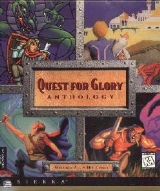
- Quest for Glory Anthology (1996) a package that includes the first four games, including the fully patched CD version of QFG IV; game copy protection codes (a feature of Quest for Glory 4) are included in the manual and on CD, while game saves are included in the save folder of the CD and the VGA version of Quest for Glory 1.
- Quest for Glory Collection Series (1997) re-release of QFG Anthology with a Dragon Fire demo and sample soundtrack.
The World
The fantasy world in which the action takes place is known as Gloriana, and is somewhat a mirror of our own world.The Characters
Along with the Hero, several memorable characters appear and re-appear throughout the series including Rakeesh Sah Tarna, Abdullah Doo, Elsa von Spielburg, the evil Ad Avis and many others.Original Concept
Originally, the series was to be a tetralogyTetralogy
A tetralogy is a compound work that is made up of four distinct works, just as a trilogy is made up of three works....
, consisting of 4 games, with the following themes and cyles:
the 4 cardinal direction
Cardinal direction
The four cardinal directions or cardinal points are the directions of north, east, south, and west, commonly denoted by their initials: N, E, S, W. East and west are at right angles to north and south, with east being in the direction of rotation and west being directly opposite. Intermediate...
s, the 4 classical element
Classical element
Many philosophies and worldviews have a set of classical elements believed to reflect the simplest essential parts and principles of which anything consists or upon which the constitution and fundamental powers of anything are based. Most frequently, classical elements refer to ancient beliefs...
s, the 4 season
Season
A season is a division of the year, marked by changes in weather, ecology, and hours of daylight.Seasons result from the yearly revolution of the Earth around the Sun and the tilt of the Earth's axis relative to the plane of revolution...
s and 4 different mythologies
Mythology
The term mythology can refer either to the study of myths, or to a body or collection of myths. As examples, comparative mythology is the study of connections between myths from different cultures, whereas Greek mythology is the body of myths from ancient Greece...
.
This is what the creators originally had in mind:
| Game | Cardinal Direction | Central Element | Season | Central Mythology |
|---|---|---|---|---|
| Quest for Glory I: So You Want To Be A Hero Quest for Glory I: So You Want To Be A Hero Hero's Quest: So You Want to Be a Hero is an adventure game/role-playing game hybrid, designed by Lori Ann Cole and published by Sierra On-line. It is the first game in the Quest for Glory series... |
North | Earth | Spring | Germanic |
| Quest for Glory II: Trial by Fire Quest for Glory II: Trial by Fire Quest for Glory II: Trial by Fire is the second video game in Sierra's Quest for Glory series, and the sequel to Hero's Quest: So You Want to Be a Hero .-Gameplay:... |
South | Fire | Summer | Middle Eastern |
| Quest for Glory III: Shadows of Darkness Quest for Glory IV: Shadows of Darkness Quest for Glory: Shadows of Darkness is an adventure game/role-playing video game hybrid. It is the fourth installment of the Quest for Glory computer game series by Sierra Entertainment.- Release :... |
East | Air | Fall | Slavic |
| Quest for Glory IV: Dragon Fire Quest for Glory V: Dragon Fire Quest for Glory V: Dragon Fire is the fifth and final game in the Quest for Glory computer game series by Sierra Entertainment. Unlike the first four games, Dragon Fire is an Action/RPG with few elements of Adventure.-Story:... |
West | Water | Winter | Greek |
However, when Shadows of Darkness
Quest for Glory IV: Shadows of Darkness
Quest for Glory: Shadows of Darkness is an adventure game/role-playing video game hybrid. It is the fourth installment of the Quest for Glory computer game series by Sierra Entertainment.- Release :...
was designed, it was thought that it would be too difficult for the hero to go straight from Shapeir to Mordavia and defeat the Dark One. To solve the problem, a new game, Wages of War
Quest for Glory III: Wages of War
Quest for Glory III: Wages of War is a hybrid adventure/role-playing video game released in 1992 for the MS-DOS PC and Apple Macintosh. It is the sequel to Quest for Glory II: Trial by Fire....
, was inserted into the canon, and caused a renumbering of the series. Evidence for this can be found in the end of Trial by Fire
Quest for Glory II: Trial by Fire
Quest for Glory II: Trial by Fire is the second video game in Sierra's Quest for Glory series, and the sequel to Hero's Quest: So You Want to Be a Hero .-Gameplay:...
: the player is told that the next game will be Shadows of Darkness
Quest for Glory IV: Shadows of Darkness
Quest for Glory: Shadows of Darkness is an adventure game/role-playing video game hybrid. It is the fourth installment of the Quest for Glory computer game series by Sierra Entertainment.- Release :...
and a fanged vampyric moon is shown, to hint at the next game's theme.
They talked about it in the Fall 1992 issue of Sierra
Sierra Entertainment
Sierra Entertainment Inc. was an American video-game developer and publisher founded in 1979 as On-Line Systems by Ken and Roberta Williams...
's InterAction magazine, and an online chat room: