

Public transport in Wellington

Encyclopedia
Public transport in Wellington, the capital of New Zealand, is well developed compared to other parts of the country. The system covers the Greater Wellington region, including Wellington
city, Lower Hutt
, Upper Hutt
, Porirua
, the Kapiti Coast
and the Wairarapa
.
es, trolleybus
es, train
s, ferries
and a funicular
(the Wellington Cable Car
), and, historically, tram
s. Buses and ferries are privately owned with the infrastructure owned by public bodies, and public transport is often subsidised
. The body responsible for planning and subsidising public transport in Wellington is the Greater Wellington Regional Council
which pays around NZ$30 million for bus and train services each year. The region's transport services are marketed under the name Metlink.
Of the approximately 35 million trips, around 23 million are made by bus, 11 million are made by train and 180,000 are made by ferry.
GIS information indicates that 77% of the region’s population lives within 800 metres of
public transport stop with a 30 minute frequency or better.
Wellington's hilly terrain has a considerable effect on Wellington's public transport. Some planners consider Wellington to be a "good" city for public transport management, as the topography concentrates settlement in valleys or along coastlines, providing clear, dense "corridors" for transport routes. At the same time, however, the hilly terrain proved a hindrance for the construction of rail and tram lines, and buses sometimes have difficulty on narrow and winding streets.
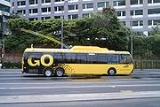
 Wellington has an extensive network of bus routes. Routes are determined by the Regional Council, which regulates commercially-provided services and solicits bids from private operators to run the services it is prepared to subsidise. The largest operator is NZ Bus, which provides services for most of Wellington city under the GOWellington
brand and for the Hutt Valley under the Valley Flyer
and Runciman Motors brands. In Porirua and the Kapiti Coast most services are provided by Mana Coach Services, which also owns Newlands Coach Services, serving the northern suburbs of Wellington - Newlands, Johnsonville, Churton Park, Paparangi and Grenada North.
The majority of buses in the Wellington area are powered by diesel, but GOWellington has 65 trolleybus
es that it operates within Wellington city. The trolleybus network was introduced to replace Wellington's trams (see below).
All GOWellington and Valley Flyer buses accept the contactless Snapper card
payment method. As of April 2011, GOWellington buses report real time location information which is displayed on electronic signs in some Wellington bus stops and can be viewed online.
 Wellington and Auckland
are the only two cities in New Zealand to have suburban passenger trains. Wellington's rail network is used primarily by commuters travelling to and from the central city — all lines converge on Wellington Railway Station
.
There are two major rail corridors in Wellington. The North Island Main Trunk runs along the western coastline, passing through Porirua and Paraparaumu
to Waikanae
on the Kapiti Coast; the Wairarapa Line
runs along the edge of Wellington Harbour
and then up the Hutt Valley, passing through both Lower and Upper Hutt. Less frequent services continue on through the rural Wairarapa
, stopping at a number of small towns before terminating at Masterton
. There are also the Johnsonville Line in the north of Wellington and the Melling Line
on the western side of Lower Hutt
. Lines are double track
except for a short stretch between Muri and Paekakariki on the NIMT and then north of Waikanae, the Wairarapa Line beyond Trentham, and the Johnsonville and Melling Lines, which are single track.
There are long-distance trains to Palmerston North
(the Capital Connection commuter train) and Auckland
(The Overlander). These are not part of the Wellington transport system.
 Most Wellington trains are electric, with Wellington currently being the only city in the country to have electric passenger trains - Auckland's network is due to be electrified by 2013.
There are 49 stations in the Wellington rail network, all except Wellington
station owned by Greater Wellington Regional Council. Wellington is the busiest by far, with trains arriving and departing every few minutes at peak times. The next busiest stations are Porirua, Waterloo (in Lower Hutt) and Johnsonville. Most stations are served by only one line.
Passenger trains are owned by Greater Wellington Regional Council. They are operated by Tranz Metro
, and the rail infrastructure is owned by KiwiRail
, its parent. The Regional Council estimates that around 800,000 train trips are made each month.
Most trains are EMU
s in sets of two to eight cars. The majority of cars are Ganz Mavag
units, 20–25 years old, and were extensively refurbished in the late 1990s. The 50-year-old English Electric
units operate primarily to Johnsonville, Melling and Taita
. The EE units have undergone minor refurbishment to extend their life to 2010. On 22 September 2006 the Regional Council announced http://www.radionz.co.nz/news/latest/200609221254/supplier_sought_for_new_railway_carriages_for_wellington_commuters that it would begin the tender process for 29 new two-car EMUs (reported as 58 "electric carriages"), to replace the EE EMUs and expand the passenger rail fleet by 2010. Trains to the Wairarapa are hauled by diesel locomotives.
Wellington is to get 35 two-car EMUs by 2010 by a consortium of Rotem
and Mitsui
, announced as the preferred supplier in July 2007. The Greater Wellington Regional Council had earlier named three short-listed tenderers; the others were Bombardier
(Australia) and CAF
(Spain). This is part of a $500 million package announced in July 2007 with the government, which includes double-tracking and electrification to Waikanae and an extra track from Kaiwharawhara into Wellington. Proposals for new stations at Lindale and Raumati and double-tracking of part of the Paekakariki-Muri section including opening up the northernmost tunnel are in abeyance. (Dominion Post 25 July 2007).
 Only the western and northern shores of Wellington Harbour are heavily populated, and the trip between these population centres is often as quick along the coast as it is by water: demand for ferries has been lower than might otherwise be expected. Two ferry routes are operated by East by West, a privately-owned company: daily between central Wellington and Days Bay on the harbour's eastern coast, near Eastbourne
, serving Seatoun
at peak times from 3 April 2008; and the Harbour Explorer Excursion at weekends, also serving Petone
and Seatoun
. Off-peak and weekend sailings call at Matiu/Somes Island
, a nature reserve.
Historically ferries also served Miramar
, Karaka Bay, and Eastbourne proper. These routes were discontinued as road connections around the region improved.
There are also larger road and rail ferries linking Wellington to the South Island
, crossing Cook Strait
. These ferries are not part of Wellington's local public transport system, but as the largest ferry operator, the Interislander, is owned by KiwiRail
, they are interlinked.
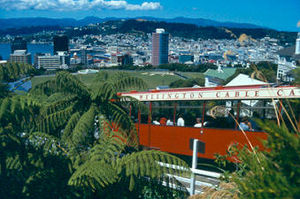 The Wellington Cable Car, which runs between the central city and the hill suburb of Kelburn
, is something of a Wellington icon. It is used by commuters travelling to and from work, by people travelling from the city to the Wellington Botanic Garden
, and by students at Victoria University
.
Despite its name it is a funicular
with two counter-balanced cars permanently attached to each other by a cable, rather than a true cable car
, where the cars grip or release the cable as needed. The cable runs through a pulley at the top of the hill, driven by an electric motor. Originally the Cable Car was a hybrid between a true cable car and a funicular, and retained its name when it was converted to a full funicular.
The Wellington Cable Car is owned and operated by Wellington Cable Car Ltd, a wholly owned subsidiary of Wellington City Council. Until 2007 it was operated under contract by Transfield Services, a private company. Unlike most other public transport in Wellington, it runs without subsidy.
s serving the western, eastern and southern suburbs, with the northern suburbs served by trains. The trams were replaced by buses or trolleybuses, and occasional calls are made for light rail to be reintroduced.
Following the 2010 mayoral elections, Mayor Celia Wade-Brown
pledged to investigate a light rail system running between the rail-way station and the airport.
Wellington
Wellington is the capital city and third most populous urban area of New Zealand, although it is likely to have surpassed Christchurch due to the exodus following the Canterbury Earthquake. It is at the southwestern tip of the North Island, between Cook Strait and the Rimutaka Range...
city, Lower Hutt
Lower Hutt
Lower Hutt is a city in the Wellington region of New Zealand. Its council has adopted the name Hutt City Council, but neither the New Zealand Geographic Board nor the Local Government Act recognise the name Hutt City. This alternative name can lead to confusion, as there are two cities in the...
, Upper Hutt
Upper Hutt
Upper Hutt is a satellite city of Wellington. It is New Zealand's smallest city by population, the second largest by land area. It is in Greater Wellington.-Geography:Upper Hutt is 30 km north-east of Wellington...
, Porirua
Porirua
Porirua is a city in the Wellington Region of New Zealand, immediately north of the city of Wellington, with their central business districts 20 km apart. A large proportion of the population commutes to Wellington, so it may be considered a satellite city. It almost completely surrounds...
, the Kapiti Coast
Kapiti Coast
The Kapiti Coast is the name of the section of the coast of the south-western North Island of New Zealand that is north of Wellington and opposite Kapiti Island. It falls under the jurisdiction of the Wellington Regional Council...
and the Wairarapa
Wairarapa
Wairarapa is a geographical region of New Zealand. It occupies the south-eastern corner of the North Island, east of metropolitan Wellington and south-west of the Hawke's Bay region. It is lightly populated, having several rural service towns, with Masterton being the largest...
.
Administration
Public transport in Wellington consists of busBus
A bus is a road vehicle designed to carry passengers. Buses can have a capacity as high as 300 passengers. The most common type of bus is the single-decker bus, with larger loads carried by double-decker buses and articulated buses, and smaller loads carried by midibuses and minibuses; coaches are...
es, trolleybus
Trolleybus
A trolleybus is an electric bus that draws its electricity from overhead wires using spring-loaded trolley poles. Two wires and poles are required to complete the electrical circuit...
es, train
Train
A train is a connected series of vehicles for rail transport that move along a track to transport cargo or passengers from one place to another place. The track usually consists of two rails, but might also be a monorail or maglev guideway.Propulsion for the train is provided by a separate...
s, ferries
Ferry
A ferry is a form of transportation, usually a boat, but sometimes a ship, used to carry primarily passengers, and sometimes vehicles and cargo as well, across a body of water. Most ferries operate on regular, frequent, return services...
and a funicular
Funicular
A funicular, also known as an inclined plane or cliff railway, is a cable railway in which a cable attached to a pair of tram-like vehicles on rails moves them up and down a steep slope; the ascending and descending vehicles counterbalance each other.-Operation:The basic principle of funicular...
(the Wellington Cable Car
Wellington Cable Car
The Wellington Cable Car is a funicular railway in Wellington, New Zealand between Lambton Quay, the main shopping street, and Kelburn, a suburb in the hills overlooking the central city, rising 120 m over a length of 612 m. It is widely recognised as a symbol of Wellington.-Track and stations:The...
), and, historically, tram
Tram
A tram is a passenger rail vehicle which runs on tracks along public urban streets and also sometimes on separate rights of way. It may also run between cities and/or towns , and/or partially grade separated even in the cities...
s. Buses and ferries are privately owned with the infrastructure owned by public bodies, and public transport is often subsidised
Subsidy
A subsidy is an assistance paid to a business or economic sector. Most subsidies are made by the government to producers or distributors in an industry to prevent the decline of that industry or an increase in the prices of its products or simply to encourage it to hire more labor A subsidy (also...
. The body responsible for planning and subsidising public transport in Wellington is the Greater Wellington Regional Council
Wellington Region
The Wellington region of New Zealand occupies the southern end of the North Island.-Governance:The official Wellington Region, as administered by the Wellington Regional Council covers the conurbation around the capital city, Wellington, and the cities of Lower Hutt, Porirua, and Upper Hutt, each...
which pays around NZ$30 million for bus and train services each year. The region's transport services are marketed under the name Metlink.
Usage
According to the Regional Council, around 35 million passenger trips are made by public transport in Wellington each year, and this number has been growing in recent years. The Wellington region has the highest per capita use of public transport in New Zealand.Of the approximately 35 million trips, around 23 million are made by bus, 11 million are made by train and 180,000 are made by ferry.
| Year | Bus | Ferry | Rail | Total Patronage |
|---|---|---|---|---|
| 2001/02 | 19,795,687 | 114,163 | 10,163,061 | 30,072,911 |
| 2002/03 | 20,711,898 | 117,027 | 10,010,448 | 30,839,373 |
| 2003/04 | 21,338,606 | 127,110 | 9,953,408 | 31,419,124 |
| 2004/05 | 21,902,604 | 137,844 | 10,253,811 | 32,294,259 |
| 2005/06 | 23,487,552 | 155,799 | 11,097,423 | 34,740,774 |
| 2006/07 | 2,279,4990 | 156,718 | 11,175,993 | 34,127,701 |
| 2007/08 | 22,964,384 | 177,128 | 11,552,453 | 34,693,965 |
| 2008/09 | 23,381,247 | 179,981 | 11,875,820 | 35,437,048 |
| 2009/10 | 23,647,840 | 182,034 | 11,133,677 | 34,963,551 |
Extent
The Regional Council's Regional Public Transport Plan notes Wellington has:- a rail network with 147 carriages, serving 53 stations
- a bus network with 470 buses (including trolleybuses) serving around 2,800 stops on around 108 routes
- two harbour ferries
- a five-station funicularFunicularA funicular, also known as an inclined plane or cliff railway, is a cable railway in which a cable attached to a pair of tram-like vehicles on rails moves them up and down a steep slope; the ascending and descending vehicles counterbalance each other.-Operation:The basic principle of funicular...
, the Cable Car.
GIS information indicates that 77% of the region’s population lives within 800 metres of
public transport stop with a 30 minute frequency or better.
Wellington's hilly terrain has a considerable effect on Wellington's public transport. Some planners consider Wellington to be a "good" city for public transport management, as the topography concentrates settlement in valleys or along coastlines, providing clear, dense "corridors" for transport routes. At the same time, however, the hilly terrain proved a hindrance for the construction of rail and tram lines, and buses sometimes have difficulty on narrow and winding streets.
Buses
GOWellington
GO Wellington is the brand name of the NZ Bus Wellington, New Zealand subsidiary Wellington City Transport Ltd, branded Stagecoach Wellington by its previous owner, the Stagecoach Group. The name was announced in November 2006 with a new livery, by NZ Bus owner Infratil...
brand and for the Hutt Valley under the Valley Flyer
Valley Flyer
The Valley Flyer was a short-lived, named passenger train of the Atchison, Topeka and Santa Fe Railway.The all-heavyweight, "semi-streamlined" train operated between Bakersfield and Oakland, California during the 1939–1940 Golden Gate International Exposition, located on "Treasure Island" in...
and Runciman Motors brands. In Porirua and the Kapiti Coast most services are provided by Mana Coach Services, which also owns Newlands Coach Services, serving the northern suburbs of Wellington - Newlands, Johnsonville, Churton Park, Paparangi and Grenada North.
The majority of buses in the Wellington area are powered by diesel, but GOWellington has 65 trolleybus
Trolleybus
A trolleybus is an electric bus that draws its electricity from overhead wires using spring-loaded trolley poles. Two wires and poles are required to complete the electrical circuit...
es that it operates within Wellington city. The trolleybus network was introduced to replace Wellington's trams (see below).
All GOWellington and Valley Flyer buses accept the contactless Snapper card
Snapper card
The Snapper card is a contactless electronic ticketing card used to pay for bus fares and other small purchases, such as food. It was introduced in Wellington, New Zealand, in July 2008...
payment method. As of April 2011, GOWellington buses report real time location information which is displayed on electronic signs in some Wellington bus stops and can be viewed online.
Trains
Auckland
The Auckland metropolitan area , in the North Island of New Zealand, is the largest and most populous urban area in the country with residents, percent of the country's population. Auckland also has the largest Polynesian population of any city in the world...
are the only two cities in New Zealand to have suburban passenger trains. Wellington's rail network is used primarily by commuters travelling to and from the central city — all lines converge on Wellington Railway Station
Wellington Railway Station
Wellington Railway Station is the southern terminus of New Zealand's North Island Main Trunk railway, Wairarapa Line and Johnsonville Line. In terms of number of services and in passenger numbers, it is New Zealand's busiest railway station.-Development:...
.
There are two major rail corridors in Wellington. The North Island Main Trunk runs along the western coastline, passing through Porirua and Paraparaumu
Paraparaumu
Paraparaumu is a town in the south-western North Island of New Zealand. It lies in the Kapiti Coast, 50 kilometres north of the nation's capital city, Wellington....
to Waikanae
Waikanae
Waikanae is a small town on New Zealand's Kapiti Coast. The name is a Māori word meaning "The waters of the yellow eyed mullet". Another settlement called Waikanae Beach exists near Gisborne on the east coast of the North Island of New Zealand....
on the Kapiti Coast; the Wairarapa Line
Wairarapa Line
The Wairarapa Line is a secondary railway line in the south-east of the North Island of New Zealand, connecting the capital city of Wellington with the Wairarapa region. The line ends at Woodville, where it joins the Palmerston North - Gisborne Line...
runs along the edge of Wellington Harbour
Wellington Harbour
Wellington Harbour is the large natural harbour at the southern tip of New Zealand's North Island. New Zealand's capital, Wellington, is on the western side of Wellington Harbour. The harbour was officially named Port Nicholson until it assumed its current name in the 1980s.In Māori the harbour is...
and then up the Hutt Valley, passing through both Lower and Upper Hutt. Less frequent services continue on through the rural Wairarapa
Wairarapa
Wairarapa is a geographical region of New Zealand. It occupies the south-eastern corner of the North Island, east of metropolitan Wellington and south-west of the Hawke's Bay region. It is lightly populated, having several rural service towns, with Masterton being the largest...
, stopping at a number of small towns before terminating at Masterton
Masterton
Masterton is a large town and local government district in the Wellington Region of New Zealand. It is the largest town in the Wairarapa, a region separated from Wellington by the Rimutaka ranges...
. There are also the Johnsonville Line in the north of Wellington and the Melling Line
Melling Branch
The Melling Branch is a railway branch line in the Hutt Valley, north of Wellington, New Zealand. It is part of the national rail network and formerly part of the Wairarapa Line...
on the western side of Lower Hutt
Lower Hutt
Lower Hutt is a city in the Wellington region of New Zealand. Its council has adopted the name Hutt City Council, but neither the New Zealand Geographic Board nor the Local Government Act recognise the name Hutt City. This alternative name can lead to confusion, as there are two cities in the...
. Lines are double track
Double track
A double track railway usually involves running one track in each direction, compared to a single track railway where trains in both directions share the same track.- Overview :...
except for a short stretch between Muri and Paekakariki on the NIMT and then north of Waikanae, the Wairarapa Line beyond Trentham, and the Johnsonville and Melling Lines, which are single track.
There are long-distance trains to Palmerston North
Palmerston North
Palmerston North is the main city of the Manawatu-Wanganui region of the North Island of New Zealand. It is an inland city with a population of and is the country's seventh largest city and eighth largest urban area. Palmerston North is located in the eastern Manawatu Plains near the north bank...
(the Capital Connection commuter train) and Auckland
Auckland
The Auckland metropolitan area , in the North Island of New Zealand, is the largest and most populous urban area in the country with residents, percent of the country's population. Auckland also has the largest Polynesian population of any city in the world...
(The Overlander). These are not part of the Wellington transport system.
There are 49 stations in the Wellington rail network, all except Wellington
Wellington Railway Station
Wellington Railway Station is the southern terminus of New Zealand's North Island Main Trunk railway, Wairarapa Line and Johnsonville Line. In terms of number of services and in passenger numbers, it is New Zealand's busiest railway station.-Development:...
station owned by Greater Wellington Regional Council. Wellington is the busiest by far, with trains arriving and departing every few minutes at peak times. The next busiest stations are Porirua, Waterloo (in Lower Hutt) and Johnsonville. Most stations are served by only one line.
Passenger trains are owned by Greater Wellington Regional Council. They are operated by Tranz Metro
Tranz Metro
Tranz Metro, part of KiwiRail, is the operator of Metlink suburban trains owned by the Greater Wellington Regional Council in the Wellington Region of New Zealand....
, and the rail infrastructure is owned by KiwiRail
KiwiRail
KiwiRail Holdings Limited is the rail operations subsidiary of the New Zealand Railways Corporation, which trades as KiwiRail. Headquartered in Wellington, New Zealand, KiwiRail is the largest rail transport operator in New Zealand. Since July 2010 John Spencer has been the Chairman...
, its parent. The Regional Council estimates that around 800,000 train trips are made each month.
Most trains are EMU
Multiple unit
The term multiple unit or MU is used to describe a self-propelled carriages capable of coupling with other units of the same or similar type and still being controlled from one driving cab. The term is commonly used to denote passenger trainsets consisting of more than one carriage...
s in sets of two to eight cars. The majority of cars are Ganz Mavag
NZR EM class (Electric Multiple Unit)
The NZR EM/ET class is a type of electric multiple unit used on suburban services in Wellington, New Zealand. They are owned by the Greater Wellington Regional Council and operated by Tranz Metro, a division of national railway operator KiwiRail....
units, 20–25 years old, and were extensively refurbished in the late 1990s. The 50-year-old English Electric
NZR DM class (Electric Multiple Unit)
The NZR DM/D class is a type of electric multiple unit used on the rail passenger network of Wellington, New Zealand formed of DM power cars and D trailers...
units operate primarily to Johnsonville, Melling and Taita
Taita, New Zealand
Taitā is one of the easternmost suburbs of Lower Hutt City in New Zealand, situated toward the northern end of the city...
. The EE units have undergone minor refurbishment to extend their life to 2010. On 22 September 2006 the Regional Council announced http://www.radionz.co.nz/news/latest/200609221254/supplier_sought_for_new_railway_carriages_for_wellington_commuters that it would begin the tender process for 29 new two-car EMUs (reported as 58 "electric carriages"), to replace the EE EMUs and expand the passenger rail fleet by 2010. Trains to the Wairarapa are hauled by diesel locomotives.
Wellington is to get 35 two-car EMUs by 2010 by a consortium of Rotem
Rotem
Hyundai Rotem is a South Korean company manufacturing rolling stock, defense products and plant equipment. It is part of the Hyundai Motor Group...
and Mitsui
Mitsui
is one of the largest corporate conglomerates in Japan and one of the largest publicly traded companies in the world.-History:Founded by Mitsui Takatoshi , who was the fourth son of a shopkeeper in Matsusaka, in what is now today's Mie prefecture...
, announced as the preferred supplier in July 2007. The Greater Wellington Regional Council had earlier named three short-listed tenderers; the others were Bombardier
Bombardier Transportation
Bombardier Transportation is the rail equipment division of the Canadian firm, Bombardier Inc. Bombardier Transportation is one of the world's largest companies in the rail-equipment manufacturing and servicing industry. Its headquarters are in Berlin, Germany....
(Australia) and CAF
Construcciones y Auxiliar de Ferrocarriles
Construcciones y Auxiliar de Ferrocarriles is a rail equipment manufacturer based in Beasain in the Basque Country, Spain. Equipment manufactured by CAF includes light rail vehicles, rapid transit trains, railroad cars and locomotives, as well as variable gauge axles that can be fitted on any...
(Spain). This is part of a $500 million package announced in July 2007 with the government, which includes double-tracking and electrification to Waikanae and an extra track from Kaiwharawhara into Wellington. Proposals for new stations at Lindale and Raumati and double-tracking of part of the Paekakariki-Muri section including opening up the northernmost tunnel are in abeyance. (Dominion Post 25 July 2007).
Ferries
Eastbourne, New Zealand
Eastbourne is a suburb of Lower Hutt city in the southern North Island of New Zealand. Its population is about 4,600.-Location:An outer suburb, it is situated on the eastern shore of Wellington Harbour, 5 kilometres south of the main Lower Hutt urban area, and directly across the harbour from the...
, serving Seatoun
Seatoun
Seatoun is an eastern suburb of Wellington, the capital city of New Zealand. It is on the east coast of the Miramar Peninsula, close to the entrance to Wellington Harbour , some seven kilometres southeast of the CBD...
at peak times from 3 April 2008; and the Harbour Explorer Excursion at weekends, also serving Petone
Petone
Petone is a major suburb of the city of Lower Hutt in New Zealand. It is located at the southern end of the narrow triangular plain of the Hutt River, on the northern shore of Wellington Harbour...
and Seatoun
Seatoun
Seatoun is an eastern suburb of Wellington, the capital city of New Zealand. It is on the east coast of the Miramar Peninsula, close to the entrance to Wellington Harbour , some seven kilometres southeast of the CBD...
. Off-peak and weekend sailings call at Matiu/Somes Island
Matiu/Somes Island
Matiu/Somes Island, at , is the largest of three islands in the northern half of Wellington Harbour, New Zealand. It lies south of the suburb of Petone and the mouth of the Hutt River, and about northwest of the much smaller Makaro/Ward Island....
, a nature reserve.
Historically ferries also served Miramar
Miramar, New Zealand
Miramar is a suburb of Wellington, New Zealand, south-east of the city centre. It is on the Miramar Peninsula, directly east of the isthmus of Rongotai, the site of Wellington International Airport.-History:...
, Karaka Bay, and Eastbourne proper. These routes were discontinued as road connections around the region improved.
There are also larger road and rail ferries linking Wellington to the South Island
South Island
The South Island is the larger of the two major islands of New Zealand, the other being the more populous North Island. It is bordered to the north by Cook Strait, to the west by the Tasman Sea, to the south and east by the Pacific Ocean...
, crossing Cook Strait
Cook Strait
Cook Strait is the strait between the North and South Islands of New Zealand. It connects the Tasman Sea on the west with the South Pacific Ocean on the east....
. These ferries are not part of Wellington's local public transport system, but as the largest ferry operator, the Interislander, is owned by KiwiRail
KiwiRail
KiwiRail Holdings Limited is the rail operations subsidiary of the New Zealand Railways Corporation, which trades as KiwiRail. Headquartered in Wellington, New Zealand, KiwiRail is the largest rail transport operator in New Zealand. Since July 2010 John Spencer has been the Chairman...
, they are interlinked.
Cable Car
Kelburn, New Zealand
thumb|300px|Panorama of Wellington including the Kelburn cable car.Kelburn is an inner suburb of Wellington, New Zealand. It is located on the hills to the west of the Central Business District.-Features of Kelburn:...
, is something of a Wellington icon. It is used by commuters travelling to and from work, by people travelling from the city to the Wellington Botanic Garden
Wellington Botanic Garden
The Wellington Botanic Garden, Wellington, New Zealand, covers 25 hectares of land on the side of the hill between Thorndon and Kelburn, near central Wellington....
, and by students at Victoria University
Victoria University of Wellington
Victoria University of Wellington was established in 1897 by Act of Parliament, and was a former constituent college of the University of New Zealand. It is particularly well known for its programmes in law, the humanities, and some scientific disciplines, but offers a broad range of other courses...
.
Despite its name it is a funicular
Funicular
A funicular, also known as an inclined plane or cliff railway, is a cable railway in which a cable attached to a pair of tram-like vehicles on rails moves them up and down a steep slope; the ascending and descending vehicles counterbalance each other.-Operation:The basic principle of funicular...
with two counter-balanced cars permanently attached to each other by a cable, rather than a true cable car
Cable car (railway)
A cable car or cable railway is a mass transit system using rail cars that are hauled by a continuously moving cable running at a constant speed. Individual cars stop and start by releasing and gripping this cable as required...
, where the cars grip or release the cable as needed. The cable runs through a pulley at the top of the hill, driven by an electric motor. Originally the Cable Car was a hybrid between a true cable car and a funicular, and retained its name when it was converted to a full funicular.
The Wellington Cable Car is owned and operated by Wellington Cable Car Ltd, a wholly owned subsidiary of Wellington City Council. Until 2007 it was operated under contract by Transfield Services, a private company. Unlike most other public transport in Wellington, it runs without subsidy.
Trams (historic)
Between 1878 and 1964 the city of Wellington had tramTram
A tram is a passenger rail vehicle which runs on tracks along public urban streets and also sometimes on separate rights of way. It may also run between cities and/or towns , and/or partially grade separated even in the cities...
s serving the western, eastern and southern suburbs, with the northern suburbs served by trains. The trams were replaced by buses or trolleybuses, and occasional calls are made for light rail to be reintroduced.
Following the 2010 mayoral elections, Mayor Celia Wade-Brown
Celia Wade-Brown
Celia Wade-Brown is the 34th and current Mayor of Wellington, the capital city of New Zealand. She is the third woman to fill that role, replacing centre-right Kerry Prendergast. She is the second Green Party of Aotearoa New Zealand mayor of a major New Zealand city, after Dunedin's Sukhi Turner...
pledged to investigate a light rail system running between the rail-way station and the airport.