


Pseudocydonia

Encyclopedia
Deciduous
Deciduous means "falling off at maturity" or "tending to fall off", and is typically used in reference to trees or shrubs that lose their leaves seasonally, and to the shedding of other plant structures such as petals after flowering or fruit when ripe...
or semi-evergreen
Evergreen
In botany, an evergreen plant is a plant that has leaves in all seasons. This contrasts with deciduous plants, which completely lose their foliage during the winter or dry season.There are many different kinds of evergreen plants, both trees and shrubs...
tree
Tree
A tree is a perennial woody plant. It is most often defined as a woody plant that has many secondary branches supported clear of the ground on a single main stem or trunk with clear apical dominance. A minimum height specification at maturity is cited by some authors, varying from 3 m to...
in the family Rosaceae
Rosaceae
Rosaceae are a medium-sized family of flowering plants, including about 2830 species in 95 genera. The name is derived from the type genus Rosa. Among the largest genera are Alchemilla , Sorbus , Crataegus , Cotoneaster , and Rubus...
, native to eastern Asia
Asia
Asia is the world's largest and most populous continent, located primarily in the eastern and northern hemispheres. It covers 8.7% of the Earth's total surface area and with approximately 3.879 billion people, it hosts 60% of the world's current human population...
in China
China
Chinese civilization may refer to:* China for more general discussion of the country.* Chinese culture* Greater China, the transnational community of ethnic Chinese.* History of China* Sinosphere, the area historically affected by Chinese culture...
. It is closely related to the east Asian genus Chaenomeles
Chaenomeles
Chaenomeles is a genus of three species of deciduous spiny shrubs, usually 1–3 m tall, in the family Rosaceae. They are native to eastern Asia in Japan, China and Korea...
, and is sometimes placed in Chaenomeles as C. sinensis, but notable differences are the lack of thorns, and that the flower
Flower
A flower, sometimes known as a bloom or blossom, is the reproductive structure found in flowering plants . The biological function of a flower is to effect reproduction, usually by providing a mechanism for the union of sperm with eggs...
s are produced singly, not in clusters. It is also related to the European Quince genus Cydonia
Quince
The quince , or Cydonia oblonga, is the sole member of the genus Cydonia and native to warm-temperate southwest Asia in the Caucasus region...
, but one notable difference is the serrated leaves
Leaf
A leaf is an organ of a vascular plant, as defined in botanical terms, and in particular in plant morphology. Foliage is a mass noun that refers to leaves as a feature of plants....
.
In China
China
Chinese civilization may refer to:* China for more general discussion of the country.* Chinese culture* Greater China, the transnational community of ethnic Chinese.* History of China* Sinosphere, the area historically affected by Chinese culture...
, the species is called "mugua", while in Korea
Korea
Korea ) is an East Asian geographic region that is currently divided into two separate sovereign states — North Korea and South Korea. Located on the Korean Peninsula, Korea is bordered by the People's Republic of China to the northwest, Russia to the northeast, and is separated from Japan to the...
, it is called "mogwa" (hangul: 모과; Chinese/hanja: - not to be confused with "papaya", whose Chinese transliteration is also called ) which is used for medicine or for making beverages.
In Japan
Japan
Japan is an island nation in East Asia. Located in the Pacific Ocean, it lies to the east of the Sea of Japan, China, North Korea, South Korea and Russia, stretching from the Sea of Okhotsk in the north to the East China Sea and Taiwan in the south...
, it is known as "karin - 花梨" (花 - a flower, 梨 - a pear of an Asian round variety that is called "nashi").
It grows to 10–18 m tall, with a dense, twiggy crown. The leaves
Leaf
A leaf is an organ of a vascular plant, as defined in botanical terms, and in particular in plant morphology. Foliage is a mass noun that refers to leaves as a feature of plants....
are alternately arranged, simple, 6–12 cm long and 3–6 cm broad, and have a serrated margin. The flower
Flower
A flower, sometimes known as a bloom or blossom, is the reproductive structure found in flowering plants . The biological function of a flower is to effect reproduction, usually by providing a mechanism for the union of sperm with eggs...
s are 2.5–4 cm diameter, with five pale pink petal
Petal
Petals are modified leaves that surround the reproductive parts of flowers. They often are brightly colored or unusually shaped to attract pollinators. Together, all of the petals of a flower are called a corolla. Petals are usually accompanied by another set of special leaves called sepals lying...
s; flowering is in mid spring. The fruit
Fruit
In broad terms, a fruit is a structure of a plant that contains its seeds.The term has different meanings dependent on context. In non-technical usage, such as food preparation, fruit normally means the fleshy seed-associated structures of certain plants that are sweet and edible in the raw state,...
is a large ovoid pome
Pome
In botany, a pome is a type of fruit produced by flowering plants in the subfamily Maloideae of the family Rosaceae.A pome is an accessory fruit composed of one or more carpels surrounded by accessory tissue...
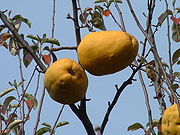
12–17 cm long with five carpels; it gives off an intense, sweet smell and it ripens in late autumn.
Uses
The fruit is hard and astringent, though it does soften and becomes less astringent ("bletted") after frostFrost
Frost is the solid deposition of water vapor from saturated air. It is formed when solid surfaces are cooled to below the dew point of the adjacent air as well as below the freezing point of water. Frost crystals' size differ depending on time and water vapour available. Frost is also usually...
. It can be used in the same way as quince
Quince
The quince , or Cydonia oblonga, is the sole member of the genus Cydonia and native to warm-temperate southwest Asia in the Caucasus region...
s for making jam. It is also grown as an ornamental tree
Ornamental plant
Ornamental plants are plants that are grown for decorative purposes in gardens and landscape design projects, as house plants, for cut flowers and specimen display...
in southern Europe.
See also
- ChaenomelesChaenomelesChaenomeles is a genus of three species of deciduous spiny shrubs, usually 1–3 m tall, in the family Rosaceae. They are native to eastern Asia in Japan, China and Korea...
- QuinceQuinceThe quince , or Cydonia oblonga, is the sole member of the genus Cydonia and native to warm-temperate southwest Asia in the Caucasus region...
(i.e. Cydonia) - Carica papaya, also called mugua