


Protonated molecular hydrogen

Encyclopedia
Ion
An ion is an atom or molecule in which the total number of electrons is not equal to the total number of protons, giving it a net positive or negative electrical charge. The name was given by physicist Michael Faraday for the substances that allow a current to pass between electrodes in a...
s in the universe. It is stable in the interstellar medium
Interstellar medium
In astronomy, the interstellar medium is the matter that exists in the space between the star systems in a galaxy. This matter includes gas in ionic, atomic, and molecular form, dust, and cosmic rays. It fills interstellar space and blends smoothly into the surrounding intergalactic space...
(ISM) due to the low temperature and low density of interstellar space. The role that H3+ plays in the gas-phase chemistry of the ISM is unparalleled by any other molecular ion. The cation is also the simplest triatomic molecule, since its two electrons are the only valence electrons in the system. It is also the simplest example of a three-center two-electron bond
Three-center two-electron bond
A three-center two-electron bond is an electron-deficient chemical bond where three atoms share two electrons. The combination of three atomic orbitals form three molecular orbitals: one bonding, one non-bonding, and one anti-bonding. The two electrons go into the bonding orbital, resulting in a...
system.
History
H3+ was first discovered by J.J. Thomson in 1911. While studying the resultant species of plasmaPlasma (physics)
In physics and chemistry, plasma is a state of matter similar to gas in which a certain portion of the particles are ionized. Heating a gas may ionize its molecules or atoms , thus turning it into a plasma, which contains charged particles: positive ions and negative electrons or ions...
discharges, he discovered something very odd. Using an early form of mass spectrometry
Mass spectrometry
Mass spectrometry is an analytical technique that measures the mass-to-charge ratio of charged particles.It is used for determining masses of particles, for determining the elemental composition of a sample or molecule, and for elucidating the chemical structures of molecules, such as peptides and...
, he discovered a large abundance of a molecular ion with a mass-to-charge ratio
Mass-to-charge ratio
The mass-to-charge ratio ratio is a physical quantity that is widely used in the electrodynamics of charged particles, e.g. in electron optics and ion optics. It appears in the scientific fields of lithography, electron microscopy, cathode ray tubes, accelerator physics, nuclear physics, Auger...
of 3. He stated that the only two possibilities were C4+ or H3+. Since C4+ would be very unlikely and the signal grew stronger in pure hydrogen
Hydrogen
Hydrogen is the chemical element with atomic number 1. It is represented by the symbol H. With an average atomic weight of , hydrogen is the lightest and most abundant chemical element, constituting roughly 75% of the Universe's chemical elemental mass. Stars in the main sequence are mainly...
gas, he correctly assigned the species as H3+.
The formation pathway was discovered by Hogness & Lunn in 1925. They also used an early form of mass spectrometry to study hydrogen discharges. They found that as the pressure of hydrogen increased, the amount of H3+ increased linearly and the amount of H2+ decreased linearly. In addition, there was little H+ at any pressure. This data suggested the proton
Proton
The proton is a subatomic particle with the symbol or and a positive electric charge of 1 elementary charge. One or more protons are present in the nucleus of each atom, along with neutrons. The number of protons in each atom is its atomic number....
exchange formation pathway discussed below.
In 1961, Martin et al. first suggested that H3+ may be present in interstellar space given the large amount of hydrogen in interstellar space and its reaction pathway was exothermic
Exothermic
In thermodynamics, the term exothermic describes a process or reaction that releases energy from the system, usually in the form of heat, but also in the form of light , electricity , or sound...
(~1.5 eV
Electronvolt
In physics, the electron volt is a unit of energy equal to approximately joule . By definition, it is equal to the amount of kinetic energy gained by a single unbound electron when it accelerates through an electric potential difference of one volt...
). This led to the suggestion of Watson and Herbst & Klemperer in 1973 that H3+ is responsible for the formation of many observed molecular ions.
It was not until 1980 that the first spectrum of H3+ was discovered by Takeshi Oka, which was of the ν2 fundamental band using a technique called frequency modulation
Frequency modulation
In telecommunications and signal processing, frequency modulation conveys information over a carrier wave by varying its instantaneous frequency. This contrasts with amplitude modulation, in which the amplitude of the carrier is varied while its frequency remains constant...
detection. This started the search for interstellar H3+. Emission lines were detected in the late 1980s and early 1990s in the ionosphere
Ionosphere
The ionosphere is a part of the upper atmosphere, comprising portions of the mesosphere, thermosphere and exosphere, distinguished because it is ionized by solar radiation. It plays an important part in atmospheric electricity and forms the inner edge of the magnetosphere...
s of Jupiter
Jupiter
Jupiter is the fifth planet from the Sun and the largest planet within the Solar System. It is a gas giant with mass one-thousandth that of the Sun but is two and a half times the mass of all the other planets in our Solar System combined. Jupiter is classified as a gas giant along with Saturn,...
, Saturn
Saturn
Saturn is the sixth planet from the Sun and the second largest planet in the Solar System, after Jupiter. Saturn is named after the Roman god Saturn, equated to the Greek Cronus , the Babylonian Ninurta and the Hindu Shani. Saturn's astronomical symbol represents the Roman god's sickle.Saturn,...
, and Uranus
Uranus
Uranus is the seventh planet from the Sun. It has the third-largest planetary radius and fourth-largest planetary mass in the Solar System. It is named after the ancient Greek deity of the sky Uranus , the father of Cronus and grandfather of Zeus...
. In 1996, H3+ was finally detected in the ISM by Geballe & Oka in two molecular interstellar clouds in the sightlines GL2136 and W33A. In 1998, H3+ was unexpectedly detected by McCall et al. in a diffuse interstellar cloud in the sightline Cyg OB2 No. 12.
Structure
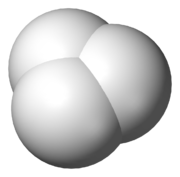
The arrangement of the hydrogen atoms in the molecule is an equilateral triangle. The molecule has a resonance structure which represents a three-centre, two-electron bond. The strength of the bond has been calculated to be around 4.5 eVElectronvolt
In physics, the electron volt is a unit of energy equal to approximately joule . By definition, it is equal to the amount of kinetic energy gained by a single unbound electron when it accelerates through an electric potential difference of one volt...
(104 kcal per mole). This molecule is a good example which illustrates the importance of electron pair delocalization which contributes to the stability of molecules.
Formation
The information for this section was from a paper by Eric Herbst. The main pathway for the production of H3+ is by the reaction of H2+ and H2.- H2+ + H2 → H3+ + H
The concentration of H2+ is what limits this reaction. H3+ can only be produced in interstellar space by a cosmic ray
Cosmic ray
Cosmic rays are energetic charged subatomic particles, originating from outer space. They may produce secondary particles that penetrate the Earth's atmosphere and surface. The term ray is historical as cosmic rays were thought to be electromagnetic radiation...
ionizing H2.
- H2 + cosmic ray → H2+ + e- + cosmic ray
However, the cosmic ray has so much energy, it is almost unaffected by the relatively small energy required to ionize an H2 molecule. In interstellar clouds, cosmic rays leave behind a trail of H2+, and therefore H3+. In laboratories, H3+ is produced by the same mechanism in plasma discharge cells, with the discharge potential providing the energy to ionize the H2.
Destruction
The information for this section was also from a paper by Eric Herbst. There are many destruction reactions for H3+. The dominant destruction pathway in dense interstellar clouds is by proton transfer with a neutral collision partner. The most likely candidate for a destructive collision partner is the second most abundant molecule in space, COCarbon monoxide
Carbon monoxide , also called carbonous oxide, is a colorless, odorless, and tasteless gas that is slightly lighter than air. It is highly toxic to humans and animals in higher quantities, although it is also produced in normal animal metabolism in low quantities, and is thought to have some normal...
.
- H3+ + CO → HCO+ + H2
The significant product of this reaction is HCO+, an important molecule for interstellar chemistry. Its strong dipole
Dipole
In physics, there are several kinds of dipoles:*An electric dipole is a separation of positive and negative charges. The simplest example of this is a pair of electric charges of equal magnitude but opposite sign, separated by some distance. A permanent electric dipole is called an electret.*A...
and high abundance make it easily detectable by radioastronomy. H3+ can also react with atomic oxygen
Oxygen
Oxygen is the element with atomic number 8 and represented by the symbol O. Its name derives from the Greek roots ὀξύς and -γενής , because at the time of naming, it was mistakenly thought that all acids required oxygen in their composition...
to form OH+ and H2.
- H3+ + O → OH+ + H2
OH+ then usually reacts with more H2 to create further hydrogenated molecules.
- OH+ + H2 → OH2+ + H
- OH2+ + H2 → OH3+ + H
At this point, the reaction between OH3+ and H2 is no longer exothermic in interstellar clouds. The most common destruction pathway for OH3+ is dissociative recombination
Dissociative recombination
Dissociative recombination is a process where a positive molecular ion recombines with an electron, and as a result, the neutral molecule dissociates. This reaction is important for extraterrestrial and atmospheric chemistry. On Earth, dissociative recombination is practically non-existent, as...
, yielding four possible sets of products: H2O + H, OH + H2, OH + 2H, and O + H2 + H. While water
Water
Water is a chemical substance with the chemical formula H2O. A water molecule contains one oxygen and two hydrogen atoms connected by covalent bonds. Water is a liquid at ambient conditions, but it often co-exists on Earth with its solid state, ice, and gaseous state . Water also exists in a...
is a possible product of this reaction, it is not a very efficient product. Different experiments have suggested that water is created anywhere from 5–33% of the time. Water formation on grains
Cosmic dust
Cosmic dust is a type of dust composed of particles in space which are a few molecules to 0.1 µm in size. Cosmic dust can be further distinguished by its astronomical location; for example: intergalactic dust, interstellar dust, interplanetary dust and circumplanetary dust .In our own Solar...
is still considered the primary source of water in the interstellar medium.
The most common destruction pathway of H3+ in diffuse interstellar clouds is dissociative recombination. This reaction has multiple products. The major product is dissociation into three hydrogen atoms, which occurs roughly 75% of the time. The minor product is H2 and H, which occurs roughly 25% of the time.
Ortho/Para-H3+
The most abundant molecule in dense interstellar clouds is H2. When a H3+ molecule collides with H2, stoichometrically there is no net yield. However, a proton transfer still can take place, which can potentially change the total nuclear spinSpin (physics)
In quantum mechanics and particle physics, spin is a fundamental characteristic property of elementary particles, composite particles , and atomic nuclei.It is worth noting that the intrinsic property of subatomic particles called spin and discussed in this article, is related in some small ways,...
of the two molecules depending on the nuclear spins of the protons. Two different spin configurations for H3+ are possible, called ortho and para. Ortho-H3+ has all three proton spins parallel, yielding a total nuclear spin of 3/2. Para-H3+ has two proton spins parallel while the other is anti-parallel, yielding a total nuclear spin of 1/2. Similarly, H2 also has ortho and para states
Spin isomers of hydrogen
Molecular hydrogen occurs in two isomeric forms, one with its two proton spins aligned parallel , the other with its two proton spins aligned antiparallel...
, with ortho-H2 having a total nuclear spin 1 and para-H2 having a total nuclear spin of 0. When an ortho-H3+ and a para-H2 collide, the transferred proton changes the total spins of the molecules, yielding instead a para-H3+ and an ortho-H2.
Spectroscopy
The spectroscopySpectroscopy
Spectroscopy is the study of the interaction between matter and radiated energy. Historically, spectroscopy originated through the study of visible light dispersed according to its wavelength, e.g., by a prism. Later the concept was expanded greatly to comprise any interaction with radiative...
of H3+ is challenging. Due to its lack of a permanent dipole moment, pure rotational spectroscopy
Rotational spectroscopy
Rotational spectroscopy or microwave spectroscopy studies the absorption and emission of electromagnetic radiation by molecules associated with a corresponding change in the rotational quantum number of the molecule...
of H3+ is impossible. Ultraviolet light is too energetic and would dissociate the molecule. Rovibronic spectroscopy provides the ability to observe H3+. Rovibronic spectroscopy is possible with H3+ because one of the vibrational modes
Normal mode
A normal mode of an oscillating system is a pattern of motion in which all parts of the system move sinusoidally with the same frequency and with a fixed phase relation. The frequencies of the normal modes of a system are known as its natural frequencies or resonant frequencies...
of H3+, the ν2 asymmetric bend mode, has a weak dipole moment. Since Oka's initial spectrum, over 900 absorption lines have been detected in the infrared region. H3+ emission lines have also been found by observing the atmospheres of the Jovian planets. H3+ emission lines are found by observing molecular hydrogen and finding a line that cannot be attributed to molecular hydrogen.
Astronomical detection
H3+ has been detected in two types of celestial environments: Jovian planets and interstellar clouds. In Jovian planets, it has been detected in the planet’s ionospheres, the region where the Sun’s high energy radiation ionizes the particles in the atmosphere. Since there is a high level of H2 in these atmospheres, this radiation can produce a significant amount of H3+. Also, with a broadband source like the Sun, there is plenty of radiation to pump the H3+ to higher energy states from which it can relax by stimulated and spontaneous emission.Planetary atmospheres
The detection of the first H3+ emission lines was reported in 1989 by Drossart et al., found in the ionosphere of Jupiter. Drossart found a total of 23 H3+ lines with a column density of 1.39 109/cm2. Using these lines, they were able to assign a temperature of the H3+ of ~1100 K (826.9 °C), which is comparable to temperatures determined from emission lines of other species like H2. In 1993, H3+ was found in Saturn by Geballe et al. and in Uranus by Trafton et al.Molecular interstellar clouds
H3+ was not detected in the interstellar medium until 1996, when Geballe & Oka reported the detection of H3+ in two molecular cloud sightlines, GL2136 and W33A. Both sources had temperatures of H3+ of about 35 K (-238 °C) and column densities of about 1014/cm2. Since then, H3+ has been detected in numerous other molecular cloud sightlines, such as AFGL 2136, Mon R2 IRS 3, GCS 3-2, GC IRS 3, and LkHα 101.Diffuse interstellar clouds
Unexpectedly, three H3+ lines were detected in 1998 by McCall et al. in the diffuse cloud sightline of Cyg OB2 No. 12. Before 1998, the density of H2 was thought to be too low to produce a detectable amount of H3+. McCall detected a temperature of ~27 K (-246 °C) and a column density of ~ 1014/cm2, the same column density as Geballe & Oka. Since then, H3+ has been detected in many other diffuse cloud sightlines, such as GCS 3-2, GC IRS 3, and ζ Persei.Steady-state model predictions
To approximate the pathlength of H3+ in these clouds, Oka used the steady-state model to determine the predicted number densities in diffuse and dense clouds. As explained above, both diffuse and dense clouds have the same formation mechanism for H3+, but different dominating destruction mechanisms. In dense clouds, proton transfer with CO is the dominating destruction mechanism. This corresponds to a predicted number density of 10−4 cm−3 in dense clouds.- n(H3+) = (ζ / kCO)[n(H2) / n(CO)] ≈ 10−4/cm3
- n(H3+) = (ζ / ke)[n(H2) / n(C+)] ≈ 10−6/cm3
In diffuse clouds, the dominating destruction mechanism is dissociative recombination. This corresponds to a predicted number density of 10−6/cm3 in diffuse clouds. Therefore, since column densities for diffuse and dense clouds are roughly the same order of magnitude, diffuse clouds must have a pathlength 100 times greater than that for dense clouds. Therefore, by using H3+ as a probe of these clouds, their relative sizes can be determined.