
In Depth
See Also

Normal mode

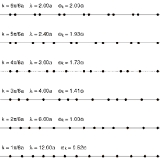
A normal mode in an oscillating system is the frequency at which a deformable structure will oscillate when disturbed. Normal modes are also known as natural frequencies or resonant frequencies. There is a set of these frequencies that are unique to each structure. It is common to use a spring-mass system to illustrate a deformable structure. When such a system is excited at one of these natural frequencies, all of the masses move at the same frequency. The phases of the masses are either exactly the same or exactly opposite. The practial significance of this can be illustrated by a mass-spring model of a building.

Discussions

  Discussion Features

   Ask a question about 'Normal mode'

   Start a new discussion about 'Normal mode'

   Answer questions about 'Normal mode'

   'Normal mode' discussion forum


Encyclopedia


A normal mode in an oscillating system is the frequency at which a deformable structure will oscillate when disturbed. Normal modes are also known as natural frequencies or resonant frequencies. There is a set of these frequencies that are unique to each structure.

It is common to use a spring-mass system to illustrate a deformable structure. When such a system is excited at one of these natural frequencies, all of the masses move at the same frequency. The phases of the masses are either exactly the same or exactly opposite. The practial significance of this can be illustrated by a mass-spring model of a building. If an earthquake excites the system near one of the natural frequencies, the displacement of one floor with respect to another will be maximum. Obviously, buildings can only withstand this displacement up to a certain point. Being able to model a building and find its normal modes is an easy way to check the safety of a building's design. The concept of normal modes also finds application in wave theory Wave

[i], often transferring [[energy]... 

, optics Optics

Optics is a branch of physics [i] that describes the behavior and properties of light [i] and the inter ... 

 and quantum mechanics Quantum mechanics

Quantum mechanics is a first quantized [i] quantum theory [i] that supersedes classical mechanics [i] ... 

.

Example - normal modes of coupled oscillators


Consider two bodies , each of mass Mass

Mass is a property of a physical [i] object that quantifies the amount of matter [i] and energy [i] ... 

 M, attached to three springs with stiffness K. They are attached in the following manner:


where the edge points are fixed and cannot move. We'll use x1 to denote the displacement of the leftmost mass, and x2 to denote the displacement of the rightmost.

If we denote the second derivative Derivative

In mathematics [i], the derivative is defined as the instantaneous rate of change of a function [i] ... 

 of x with respect to time as x″, the equations of motion are:

Since we expect oscillatory motion, we try:

Substituting these into the equations of motion gives us:

Since the exponential factor is common to all terms, we omit it and simplify:

And in matrix representation:

For this equation to have a non-trivial solution, the determinant of the matrix on the left must be equal to 0, so:

Solving for , we have:

If we substitute into the matrix and solve for , we get . If we substitute , we get
.

The first normal mode is:

and the second normal mode is:

The general solution is a superposition of the normal modes where c1, c2, φ1, and φ2, are determined by the initial conditions of the problem.

The process demonstrated here can be generalized and formulated using the formalism of Lagrangian mechanics or Hamiltonian mechanics.

Standing waves


A standing wave Standing wave

A standing wave, also known as a stationary wave, is a wave [i] that remains in a constant position.... 

 is a continuous form of normal mode. In a standing wave, all the space elements are oscillating in the same frequency Frequency

[i] of the number of times that a repeated event occurs per unit of [[time]... 

 and in phase , but each has a different amplitude.


The general form of a standing wave is:

where f represents the dependence of amplitude on location and the cosine\sine are the oscillations in time.

Physically, standing waves are formed by the interference Interference

Interference is the superposition [i] of two or more wave [i]s resulting in a ne ... 

  of waves and their reflections . The geometric shape of the medium determines what would be the interference pattern, thus determines the f form of the standing wave. This space-dependence is called a normal mode.

Usually, for problems with continuous dependence on there is no single or finite number of normal mode, but there are infinitely many normal modes. If the problem is bounded there are countably many  normal modes . If the problem is not bounded, there is a continuous spectrum Spectrum

A spectrum is a condition or value that is not limited to a specific set of values but can vary infinel... 

 of normal modes.

The allowed frequencies are dependent on the normal modes, as well on physical constants of the problem which sets the phase velocity of the wave. The range of all possible normal frequencies is called the frequency spectrum Frequency spectrum

Familiar concepts associated with a frequency [i] are colors, musical notes, radio/TV channels, and even the r ... 

. Usually, each frequency is modulated by the amplitude at which it has arisen, creating a graph of the power spectrum Spectral density

In applied mathematics [i] and physics [i], the spectral density, power spectral density, or en... 

 of the oscillations.

When relating to music Music

Music is an art, entertainment [i], or other human activity that involves organized and audible sounds a ... 

, normal modes of a vibrating instruments are called "harmonics".

Normal modes in quantum mechanics


In quantum mechanics Quantum mechanics

Quantum mechanics is a first quantized [i] quantum theory [i] that supersedes classical mechanics [i] ... 

, a state of a system is described by a wavefunction which solves the Schrödinger equation. The square of the absolute value of ,i.e.

is the probability  to measure the particle in place Distance

Distance is a numerical description of how far apart things lie.... 

 x at time Time

Two distinct views exist on the meaning of time.... 

 t.

Usually, when involving some sort of potential, the wavefunction is decomposed into a superposition of energy eigenstate Eigenstate

Sorry, no overview for this topic 

s, each oscillating with frequency of . Thus, we may write

The eigenstates have a physical meaning further than an orthonormal basis. When the energy of the system is measured, the wavefunction collapses into one of its eigenstates and so the particle wavefunction is described by the pure eigenstate corresponding to the measured energy Energy

In general, the concept [i] of energy refers to "the potential for causing changes." The word is used in ... 

.

See also


  • Physical applications:
    • Wave Wave

      [i], often transferring [[energy]... 

      s
    • Optics Optics

      Optics is a branch of physics [i] that describes the behavior and properties of light [i] and the inter ... 

    • harmonic oscillator Harmonic oscillator

      In classical mechanics [i], a Harmonic oscillator is a system which, when displaced from its equilibrium ... 

    • vibrational spectroscopy
    • quantum theory
      • Schrödinger equation
      • Wavefunction
      • Measurement in quantum mechanics
    • harmonic series
  • Mathematical tools:
    • linear algebra
    • eigenvectors Eigenvalue, eigenvector and eigenspace

      In mathematics [i], an of a transformation [i]In this context, only linear transformation [i] ... 

    • differential equation Differential equation

      In mathematics [i], a differential equation is an equation [i] in which the derivative [i]s of a function [i]... 

      s
    • Fourier analysis
    • Sturm-Liouville theory
    • Boundary value problem Boundary value problem

      In mathematics [i], a boundary value problem consists of a differential equation [i] and the initial or ... 


External links


  • .
  • Java simulation of the normal modes of a , , and .