
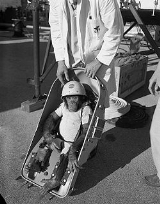
Ham (July 1956 – January 19, 1983), also known as
Ham the Chimp and
Ham the Astrochimp, was the first hominid launched into
outer spaceOuter space is the void that exists beyond any celestial body including the Earth. It is not completely empty , but contains a low density of particles, predominantly hydrogen plasma, as well as electromagnetic radiation, magnetic fields, and neutrinos...
. Ham's name is an acronym for the lab that prepared him for his historic mission — the
Holloman
Aerospace
Medical Center, located at
Holloman Air Force BaseHolloman Air Force Base is a United States Air Force base located six miles southwest of the central business district of Alamogordo, a city in Otero County, New Mexico, United States. The base was named in honor of Col. George V. Holloman, a pioneer in guided missile research. It is the home of...
in
New MexicoNew Mexico is a state located in the southwestern region of the United States. With a population density of 16 per square mile, New Mexico is the sixth- most sparsely inhabited U.S. state....
.
Early life
Ham was born July 1956 in
CameroonThe Republic of Cameroon is a country of central and western Africa. It is bordered by Nigeria to the west; Chad to the northeast; the Central African Republic to the east; and Equatorial Guinea, Gabon, and the Republic of the Congo to the south. Cameroon's coastline lies on the Bight of Bonny,...
, captured by animal trappers and sent to Rare Bird Farm in Miami,
FloridaThe state of Florida is located in the southeastern region of the United States, bordering Alabama to the northwest and Georgia to the north. It was the 27th state admitted to the United States...
. He was purchased by the
United States Air ForceThe United States Air Force is the aerial warfare, space warfare, and cyberwarfare service branch of the United States armed forces and one of the American uniformed services. Initially part of the United States Army, the USAF was formed as a separate branch of the military on September 18, 1947...
and brought to
Holloman Air Force BaseHolloman Air Force Base is a United States Air Force base located six miles southwest of the central business district of Alamogordo, a city in Otero County, New Mexico, United States. The base was named in honor of Col. George V. Holloman, a pioneer in guided missile research. It is the home of...
in 1959.
There were originally 40
chimpanzeeChimpanzee, sometimes colloquially chimp, is the common name for the two extant species of ape in the genus Pan. The Congo River forms the boundary between the native habitat of the two species:...
flight candidates at Holloman. After evaluation the number of candidates was reduced to 18, then to 6 including Ham. Officially, Ham was known as #65 before his flight, and only renamed "Ham" upon his successful return to earth. This was reportedly because officials did not want the bad press that would come from the death of a "named" chimpanzee if the mission were a failure. Among his handlers, #65 had been known as
Chop Chop Chang.
Training and mission
Beginning in July 1959, the two-year-old
chimpanzeeChimpanzee, sometimes colloquially chimp, is the common name for the two extant species of ape in the genus Pan. The Congo River forms the boundary between the native habitat of the two species:...
was trained at the
Holloman Air Force BaseHolloman Air Force Base is a United States Air Force base located six miles southwest of the central business district of Alamogordo, a city in Otero County, New Mexico, United States. The base was named in honor of Col. George V. Holloman, a pioneer in guided missile research. It is the home of...
Aero Medical Field Laboratory to do simple, timed tasks in response to electric lights and sounds.
In his pre-flight training, Ham was taught to push a lever within five seconds of seeing a flashing blue light; failure to do so would result in an application of positive punishment in the form of a mild
electric shockAn electric shock occurs upon contact of a human body with any source of voltage high enough to cause sufficient current through the skin, muscles or hair. The minimum current a human can feel is thought to be about 1 milliampere ....
to the soles of his feet, while a correct response earned him a banana pellet.
What differentiates Ham's mission from all the other primate flights to this point is that he was not merely a passenger, and the results from his test flight led directly to the mission
Alan ShepardAlan Bartlett Shepard, Jr. was an American naval aviator and astronaut who became second person, and the first American, in space. Ten years later, he commanded the Apollo 14 mission, and was the fifth person to walk on the moon.-Naval career:Shepard was born in East Derry, New Hampshire, to Lt...
would make on May 5, 1961 aboard the
Freedom 7Mercury-Redstone 3 was a U.S. Mercury program human crewed space mission launched on May 5, 1961 using a Redstone rocket, from Launch Complex 5 at Cape Canaveral, Florida. The Mercury spacecraft was named Freedom 7 which performed a suborbital flight piloted by astronaut Alan Shepard, who became...
.
On January 31, 1961, Ham was secured in a
Project MercuryProject Mercury was the first human spaceflight program of the United States. It ran from 1959 through 1963 with the goal of putting a human in orbit around the Earth. The Mercury-Atlas 6 flight on February 20, 1962, was the first Mercury flight to achieve this goal...
capsule labeled
MR-2Mercury-Redstone 2 was a rocket mission, launched at 16:55 UTC on January 31, 1961 from LC-5 at Cape Canaveral, Florida. Mercury spacecraft # 5 carried Ham the Chimp as a passenger on a suborbital space flight launched on Redstone MRLV-2.-Background:...
and launched from
Cape Canaveral, FloridaCape Canaveral is a city in Brevard County, Florida, United States. The population was 8,829 at the 2000 census. As of 2008, the estimated population according to the U.S. Census Bureau was 10,147...
, into outer space.
Ham had his vital signs and tasks monitored using computers back on
EarthEarth is the third planet from the Sun, and the densest and fifth-largest of the eight planets in the Solar System. It is also the largest of the Solar System's four terrestrial planets...
. The capsule suffered a partial loss of pressure during the flight, but Ham's
space suitA space suit is a complex system of garments, equipment and environmental systems designed to keep a person alive and comfortable in the harsh environment of outer space...
prevented him from suffering any harm. Ham's lever-pushing performance in space was only a fraction of a second slower than on Earth, demonstrating that tasks could be performed in space. Ham's capsule splashed down in the
Atlantic OceanThe Atlantic Ocean is the second-largest of the world's oceanic divisions. With a total area of about , it covers approximately twenty percent of the Earth's surface and about twenty-six percent of its water surface area...
and was recovered by a rescue ship later that day. He only suffered a bruised nose. His flight was 16 minutes and 39 seconds long.
Ten months later, another chimp, named
EnosEnos was a chimpanzee that was launched into space.Enos was purchased from the Miami Rare Bird Farm in April 3, 1960. He completed more than 1,250 hours of training for his mission at the University of Kentucky and Holloman Air Force Base...
, successfully orbited the earth. This was several months after Soviet cosmonaut
Yuri Gagarin'sYuri Alekseyevich Gagarin , Hero of the Soviet Union, was a Soviet cosmonaut. On 12 April 1961, he became the first human in outer space and the first to orbit the Earth...
orbital flight and
ShepardAlan Bartlett Shepard, Jr. was an American naval aviator and astronaut who became second person, and the first American, in space. Ten years later, he commanded the Apollo 14 mission, and was the fifth person to walk on the moon.-Naval career:Shepard was born in East Derry, New Hampshire, to Lt...
and Grissom's suborbital flights, but before US astronaut
John GlennJohn Herschel Glenn, Jr. is a retired United States Marine Corps pilot, a former astronaut and United States senator who was the first American and third person to orbit the Earth. Glenn was a Marine Corps fighter pilot before joining NASA's Mercury program as a member of NASA's original astronaut...
's orbital flight aboard Mercury's
Friendship 7Mercury-Atlas 6 was a human spaceflight mission conducted by NASA, the space agency of the United States. As part of Project Mercury, MA-6 was the successful first attempt by NASA to place an astronaut into orbit. The MA-6 mission was launched February 20, 1962...
.
Later life
After the flight, Ham lived for 17 years in the
National ZooThe Smithsonian National Zoological Park, commonly known as the National Zoo, is one of the oldest zoos in the country, and as part of the Smithsonian Institution, does not charge admission. Founded in 1889, its mission is to provide leadership in animal care, science, education, sustainability and...
in
Washington, D.C.Washington, D.C. , formally the District of Columbia and commonly referred to as Washington, the District, or simply D.C., is the capital of the United States, founded on July 16, 1790...
, then at the
North Carolina ZooThe North Carolina Zoo is located in Asheboro in Randolph County, North Carolina in the Uwharrie Mountains near the geographic center of the state, approximately 75 miles west of Raleigh, NC, United States. At , it is the largest "walk-through" natural-habitat zoo in the world, the first in the...
before his death at the age of 26 on
January 19, 1983.
Ham appeared repeatedly on television, as well as on film with
Evel KnievelRobert Craig Knievel , better known as Evel Knievel , was an American motorcycle daredevil and entertainer famous in the United States and elsewhere between the late 1960s and early 1980s...
.
After his death, Ham's body was turned over to the Armed Forces Institute of Pathology for necropsy. It was decided that the AFIP would retain Ham's skeleton for further study, and his body was cleaned of soft tissue by lengthy placement in the Dermestid beetle colony at the Smithsonian. Whatever remained, minus the skeleton, was transported to the International Space Hall of Fame in Alamogordo, NM, and buried. The grave is marked by a memorial plaque. Interestingly, the "Animals in Space" section on the official NASA history website disingenuously states that "Upon his death on January 17, 1983, Ham's body was preserved and loaned by the Smithsonian Institution to the International Space Hall of Fame in Alamogordo, New Mexico," though Ham's skeleton resides in the AFIP's National Museum of Health and Medicine where he is kept and cared for alongside the skeletal remains of Civil War soldiers.
Ham's backup, Minnie, was the only female chimp trained for the Mercury program. After her role in the Mercury program ended, Minnie became part of an Air Force chimpanzee breeding program, producing nine offspring and helping to raise the offspring of several other members of the chimpanzee colony. The last surviving astro-chimp, she died at age 41 on March 14, 1998.
- A 2008 animated film entitled Space Chimps
Space Chimps is a 2008 computer-animated family comedy film produced by Vanguard Animation, Starz Media and 20th Century Fox, and it was released on July 18, 2008. The film is produced by Barry Sonnenfeld, John H. Williams, and John W. Hyde and stars the voices of Andy Samberg, Jeff Daniels, Cheryl...
was a movie about sending chimps to space. The main character and hero of the movie was named Ham III, the grandson of Ham.
- In 2008, Bark Hide & Horn, a folk-rock band from Portland, Oregon, released a song titled, "Ham the Astrochimp," detailing the journey of Ham from his perspective.
- In 2000, in the film Space Cowboys
Space Cowboys is a 2000 adventure/comedy film directed by Clint Eastwood. Eastwood also stars in the film alongside Tommy Lee Jones, Donald Sutherland, and James Garner as four older "ex-test pilots" who are sent into space to repair an old Soviet satellite...
, the main characters Frank Corvin (Clint EastwoodClinton "Clint" Eastwood is an American film actor, director, producer and composer. He has received five Academy Awards, five Golden Globe Awards, a Screen Actors Guild Life Achievement Award, two Cannes Film Festival awards, and five People's Choice Awards — including one for Favorite All-Time...
), Hawk Hawkins (Tommy Lee JonesTommy Lee Jones is an American actor and director.His film roles include federal marshal Samuel Gerard in The Fugitive and U.S. Marshals, the villain "Two-Face" in Batman Forever, terrorist William Strannix in Under Siege, Agent K in the Men in Black films, Western police officers Woodrow F...
) and their team Daedalus of the U.S. Air Force are replaced by a chimpanzee named Marianne for the new civilian organization (NASAThe National Aeronautics and Space Administration is an Executive Branch agency of the United States government, responsible for the nation's civilian space program and aeronautics and aerospace research...
) to take control of the new external atmosphere exploration program. The film mentions that the chimp became the first American to cross into outer space.
- A 2001 film entitled Race to Space
Race to Space is an American family/drama film. The film was shot on location at Cape Canaveral and Cocoa Beach and Edwards AFB CA in cooperation with NASA and the U.S. Air Force.-Plot:...
, was a fictionalized version of Ham's story about sending chimps to space. The chimpanzee in the movie was named Mac.
See also
- Animals in space
Animals in space originally only served to test the survivability of spaceflight, before manned space missions were attempted. Later, animals were also flown to investigate various biological processes and the effects microgravity and space flight might have on them...
- Monkeys in space
Before humans went into space, several animals were launched into orbit, including numerous monkeys, so that scientists could investigate the biological effects of space travel. The United States launched flights containing primate cargo primarily between 1948-1961 with one flight in 1969 and one...
- One Small Step: The Story of the Space Chimps
One Small Step: The Story of the Space Chimps is a documentary film produced and directed by David Cassidy and Kristin Davy which aired on History Channel UK and CBC Television. The film chronicles the real story behind the early use of chimpanzees in space exploration. The film was released on DVD...
Further reading
Brief biography of Ham, aimed at children ages 9–12
A novel about Ham and his trainer.
- Burgess, Colin
Colin Burgess is an Australian author and historian, specializing in space flight and military history. He is a former customer service manager for Qantas Airways, and a regular contributor to the collectSPACE online community. He lives in New South Wales...
; Dubbs, Chris. Animals in Space: From Research Rockets to the Space Shuttle. Springer-Praxis Books, ISBN 9780387360539. Book covering the life and flight of Ham, plus other space animals.
External links