

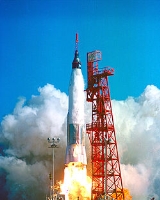
Atlas LV-3B

Encyclopedia
The Atlas LV-3B, Atlas D Mercury Launch Vehicle or Mercury-Atlas Launch Vehicle, was a man-rated expendable launch system used as part of the United States
Project Mercury
to send astronaut
s into low Earth orbit
. It was derived from the SM-65D Atlas
missile, and was a member of the Atlas family of rockets
. It first flew on 29 July 1960, conducting the suborbital Mercury-Atlas 1
test flight. The rocket suffered a structural failure shortly after launch, and as a result failed to place the spacecraft onto its intended trajectory.
Nine LV-3Bs were launched, two on unmanned suborbital test flights, three on unmanned orbital test flights, and four with manned
Mercury spacecraft. In addition to the maiden flight, the first orbital launch, Mercury-Atlas 3
also failed. This failure was due to a problem with the guidance system failing to execute pitch and roll commands, necessitating that the Range Safety Officer
destroy the vehicle. The spacecraft separated by means of its launch escape system
and was recovered 1.8 kilometres (1.1 mi) from the launch pad.
Atlas LV-3B launches were conducted from Launch Complex 14
at the Cape Canaveral Air Force Station
, Florida.
A further series of Mercury launches were planned, which would have used additional LV-3Bs; however these flights were canceled after the success of the initial Mercury missions.
The last LV-3B launch was conducted on 15 May 1963.
United States
The United States of America is a federal constitutional republic comprising fifty states and a federal district...
Project Mercury
Project Mercury
In January 1960 NASA awarded Western Electric Company a contract for the Mercury tracking network. The value of the contract was over $33 million. Also in January, McDonnell delivered the first production-type Mercury spacecraft, less than a year after award of the formal contract. On February 12,...
to send astronaut
Astronaut
An astronaut or cosmonaut is a person trained by a human spaceflight program to command, pilot, or serve as a crew member of a spacecraft....
s into low Earth orbit
Low Earth orbit
A low Earth orbit is generally defined as an orbit within the locus extending from the Earth’s surface up to an altitude of 2,000 km...
. It was derived from the SM-65D Atlas
SM-65D Atlas
The SM-65D Atlas, or Atlas D, was the first operational version of the U.S. Atlas missile. It first flew on April 14, 1959. Atlas D missiles were also used for orbital launches, both with upper stages and on their own as a stage-and-a-half vehicle....
missile, and was a member of the Atlas family of rockets
Atlas (rocket family)
Atlas is a family of U.S. space launch vehicles. The original Atlas missile was designed in the late 1950s and produced by the Convair Division of General Dynamics, to be used as an intercontinental ballistic missile...
. It first flew on 29 July 1960, conducting the suborbital Mercury-Atlas 1
Mercury-Atlas 1
Mercury-Atlas 1 was launched at 13:13 UTC on July 29, 1960 from Cape Canaveral, Florida. The Mercury spacecraft was unmanned and carried no launch escape system. The mission was to conduct a suborbital test flight and reentry of the spacecraft...
test flight. The rocket suffered a structural failure shortly after launch, and as a result failed to place the spacecraft onto its intended trajectory.
Nine LV-3Bs were launched, two on unmanned suborbital test flights, three on unmanned orbital test flights, and four with manned
Human spaceflight
Human spaceflight is spaceflight with humans on the spacecraft. When a spacecraft is manned, it can be piloted directly, as opposed to machine or robotic space probes and remotely-controlled satellites....
Mercury spacecraft. In addition to the maiden flight, the first orbital launch, Mercury-Atlas 3
Mercury-Atlas 3
Mercury-Atlas 3 was launched unmanned on April 25, 1961 at 16:15 UTC, from Launch Complex 14 at Cape Canaveral, Florida. The Mercury capsule contained a robotic "mechanical astronaut". Mercury spacecraft No. 8 and Atlas No...
also failed. This failure was due to a problem with the guidance system failing to execute pitch and roll commands, necessitating that the Range Safety Officer
Range Safety Officer
In the field of rocketry, Range Safety Officer is a generic term referring to an individual who monitors the performance of rockets in flight, and who is responsible for their remote destruction if it should be judged that they pose a hazard...
destroy the vehicle. The spacecraft separated by means of its launch escape system
Launch escape system
A Launch Escape System is a top-mounted rocket connected to the crew module of a crewed spacecraft and used to quickly separate the crew module from the rest of the rocket in case of emergency. Since the escape rockets are above the crew module, an LES typically uses separate nozzles which are...
and was recovered 1.8 kilometres (1.1 mi) from the launch pad.
Atlas LV-3B launches were conducted from Launch Complex 14
Cape Canaveral Air Force Station Launch Complex 14
Launch Complex 14 is a launch site at Cape Canaveral Air Force Station, Florida. LC-14 was used for various manned and unmanned Atlas launches, including the Friendship 7 flight aboard which John Glenn became the first American to orbit the Earth....
at the Cape Canaveral Air Force Station
Cape Canaveral Air Force Station
Cape Canaveral Air Force Station is an installation of the United States Air Force Space Command's 45th Space Wing, headquartered at nearby Patrick Air Force Base. Located on Cape Canaveral in the state of Florida, CCAFS is the primary launch head of America's Eastern Range with four launch pads...
, Florida.
A further series of Mercury launches were planned, which would have used additional LV-3Bs; however these flights were canceled after the success of the initial Mercury missions.
The last LV-3B launch was conducted on 15 May 1963.