

Postage stamp design

Encyclopedia
Graphic design
Graphic design is a creative process – most often involving a client and a designer and usually completed in conjunction with producers of form – undertaken in order to convey a specific message to a targeted audience...
as applied to postage stamp
Postage stamp
A postage stamp is a small piece of paper that is purchased and displayed on an item of mail as evidence of payment of postage. Typically, stamps are made from special paper, with a national designation and denomination on the face, and a gum adhesive on the reverse side...
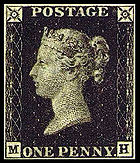
s. Many thousands of designs have been created since a profile bust of Queen Victoria
Victoria of the United Kingdom
Victoria was the monarch of the United Kingdom of Great Britain and Ireland from 20 June 1837 until her death. From 1 May 1876, she used the additional title of Empress of India....
was adopted for the Penny Black
Penny Black
The Penny Black was the world's first adhesive postage stamp used in a public postal system. It was issued in Britain on 1 May 1840, for official use from 6 May of that year....
in 1840; some considered very successful, others
less so.
A stamp design includes several elements required for it to accomplish its purpose satisfactorily. Most important is the denomination indicating its monetary value, while international agreements require a country name on almost all types of stamps. A graphic design is very nearly universal; in addition to making counterfeit
Counterfeit
To counterfeit means to illegally imitate something. Counterfeit products are often produced with the intent to take advantage of the superior value of the imitated product...
s harder to produce and aiding clerks in quick recognition of appropriate postage, postal customers simply expect stamps to carry a design.
Denomination
Denomination (postage stamp)
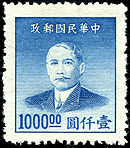
:This article deals with the price of a postage stamp. For other meanings of the word 'denomination' see Denomination .In philately, the denomination is the "inscribed value of a stamp"...
has been omitted; for instance, during the tumults of 1949 China, undenominated stamps were issued, so as to allow the price of a stamp to fluctuate on a daily basis depending on the value of the gold yuan.
The usual form of the denomination is a number, optionally preceded or followed by a currency symbol. Many early stamps wrote the denomination out in words, but the Universal Postal Union
Universal Postal Union
The Universal Postal Union is an international organization that coordinates postal policies among member nations, in addition to the worldwide postal system. The UPU contains four bodies consisting of the Congress, the Council of Administration , the Postal Operations Council and the...
later required that stamps on international mail use Arabic numerals
Arabic numerals
Arabic numerals or Hindu numerals or Hindu-Arabic numerals or Indo-Arabic numerals are the ten digits . They are descended from the Hindu-Arabic numeral system developed by Indian mathematicians, in which a sequence of digits such as "975" is read as a numeral...
, for the benefit of clerks in foreign countries. A number of recent stamps have substituted a textual description of the rate being charged, such as "1st" for first-class letters, or "presorted ZIP+4" to indicate a particular type of bulk mail
Bulk mail
Bulk mail broadly refers to mail that is mailed and processed in bulk at reduced rates. The term does not denote any particular purpose for the mail; but in general usage is synonymous with "junk mail."...
. Another form of nonnumerical denomination is that used for rate change stamps, in which the timing and politics of the rate-setting process is such that the stamps must be printed before the rate is known. In such cases, the preprinted stamps simply state "A", "B", etc., with the equivalent rate being announced just before they go on sale.
Semi-postal stamps are usually denominated with two values, with a "+" between, the first indicating the actual rate, and the second the additional amount to be given to a charity. In a very few cases a country has had a dual currency, and the stamps may depict a value in both currencies.
Country name
United Kingdom of Great Britain and Ireland
The United Kingdom of Great Britain and Ireland was the formal name of the United Kingdom during the period when what is now the Republic of Ireland formed a part of it....
, had no name. In 1874 the Universal Postal Union exempted Great Britain from its rule which stated that a country's name had to appear on their postage stamps, so a profile of the reigning monarch was all that was required for identification of Britain's stamps. To this day the UK remains the only country not required to name itself on its stamps. For all other UPU members, the name must appear in Latin letters
Latin alphabet
The Latin alphabet, also called the Roman alphabet, is the most recognized alphabet used in the world today. It evolved from a western variety of the Greek alphabet called the Cumaean alphabet, which was adopted and modified by the Etruscans who ruled early Rome...
.
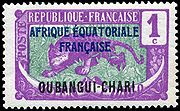
The name chosen is typically the country's own name for itself, with a modern trend towards using simpler and shorter forms, or abbreviations. For instance, the Republic of South Africa inscribes with "RSA", while Jordan
Jordan
Jordan , officially the Hashemite Kingdom of Jordan , Al-Mamlaka al-Urduniyya al-Hashemiyya) is a kingdom on the East Bank of the River Jordan. The country borders Saudi Arabia to the east and south-east, Iraq to the north-east, Syria to the north and the West Bank and Israel to the west, sharing...
originally used "The Hashemite Kingdom of Jordan", and now just "Jordan". Some countries have multiple allowed forms, from which the designer may choose the most suitable. The name may appear in an adjectival form, as in Posta Romana ("Romanian Post") for Romania. Dependent territories may or may not include the name of the parent country.
Graphic design
The graphic element of a stamp design falls into one of four major categories:- Portrait bust - profile or full-face
- Emblem - coat of arms, flag, national symbol, posthorn, etc.
- Numeric - a design built around the numeral of value
- Pictorial
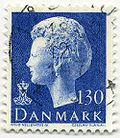
The use of portrait busts (of the ruler or other significant person) or emblems was typical of the first stamps, by extension from currency
Currency
In economics, currency refers to a generally accepted medium of exchange. These are usually the coins and banknotes of a particular government, which comprise the physical aspects of a nation's money supply...
, which was the closest model available to the early stamp designers.
Usage pattern has varied considerably; for 60 years, from 1840 to 1900, all British stamps used exactly the same portrait bust of Victoria, enclosed in a dizzying variety of frames, while Spain
Spain
Spain , officially the Kingdom of Spain languages]] under the European Charter for Regional or Minority Languages. In each of these, Spain's official name is as follows:;;;;;;), is a country and member state of the European Union located in southwestern Europe on the Iberian Peninsula...
periodically updated the image of Alfonso XIII as he grew from child to adult. Norway
Norway
Norway , officially the Kingdom of Norway, is a Nordic unitary constitutional monarchy whose territory comprises the western portion of the Scandinavian Peninsula, Jan Mayen, and the Arctic archipelago of Svalbard and Bouvet Island. Norway has a total area of and a population of about 4.9 million...
has issued stamps with the same posthorn motif for over a century, changing only the details from time to time as printing technology improves, while the US has placed the flag of the United States
Flag of the United States
The national flag of the United States of America consists of thirteen equal horizontal stripes of red alternating with white, with a blue rectangle in the canton bearing fifty small, white, five-pointed stars arranged in nine offset horizontal rows of six stars alternating with rows...
into a wide variety of settings since first using it on a stamp in the 1950s.
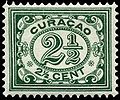
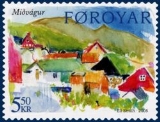
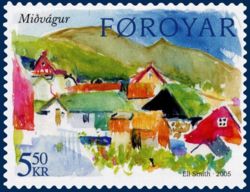
By far the greatest variety of stamp design seen today is in pictorial issues. The choice of image is nearly unlimited, ranging from plants and animals, to figures from history, to landscapes, to original artwork. Images may represent real-world objects, or be allegories or abstract designs.
Christmas stamp
Many nations of the world issue Christmas stamps, postage stamps with a Christmas theme and intended for use on seasonal mail such as Christmas cards. These stamps are regular postage stamps, unlike Christmas seals, and are usually valid for postage year-round...
s), postal rate changes, exhaustion of existing stamp stocks, and popular demand. Since postal administrations are either a branch of government or an official monopoly under governmental supervision, the government has ultimate control over the choice of designs. This means that the designs tend to depict a country as the government would like it to be perceived, rather than as it really is. The Soviet Union
Soviet Union
The Soviet Union , officially the Union of Soviet Socialist Republics , was a constitutionally socialist state that existed in Eurasia between 1922 and 1991....
issued thousands of stamps extolling the successes of communism, even as it was falling apart, while in the US the only contemporary stamp hinting at the unrest of the 1960s is an issue exhorting Americans to support their local police.
In some cases, overt political pressure has resulted in a backlash; a famous example is that of the US in the late 1940s, when the US Congress had direct authority over stamp design, and a large number of issues were put out merely to please a representative's constituency or industry lobbyists. The resulting uproar resulted in the formation of an independent
Citizens' Stamp Advisory Committee
Citizens' Stamp Advisory Committee
The United States Postal Service's Citizens' Stamp Advisory Committee evaluates potential subjects for U.S. postage stamps and reports its recommendations to the Postmaster General, who makes the final decision.-Purpose:...
that reviews and chooses from hundreds of proposals received each year. Occasionally the public is polled for its choice of design, as with the US Elvis stamp of 1993, or some issues of the Celebrate the Century
Celebrate the Century
Celebrate the Century is the name of a series of postage stamps made by the United States Postal Service featuring images recalling various important events in the 20th century in the United States....
series.
Many countries have specific rules governing the choice of designs or design elements. Stamps of the UK must depict the sovereign (typically as a silhouette), while stamps of the US may not visibly depict any person who has been dead for less than 10 years, except for ex-Presidents, who may appear on a stamp one year after their demise. The choice of postage stamp color
Postage stamp color
The colors of postage stamps are at once obvious, and among the most difficult areas of philately. Different denominations of stamps have been printed in different colors since the very beginning; as with their successors, postal clerks could distinguish the Penny Black and Two pence blue more...
may be specified, acting as a sort of color code
Color code
A color code is a system for displaying information by using different colors. Color codes are often difficult for color blind and blind people to interpret....
to different rates.
Most countries issue commemorative issues from time to time, perhaps to celebrate some special event, with designs relating to the event. While they are legitimate postage stamps, and often used for routine post, they are intended to appeal particularly to
stamp collectors
Stamp collecting
Stamp collecting is the collecting of postage stamps and related objects. It is one of the world's most popular hobbies, with the number of collectors in the United States alone estimated to be over 20 million.- Collecting :...
. Stamps that are collected without being used are paid for, but the purchaser chooses not to use the postal service purchased, leaving 100% clear profit. First day covers
First day of issue
A First Day of Issue Cover or First Day Cover is a postage stamp on a cover, postal card or stamped envelope franked on the first day the issue is authorized for use within the country or territory of the stamp-issuing authority. Sometimes the issue is made from a temporary or permanent foreign or...
, often containing more stamps than are required for postage, are an additional source of revenue. This source of money is not inexhaustible, as excessive stamp issues go unpurchased.
Some countries, usually poorer ones, produce many special issues intended purely for collectors from other countries. These stamps are designed for visual appeal, with attractive brightly coloured designs on interesting topics, often large and of unusual shape. Themes have included space-related subjects from a country with no space program, polar animals from a country on the equator, Western rock stars from a conservative Muslim country, and so forth. International organizations of philatelists discourage the practice, not wanting collectors to be discouraged by floods of stamps which will never have any rarity value. See stamp program
Stamp program
The stamp program of a postal organization is an umbrella term for the entire process of postage stamp issuance and distribution by the organization. Aspects include the decision of about stamps to issue, what postal rates they will pay, postage stamp design, printing, and publicity for the new...
for more detail.
Textual elements
_israel_stamp.jpg)
Plate number
A plate number is a number printed in the margin of a sheet or roll of postage stamps which shows the printing plate used to print the stamps.A plate number is the serial number of a printing plate. It is printed in the selvage or border of a pane of postage stamps. Philatelists and stamp...
, the name of a person being portrayed, the occasion being commemorated, the year of stamp issue, and national mottoes.
Occasionally designs use text as their primary design element; for instance, a series of US stamps from the 1970s featured quotations from the United States Declaration of Independence
United States Declaration of Independence
The Declaration of Independence was a statement adopted by the Continental Congress on July 4, 1776, which announced that the thirteen American colonies then at war with Great Britain regarded themselves as independent states, and no longer a part of the British Empire. John Adams put forth a...
. In general however, text has come to be used more sparingly in recent years.
Countries with multiple languages and multiple scripts may need to write the material multiple times. Labuan
Labuan
Labuan is a federal territory in East Malaysia. It is an island off the coast of the state of Sabah. Labuan's capital is Victoria and is best known as an offshore financial centre offering international financial and business services via Labuan IBFC since 1990 as well as being an offshore support...
is an early example; more recently, stamps of Israel
Israel
The State of Israel is a parliamentary republic located in the Middle East, along the eastern shore of the Mediterranean Sea...
include its name in Hebrew, Latin, and Arabic characters.
In addition to text woven into the description, stamps may also have inscriptions in the outside margin. These are almost always at the bottom, and are usually the name of the printer and/or designer. Occasionally a textual description of the design is found in the margin, while in recent years, the lower left margin has become a common place to include the year of issue. Philatelists count changes in these marginal inscriptions as distinct types of stamps.
Hidden elements and "secret marks"
Sometimes designers include tiny elements into a design, sometimes at the request of the stamp-issuing authority, sometimes on their own. Stamps may have a year or name worked into a design, while the US stamp honoring Rabbi Bernard RevelBernard Revel
Bernard Revel was an Orthodox rabbi and scholar. He served as the first President of Yeshiva College from 1915 until his death in 1940...
has a minute Star of David
Star of David
The Star of David, known in Hebrew as the Shield of David or Magen David is a generally recognized symbol of Jewish identity and Judaism.Its shape is that of a hexagram, the compound of two equilateral triangles...
visible in his beard.
Secret marks are small design alterations added to distinguish printings unambiguously. These usually take the form of small lines or marks added to clear areas of a design. Chinese stamps of the 1940s have secret marks in the form of slightly altered characters, where two arms might be changed to touch, when previously they were separate.
Shape and size
Rectangle
In Euclidean plane geometry, a rectangle is any quadrilateral with four right angles. The term "oblong" is occasionally used to refer to a non-square rectangle...
, this being an efficient way to pack stamps on a sheet. A rectangle wider than tall is called a "horizontal design", while taller than wide is a "vertical design".
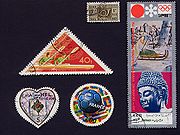
A number of additional shapes have been used, including triangle
Triangle
A triangle is one of the basic shapes of geometry: a polygon with three corners or vertices and three sides or edges which are line segments. A triangle with vertices A, B, and C is denoted ....
s, rhombus
Rhombus
In Euclidean geometry, a rhombus or rhomb is a convex quadrilateral whose four sides all have the same length. The rhombus is often called a diamond, after the diamonds suit in playing cards, or a lozenge, though the latter sometimes refers specifically to a rhombus with a 45° angle.Every...
es, octagons, circle
Circle
A circle is a simple shape of Euclidean geometry consisting of those points in a plane that are a given distance from a given point, the centre. The distance between any of the points and the centre is called the radius....
s, and various freeform shapes including heart shapes, and even a banana shaped stamp issued by Tonga
Tonga
Tonga, officially the Kingdom of Tonga , is a state and an archipelago in the South Pacific Ocean, comprising 176 islands scattered over of ocean in the South Pacific...
from 1969 to 1985.
The usual size ranges from 10 to 30 mm in each direction, experience having shown this to be the easiest to handle. Many countries use only a limited selection of dimensions, to simplify automated machinery that handles stamps.
The smallest postage stamp on record was issued by Mecklenburg-Schwerin
Mecklenburg-Schwerin
Mecklenburg-Schwerin was a duchy in northern Germany created in 1348, when Albert II of Mecklenburg and his younger brother John were raised to Dukes of Mecklenburg by King Charles IV...
in 1856, and was a square, with sides measuring 10 millimeters.
The biggest stamps in history were used in the USA from 1865 and measured 52 by 95 millimeters, but were used exclusively for mailing newspapers.
Design evolution
Stamp design has undergone a gradual process of evolution, traceable both to advances in printing technology and general changes in taste. Design "fads" may also be observed, where a number of countries tend to imitate each other. This may be driven by printing houses, many of which design and print stamps for multiple countries.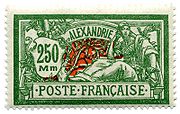
From time to time postal administrations also try experiments. For instance, the US tried issuing very small stamps during the 1970s, as a cost savings measure. They were extremely unpopular, and the experiment was abandoned.

Design process
Once a general subject has been chosen, the postal administration typically contracts an outside artist to produce a design.In working up a design, the artist must take into account the rules and constraints as mentioned above, and perhaps additional requirements, such as membership in a series of related designs.
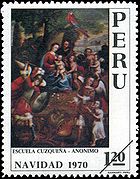
The artist then submits one or more designs for the postal administration's approval. The accepted design may undergo several rounds of modification before entering the production process. The design may also be abandoned, perhaps if circumstances have changed, such as a change of government.
Designs may also be modified as a result of other considerations; for instance, the design of a US stamp honoring Jackson Pollock was based on a photograph showing him smoking a cigarette, but not desiring to be promoting, the cigarette was removed from the design. In general, stamps are not photographic reproductions of the subjects they depict.
Design successes and failures
In the end, successful stamp designs receive relatively little notice from the general public, but considerable praise from the philatelic press. Publications such as Linn's Stamp NewsLinn's Stamp News
Linn's Stamp News an American publication, is the largest weekly newspaper for stamp collectors, with a paid circulation of just over 46,000 Circulation peaked at almost 92,000 in 1978 and has declined ever since because fewer new collectors are subscribing to replace those who subscribed in the...
will headline the most interesting new stamps on their front page, and report the results of popularity polls.
On the other side, design errors regularly get through the multiple stages of review and checking. Errors have ranged from minute points of rendition (such as the subtly-reversed ears on an Austrian stamp of the 1930s), to misrepresentations of disputed territory in maps, to mistaken text ("Sir Codrington" on 1920s Greece), to the truly spectacular, such as the US "Legends of the West" sheet using the picture of the wrong person. See stamp design error for further detail.
Another category of failure includes designs that are simply rejected by the stamp-buying public. The 1970s-era anti-alcoholism stamp of the US is a well-known example; it consists merely of the slogan "Alcoholism: You Can Beat It!", which must have looked good during the design process, but affixed to the corner of an envelope it suggests that the recipient is an alcoholic in need of public encouragement, and few people ever used this stamp on their mail.