

Origami

Encyclopedia
is the traditional Japanese art of paper folding, which started in the 17th century AD at the latest and was popularized outside Japan in the mid-1900s. It has since then evolved into a modern art form. The goal of this art is to transform a flat sheet of material into a finished sculpture through folding and sculpting techniques, and as such the use of cuts or glue are not considered to be origami.
The number of basic origami folds
is small, but they can be combined in a variety of ways to make intricate designs. The best known origami model is probably the Japanese paper crane. In general, these designs begin with a square
sheet of paper whose sides may be different colors or prints. Traditional Japanese origami, which has been practiced since the Edo era (1603–1867), has often been less strict about these conventions, sometimes cutting the paper or using nonsquare shapes to start with.
The principles of origami are also being used in stent
s, packaging and other engineering structures.
, as well as in Germany, Italy and Spain among other places. However because of the problems associated with preserving origami, there is very little direct evidence of its age or origins, aside from references in published material.
In China, traditional funerals include burning folded paper, most often representations of gold nuggets (yuanbao
). It is not known when this practice started, but it seems to have become popular during the Sung Dynasty (905–1125 CE). The paper folding has typically been of objects like dishes, hats or boats rather than animals or flowers.
The earliest evidence of paperfolding in Europe is a picture of a small paper boat in Tractatus de sphaera mundi
from 1490. There is also evidence of a cut and folded paper box from 1440. It is probable paperfolding in the west originated with the Moors much earlier, it is not known if it was independently discovered or knowledge of origami came along the silk route.
In Japan, the earliest unambiguous reference to a paper model is in a short poem by Ihara Saikaku
in 1680 which describes paper butterflies in a dream. Origami butterflies were used during the celebration of Shinto weddings
to represent the bride and groom, so paperfolding had already become a significant aspect of Japanese ceremony by the Heian period
(794–1185) of Japanese history, enough that the reference in this poem would be recognized. Samurai warriors
would exchange gifts adorned with noshi
, a sort of good luck token made of folded strips of paper.
In the early 1900s, Akira Yoshizawa
, Kosho Uchiyama
, and others began creating and recording original origami works. Akira Yoshizawa in particular was responsible for a number of innovations, such as wet-folding
and the Yoshizawa-Randlett diagramming system, and his work inspired a renaissance of the art form. During the 1980s a number of folders started systematically studying the mathematical properties of folded forms, which led to a steady increase in the complexity of origami models, which continued well into the 1990s, after which some designers started returning to simpler forms.
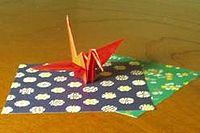 Almost any laminar material can be used for folding; the only requirement is that it should hold a crease.
Origami paper, often referred to as "kami" (Japanese for paper), is sold in prepackaged squares of various sizes ranging from 2.5 cm to 25 cm or more. It is commonly colored on one side and white on the other; however, dual coloured and patterned versions exist and can be used effectively for color-changed models. Origami paper weighs slightly less than copy paper, making it suitable for a wider range of models.
Normal copy paper with weights of 70–90 g/m2 can be used for simple folds, such as the crane
and waterbomb. Heavier weight papers of (19–24&nb 100 g/m2 (approx. 25 lb) or more can be wet-folded. This technique allows for a more rounded sculpting of the model, which becomes rigid and sturdy when it is dry.
Foil-backed paper, just as its name implies, is a sheet of thin foil glued to a sheet of thin paper. Related to this is tissue foil, which is made by gluing a thin piece of tissue paper to kitchen aluminium foil
. A second piece of tissue can be glued onto the reverse side to produce a tissue/foil/tissue sandwich. Foil-backed paper is available commercially, but not tissue foil; it must be handmade. Both types of foil materials are suitable for complex models.
is the traditional origami paper used in Japan. Washi is generally tougher than ordinary paper made from wood pulp, and is used in many traditional arts. Washi is commonly made using fibres from the bark of the gampi tree, the mitsumata shrub (Edgeworthia papyrifera), or the paper mulberry
but also can be made using bamboo
, hemp
, rice, and wheat.
Artisan papers such as unryu, lokta, hanji, gampi, kozo, saa, and abaca have long fibres and are often extremely strong. As these papers are floppy to start with, they are often backcoated
or resized
with methylcellulose
or wheat paste before folding. Also, these papers are extremely thin and compressible, allowing for thin, narrowed limbs as in the case of insect models.
Paper money from various countries is also popular to create origami with; this is known variously as Dollar Origami, Orikane, and Money Origami.
allows sharp creases to be made in the paper easily, paper clip
s can act as extra pairs of fingers, and tweezers can be used to make small folds. When making complex models from origami crease pattern
s, it can help to use a ruler
and ballpoint embosser to score the creases. Completed models can be sprayed so they keep their shape better, and of course a spray is needed when wet folding.
of a person's hands, applied at a certain region on the model, to move another flap or limb. Some argue that, strictly speaking, only the latter is really "recognized" as action origami. Action origami, first appearing with the traditional Japanese flapping bird, is quite common. One example is Robert Lang
's instrumentalists; when the figures' heads are pulled away from their bodies, their hands will move, resembling the playing of music.
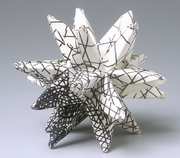
Modular origami consists of putting a number of identical pieces together to form a complete model. Normally the individual pieces are simple but the final assembly may be tricky. Many of the modular origami models are decorative balls like kusudama
, the technique differs though in that kusudama allows the pieces to be put together using thread or glue.
Chinese paper folding
includes a style called 3D origami where large numbers of pieces are put together to make elaborate models. Sometimes paper money is used for the modules. This style originated from some Chinese refugees while they were detained in America and is also called Golden Venture
folding from the ship they came on.
refers to a collection of figures fill a plane with no gaps or overlaps. In origami tessellations, pleats are used to connect molecules such as twist folds together in a repeating fashion.
During the 1960s, Shuzo Fujimoto was the first to explore twist fold tessellations in any systematic way, coming up with dozens of patterns and establishing the genre in the origami mainstream. Around the same time period, Ron Resch patented some tessellation patterns as part of his explorations into kinetic sculpture and developable surfaces, although his work was not known by the origami community until the 1980s. Chris Palmer is an artist who has extensively explored tessellations after seeing the Zilij
patterns in the Alhambra
, and has found ways to create detailed origami tessellations out of silk. Robert Lang
and Alex Bateman are two designers who use computer programs to create origami tessellations. The first American book on origami tessellations was just published by Eric Gjerde and the field has been expanding rapidly. There are numerous origami tessellation artists including Chris Palmer (U.S.), Eric Gjerde (U.S.), Polly Verity (Scotland), Joel Cooper (U.S.), Christine Edison (U.S.), Ray Schamp (U.S.), Roberto Gretter (Italy), Goran Konjevod (U.S.),and Christiane Bettens (Switzerland) that are showing works that are both geometric and representational.
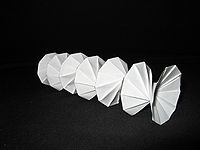
The practice and study of origami encapsulates several subjects of mathematical
interest. For instance, the problem of flat-foldability (whether a crease pattern can be folded into a 2-dimensional model) has been a topic of considerable mathematical study.
A number of technological advances have come from insights obtained through paper folding. For example, techniques have been developed for the deployment of car airbag
s and stent
implants from a folded position.
The problem of rigid origami
("if we replaced the paper with sheet metal and had hinges in place of the crease lines, could we still fold the model?") has great practical importance. For example, the Miura map fold
is a rigid fold that has been used to deploy large solar panel arrays for space satellites.
There may soon be an origami airplane launched from space
. A prototype passed a durability test in a wind tunnel on March 2008, and Japan's space agency adopted it for feasibility studies.
, Meguro Toshiyuki and others, and allows for the creation of extremely complex multi-limbed models such as many-legged centipedes, human figures with a full complement of fingers and toes, and the like.
The main starting point for such technical designs is the crease pattern
(often abbreviated as CP), which is essentially the layout of the creases required to form the final model. Although not intended as a substitute for diagrams, folding from crease patterns is starting to gain in popularity, partly because of the challenge of being able to 'crack' the pattern, and also partly because the crease pattern is often the only resource available to fold a given model, should the designer choose not to produce diagrams. Still, there are many cases in which designers wish to sequence the steps of their models but lack the means to design clear diagrams. Such origamists occasionally resort to the Sequenced Crease Pattern (abbreviated as SCP) which is a set of crease patterns showing the creases up to each respective fold. The SCP eliminates the need for diagramming programs or artistic ability while maintaining the step-by-step process for other folders to see. Another name for the Sequenced Crease Pattern is the Progressive Crease Pattern (PCP).
Paradoxically enough, when origami designers come up with a crease pattern for a new design, the majority of the smaller creases are relatively unimportant and added only towards the completion of the crease pattern. What is more important is the allocation of regions of the paper and how these are mapped to the structure of the object being designed. For a specific class of origami bases known as 'uniaxial bases', the pattern of allocations is referred to as the 'circle-packing'. Using optimization algorithms, a circle-packing figure can be computed for any uniaxial base of arbitrary complexity. Once this figure is computed, the creases which are then used to obtain the base structure can be added. This is not a unique mathematical process, hence it is possible for two designs to have the same circle-packing, and yet different crease pattern structures.
As a circle encloses the minimum amount of area for a given perimeter, circle packing allows for maximum efficiency in terms of paper usage. However, other polygonal shapes can be used to solve the packing problem as well. The use of polygonal shapes other than circles is often motivated by the desire to find easily locatable creases (such as multiples of 22.5 degrees) and hence an easier folding sequence as well. One popular offshoot of the circle packing method is box-pleating, where squares are used instead of circles. As a result, the crease pattern that arises from this method contains only 45 and 90 degree angles, which makes for easier folding.
The number of basic origami folds
Origami techniques
The Yoshizawa-Randlett system is a diagramming system used to describe the folds of origami models. Many origami books begin with a description of basic origami techniques which are used to construct the models. There are also a number of standard bases which are commonly used as a first step in...
is small, but they can be combined in a variety of ways to make intricate designs. The best known origami model is probably the Japanese paper crane. In general, these designs begin with a square
Square (geometry)
In geometry, a square is a regular quadrilateral. This means that it has four equal sides and four equal angles...
sheet of paper whose sides may be different colors or prints. Traditional Japanese origami, which has been practiced since the Edo era (1603–1867), has often been less strict about these conventions, sometimes cutting the paper or using nonsquare shapes to start with.
The principles of origami are also being used in stent
Stent
In the technical vocabulary of medicine, a stent is an artificial 'tube' inserted into a natural passage/conduit in the body to prevent, or counteract, a disease-induced, localized flow constriction. The term may also refer to a tube used to temporarily hold such a natural conduit open to allow...
s, packaging and other engineering structures.
History
There is much speculation about the origin of Origami. While Japan seems to have had the most extensive tradition, there is evidence of an independent tradition of paperfolding in ChinaChinese paper folding
Chinese Paper Folding, or Zhezhi , is the art of paper folding that originated in China.The work of Akira Yoshizawa widely popularized the Japanese name "origami"- however, in China, and other Chinese speaking places, the art is referred to by the chinese name, Zhe Zhi...
, as well as in Germany, Italy and Spain among other places. However because of the problems associated with preserving origami, there is very little direct evidence of its age or origins, aside from references in published material.
In China, traditional funerals include burning folded paper, most often representations of gold nuggets (yuanbao
Sycee
A sycee was a type of silver or gold ingot currency used in China until the 20th century. The name derives from the Cantonese words meaning "fine silk"...
). It is not known when this practice started, but it seems to have become popular during the Sung Dynasty (905–1125 CE). The paper folding has typically been of objects like dishes, hats or boats rather than animals or flowers.
The earliest evidence of paperfolding in Europe is a picture of a small paper boat in Tractatus de sphaera mundi
De sphaera mundi
De sphaera mundi is a medieval introduction to the basic elements of astronomy written by Johannes de Sacrobosco c. 1230...
from 1490. There is also evidence of a cut and folded paper box from 1440. It is probable paperfolding in the west originated with the Moors much earlier, it is not known if it was independently discovered or knowledge of origami came along the silk route.
In Japan, the earliest unambiguous reference to a paper model is in a short poem by Ihara Saikaku
Ihara Saikaku
was a Japanese poet and creator of the "floating world" genre of Japanese prose .-Biography:Born the son of the wealthy merchant Hirayama Tōgo in Osaka, he first studied haikai poetry under Matsunaga Teitoku, and later studied under Nishiyama Sōin of the Danrin School of poetry, which emphasized...
in 1680 which describes paper butterflies in a dream. Origami butterflies were used during the celebration of Shinto weddings
Shinto
or Shintoism, also kami-no-michi, is the indigenous spirituality of Japan and the Japanese people. It is a set of practices, to be carried out diligently, to establish a connection between present day Japan and its ancient past. Shinto practices were first recorded and codified in the written...
to represent the bride and groom, so paperfolding had already become a significant aspect of Japanese ceremony by the Heian period
Heian period
The is the last division of classical Japanese history, running from 794 to 1185. The period is named after the capital city of Heian-kyō, or modern Kyōto. It is the period in Japanese history when Buddhism, Taoism and other Chinese influences were at their height...
(794–1185) of Japanese history, enough that the reference in this poem would be recognized. Samurai warriors
Samurai
is the term for the military nobility of pre-industrial Japan. According to translator William Scott Wilson: "In Chinese, the character 侍 was originally a verb meaning to wait upon or accompany a person in the upper ranks of society, and this is also true of the original term in Japanese, saburau...
would exchange gifts adorned with noshi
Noshi
are a kind of ceremonial origami fold entirely distinct from "origami-tsuki". They are not certificates, but are attached to gifts to express "good wishes". Noshi consists of white paper folded with a strip of dried abalone or meat, considered a token of good fortune.-References:*...
, a sort of good luck token made of folded strips of paper.
In the early 1900s, Akira Yoshizawa
Akira Yoshizawa
Akira Yoshizawa was considered to be the grandmaster of origami. He is credited with raising origami from a craft to a living art...
, Kosho Uchiyama
Kosho Uchiyama
was a Sōtō priest, origami master, and the former abbot of Antaiji near Kyoto, Japan.The author of more than twenty books on Zen Buddhism and origami—of which Opening the Hand of Thought: Foundations of Zen Buddhist Practice is best-known—Uchiyama graduated from Waseda University with a masters...
, and others began creating and recording original origami works. Akira Yoshizawa in particular was responsible for a number of innovations, such as wet-folding
Wet-folding
Wet-folding is an origami technique developed by Akira Yoshizawa that employs water to dampen the paper so that it can be manipulated more easily. This process adds an element of sculpture to origami, which is otherwise purely geometric. Wet-folding is used very often by professional folders for...
and the Yoshizawa-Randlett diagramming system, and his work inspired a renaissance of the art form. During the 1980s a number of folders started systematically studying the mathematical properties of folded forms, which led to a steady increase in the complexity of origami models, which continued well into the 1990s, after which some designers started returning to simpler forms.
Techniques
Many origami books begin with a description of basic origami techniques which are used to construct the models. These include simple diagrams of basic folds like valley and mountain folds, pleats, reverse folds, squash folds, and sinks. There are also standard named bases which are used in a wide variety of models, for instance the bird base is an intermediate stage in the construction of the flapping bird.Origami paper
Origami paper, often referred to as "kami" (Japanese for paper), is sold in prepackaged squares of various sizes ranging from 2.5 cm to 25 cm or more. It is commonly colored on one side and white on the other; however, dual coloured and patterned versions exist and can be used effectively for color-changed models. Origami paper weighs slightly less than copy paper, making it suitable for a wider range of models.
Normal copy paper with weights of 70–90 g/m2 can be used for simple folds, such as the crane
Crane (bird)
Cranes are a family, Gruidae, of large, long-legged and long-necked birds in the order Gruiformes. There are fifteen species of crane in four genera. Unlike the similar-looking but unrelated herons, cranes fly with necks outstretched, not pulled back...
and waterbomb. Heavier weight papers of (19–24&nb 100 g/m2 (approx. 25 lb) or more can be wet-folded. This technique allows for a more rounded sculpting of the model, which becomes rigid and sturdy when it is dry.
Foil-backed paper, just as its name implies, is a sheet of thin foil glued to a sheet of thin paper. Related to this is tissue foil, which is made by gluing a thin piece of tissue paper to kitchen aluminium foil
Aluminium foil
Aluminium foil is aluminium prepared in thin metal leaves, with a thickness less than , thinner gauges down to are also commonly used. In the USA, foils are commonly gauged in mils. Standard household foil is typically thick and heavy duty household foil is typically .The foil is pliable, and...
. A second piece of tissue can be glued onto the reverse side to produce a tissue/foil/tissue sandwich. Foil-backed paper is available commercially, but not tissue foil; it must be handmade. Both types of foil materials are suitable for complex models.
is the traditional origami paper used in Japan. Washi is generally tougher than ordinary paper made from wood pulp, and is used in many traditional arts. Washi is commonly made using fibres from the bark of the gampi tree, the mitsumata shrub (Edgeworthia papyrifera), or the paper mulberry
Paper Mulberry
The Paper Mulberry is a tree in the family Moraceae, native to eastern Asia. Other names include Dak, Halibun, Kalivon, Kozo, and Tapacloth tree.It is a deciduous tree growing to tall...
but also can be made using bamboo
Bamboo
Bamboo is a group of perennial evergreens in the true grass family Poaceae, subfamily Bambusoideae, tribe Bambuseae. Giant bamboos are the largest members of the grass family....
, hemp
Hemp
Hemp is mostly used as a name for low tetrahydrocannabinol strains of the plant Cannabis sativa, of fiber and/or oilseed varieties. In modern times, hemp has been used for industrial purposes including paper, textiles, biodegradable plastics, construction, health food and fuel with modest...
, rice, and wheat.
Artisan papers such as unryu, lokta, hanji, gampi, kozo, saa, and abaca have long fibres and are often extremely strong. As these papers are floppy to start with, they are often backcoated
Backcoating
Backcoating is the lamination of two sheets of paper back to back to create a superior paper for folding origami models....
or resized
Sizing
Sizing or size is any one of numerous specific substances that is applied to or incorporated in other material, especially papers and textiles, to act as a protecting filler or glaze....
with methylcellulose
Methylcellulose
Methyl cellulose is a chemical compound derived from cellulose. It is a hydrophilic white powder in pure form and dissolves in cold water, forming a clear viscous solution or gel. It is sold under a variety of trade names and is used as a thickener and emulsifier in various food and cosmetic...
or wheat paste before folding. Also, these papers are extremely thin and compressible, allowing for thin, narrowed limbs as in the case of insect models.
Paper money from various countries is also popular to create origami with; this is known variously as Dollar Origami, Orikane, and Money Origami.
Tools
It is common to fold using a flat surface but some folders like doing it in the air with no tools especially when displaying the folding. Many folders believe no tool should be used when folding. However a couple of tools can help especially with the more complex models. For instance a bone folderBone folder
A bone folder or bonefolder is a dull edged device used to crease material in crafts such as bookbinding, cardmaking and any other craft where a sharp crease is needed. It is also used for marking fabric where a temporary mark needs to be made without damaging the material. Often made from the leg...
allows sharp creases to be made in the paper easily, paper clip
Paper Clip
"Paper Clip" is a 1995 episode of The X-Files television series. It was the second episode broadcast in the show's third season. Paper Clip concludes the story regarding the agents' possession of a digital tape containing government secrets on extraterrestrials.- Plot :Continuing from the previous...
s can act as extra pairs of fingers, and tweezers can be used to make small folds. When making complex models from origami crease pattern
Crease pattern
A Crease Pattern is an origami diagram type that consists of all or most of the creases in the final model, rendered into one image. This comes in handy for diagramming complex and super-complex models, where the model is often not simple enough to diagram efficiently.The use of crease patterns...
s, it can help to use a ruler
Ruler
A ruler, sometimes called a rule or line gauge, is an instrument used in geometry, technical drawing, printing and engineering/building to measure distances and/or to rule straight lines...
and ballpoint embosser to score the creases. Completed models can be sprayed so they keep their shape better, and of course a spray is needed when wet folding.
Action origami
Origami not only covers still-life, there are also moving objects; Origami can move in clever ways. Action origami includes origami that flies, requires inflation to complete, or, when complete, uses the kinetic energyKinetic energy
The kinetic energy of an object is the energy which it possesses due to its motion.It is defined as the work needed to accelerate a body of a given mass from rest to its stated velocity. Having gained this energy during its acceleration, the body maintains this kinetic energy unless its speed changes...
of a person's hands, applied at a certain region on the model, to move another flap or limb. Some argue that, strictly speaking, only the latter is really "recognized" as action origami. Action origami, first appearing with the traditional Japanese flapping bird, is quite common. One example is Robert Lang
Robert J. Lang
Dr. Robert J. Lang is an American physicist who is also one of the foremost origami artists and theorists in the world. He is known for his complex and elegant designs, most notably of insects and animals. He has long been a student of the mathematics of origami and of using computers to study the...
's instrumentalists; when the figures' heads are pulled away from their bodies, their hands will move, resembling the playing of music.
Modular origami
Modular origami consists of putting a number of identical pieces together to form a complete model. Normally the individual pieces are simple but the final assembly may be tricky. Many of the modular origami models are decorative balls like kusudama
Kusudama
The Japanese kusudama is a paper model that is usually created by sewing multiple identical pyramidal units together through their points to form a spherical shape. Alternately the individual components may be glued together. The Japanese kusudama (薬玉; lit. medicine ball) is a paper model that...
, the technique differs though in that kusudama allows the pieces to be put together using thread or glue.
Chinese paper folding
Chinese paper folding
Chinese Paper Folding, or Zhezhi , is the art of paper folding that originated in China.The work of Akira Yoshizawa widely popularized the Japanese name "origami"- however, in China, and other Chinese speaking places, the art is referred to by the chinese name, Zhe Zhi...
includes a style called 3D origami where large numbers of pieces are put together to make elaborate models. Sometimes paper money is used for the modules. This style originated from some Chinese refugees while they were detained in America and is also called Golden Venture
Golden Venture
On June 6, 1993, at around 2 a.m., the Golden Venture — a ship bearing 286 illegal immigrants from China along with 13 crew members — ran aground on Rockaway Beach in Queens, New York after a mutiny by the smugglers. The ship had set sail from Thailand, stopped in Kenya and circled the...
folding from the ship they came on.
Wet-folding
Wet-folding is an origami technique for producing models with gentle curves rather than geometric straight folds and flat surfaces. The paper is dampened so it can be moulded easily, the final model keeps its shape when it dries. It can be used, for instance, to produce very natural looking animal models. Size, an adhesive that is crisp and hard when dry, but dissolves in water when wet and becoming soft and flexible, is often applied to the paper either at the pulp stage while the paper is being formed, or on the surface of a ready sheet of paper. The latter method is called external sizing and most commonly uses Methylcellulose, or MC, paste, or various plant starches.Pureland origami
Pureland origami is origami with the restriction that only one fold may be done at a time, more complex folds like reverse folds are not allowed, and all folds have straightforward locations. It was developed by John Smith in the 1970s to help inexperienced folders or those with limited motor skills. Some designers also like the challenge of creating good models within the very strict constraints.Origami Tessellations
This branch of origami is one that has grown in popularity recently. TessellationTessellation
A tessellation or tiling of the plane is a pattern of plane figures that fills the plane with no overlaps and no gaps. One may also speak of tessellations of parts of the plane or of other surfaces. Generalizations to higher dimensions are also possible. Tessellations frequently appeared in the art...
refers to a collection of figures fill a plane with no gaps or overlaps. In origami tessellations, pleats are used to connect molecules such as twist folds together in a repeating fashion.
During the 1960s, Shuzo Fujimoto was the first to explore twist fold tessellations in any systematic way, coming up with dozens of patterns and establishing the genre in the origami mainstream. Around the same time period, Ron Resch patented some tessellation patterns as part of his explorations into kinetic sculpture and developable surfaces, although his work was not known by the origami community until the 1980s. Chris Palmer is an artist who has extensively explored tessellations after seeing the Zilij
Zellige
Zellige, zillij or zellij is terra cotta tilework covered with enamel in the form of chips set into plaster. It is one of the main characteristics of the Moroccan architecture...
patterns in the Alhambra
Alhambra
The Alhambra , the complete form of which was Calat Alhambra , is a palace and fortress complex located in the Granada, Andalusia, Spain...
, and has found ways to create detailed origami tessellations out of silk. Robert Lang
Robert Lang
Robert Lang is the name of:*Robert Lang , Czech hockey player in the NHL*Robert Lang , cricketer*Robert Lang , British swimmer at the 2007 World Championships.*Robert J...
and Alex Bateman are two designers who use computer programs to create origami tessellations. The first American book on origami tessellations was just published by Eric Gjerde and the field has been expanding rapidly. There are numerous origami tessellation artists including Chris Palmer (U.S.), Eric Gjerde (U.S.), Polly Verity (Scotland), Joel Cooper (U.S.), Christine Edison (U.S.), Ray Schamp (U.S.), Roberto Gretter (Italy), Goran Konjevod (U.S.),and Christiane Bettens (Switzerland) that are showing works that are both geometric and representational.
Kirigami
Kirigami is a Japanese term for paper cutting. Cutting was often used in traditional Japanese origami, but modern innovations in technique have made the use of cuts unnecessary. Most origami designers no longer consider models with cuts to be origami, instead using the term Kirigami to describe them. This change in attitude occurred during the 1960s and 70s, so early origami books often use cuts, but for the most part they have disappeared from the modern origami repertoire; most modern books don't even mention cutting.Mathematics and practical applications
The practice and study of origami encapsulates several subjects of mathematical
Mathematics
Mathematics is the study of quantity, space, structure, and change. Mathematicians seek out patterns and formulate new conjectures. Mathematicians resolve the truth or falsity of conjectures by mathematical proofs, which are arguments sufficient to convince other mathematicians of their validity...
interest. For instance, the problem of flat-foldability (whether a crease pattern can be folded into a 2-dimensional model) has been a topic of considerable mathematical study.
A number of technological advances have come from insights obtained through paper folding. For example, techniques have been developed for the deployment of car airbag
Airbag
An Airbag is a vehicle safety device. It is an occupant restraint consisting of a flexible envelope designed to inflate rapidly during an automobile collision, to prevent occupants from striking interior objects such as the steering wheel or a window...
s and stent
Stent
In the technical vocabulary of medicine, a stent is an artificial 'tube' inserted into a natural passage/conduit in the body to prevent, or counteract, a disease-induced, localized flow constriction. The term may also refer to a tube used to temporarily hold such a natural conduit open to allow...
implants from a folded position.
The problem of rigid origami
Rigid origami
Rigid origami is a branch of origami which is concerned with folding structures using flat rigid sheets joined by hinges. It is a part of the study of the mathematics of paper folding, it can be considered as a type of mechanical linkage, and has great practical utility. For instance it was used in...
("if we replaced the paper with sheet metal and had hinges in place of the crease lines, could we still fold the model?") has great practical importance. For example, the Miura map fold
Miura map fold
The is a rigid fold that has been used to simulate large solar panel arrays for space satellites in the Japanese 1995 Space Flight Unit. It was invented by Japanese astrophysicist Koryo Miura...
is a rigid fold that has been used to deploy large solar panel arrays for space satellites.
There may soon be an origami airplane launched from space
Origami Airplane Launched From Space
Japanese scientists and origami masters considered in 2008 launching a flotilla of paper planes from space. The launch was tentatively slated for 2009 from the International Space Station 250 miles above Earth...
. A prototype passed a durability test in a wind tunnel on March 2008, and Japan's space agency adopted it for feasibility studies.
Technical origami
Technical origami, also known as , is a field of origami that has developed almost hand-in-hand with the field of mathematical origami. In the early days of origami, development of new designs was largely a mix of trial-and-error, luck and serendipity. With advances in origami mathematics however, the basic structure of a new origami model can be theoretically plotted out on paper before any actual folding even occurs. This method of origami design was developed by Robert LangRobert J. Lang
Dr. Robert J. Lang is an American physicist who is also one of the foremost origami artists and theorists in the world. He is known for his complex and elegant designs, most notably of insects and animals. He has long been a student of the mathematics of origami and of using computers to study the...
, Meguro Toshiyuki and others, and allows for the creation of extremely complex multi-limbed models such as many-legged centipedes, human figures with a full complement of fingers and toes, and the like.
The main starting point for such technical designs is the crease pattern
Crease pattern
A Crease Pattern is an origami diagram type that consists of all or most of the creases in the final model, rendered into one image. This comes in handy for diagramming complex and super-complex models, where the model is often not simple enough to diagram efficiently.The use of crease patterns...
(often abbreviated as CP), which is essentially the layout of the creases required to form the final model. Although not intended as a substitute for diagrams, folding from crease patterns is starting to gain in popularity, partly because of the challenge of being able to 'crack' the pattern, and also partly because the crease pattern is often the only resource available to fold a given model, should the designer choose not to produce diagrams. Still, there are many cases in which designers wish to sequence the steps of their models but lack the means to design clear diagrams. Such origamists occasionally resort to the Sequenced Crease Pattern (abbreviated as SCP) which is a set of crease patterns showing the creases up to each respective fold. The SCP eliminates the need for diagramming programs or artistic ability while maintaining the step-by-step process for other folders to see. Another name for the Sequenced Crease Pattern is the Progressive Crease Pattern (PCP).
Paradoxically enough, when origami designers come up with a crease pattern for a new design, the majority of the smaller creases are relatively unimportant and added only towards the completion of the crease pattern. What is more important is the allocation of regions of the paper and how these are mapped to the structure of the object being designed. For a specific class of origami bases known as 'uniaxial bases', the pattern of allocations is referred to as the 'circle-packing'. Using optimization algorithms, a circle-packing figure can be computed for any uniaxial base of arbitrary complexity. Once this figure is computed, the creases which are then used to obtain the base structure can be added. This is not a unique mathematical process, hence it is possible for two designs to have the same circle-packing, and yet different crease pattern structures.
As a circle encloses the minimum amount of area for a given perimeter, circle packing allows for maximum efficiency in terms of paper usage. However, other polygonal shapes can be used to solve the packing problem as well. The use of polygonal shapes other than circles is often motivated by the desire to find easily locatable creases (such as multiples of 22.5 degrees) and hence an easier folding sequence as well. One popular offshoot of the circle packing method is box-pleating, where squares are used instead of circles. As a result, the crease pattern that arises from this method contains only 45 and 90 degree angles, which makes for easier folding.
Origami Related Computer Programs
- Doodle: Helping to diagram. This one is useful to create a file *.ps that contain all the steps and figures involved in the creation of a figure. Link:http://doodle.sourceforge.net/. The disadvantage is that is difficult to write the instructions.
- Treemaker: useful to design a figure. Only you see the create pattern of your model. Create the circles mentioned above. Link: http://www.langorigami.com/science/treemaker/treemaker5.php4
- OriPa: a program for drawing up crease patterns. It gives you the ability to see what your crease pattern looks like when folded. Link:http://mitani.cs.tsukuba.ac.jp/pukiwiki-oripa/index.php?ORIPA%3B%20Origami%20Pattern%20Editor
See also
- Card model
- Chinese paper foldingChinese paper foldingChinese Paper Folding, or Zhezhi , is the art of paper folding that originated in China.The work of Akira Yoshizawa widely popularized the Japanese name "origami"- however, in China, and other Chinese speaking places, the art is referred to by the chinese name, Zhe Zhi...
- Fold-formingFold-formingFold-forming is a technique of metalworking whereby metal is folded, repeatedly forged and annealed, and unfolded; at which stage it generally has a dramatic new three-dimensional form....
- FuroshikiFuroshikiFuroshiki are a type of traditional Japanese wrapping cloth that were frequently used to transport clothes, gifts, or other goods. Although possibly dating back as far as the Nara period, the name, meaning "bath spread", derives from the Edo period practice of using them to bundle clothes while at...
- Japanese artJapanese artJapanese art covers a wide range of art styles and media, including ancient pottery, sculpture in wood and bronze, ink painting on silk and paper and more recently manga, cartoon, along with a myriad of other types of works of art...
- KirigamiKirigamiis a variation of origami that includes cutting of the paper .It is also called "Kirie" . From "Kiru"= to cut, "e"= picture....
- List of origamists
- Origamic architectureOrigamic architectureOrigamic architecture involves the three-dimensional reproduction of architecture, geometric patterns, everyday objects, or other images, on various scales, using cut-out and folded paper, usually thin paperboard. Visually, these creations are comparable to intricate 'pop-ups', indeed, some works...
- Paper craft
- Paper fortune teller
- Paper planePaper planeA paper plane, paper aeroplane , paper airplane , paper glider, paper dart or dart is a toy aircraft, usually a glider made out of paper or paperboard; the practice of constructing paper planes is sometimes referred to as aerogami , after origami, the Japanese art of paper folding.-History:The...
- Papercraft
Further reading
- Robert J. LangRobert J. LangDr. Robert J. Lang is an American physicist who is also one of the foremost origami artists and theorists in the world. He is known for his complex and elegant designs, most notably of insects and animals. He has long been a student of the mathematics of origami and of using computers to study the...
. The Complete Book of Origami: Step-by-Step Instructions in Over 1000 Diagrams. Dover PublicationsDover PublicationsDover Publications is an American book publisher founded in 1941 by Hayward Cirker and his wife, Blanche. It publishes primarily reissues, books no longer published by their original publishers. These are often, but not always, books in the public domain. The original published editions may be...
, Mineola, NY. Copyright 1988 by Robert J. Lang. ISBN 0-486-25837-8 (pbk.)-
- Pages 1–30 are an excellent introduction to basic origami moves and notations. Each of the first 13 models is designed to allow the reader to practice one skill several times. Many models are folded from non-square paper.
-
- Kunihiko KasaharaKunihiko Kasaharais a Japanese origami master. He has made hundreds of models, from simple lion masks to complex modular origami, such as a small stellated dodecahedron. He does not specialize in what is known as "super complex origami", but rather he likes making simple, elegant animals, and modular designs such...
. Origami Omnibus: Paper Folding for Everybody. Japan Publications, inc. Tokyo. Copyright 1988 by Kunihiko Kasahara. ISBN 4-8170-9001-4-
- A book for a more advanced origamian; this book presents many more complicated ideas and theories, as well as related topics in geometry and culture, along with model diagrams.
-
- Kunihiko Kasahara and Toshie Takahama. Origami for the Connoisseur. Japan Publications, inc. Tokyo. Copyright 1987 by Kunihiko Kasahara and Toshie Takahama. ISBN 0-87040-670-1
- Satoshi KamiyaSatoshi Kamiyais among the most advanced origami masters in the world. He began the art at age two, and began seriously designing more advanced models in 1995, and has since made hundreds of origami models. Perhaps his most famous design is Ryujin 3.5, an elaborate dragon covered with scales and having feelers,...
. Works by Satoshi Kamiya, 1995–2003. Origami House, Tokyo. Copyright 2005 by Satoshi Kamiya.-
- An extremely complex book for the elite origamian, most models take 100+ steps to complete. Includes his famous Divine Dragon Bahamut and Ancient Dragons. Instructions are in Japanese and English.
-
- Issei Yoshino. Issei Super Complex Origami. Origami House, Tokyo.
-
- Contains many complex models, notably his Samurai Helmet, Horse, and multimodular TriceratopsTriceratopsTriceratops is a genus of herbivorous ceratopsid dinosaur which lived during the late Maastrichtian stage of the Late Cretaceous Period, around 68 to 65 million years ago in what is now North America. It was one of the last dinosaur genera to appear before the great Cretaceous–Paleogene...
skeleton. Instructions are in Japanese.
- Contains many complex models, notably his Samurai Helmet, Horse, and multimodular Triceratops
-
- One Thousand Paper Cranes: The Story of Sadako and the Children's Peace Statue by Takayuki Ishii, ISBN 0-440-22843-3
- Sadako and the Thousand Paper Cranes by Eleanor Coerr, ISBN 0-698-11802-2
- Extreme Origami, Kunihiko KasaharaKunihiko Kasaharais a Japanese origami master. He has made hundreds of models, from simple lion masks to complex modular origami, such as a small stellated dodecahedron. He does not specialize in what is known as "super complex origami", but rather he likes making simple, elegant animals, and modular designs such...
, 2001, ISBN 0-8069-8853-3 - Ariomar Ferreira da Silva. Brincando com Origami Arquitetônico: 16 diagrams. Global Editora, São Paulo, Brazil. Copyright 1991 by Ariomar Ferreira da Silva and Leôncio de O. Carvalho. ISBN 85-260-0273-2
- Masterworks of Paper Folding by Michael LaFosse
- Papercopia: Origami Designs by David Shall, 2008 ISBN 978-0-9796487-0-0. Contains diagrams for 24 original models by the author including Claw Hammer, Daffodil, Candlestick.
- Nick RobinsonNick Robinson (origami)Nick Robinson is a British paperfolder best known for publishing books of paper aeroplanes. He was awarded the Sydney French medal in 2004 by the British Origami Society. He has written over thirty books of origami including Origami for Dummies. His origami designs are usually simple and elegant...
. Origami For Dummies. John Wiley, Copyright 2008 by Nick Robinson. ISBN 0470758570. An excellent book for beginners, covering many aspects of origami overlooked by other books. - Nick Robinson. Encyclopedia of Origami. Quarto, Copyright 2004 by Nick Robinson. ISBN 1-84448-025-9. An book full of stimulating designs.
- Linda Wright. Toilet Paper Origami: Delight Your Guests with Fancy Folds and Simple Surface Embellishments. Copyright 2008 by Lindaloo Enterprises, Santa Barbara, CA. ISBN 9780980092318.
External links
- Free Origami Instruction Database !, a collection of links to free origami instructions, pictures and videos.
- OrigamiTube.com Watch, Fold, Show Off! Collection of origami instructional and origami related videos.
- Origami Nut Original instructional videos of origami folding with diagrams and varying difficulty levels.
- Origami.com, collection of diagrams, suitable for beginners.
- GiladOrigami.com, contains a large gallery.
- Paper Circle: Origami Out of Hand – Exhibition by Origami artists Tomoko Fuse, Robert J. Lang, and David and Assia Brill of Great Britain.
- The Fold, a large collection of diagrams.
- WikiHow on How to Make Origami
- Origami.org.uk, 3D animated origami diagrams of peace crane and flapping bird.
- Origami Surprise !, a brand new type of origami folding instructions.
- Between the Folds Documentary film featuring 15 international origami practitioners
- Interview with Robert Lang at Institute for Advanced Study, University of Minnesota, March, 2011