

Stent

Encyclopedia
In the technical vocabulary of medicine
, a stent is an artificial 'tube' inserted into a natural passage/conduit in the body to prevent, or counteract, a disease-induced, localized flow constriction. The term may also refer to a tube used to temporarily hold such a natural conduit open to allow access for surgery.
) and some believe this to be the origin. Others attribute the noun stent to Jan F. Esser
, a Dutch plastic surgeon who in 1916 used the word to describe a dental impression compound invented in 1856 by the English dentist
Charles Stent
(1807–1885), whom Esser employed to craft a form for facial reconstruction. The full account is described in the Journal of the History of Dentistry. According to the author, from the use of Stent's compound as support for facial tissues grew the eventual use of stent to open various bodily structures.
Worth noting though is that the first "stents" used in medical practice were initially called "Wallstents".
Medicine
Medicine is the science and art of healing. It encompasses a variety of health care practices evolved to maintain and restore health by the prevention and treatment of illness....
, a stent is an artificial 'tube' inserted into a natural passage/conduit in the body to prevent, or counteract, a disease-induced, localized flow constriction. The term may also refer to a tube used to temporarily hold such a natural conduit open to allow access for surgery.
Etymology
The origin of the word stent remains unsettled. The verb stenting was used for centuries for the process of stiffening garments (a usage long obsolete, per the Oxford English DictionaryOxford English Dictionary
The Oxford English Dictionary , published by the Oxford University Press, is the self-styled premier dictionary of the English language. Two fully bound print editions of the OED have been published under its current name, in 1928 and 1989. The first edition was published in twelve volumes , and...
) and some believe this to be the origin. Others attribute the noun stent to Jan F. Esser
Jan F. Esser
Johannes "Jan" Fredericus Samuel Esser was a Dutch plastic surgeon who pioneered innovative methods of reconstructive surgery on soldiers wounded in the First World War...
, a Dutch plastic surgeon who in 1916 used the word to describe a dental impression compound invented in 1856 by the English dentist
Dentist
A dentist, also known as a 'dental surgeon', is a doctor that specializes in the diagnosis, prevention, and treatment of diseases and conditions of the oral cavity. The dentist's supporting team aides in providing oral health services...
Charles Stent
Charles Stent
Charles Stent was a nineteenth-century English dentist notable for his advances in the field of denture making.In 1847, Edwin Truman introduced gutta-percha as a material for making dental impressions; however, this was unsatisfactory for several reasons, including its tendency to distort upon...
(1807–1885), whom Esser employed to craft a form for facial reconstruction. The full account is described in the Journal of the History of Dentistry. According to the author, from the use of Stent's compound as support for facial tissues grew the eventual use of stent to open various bodily structures.
Worth noting though is that the first "stents" used in medical practice were initially called "Wallstents".
Stent types
| Type and description | Illustration |
|---|---|
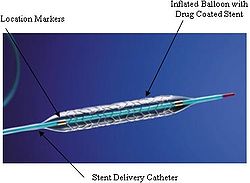
| The most widely known stent use is in the coronary arteries with a bare-metal stent Bare-metal stent Bare-metal stent is a vascular stent without a coating . It is a mesh-like tube of thin wire. The first stents licenced for use in cardiac arteries were bare metal - often 316L stainless steel... , a drug-eluting stent Drug-eluting stent A drug-eluting stent ' is a peripheral or coronary stent placed into narrowed, diseased peripheral or coronary arteries that slowly releases a drug to block cell proliferation. This prevents fibrosis that, together with clots , could otherwise block the stented artery, a process called restenosis... or occasionally a covered stent. Coronary stent Coronary stent A coronary stent is a tube placed in the coronary arteries that supply the heart, to keep the arteries open in the treatment of coronary heart disease. It is used in a procedure called percutaneous coronary intervention... s are placed during a percutaneous coronary intervention Percutaneous coronary intervention Percutaneous coronary intervention , commonly known as coronary angioplasty or simply angioplasty, is one therapeutic procedure used to treat the stenotic coronary arteries of the heart found in coronary heart disease. These stenotic segments are due to the build up of cholesterol-laden plaques... procedure, also known as an angioplasty Angioplasty Angioplasty is the technique of mechanically widening a narrowed or obstructed blood vessel, the latter typically being a result of atherosclerosis. An empty and collapsed balloon on a guide wire, known as a balloon catheter, is passed into the narrowed locations and then inflated to a fixed size... . |
 |
| Ureteral stents are used to ensure the patency of a ureter Ureter In human anatomy, the ureters are muscular tubes that propel urine from the kidneys to the urinary bladder. In the adult, the ureters are usually long and ~3-4 mm in diameter.... , which may be compromised, for example, by a kidney stone Kidney stone A kidney stone, also known as a renal calculus is a solid concretion or crystal aggregation formed in the kidneys from dietary minerals in the urine... . This method is sometimes used as a temporary measure, to prevent damage to a blocked kidney, until a procedure to remove the stone can be performed. Indwelling times of 12 months or longer are indicated to hold ureters open, which are compressed by tumors in the neighbourhood of the ureter or by tumors of the ureter itself. In many cases these tumors are inoperable and the stents are used to ensure drainage of urine through the ureter. If drainage is compromised for longer periods, the kidney can be damaged. The main complications with ureteral stents are dislocation, infection and blockage by encrustation. Recently stents with coatings (e.g. heparin) were approved to reduce infection, encrustation and therefore stent exchanges. |
|
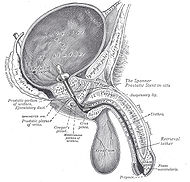
| A urethral or Prostatic stent Prostatic stent A prostatic stent is a stent used to keep open the male urethra and allow the passing of urine in cases of prostatic obstruction and lower urinary tract symptoms . Prostatic obstruction is a common condition with a variety of etiologies... might be needed if a man is unable to urinate. Often this situation occurs when an enlarged prostate pushes against the urethra, blocking the flow of urine. The placement of a stent can open the obstruction. Recent scientific breakthroughs have now meant using a Prostatic stent is a viable method of dis-obstructing the prostate. Stents can be temporary or permanent. Temporary stents can be placed in the Urologist's office in a manner similar to placing a Foley catheter taking less than 10 minutes and using only Lidocaine jelly. Clinical results show the temporary stent is effective and well tolerated. Permanent stents are mostly placed on an outpatient basis under local or spinal anesthesia and usually take about 30 minutes. Clinical results show occurrences of migration, painful wearing and difficult removal. Prostatic/sphinchter stents can be used for draining the bladder in patient with urethra obstruction, or nerve damages to the nerves controlling the bladder. Stents could be placed in the prostate, across the outer and inner sphinchter to achieve a good drainage of the bladder. The patient will need to use diapers, incontinence pants/plastic pants, or a external collection device (external catheter) to collect the urine. |
 |
| Stents are used in a variety of vessels aside from the coronary arteries. Stents may be used as a component of peripheral artery angioplasty. | 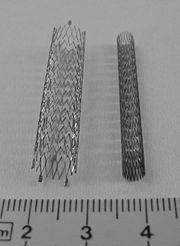 |
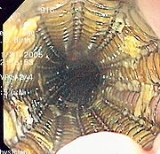
| Esophageal stent Esophageal stent An esophageal stent is a stent placed in the esophagus to keep a blocked area open so the patient can swallow soft food and liquids. Esophageal stents may be self-expandable metallic stents, or made of plastic, or silicone, and may be used in the treatment of esophageal cancer.A 2007 study showed... |
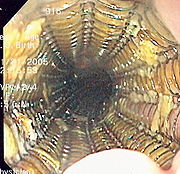 |
| Biliary stent, providing bile drainage | 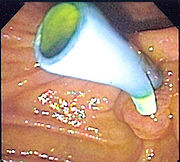 |
| A stent graft is a tubular device, which is composed of special fabric supported by a rigid structure, usually metal. The rigid structure is called a stent. An average stent on its own has no covering, and therefore is usually just a metal mesh. Although there are many types of stent, these stents are used mainly for vascular intervention. The device is used primarily in endovascular surgery Endovascular surgery Endovascular surgery is a form of minimally invasive surgery that was designed to access many regions of the body via major blood vessels.Endovascular techniques were originally designed for diagnostic purposes. Basic techniques involve the introduction of a catheter percutaneously into a large... . Stent grafts are used to support weak points in arteries, such a point commonly known as an aneurysm Aneurysm An aneurysm or aneurism is a localized, blood-filled balloon-like bulge in the wall of a blood vessel. Aneurysms can commonly occur in arteries at the base of the brain and an aortic aneurysm occurs in the main artery carrying blood from the left ventricle of the heart... . Stent grafts are most commonly used in the repair of an abdominal aortic aneurysm Abdominal aortic aneurysm Abdominal aortic aneurysm is a localized dilatation of the abdominal aorta exceeding the normal diameter by more than 50 percent, and is the most common form of aortic aneurysm... , in a procedure called an EVAR. The theory behind the procedure is that once in place inside the aorta Aorta The aorta is the largest artery in the body, originating from the left ventricle of the heart and extending down to the abdomen, where it branches off into two smaller arteries... , the stent graft acts as a false lumen for blood to travel through, instead of flowing into the aneurysm sack. Stent grafts are also commonly placed within grafts and fistulas used for dialysis. These accesses can become obstructed over time, or develop aneurysms similar to other blood vessels in the body. A stent graft can be used in either situation to create an open lumen and prevent blood from flowing outside it. |
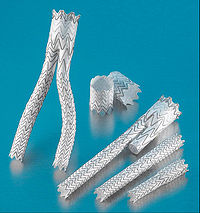 |
| Other types of stents include Duodenal Stents, Colonic Stents, and Pancreatic Stents |
See also
- AngioplastyAngioplastyAngioplasty is the technique of mechanically widening a narrowed or obstructed blood vessel, the latter typically being a result of atherosclerosis. An empty and collapsed balloon on a guide wire, known as a balloon catheter, is passed into the narrowed locations and then inflated to a fixed size...
- BronchoscopyBronchoscopyBronchoscopy is a technique of visualizing the inside of the airways for diagnostic and therapeutic purposes. An instrument is inserted into the airways, usually through the nose or mouth, or occasionally through a tracheostomy. This allows the practitioner to examine the patient's airways for...
- ColonoscopyColonoscopyColonoscopy is the endoscopic examination of the large bowel and the distal part of the small bowel with a CCD camera or a fiber optic camera on a flexible tube passed through the anus. It may provide a visual diagnosis and grants the opportunity for biopsy or removal of suspected...
- EsophagogastroduodenoscopyEsophagogastroduodenoscopyFor other expansions of the initialism "OGD", see the disambiguation page.In medicine , esophagogastroduodenoscopy is a diagnostic endoscopic procedure that visualizes the upper part of the gastrointestinal tract up to the duodenum...
- GrommetGrommetthumb|right|250px|Some rubber grommets.A grommet is a ring inserted into a hole through thin material, such as fabric. Grommets are generally flared or collared on each side to keep them in place, and are often made of metal, plastic, or rubber. They may be used to prevent tearing or abrasion of...
- Interventional RadiologyInterventional radiologyInterventional radiology is a specialty of radiology, in which image-guided procedures are used to diagnose and treat a multitude of diseases across all body systems...
- RestenosisRestenosisRestenosis literally means the reoccurrence of stenosis, a narrowing of a blood vessel, leading to restricted blood flow. Restenosis usually pertains to an artery or other large blood vessel that has become narrowed, received treatment to clear the blockage and subsequently become renarrowed...
- Bioresorbable stentsBioresorbable stentsIn medicine, a stent is any device which is inserted into a blood vessel or other internal duct in order to expand the vessel to prevent or alleviate a blockage. Traditionally, such devices are fabricated from metal mesh and remain in the body permanently or until removed through further surgical...