
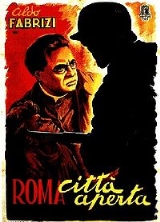
Rome, Open City is a 1945 Italian
warWar films are a film genre concerned with warfare, usually about naval, air or land battles, sometimes focusing instead on prisoners of war, covert operations, military training or other related subjects. At times war films focus on daily military or civilian life in wartime without depicting battles...
drama filmA drama film is a film genre that depends mostly on in-depth development of realistic characters dealing with emotional themes. Dramatic themes such as alcoholism, drug addiction, infidelity, moral dilemmas, racial prejudice, religious intolerance, poverty, class divisions, violence against women...
, directed by
Roberto RosselliniRoberto Rossellini was an Italian film director and screenwriter. Rossellini was one of the directors of the Italian neorealist cinema, contributing films such as Roma città aperta to the movement.-Early life:Born in Rome, Roberto Rossellini lived on the Via Ludovisi, where Benito Mussolini had...
. The picture features
Aldo FabriziAldo Fabrizi was an Italian actor and cinema and theatre director.-Actor Filmography:* Avanti, c'è posto... by Mario Bonnard...
,
Anna MagnaniAnna Magnani was an Italian stage and film actress. She won the Academy Award for Best Actress, along with four other international awards, for her portrayal of a Sicilian widow in The Rose Tattoo....
and
Marcello PaglieroMarcello Pagliero was an Italian film director, actor, and screenwriter.Pagliero was born in London and died in Paris...
, and is set in
RomeRome is the capital of Italy and the country's largest and most populated city and comune, with over 2.7 million residents in . The city is located in the central-western portion of the Italian Peninsula, on the Tiber River within the Lazio region of Italy.Rome's history spans two and a half...
during the
NaziNazism, the common short form name of National Socialism was the ideology and practice of the Nazi Party and of Nazi Germany...
occupation in 1944. The film won several awards at various film festivals and was also nominated for an Academy Award for Best Adapted Screenplay.
Plot
As German soldiers march through town, Giorgio Manfredi eludes them by jumping across the rooftops. A priest, Don Pietro Pellegrini, helps the resistance by transmitting messages and money. Don Pietro is scheduled to officiate Pina's wedding. Francesco, her betrothed, is not very religious, but would rather be married by a patriot priest than a fascist official. Her son, Marcello, and his friends have a small role in the resistance. Pina's sister befriends Marina, Giorgio's former girlfriend, who betrays the resistance in exchange for drugs, fur coats, and other creature comforts.
The
GestapoThe Gestapo was the official secret police of Nazi Germany. Beginning on 20 April 1934, it was under the administration of the SS leader Heinrich Himmler in his position as Chief of German Police...
commander in the city, with the help of the Italian police commissioner, captures Giorgio and the priest, and interrogates Giorgio violently. They attempt to use Pietro's religious beliefs to convince him to betray his cause, citing that he allies himself with atheists. Pietro responds that anyone who strives to help others is on the path of
GodGod is the English name given to a singular being in theistic and deistic religions who is either the sole deity in monotheism, or a single deity in polytheism....
whether they believe in Him or not. They then force Pietro to watch as Giorgio is tortured to death. When Don Pietro still refuses to crack, he is executed.
Cast
- Aldo Fabrizi
Aldo Fabrizi was an Italian actor and cinema and theatre director.-Actor Filmography:* Avanti, c'è posto... by Mario Bonnard...
as Don Pietro Pellegrini
- Anna Magnani
Anna Magnani was an Italian stage and film actress. She won the Academy Award for Best Actress, along with four other international awards, for her portrayal of a Sicilian widow in The Rose Tattoo....
as Pina
- Marcello Pagliero
Marcello Pagliero was an Italian film director, actor, and screenwriter.Pagliero was born in London and died in Paris...
as Giorgio Manfredi, alias Luigi Ferraris
- Vito Annicchiarico as Marcello, Pina's son
- Nando Bruno as Agostino, the Sexton
- Harry Feist as Major Bergmann
- Giovanna Galletti as Ingrid
- Francesco Grandjacquet as Francesco
- Eduardo Passarelli as neighborhood Police Sergeant
- Maria Michi
Maria Michi was an Italian supporting actress who worked with Roberto Rossellini on his two early neorealism masterpieces: Rome, Open City and Paisà. In 1948, she worked with Christian-Jaque in La Chartreuse de Parme...
as Marina Mari
- Carla Rovere as Lauretta, Pina's sister
- Carlo Sindici as Police Commissioner
- Joop van Hulzen as Captain Hartmann
- Ákos Tolnay as Austrian deserter
Production
In August 1944, just two months after the Allies had forced the Germans to evacuate Rome, Rossellini,
Federico FelliniFederico Fellini, Cavaliere di Gran Croce OMRI , was an Italian film director and scriptwriter. Known for a distinct style that blends fantasy and baroque images, he is considered one of the most influential and widely revered filmmakers of the 20th century...
, and
Sergio AmideiSergio Amidei was an Italian screenwriter and an important figure in Italy's neorealist movement.Amidei was born in Trieste. He worked with famed Italian directors such as Roberto Rossellini and Vittorio De Sica...
began working on the script for the film. The devastation that was the result of the war surrounded them as they wrote the script. Shooting for the film began in January 1945. Rossellini relied on traditional devices of melodrama, such as identification of the film's central characters and a clear distinction between good and evil characters. Four interior sets were constructed for the most important locations of the film.
It was believed that the actual film stock was put together out of many different disparate bits, giving the film its iconic documentary or newsreel style. But, when the Cineteca Nazionale restored the print in 1995, "the original negative consisted of just three different types of film: Ferrania C6 for all the outdoor scenes and the more sensitive Agfa Super Pan and Agfa Ultra Rapid for the interiors." The previously unexplained changes in image brightness and consistency are now blamed on "poor processing (variable development times, insufficient agitation in the developing bath and insufficient fixing).
Critical response
This film is considered a quintessential example of
neorealismIn art, neorealism was established by the ex-Camden Town Group painters Charles Ginner and Harold Gilman at the beginning of World War I. They set out to explore the spirit of their age through the shapes and colours of daily life...
in film, so much so that together with
PaisàPaisà is a 1946 Italian film directed by Roberto Rossellini, the second of a trilogy by Rossellini. It is divided into six episodes. They are set in the Italian Campaign during World War II when Nazi Germany was losing the war against the Allies, using themes such as the difficulty of communication...
and
Germania anno zero it is called Rossellini's "Neorealist Trilogy." Robert Burgoyne called it "the perfect exemplar of this mode of cinematic creation [neorealism] whose established critical definition was given by
André BazinAndré Bazin was a renowned and influential French film critic and film theorist.-Life:Bazin was born in Angers, France, in 1918...
." More recent scholarship points out that this film is actually less neo-realist and rather melodramatic.
Critics debate whether the pending marriage of the Catholic Pina and the communist Francesco really "acknowledges the working partnership of communists and Catholics in the actual historical resistance."
Bosley CrowtherBosley Crowther was a journalist and author who was film critic for The New York Times for 27 years. His reviews and articles helped shape the careers of actors, directors and screenwriters, though his reviews, at times, were unnecessarily mean...
, film critic for
The New York TimesThe New York Times is an American daily newspaper founded and continuously published in New York City since 1851. The New York Times has won 106 Pulitzer Prizes, the most of any news organization...
, gave the film a highly positive review, and wrote, "Yet the total effect of the picture is a sense of real experience, achieved as much by the performance as by the writing and direction. The outstanding performance is that of Aldo Fabrizi as the priest, who embraces with dignity and humanity a most demanding part. Marcello Pagliero is excellent too, as the resistance leader, and Anna Magnani brings humility and sincerity to the role of the woman who is killed. The remaining cast is unqualifiedly fine, with the exception of Harry Feist in the role of the German commander. His elegant arrogance is a bit too vicious—but that may be easily understood."
Distribution
The film opened in Italy on September 27, 1945, with the war damage to Rome not yet repaired. The
United StatesThe United States of America is a federal constitutional republic comprising fifty states and a federal district...
premiere followed on February 25, 1946 in
New YorkNew York is a state in the Northeastern region of the United States. It is the nation's third most populous state. New York is bordered by New Jersey and Pennsylvania to the south, and by Connecticut, Massachusetts and Vermont to the east...
. The American release was censored, resulting in a cut of about 15 minutes. The story of the film's journey from Italy to the United States is recounted in
Federico FelliniFederico Fellini, Cavaliere di Gran Croce OMRI , was an Italian film director and scriptwriter. Known for a distinct style that blends fantasy and baroque images, he is considered one of the most influential and widely revered filmmakers of the 20th century...
's autobiographical essay, "Sweet Beginnings." Rod Geiger, a U.S. Army private stationed in Rome, met Rossellini and Fellini as they were working on the movie. According to Fellini's essay, Geiger was "a 'half-drunk' soldier who stumbled (literally as well as figuratively) onto the set of
Open City. [He] misrepresented himself as an American producer when actually he 'was a nobody and didn't have a dime.'"
http://cases.justia.com/us-court-of-appeals/F2/719/515/148907/ Nonetheless, Geiger ended up with a reel of
Open City, brought it back to the U.S. in his barracks bags, and managed to get the film released in theaters.
Fellini's account of Geiger's involvement in the film was the subject of a defamation lawsuit brought by Geiger against Fellini.
http://cases.justia.com/us-court-of-appeals/F2/719/515/148907/ The film was banned in several countries. For example,
West GermanyWest Germany is the common English, but not official, name for the Federal Republic of Germany or FRG in the period between its creation in May 1949 to German reunification on 3 October 1990....
banned the picture from 1951-1960. In
ArgentinaArgentina , officially the Argentine Republic , is the second largest country in South America by land area, after Brazil. It is constituted as a federation of 23 provinces and an autonomous city, Buenos Aires...
, the film was inexplicably withdrawn in 1947 following an anonymous government order.
Awards
Wins
- Cannes Film Festival
The Cannes International Film Festival , is an annual film festival held in Cannes, France, which previews new films of all genres including documentaries from around the world. Founded in 1946, it is among the world's most prestigious and publicized film festivals...
: Grand Prize of the Festival; Roberto Rossellini; 1946.
- Italian National Syndicate of Film Journalists: Silver Ribbon; Best Film; Best Supporting Actress, Anna Magnani; 1946.
- National Board of Review: NBR Award Best Actress; Anna Magnani; Best Foreign Film, Italy; 1946.
- New York Film Critics Circle Awards
New York Film Critics' Circle Awards are given annually to honor excellence in cinema worldwide by an organization of film reviewers from New York City-based publications. It is considered one of the most important precursors to the Academy Awards....
: NYFCC Award Best Foreign Language Film, Italy; 1946.
External links