Home      Discussion      Topics      Dictionary      Almanac
Signup       Login
Oldsmobile Toronado

Oldsmobile Toronado

Overview

Discussion
Ask a question about 'Oldsmobile Toronado'
Start a new discussion about 'Oldsmobile Toronado'
Answer questions from other users
Full Discussion Forum
 
Unanswered Questions
Encyclopedia

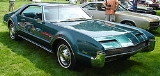
The original Toronado began as a design painting by Oldsmobile stylist David North in 1962. His design, dubbed the "Flame Red Car," was for a compact sports/personal car never intended for production. A few weeks after the design was finished, however, Oldsmobile division was informed it would be permitted to build a personal car in the Riviera/Thunderbird class for the 1966 model year, and North's design was selected. For production economy, the still-unnamed car was to share the so-called E-body
GM E platform
The General Motors E platform or E-Body was the automobile platform designation used for a number of personal luxury cars produced from 1963 to 2002...

 shell with the redesigned 1966 Buick Riviera
Buick Riviera
The Riviera by Buick is an automobile produced by Buick in the United States from the 1963 to 1999 model years, with 1,127,261 produced.A full-size coupé or personal luxury car, the early models of the Riviera in particular have been highly praised by automotive journalists and writers.A common...

, which was substantially bigger than North had envisioned. Despite the efforts of Oldsmobile and General Motors styling chief Bill Mitchell to put the car on the smaller A-body
GM A platform (RWD)
The General Motors A platform was a rear wheel drive automobile platform designation used from at least 1939 up until 1981...

 intermediate, they were overruled for cost reasons.

Oldsmobile had been working on front-wheel drive since 1958, a project shepherded by engineer John Beltz
John Beltz
John Beltz was Oldsmobile's chief engineer in 1964 and one of the prime movers of the Oldsmobile Toronado and 442 project. Beltz was promoted to Oldsmobile general manager at age 43 in 1969 when Harold N. Metzel retired. Beltz died in May 1972 from cancer at the age of 46. He was revered in the...

 (who originated the 442
Oldsmobile 442
The Oldsmobile 442 was a muscle car produced by the Oldsmobile division of General Motors. It was introduced as an option package for F-85 and Cutlass models sold in the United States beginning with the 1964 model year. It became a model in its own right from 1968 to 1971, then reverted to an...

 and would later become head of the division). Although initially envisioned for the smaller F-85 line
Oldsmobile Cutlass
The Oldsmobile Cutlass is a line of automobiles made by the Oldsmobile division of General Motors. The Cutlass began as a unibody compact car, but saw its greatest success as a body-on-frame intermediate car....

, its cost and experimental nature pushed the program towards a larger, more expensive car. Engineer F. J. Hooven of the Ford Motor Company
Ford Motor Company
Ford Motor Company is an American multinational automaker based in Dearborn, Michigan, a suburb of Detroit. The automaker was founded by Henry Ford and incorporated on June 16, 1903. In addition to the Ford and Lincoln brands, Ford also owns a small stake in Mazda in Japan and Aston Martin in the UK...

, had patented a similar FWD layout, and Ford was seriously considering the design for the 1961 Ford Thunderbird. However, the time to develop and engineer such a design in such short notice made this a doubtful proposition.

Oldsmobile spent seven years developing the Toronado. Prior to its introduction to the public, over 1.5 million brutal test miles had been performed to verify the strength and reliability of the Toronado's front-drive components. Obviously, Oldsmobile did not want anyone to experience problems with the new design. History has confirmed the Toronado design was indeed heavily over-built; the GMC motorhome
GMC motorhome
The GMC motorhome was produced by the GMC Truck & Coach Division of General Motors for the 1973 through 1978 model years in Pontiac, Michigan, USA. It was the only complete motorhome built by a major auto/truck manufacturer producing what GMC hoped would be their halo vehicle...

 of the 1970s, which used a basically unchanged Toronado-derived drivetrain, stands as a testament to that fact. Nevertheless, the re-introduction of front wheel drive earned the new Toronado Motor Trend
Motor Trend
Motor Trend is an American automobile magazine. It first appeared in September 1949, issued by Petersen Publishing Company in Los Angeles, and bearing the tag line "The Magazine for a Motoring World". Petersen Publishing was sold to British publisher EMAP in 1998, who sold the former Petersen...

"Car of the Year" honors in 1966.

Naming the Toronado was also an event in itself. Some other known names being considered during development are: Magnum (later used by Dodge
Dodge
Dodge is a United States-based brand of automobiles, minivans, and sport utility vehicles, manufactured and marketed by Chrysler Group LLC in more than 60 different countries and territories worldwide....

), Scirocco (later used by Volkswagen
Volkswagen
Volkswagen is a German automobile manufacturer and is the original and biggest-selling marque of the Volkswagen Group, which now also owns the Audi, Bentley, Bugatti, Lamborghini, SEAT, and Škoda marques and the truck manufacturer Scania.Volkswagen means "people's car" in German, where it is...

) and Raven.

During its seven-year development period, several General Motors innovations and designs came about because of the Toronado:
  • Heavy-duty Turbo-Hydramatic
    Turbo-Hydramatic
    Turbo-Hydramatic is the registered tradename of a family of automatic transmissions developed and produced by General Motors. These transmissions mate a three-element torque converter to a Simpson planetary geartrain, providing three forward speeds plus reverse.The Turbo-Hydramatic series was...

     400 3-speed automatic transmission (named THM425 in FWD
    Front-wheel drive
    Front-wheel drive is a form of engine/transmission layout used in motor vehicles, where the engine drives the front wheels only. Most modern front-wheel drive vehicles feature a transverse engine, rather than the conventional longitudinal engine arrangement generally found in rear-wheel drive and...

     form)
  • Rochester Quadrajet
    Quadrajet
    In automobile mechanics, the Quadrajet is a four-barrel carburetor made by the Rochester Products Division of GM that was widely used in General Motors motor vehicles until 1990...

     4-barrel carburetor
  • Spherical shaped exhaust-manifold flange gaskets, which provided freedom of movement in the exhaust system and prevented leaks
  • "Draft-Free" ventilation system, which reduced wind noise considerably by eliminating the conventional front-door vent windows


Firestone
Firestone Tire and Rubber Company
The Firestone Tire and Rubber Company is an American tire company founded by Harvey Firestone in 1900 to supply pneumatic tires for wagons, buggies, and other forms of wheeled transportation common in the era. Firestone soon saw the huge potential for marketing tires for automobiles. The company...

 also designed an 8.85" x 15" tire especially for the Toronado called the TFD (Toronado-Front-Drive) tire. It had a stiffer sidewall than normal, and the tread and stylishly thin white pin-stripe were also unique.

The unusual Toronado powertrain was dubbed the Unitized Power Package (UPP). It was designed to combine an engine and transmission into an engine bay no larger than a conventional rear-wheel drive car.

To power the car, Oldsmobile engineers selected a conventional, although performance-boosted, Olds 425 cu in (7.0 L) Super Rocket V8 rated at 385 hp (287 kW) and 475 ft·lb (644 Nm) of torque. It provided an increase of 10 hp over the Starfire
Oldsmobile Starfire
Oldsmobile Starfire are automobiles produced by the Oldsmobile division of General Motors in two generations from 1961–1966 and 1975–1980. The Starfire nameplate was also used for the 1954–1956 Ninety- Eight series convertibles, and all 1957 Ninety-Eight series models. 1961 was the first year for...

 425, and an increase of 20 hp over the standard 425 engine in the Ninety-Eight
Oldsmobile 98
The Oldsmobile 98 was a full-size automobile and the flagship model of the Oldsmobile division of General Motors. The name first appeared in 1941 and was used again after American consumer automobile production resumed post-World War II...

. The Toronado's intake manifold was unique and was depressed down to allow for engine hood clearance.

The Turbo-Hydramatic heavy-duty 3-speed automatic transmission, (or THM400, TH400) came about during development of the Toronado. Called the TH425 in FWD form, the transmission's torque converter
Torque converter
In modern usage, a torque converter is generally a type of hydrodynamic fluid coupling that is used to transfer rotating power from a prime mover, such as an internal combustion engine or electric motor, to a rotating driven load...

 was separated from its planetary gearset
Epicyclic gearing
Epicyclic gearing or planetary gearing is a gear system consisting of one or more outer gears, or planet gears, revolving about a central, or sun gear. Typically, the planet gears are mounted on a movable arm or carrier which itself may rotate relative to the sun gear...

, with the torque converter driving the gearset through a 2" wide silent chain-drive called Hy-Vo, riding on two 12" sprockets. The Hy-Vo chain drive was developed by GM's Hydra-Matic Division and Morse Chain Division of Borg-Warner. The chains were made from a very strong hardened steel and required no tensioners or idler pulleys because they were pre-stretched on a special machine at the factory. Although the rotation direction of the transmission's gearing had to be reversed, a large number of components were shared with the conventional TH400. Use of the automatic also obviated the need to devise a workable manual-shift linkage; no manual transmission was ever contemplated, as engineers deemed performance to be adequate with the automatic transmission
Automatic transmission
An automatic transmission is one type of motor vehicle transmission that can automatically change gear ratios as the vehicle moves, freeing the driver from having to shift gears manually...

 and the fact that virtually all U.S.-built luxury cars during this period came with automatic transmissions as standard equipment.

The Toronado was GM's first subframe
Subframe
A subframe is a structural component of a vehicle, such as an automobile or an aircraft, that uses a discrete, separate structure within a larger body-on-frame or unit body to carry certain components, such as the engine, drivetrain, or suspension. The subframe is bolted and/or welded to the vehicle...

 automobile, which means it was partly unitized
Monocoque
Monocoque is a construction technique that supports structural load by using an object's external skin, as opposed to using an internal frame or truss that is then covered with a non-load-bearing skin or coachwork...

, and used a subframe that ended at the forward end of the rear suspension leaf springs, serving as an attachment point for the springs. It carried the powertrain, front suspension and floorpan, allowing greater isolation of road and engine harshness (the design was conceptually similar to the Chevrolet Camaro
Chevrolet Camaro
The Chevrolet Camaro is an automobile manufactured by General Motors under the Chevrolet brand, classified as a pony car and some versions also as a muscle car. It went on sale on September 29, 1966, for the 1967 model year and was designed as a competing model to the Ford Mustang...

 and Pontiac Firebird
Pontiac Firebird
The Pontiac Firebird was built by the Pontiac division of General Motors between 1967 and 2002. The Firebird was introduced the same year as the automaker's platform-sharing model, the Chevrolet Camaro...

 that would debut for 1967).

For space reasons, Oldsmobile adopted torsion bars
Torsion spring
A torsion spring is a spring that works by torsion or twisting; that is, a flexible elastic object that stores mechanical energy when it is twisted. The amount of force it exerts is proportional to the amount it is twisted. There are two types...

 for the Toro's front suspension (the first GM passenger car application of torsion bars), with conventional, unequal-length double wishbones. Rear suspension was a simple beam axle
Beam axle
A beam axle is a suspension system, also called a solid axle, in which one set of wheels is connected laterally by a single beam or shaft...

 on single leaf springs, unusual only in having dual shock absorber
Shock absorber
A shock absorber is a mechanical device designed to smooth out or damp shock impulse, and dissipate kinetic energy. It is a type of dashpot.-Nomenclature:...

s, one vertical, one horizontal (allowing it to act as a radius rod
Radius rod
A radius rod is a suspension member intended to control wheel motion in the longitudinal plane. The link is connected on one end to the wheel carrier or axle, on the other to the chassis or unibody of the vehicle.Radius rods typically are mounted ahead of the wheel...

 to control wheel movement).

Brakes were conventional drums
Drum brake
A drum brake is a brake in which the friction is caused by a set of shoes or pads that press against a rotating drum-shaped part called a brake drum....

 of 11 inch (279 mm) diameter), which were generally considered the Toronado's weak link. Being a rather heavy car, after several panic stops, the brake drums would overheat, resulting in considerable fade and long stopping distances. The 1967 addition of front vented disc brake
Disc brake
The disc brake or disk brake is a device for slowing or stopping the rotation of a wheel while it is in motion.A brake disc is usually made of cast iron, but may in some cases be made of composites such as reinforced carbon–carbon or ceramic matrix composites. This is connected to the wheel and/or...

s as an option provided substantial improvement.

The Toronado's UPP enabled the interior to have a completely flat floor, but interior space (primarily rear seat headroom) was somewhat restricted by the fastback
Fastback
A fastback is a car body style whose roofline slopes continuously down at the back. The word can also designate the car itself. The style is seen on two-door coupés as well as four-door sedans.-History:...

 styling. Although a two door coupe, the Toronado featured elongated doors, allowing easier access for passengers boarding the rear seating area. Even rear-mounted handles were available optionally to enable rear-seat passengers to open the doors without reaching across the front seat back; this feature was also available on Imperial
Imperial (automobile)
Imperial was the Chrysler Corporation's luxury automobile brand between 1955 and 1975, with a brief reappearance in 1981 to 1983.The Imperial name had been used since 1926, but was never a separate make, just the top-of-the-line Chrysler. In 1955, the company decided to spin it off as its own make...

 cars of the era. Head rests were optional for $52. Also optional was a tilt-telescopic.

Drivers faced a highly stylized steering wheel with a double-delta shaped horn ring, which framed the view of an unusual speedometer which consisted of a stationary indicator "needle" and a vertically rotating drum on which the numerals were printed. All other gauges, indicators and controls were grouped within fairly easy reach of the driver.

Despite an average test-weight approaching 5,000 lb (2,300 kg), published performance test data shows the 1966 Toronado was capable of accelerating from 0–60 mph (0–97 km/h) in 7.5 seconds, and through the standing 1/4 mile (~400 m) in 16.4 seconds at 93 mph (150 km/h). It was also capable of a maximum speed of 135 mph (217 km/h). Testers found the Toro's handling, despite its noticeable front weight bias and consequent understeer
Understeer
Understeer and oversteer are vehicle dynamics terms used to describe the sensitivity of a vehicle to steering. Simply put, oversteer is what occurs when a car turns by more than the amount commanded by the driver...

, was not substantially different from other full-size American cars when driven under normal conditions. In fact, many contemporary testers felt that the Toronado was more poised and responsive than other cars, and when pushed to the limits, exhibited superior handling characteristics, although it was essentially incapable of terminal oversteer.

A special option code called W-34 was available on the 1968–70 Toronado. This option included a cold air induction system for the air cleaner, a special performance camshaft and a "GT" transmission calibrated for quick and firm up-shifts and better torque multiplication at 5 mph (8 km/h). Dual exhaust outlets similar to the 1966–67 model years with cutouts in the bumper were also included with W-34. The standard models did have dual exhaust systems, but only a single somewhat hidden outlet running from the muffler exiting rearward on the right side. For 1970 only, the W-34 option also included special "GT" badges on the exterior of the car. The W-34 Toronado was capable of 0–60 mph in 7.5 seconds and the standing 1/4 mile in 15.7 seconds at 89.8 mph (144.5 km/h).

The Toronado sold reasonably well at introduction, with 40,963 produced for 1966. The car also gained great publicity for the division by winning several leading automotive awards, such as Motor Trend
Motor Trend
Motor Trend is an American automobile magazine. It first appeared in September 1949, issued by Petersen Publishing Company in Los Angeles, and bearing the tag line "The Magazine for a Motoring World". Petersen Publishing was sold to British publisher EMAP in 1998, who sold the former Petersen...

's Car of the Year
Car of the Year
Car of the Year is a phrase usually considered to have been invented by Motor Trend magazine in the 1950s for their annual award for best American automobile...

 Award and Car Life's Award for Engineering Excellence. It also was a third-place finisher in the European Car of the Year
European Car of the Year
The European Car of the Year award was established in 1964 by a collective of automobile magazines from different countries in Europe. The current organisers of the award are Auto , Autocar , Autopista , Autovisie , L'Automobile Magazine , Stern and Vi Bilägare .The voting jury consists of motoring...

 competition.

Sales for the 1967 model, which was most notably distinguished by a slight facelift, the addition of optional disc brakes, and a slightly softer ride, dropped by nearly half, to 22,062. A stereo tape player was optional. It would be 1971 before the Toro would match its first-year sales mark.

In 1967 Cadillac
Cadillac
Cadillac is an American luxury vehicle marque owned by General Motors . Cadillac vehicles are sold in over 50 countries and territories, but mostly in North America. Cadillac is currently the second oldest American automobile manufacturer behind fellow GM marque Buick and is among the oldest...

 adopted its own version of the UPP for the Cadillac Eldorado
Cadillac Eldorado
The 1953 Eldorado was a special-bodied, low-production convertible . It was the production version of the 1952 El Dorado "Golden Anniversary" concept car, and borrowed bumper bullets from the 1951 GM Le Sabre show car...

, using the Cadillac V8 engine
Cadillac V8 engine
Cadillac was the first automobile maker to mass produce a V8 engine. The company has produced eight generations of V8s since 1914, and was the last General Motors division to retain its own V8 design.-L-Head:...

. The Eldorado also shared the basic E-body shell with the Toronado and Riviera, but its radically different styling meant that the three cars did not look at all similar.

The first-generation Toronado lasted with the usual annual facelifts through 1970. Other than the brakes, the major changes were the replacement of the original 425 cu in (7.0 L) V8 with the new 455 cu in (7.5 L) in 1968 that was rated at 375 hp in standard form or 400 hp with the W-34 option, revised rear quarter panels (with small fins to disguise the slope of the rear body in side view) in 1969, and the disappearance of hidden headlights and the introduction of squared wheel arch bulges in 1970. A ignition lock became standard in 1969.

Slight interior cosmetic changes were also implemented for each new model year, and a full-length center console with floor-mounted shifter was available as an extra-cost option with the Strato bucket seats from 1968 to 1970, though few Toronados were so ordered. The vast majority of customers went for the standard Strato bench seat to take full advantage of the flatter floor resulting from the front-drive layout; the lack of a "hump" in the floor made three-abreast seating more comfortable than in rear-drive cars, as the center passengers both front and rear did not have to sit with their legs in an awkward position.

The firmness of the suspension, and thus the quality of the ride, was gradually softened through the years as well, hinting at what Toronado eventually would become in 1971. Interestingly, a heavy-duty suspension was offered optionally on later first generation Toronados, which included the original torsion bar springs that were used on the 1966.

Manufacturer's specifications
  • Engine: 1966–67 - 425 cu in (7.0 L) OHV V8, 1968–70 - 455 cu in (7.5 L) OHV V8
  • Power: 1966–67 - 385 hp (287 kW) @ 4800 rpm, 1968–70 - 375 hp (280 kW) @ 4400 rpm, 400 (298 kW) @ 5000 rpm with option code W-34
  • Torque: 1966–67 – 475 ft·lbf (644 N•m) @ 3200 rpm, 1968–70 – 510 ft·lbf (691 N•m) @ 3000 rpm, 500 ft·lbf (678 N•m) @ 3200 rpm with option code W-34
  • Transmission: 3-speed automatic, Turbo-Hydramatic 425 (THM-425)
  • Final drive ratio: 1966–67 - 3.21:1, 1968–70 - 3.07:1
  • Wheelbase: 119.0" (3023 mm)
  • Overall length: 1966–67 - 211" (5359 mm), 1968 - 211.6" (5375 mm), 1969–70 - 214.8" (5456 mm)
  • Overall height: 52.8" (1341 mm)
  • Overall width: 78.5" (1994 mm)
  • Track, front/rear: 63.5" (1613 mm) / 63.0" (1600 mm)
  • Weight, shipping/curb: 4311/4,496 lb (1955/2039 kg)
  • Weight distribution, front/rear (%): 60.3/39.7

Limousine conversion


During the late 1960s (1968), the only Oldsmobile professionally made into a limousine was the Toronado, known as the AQC Jetway 707. The 707 rode on six wheels. Only a handful were built.

Second generation, 1971–1978


With radically different styling than the first generation, the Toronado had metamorphosed from a "GT"-style car into something more traditional in the luxury car field. It was now more similar to the Cadillac Eldorado than the Buick Riviera, with styling taking several cues from the 1967-70 Eldorado. The new look attracted many new buyers, as sales increased dramatically. Front disc brakes became standard.

All overall dimensions of the '71 Toronado were larger than previous models with wheelbase increased from 119 to 122 inches (3,098.8 mm), only two inches less than the full-sized Delta 88. Also, the subframe design of first-generation Toronados was replaced by a separate body-on-frame similar to full-sized Delta 88
Oldsmobile 88
The Oldsmobile 88 was a full-size car sold by the Oldsmobile division of General Motors and produced from 1949 until 1999. From 1950 to 1974 the 88 was the division's top-selling line, particularly the entry-level models such as the 88 and Dynamic 88...

 and Ninety-Eight models. The front torsion bar suspension was retained, but the multi-leaf springs in the rear were replaced by coil springs. In addition, the Toronado introduced as a novelty what later became a federal mandate in a modified form, two high-mounted taillights above the trunk and below the rear window. These taillights mirrored brake and turn functions of the normal taillights, but not the nighttime taillights. A rear-wheel ABS
ABS
- Anatomy :* Abdominal muscles , which is the rectus abdominis or the stomach muscles-Music and media:Music ensembles* A.B.'s, a Japanese 80's instrumental band* Abingdon Boys School, a Japanese rock band...

 became optional.

The 455 cubic-inch Rocket V8 was carried over from previous models as the standard Toronado engine. The introduction of the second-generation Toronado coincided with the implementation of a GM corporate edict that took effect with the 1971 models; all engines had to run on lower-octane regular leaded, low lead or unleaded gasoline to meet increasing more stringent Federal (and California) emission control regulations, a goal that was reached by reducing compression ratios. This was a first step toward the introduction of catalytic converters in 1975, which mandated the use of unleaded fuel. The '71 Toronado's 455 cubic-inch V8 was rated at 350 horsepower (down from 375 in 1970) with a compression ratio of 8.5 to 1 (down from 10.5 to 1 in 1970).

For 1972, the advertised horsepower rating for the 455 engine dropped to 250 thanks to a switch in power measurements from the gross ratings in which power was measured by a dynometer with no accessories attached to "net" ratings which were measured as installed in a vehicle with all accessories and emissions equipment attached. By 1976, the last year for the 455 engine in the Toronado, the rating dropped to 215 net horsepower.

The 1971–78 generation is mainly noted for the early use of two safety features that are now required on all cars in the United States, the aforementioned high mounted taillights (although a somewhat similar feature had appeared briefly as an option on the Ford Thunderbird
Ford Thunderbird
The Thunderbird , is an automobile manufactured by the Ford Motor Company in the United States over eleven model generations from 1955 through 2005...

 in the late 1960s), and from 1974 through 1976, the Toronado was part of GM's first experimental production run of driver- and passenger-side airbag
Airbag
An Airbag is a vehicle safety device. It is an occupant restraint consisting of a flexible envelope designed to inflate rapidly during an automobile collision, to prevent occupants from striking interior objects such as the steering wheel or a window...

s, which GM named the Air Cushion Restraint System. These Toronados used a unique steering wheel and were fitted with a knee blocker beneath the driver's portion of the dashboard.

Styling/engineering highlights through the years included disc brakes with audible wear indicators for 1972, a federally-mandated 5 MPH front bumper along with new vertical taillights in 1973, a stand-up hood ornament, 5 MPH rear bumper and optional fixed rear side opera windows in 1974 and rectangular headlights in 1975.

During most of the Toronado's second-generation run, two interior trims were generally offered each year. The standard interior trim consisted of a choice of cloth or vinyl upholstery and a Custom Sport notchback bench seat with center armrest. An optional Brougham interior available in cloth, velour or vinyl trims included cut-pile carpeting, door-mounted courtesy lighting and a split 60/40 bench seat with armrest. From 1971 to 1973, the Toronado's "Command Center" wrap-around instrument panel was similar to other full-sized Oldsmobiles featuring a large squared speedometer directly in front of the driver, heating/air conditioning and lights/wipers switches on the left hand side and the radio controls and cigar lighter on the right hand side. From 1974 to 1978, a flat instrument panel (again shared with Delta 88 and Ninety-Eight models) was used that featured a horizontal sweep speedometer flanked by a "Message Center" of warning lights, fuel gauge and shift quadrant, with the other controls in the same locations as in previous years.

As befitting a luxury car, Toronados featured a long list of standard equipment that included Turbo Hydra-Matic transmission, variable-ratio power steering, power front disc brakes along with an electric clock, carpeting and deluxe wheel covers. Virtually all Toronados were sold loaded with extra-cost options including air conditioning, AM/FM stereo with 8-track tape player, power trunk release, vinyl roof, tilt and telescopic steering wheel, cruise control, power windows, power door locks and six-way power seats. Power windows became standard equipment in 1975. A new feature in 1975 was a gauge that monitored if the driver was driving economically or not.

The later years of this generation of Toronado saw new features mostly confined to minor styling tweaks to the grille and trim, although in 1977, the XS and XSR models debuted. Both featured a three-sided, hot wire "bent-glass" rear window (image) and, on the XSR, electric t-tops which slid inwards at the touch of a button. However, as built in prototype form, the XSR had no means of channeling water away from the retractable sections, meaning that the car leaked mercilessly in the rain. No one, it seems, could come up with a workable solution to the problem within the design, so only the single prototype was built ... and that portion of the project quietly died. The XS, which did enter production, was offered with GM's more reliable (and no doubt more leak-resistant) Astroroof sliding sunroof instead. Air conditioning was standard.

The running factory "XSR" prototype was documented as "restored" by Collectible Automobile Magazine in the late 1990s.

Also for 1977, the 455 cu in (7.5 L) V8 was replaced by a smaller 403 cu in (6.6 L) engine, due mainly to forthcoming government fuel efficiency standards (known as CAFE
Café
A café , also spelled cafe, in most countries refers to an establishment which focuses on serving coffee, like an American coffeehouse. In the United States, it may refer to an informal restaurant, offering a range of hot meals and made-to-order sandwiches...

, and implemented beginning with the 1978 model year). In addition, the '77 Delta 88 and Ninety-Eight models, formerly the biggest cars in the Oldsmobile stable, were downsized. For two more model years, the Toronado would be the largest Oldsmobile, and, after the mid-sized Cutlass line's downsizing for '78, the Toronado looked hopelessly out of place in the Olds lineup, given the industry-wide shift to smaller cars.

This generation was probably helped in the sales race by the radical and controversial "boat-tail" (image) design of the contemporary Buick Riviera
Buick Riviera
The Riviera by Buick is an automobile produced by Buick in the United States from the 1963 to 1999 model years, with 1,127,261 produced.A full-size coupé or personal luxury car, the early models of the Riviera in particular have been highly praised by automotive journalists and writers.A common...

, since during this period the Toronado outsold its Buick
Buick
Buick is a premium brand of General Motors . Buick models are sold in the United States, Canada, Mexico, China, Taiwan, and Israel, with China being its largest market. Buick holds the distinction as the oldest active American make...

 cousin for the first time. However, the higher-priced Cadillac Eldorado
Cadillac Eldorado
The 1953 Eldorado was a special-bodied, low-production convertible . It was the production version of the 1952 El Dorado "Golden Anniversary" concept car, and borrowed bumper bullets from the 1951 GM Le Sabre show car...

 managed, in turn, to outsell the Toronado in most of these years.

Third generation, 1979–1985


The third generation Toronado debuted in the fall of 1978 as a 1979 model. The car lost nearly 1000 pounds (453.6 kg) and more than 20 inches (508 mm) in length, shrinking to a 114 inches (2,895.6 mm) wheelbase and an overall length of 204 inches (5,181.6 mm), all the while gaining passenger space.

This newly-downsized Toronado came equipped with smaller engines than in previous years including Oldsmobile Rocket V8s of 350 cu in (5.7 L) and, beginning in 1980, the 307 cu in (5.0 L).
Still later, a larger 252 cu in (4.1 L) version of the Buick V6 was made available from 1981 to 1984, but it proved unpopular due to its slow acceleration; despite its massive diet, after all, the Toronado was still a fairly heavy automobile, and it would take another downsizing before a six-cylinder engine of any kind could move it effectively.

Also offered in these years was Oldsmobile's new diesel V8, converted from Olds' well-regarded gasoline-powered 350 cu in (5.7 L) V8. This engine was novel and economical, and sales were initially good. Unfortunately, the diesel conversion acquired a terrible mechanical reputation, becoming a genuine black eye for Oldsmobile. Many cars which originally came diesel-equipped were eventually converted to gasoline engines when disgusted owners finally threw in the towel.

The three-speed Turbo Hydra-Matic automatic transmission
Automatic transmission
An automatic transmission is one type of motor vehicle transmission that can automatically change gear ratios as the vehicle moves, freeing the driver from having to shift gears manually...

 was standard equipment from 1979 to 1981 and replaced by the four-speed Turbo Hydra-Matic 325-4L overdrive unit from 1982 to 1985. The 307 cubic-inch Rocket V8 was standard on 1985 Toronados.

Independent rear suspension
Independent suspension
Independent suspension is a broad term for any automobile suspension system that allows each wheel on the same axle to move vertically independently of each other. This is contrasted with a beam axle, live axle or deDion axle system in which the wheels are linked – movement on one side affects...

 (designed by Cadillac
Cadillac
Cadillac is an American luxury vehicle marque owned by General Motors . Cadillac vehicles are sold in over 50 countries and territories, but mostly in North America. Cadillac is currently the second oldest American automobile manufacturer behind fellow GM marque Buick and is among the oldest...

 engineers) was adopted for the new car, which helped to increase usable rear-seat and trunk space in the smaller body, as well as improved handling over previous Toronados with no sacrifice in ride quality. Rear disc brakes were optional.
In addition to the base Toronado Brougham, various trim packages were available under the XSC (1980–81) and Caliente (1984–85) names were offered along with choices of velour or leather upholstery and digital instrumentation. The third-generation Toronado was also made into convertibles by the American Sunroof Company, with a power-operated cloth top. Reclining backrests were and option.< ref>

This Toronado, along with its Riviera and Eldorado cousins, were the last body-on-frame, front wheel drive cars with longitudinally-mounted V8 engines.

Fourth generation, 1986–1992


The fourth and, as it proved, final generation Toronado was on the market from 1986 to 1992. It was even smaller, lost its body-on-frame construction in favor of a unibody platform, and was the first Toronado since 1969 to feature hidden headlights.

V8 engines were gone, with the fuel-injected version of the Buick 231 cu in (3.8 L) V6
Buick V6 engine
The Buick V6, initially marketed as Fireball at its introduction in 1962, was a large V6 engine used by General Motors. The block is made of cast iron and all use two-valve-per-cylinder iron heads, actuated by pushrods....

, now the only powerplant available. A good, powerful engine, it was well-suited to this much smaller, lighter car.

Inside, a new digital instrument panel and optional voice alert system were employed and the same luxury trappings were offered as standard equipment and options as before. Standard seating was a cloth 60/40 bench with center armrest. For the first time since 1970, Strato bucket seats were offered as an option, and they included a full-length center console with a horseshoe-like "basket handle" gear shift similar to that found in some 1960s and 1970s Buicks and Chevrolets. Upholstery choices included cloth or leather.

Unfortunately, GM's timing with this latest downsizing proved to be off the mark. Gasoline prices had dropped dramatically — below $1.00 per gallon in many parts of the U.S. — by the fall of 1985, against corporate soothsayers' predictions of $3.00 and up. Buyers, faced with GM's spate of stubby new choices across the board, chose instead to "buy big" in 1986, with cars like the Lincoln Town Car
Lincoln Town Car
The Lincoln Town Car is a full-size luxury sedan that was sold by the upscale Lincoln division of Ford Motor Company; it was produced from 1981 to the 2011 model years...

 and Chrysler's long-in-the-tooth, V8-powered Fifth Avenue
Chrysler Fifth Avenue
With the R-body out of production and the LeBaron name transferred to the Chrysler K platform for 1982, the New Yorker was downsized once again, becoming a mid-sized car ....

 setting sales records for the '86 model year.

Sadly, along with its shrunken sisters, the Eldorado and Riviera, the Toronado suffered a serious sales decline which would never be reversed. Critics blamed the downsizing, as well as "cookie cutter" styling that looked too much like the cheaper, less-luxurious compacts at GM, notably the Oldsmobile Calais and Pontiac Grand Am
Pontiac Grand Am
The original Grand Am was introduced in the fall of 1972 as a 1973 model. It was based on the GM A platform along with other cars such as the Pontiac LeMans, Pontiac GTO, Chevrolet Chevelle, Buick Century, and the Oldsmobile Cutlass Supreme...

.

In mid-1987, Oldsmobile attempted to bolster sagging Toronado sales by introducing a sportier model called the Troféo, which boasted standard leather bucket seats, faux dual exhaust, more-aggressive styling, and a stiffer suspension (the highly-regarded corporate FE3 package, with retuned shocks, struts and other components).

For 1988, changes for the Troféo included new seats and monochromatic paint; both Toro and Troféo benefitted from larger climate control buttons and rear three-point seatbelts. Additionally, power increased with the introduction of the new Buick 3800 LN3 V6 engine. Wire wheelcovers were deleted from the options sheet. Other changes were minor and mainly cosmetic.

The 1989 Troféo, which was no longer badged externally as a Toronado, could be ordered with the Visual Information Center: a dash mounted touch-screen CRT that controlled the vehicle's thermostat and radio and also supplied advanced instrumentation such as a trip computer
Trip computer
A trip computer is an onboard computer device fitted to cars which can generally record distance travelled, average speed, average fuel consumption, and display real time fuel consumption information...

. The following is a link to pictures of various CRT screens. The VIC could also serve as the interface to an in-car hands-free cell phone. Troféo also received standard anti-lock brakes and a new steering wheel that featured buttons for radio and climate controls. Toronados now had standard bucket seats with console, although the split-bench seat was still offered as an option

1990 saw Oldsmobile literally and figuratively going to great lengths to revive Toronado and Troféo sales. The hood was the only carryover piece of exterior sheetmetal as Olds designers completely redesigned the body, particularly in the rear, increasing the overall length by about 1 feet (30 cm). While the redesign did not increase passenger space, it did answer criticism of the car's trunk space. Toronado/Troféo owners could easily carry enough luggage for a long vacation or four golf bags with room to spare.

On the safety front, for the first time since 1976, an airbag was installed, this time for the driver only, and it was standard equipment; it was fitted in a new steering wheel shared by both models. The new steering wheel framed the driver's view of new analog gauges and information center, as well. The bulky owner's manual for the '90 Toro and Troféo had more room, as well, thanks to a larger glovebox.

Unfortunately, the new look did not help stem the tide of sagging sales. Even so, Olds was not ready to throw in the towel just yet. The 1991 models added a couple of new features at no extra cost: previously optional remote keyless entry and anti-lock brakes were made standard across the board. The engine got another small horsepower bump. Troféos got a new interior choice over the standard leather upholstery — Ultrasuede — which must have sold poorly, as it is extremely rare today. The moonroof option no longer required bucket seats to be ordered.
The '92 models debuted with a new old option: wire wheelcover fans could indulge themselves on Toronados for the first time since 1987. Troféos got a stiffer standard suspension (the formerly-optional FE3 package).

Although the Toronado and Troféo were, by this time, as good as GM's designers and engineers could make them, buyers were not buying them since the "SUV craze" was in its infancy and personal luxury coupes, in general, were declining in sales. Oldsmobile management realized this, and decided to cancel the Toronado and Troféo at the end of the 1992 model year. They were replaced in the lineup by the Aurora
Oldsmobile Aurora
The Oldsmobile Aurora was a full-size sports sedan made by the Oldsmobile division of General Motors and launched in 1995. The Aurora rode on the same Cadillac-derived G platform as the 2-door Buick Riviera....

sports sedan which debuted in early 1994 as a 1995 model.

The last Toronado rolled off the assembly line on May 28, 1992

External links