

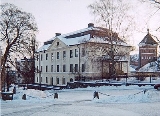
Archbishop of Uppsala

Encyclopedia

Primate (religion)
Primate is a title or rank bestowed on some bishops in certain Christian churches. Depending on the particular tradition, it can denote either jurisdictional authority or ceremonial precedence ....
in Sweden in an unbroken succession since 1164, first during the Catholic
Roman Catholic Church
The Catholic Church, also known as the Roman Catholic Church, is the world's largest Christian church, with over a billion members. Led by the Pope, it defines its mission as spreading the gospel of Jesus Christ, administering the sacraments and exercising charity...
era, and from the 1530s and onward under the Lutheran church.
Historical overview
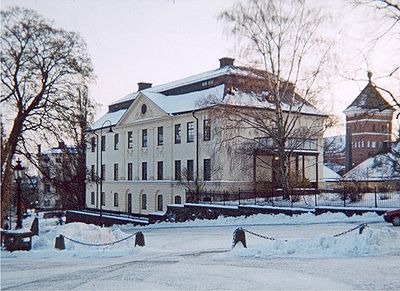
There have been bishops in Uppsala
Uppsala
- Economy :Today Uppsala is well established in medical research and recognized for its leading position in biotechnology.*Abbott Medical Optics *GE Healthcare*Pfizer *Phadia, an offshoot of Pharmacia*Fresenius*Q-Med...
from the time of Swedish King Ingold the Elder in the 11th century. They were governed by the archbishop of Hamburg-Bremen until Uppsala was made an archbishopric in 1164. The archbishop in Lund (which at that time belonged to Denmark) was declared primate
Primate (religion)
Primate is a title or rank bestowed on some bishops in certain Christian churches. Depending on the particular tradition, it can denote either jurisdictional authority or ceremonial precedence ....
of Sweden, meaning it was his right to select and ordain the Uppsala archbishop by handing him the pallium
Pallium
The pallium is an ecclesiastical vestment in the Roman Catholic Church, originally peculiar to the Pope, but for many centuries bestowed by him on metropolitans and primates as a symbol of the jurisdiction delegated to them by the Holy See. In that context it has always remained unambiguously...
. To gain independence, Folke Johansson Ängel
Folke Johansson Ängel
Folke Johansson Ängel was Archbishop of Uppsala, Sweden , although he was not ordained by the Pope until 1274...
in 1274 went to Rome and was ordained directly by the pope. This practice was increasing, so that no Uppsala archbishop was in Lund after Olov Björnsson, in 1318. In 1457, the archbishop Jöns Bengtsson (Oxenstierna) was allowed by the pope to declare himself primate of Sweden.
Uppsala (then a village) was originally located a couple of miles to the north of the present city, in what is today known as Gamla Uppsala
Gamla Uppsala
Gamla Uppsala is a parish and a village outside Uppsala in Sweden. It had 16,231 inhabitants in 1991.As early as the 3rd century AD and the 4th century AD and onwards, it was an important religious, economic and political centre...
(Old Uppsala). In 1273, the archbishopric, together with the relics of King Eric the Saint
Eric IX of Sweden
Eric "IX" of Sweden, , also called Eric the Lawgiver, Erik the Saint, Eric the Holy and in Sweden Sankt Erik meaning Saint Eric was a Swedish king c.1155 – 1160...
, was moved to the market town of Östra Aros, which from then on is named Uppsala.
In 1531, Laurentius Petri
Laurentius Petri
Laurentius Petri Nericius was a Swedish clergyman and the first Evangelical Lutheran Archbishop of Sweden. He and his brother Olaus Petri are, together with the King Gustav Vasa, regarded as the main Protestant reformers of Sweden...
was chosen by King Gustav I of Sweden
Gustav I of Sweden
Gustav I of Sweden, born Gustav Eriksson of the Vasa noble family and later known simply as Gustav Vasa , was King of Sweden from 1523 until his death....
(Vasa) to be archbishop, taking that privilege from the pope and in effect making Sweden Protestant. The archbishop was then declared primus inter pares
Primus inter pares
Primus inter pares is Latin phrase describing the most senior person of a group sharing the same rank or office.When not used in reference to a specific title, it may indicate that the person so described is formally equal, but looked upon as an authority of special importance by their peers...
i.e. first among equals. The archbishop is both bishop of his diocese and Primate of Sweden; he has however no more authority than other bishops, although in effect his statements have a more widespread effect. In 2000, the Archbishop of Uppsala was aided in the diocese by a bishop of Uppsala, currently Ragnar Persenius.
Notable archbishops
The labours of the archbishops extended in all directions. Some were zealous pastors of their flocks, such as Jarler and others; some were distinguished canonists, such as Birger Gregerson (1367–83) and Olof Larsson (1435-8); others were statesmen, such as Jöns Bengtsson Oxenstjerna (d. 1467), or capable administrators, such as Jacob Ulfsson Örnfot, who was distinguished as a prince of the Church, royal councillor, patron of art and learning, founder of the University of Upsala and an efficient helper in the introduction of printing into Sweden. There were also scholars, such as Johannes Magnus (died 1544), who wrote the "Historia de omnibus Gothorum sueonumque regibus" and the "Historia metropolitanæ ecclesiæ Upsaliensis", and his brother Olaus Magnus (d. 1588), who wrote the "Historia de gentibus septentrionalibus" and who was the last Catholic Archbishop of Upsala.The archbishops and secular clergy found active co-workers among the regular clergy (i.e. religious orders). Among the orders represented in Sweden were the Benedictines, Cistercians, Dominicans, Franciscans, Brigittines (with the mother-house at Wadstena) and Carthusians. A Swedish Protestant investigator, Carl Silfverstolpe, wrote: "The monks were almost the sole bond of union in the Middle Ages between the civilization of the north and that of southern Europe, and it can be claimed that the active relations between our monasteries and those in southern lands were the arteries through which the higher civilization reached our country."
See Birger Gregersson
Birger Gregersson
Birger Gregersson was Archbishop of Uppsala, Sweden, from 1366 to his death 1383.It is known that he was vicar of Österhaninge and then priest in Uppsala. He was a supporter of King Albrekt, who appointed him chancellor....
(1366–83; hymnist and author), Nils Ragvaldsson
(1438–48; early adherent of Old Norse mythology), Jöns Bengtsson (Oxenstierna) (1448–67; King of Sweden), Jakob Ulfsson (1470–1514; founder of Uppsala University), Gustav Trolle
Gustav Trolle
Gustav Eriksson Trolle was Archbishop of Uppsala, Sweden, in two sessions, during the turbulent Reformation events.After returning from studies abroad, in Cologne and Rome, he was in 1513 elected vicar in Linköping. One year later he became Archbishop of Uppsala...
(1515–21; supporter of the Danish King), Johannes Magnus
Johannes Magnus
Johannes Magnus was the last functioning Catholic Archbishop in Sweden, and also a theologian, genealogist, and historian.-Life:Johannes Magnus was born in Linköping, son of the burgess Måns Pedersson and his wife Kristina...
(1523-26: wrote an imaginative Scandianian Chronicle), Laurentius Petri
Laurentius Petri
Laurentius Petri Nericius was a Swedish clergyman and the first Evangelical Lutheran Archbishop of Sweden. He and his brother Olaus Petri are, together with the King Gustav Vasa, regarded as the main Protestant reformers of Sweden...
(1531–73; main character behind the Swedish Lutheran reformation), Abraham Angermannus
Abraham Angermannus
Abraham Andersson, usually known under the Latin form of his name, Abrahamus Andreæ Angermannus or just Abraham Angermannus was the fourth Lutheran Archbishop of Uppsala in the Church of Sweden from 1593 to 1599...
(1593–99; controversial critic of the King), Olaus Martini
Olaus Martini
Olof Mårtensson also known in the Latin form Olaus Martini, was Archbishop of Uppsala from 1601 to his death.Born in Uppsala, Sweden, he first enrolled in the University of Uppsala, but when it was temporarily closed in 1578 he travelled abroad...
(1601–09), Petrus Kenicius
Petrus Kenicius
Petrus Kenicius was Archbishop of Uppsala in the Church of Sweden from 1609 to his death.He got his education from the Universities of Wittenberg and Rostock....
(1609–36),
Laurentius Paulinus Gothus
Laurentius Paulinus Gothus
Laurentius Paulinus Gothus was a Swedish theologian, astronomer and Archbishop of Uppsala .-Life:In 1588 Gothus travelled to Germany and studied in the Rostock University for three years...
(1637–46; astronomer and philosopher of Ramus
Petrus Ramus
Petrus Ramus was an influential French humanist, logician, and educational reformer. A Protestant convert, he was killed during the St. Bartholomew's Day Massacre.-Early life:...
school), Johannes Canuti Lenaeus
Johannes Canuti Lenaeus
Johannes Canuti Lenaeus was professor at Uppsala University and Archbishop of Uppsala in the Church of Sweden from 1657 to his death....
(1647–69; aristotelean and logician), Erik Benzelius the Elder
Erik Benzelius the Elder
Erik Benzelius was a Swedish theologian and Archbishop of Uppsala.Benzelius was born at the Bentseby farm in the parish of Luleå in northern Sweden, son of the farmer and lay assessor Henrik Jakobsson...
(1700–09; highly knowledgeable), Haquin Spegel
Haquin Spegel
Haquin Spegel , born Håkan Spegel in Ronneby in south-east Sweden, was a religious author and hymn writer who held several bishop's seats.- Life :...
(1711–14; public educator), Mattias Steuchius (1714–30),
Uno von Troil
Uno von Troil
Uno von Troil was Archbishop of Uppsala, Sweden, 1786-1803. He was the son of Samuel Troilius, who had also been archbishop ....
(1786–1803; politician), Jakob Axelsson Lindblom
(1805–19), Johan Olof Wallin
Johan Olof Wallin
Johan Olof Wallin, , was a Swedish minister, orator, poet and later Archbishop of Uppsala, Sweden. He is most remembered today for his hymns.- Early life :...
(1837–39; beloved poet and hymnist), Karl Fredrik af Wingård (1839–51; politician), Henrik Reuterdahl (1856–70) Anton Niklas Sundberg (1870–1900; outspoken and controversial) and Nathan Söderblom
Nathan Söderblom
Lars Olof Jonathan Söderblom was a Swedish clergyman, Archbishop of Uppsala in the Church of Sweden, and recipient of the 1930 Nobel Peace Prize...
(1914–1931; Nobel Prize winner).
Earliest bishops
The first written mention of a bishop at Uppsala is from Adam of BremenAdam of Bremen
Adam of Bremen was a German medieval chronicler. He lived and worked in the second half of the eleventh century. He is most famous for his chronicle Gesta Hammaburgensis Ecclesiae Pontificum .-Background:Little is known of his life other than hints from his own chronicles...
's Gesta Hammaburgensis ecclesiae pontificum that records in passing Adalvard the Younger
Adalvard the Younger
Adalvard the Younger was a German missionary bishop from Bremen who was active in Sigtuna, in Sweden, in the 1060s. According to Adam of Bremen, Adalvard tried to make the Swedish king Stenkil close the great temple at Uppsala. This attempt failed and so Adalvard had to flee to Västergötland,...
appointed as the bishop for Sictunam et Ubsalam in the 1060s. Swedish sources never mention him either in Sigtuna or Uppsala.
The medieval Annales Suecici Medii Aevi and the 13th century legend of Saint Botvid
Saint Botvid
-Biography:Botvid, who was born in Södermanland, Sweden, went on a trade trip to England and where he came into contact with Christianity and was converted to the Christian faith. Botvid was sent back as a missionary to Sweden by Saint Sigfrid of Växjö along with Saint David and Saint Eskil. The...
mention some Henry as the Bishop of Uppsala (Henricus scilicet Upsalensis) in 1129, participating in the consecration of the saint's newly built church. He is apparently the same Bishop Henry who died at the Battle of Fotevik
Battle of Fotevik
Battle of Fotevik was fought between forces of King Niels of Denmark together with those of his son Magnus Nilsson against those of Erik Emune on June 4, 1134 at the bay of Fotevik in Skåne....
in 1134, fighting along with the Danes after being banished from Sweden. Known from the Chronicon Roskildense
Chronicon Roskildense
Chronicon Roskildense a small Danish historical work, which except for few yearbooks, is the oldest known attempt to write a coherent account of Danish history by a Danish author, from the time of the introduction of Christianity in Denmark to the author's own time...
written soon after his death and from Saxo Grammaticus
Saxo Grammaticus
Saxo Grammaticus also known as Saxo cognomine Longus was a Danish historian, thought to have been a secular clerk or secretary to Absalon, Archbishop of Lund, foremost advisor to Valdemar I of Denmark. He is the author of the first full history of Denmark.- Life :The Jutland Chronicle gives...
' Gesta Danorum
Gesta Danorum
Gesta Danorum is a patriotic work of Danish history, by the 12th century author Saxo Grammaticus . It is the most ambitious literary undertaking of medieval Denmark and is an essential source for the nation's early history...
from the early 13th century, he had fled to Denmark from Sigtuna
Sigtuna
Sigtuna is a locality situated in Sigtuna Municipality, Stockholm County, Sweden with 18 inhabitants in 2005. It is the namesake of the municipality even though the seat is in Märsta....
. Also he is omitted from, or at least redated in, the first list of bishops made in the 15th century. In this list, the first bishop at Uppsala was Sverinius (Siwardus?), succeeded by Nicolaus, Sveno, Henricus and Kopmannus. With the exception of Henricus, the list only mentions their names.
Archbishops before the Reformation

12th century
- 1164–1185 StefanStefan (archbishop of Uppsala)Stefan was created the first Archbishop of Uppsala in Sweden in the year 1164, a post he held until his death.Stefan was a Cistercian monk from Alvastra monastery...
- 1185–1187 JohannesJohannes (archbishop of Uppsala)Johannes was the second Archbishop of Uppsala, Sweden. His short-lived reign was between 1185 and 1187.His name is sometimes spelled as Johan, the Swedish form of Johannes, but since the Swedish language had yet to be established it is of little importance. About Johannes little is known...
.
Johannes was ordained by the Archbishop of Lund
Lund
-Main sights:During the 12th and 13th centuries, when the town was the seat of the archbishop, many churches and monasteries were built. At its peak, Lund had 27 churches, but most of them were demolished as result of the Reformation in 1536. Several medieval buildings remain, including Lund...
, Absalon
Absalon
Absalon was a Danish archbishop and statesman, who was the Bishop of Roskilde from 1158 to 1192 and Archbishop of Lund from 1178 until his death. He was the foremost politician and churchfather of Denmark in the second half of the 12th century, and was the closest advisor of King Valdemar I of...
by November 1185. In 1187, a ship from the pagan
Paganism
Paganism is a blanket term, typically used to refer to non-Abrahamic, indigenous polytheistic religious traditions....
Estonia entered Mälaren, a lake close to Uppsala, on a plundering expedition. It sailed to Sigtuna
Sigtuna
Sigtuna is a locality situated in Sigtuna Municipality, Stockholm County, Sweden with 18 inhabitants in 2005. It is the namesake of the municipality even though the seat is in Märsta....
, a prosperous city at that time, and plundered it. On its way back, barricades were set up at the only exit point at Almarestäket
Almarestäket
Almarestäket, or Stäket, is a strait at the inlet of Lake Mälaren in mid-east Sweden. A fortress existed there between about 1370 and 1517, also named Almarestäket....
to prevent the ship from escaping. Johannes was there also. As the ship struggled to pass through, Johannes were among those killed.
- 1187–1197 PetrusPetrus (archbishop of Uppsala)Petrus was the third archbishop of Uppsala, Sweden, between 1187-1197.He was ordained by the mighty Danish archbishop Absalon in Lund, the primate of Sweden at that time. When Sweden got a new king, Sverker, who was related to the Danish Royal Court, Absalon extended his authority over Sweden...
.
He was ordained by Absalon. Sweden got a new king, Sverker II of Sweden
Sverker II of Sweden
Sverker II was King of Sweden from 1196 to 1208.-Biography:...
in 1196, who was related to the Danish Royal Court, whereby Absalon extended his authority over Sweden. When Petrus in 1196 elected three bishops, Absalon requested that the pope decide since the bishops were the sons of other priests, and this was not allowed by papal decree. He also mentioned that several Swedish bishops refused to travel to his synod
Synod
A synod historically is a council of a church, usually convened to decide an issue of doctrine, administration or application. In modern usage, the word often refers to the governing body of a particular church, whether its members are meeting or not...
s. Absalon was an authoritative person whom the pope trusted and gave him rights, but by the time the message reached Uppsala Petrus had already died.
13th century
- 1198–1206 Olov LambatungaOlov LambatungaOlov Lambatunga was archbishop of Uppsala, Sweden, 1198-1206.Little is known about Olov. A couple of papal letters exist: In 1200, the pope declared that Catholic Church estates were free from government taxes and that clerics should not be subjected to the courts and judges of the government, but...
.
In 1200, Pope Innocent III
Pope Innocent III
Pope Innocent III was Pope from 8 January 1198 until his death. His birth name was Lotario dei Conti di Segni, sometimes anglicised to Lothar of Segni....
demanded that Church estate be free from the king's taxes and that clerics be judged only by bishops and prelates, and not civil courts and judges. This was a step in the separation between worldy and spiritual matters, which the Swedish Church had not yet taken. Innocent also demanded that Olov dismiss the two bishops ordained by Petrus.
When Uppsala burnt in 1204, Olov's pallium was burnt and he sent a request to Innocent III for a new one to be made.
- 1207–1219 ValeriusValerius (archbishop of Uppsala)Valerius was the Swedish Archbishop 1207–1219 . He was the fifth archbishop after the establishment of the see in 1164.- Appointment :...
.
Valerius was most likely the son of a church man – and the Archbishop of Lund appealed the election to Rome. The pope allowed a dispensation for Valerius on the grounds that there was no other suitable candidate and because Valierus was known as a learned man with good customs and virtues.
Valerius joined sides with the King Sverker II of Sweden
Sverker II of Sweden
Sverker II was King of Sweden from 1196 to 1208.-Biography:...
who belonged to the House of Sverker. The House of Sverker was one of the antagonists in a civil war that had been going on and off since 1130. In 1208 the opposing side, the House of Eric
House of Eric
The House of Eric was one of the two clans, which were rivals for the kingship of Sweden between 1150 and 1220. The first king from the clan of the Erics who had won the power struggle against the Sverkers was Eric IX of Sweden whom the later world has dubbed Saint Eric...
, besieged the capital Stockholm; Sverker and Valierus fled to Denmark.
Sverker gathered a small army in Denmark and tried to conquer Sweden but was killed. Valerius then decided to accept King Eric X's authority, and as a result was allowed to return to Uppsala, where he crowned Eric X in 1210. Pope Innocent III sent a letter to Valerius where he proclaimed the procedure to be unauthorised and unlawful, but it seems to have had little impact.
- 1219(1224)-1234 Olov Basatömer. N/A
- 1236–1255 JarlerJarlerJarler was Archbishop of Sweden from 1236 to 1255.Jarler was one of the two earliest known Swedish students at the University of Paris....
He was one of the first known Swedish students at the University of Paris
University of Paris
The University of Paris was a university located in Paris, France and one of the earliest to be established in Europe. It was founded in the mid 12th century, and officially recognized as a university probably between 1160 and 1250...
. As archbishop, he established several clerical regulations.
- 1255–1267 LarsLars (archbishop of Uppsala)Lars was the name of the Archbishop of Sweden 1255–1267.Lars is a Swedish form for the Latin name Laurentius, which in English is Lawrence. This was the name Lars used as an archbishop. His birthname is unknown....
(Laurentius).
Lars was recruited from the recently established Franciscan
Franciscan
Most Franciscans are members of Roman Catholic religious orders founded by Saint Francis of Assisi. Besides Roman Catholic communities, there are also Old Catholic, Anglican, Lutheran, ecumenical and Non-denominational Franciscan communities....
monastery in Enköping
Enköping
Enköping is a locality and the seat of Enköping Municipality, Uppsala County, Sweden with 20,204 inhabitants in 2005.- Geography :Enköping is situated near Lake Mälaren, about 78 km west of Stockholm....
and was most likely a foreigner. The Pope expressed trust in the recently crowned Swedish monarch Birger Jarl
Birger jarl
, or Birger Magnusson, was a Swedish statesman, Jarl of Sweden and a member of the House of Bjelbo, who played a pivotal role in the consolidation of Sweden. Birger also led the Second Swedish Crusade, which established Swedish rule in Finland. Additionally, he is traditionally attributed to have...
who, unlike his predecessors, had promised to support the Church by granting it freedom from taxes and establish missionairies
Missionary
A missionary is a member of a religious group sent into an area to do evangelism or ministries of service, such as education, literacy, social justice, health care and economic development. The word "mission" originates from 1598 when the Jesuits sent members abroad, derived from the Latin...
to yet un-Christianised parts – or parts who had returned to paganim – specifically Finland
Finland
Finland , officially the Republic of Finland, is a Nordic country situated in the Fennoscandian region of Northern Europe. It is bordered by Sweden in the west, Norway in the north and Russia in the east, while Estonia lies to its south across the Gulf of Finland.Around 5.4 million people reside...
and the Baltic states
Baltic states
The term Baltic states refers to the Baltic territories which gained independence from the Russian Empire in the wake of World War I: primarily the contiguous trio of Estonia, Latvia, Lithuania ; Finland also fell within the scope of the term after initially gaining independence in the 1920s.The...
.
But this promise was not realised because of the shaky political situation in Sweden. There was an ongoing struggle for power, which eventually forced the antagonists to tax Church property in order to support the war.
Lars tried to impose clerical celibacy
Clerical celibacy
Clerical celibacy is the discipline by which some or all members of the clergy in certain religions are required to be unmarried. Since these religions consider deliberate sexual thoughts, feelings, and behavior outside of marriage to be sinful, clerical celibacy also requires abstension from these...
, which still had not been enforced in Sweden because the low population figures in Sweden required priests to marry and have children. In 1258 Lars sent Pope Alexander IV
Pope Alexander IV
Pope Alexander IV was Pope from 1254 until his death.Born as Rinaldo di Jenne, in Jenne , he was, on his mother's side, a member of the de' Conti di Segni family, the counts of Segni, like Pope Innocent III and Pope Gregory IX...
a request that married clergy not be excommunicated, a request which indicates married clery were not uncommon.
Also in 1258 the move of the archdiocese to its present location was decided, but it would not take effect for another decade.
- 1267–1277 Folke Johansson Ängel (Fulco Angelus).
Folke belonged to the influential family Ängel, which used the Archangel Gabriel as a heraldic charge.
He was, for unclear reasons, not ordained until 1274. Civil distrubances may have been a cause, but also the reluctance of the cathedral chapter to be under the authority of Lund. In 1274, Folke ignored the Primate of Lund by travelling to Rome and getting ordained by the pope Gregory X himself
Folke's most important contribution was to commission the moving of the episcopal see from its old location to its present location. At his death he was one of the first to be buried in Uppsala Cathedral
Uppsala Cathedral
Uppsala Cathedral is a cathedral located centrally in the city of Uppsala, Sweden. It dates back to the late 13th century and at a height of 118.7 m is the tallest church building in Scandinavia. Originally built under Roman Catholicism and used for coronations of the Swedish monarch, since the...
.
- 1277–1281 Jakob Israelsson
Was from the same family as his predecessor. Little else is known about him.
- 1281–1284 Johan Odulfsson
Not ordained. Little is known about him.
- 1285–1289 Magnus Bosson.
Little is known abut him.
- 1289–1291 Johan.
Had served as prior
Prior
Prior is an ecclesiastical title, derived from the Latin adjective for 'earlier, first', with several notable uses.-Monastic superiors:A Prior is a monastic superior, usually lower in rank than an Abbot. In the Rule of St...
at the Sigtuna
Sigtuna
Sigtuna is a locality situated in Sigtuna Municipality, Stockholm County, Sweden with 18 inhabitants in 2005. It is the namesake of the municipality even though the seat is in Märsta....
monastery and Bishop of Åbo
Abo
Abo may refer to:* ABO blood group system, a human blood type and blood group system** ABO , enzyme encoded by the ABO gene that determines the ABO blood group of an individual* Abo of Tiflis , an Arab East Orthodox Catholic saint...
. Died in Avignon
Avignon
Avignon is a French commune in southeastern France in the départment of the Vaucluse bordered by the left bank of the Rhône river. Of the 94,787 inhabitants of the city on 1 January 2010, 12 000 live in the ancient town centre surrounded by its medieval ramparts.Often referred to as the...
while travelling to Rome to receive the pallium
Pallium
The pallium is an ecclesiastical vestment in the Roman Catholic Church, originally peculiar to the Pope, but for many centuries bestowed by him on metropolitans and primates as a symbol of the jurisdiction delegated to them by the Holy See. In that context it has always remained unambiguously...
.
14th century
- 1292–1305 Nils AllessonNils AllessonNils Allesson was Archbishop of Uppsala, Sweden, 1292-1305.It is believed that he studied at the University of Paris in 1278. After returning to Sweden, he became deacon in Uppsala in 1286 and was elected Archbishop in 1292...
(Nicolaus Allonius).
He studied at the University of Paris
University of Paris
The University of Paris was a university located in Paris, France and one of the earliest to be established in Europe. It was founded in the mid 12th century, and officially recognized as a university probably between 1160 and 1250...
in 1278. After returning to Sweden, he became deacon in Uppsala in 1286 and was elected Archbishop in 1292. As Nils Allesson was the son of a priest, the cathedral chapter in Lund, Denmark - the primate over Uppsala - appealed the election to the pope. Nils travelled to Rome in 1295 to meet the Pope Boniface VIII and defend his case, which was eventually accepted.
Nils was known as a vigorous archbishop. He founded and supervised institutions for safety and order around the archdiocese, such as accommodations for travellers.
- 1308–1314 Nils Kettilsson
Little is known about him.
- 1315–1332 Olov Björnsson (Olov the Wise; Olavus sapiens).
Under his time the chapter in Uppsala stopped accepting Archbishop of Lund
Lund
-Main sights:During the 12th and 13th centuries, when the town was the seat of the archbishop, many churches and monasteries were built. At its peak, Lund had 27 churches, but most of them were demolished as result of the Reformation in 1536. Several medieval buildings remain, including Lund...
as primate, and Olov was to be the last Uppsala archbishop to be ordained there.
- 1332–1341 Petrus FilipssonPetrus FilipssonPetrus Filipsson was Archbishop of Uppsala, Sweden 1332–1341. Some call him Peder Filipsson Röde.He came from Uppland and was a son of the important high noble family of Rumby, being son of Sir Filip Finvidson of Rumby, called Filip Röde, and his wife, herself the daughter of Lord Karl Tjelveson...
(Petrus Philippi).
He came from a smaller town in Uppland, the son of the knight Filip Finnvedson, one of the most important men in Uppland
Uppland
Uppland is a historical province or landskap on the eastern coast of Sweden, just north of Stockholm, the capital. It borders Södermanland, Västmanland and Gästrikland. It is also bounded by lake Mälaren and the Baltic sea...
(the land of Uppsala). Petrus held various clerical offices until he was elected archbishop. Following the election he travelled to Avignon
Avignon
Avignon is a French commune in southeastern France in the départment of the Vaucluse bordered by the left bank of the Rhône river. Of the 94,787 inhabitants of the city on 1 January 2010, 12 000 live in the ancient town centre surrounded by its medieval ramparts.Often referred to as the...
, the residence of Pope John XXII
Pope John XXII
Pope John XXII , born Jacques Duèze , was pope from 1316 to 1334. He was the second Pope of the Avignon Papacy , elected by a conclave in Lyon assembled by Philip V of France...
, to be ordained as bishop.
He had a strained relationship with the Franciscan order. At the request of Pope Benedict XII
Pope Benedict XII
Pope Benedict XII , born Jacques Fournier, the third of the Avignon Popes, was Pope from 1334 to 1342.-Early life:...
, Paul, Archbishop of Nidaros (now Trondheim) in Norway, was to make a judgement on the matter, and this led to a settlement between the two parties in 1339.
In 1341 Petrus died and was buried in Sigtuna's Dominican order
Dominican Order
The Order of Preachers , after the 15th century more commonly known as the Dominican Order or Dominicans, is a Catholic religious order founded by Saint Dominic and approved by Pope Honorius III on 22 December 1216 in France...
church which today is called Mariakyrkan.
- 1341–1351 Hemming Nilsson.
At the death of Petrus, Pope Benedict XII wished to occupy the archbishop's seat through commission, but following Hemming's election by the cathedral chapter, Hemming travelled to Avignon and persuaded Benedict to ordain him bishop.
During his time, he helped in the political world, made a visitation through Norway
Norway
Norway , officially the Kingdom of Norway, is a Nordic unitary constitutional monarchy whose territory comprises the western portion of the Scandinavian Peninsula, Jan Mayen, and the Arctic archipelago of Svalbard and Bouvet Island. Norway has a total area of and a population of about 4.9 million...
and established Uppsala ecclesiastical records. His last will shows that he was also quite wealthy. http://runeberg.org/nfbk/0219.html
- 1351–1366 Petrus TorkilssonPetrus TorkilssonPetrus Torkilsson was Archbishop of Uppsala, Sweden, 1351–1366.It is unknown when he was born, but the first mentioning of him is from 1320, when he was vicar in Färentuna. He was chancellor of the King Magnus Eriksson in 1340 and continued to support him during the civil wars in the 1360s.-...
(Petrus Tyrgilli; died 19 October 1366).
The first mention of him is from 1320, when he was vicar in Färentuna. He was chancellor of the King Magnus II of Sweden in 1340 and continued to support him during through the 1360s when Sweden was in a civil war.
In 1342 he was appointed Bishop of Linköping, where he assisted the building of the Linköping Cathedral
Linköping Cathedral
The Linköping Cathedral is a church in the Swedish city of Linköping. The cathedral is the seat for the bishop in the Church of Sweden Diocese of Linköping. It is situated opposite Linköping Castle.-History:...
. He was assessor during King Magnus monetary transactions, among them the repayment of a loan Magnus hade made from the Church. After the new King Albert of Sweden
Albert of Sweden
Albert was King of Sweden from 1364 to 1389 and Duke of Mecklenburg-Schwerin from 1384 to 1412.-Background:...
took power, Petrus supported him as well.
- 1366–1383 Birger GregerssonBirger GregerssonBirger Gregersson was Archbishop of Uppsala, Sweden, from 1366 to his death 1383.It is known that he was vicar of Österhaninge and then priest in Uppsala. He was a supporter of King Albrekt, who appointed him chancellor....
.
Was known as a vigorous archbishop. He was also a supporter of the Swedish, highly revered, Saint Birgitta (1303–1373), and wrote a biography of her. He also wrote in honour of her and of Saint Botvid
Saint Botvid
-Biography:Botvid, who was born in Södermanland, Sweden, went on a trade trip to England and where he came into contact with Christianity and was converted to the Christian faith. Botvid was sent back as a missionary to Sweden by Saint Sigfrid of Växjö along with Saint David and Saint Eskil. The...
, another Swedish saint. As a writer, he has a prominent place in early Swedish literature
Early Swedish literature
Early Swedish literature designates Swedish literature written between approximately 1200–1500 AD.As Swedish evolved from Old Norse in the 13th century, the Swedish literature began to take form as an independent body of literature. The earliest form of an independent Swedish language is...
.
- 1383–1408 Henrik Karlsson (Henricus Caroli).
Was also friends with Saint Birgitta, in Rome
Rome
Rome is the capital of Italy and the country's largest and most populated city and comune, with over 2.7 million residents in . The city is located in the central-western portion of the Italian Peninsula, on the Tiber River within the Lazio region of Italy.Rome's history spans two and a half...
and took part in the important political decisions during his years as archbishop, such as the Kalmar Union
Kalmar Union
The Kalmar Union is a historiographical term meaning a series of personal unions that united the three kingdoms of Denmark, Norway , and Sweden under a single monarch, though intermittently and with a population...
in 1397.
Had a good economical skill, was a wealthy man, and acquired many farms for the Church. At his death, he left them to the cathedral chapter, but Queen Margaret
Margaret I of Denmark
Margaret I was Queen of Denmark, Norway and Sweden and founder of the Kalmar Union, which united the Scandinavian countries for over a century. Although she acted as queen regnant, the laws of contemporary Danish succession denied her formal queenship. Her title in Denmark was derived from her...
is said to have taken them in possession instead, which marked the beginning of disputes between the chapter and the states in the union (which lasted until 1520).
15th century
- 1408–1421 Jöns GerekessonJöns GerekessonJöns Gerekesson was a controversial Archbishop of Uppsala, Sweden 1408–1421, and of Iceland 1426–1433 until he was drowned...
(Johannes Gerechini)
Jöns originated the influential Danish family Lodehat. His uncle was bishop of Roskilde and a former chancellor of the Queen. Jöns himself became, thanks to his family's Royal connection, chancellor to the King of Scandinavia
Scandinavia
Scandinavia is a cultural, historical and ethno-linguistic region in northern Europe that includes the three kingdoms of Denmark, Norway and Sweden, characterized by their common ethno-cultural heritage and language. Modern Norway and Sweden proper are situated on the Scandinavian Peninsula,...
, Eric of Pomerania
Eric of Pomerania
Eric of Pomerania KG was King Eric III of Norway Norwegian Eirik, King Eric VII of Denmark , and as Eric King of Sweden...
.
At the death of the Archbishop Henrik, King Eric appointed Jöns, who had no connection to Uppsala, as new archbishop without regards to the candidates of the chapter.
During his time, Jöns paid little respect to the duties of archbishop. He embessled Church property and mistreated Church officials. Eventually, the chapter complained to the Pope, who conducted an investigation and dismissed Jöns Gereksson in 1421.
- 1421–1432 Johan HåkanssonJohan HåkanssonJohan Håkansson was Archbishop of Uppsala, Sweden, 1421–1432.His first known occupations were at a school in Söderköping and as a canon in Linköping. In 1411 he enrolled at Vadstena monastery...
(Johannes Haquini)
Was originally a monk at Vadstena
Vadstena
Vadstena is a locality and the seat of Vadstena Municipality, Östergötland County, Sweden, with 5,612 inhabitants in 2005. From 1974 to 1979 Vadstena was administered as part of Motala Municipality....
monastery. As archbishop, he freed clerical
Clergy
Clergy is the generic term used to describe the formal religious leadership within a given religion. A clergyman, churchman or cleric is a member of the clergy, especially one who is a priest, preacher, pastor, or other religious professional....
s of taxation, and built a permanent house for the archbishop.
- 1432–1438 Olov LarssonOlaus LaurentiiOlaus Laurentii was a Swedish ecclesiastic and archbishop of Uppsala.Olaus Laurentii came from Uppland and studied at the universities of Prague, Leipzig and Paris. He was elected Dean of Uppsala Cathedral in 1417 and archbishop in 1432...
(Olaus Laurentii) - 1433–1434 Arnold of Bergen (unofficial) (Arend in Norwegian; died 1434) was bishop of Bergen, Norway, and was never ordained as archbishop.
When Olaus Laurentii was elected by the Chapter to become Archbishop of Uppsala and Sweden, the Swedish King Eric of Pomerania
Eric of Pomerania
Eric of Pomerania KG was King Eric III of Norway Norwegian Eirik, King Eric VII of Denmark , and as Eric King of Sweden...
was displeased because he was not consulted and therefor decided that Arnold of Bergen should become archbishop in 1433 while Olaus Laurentii was in Rome to be ordained. Arnold moved into the archbishopseat in Uppsala despite protests from the chapter.
The quarrels were resolved when Arnold died in 1434; then the king decided to accept Olaus Laurentii who had just returned from Rome. http://runeberg.org/nfal/0090.html
- 1438–1448 Nils Ragvaldsson (Nicolaus Ragvaldi)
- 1448–1467 Jöns Bengtsson (Oxenstierna)
- 1468–1469 Tord Pedersson (Bonde)Tord Pedersson (Bonde)Tord Pedersson was the un-ordained Archbishop of Uppsala from 1468 to 1469. He was born as Tord Pedersson, but since his mother was of the Bonde family, he would often use this name in addition to his own....
(not ordained) - 1469–1515 Jakob UlvssonJakob UlvssonJakob Ulvsson was Archbishop of Uppsala, Sweden, 1469–1515 and the founder of Uppsala University.Jakob Ulvsson came from a noble family background in Uppland and studied at the universities in Rostock and Paris .He spent the years 1465–1470 in Rome and was meanwhile appointed Canon of...
- 1515–1517 and 1520–1521 Gustav TrolleGustav TrolleGustav Eriksson Trolle was Archbishop of Uppsala, Sweden, in two sessions, during the turbulent Reformation events.After returning from studies abroad, in Cologne and Rome, he was in 1513 elected vicar in Linköping. One year later he became Archbishop of Uppsala...
Gustav Eriksson Trolle (1488–1533) was a controversial person. He was in disputed with the king, since he was a supporter of the Danish King Christian II
Christian II of Denmark
Christian II was King of Denmark, Norway and Sweden , during the Kalmar Union.-Background:...
. In 1515 he was removed from office, but barricaded himself in the archbishop's mansion/fortress at Almarestäket
Almarestäket
Almarestäket, or Stäket, is a strait at the inlet of Lake Mälaren in mid-east Sweden. A fortress existed there between about 1370 and 1517, also named Almarestäket....
, until an assembly of chancellors ordered its destruction in 1517. In 1520, Danish King Christian conquered Swedish territory, and Gustav was reinstated. However, King Christian's reign in Sweden lasted but one year, and in 1521 Gustav was forced to flee to Denmark to seek refuge.
When the Pope months later received news of the deposition of Trolle, he ordered the reigning Swedish King Gustav Vasa to reinstate Trolle, not realizing the severity of the matter. Not being allowed to have his selected archbishop consecrated, King Gustav Vasa in effect broke away from the Catholic tradition, making Sweden a Lutheran nation starting 1531.
Archbishops during the Reformation
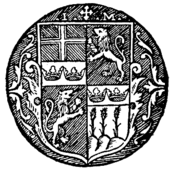
- 1523–1544 Johannes MagnusJohannes MagnusJohannes Magnus was the last functioning Catholic Archbishop in Sweden, and also a theologian, genealogist, and historian.-Life:Johannes Magnus was born in Linköping, son of the burgess Måns Pedersson and his wife Kristina...
Magnus was the last Catholic archbishop. He was selected to be archbishop in 1523, but the Pope deemed the disposal of Gustav Trolle unlawful, and demanded he should be reinstated. Gustav Vasa then broke with the Church, and ordained Johannes Magnus in his own ceremony. But before long, Magnus expressed his disapproval of Lutheran teachings, and Gustav Vasa sent him to Russia as a diplomat in 1526.
Gustav Vasa appointed a new archbishop, Laurentius Petri, in 1531, and Johannes realized that his time as archbishop was over. He travelled to Rome where he settled for the remainder of his life.
- 1544–1557 Olaus MagnusOlaus MagnusOlaus Magnus was a Swedish ecclesiastic and writer, who did pioneering work for the interest of Nordic people. He was reported as born in October 1490 in Östergötland, and died on August 1, 1557. Magnus, Latin for the Swedish Stor “great”, is a Latin family name taken personally, and not a...
Brother of the previous, with whom he was in exile in Rome. After the death of his brother, Olaus was consecrated by the Pope in 1544, but he never returned home. He was the last Swedish archbishop to get papal consecration.
Staying in Rome, Olaus wrote several highly regarded works about Scandinavia that still interest readers today. He also had published works by his brother Johannes.
16th century
- 1531–1573 Laurentius Petri (Nericius)Laurentius PetriLaurentius Petri Nericius was a Swedish clergyman and the first Evangelical Lutheran Archbishop of Sweden. He and his brother Olaus Petri are, together with the King Gustav Vasa, regarded as the main Protestant reformers of Sweden...
He and his brothers Olaus Petri
Olaus Petri
Olof Persson , better known under the Latin form of his name, Olaus Petri , was a clergyman, writer, and a major contributor to the Protestant Reformation in Sweden...
were the main Protestant reformers in Sweden; while his brother was more energetic, Laurentius laid the theoretical foundation for the Swedish Church Ordinance 1571
Swedish Church Ordinance 1571
The Swedish Church Ordinance of 1571 was the first complete Swedish church order following the Swedish Reformation in the 1520s.The main originator of the ordinance was archbishop Laurentius Petri. Petri had been archbishop since 1531, and had published many doctrinal texts. He had in vain tried to...
.
- 1575–1579 Laurentius Petri GothusLaurentius Petri GothusLaurentius Petri Gothus was the second Swedish Lutheran Archbishop of Uppsala, Sweden, 1575-1579.He was born in 1529 or 1530 in the province Östergötland, from where the name Gothus is derived as the means of separating him from his predecessor as archbishop, Laurentius Petri Nericius.He was a...
Before becoming archbishop, Gothus appears to have been inclined towards King Johan III of Sweden's more Catholic viewpoint. He was for this reason ordained by the King in a Catholic ritual with all its apparatus, and wrote the introduction to the King's "red book". As the Jesuitic
Society of Jesus
The Society of Jesus is a Catholic male religious order that follows the teachings of the Catholic Church. The members are called Jesuits, and are also known colloquially as "God's Army" and as "The Company," these being references to founder Ignatius of Loyola's military background and a...
tendencies grew stronger in Sweden in the 1570s, he became more wary; he refused to support the views of the King any longer, and published Contra novas papistarum machinationes which, although it gives proper respect to the Church fathers, polemizes against the foundation of Catholicism and the Jesuits.
- 1583–1591 Andreas Laurentii BjörnramAndreas Laurentii BjörnramAndreas Laurentii Björnram , also known as Bothniensis, Bureus which he called himself in honor of his mother's family, was Archbishop of Uppsala in the Church of Sweden from 1583 to his death...
He was vicar in Gävle
Gävle
Gävle is a city in Sweden, the seat of Gävle Municipality and the capital of Gävleborg County. It had 71,033 inhabitants in 12/31 2010. It is the oldest city in the historical Norrland , having received its charter in 1446 from Christopher of Bavaria.-History:It is believed that the name Gävle...
1570 and is reported as one of the first priests to have used the King's "red book" in his sermons, which sparked the King's interest, and he subsequently appointed him archbishop after a four year vacancy.
Björnram upset Church officials by declaring that the liturgy of the King was in accordance with the Apostles' Creed
Apostles' Creed
The Apostles' Creed , sometimes titled Symbol of the Apostles, is an early statement of Christian belief, a creed or "symbol"...
and that he supported it. Surprisingly, he nonetheless advocated the reading of Luther's works.
- 1593–1599 Abraham AngermannusAbraham AngermannusAbraham Andersson, usually known under the Latin form of his name, Abrahamus Andreæ Angermannus or just Abraham Angermannus was the fourth Lutheran Archbishop of Uppsala in the Church of Sweden from 1593 to 1599...
Angermannus first became known as a critic of the liturgy of King John, and the king had him put him in jail in Åbo
Abo
Abo may refer to:* ABO blood group system, a human blood type and blood group system** ABO , enzyme encoded by the ABO gene that determines the ABO blood group of an individual* Abo of Tiflis , an Arab East Orthodox Catholic saint...
, Finland. But he managed to escape back to Stockholm, under the protection of influential friends. However, eventually he had to flee to Germany, where he lived for 11 years. He visited the renowned universities there and wrote several book of Lutheran contents, directed to Swedish readers.
In 1593 the cathedral chapter in Uppsala elected him archbishop, and he moved back to Sweden and took the seat. He was a harsh critic of Catholicism remnants of which were still in practice around Sweden. In 1599 the King had had enough of him, and prosecuted him. Angermannus was put in prison in Gripsholm, where he was forced to remain until his death in 1607.
- 1599–1600 Nicolaus Olai BothniensisNicolaus Olai BothniensisNicolaus Olai Bothniensis was Archbishop of Uppsala in the Church of Sweden 1599–1600. He was appointed in place of Abraham Angermannus who had been put in prison, but before getting inducted he died of a sickness, about 50 years old.In his younger days he had been a student at the University of...
(not ordained)
Like his predecessor Angermannus, Bothniensis was imprisoned for 1,5 years due to his resistance to John III's non-Lutheran liturgy.
He in 1593 became the first professor of theology
Theology
Theology is the systematic and rational study of religion and its influences and of the nature of religious truths, or the learned profession acquired by completing specialized training in religious studies, usually at a university or school of divinity or seminary.-Definition:Augustine of Hippo...
at the Uppsala University
Uppsala University
Uppsala University is a research university in Uppsala, Sweden, and is the oldest university in Scandinavia, founded in 1477. It consistently ranks among the best universities in Northern Europe in international rankings and is generally considered one of the most prestigious institutions of...
. He died before being consecrated.
17th century
- 1601–1609 Olaus MartiniOlaus MartiniOlof Mårtensson also known in the Latin form Olaus Martini, was Archbishop of Uppsala from 1601 to his death.Born in Uppsala, Sweden, he first enrolled in the University of Uppsala, but when it was temporarily closed in 1578 he travelled abroad...
(Olof Mårtensson)
Born 1557 in Uppsala. Educated first in Uppsala, then abroad.He was against the liturgy of King John III of Sweden
John III of Sweden
-Family:John married his first wife, Catherine Jagellonica of Poland , house of Jagiello, in Vilnius on 4 October 1562. In Sweden, she is known as Katarina Jagellonica. She was the sister of king Sigismund II Augustus of Poland...
. He was made archbishop owing to the support of Duke Charles (Charles IX of Sweden
Charles IX of Sweden
Charles IX of Sweden also Carl, was King of Sweden from 1604 until his death. He was the youngest son of King Gustav I of Sweden and his second wife, Margaret Leijonhufvud, brother of Eric XIV and John III of Sweden, and uncle of Sigismund III Vasa king of both Sweden and Poland...
), although they later clashed because of their fundamentally different beliefs.
- 1609–1636 Petrus KeniciusPetrus KeniciusPetrus Kenicius was Archbishop of Uppsala in the Church of Sweden from 1609 to his death.He got his education from the Universities of Wittenberg and Rostock....
Born 1555. Was against the King's liturgy, and was imprisoned for a short time of 1589. Participated in the Uppsala Synod 1593. Was archbishop for a long time, into his old age.
- 1637–1646 Laurentius Paulinus GothusLaurentius Paulinus GothusLaurentius Paulinus Gothus was a Swedish theologian, astronomer and Archbishop of Uppsala .-Life:In 1588 Gothus travelled to Germany and studied in the Rostock University for three years...
Born 1565. Was knowledgeable in several subjects, and was professor of astronomy and logistics at Uppsala University. Wrote several works on astronomy, astrology and theology.
- 1647–1669 Johannes Canuti LenaeusJohannes Canuti LenaeusJohannes Canuti Lenaeus was professor at Uppsala University and Archbishop of Uppsala in the Church of Sweden from 1657 to his death....
Professor of Logic, Hebrew and Greek. Wrote an influential book about the philosophy of Aristotle
Aristotle
Aristotle was a Greek philosopher and polymath, a student of Plato and teacher of Alexander the Great. His writings cover many subjects, including physics, metaphysics, poetry, theater, music, logic, rhetoric, linguistics, politics, government, ethics, biology, and zoology...
that revived interest in Aristotelianism
Aristotelianism
Aristotelianism is a tradition of philosophy that takes its defining inspiration from the work of Aristotle. The works of Aristotle were initially defended by the members of the Peripatetic school, and, later on, by the Neoplatonists, who produced many commentaries on Aristotle's writings...
and was used as a textbook for several years.
- 1670–1676 Lars StigzeliusLars StigzeliusLars Stigzelius was Archbishop of Uppsala in the Church of Sweden from 1670 to his death.He was the son of a priest and was a student at the Uppsala University until his Master of Arts in 1625....
Professor of Logic at Uppsala where he supported Aristotelian philosophy against the adherents of Ramism
Ramism
Ramism was a collection of theories on rhetoric, logic and pedagogy based on the teachings of Petrus Ramus, a French academic, philosopher and Huguenot convert who was murdered in 1572.According to Jonathan Israel, Ramism-Development:...
. Was considered a highly learned man and was involved in various political and clerical tasks. As an archbishop he did not make any great contribution owing to his advanced age.
- 1677–1681 Johan Baazius the youngerJohan Baazius the youngerJohan Baazius the younger was born in Jönköping July 17, 1626 as the a son of a knowledgeable theologian and bishop of Växjö. He was Archbishop of Uppsala in the Church of Sweden from 1677 to his death on May 12, 1681....
- 1681–1700 Olov SvebiliusOlov SvebiliusOlov Svebilius was Archbishop of Uppsala, Sweden, 1681-1700. He was born in Ljungby, close to Kalmar in Sweden, January 1, 1624 and died the 29 June 1700....
, (Olaus Svebilius)
Commissioned the new Bible
Bible
The Bible refers to any one of the collections of the primary religious texts of Judaism and Christianity. There is no common version of the Bible, as the individual books , their contents and their order vary among denominations...
translation and revising the Swedish book of hymns. Published many works, most notably A simple explanation of Martin Luther's little catechism.
18th century

- 1700–1709 Erik Benzelius the elderErik Benzelius the ElderErik Benzelius was a Swedish theologian and Archbishop of Uppsala.Benzelius was born at the Bentseby farm in the parish of Luleå in northern Sweden, son of the farmer and lay assessor Henrik Jakobsson...
Benzelius took an important part in the various ecclesiastical committees active during the reigns of Charles XI
Charles XI of Sweden
Charles XI also Carl, was King of Sweden from 1660 until his death, in a period in Swedish history known as the Swedish empire ....
and Charles XII
Charles XII of Sweden
Charles XII also Carl of Sweden, , Latinized to Carolus Rex, Turkish: Demirbaş Şarl, also known as Charles the Habitué was the King of the Swedish Empire from 1697 to 1718...
, such as that concerning the new Church Law of 1686, the new hymn book of 1695 and the new Bible translation.
He was a typical representative of 17th century Swedish Lutheran orthodoxy
Lutheran Orthodoxy
Lutheran orthodoxy was an era in the history of Lutheranism, which began in 1580 from the writing of the Book of Concord and ended at the Age of Enlightenment. Lutheran orthodoxy was paralleled by similar eras in Calvinism and tridentine Roman Catholicism after the...
, careful not to deviate from established theological principles, and lacked originality in his writing. Nevertheless, he was a productive author of works in theology, and his work on church history was used as a textbook for the following century.http://runeberg.org/nfbb/0736.html
- 1711–1714 Haquin SpegelHaquin SpegelHaquin Spegel , born Håkan Spegel in Ronneby in south-east Sweden, was a religious author and hymn writer who held several bishop's seats.- Life :...
(born Håkan Spegel; 14 June 1645 – 17 April 1714)
He was an important religious author and hymn writer. He held several bishop's seats before becoming archbishop.
- 1714–1730 Mathias SteuchiusMathias SteuchiusMathias Steuchius was Bishop of the Diocese of Lund, 1694 to 1714 and Archbishop of Uppsala in the Swedish Church from 1714 to his death....
- 1730–1742 Johannes SteuchiusJohannes SteuchiusJohannes Steuchius was Archbishop of Uppsala in the Church of Sweden from 1730 to his death. His family name was ennobled in 1719 to Steuch.He was the son of the previous archbishop Mathias Steuchius....
, (Johannes Steuch) - 1742–1743 Erik Benzelius the youngerErik Benzelius the youngerErik Benzelius the younger was a priest, theologian, librarian, and Archbishop of Uppsala, Sweden, 1742–1743. He was a highly learned man and one of Sweden's important Enlightenment figures....
- 1744–1747 Jakob BenzeliusJakob BenzeliusJakob Benzelius was Archbishop of Uppsala in the Church of Sweden from 1744 to his death.Jakob Benzelius studied at Uppsala University, graduated as filosofie magister in 1703 and, after a few years teaching in Uppsala, spent several years traveling and visiting foreign universities...
- 1747–1758 Henric Benzelius
- 1758–1764 Samuel TroiliusSamuel TroiliusSamuel Troilius was Archbishop of Uppsala in the Church of Sweden from 1758 to his death.He was born in Stora Skedvi parish in the province of Dalarna, somewhat north of mid Sweden. His father was a vicar....
- 1764–1775 Magnus BeroniusMagnus BeroniusMagnus Olai Beronius was Archbishop of Uppsala in the Church of Sweden from 1764 to his death.He studied in Uppsala for nine years to a master's degree in 1716. In 1724 he was elected lecturer in Gävle...
- 1775–1786 Carl Fredrik Mennander
- 1786–1803 Uno von TroilUno von TroilUno von Troil was Archbishop of Uppsala, Sweden, 1786-1803. He was the son of Samuel Troilius, who had also been archbishop ....
19th century
- 1805–1819 Jakob Axelsson Lindblom
- 1819–1836 Carl von Rosenstein (Carl Rosén von Rosenstein)
(Uppsala
Uppsala
- Economy :Today Uppsala is well established in medical research and recognized for its leading position in biotechnology.*Abbott Medical Optics *GE Healthcare*Pfizer *Phadia, an offshoot of Pharmacia*Fresenius*Q-Med...
13 May 1736 – 2 December 1836) was a member of the Swedish Academy
Swedish Academy
The Swedish Academy , founded in 1786 by King Gustav III, is one of the Royal Academies of Sweden.-History:The Swedish Academy was founded in 1786 by King Gustav III. Modelled after the Académie française, it has 18 members. The motto of the Academy is "Talent and Taste"...
. He belonged to the influential noble families von Rosén and Rosenstein.
He was knowledgeable in the classic languages, had an unusual knowledge of agriculture and was a member of all the Swedish Royal Academies
Swedish Royal Academies
The Royal Academies are independent organisations, founded on Royal command, that act to promote the arts, culture, and science in Sweden. The Swedish Academy and Academy of Sciences are also responsible for the selection of Nobel Prize laureates in Literature, Physics, Chemistry, and the Prize in...
at the time, except for the Academy of Arts
Royal Swedish Academy of Arts
The Royal Swedish Academy of Arts or Kungl. Akademien för de fria konsterna, founded in 1773 by King Gustav III, is one of the Royal Academies in Sweden...
. The academies he joined were: the Academy of Science and Literature (joined in 1807), Academy of Science
Royal Swedish Academy of Sciences
The Royal Swedish Academy of Sciences or Kungliga Vetenskapsakademien is one of the Royal Academies of Sweden. The Academy is an independent, non-governmental scientific organization which acts to promote the sciences, primarily the natural sciences and mathematics.The Academy was founded on 2...
(1808), the Academy of Literature History (1810), the Academy of Agriculture and Forestry
Royal Swedish Academy of Agriculture and Forestry
The Royal Swedish Academy of Agriculture and Forestry , formerly the Royal Swedish Academy of Agriculture , founded in 1813 at the initiative of Crown Prince Charles, is one of the Royal Academies in Sweden...
(1818), the Swedish Academy
Swedish Academy
The Swedish Academy , founded in 1786 by King Gustav III, is one of the Royal Academies of Sweden.-History:The Swedish Academy was founded in 1786 by King Gustav III. Modelled after the Académie française, it has 18 members. The motto of the Academy is "Talent and Taste"...
(1819), the Scientific society in Uppsala (1820) and the Academy of Music
Royal Swedish Academy of Music
The Royal Swedish Academy of Music or Kungl. Musikaliska Akademien, founded in 1771 by King Gustav III, is one of the Royal Academies in Sweden...
(1822). He was regarded as a generous and social person, friendly, handsome and cheerful.
- 1837–1839 Johan Olof WallinJohan Olof WallinJohan Olof Wallin, , was a Swedish minister, orator, poet and later Archbishop of Uppsala, Sweden. He is most remembered today for his hymns.- Early life :...
(1779–1839), minister, orator, poet. He was a prolific writer, today best remembered for the hymns he wrote. - 1839–1851 Carl Fredrik af WingårdCarl Fredrik af WingårdCarl Fredrik af Wingård was a Swedish politician and Archbishop of Uppsala, Sweden, 1839–1851....
- 1852–1855 Hans Olov Holmström (15 October 1784 – 27 August 1855)
After acquiring his Master of Arts
Master of Arts (postgraduate)
A Master of Arts from the Latin Magister Artium, is a type of Master's degree awarded by universities in many countries. The M.A. is usually contrasted with the M.S. or M.Sc. degrees...
in philosophy and theology and becoming assistant professor in Latin at Uppsala University, he moved to Strängnäs
Strängnäs
Strängnäs is a locality and the seat of Strängnäs Municipality, Södermanland County, Sweden with 12,296 inhabitants in 2005. It is located by Lake Mälaren and is the episcopal see of the Diocese of Strängnäs, a former Roman Catholic and present Lutheran Diocese, with the Strängnäs Cathedral, built...
where he was eventually appointed bishop in 1839. He was also an influential politician in the Swedish Riksdag from 1828 to his death.
He was known as a soft and gently person, and very firm in his beliefs.
- 1856–1870 Henrik ReuterdahlHenrik ReuterdahlHenrik Reuterdahl was archbishop of Sweden from 1856 to his death.Stemming from Malmö, he was orphaned at an early age and had to rely on others for his education and support...
(1795–1870)
Stemming from Malmö
Malmö
Malmö , in the southernmost province of Scania, is the third most populous city in Sweden, after Stockholm and Gothenburg.Malmö is the seat of Malmö Municipality and the capital of Skåne County...
, he was orphaned early on and had to rely on others for his education and support. Despite this he managed to get a higher education at the Lund University
Lund University
Lund University , located in the city of Lund in the province of Scania, Sweden, is one of northern Europe's most prestigious universities and one of Scandinavia's largest institutions for education and research, frequently ranked among the world's top 100 universities...
in theology, philology
Philology
Philology is the study of language in written historical sources; it is a combination of literary studies, history and linguistics.Classical philology is the philology of Greek and Classical Latin...
and Church history, influenced by local academic dignitaries such as Erik Gustaf Geijer
Erik Gustaf Geijer
Erik Gustaf Geijer was a Swedish writer, historian, poet, philosopher, and composer. His writings served to promote Swedish National Romanticism. He also was an influential advocate of Liberalism.-Biography:...
and the German Schleiermacher
Schleiermacher
Schleiermacher is the name of:* Friedrich Schleiermacher - German theologian and philosopher* Ruth Schleiermacher - speedskater* Steffen Schleiermacher - composer...
whose works were popular in Lund at the time.
He later published a comprehensive history of the Church in Sweden, and was a member of the Swedish Academy from 1852.
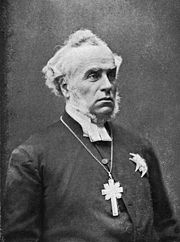
- 1870–1900 Anton Niklas SundbergAnton Niklas SundbergAnton Niklas Sundberg was archbishop of Uppsala 1870–1900.He acquired a philosophy doctor's degree in Uppsala, became dean and was ordained a clergyman, and then undertook travel through Europe in 1849-50...
(27 May 1818 – 2 February 1900)
He acquired a philosophy doctor's degree in Uppsala, became dean and was ordained priest, and then undertook travel through Europe in 1849-50.
He was known as a controversial person; very outspoken, no stranger to using strong language, despising hypocrisy, but he displayed a notable sense of wit and authority.
20th century
- 1900–1913 Johan August EkmanJohan August EkmanJohan August Ekman was Archbishop of Uppsala, Sweden, 1900-1913.He was a student at the University of Uppsala, and was ordained priest in that city 1873. Thereafter he worked as a vicar and held other church offices in Uppsala...
- 1914–1931 Nathan SöderblomNathan SöderblomLars Olof Jonathan Söderblom was a Swedish clergyman, Archbishop of Uppsala in the Church of Sweden, and recipient of the 1930 Nobel Peace Prize...
- 1931–1950 Erling EidemErling EidemErling Eidem was a Swedish theologian who served as archbishop of Uppsala 1931–1950....
- 1950–1958 Yngve BriliothYngve BriliothYngve Brilioth was professor for church history, later for Practical theology in Uppsala, Turku and Lund, Lutheran Bishop of Växjö from 1938 to 1950 and Archbishop of Uppsala from 1950 until 1958. He was the author of a history of the Oxford Movement, written to coincide with its centenary in 1933...
(12 July 1891 in Västra Ed, Kalmar CountyKalmar CountyKalmar County is a county or län in southern Sweden. It borders the counties of Kronoberg, Jönköping, Blekinge and Östergötland. To the east in the Baltic Sea is the island Gotland....
– died 27 April 1959 in UppsalaUppsala- Economy :Today Uppsala is well established in medical research and recognized for its leading position in biotechnology.*Abbott Medical Optics *GE Healthcare*Pfizer *Phadia, an offshoot of Pharmacia*Fresenius*Q-Med...
)
Was Ph.D. in Uppsala and subsequently a dean and professor of philosophy and bishop of Växjö
Växjö
Växjö is a city and the seat of Växjö Municipality, Kronoberg County, Sweden with 64 200 inhabitants in 2010. It is the administrative, cultural and industrial centre of Kronoberg County. Furthermore it is the episcopal see of the Diocese of Växjö. It has a population of about 64 200, out of a...
.
He wrote many international historical and theological books. For his contribution to the history of the Anglican Church, in 1942 he was awarded the Lambeth Cross, the highest award in the Anglican Church.
He used his deep historical knowledge when he was archbishop to take measures concerning the organisation, liturgy and methods of preaching; he furthermore had an international interest and was chairman of the Faith and Order
World Council of Churches
The World Council of Churches is a worldwide fellowship of 349 global, regional and sub-regional, national and local churches seeking unity, a common witness and Christian service. It is a Christian ecumenical organization that is based in the Ecumenical Centre in Geneva, Switzerland...
commission.
- 1958–1967 Gunnar Hultgren
(Born 19 February 1902 in Eskilstuna; died 13 February 1991 in Uppsala.)
- 1967–1972 Ruben Josefson
(Born 25 August 1907 in Svenljunga
Svenljunga
Svenljunga is a locality and the seat of Svenljunga Municipality, Västra Götaland County, Sweden with 3,379 inhabitants in 2005.- References :...
, Älvsborgs län; died 19 March 1972 in Uppsala.)
- 1972–1983 Olof Sundby (1917–1996)
He married the present King Carl XVI Gustaf and Queen Silvia
Queen Silvia of Sweden
|align=right|Queen Silvia of Sweden is the Queen consort of King Carl XVI Gustaf of Sweden. Styled Her Majesty The Queen, Silvia is the mother of the heir apparent to the throne, Crown Princess Victoria.-Childhood:Queen Silvia was born in Heidelberg, Germany, on 23 December 1943...
on 19 June 1976 in Storkyrkan in Stockholm.
- 1983–1993 Bertil Werkström (1928–2010)
- 1993–1997 Gunnar Weman (born 1932)
- 1997–2006 Karl Gustav Hammar (born 1943)
- 2006–present Anders WejrydAnders WejrydAnders Harald Wejryd is a Swedish Lutheran clergyman. Having been Bishop of Växjö since 1995, he was elected Archbishop of Uppsala and primate of the Church of Sweden in March 2006 and took office in September of the same year....
(born 1948)
See also
- History of SwedenHistory of SwedenModern Sweden started out of the Kalmar Union formed in 1397 and by the unification of the country by King Gustav Vasa in the 16th century. In the 17th century Sweden expanded its territories to form the Swedish empire. Most of these conquered territories had to be given up during the 18th century...
- List of archbishops of Uppsala