


Johannes Magnus

Encyclopedia

Catholic
The word catholic comes from the Greek phrase , meaning "on the whole," "according to the whole" or "in general", and is a combination of the Greek words meaning "about" and meaning "whole"...
Archbishop
Archbishop
An archbishop is a bishop of higher rank, but not of higher sacramental order above that of the three orders of deacon, priest , and bishop...
in Sweden, and also a theologian, genealogist, and historian.
Life
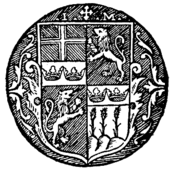
Linköping
Linköping is a city in southern middle Sweden, with 104 232 inhabitants in 2010. It is the seat of Linköping Municipality with 146 736 inhabitants and the capital of Östergötland County...
, son of the burgess Måns Pedersson and his wife Kristina. (His own later claims to be descended from a noble family named Store are unverified.)
Magnus was selected by King Gustav I of Sweden
Gustav I of Sweden
Gustav I of Sweden, born Gustav Eriksson of the Vasa noble family and later known simply as Gustav Vasa , was King of Sweden from 1523 until his death....
(Vasa) to become Archbishop, in 1523. As he was about to travel to Rome to be ordained, a papal bull
Papal bull
A Papal bull is a particular type of letters patent or charter issued by a Pope of the Catholic Church. It is named after the bulla that was appended to the end in order to authenticate it....
from Pope Clement VII
Pope Clement VII
Clement VII , born Giulio di Giuliano de' Medici, was a cardinal from 1513 to 1523 and was Pope from 1523 to 1534.-Early life:...
was received, stating that the previous Archbishop Gustav Trolle
Gustav Trolle
Gustav Eriksson Trolle was Archbishop of Uppsala, Sweden, in two sessions, during the turbulent Reformation events.After returning from studies abroad, in Cologne and Rome, he was in 1513 elected vicar in Linköping. One year later he became Archbishop of Uppsala...
, who was at the time in exile abroad, should be reinstated. The papal bull declared the deposing of Trolle unlawful.
However, Gustav Trolle was deemed a traitor to the country, and Gustav Vasa could not reinstate him. Instead he ignored the papal bull and took it upon himself to install Magnus without papal acceptance. Before long, however, Johannes Magnus rebelled by declaring his discontent with the Lutheran teachings spread by the brothers Olaus
Olaus Petri
Olof Persson , better known under the Latin form of his name, Olaus Petri , was a clergyman, writer, and a major contributor to the Protestant Reformation in Sweden...
and Laurentius Petri
Laurentius Petri
Laurentius Petri Nericius was a Swedish clergyman and the first Evangelical Lutheran Archbishop of Sweden. He and his brother Olaus Petri are, together with the King Gustav Vasa, regarded as the main Protestant reformers of Sweden...
, under the supervision of King Gustav Vasa. The King then sent him off to Russia as a diplomat in 1526. Johannes Magnus was careful not to return home during that time, realizing that he was unwanted. Gustav Vasa appointed a new archbishop, Laurentius Petri
Laurentius Petri
Laurentius Petri Nericius was a Swedish clergyman and the first Evangelical Lutheran Archbishop of Sweden. He and his brother Olaus Petri are, together with the King Gustav Vasa, regarded as the main Protestant reformers of Sweden...
, in 1531, and Johannes realized that his time as archbishop was over.
His brother, Olaus Magnus
Olaus Magnus
Olaus Magnus was a Swedish ecclesiastic and writer, who did pioneering work for the interest of Nordic people. He was reported as born in October 1490 in Östergötland, and died on August 1, 1557. Magnus, Latin for the Swedish Stor “great”, is a Latin family name taken personally, and not a...
, had meanwhile travelled to Rome to explain the matter of Gustav Trolle to the Pope. In 1533 the Pope finished investigating the Trolle matter and decided that Magnus was the most appropriate successor, and Magnus travelled to Rome to be ordained. However, as Sweden now no longer took direction from the Vatican, both brothers remained in Italy for the remainder of their lives.
Magnus spent his time in Venice
Venice
Venice is a city in northern Italy which is renowned for the beauty of its setting, its architecture and its artworks. It is the capital of the Veneto region...
and Rome
Rome
Rome is the capital of Italy and the country's largest and most populated city and comune, with over 2.7 million residents in . The city is located in the central-western portion of the Italian Peninsula, on the Tiber River within the Lazio region of Italy.Rome's history spans two and a half...
, where he wrote two historical works about Sweden: Historia de omnibus Gothorum Sueonumque regibus and Historia metropolitanæ ecclesiæ Upsaliensis, which are important for their historical information, but are also filled with tales that have no reliable foundation. After the death of Johannes in 1544, the line of Swedish archbishops consecrated by the Pope ended. He died in Rome.
Works
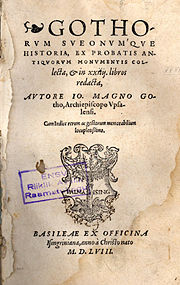
Rome
Rome is the capital of Italy and the country's largest and most populated city and comune, with over 2.7 million residents in . The city is located in the central-western portion of the Italian Peninsula, on the Tiber River within the Lazio region of Italy.Rome's history spans two and a half...
in 1554, by Johannes' brother Olaus Magnus
Olaus Magnus
Olaus Magnus was a Swedish ecclesiastic and writer, who did pioneering work for the interest of Nordic people. He was reported as born in October 1490 in Östergötland, and died on August 1, 1557. Magnus, Latin for the Swedish Stor “great”, is a Latin family name taken personally, and not a...
. Olaus sent it to Sweden
Sweden
Sweden , officially the Kingdom of Sweden , is a Nordic country on the Scandinavian Peninsula in Northern Europe. Sweden borders with Norway and Finland and is connected to Denmark by a bridge-tunnel across the Öresund....
with a dedication to the dukes Eric
Eric XIV of Sweden
-Family and descendants:Eric XIV had several relationships before his marriage. With Agda Persdotter he had four daughters:#Margareta Eriksdotter , married 1592 to Olov Simonsson, vicar of Horn....
, John
John III of Sweden
-Family:John married his first wife, Catherine Jagellonica of Poland , house of Jagiello, in Vilnius on 4 October 1562. In Sweden, she is known as Katarina Jagellonica. She was the sister of king Sigismund II Augustus of Poland...
, Magnus
Magnus, Duke of Östergötland
Magnus Vasa , prince of Sweden, Duke of Östergötland from 1555. Magnus was the third son of king Gustav Vasa. His mother was queen Margareta Leijonhufvud....
and Charles
Charles IX of Sweden
Charles IX of Sweden also Carl, was King of Sweden from 1604 until his death. He was the youngest son of King Gustav I of Sweden and his second wife, Margaret Leijonhufvud, brother of Eric XIV and John III of Sweden, and uncle of Sigismund III Vasa king of both Sweden and Poland...
. It was subsequently republished several times. It appeared in a Swedish translation by Er. Schroderus for the first time in 1620. It is a very unreliable source for early Swedish history.
Johannes Magnus made creative use of Jordanes' Getica
Getica (Jordanes)
De origine actibusque Getarum , or the Getica, written in Late Latin by Jordanes in 551, claims to be a summary of a voluminous account by Cassiodorus of the origin and history of the Gothic people, which may have had the title "Origo Gothica" and which is now lost...
and of Saxo Grammaticus
Saxo Grammaticus
Saxo Grammaticus also known as Saxo cognomine Longus was a Danish historian, thought to have been a secular clerk or secretary to Absalon, Archbishop of Lund, foremost advisor to Valdemar I of Denmark. He is the author of the first full history of Denmark.- Life :The Jutland Chronicle gives...
to depict a history of the Swedish people, of their kings, and of the "Goths abroad". He states that Magog
Magog (Bible)
Magog, Hebrew מגוג, Greek Μαγωγ, [ ma'gog ], is the second of the seven sons of Japheth mentioned in the Table of Nations in Genesis 10. It may represent Hebrew for "from Gog", though this is far from certain....
, son of Japheth, was Sweden's first king. The first 16 volumes are taken up by the period before AD 1000 in a strange mixture of tales from earlier writers and his own fiction, allegedly derived from runic records at Uppsala in the Younger Futhark
Younger Futhark
The Younger Futhark, also called Scandinavian runes, is a runic alphabet, a reduced form of the Elder Futhark, consisting of only 16 characters, in use from ca. 800 CE...
, which he claimed had served the Goths as an alphabet for some two millennia before Christ. Johannes Magnus invented a list of kings of Sweden with six Erics before Eric the Victorious, where he started counting from Jordanes' Berig
Berig
Berig is a legendary king of the Goths appearing in the Getica by Jordanes. According to Jordanes, Berig led his people on three ships from Scandza to Gothiscandza...
as Eric I. He also invented six kings of the name Charles before Karl Sverkersson. This is how Gustav Vasa's sons could style themselves as Eric XIV and Charles IX
Charles IX of Sweden
Charles IX of Sweden also Carl, was King of Sweden from 1604 until his death. He was the youngest son of King Gustav I of Sweden and his second wife, Margaret Leijonhufvud, brother of Eric XIV and John III of Sweden, and uncle of Sigismund III Vasa king of both Sweden and Poland...
. While the work describes these fictional Erics and Charleses in generally positive terms, it also includes a few invented tyrants with names similar to king Gustav.
The work is exceedingly patriotic and suggests that Denmark was populated by convicts exiled from Sweden, a charge drawing a sharp rebuttal from the Danish court.
Sources
http://runeberg.org/sbh/b0115.html Svenskt biografiskt handlexikonSee also
- Ballad of Eric
- List of Archbishops of Uppsala