

Odd Man Out

Encyclopedia
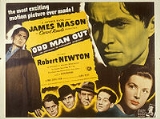
Odd Man Out is a 1947 Anglo-Irish
film noir
directed by Carol Reed
, starring James Mason
, and is based on a novel of the same name by F. L. Green
.
The city and the illegal organisation are never explicitly named in the film, but the protagonist is a chieftain in an IRA
-like organization. James Mason
plays Johnny McQueen, who is trying to escape from the police
after an ill-advised mill robbery meant to replenish the organization's coffers. The film follows McQueen, who has been wounded in the robbery, through an increasingly surreal odyssey over a day and a night. The bleak city (almost certainly Belfast
), with its labyrinth of havens and traps, draws Johnny ever deeper into itself as the night wears on.
 Aside from Mason, the supporting cast was drawn largely from Dublin's Abbey Theatre
. Among the other members of the Organisation are Cyril Cusack
, Robert Beatty
, and Dan O'Herlihy
. On his travels, Johnny meets an opportunistic bird-fancier played by F. J. McCormick
, a drunken artist played by Robert Newton
, a barman (William Hartnell
) and a failed surgeon (Elwyn Brook-Jones
). Denis O'Dea
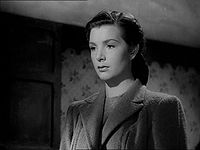
is the Inspector on Johnny's trail, and Kathleen Ryan
, in her first feature film, plays the woman who loves Johnny. Also of note are W. G. Fay
-- a founder of the Abbey Theatre—as the kindly Father Tom, Fay Compton
, Joseph Tomelty
, and Eddie Byrne
. A number of non-speaking parts were filled by actors who later went on to achieve a modicum of fame, including Wilfrid Brambell
, Dora Bryan
, Geoffrey Keen
, Noel Purcell
, and Guy Rolfe
. Few of the main actors in the film actually manage an authentic Ulster
accent.
The cinematographer
was Robert Krasker
, in his first film for director Reed, lighting sets designed by Ralph Brinton and Roger Furse.
This was the first screen appearance of Steptoe and Son
actor Wilfrid Brambell
who began his 35 year career as a standing passenger in the tram scene of this film.
The main set was based on the Crown Bar in Belfast
; contrary to some sources, it was a studio set built at D&P Studios
in Denham
, Buckinghamshire
, and was not filmed in the real Crown. However, much of the film was shot on location: exterior scenes were shot in West Belfast, although some were shot at Broadway Market
, Hackney
in London
.
Composer William Alwyn
was involved writing the leitmotif
-based score
from the very beginning of the production. It was performed by the London Symphony Orchestra
conducted by Muir Mathieson
.
for Best British Film in 1948. It was nominated for the Golden Lion award at the Venice Film Festival
in 1947, and nominated for a Best Film Editing Oscar in 1948.
Filmmaker Roman Polanski
has repeatedly cited Odd Man Out as his favourite film. Polanski feels that Odd Man Out is superior to The Third Man
, generally considered to be Reed's masterpiece:
, Odd Man Out can be seen billed on the RKO Theatre located on the corner of 8th and Hill Streets in downtown Los Angeles
.
Anglo-Irish
Anglo-Irish was a term used primarily in the 19th and early 20th centuries to identify a privileged social class in Ireland, whose members were the descendants and successors of the Protestant Ascendancy, mostly belonging to the Church of Ireland, which was the established church of Ireland until...
film noir
Film noir
Film noir is a cinematic term used primarily to describe stylish Hollywood crime dramas, particularly those that emphasize cynical attitudes and sexual motivations. Hollywood's classic film noir period is generally regarded as extending from the early 1940s to the late 1950s...
directed by Carol Reed
Carol Reed
Sir Carol Reed was an English film director best known for Odd Man Out , The Fallen Idol , The Third Man and Oliver!...
, starring James Mason
James Mason
James Neville Mason was an English actor who attained stardom in both British and American films. Mason remained a powerful figure in the industry throughout his career and was nominated for three Academy Awards as well as three Golden Globes .- Early life :Mason was born in Huddersfield, in the...
, and is based on a novel of the same name by F. L. Green
F. L. Green
Frederick Laurence Green was a British author who had 14 titles published between 1934 and 1952. He is best known for his 1945 novel, Odd Man Out, which was memorably filmed by Carol Reed in 1947....
.
Plot
The film's opening intertitle reads:- "This story is told against a background of political unrest in a city of Northern IrelandNorthern IrelandNorthern Ireland is one of the four countries of the United Kingdom. Situated in the north-east of the island of Ireland, it shares a border with the Republic of Ireland to the south and west...
. It is not concerned with the struggle between the law and an illegal organisation, but only with the conflict in the hearts of the people when they become unexpectedly involved."
The city and the illegal organisation are never explicitly named in the film, but the protagonist is a chieftain in an IRA
Irish Republican Army (1922–1969)
The original Irish Republican Army fought a guerrilla war against British rule in Ireland in the Irish War of Independence 1919–1921. Following the signing of the Anglo-Irish Treaty on 6 December 1921, the IRA in the 26 counties that were to become the Irish Free State split between supporters and...
-like organization. James Mason
James Mason
James Neville Mason was an English actor who attained stardom in both British and American films. Mason remained a powerful figure in the industry throughout his career and was nominated for three Academy Awards as well as three Golden Globes .- Early life :Mason was born in Huddersfield, in the...
plays Johnny McQueen, who is trying to escape from the police
Royal Ulster Constabulary
The Royal Ulster Constabulary was the name of the police force in Northern Ireland from 1922 to 2000. Following the awarding of the George Cross in 2000, it was subsequently known as the Royal Ulster Constabulary GC. It was founded on 1 June 1922 out of the Royal Irish Constabulary...
after an ill-advised mill robbery meant to replenish the organization's coffers. The film follows McQueen, who has been wounded in the robbery, through an increasingly surreal odyssey over a day and a night. The bleak city (almost certainly Belfast
Belfast
Belfast is the capital of and largest city in Northern Ireland. By population, it is the 14th biggest city in the United Kingdom and second biggest on the island of Ireland . It is the seat of the devolved government and legislative Northern Ireland Assembly...
), with its labyrinth of havens and traps, draws Johnny ever deeper into itself as the night wears on.
Production
Abbey Theatre
The Abbey Theatre , also known as the National Theatre of Ireland , is a theatre located in Dublin, Ireland. The Abbey first opened its doors to the public on 27 December 1904. Despite losing its original building to a fire in 1951, it has remained active to the present day...
. Among the other members of the Organisation are Cyril Cusack
Cyril Cusack
Cyril James Cusack was an Irish actor, who appeared in more than 90 films.-Early life:Cusack was born in Durban, Natal, South Africa, the son of Alice Violet , an actress, and James Walter Cusack, a sergeant in the Natal mounted police. His parents separated when he was young and his mother took...
, Robert Beatty
Robert Beatty
Robert Beatty was a Canadian actor who worked in film, television and radio for most of his career and was especially known in the UK.-Career:Born in Hamilton, Ontario, Beatty began his acting career in Britain in 1939....
, and Dan O'Herlihy
Dan O'Herlihy
Daniel O'Herlihy was an Oscar nominated Irish film actor.-Early life:O'Herlihy was born in Wexford, Ireland in 1919. His family moved to Dublin at a young age...
. On his travels, Johnny meets an opportunistic bird-fancier played by F. J. McCormick
F. J. McCormick
F. J. McCormick was an Irish actor who came to fame as part of Dublin's Abbey Theatre. He was also in four films; most famously Carol Reed's Odd Man Out , in which he played the opportunistic Shell. He died in 1947 of a brain tumor.-External links: at the Internet Movie Database...
, a drunken artist played by Robert Newton
Robert Newton
Robert Newton was an English stage and film actor. Along with Errol Flynn, Newton was one of the most popular actors among the male juvenile audience of the 1940s and early 1950s, especially with British boys...
, a barman (William Hartnell
William Hartnell
William Henry Hartnell was an English actor. During 1963-66, he was the first actor to play the Doctor in the long-running BBC science fiction television series Doctor Who.-Early life:...
) and a failed surgeon (Elwyn Brook-Jones
Elwyn Brook-Jones
Elwyn Brook-Jones was a British film and television actor.-Life:Brook-Jones was born in Sarawak on the island of Borneo. After a private education, he attended Jesus College, Oxford. His public debut was in Australia, aged 11, as a concert pianist; he later made cabaret appearances in America...
). Denis O'Dea
Denis O'Dea
Denis O'Dea was an Irish stage and film actor.O'Dea was a leading member of Dublin's Abbey Theatre, where his work led to a number of notable film roles, including two mid-1930s John Ford films, The Informer and The Plough and the Stars , and the part of the police inspector in pursuit of IRA man...
is the Inspector on Johnny's trail, and Kathleen Ryan
Kathleen Ryan
Kathleen Ryan was an Irish actress.She was born in Dublin, Ireland of Tipperary parentage and was a spirited and heart warming Irish actress who appeared in British and Hollywood movies between 1947 and 1957.-Family:...
, in her first feature film, plays the woman who loves Johnny. Also of note are W. G. Fay
William Fay
William George Fay was an actor and theatre producer who was one of the co-founders of the Abbey Theatre....
-- a founder of the Abbey Theatre—as the kindly Father Tom, Fay Compton
Fay Compton
Fay Compton was an English actress from a notable acting lineage; her father was actor/manager Edward Compton; her mother, Virginia Bateman, was a distinguished member of the profession, as were her sister, the actress Viola Compton, and her uncles and aunts. Her grandfather was the 19th-century...
, Joseph Tomelty
Joseph Tomelty
Joseph Tomelty was a Northern Irish character actor and playwright. He worked in film, television, radio and on the stage, starring in Sam Thompson's 1960 play Over the Bridge.-Early life:...
, and Eddie Byrne
Eddie Byrne
Eddie Byrne was an Irish actor. Outside Ireland he is probably best known for his minor role as General Vanden Willard in Star Wars Episode IV: A New Hope, but fans of cult sci-fi might also remember him as the skeptical Inspector Mulrooney in The Mummy and as the kindly Dr. Reginald Landers in...
. A number of non-speaking parts were filled by actors who later went on to achieve a modicum of fame, including Wilfrid Brambell
Wilfrid Brambell
Henry Wilfrid Brambell was an Irish film and television actor best known for his role in the British television series Steptoe and Son. He also performed alongside The Beatles in their film A Hard Day's Night, playing Paul McCartney's fictional grandfather.- Early life :Brambell was born in Dublin...
, Dora Bryan
Dora Bryan
Dora May Bryan OBE is an English actress of stage, film and television.-Early life:Bryan was born as Dora May Broadbent in Southport, Lancashire, England. Her father was a salesman and she attended Hathershaw County Primary School in Oldham, Lancashire...
, Geoffrey Keen
Geoffrey Keen
Geoffrey Keen was an English actor who appeared in supporting roles in many famous films.-Early life:Keen was born in Wallingford, Oxfordshire, England, the son of stage actor Malcolm Keen. He was educated at Bristol Grammar School. He then joined the Little Repertory Theatre in Bristol for whom...
, Noel Purcell
Noel Purcell (actor)
Noel Purcell was an Irish film and television actor.-Career:Purcell began his show business career at the age of 12 in Dublin's Gaiety Theatre. Later, he toured Ireland in a vaudeville act with Jimmy O'Dea....
, and Guy Rolfe
Guy Rolfe
Guy Rolfe was an English actor born in London.He made his screen debut in 1937 with an uncredited appearance in Knight Without Armour. Notable roles include: Prince John in Ivanhoe , Ned Seymour in Young Bess , Caiaphas in King of Kings , and Prince Grigory in Taras Bulba...
. Few of the main actors in the film actually manage an authentic Ulster
Ulster
Ulster is one of the four provinces of Ireland, located in the north of the island. In ancient Ireland, it was one of the fifths ruled by a "king of over-kings" . Following the Norman invasion of Ireland, the ancient kingdoms were shired into a number of counties for administrative and judicial...
accent.
The cinematographer
Cinematographer
A cinematographer is one photographing with a motion picture camera . The title is generally equivalent to director of photography , used to designate a chief over the camera and lighting crews working on a film, responsible for achieving artistic and technical decisions related to the image...
was Robert Krasker
Robert Krasker
Robert Krasker, A.S.C. was a cinematographer, who worked on more than fifty films in his career.He was born in Perth, Australia andtravelled to England in 1932 via photographic studios in Paris and Dresden...
, in his first film for director Reed, lighting sets designed by Ralph Brinton and Roger Furse.
This was the first screen appearance of Steptoe and Son
Steptoe and Son
Steptoe and Son is a British sitcom written by Ray Galton and Alan Simpson about two rag and bone men living in Oil Drum Lane, a fictional street in Shepherd's Bush, London. Four series were broadcast by the BBC from 1962 to 1965, followed by a second run from 1970 to 1974. Its theme tune, "Old...
actor Wilfrid Brambell
Wilfrid Brambell
Henry Wilfrid Brambell was an Irish film and television actor best known for his role in the British television series Steptoe and Son. He also performed alongside The Beatles in their film A Hard Day's Night, playing Paul McCartney's fictional grandfather.- Early life :Brambell was born in Dublin...
who began his 35 year career as a standing passenger in the tram scene of this film.
The main set was based on the Crown Bar in Belfast
Belfast
Belfast is the capital of and largest city in Northern Ireland. By population, it is the 14th biggest city in the United Kingdom and second biggest on the island of Ireland . It is the seat of the devolved government and legislative Northern Ireland Assembly...
; contrary to some sources, it was a studio set built at D&P Studios
Denham Film Studios
Denham Film Studios were a British film production studio operating from 1936 to 1952.The studios were founded by Alexander Korda, on a 165 acre site near the village of Denham, Buckinghamshire. At the time it was the largest facility of its kind in the UK, but it was merged with Rank's Pinewood...
in Denham
Denham
- People :* Carl Denham, fictional character from King Kong* Daryl Denham, British radio DJ* Digby Denham, Australian politician* Dixon Denham, British explorer* Henry Denham, British printer* Henry Mangles Denham, , Royal navy...
, Buckinghamshire
Buckinghamshire
Buckinghamshire is a ceremonial and non-metropolitan home county in South East England. The county town is Aylesbury, the largest town in the ceremonial county is Milton Keynes and largest town in the non-metropolitan county is High Wycombe....
, and was not filmed in the real Crown. However, much of the film was shot on location: exterior scenes were shot in West Belfast, although some were shot at Broadway Market
Broadway Market
Broadway Market is a street running from London Fieldsto the Regent's Canal in Haggerston in the London Borough of Hackney, east London.Before the late 20th century it was the site of a busy fruit and vegetable market, but this slowly dwindled over time - in the early 2000s, market activity was...
, Hackney
London Borough of Hackney
The London Borough of Hackney is a London borough of North/North East London, and forms part of inner London. The local authority is Hackney London Borough Council....
in London
London
London is the capital city of :England and the :United Kingdom, the largest metropolitan area in the United Kingdom, and the largest urban zone in the European Union by most measures. Located on the River Thames, London has been a major settlement for two millennia, its history going back to its...
.
Composer William Alwyn
William Alwyn
William Alwyn, CBE, born William Alwyn Smith was an English composer, conductor, and music teacher.-Life and music:...
was involved writing the leitmotif
Leitmotif
A leitmotif , sometimes written leit-motif, is a musical term , referring to a recurring theme, associated with a particular person, place, or idea. It is closely related to the musical idea of idée fixe...
-based score
Film score
A film score is original music written specifically to accompany a film, forming part of the film's soundtrack, which also usually includes dialogue and sound effects...
from the very beginning of the production. It was performed by the London Symphony Orchestra
London Symphony Orchestra
The London Symphony Orchestra is a major orchestra of the United Kingdom, as well as one of the best-known orchestras in the world. Since 1982, the LSO has been based in London's Barbican Centre.-History:...
conducted by Muir Mathieson
Muir Mathieson
James Muir Mathieson was a Scottish conductor and composer. Mathieson was almost always described as a "Musical Director" on a large number of British films.-Career:...
.
Reception
The film's violent ending attracted advance criticism from the censors, and had to be toned down in the finished film. The film received the BAFTA AwardBritish Academy of Film and Television Arts
The British Academy of Film and Television Arts is a charity in the United Kingdom that hosts annual awards shows for excellence in film, television, television craft, video games and forms of animation.-Introduction:...
for Best British Film in 1948. It was nominated for the Golden Lion award at the Venice Film Festival
Venice Film Festival
The Venice International Film Festival is the oldest international film festival in the world. Founded by Count Giuseppe Volpi in 1932 as the "Esposizione Internazionale d'Arte Cinematografica", the festival has since taken place every year in late August or early September on the island of the...
in 1947, and nominated for a Best Film Editing Oscar in 1948.
Filmmaker Roman Polanski
Roman Polanski
Roman Polanski is a French-Polish film director, producer, writer and actor. Having made films in Poland, Britain, France and the USA, he is considered one of the few "truly international filmmakers."...
has repeatedly cited Odd Man Out as his favourite film. Polanski feels that Odd Man Out is superior to The Third Man
The Third Man
The Third Man is a 1949 British film noir, directed by Carol Reed and starring Joseph Cotten, Alida Valli, Orson Welles, and Trevor Howard. Many critics rank it as a masterpiece, particularly remembered for its atmospheric cinematography, performances, and unique musical score...
, generally considered to be Reed's masterpiece:
In Popular Culture
In the 2011 computer game L.A. NoireL.A. Noire
L.A. Noire is a 2011 crime video game developed by Team Bondi and published by Rockstar Games. It was released for PlayStation 3, Xbox 360, Microsoft Windows. It was released as a 3-disc game for the Xbox 360 console, which prompts the player to switch to another disc at certain points in the...
, Odd Man Out can be seen billed on the RKO Theatre located on the corner of 8th and Hill Streets in downtown Los Angeles
Los Ángeles
Los Ángeles is the capital of the province of Biobío, in the commune of the same name, in Region VIII , in the center-south of Chile. It is located between the Laja and Biobío rivers. The population is 123,445 inhabitants...
.