

OPEC Fund for International Development

Encyclopedia
The OPEC
Fund for International Development (OFID) is a multilateral development finance institution established in 1976 by the Member Countries of the Organization of the Petroleum Exporting Countries (OPEC). Its objective is to reinforce financial cooperation between OPEC Member Countries and other developing countries, by providing financial support to the latter for their socio-economic development. The resources of OFID are also used to provide grants for food aid, technical assistance, research and similar intellectual activities. One of the institution's central aims is to advance South-South solidarity. OFID has been headquartered in Vienna
, Austria
since 1976. The current Director-General of OFID is Mr. Suleiman Jasir Al-Herbish
of Saudi Arabia
.
 ]
]
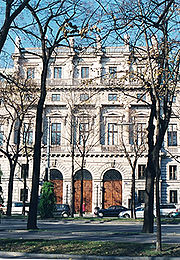 The OFID Headquarters Building (located in Vienna's first district, on the Ringstraße
) was the residential palace of the Austrian Archduke Wilhelm Franz Karl. Built between 1864-68 to the architectural design of Theophil von Hansen (1813-1891), the palace was sold to the German Order of Knights (Teutonic Order) in 1870 and used as headquarters of the Grand Master, the last of whom was Archduke Eugen. From 1894, it served as the palace of both the Grand and German Masters, acquiring the name, Palais Deutschmeister. In 1938, following the dissolution of the German Order of Knights, the building was seized by National Socialist (Nazi) Germany and, in 1942, it was handed over to the police authorities. Between 1945-1975 it served as headquarters of the Vienna police. After an interregnum, the building became the property of OFID.
, Algeria
in 1975, Member Countries expressed their commitment to assist the developing countries through a collective financial facility. As a result, in 1976, the Finance Ministers of Member Countries met and established the OPEC Special Fund through which Member countries would channel aid to developing countries. OFID started its operations in 1976, with an initial endowment of $800 million and in little over a year, its resources had doubled. By the end of 1977 it had extended 71 loans to 58 developing countries, as well as channelling donations from its Member Countries to other development institutions, including the International Monetary Fund
(IMF) Trust Fund and the International Fund for Agricultural Development
(IFAD). As a result of its successful performance, Member Countries decided in 1980 to convert the temporary facility into a permanent legal entity called the OPEC Fund for International Development (OFID). OFID became a fully fledged, permanent international development agency in May 1980.
(HIPC) Initiative; trade financing; support to private enterprises; grants for technical assistance, food aid, research and humanitarian relief work; and contributions to the resources of other development organizations whose activities benefit developing countries.
(LDCs). Women and children, especially, are accorded high priority. Technical assistance grants are awarded largely on the basis of the type of project and its expected outcomes, the number of beneficiaries and the recipient country’s socio-economic situation.
and the WFP.
) placed Energy Poverty on the global agenda, by calling on the World Bank to launch an initiative for impoverished countries known as the "Energy for the Poor Initiative". This initiative, by mobilizing the donor community, aims at providing assistance to help the poor and low-income people to access energy in an affordable way. OFID is helping to coordinate the stakeholders’ actions regarding this initiative in which the World Bank
and the Saudi Fund for Development are actively participating. The institution has contributed to the conceptualization of this initiative. OFID has proposed a financial mechanism to reach the dual objective of first, increasing the level of concessionality to make it accessible to the poor countries and second, to achieve a scope and a volume of funding commensurate with the scale of the financial challenge in this domain. OFID has played a catalyst role and suggested blending grants and loans to reach this dual objective. Furthermore, OFID has already identified concrete energy poverty alleviation projects totaling US$500 million.
OPEC
OPEC is an intergovernmental organization of twelve developing countries made up of Algeria, Angola, Ecuador, Iran, Iraq, Kuwait, Libya, Nigeria, Qatar, Saudi Arabia, the United Arab Emirates, and Venezuela. OPEC has maintained its headquarters in Vienna since 1965, and hosts regular meetings...
Fund for International Development (OFID) is a multilateral development finance institution established in 1976 by the Member Countries of the Organization of the Petroleum Exporting Countries (OPEC). Its objective is to reinforce financial cooperation between OPEC Member Countries and other developing countries, by providing financial support to the latter for their socio-economic development. The resources of OFID are also used to provide grants for food aid, technical assistance, research and similar intellectual activities. One of the institution's central aims is to advance South-South solidarity. OFID has been headquartered in Vienna
Vienna
Vienna is the capital and largest city of the Republic of Austria and one of the nine states of Austria. Vienna is Austria's primary city, with a population of about 1.723 million , and is by far the largest city in Austria, as well as its cultural, economic, and political centre...
, Austria
Austria
Austria , officially the Republic of Austria , is a landlocked country of roughly 8.4 million people in Central Europe. It is bordered by the Czech Republic and Germany to the north, Slovakia and Hungary to the east, Slovenia and Italy to the south, and Switzerland and Liechtenstein to the...
since 1976. The current Director-General of OFID is Mr. Suleiman Jasir Al-Herbish
Suleiman Jasir Al-Herbish
[Image:H.E. Mr. Suleiman J. Al-Herbish is the current Director-General and Chief Executive Officer of the Vienna-based OPEC Fund for International Development . A former assistant deputy minister, Mr. Al-Herbish has also served as chairman and member of the Board of Directors of several Saudi...
of Saudi Arabia
Saudi Arabia
The Kingdom of Saudi Arabia , commonly known in British English as Saudi Arabia and in Arabic as as-Sa‘ūdiyyah , is the largest state in Western Asia by land area, constituting the bulk of the Arabian Peninsula, and the second-largest in the Arab World...
.
OFID Headquarters
Ringstraße
The Ringstraße is a circular road surrounding the Innere Stadt district of Vienna, Austria and is one of its main sights...
) was the residential palace of the Austrian Archduke Wilhelm Franz Karl. Built between 1864-68 to the architectural design of Theophil von Hansen (1813-1891), the palace was sold to the German Order of Knights (Teutonic Order) in 1870 and used as headquarters of the Grand Master, the last of whom was Archduke Eugen. From 1894, it served as the palace of both the Grand and German Masters, acquiring the name, Palais Deutschmeister. In 1938, following the dissolution of the German Order of Knights, the building was seized by National Socialist (Nazi) Germany and, in 1942, it was handed over to the police authorities. Between 1945-1975 it served as headquarters of the Vienna police. After an interregnum, the building became the property of OFID.
History
Following the First OPEC Summit in AlgiersAlgiers
' is the capital and largest city of Algeria. According to the 1998 census, the population of the city proper was 1,519,570 and that of the urban agglomeration was 2,135,630. In 2009, the population was about 3,500,000...
, Algeria
Algeria
Algeria , officially the People's Democratic Republic of Algeria , also formally referred to as the Democratic and Popular Republic of Algeria, is a country in the Maghreb region of Northwest Africa with Algiers as its capital.In terms of land area, it is the largest country in Africa and the Arab...
in 1975, Member Countries expressed their commitment to assist the developing countries through a collective financial facility. As a result, in 1976, the Finance Ministers of Member Countries met and established the OPEC Special Fund through which Member countries would channel aid to developing countries. OFID started its operations in 1976, with an initial endowment of $800 million and in little over a year, its resources had doubled. By the end of 1977 it had extended 71 loans to 58 developing countries, as well as channelling donations from its Member Countries to other development institutions, including the International Monetary Fund
International Monetary Fund
The International Monetary Fund is an organization of 187 countries, working to foster global monetary cooperation, secure financial stability, facilitate international trade, promote high employment and sustainable economic growth, and reduce poverty around the world...
(IMF) Trust Fund and the International Fund for Agricultural Development
International Fund for Agricultural Development
The International Fund for Agricultural Development , a specialized agency of the United Nations, was established as an international financial institution in 1977 as one of the major outcomes of the 1974 World Food Conference. IFAD is dedicated to eradicating rural poverty in developing countries...
(IFAD). As a result of its successful performance, Member Countries decided in 1980 to convert the temporary facility into a permanent legal entity called the OPEC Fund for International Development (OFID). OFID became a fully fledged, permanent international development agency in May 1980.
Member countries
- AlgeriaAlgeriaAlgeria , officially the People's Democratic Republic of Algeria , also formally referred to as the Democratic and Popular Republic of Algeria, is a country in the Maghreb region of Northwest Africa with Algiers as its capital.In terms of land area, it is the largest country in Africa and the Arab...
- GabonGabonGabon , officially the Gabonese Republic is a state in west central Africa sharing borders with Equatorial Guinea to the northwest, Cameroon to the north, and with the Republic of the Congo curving around the east and south. The Gulf of Guinea, an arm of the Atlantic Ocean is to the west...
- IndonesiaIndonesiaIndonesia , officially the Republic of Indonesia , is a country in Southeast Asia and Oceania. Indonesia is an archipelago comprising approximately 13,000 islands. It has 33 provinces with over 238 million people, and is the world's fourth most populous country. Indonesia is a republic, with an...
- IranIranIran , officially the Islamic Republic of Iran , is a country in Southern and Western Asia. The name "Iran" has been in use natively since the Sassanian era and came into use internationally in 1935, before which the country was known to the Western world as Persia...
- IraqIraqIraq ; officially the Republic of Iraq is a country in Western Asia spanning most of the northwestern end of the Zagros mountain range, the eastern part of the Syrian Desert and the northern part of the Arabian Desert....
- KuwaitKuwaitThe State of Kuwait is a sovereign Arab state situated in the north-east of the Arabian Peninsula in Western Asia. It is bordered by Saudi Arabia to the south at Khafji, and Iraq to the north at Basra. It lies on the north-western shore of the Persian Gulf. The name Kuwait is derived from the...
- LibyaLibyaLibya is an African country in the Maghreb region of North Africa bordered by the Mediterranean Sea to the north, Egypt to the east, Sudan to the southeast, Chad and Niger to the south, and Algeria and Tunisia to the west....
- NigeriaNigeriaNigeria , officially the Federal Republic of Nigeria, is a federal constitutional republic comprising 36 states and its Federal Capital Territory, Abuja. The country is located in West Africa and shares land borders with the Republic of Benin in the west, Chad and Cameroon in the east, and Niger in...
- QatarQatarQatar , also known as the State of Qatar or locally Dawlat Qaṭar, is a sovereign Arab state, located in the Middle East, occupying the small Qatar Peninsula on the northeasterly coast of the much larger Arabian Peninsula. Its sole land border is with Saudi Arabia to the south, with the rest of its...
- Saudi ArabiaSaudi ArabiaThe Kingdom of Saudi Arabia , commonly known in British English as Saudi Arabia and in Arabic as as-Sa‘ūdiyyah , is the largest state in Western Asia by land area, constituting the bulk of the Arabian Peninsula, and the second-largest in the Arab World...
- United Arab EmiratesUnited Arab EmiratesThe United Arab Emirates, abbreviated as the UAE, or shortened to "the Emirates", is a state situated in the southeast of the Arabian Peninsula in Western Asia on the Persian Gulf, bordering Oman, and Saudi Arabia, and sharing sea borders with Iraq, Kuwait, Bahrain, Qatar, and Iran.The UAE is a...
- VenezuelaVenezuelaVenezuela , officially called the Bolivarian Republic of Venezuela , is a tropical country on the northern coast of South America. It borders Colombia to the west, Guyana to the east, and Brazil to the south...
Means
The methods of OFID's funding include public sector loans for development projects and programs, balance of payments support and debt relief under the Heavily Indebted Poor CountriesHeavily Indebted Poor Countries
Heavily Indebted Poor Countries is a group of 40 developing countries with high levels of poverty and debt overhang which are eligible for special assistance from the International Monetary Fund and the World Bank.- History and structure :...
(HIPC) Initiative; trade financing; support to private enterprises; grants for technical assistance, food aid, research and humanitarian relief work; and contributions to the resources of other development organizations whose activities benefit developing countries.
Resources
OFID's resources consist of voluntary contributions made by OPEC Member Countries and the accumulated reserves derived from the institution's various operations. At the close of 2008, contributions pledged by member countries totaled $3,435.0 million, out of which $2,463.15 million was direct contributions to OFID.Beneficiaries
All developing countries, with the exception of OPEC member countries themselves, are in principle eligible for OFID assistance. The least developed countries, however, are accorded higher priority and have consequently attracted the lion's share of OFID's resources. Today, 121 countries from the developing world - Africa, Asia, Latin America, the Caribbean, the Middle East and Europe - have benefited from OFID's assistance.Areas of pperation
- Agriculture & Agro-Industry
- Education
- Energy
- Financial Sector
- Health
- Industry
- Infrastructure
- Manufacturing
- Mining
- Poverty Reduction
- Private Sector
- Public Sector
- Rural Development
- Sanitation
- Telecommunication
- Textiles
- Tourism
- Trade
- Transportation
- Water Supply & Sewerage
Public sector operations
This is OFID's traditional financing window which comprises loans for project and program financing and for balance of payments support. The loans are given directly to the governments of cooperating countries to support development operations across a wide range of social and economic sectors. Typical activities financed through this window include agricultural development, the provision of basic infrastructure such as roads, energy supplies, clean water and sanitation services, and the construction of schools and hospitals.Private sector operations
OFID's Private Sector Facility was established in 1998 in response to growing demand among partner countries for investment in private enterprise, which is widely accepted as the engine of economic growth. A diversity of financing instruments is available, including loans, lines of credit, equity, quasi-equity and leasing. Financing may be given directly to private entities or channeled through intermediaries, such as local financial institutions. The Facility supports projects in a broad variety of sectors, from industry, telecommunications and manufacturing, to health, urban development and financial services. The institution's operations in the private sector of partner countries is hinged on the signing of the Agreement for the Encouragement and Protection of Investment, between the countries and OFID.Grant operations
The OFID grant program provides much-needed financing for development activities that fall outside the scope of its lending operations. These primarily include small-scale social projects, research and studies and humanitarian causes. In addition to its regular program, the grants window encompasses three Special Accounts for: Food Aid to Africa, HIV/AIDS mitigation activities, and relief and reconstruction efforts in Palestine.Technical assistance grant operations
Since OFID's inception, technical assistance operations have constituted its core grants activities. Such grants are extended to national and regional development projects that aim at sustainable development and poverty reduction, and that serve the poorest segments of society, particularly those in the Least Developed CountriesLeast Developed Countries
Least developed country is the name given to a country which, according to the United Nations, exhibits the lowest indicators of socioeconomic development, with the lowest Human Development Index ratings of all countries in the world...
(LDCs). Women and children, especially, are accorded high priority. Technical assistance grants are awarded largely on the basis of the type of project and its expected outcomes, the number of beneficiaries and the recipient country’s socio-economic situation.
Research and similar intellectual activities
This type of assistance focuses on activities that increase South-South and North-South cooperation and enhance capacity-building, including human resource development, particularly in the LDCs. A heavy emphasis is placed on research topics and studies of particular relevance to poorer countries and on the advancement of science and technology. Human capital is enhanced through the sponsorship of seminars, training courses and workshops.Emergency aid operations
Emergency assistance from OFID is extended to help mitigate the suffering of victims of all kinds of catastrophes around the world, including OFID Member States. In the interests of sustainable development, OFID often follows up emergency assistance with conventional, low-interest loans to aid longer-term reconstruction in devastated regions. Emergency aid is channelled through specialized relief agencies, such as the IFRC, UNHCR, OCHAOcha
Ocha is a genus of moth in the family Lasiocampidae....
and the WFP.
Special grant account for HIV/AIDS
OFID's HIV/AIDS Account was launched in June 2001, with an initial endowment of US$15 million, following authorization from the Ministerial Council. The decision was inspired by a deeply felt obligation to help alleviate the threat of HIV/AIDS “before humanity faces another plague.” Subsequent replenishments have boosted the Account to US$80 million.Special grant account for Palestine
OFID has been extending assistance to Palestine since 1979. However, after the second Intifada began in 2000, the socio-economic situation in the area deteriorated so fast that humanitarian and development assistance was required on a much larger scale. In November 2002, and in coordination with its sister organizations, OFID set up its Special Grant Account to address the needs of Palestine. Endowed initially with $10 million, the Special Account has accelerated social and economic assistance to Palestinians in both the West Bank & Gaza. Subsequent replenishments have increased the Account to US$90 million.Special food aid account
The Food Aid account was set up to combat hunger. Although OFID has always responded to famine situations (most notably those of 1981 and 1984), it felt that more substantial assistance was needed in 2003, when drought-prone sub-Saharan Africa faced one of the worst food shortages in living memory. As soon as the scale of the famine became apparent, OFID allocated US$20 million to finance rapid food delivery to the affected population in nine hardest hit African countries.Trade Finance Facility (TFF)
At the 2006 meeting of OFID’s highest policy-making body, the Ministerial Council, a decision was taken to extend the institution's operations to include trade financing. This resulted in the establishment of a Trade Finance Facility (TFF). The main objective of the TFF is to further enhance the promotion of economic development by supporting the trade financing needs of institutions in partner countries, including governments, parastatals, banks and private enterprises.The Common Fund for Commodities (CFC)
OFID was instrumental in the establishment of the CFC in the early 1980s, providing a total of US$83.56 million to its resources. Of this sum, US$37.16 million was given to cover the subscriptions of 35 LDCs to enable them to become members of the CFC. The remaining US$46.4 million is being utilized to help finance projects undertaken by the CFC or the benefit of resource-poor commodity producers in the developing world.International Fund for Agricultural Development (IFAD)
OFID played a significant role in the establishment of IFAD, channeling US$861.1 million in contributions from OPEC Member Countries towards the agency’s initial capital and first replenishment. From its own resources, OFID provided US$20 million to the first replenishment as a special grant.Energy for the Poor Initiative
In June 2008, the Custodian of the Two Holy Mosques, King Abdullah bin Abdulaziz Al Saud, (Abdullah of Saudi ArabiaAbdullah of Saudi Arabia
Abdullah bin Abdul-Aziz Al Saud, Custodian of the Two Holy Mosques, is the King of Saudi Arabia. He succeeded to the throne on 1 August 2005 upon the death of his half-brother, King Fahd. When Crown Prince, he governed Saudi Arabia as regent from 1998 to 2005...
) placed Energy Poverty on the global agenda, by calling on the World Bank to launch an initiative for impoverished countries known as the "Energy for the Poor Initiative". This initiative, by mobilizing the donor community, aims at providing assistance to help the poor and low-income people to access energy in an affordable way. OFID is helping to coordinate the stakeholders’ actions regarding this initiative in which the World Bank
World Bank
The World Bank is an international financial institution that provides loans to developing countries for capital programmes.The World Bank's official goal is the reduction of poverty...
and the Saudi Fund for Development are actively participating. The institution has contributed to the conceptualization of this initiative. OFID has proposed a financial mechanism to reach the dual objective of first, increasing the level of concessionality to make it accessible to the poor countries and second, to achieve a scope and a volume of funding commensurate with the scale of the financial challenge in this domain. OFID has played a catalyst role and suggested blending grants and loans to reach this dual objective. Furthermore, OFID has already identified concrete energy poverty alleviation projects totaling US$500 million.
Coordination Group of Arab/OPEC/Islamic Development Institutions
The Coordination Group of Arab/OPEC/Islamic Development Institutions is a collective body of three bilateral and six multilateral agencies set up to provide greater cohesion and effectiveness in the delivery of Arab aid. Established in 1975, the Group meets twice a year at the level of Director of Operations to share initiatives, synchronize programs, and harmonize approaches and best practices. By pooling information and resources, coordinating efforts and drawing on the combined skills and expertise of its members, the Group has maximized aid effectiveness and cost efficiency, and succeeded to a measurable degree in eliminating duplication and waste. Its members are the Abu Dhabi Fund for Development (ADFD), the Arab Bank for Economic Development in Africa (BADEA), the Arab Monetary Fund (AMF), The Arab Fund for Economic and Social Development (AFESD), The Arab Gulf Program for United Nations Development Organizations (AGFUND), the Islamic Development Bank (IsDB), the Kuwait Fund for Arab Economic Development (KFAED), the OPEC Fund for International Development (OFID) and the Saudi Fund for Development (SFD).See also
- Organization of the Petroleum Exporting Countries (OPEC)
- International Fund for Agricultural DevelopmentInternational Fund for Agricultural DevelopmentThe International Fund for Agricultural Development , a specialized agency of the United Nations, was established as an international financial institution in 1977 as one of the major outcomes of the 1974 World Food Conference. IFAD is dedicated to eradicating rural poverty in developing countries...
(IFAD) - International Monetary FundInternational Monetary FundThe International Monetary Fund is an organization of 187 countries, working to foster global monetary cooperation, secure financial stability, facilitate international trade, promote high employment and sustainable economic growth, and reduce poverty around the world...
- The World Bank
- Common Fund for CommoditiesCommon Fund for CommoditiesThe Common Fund for Commodities is an inter-governmental financial institution established within the framework of the United Nations. It is a vestige of the proposed New International Economic Order.-External links:*...
(CFC) - Arab Bank for Economic Development in AfricaArab Bank for Economic Development in AfricaThe Arab Bank for Economic Development in Africa is a financial institution funded by the Governments of the Member States of the League of Arab States on 18 February 1974 . It is an independent international institution enjoying international legal status and autonomy in administrative and...
(BADEA) - Arab Monetary FundArab Monetary FundThe Arab Monetary Fund is a regional Arab organization, founded 1976, and operational from 1977. It is a working sub-organization of the Arab League.-Objectives:...
(AMF) - Islamic Development BankIslamic Development BankThe Islamic Development Bank is a multilateral development financing institution located in Jeddah, Saudi Arabia. It was founded by the first conference of Finance Ministers of the Organisation of the Islamic Conference , convened 23 Dhu'l Qa'dah 1393 AH.The bank officially began its activities on...
(IsDB) - Kuwait Fund for Arab Economic DevelopmentKuwait Fund for Arab Economic DevelopmentThe Kuwait Fund for Arab Economic Development , commonly known as the Kuwait Fund, is the State of Kuwait’s agency for the provision and administration of financial and technical assistance to developing countries...
(KFAED)
External links
- OFID official website http://www.ofid.org
- OFID and IFAD - Partners in the Fight Against Rural Poverty http://www.ofid.org/publications/PDF/making_difference/OFID_IFAD.pdf
- OFID and ICARDA (International Center for Agricultural Research in the Dry Areas) http://www.icarda.org/News/2008/7Aug08/7Aug08_A.htm
- Energy for the Poor Initiative http://www.ameinfo.com/162276.html
- Biofuels and Food Security: Implications of an Accelerated Biofuels Production (2009) http://www.ofid.org/publications/PDF/pamphlet/ofid_pam38_Biofuels.pdf
- Macro-Economic Evolutions of Arab Economies Issue: A Foundation for Structural Reforms(2007) http://www.ofid.org/publications/PDF/pamphlet/ofid_pam36w.pdf
- The Quest for Economic Reform and Structural Transformation in the Arab Region (2007) http://www.ofid.org/publications/PDF/pamphlet/ofid_pam37w.pdf