

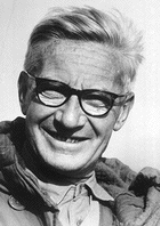
Nikolaas Tinbergen

Encyclopedia
Nikolaas "Niko" Tinbergen (15 April 1907 – 21 December 1988) was a Dutch
ethologist
and ornithologist who shared the 1973 Nobel Prize in Physiology or Medicine
with Karl von Frisch
and Konrad Lorenz
for their discoveries concerning organization and elicitation of individual and social behaviour patterns in animal
s.
In the 1960s he collaborated with filmmaker Hugh Falkus
on a series of wildlife films, including The Riddle of the Rook
(1972) and Signals for Survival (1969), which won the Italia prize in that year and the American blue ribbon in 1971.
, Netherlands
, he is also noted as the brother of Jan Tinbergen
, who won the first Bank of Sweden Prize in Economic Sciences in Memory of Alfred Nobel. He had a third eminent brother, Luuk Tinbergen
who committed suicide in 1955 at age 39.
Tinbergen's interest in nature manifested itself when he was young. He studied biology
at Leiden University
and was a prisoner of war during World War II
. Tinbergen's experience as a prisoner of the Nazis led to some friction with longtime intellectual collaborator Konrad Lorenz
, and it was several years before the two reconciled. After the war, Tinbergen moved to England, where he taught at the University of Oxford
. Several of his Oxford graduate students went on to become prominent biologists; these include Richard Dawkins
, Marian Dawkins
, Desmond Morris
, and Iain Douglas Hamilton.
He married Elisabeth Rutten and they had five children. Later in life he suffered depression and feared he might, like his brother, commit suicide. He was treated by his friend, whose ideas he had greatly influenced, John Bowlby
. Tinbergen died on 21 December 1988, after suffering a stroke at his home in Oxford, England.
Proximate mechanisms:
Ultimate mechanisms:
In ethology
and sociobiology
causation and ontogeny are summarized as the "proximate mechanisms" and adaptation and phylogeny as the "ultimate mechanisms".
They are still considered as the cornerstone of modern ethology, sociobiology and transdisciplinarity
in Human Sciences.
Tinbergen found that territorial male stickleback fish would attack a wooden fish model more vigorously than a real male if its underside was redder. He constructed cardboard dummy butterflies with more defined markings that male butterflies would try to mate with in preference to real females. The superstimulus, by its exaggerations, clearly delineated what characteristics were eliciting the instinctual response.
Among the modern works calling attention to Tinbergen's classic work in the field of Supernormal Stimuli has been the Deirdre Barrett
book of 2010, "Supernormal Stimuli".
. He recommended a "holding therapy
" in which parents hold their autistic children for long periods of time while attempting to establish eye contact, even when a child resists the embrace. However, his interpretations of autistic behavior, and the holding therapy that he recommended, lacked scientific support.
Netherlands
The Netherlands is a constituent country of the Kingdom of the Netherlands, located mainly in North-West Europe and with several islands in the Caribbean. Mainland Netherlands borders the North Sea to the north and west, Belgium to the south, and Germany to the east, and shares maritime borders...
ethologist
Ethology
Ethology is the scientific study of animal behavior, and a sub-topic of zoology....
and ornithologist who shared the 1973 Nobel Prize in Physiology or Medicine
Nobel Prize in Physiology or Medicine
The Nobel Prize in Physiology or Medicine administered by the Nobel Foundation, is awarded once a year for outstanding discoveries in the field of life science and medicine. It is one of five Nobel Prizes established in 1895 by Swedish chemist Alfred Nobel, the inventor of dynamite, in his will...
with Karl von Frisch
Karl von Frisch
Karl Ritter von Frisch was an Austrian ethologist who received the Nobel Prize in Physiology or Medicine in 1973, along with Nikolaas Tinbergen and Konrad Lorenz....
and Konrad Lorenz
Konrad Lorenz
Konrad Zacharias Lorenz was an Austrian zoologist, ethologist, and ornithologist. He shared the 1973 Nobel Prize with Nikolaas Tinbergen and Karl von Frisch...
for their discoveries concerning organization and elicitation of individual and social behaviour patterns in animal
Animal
Animals are a major group of multicellular, eukaryotic organisms of the kingdom Animalia or Metazoa. Their body plan eventually becomes fixed as they develop, although some undergo a process of metamorphosis later on in their life. Most animals are motile, meaning they can move spontaneously and...
s.
In the 1960s he collaborated with filmmaker Hugh Falkus
Hugh Falkus
Hugh Falkus , Cheam, Surrey, England – , was a British writer, film maker, World War II pilot and angler...
on a series of wildlife films, including The Riddle of the Rook
Rook (bird)
The Rook is a member of the Corvidae family in the passerine order of birds. Named by Carl Linnaeus in 1758, the species name frugilegus is Latin for "food-gathering"....
(1972) and Signals for Survival (1969), which won the Italia prize in that year and the American blue ribbon in 1971.
Origins
Born in The HagueThe Hague
The Hague is the capital city of the province of South Holland in the Netherlands. With a population of 500,000 inhabitants , it is the third largest city of the Netherlands, after Amsterdam and Rotterdam...
, Netherlands
Netherlands
The Netherlands is a constituent country of the Kingdom of the Netherlands, located mainly in North-West Europe and with several islands in the Caribbean. Mainland Netherlands borders the North Sea to the north and west, Belgium to the south, and Germany to the east, and shares maritime borders...
, he is also noted as the brother of Jan Tinbergen
Jan Tinbergen
Jan Tinbergen , was a Dutch economist. He was awarded the first Bank of Sweden Prize in Economic Sciences in Memory of Alfred Nobel in 1969, which he shared with Ragnar Frisch for having developed and applied dynamic models for the analysis of economic processes...
, who won the first Bank of Sweden Prize in Economic Sciences in Memory of Alfred Nobel. He had a third eminent brother, Luuk Tinbergen
Luuk Tinbergen
Luuk Tinbergen was a Dutch ornithologist and ecologist.Tinbergen was the youngest of three eminent brothers — both Jan and Nikolaas won Nobel Prizes, for economics and physiology or medicine, respectively.He was appointed in 1949 by Gerard Baerends to the University of Groningen, where he...
who committed suicide in 1955 at age 39.
Tinbergen's interest in nature manifested itself when he was young. He studied biology
Biology
Biology is a natural science concerned with the study of life and living organisms, including their structure, function, growth, origin, evolution, distribution, and taxonomy. Biology is a vast subject containing many subdivisions, topics, and disciplines...
at Leiden University
Leiden University
Leiden University , located in the city of Leiden, is the oldest university in the Netherlands. The university was founded in 1575 by William, Prince of Orange, leader of the Dutch Revolt in the Eighty Years' War. The royal Dutch House of Orange-Nassau and Leiden University still have a close...
and was a prisoner of war during World War II
World War II
World War II, or the Second World War , was a global conflict lasting from 1939 to 1945, involving most of the world's nations—including all of the great powers—eventually forming two opposing military alliances: the Allies and the Axis...
. Tinbergen's experience as a prisoner of the Nazis led to some friction with longtime intellectual collaborator Konrad Lorenz
Konrad Lorenz
Konrad Zacharias Lorenz was an Austrian zoologist, ethologist, and ornithologist. He shared the 1973 Nobel Prize with Nikolaas Tinbergen and Karl von Frisch...
, and it was several years before the two reconciled. After the war, Tinbergen moved to England, where he taught at the University of Oxford
University of Oxford
The University of Oxford is a university located in Oxford, United Kingdom. It is the second-oldest surviving university in the world and the oldest in the English-speaking world. Although its exact date of foundation is unclear, there is evidence of teaching as far back as 1096...
. Several of his Oxford graduate students went on to become prominent biologists; these include Richard Dawkins
Richard Dawkins
Clinton Richard Dawkins, FRS, FRSL , known as Richard Dawkins, is a British ethologist, evolutionary biologist and author...
, Marian Dawkins
Marian Stamp Dawkins
Marian Ellina Stamp Dawkins is professor for animal behaviour at the University of Oxford, where she heads the Animal Behaviour Research Group. She has published several books, one of which has been translated into German, and many peer-reviewed papers. She is considered an expert in animal welfare...
, Desmond Morris
Desmond Morris
Desmond John Morris, born 24 January 1928 in Purton, north Wiltshire, is a British zoologist and ethologist, as well as a popular anthropologist. He is also known as a painter, television presenter and popular author.-Life:...
, and Iain Douglas Hamilton.
He married Elisabeth Rutten and they had five children. Later in life he suffered depression and feared he might, like his brother, commit suicide. He was treated by his friend, whose ideas he had greatly influenced, John Bowlby
John Bowlby
Edward John Mostyn "John" Bowlby was a British psychologist, psychiatrist and psychoanalyst, notable for his interest in child development and for his pioneering work in attachment theory.- Family background :...
. Tinbergen died on 21 December 1988, after suffering a stroke at his home in Oxford, England.
Four Questions
He is well known for originating the four questions he believed should be asked of any animal behaviour, which were:Proximate mechanisms:
- 1. CausationCausalityCausality is the relationship between an event and a second event , where the second event is understood as a consequence of the first....
(Mechanism): what are the stimuli that elicit the response, and how has it been modified by recent learningLearningLearning is acquiring new or modifying existing knowledge, behaviors, skills, values, or preferences and may involve synthesizing different types of information. The ability to learn is possessed by humans, animals and some machines. Progress over time tends to follow learning curves.Human learning...
? How do behaviour and psyche "function" on the molecular, physiological, neuro-ethological, cognitive and social level, and what do the relations between the levels look like? (compare: Nicolai HartmannNicolai Hartmann-Biography:Hartmann was born of German descent in Riga, which was then the capital of the Russian province of Livonia, and which is now in Latvia. He studied Medicine at the University of Tartu , then Philosophy in St. Petersburg and at the University of Marburg in Germany, where he took his Ph.D....
: "The laws about the levels of complexity") - 2. DevelopmentDevelopmental biologyDevelopmental biology is the study of the process by which organisms grow and develop. Modern developmental biology studies the genetic control of cell growth, differentiation and "morphogenesis", which is the process that gives rise to tissues, organs and anatomy.- Related fields of study...
(OntogenyOntogenyOntogeny is the origin and the development of an organism – for example: from the fertilized egg to mature form. It covers in essence, the study of an organism's lifespan...
): how does the behaviour change with age, and what early experiences are necessary for the behaviour to be shown? Which developmental steps (the ontogenesis follows an "inner plan") and which environmental factors play when / which role? (compare: Recapitulation theoryRecapitulation theoryThe theory of recapitulation, also called the biogenetic law or embryological parallelism—and often expressed as "ontogeny recapitulates phylogeny"—is a disproven hypothesis that in developing from embryo to adult, animals go through stages resembling or representing successive stages...
)
Ultimate mechanisms:
- 3. EvolutionEvolutionEvolution is any change across successive generations in the heritable characteristics of biological populations. Evolutionary processes give rise to diversity at every level of biological organisation, including species, individual organisms and molecules such as DNA and proteins.Life on Earth...
(Phylogeny): how does the behaviour compare with similar behaviour in related speciesSpeciesIn biology, a species is one of the basic units of biological classification and a taxonomic rank. A species is often defined as a group of organisms capable of interbreeding and producing fertile offspring. While in many cases this definition is adequate, more precise or differing measures are...
, and how might it have arisen through the process of phylogeny? Why did structural associations (behaviour can be seen as a "time space structure") evolve in this manner and not otherwise?* - 4. Function (AdaptationAdaptationAn adaptation in biology is a trait with a current functional role in the life history of an organism that is maintained and evolved by means of natural selection. An adaptation refers to both the current state of being adapted and to the dynamic evolutionary process that leads to the adaptation....
): how does the behaviour impact on the animal's chances of survival and reproduction?
In ethology
Ethology
Ethology is the scientific study of animal behavior, and a sub-topic of zoology....
and sociobiology
Sociobiology
Sociobiology is a field of scientific study which is based on the assumption that social behavior has resulted from evolution and attempts to explain and examine social behavior within that context. Often considered a branch of biology and sociology, it also draws from ethology, anthropology,...
causation and ontogeny are summarized as the "proximate mechanisms" and adaptation and phylogeny as the "ultimate mechanisms".
They are still considered as the cornerstone of modern ethology, sociobiology and transdisciplinarity
Transdisciplinarity
Transdisciplinarity connotes a research strategy that crosses many disciplinary boundaries to create a holistic approach. It applies to research efforts focused on problems that cross the boundaries of two or more disciplines, such as research on effective information systems for biomedical...
in Human Sciences.
Supernormal Stimuli
A major body of Tinbergen's research focused on what he termed Supernormal Stimuli. This was the concept that one could build an artificial object which was a stronger stimulus or releaser for an instinct than the object for which the instinct originally evolved. He constructed plaster eggs to see which a bird preferred to sit on, finding that they would select those that were larger, had more defined markings, or more saturated color—and a dayglo-bright one with black polka dots would be selected over the bird's own pale, dappled eggs.Tinbergen found that territorial male stickleback fish would attack a wooden fish model more vigorously than a real male if its underside was redder. He constructed cardboard dummy butterflies with more defined markings that male butterflies would try to mate with in preference to real females. The superstimulus, by its exaggerations, clearly delineated what characteristics were eliciting the instinctual response.
Among the modern works calling attention to Tinbergen's classic work in the field of Supernormal Stimuli has been the Deirdre Barrett
Deirdre Barrett
Deirdre Barrett, Ph.D. is an author and psychologist who teaches at Harvard Medical School. She is known for her research on dreams, hypnosis, and imagery and has written on evolutionary psychology. Barrett is a Past President of The International Association for the Study of Dreams and of the...
book of 2010, "Supernormal Stimuli".
Autism
Tinbergen applied his observational methods to the problems of children with autismAutism
Autism is a disorder of neural development characterized by impaired social interaction and communication, and by restricted and repetitive behavior. These signs all begin before a child is three years old. Autism affects information processing in the brain by altering how nerve cells and their...
. He recommended a "holding therapy
Attachment Therapy
Attachment therapy is the most commonly used term for a controversial category of alternative child mental health interventions intended to treat attachment disorders. The term generally includes accompanying parenting techniques...
" in which parents hold their autistic children for long periods of time while attempting to establish eye contact, even when a child resists the embrace. However, his interpretations of autistic behavior, and the holding therapy that he recommended, lacked scientific support.