


Karl von Frisch

Encyclopedia
Karl Ritter von Frisch (20 November 1886 12 June 1982) was an Austria
n ethologist
who received the Nobel Prize in Physiology or Medicine
in 1973, along with Nikolaas Tinbergen
and Konrad Lorenz
.
His work centered on investigations of the sensory perceptions of the honey bee
and he was one of the first to translate the meaning of the waggle dance
. His theory was disputed by other scientists and greeted with skepticism at the time. Only recently was it definitively proved to be an accurate theoretical analysis.
as a professor of zoology and director of an institute. In 1923 he accepted the offer of a chair at Breslau University, returning in 1925 to Munich University, where he became the head of the institute of zoology. After that institute was destroyed in World War II
, he went to the University of Graz
in 1946, remaining there until 1950 when he returned to the Munich institute after it was reopened. He retired in 1958 but continued his research.
Karl von Frisch married Margarete, née Mohr. Their son, Otto von Frisch, was director of the Braunschweig
natural history museum between 1977 and 1995.
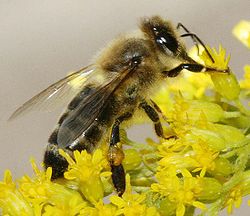
(Apis mellifera carnica).
Optical perception: Frisch was to first to demonstrate that honey bees had color vision
, which he accomplished by using classical conditioning
. He trained bees to feed on a dish of sugar water set on a colored card. He then set the colored card in the middle of a set of gray-toned cards. If the bees see the colored card as a shade of gray, then they will confuse the blue card with at least one of the gray-toned cards; bees arriving to feed will visit more than one card in the array. On the other hand, if they have color vision, then the bees visit only the blue card, as it is visually distinct from the other cards. A bee’s color perception
is comparable to that of humans, but with a shift away from the red toward the ultraviolet
part of the spectrum. For that reason bees cannot distinguish red from black (colorless), but they can distinguish the colors white, yellow, blue and violet. Color pigments which reflect UV radiation expand the spectrum of colors which can be differentiated. For example, several blossoms which may appear to humans to be of the same yellow color will appear to bees as having different colors (multicolored patterns) because of their different proportions of ultraviolet.
Powers of orientation: Frisch’s investigation of a bee’s powers of orientation were significant. He discovered that bees can recognize the desired compass direction in three different ways: by the sun, by the polarization pattern of the blue sky, and by the earth’s magnetic field, whereby the sun is used as the main compass, with the alternatives reserved for the conditions arising under cloudy skies or within a dark beehive
.
Polarization pattern: Light scattered in a blue sky forms a characteristic pattern of partially polarized light which is dependent on the position of the sun and invisible to human eyes. With a UV receptor in each of the lens units of a compound eye, and a UV filter oriented differently in each of these units, a bee is able to detect this polarization pattern. A small piece of blue sky is enough for a bee to recognize the pattern changes occurring over the course of a day. This provides not only directional but also temporal information.
Variations in the daytime position of the sun: Karl von Frisch proved that variations in the position of the sun over the course of a day provided bees with an orientation tool. They use this capability to obtain information about the progression of the day deep inside a dark beehive comparable to what is know from the position of the sun. This makes it possible for the bees to convey always up-to-date directional information during their waggle dance, without having to make a comparison with the sun during long dance phases. This provides them not only with alternative directional information, but also with additional temporal information.
Internal clock: Bees have an internal clock with three different synchronization or timekeeping mechanisms. If a bee knows the direction to a feeding place found during a morning excursion, it can also find the same location, as well as the precise time at which this source provides food, in the afternoon, based on the position of the sun.
Horizontal orientation of the honeycomb: Based on the magnetic field, the alignment of the plane of a honeycomb
under construction (e.g., the new honeycomb of a swarm) will be the same as that of the home hive of the swarm, according to Karl von Frisch. By experiment, even deformed combs bent into a circle can be produced.
Sensing the vertical: The vertical alignment of the honeycomb is attributed by Karl von Frisch to the ability of bees to identify what is vertical with the help of their head used as a pendulum together with a ring of sensory cells in the neck.
 The "waggle dance
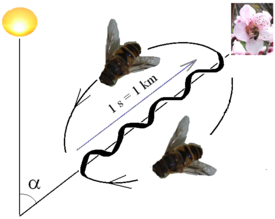
" is used to relay information about more distant food sources. In order to do this, the dancing bee moves forward a certain distance on the vertically hanging honeycomb in the hive, then traces a half circle to return to her starting point, whereupon the dance begins again. On the straight stretch, the bee “waggles” with her posterior. The direction of the straight stretch contains the information about the direction of the food source, the angle between the straight stretch and the vertical being precisely the angle which the direction of flight has to the position of the sun. The distance to the food source is relayed by the speed of the dance, in other words, by the number of times the straight stretch is traversed per unit of time. The other bees take in the information by keeping in close contact with the dancing bee and reconstructing its movements. They also receive information via their sense of smell about what is to be found at the food source (type of food, pollen, propolis
, water) as well as its specific characteristics. The orientation functions so well that the bees can find a food source with the help of the waggle dance even if there are hindrances they must detour around like an intervening mountain.
As to a sense of hearing, Karl von Frisch could not identify this perceptive faculty, but it was assumed that vibrations could be sensed and used for communication during the waggle dance. Confirmation was later provided by Dr. Jürgen Tautz, a bee researcher
at Würzburg University’s Biocenter.
work included the study of the pheromones that are emitted by the queen bee
and her daughters, which maintain the hive's very complex social order. Outside the hive, the pheromones cause the male bees, or drones
, to become attracted to a queen and mate with it. Inside the hive, the drones are not affected by the odor.
as far as preventing, through sterilisation, people with hereditary diseases from reproducing (giving as examples deafness, blindness, haemophilia
and crippled limbs). However, he cautioned that:
"such action certainly represents a great restriction of personal liberty
and it demands the highest ethical integrity of those men who are responsible for its application."
He hoped that this could be introduced through voluntary schemes and education about family planning.
Austria
Austria , officially the Republic of Austria , is a landlocked country of roughly 8.4 million people in Central Europe. It is bordered by the Czech Republic and Germany to the north, Slovakia and Hungary to the east, Slovenia and Italy to the south, and Switzerland and Liechtenstein to the...
n ethologist
Ethology
Ethology is the scientific study of animal behavior, and a sub-topic of zoology....
who received the Nobel Prize in Physiology or Medicine
Nobel Prize in Physiology or Medicine
The Nobel Prize in Physiology or Medicine administered by the Nobel Foundation, is awarded once a year for outstanding discoveries in the field of life science and medicine. It is one of five Nobel Prizes established in 1895 by Swedish chemist Alfred Nobel, the inventor of dynamite, in his will...
in 1973, along with Nikolaas Tinbergen
Nikolaas Tinbergen
Nikolaas "Niko" Tinbergen was a Dutch ethologist and ornithologist who shared the 1973 Nobel Prize in Physiology or Medicine with Karl von Frisch and Konrad Lorenz for their discoveries concerning organization and elicitation of individual and social behaviour patterns in animals.In the 1960s he...
and Konrad Lorenz
Konrad Lorenz
Konrad Zacharias Lorenz was an Austrian zoologist, ethologist, and ornithologist. He shared the 1973 Nobel Prize with Nikolaas Tinbergen and Karl von Frisch...
.
His work centered on investigations of the sensory perceptions of the honey bee
Honey bee
Honey bees are a subset of bees in the genus Apis, primarily distinguished by the production and storage of honey and the construction of perennial, colonial nests out of wax. Honey bees are the only extant members of the tribe Apini, all in the genus Apis...
and he was one of the first to translate the meaning of the waggle dance
Waggle dance
Waggle dance is a term used in beekeeping and ethology for a particular figure-eight dance of the honey bee. By performing this dance, successful foragers can share with their hive mates information about the direction and distance to patches of flowers yielding nectar and pollen, to water...
. His theory was disputed by other scientists and greeted with skepticism at the time. Only recently was it definitively proved to be an accurate theoretical analysis.
Life
Karl von Frisch was the son of the surgeon and urologist Anton Ritter von Frisch (1849-1917) and his wife Marie, née Exner. He was the youngest of four sons, all of whom became university professors. He studied in Vienna under Hans Leo Przibram and in Munich under Richard von Hertwig, initially in the field of medicine but later turning to the natural sciences. He received his doctorate in 1910 and in the same year started work as an assistant in the zoology department of Munich University. In 1912 he became a lecturer in zoology and comparative anatomy there; and in 1919 was promoted to a professorship. In 1921 he went to Rostock UniversityUniversity of Rostock
The University of Rostock is the university of the city Rostock, in the German state of Mecklenburg-Vorpommern.Founded in 1419, it is the oldest and largest university in continental northern Europe and the Baltic Sea area...
as a professor of zoology and director of an institute. In 1923 he accepted the offer of a chair at Breslau University, returning in 1925 to Munich University, where he became the head of the institute of zoology. After that institute was destroyed in World War II
World War II
World War II, or the Second World War , was a global conflict lasting from 1939 to 1945, involving most of the world's nations—including all of the great powers—eventually forming two opposing military alliances: the Allies and the Axis...
, he went to the University of Graz
University of Graz
The University of Graz , a university located in Graz, Austria, is the second-largest and second-oldest university in Austria....
in 1946, remaining there until 1950 when he returned to the Munich institute after it was reopened. He retired in 1958 but continued his research.
Karl von Frisch married Margarete, née Mohr. Their son, Otto von Frisch, was director of the Braunschweig
Braunschweig
Braunschweig , is a city of 247,400 people, located in the federal-state of Lower Saxony, Germany. It is located north of the Harz mountains at the farthest navigable point of the Oker river, which connects to the North Sea via the rivers Aller and Weser....
natural history museum between 1977 and 1995.
Research
Karl von Frisch studied the European honey beeEuropean honey bee
The Western honey bee or European honey bee is a species of honey bee. The genus Apis is Latin for "bee", and mellifera comes from Latin melli- "honey" and ferre "to bear"—hence the scientific name means "honey-bearing bee"...
(Apis mellifera carnica).
Bee perception
Sense of smell: Frisch discovered that bees can distinguish various blossoming plants by their scent, and that each bee is “flower constant”. Surprisingly, their sensitivity to a “sweet” taste is only slightly stronger than in humans. He thought it possible that a bee’s spatial sense of smell arises from the firm coupling of its olfactory sense with its tactile sense.Optical perception: Frisch was to first to demonstrate that honey bees had color vision
Color vision
Color vision is the capacity of an organism or machine to distinguish objects based on the wavelengths of the light they reflect, emit, or transmit...
, which he accomplished by using classical conditioning
Classical conditioning
Classical conditioning is a form of conditioning that was first demonstrated by Ivan Pavlov...
. He trained bees to feed on a dish of sugar water set on a colored card. He then set the colored card in the middle of a set of gray-toned cards. If the bees see the colored card as a shade of gray, then they will confuse the blue card with at least one of the gray-toned cards; bees arriving to feed will visit more than one card in the array. On the other hand, if they have color vision, then the bees visit only the blue card, as it is visually distinct from the other cards. A bee’s color perception
Color vision
Color vision is the capacity of an organism or machine to distinguish objects based on the wavelengths of the light they reflect, emit, or transmit...
is comparable to that of humans, but with a shift away from the red toward the ultraviolet
Ultraviolet
Ultraviolet light is electromagnetic radiation with a wavelength shorter than that of visible light, but longer than X-rays, in the range 10 nm to 400 nm, and energies from 3 eV to 124 eV...
part of the spectrum. For that reason bees cannot distinguish red from black (colorless), but they can distinguish the colors white, yellow, blue and violet. Color pigments which reflect UV radiation expand the spectrum of colors which can be differentiated. For example, several blossoms which may appear to humans to be of the same yellow color will appear to bees as having different colors (multicolored patterns) because of their different proportions of ultraviolet.
Powers of orientation: Frisch’s investigation of a bee’s powers of orientation were significant. He discovered that bees can recognize the desired compass direction in three different ways: by the sun, by the polarization pattern of the blue sky, and by the earth’s magnetic field, whereby the sun is used as the main compass, with the alternatives reserved for the conditions arising under cloudy skies or within a dark beehive
Beehive
A beehive is a structure in which bees live and raise their young.Beehive may also refer to:Buildings and locations:* Bee Hive, Alabama, a neighborhood in Alabama* Beehive , a wing of the New Zealand Parliament Buildings...
.
Polarization pattern: Light scattered in a blue sky forms a characteristic pattern of partially polarized light which is dependent on the position of the sun and invisible to human eyes. With a UV receptor in each of the lens units of a compound eye, and a UV filter oriented differently in each of these units, a bee is able to detect this polarization pattern. A small piece of blue sky is enough for a bee to recognize the pattern changes occurring over the course of a day. This provides not only directional but also temporal information.
Variations in the daytime position of the sun: Karl von Frisch proved that variations in the position of the sun over the course of a day provided bees with an orientation tool. They use this capability to obtain information about the progression of the day deep inside a dark beehive comparable to what is know from the position of the sun. This makes it possible for the bees to convey always up-to-date directional information during their waggle dance, without having to make a comparison with the sun during long dance phases. This provides them not only with alternative directional information, but also with additional temporal information.
Internal clock: Bees have an internal clock with three different synchronization or timekeeping mechanisms. If a bee knows the direction to a feeding place found during a morning excursion, it can also find the same location, as well as the precise time at which this source provides food, in the afternoon, based on the position of the sun.
Horizontal orientation of the honeycomb: Based on the magnetic field, the alignment of the plane of a honeycomb
Honeycomb
A honeycomb is a mass of hexagonal waxcells built by honey bees in their nests to contain their larvae and stores of honey and pollen.Beekeepers may remove the entire honeycomb to harvest honey...
under construction (e.g., the new honeycomb of a swarm) will be the same as that of the home hive of the swarm, according to Karl von Frisch. By experiment, even deformed combs bent into a circle can be produced.
Sensing the vertical: The vertical alignment of the honeycomb is attributed by Karl von Frisch to the ability of bees to identify what is vertical with the help of their head used as a pendulum together with a ring of sensory cells in the neck.
Dances as language
Knowledge about feeding places can be relayed from bee to bee. The means of communication is a special dance of which there are two forms:Round dance
The “round dance” provides the information that there is a feeding place in the vicinity of the beehive at a distance between 50 and 100 meters, without the particular direction being given. By means of close contact among the bees it also supplies information about the type of food (blossom scent).
The foraging bee...begins to perform a kind of “round dance”. On the part of the comb where she is sitting she starts whirling around in a narrow circle, constantly changing her direction, turning now right, now left, dancing clockwise and anti-clockwise, in quick succession, describing between one and two circles in each direction. This dance is performed among the thickest bustle of the hive. What makes it so particularly striking and attractive is the way it infects the surrounding bees; those sitting next to the dancer start tripping after her, always trying to keep their outstretched feelers on close contact with the tip of her abdomen....They take part in each of her manoeuvrings so that the dancer herself, in her mad wheeling movements, appears to carry behind her a perpetual comet’s tail of bees.
Waggle dance
Waggle dance
Waggle dance is a term used in beekeeping and ethology for a particular figure-eight dance of the honey bee. By performing this dance, successful foragers can share with their hive mates information about the direction and distance to patches of flowers yielding nectar and pollen, to water...
" is used to relay information about more distant food sources. In order to do this, the dancing bee moves forward a certain distance on the vertically hanging honeycomb in the hive, then traces a half circle to return to her starting point, whereupon the dance begins again. On the straight stretch, the bee “waggles” with her posterior. The direction of the straight stretch contains the information about the direction of the food source, the angle between the straight stretch and the vertical being precisely the angle which the direction of flight has to the position of the sun. The distance to the food source is relayed by the speed of the dance, in other words, by the number of times the straight stretch is traversed per unit of time. The other bees take in the information by keeping in close contact with the dancing bee and reconstructing its movements. They also receive information via their sense of smell about what is to be found at the food source (type of food, pollen, propolis
Propolis
Propolis is a resinous mixture that honey bees collect from tree buds, sap flows, or other botanical sources. It is used as a sealant for unwanted open spaces in the hive. Propolis is used for small gaps , while larger spaces are usually filled with beeswax. Its color varies depending on its...
, water) as well as its specific characteristics. The orientation functions so well that the bees can find a food source with the help of the waggle dance even if there are hindrances they must detour around like an intervening mountain.
As to a sense of hearing, Karl von Frisch could not identify this perceptive faculty, but it was assumed that vibrations could be sensed and used for communication during the waggle dance. Confirmation was later provided by Dr. Jürgen Tautz, a bee researcher
Apiology
Apiology is the scientific study of honey bees, a subdiscipline of melittology, which is itself a branch of entomology...
at Würzburg University’s Biocenter.
"Dialects"
The linguistic findings described above were based on Karl von Frisch’s work primarily with the Carnica variety of bees. Investigations with other varieties led to the discovery that language elements were variety-specific, so that how distance and direction information is relayed varies greatly.Other work
Frisch's honey beeHoney bee
Honey bees are a subset of bees in the genus Apis, primarily distinguished by the production and storage of honey and the construction of perennial, colonial nests out of wax. Honey bees are the only extant members of the tribe Apini, all in the genus Apis...
work included the study of the pheromones that are emitted by the queen bee
Queen bee
The term queen bee is typically used to refer to an adult, mated female that lives in a honey bee colony or hive; she is usually the mother of most, if not all, the bees in the hive. The queens are developed from larvae selected by worker bees and specially fed in order to become sexually mature...
and her daughters, which maintain the hive's very complex social order. Outside the hive, the pheromones cause the male bees, or drones
Drone (bee)
Drones are male honey bees. They develop from eggs that have not been fertilized, and they cannot sting, since the worker bee's stinger is a modified ovipositor .-Etymology:...
, to become attracted to a queen and mate with it. Inside the hive, the drones are not affected by the odor.
Eugenics
Frisch advocated the use of eugenicsEugenics
Eugenics is the "applied science or the bio-social movement which advocates the use of practices aimed at improving the genetic composition of a population", usually referring to human populations. The origins of the concept of eugenics began with certain interpretations of Mendelian inheritance,...
as far as preventing, through sterilisation, people with hereditary diseases from reproducing (giving as examples deafness, blindness, haemophilia
Haemophilia
Haemophilia is a group of hereditary genetic disorders that impair the body's ability to control blood clotting or coagulation, which is used to stop bleeding when a blood vessel is broken. Haemophilia A is the most common form of the disorder, present in about 1 in 5,000–10,000 male births...
and crippled limbs). However, he cautioned that:
"such action certainly represents a great restriction of personal liberty
Liberty
Liberty is a moral and political principle, or Right, that identifies the condition in which human beings are able to govern themselves, to behave according to their own free will, and take responsibility for their actions...
and it demands the highest ethical integrity of those men who are responsible for its application."
He hoped that this could be introduced through voluntary schemes and education about family planning.
Honors
- Foreign Honorary Member of the American Academy of Arts and SciencesAmerican Academy of Arts and SciencesThe American Academy of Arts and Sciences is an independent policy research center that conducts multidisciplinary studies of complex and emerging problems. The Academy’s elected members are leaders in the academic disciplines, the arts, business, and public affairs.James Bowdoin, John Adams, and...
(1952) - In 1962 Karl von Frisch received the Balzan Prize for Biology "For having consecrated his entire life to experimenting on thousands of bees, thus discovering a true language of gestures for communication and opening new insights into the knowledge of insect behaviour" (motivation of the Balzan General Prize Committee).
- In 1973 Karl von Frisch received the Nobel Prize for Physiology or Medicine together with Konrad LorenzKonrad LorenzKonrad Zacharias Lorenz was an Austrian zoologist, ethologist, and ornithologist. He shared the 1973 Nobel Prize with Nikolaas Tinbergen and Karl von Frisch...
and Nikolaas TinbergenNikolaas TinbergenNikolaas "Niko" Tinbergen was a Dutch ethologist and ornithologist who shared the 1973 Nobel Prize in Physiology or Medicine with Karl von Frisch and Konrad Lorenz for their discoveries concerning organization and elicitation of individual and social behaviour patterns in animals.In the 1960s he...
for his achievements in comparative behavioral physiology and pioneering work in communication between insects. - In his honor the Karl Ritter von Frisch Medal of the German Zoological Society (Deutschen Zoologischen Gesellschaft, DZG), is awarded every two years to scientists whose work is distinguished by extraordinary zoological achievements which represent an integration of insights from several different biological disciplines. It is Germany’s most important science prize in zoology and includes prize money of 10,000 euros.
In German
- Der Farben- und Formensinn der Bienen. In: Zoologische Jahrbücher (Physiologie) 35, 1–188, (1914–15)
- Über den Geruchssinn der Bienen und seine blütenbiologische Bedeutung. In: Zoologische Jahrbücher (Physiologie) 37, 1–238 (1919)
- Über die ‚Sprache‘ der Bienen. Eine tierpsychologische Untersuchung. In: Zoologische Jahrbücher (Physiologie) 40, 1–186 (1923)
- Aus dem Leben der Bienen. Springer Verlag Berlin (1927)
- Untersuchung über den Sitz des Gehörsinnes bei der Elritze. In: Zeitschrift für vergleichende Physiologie 17, 686–801 (1932), it R. Stetter
- Über den Geschmacksinn der Bienen. In: Zeitschrift für vergleichende Physiologie 21, 1–156 (1934)
- Du und das Leben – Eine moderne Biologie für Jedermann. (1936) [literally, You and Life: A Modern Biology for Everyman]
- Über einen Schreckstoff der Fischhaut und seine biologische Bedeutung. In: Zeitschrift für vergleichende Physiologie 29, 46–145 (1941)
- Die Tänze der Bienen. In: Österreichische Zoologische Zeitschrift 1, 1–48 (1946)
- Die Polarisation des Himmelslichtes als orientierender Faktor bei den Tänzen der Bienen. In: Experientia (Basel) 5, 142–148 (1949)
- Die Sonne als Kompaß im Leben der Bienen. In: Experientia (Basel) 6, 210–221 (1950)
- Das kleine Insektenbuch. Insel Verlag (1961)
- Tanzsprache und Orientierung der Bienen. Springer-VerlagSpringer Science+Business Media- Selected publications :* Encyclopaedia of Mathematics* Ergebnisse der Mathematik und ihrer Grenzgebiete * Graduate Texts in Mathematics * Grothendieck's Séminaire de géométrie algébrique...
Berlin/Heidelberg/New York (1965) - Aus dem Leben der Bienen. Springer-Verlag Berlin/Heidelberg/New York (9. Auflage 1977), ISBN 3-540-08212-3
- Erinnerungen eines Biologen. Springer-Verlag, Berlin/Göttingen/Heidelberg 1957 (Autobiographie)
- Die Tanzsprache der Bienen. Originaltonaufnahmen 1953–1962, hrsg. v. Klaus Sander. 2-CD-Set. supposé, Köln 2005. ISBN 978-3-932513-56-5
- " Tiere als Baumeister. Frankfurt a.M., Ullstein, 1974. 309 Seiten. 105 Zeichnungen & 114 Photographien. ISBN 3-550-07028-4
In English
- The dancing bees - an account of the life and senses of the honey bee, Harvest Books New York (1953), a translation of Aus dem Leben der Bienen, 5th revised edition, Springer Verlag
- About Biology, Oliver & Boyd (1962), a translation of Du Und Das Leben
- Animal Architecture (Originally published as Tiere Als Baumeister.) New York, Helen and Kurt Wolff. (ISBN 0-15-107251-5) (1974 1st edition)
See also
- List of Austrian scientists
- List of Austrians
- ApiologyApiologyApiology is the scientific study of honey bees, a subdiscipline of melittology, which is itself a branch of entomology...
External links
- Karl Von Frisch, The Dance Language and Orientation of Bees, (1967) Harvard University PressHarvard University PressHarvard University Press is a publishing house established on January 13, 1913, as a division of Harvard University, and focused on academic publishing. In 2005, it published 220 new titles. It is a member of the Association of American University Presses. Its current director is William P...
- Dance and communication of honey bees
- The flight paths of honeybees recruited by the waggle dance, NatureNature (journal)Nature, first published on 4 November 1869, is ranked the world's most cited interdisciplinary scientific journal by the Science Edition of the 2010 Journal Citation Reports...
435, May 2005, pp. 205–207. - Karl von Frisch, Decoding the Language of the Bee, Nobel Lecture, December 12, 1973
- Biography and bibliography in the Virtual LaboratoryVirtual LaboratoryThe online project Virtual Laboratory. Essays and Resources on the Experimentalization of Life, 1830-1930, located at the Max Planck Institute for the History of Science, is dedicated to research in the history of the experimentalization of life...
of the Max Planck Institute for the History of ScienceMax Planck Institute for the History of ScienceThe Max Planck Institute for the History of Science in Berlin was established in March 1994. Its research is primarily devoted to a theoretically oriented history of science, principally of the natural sciences, but with methodological perspectives drawn from the cognitive sciences and from... - Autobiography