

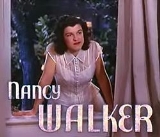
Nancy Walker

Encyclopedia
Nancy Walker was an American actress
and comedienne of stage, screen, and television. She was also a film
and television director
(most notably of The Mary Tyler Moore Show
, on which she also made several acting guest appearances). During her five-decade long career, she may be best remembered for her long-running role of Ida Morgenstern, who first appeared on several episodes of The Mary Tyler Moore Show
and later became a prominent recurring character on the spinoff series Rhoda
.
in 1922, the elder of two daughters of vaudevillian Dewey Barto (né Smoyer). Both she and her father stood 4'11" (1.50 m). Her mother died when her younger sister Betty Lou was an infant. She and Betty Lou, who would also have a musical career, were raised "in-a-trunk" by their father (Dewey Barto; 1896–1973). Barto was a vaudeville
entertainer in the comedic and acrobatic dance act, Barto and Mann
.
debut in 1941 in Best Foot Forward. The role provided Walker with her film debut when a movie version, starring Lucille Ball
, was filmed in 1943. A subsequent appearance was in the MGM
musical
, Broadway Rhythm
, in which she had a featured musical number, "Milkman, Keep Those Bottles Quiet."
Her height reportedly made her difficult to cast. Her dry comic delivery enabled her to continue acting throughout the 1940s and 1950s, originating the roles of Hildy Eszterhazy ("I Can Cook, Too!") in On the Town and Katey O'Shea in Copper and Brass on Broadway. She was nominated for a Tony Award
in 1956 for her work in the musical revue Phoenix '56 and again in 1960 for her performance in the hit musical Do Re Mi
co-starring with Phil Silvers
. Her appearances in musicals led to record releases. One such release, I Hate Men (1959), with Sid Bass
and his orchestra, featuring such show tunes as "I'm Going to Wash That Man Right Out of My Hair" and "You Irritate Me So," has been identified as having one of the worst album covers of all time.
Dozens of television guest appearances and recurring roles followed, providing her with steady work. Her career spanned five decades, and included comedies, dramas and television variety shows such as The Garry Moore Show
and The Carol Burnett Show
. In the 1960-61 television season, she appeared in two episodes of NBC
's The Tab Hunter Show
. In 1970, she secured a recurring role as Emily the housekeeper on the television series Family Affair
, which starred Brian Keith
. However the show's ratings plummeted opposite NBC's popular The Flip Wilson Show
, and was cancelled. The same year Walker made her first appearance playing Ida Morgenstern, the mother of Valerie Harper
's character Rhoda Morgenstern
on the first season of The Mary Tyler Moore Show
. The episode which introduced her character, "Support Your Local Mother," was so well-received that it won an Emmy for Outstanding Writing Achievement in a Comedy Series for James L. Brooks
and Allan Burns
. Walker thereafter became an annual guest star on the show for the next three years. In 1974, when the MTM spinoff series, Rhoda
premiered, Walker joined the cast as a regular.
From 1971-76, she was also a regular on the successful Rock Hudson
detective series McMillan & Wife, playing the McMillans' housekeeper, Mildred. These two roles brought her seven Emmy Award
nominations. In 1976, ABC-TV offered Walker a contract to headline her own series, The Nancy Walker Show
, which was produced by Norman Lear
's production company. In that show, Walker starred as Nancy Kittredge, a talent agent. Walker's contract specified that if the series was canceled before its first thirteen weeks, she would then star in another sitcom on ABC.
Before she filmed the first episode of the series, Walker made her only appearance on Rhoda
for the 1976-77 season. In the season premiere, "The Separation," Rhoda (Valerie Harper) and her husband Joe (David Groh
) decide to separate. Rhoda tries to keep the news from her mother Ida (Walker) since Ida is about to embark on a year-long trip across America with Rhoda's father (Harold Gould
). Ida learns the truth from Rhoda prior to Ida's departure. For her performance in this episode, Walker was nominated for an Emmy Award for Outstanding Single Performance By A Supporting Actress In A Comedy Or Drama Series.
The Nancy Walker Show premiered on ABC-TV in late September 1976. It received poor reviews and low ratings and was cancelled in December 1976. Almost immediately, Garry Marshall
signed Walker for another series, Blansky's Beauties
. The main character of the series was introduced a week before the series premiere in an episode of the hit sitcom, Happy Days
. The show premiered on ABC-TV in February 1977. In this program, Walker played Nancy Blansky, den mother to a group of Las Vegas showgirls. It also failed to find an audience and was canceled in May 1977, giving Walker the rare distinction of being in two failed series in the same year. She returned to Rhoda
at the beginning of the 1977–1978 season (giving the show a much needed boost in the ratings, which had fallen the previous year), and remained with the series for the rest of its run. During this time, Walker began directing, including episodes of The Mary Tyler Moore Show
, Rhoda
and Alice
.
One of Walker's last major film roles was in the 1976 all-star comedy spoof Murder by Death
. She continued to remain active in show business until her death, playing Rosie, a New Jersey
diner
waitress in a series of commercials for Bounty paper towel
s from 1970 to 1990. She helped make the product's slogan
, "The Quicker Picker Upper," a common catchphrase. Among her final appearances in a television series was the recurring role of "Aunt Angela", Sophia Petrillo (Estelle Getty
)'s widowed sister, on The Golden Girls
, for which she received an Emmy Award nomination.
group The Village People and Olympian
Bruce Jenner
in the pseudo-autobiographical musical Can't Stop the Music
. The film was a box office failure, although it later became something of a camp/cult favorite. This was the only theatrical film ever directed by Walker.
in Studio City, California on March
25, 1992, aged 69. At the time of her death, she was co-starring in the situation comedy True Colors
. Her ashes were scattered in the Virgin Islands
. She was survived by her husband and daughter.
Actor
An actor is a person who acts in a dramatic production and who works in film, television, theatre, or radio in that capacity...
and comedienne of stage, screen, and television. She was also a film
Film director
A film director is a person who directs the actors and film crew in filmmaking. They control a film's artistic and dramatic nathan roach, while guiding the technical crew and actors.-Responsibilities:...
and television director
Television director
A television director directs the activities involved in making a television program and is part of a television crew.-Duties:The duties of a television director vary depending on whether the production is live or recorded to video tape or video server .In both types of productions, the...
(most notably of The Mary Tyler Moore Show
The Mary Tyler Moore Show
The Mary Tyler Moore Show is an American television sitcom created by James L. Brooks and Allan Burns that aired on CBS from 1970 to 1977...
, on which she also made several acting guest appearances). During her five-decade long career, she may be best remembered for her long-running role of Ida Morgenstern, who first appeared on several episodes of The Mary Tyler Moore Show
The Mary Tyler Moore Show
The Mary Tyler Moore Show is an American television sitcom created by James L. Brooks and Allan Burns that aired on CBS from 1970 to 1977...
and later became a prominent recurring character on the spinoff series Rhoda
Rhoda
Rhoda is an American television sitcom, starring Valerie Harper, which ran for five seasons, from 1974 to 1978 airing in 109 episodes. The show was a spin-off from The Mary Tyler Moore Show, in which Harper between the years 1970 and 1974 had played the role of Rhoda Morgenstern, a spunky,...
.
Early life
Walker was born as Anna Myrtle Smoyer in Philadelphia, PennsylvaniaPhiladelphia, Pennsylvania
Philadelphia is the largest city in the Commonwealth of Pennsylvania and the county seat of Philadelphia County, with which it is coterminous. The city is located in the Northeastern United States along the Delaware and Schuylkill rivers. It is the fifth-most-populous city in the United States,...
in 1922, the elder of two daughters of vaudevillian Dewey Barto (né Smoyer). Both she and her father stood 4'11" (1.50 m). Her mother died when her younger sister Betty Lou was an infant. She and Betty Lou, who would also have a musical career, were raised "in-a-trunk" by their father (Dewey Barto; 1896–1973). Barto was a vaudeville
Vaudeville
Vaudeville was a theatrical genre of variety entertainment in the United States and Canada from the early 1880s until the early 1930s. Each performance was made up of a series of separate, unrelated acts grouped together on a common bill...
entertainer in the comedic and acrobatic dance act, Barto and Mann
Barto and Mann
Barto and Mann: Dewey Barto and George Mann , known as the "laugh kings" of vaudeville, were a comedic dance act from the late 1920s to the early 1940s...
.
Acting career
Walker made her BroadwayBroadway theatre
Broadway theatre, commonly called simply Broadway, refers to theatrical performances presented in one of the 40 professional theatres with 500 or more seats located in the Theatre District centered along Broadway, and in Lincoln Center, in Manhattan in New York City...
debut in 1941 in Best Foot Forward. The role provided Walker with her film debut when a movie version, starring Lucille Ball
Lucille Ball
Lucille Désirée Ball was an American comedian, film, television, stage and radio actress, model, film and television executive, and star of the sitcoms I Love Lucy, The Lucy–Desi Comedy Hour, The Lucy Show, Here's Lucy and Life With Lucy...
, was filmed in 1943. A subsequent appearance was in the MGM
Metro-Goldwyn-Mayer
Metro-Goldwyn-Mayer Inc. is an American media company, involved primarily in the production and distribution of films and television programs. MGM was founded in 1924 when the entertainment entrepreneur Marcus Loew gained control of Metro Pictures, Goldwyn Pictures Corporation and Louis B. Mayer...
musical
Musical film
The musical film is a film genre in which songs sung by the characters are interwoven into the narrative, sometimes accompanied by dancing. The songs usually advance the plot or develop the film's characters, though in some cases they serve merely as breaks in the storyline, often as elaborate...
, Broadway Rhythm
Broadway Rhythm
Broadway Rhythm is an MGM Technicolor musical film. It was produced by Jack Cummings and directed by Roy Del Ruth. The film was originally announced as Broadway Melody of 1944 to follow MGM's Broadway Melody films of 1929, 1936, 1938, and 1940. The movie was originally slated to star Eleanor...
, in which she had a featured musical number, "Milkman, Keep Those Bottles Quiet."
Her height reportedly made her difficult to cast. Her dry comic delivery enabled her to continue acting throughout the 1940s and 1950s, originating the roles of Hildy Eszterhazy ("I Can Cook, Too!") in On the Town and Katey O'Shea in Copper and Brass on Broadway. She was nominated for a Tony Award
Tony Award
The Antoinette Perry Award for Excellence in Theatre, more commonly known as a Tony Award, recognizes achievement in live Broadway theatre. The awards are presented by the American Theatre Wing and The Broadway League at an annual ceremony in New York City. The awards are given for Broadway...
in 1956 for her work in the musical revue Phoenix '56 and again in 1960 for her performance in the hit musical Do Re Mi
Do Re Mi (musical)
Do Re Mi is a musical with music by Jule Styne, lyrics by Betty Comden and Adolph Green, and a book by Garson Kanin, who also directed the original 1960 Broadway production. The plot centers on a minor-league con man who decides to go straight by going into the business of juke boxes and music...
co-starring with Phil Silvers
Phil Silvers
Phil Silvers was an American entertainer and comedy actor, known as "The King of Chutzpah." He is best known for starring in The Phil Silvers Show, a 1950s sitcom set on a U.S...
. Her appearances in musicals led to record releases. One such release, I Hate Men (1959), with Sid Bass
Sid Bass (songwriter)
Sid Bass was a songwriter and orchestra leader. He was born in New York City and attended New York University.After working for Muzak he was hired as a staff composer by RCA...
and his orchestra, featuring such show tunes as "I'm Going to Wash That Man Right Out of My Hair" and "You Irritate Me So," has been identified as having one of the worst album covers of all time.
Dozens of television guest appearances and recurring roles followed, providing her with steady work. Her career spanned five decades, and included comedies, dramas and television variety shows such as The Garry Moore Show
The Garry Moore Show
The Garry Moore Show is the name for several separate American variety series on the CBS television network in the 1950s and 1960s. Hosted by experienced radio performer, Garry Moore, the series helped launch the careers of many comedic talents, such as Don Adams, George Gobel, Carol Burnett, Don...
and The Carol Burnett Show
The Carol Burnett Show
The Carol Burnett Show is a variety / sketch comedy television show starring Carol Burnett, Harvey Korman, Vicki Lawrence, Lyle Waggoner, and Tim Conway. It originally ran on CBS from September 11, 1967, to March 29, 1978, for 278 episodes and originated from CBS Television City's Studio 33...
. In the 1960-61 television season, she appeared in two episodes of NBC
NBC
The National Broadcasting Company is an American commercial broadcasting television network and former radio network headquartered in the GE Building in New York City's Rockefeller Center with additional major offices near Los Angeles and in Chicago...
's The Tab Hunter Show
The Tab Hunter Show
The Tab Hunter Show is a 32-episode situation comedy starring former teen idol Tab Hunter. The series ran new episodes on NBC from September 18, 1960, to April 30, 1961; rebroadcasts then aired from May until September 18.-Synopsis:...
. In 1970, she secured a recurring role as Emily the housekeeper on the television series Family Affair
Family Affair
Family Affair is an American sitcom that aired on CBS from September 12, 1966 to September 9, 1971. The series explored the trials of well-to-do civil engineer and bachelor Bill Davis as he attempted to raise his brother's orphaned children in his luxury New York City apartment. Davis' traditional...
, which starred Brian Keith
Brian Keith
Brian Keith was an American film, television, and stage actor who in his four decade-long career gained recognition for his work in movies such as the 1961 Disney family film The Parent Trap, the 1966 comedy The Russians Are Coming, the Russians Are Coming, and the 1975 adventure saga The Wind and...
. However the show's ratings plummeted opposite NBC's popular The Flip Wilson Show
The Flip Wilson Show
The Flip Wilson Show is a variety show that aired in the U.S. on NBC from September 17, 1970 to June 27, 1974. The show starred American comedian Flip Wilson; the program was one of the first American television programs starring a black person in the title role to become highly successful with a...
, and was cancelled. The same year Walker made her first appearance playing Ida Morgenstern, the mother of Valerie Harper
Valerie Harper
Valerie Harper is an American actress, known for her role as Rhoda Morgenstern on the 1970s television show The Mary Tyler Moore Show, and for her starring roles on the sitcoms Rhoda and Valerie.-Early life and career:Harper was born at the Good Samaritan Hospital in Suffern, Rockland County,...
's character Rhoda Morgenstern
Rhoda Morgenstern
Rhoda Morgenstern, portrayed by Valerie Harper, is a character on the television sitcom The Mary Tyler Moore Show and subsequent spin-off Rhoda.-The Mary Tyler Moore Show:...
on the first season of The Mary Tyler Moore Show
The Mary Tyler Moore Show
The Mary Tyler Moore Show is an American television sitcom created by James L. Brooks and Allan Burns that aired on CBS from 1970 to 1977...
. The episode which introduced her character, "Support Your Local Mother," was so well-received that it won an Emmy for Outstanding Writing Achievement in a Comedy Series for James L. Brooks
James L. Brooks
James Lawrence Brooks is an American director, producer and screenwriter. Growing up in North Bergen, New Jersey, Brooks endured a fractured family life and passed the time by reading and writing. After dropping out of New York University, he got a job as an usher at CBS, going on to write for the...
and Allan Burns
Allan Burns
Allan Burns is an American screenwriter and television producer. Burns is best known for, alongside James L. Brooks, creating and writing for the television sitcoms The Mary Tyler Moore Show and Rhoda.-Early life:...
. Walker thereafter became an annual guest star on the show for the next three years. In 1974, when the MTM spinoff series, Rhoda
Rhoda
Rhoda is an American television sitcom, starring Valerie Harper, which ran for five seasons, from 1974 to 1978 airing in 109 episodes. The show was a spin-off from The Mary Tyler Moore Show, in which Harper between the years 1970 and 1974 had played the role of Rhoda Morgenstern, a spunky,...
premiered, Walker joined the cast as a regular.
From 1971-76, she was also a regular on the successful Rock Hudson
Rock Hudson
Roy Harold Scherer, Jr., later Roy Harold Fitzgerald , known professionally as Rock Hudson, was an American film and television actor, recognized as a romantic leading man during the 1950s and 1960s, most notably in several romantic comedies with Doris Day.Hudson was voted "Star of the Year",...
detective series McMillan & Wife, playing the McMillans' housekeeper, Mildred. These two roles brought her seven Emmy Award
Emmy Award
An Emmy Award, often referred to simply as the Emmy, is a television production award, similar in nature to the Peabody Awards but more focused on entertainment, and is considered the television equivalent to the Academy Awards and the Grammy Awards .A majority of Emmys are presented in various...
nominations. In 1976, ABC-TV offered Walker a contract to headline her own series, The Nancy Walker Show
The Nancy Walker Show
The Nancy Walker Show was a short-lived situation comedy produced by Norman Lear and starring Nancy Walker. It aired for half a season on ABC, premiering on September 30, 1976 and running until December 23, 1976. The series was a starring vehicle provided to Ms...
, which was produced by Norman Lear
Norman Lear
Norman Milton Lear is an American television writer and producer who produced such 1970s sitcoms as All in the Family, Sanford and Son, One Day at a Time, The Jeffersons, Good Times and Maude...
's production company. In that show, Walker starred as Nancy Kittredge, a talent agent. Walker's contract specified that if the series was canceled before its first thirteen weeks, she would then star in another sitcom on ABC.
Before she filmed the first episode of the series, Walker made her only appearance on Rhoda
Rhoda
Rhoda is an American television sitcom, starring Valerie Harper, which ran for five seasons, from 1974 to 1978 airing in 109 episodes. The show was a spin-off from The Mary Tyler Moore Show, in which Harper between the years 1970 and 1974 had played the role of Rhoda Morgenstern, a spunky,...
for the 1976-77 season. In the season premiere, "The Separation," Rhoda (Valerie Harper) and her husband Joe (David Groh
David Groh
David Lawrence Groh was an American actor best known for his portrayal of Joe Gerard in the 1970s television series Rhoda, opposite Valerie Harper.-Early life and career:...
) decide to separate. Rhoda tries to keep the news from her mother Ida (Walker) since Ida is about to embark on a year-long trip across America with Rhoda's father (Harold Gould
Harold Gould
Harold V. Goldstein , best known by his stage name Harold Gould, was an American actor best known for playing Martin Morgenstern in the 1970s sitcoms Rhoda and The Mary Tyler Moore Show and as Miles Webber in The Golden Girls...
). Ida learns the truth from Rhoda prior to Ida's departure. For her performance in this episode, Walker was nominated for an Emmy Award for Outstanding Single Performance By A Supporting Actress In A Comedy Or Drama Series.
The Nancy Walker Show premiered on ABC-TV in late September 1976. It received poor reviews and low ratings and was cancelled in December 1976. Almost immediately, Garry Marshall
Garry Marshall
Garry Kent Marshall is an American actor, director, writer and producer. His notable credits include creating Happy Days and The Odd Couple and directing Nothing In Common, Pretty Woman, Runaway Bride, Valentine's Day, and The Princess Diaries.-Early life:Marshall was born in the New York City...
signed Walker for another series, Blansky's Beauties
Blansky's Beauties
Blansky's Beauties is an American sitcom which aired on the ABC network in 1977. The main character of the series was introduced in an episode of Happy Days.-Synopsis:...
. The main character of the series was introduced a week before the series premiere in an episode of the hit sitcom, Happy Days
Happy Days
Happy Days is an American television sitcom that originally aired from January 15, 1974, to September 24, 1984, on ABC. Created by Garry Marshall, the series presents an idealized vision of life in mid-1950s to mid-1960s America....
. The show premiered on ABC-TV in February 1977. In this program, Walker played Nancy Blansky, den mother to a group of Las Vegas showgirls. It also failed to find an audience and was canceled in May 1977, giving Walker the rare distinction of being in two failed series in the same year. She returned to Rhoda
Rhoda
Rhoda is an American television sitcom, starring Valerie Harper, which ran for five seasons, from 1974 to 1978 airing in 109 episodes. The show was a spin-off from The Mary Tyler Moore Show, in which Harper between the years 1970 and 1974 had played the role of Rhoda Morgenstern, a spunky,...
at the beginning of the 1977–1978 season (giving the show a much needed boost in the ratings, which had fallen the previous year), and remained with the series for the rest of its run. During this time, Walker began directing, including episodes of The Mary Tyler Moore Show
The Mary Tyler Moore Show
The Mary Tyler Moore Show is an American television sitcom created by James L. Brooks and Allan Burns that aired on CBS from 1970 to 1977...
, Rhoda
Rhoda
Rhoda is an American television sitcom, starring Valerie Harper, which ran for five seasons, from 1974 to 1978 airing in 109 episodes. The show was a spin-off from The Mary Tyler Moore Show, in which Harper between the years 1970 and 1974 had played the role of Rhoda Morgenstern, a spunky,...
and Alice
Alice (TV series)
Alice is an American sitcom television series that ran from August 31, 1976 to July 2, 1985 on CBS. The series was based on the 1974 film Alice Doesn't Live Here Anymore. The show stars Linda Lavin in the title role, a widow who moves with her young son to start her life over again, and finds a job...
.
One of Walker's last major film roles was in the 1976 all-star comedy spoof Murder by Death
Murder by Death
Murder by Death is a 1976 comedy film with a cast featuring Eileen Brennan, Truman Capote, James Coco, Peter Falk, Alec Guinness, Elsa Lanchester, David Niven, Peter Sellers, Maggie Smith, Nancy Walker, and Estelle Winwood, written by Neil Simon and directed by Robert Moore.The plot is a spoof of...
. She continued to remain active in show business until her death, playing Rosie, a New Jersey
New Jersey
New Jersey is a state in the Northeastern and Middle Atlantic regions of the United States. , its population was 8,791,894. It is bordered on the north and east by the state of New York, on the southeast and south by the Atlantic Ocean, on the west by Pennsylvania and on the southwest by Delaware...
diner
Diner
A diner, also spelled dinor in western Pennsylvania is a prefabricated restaurant building characteristic of North America, especially in the Midwest, in New York City, in Pennsylvania and in New Jersey, and in other areas of the Northeastern United States, although examples can be found throughout...
waitress in a series of commercials for Bounty paper towel
Paper towel
A paper towel is an absorbent textile made from paper instead of cloth. Unlike cloth towels, paper towels are disposable and intended to be used only once. Paper towels soak up water because they are loosely woven which enables water to travel between them, even against gravity...
s from 1970 to 1990. She helped make the product's slogan
Slogan
A slogan is a memorable motto or phrase used in a political, commercial, religious and other context as a repetitive expression of an idea or purpose. The word slogan is derived from slogorn which was an Anglicisation of the Scottish Gaelic sluagh-ghairm . Slogans vary from the written and the...
, "The Quicker Picker Upper," a common catchphrase. Among her final appearances in a television series was the recurring role of "Aunt Angela", Sophia Petrillo (Estelle Getty
Estelle Getty
Estelle Scher-Gettleman , better known by her stage name Estelle Getty, was an American actress, who appeared in film, television, and theatre...
)'s widowed sister, on The Golden Girls
The Golden Girls
The Golden Girls is an American sitcom created by Susan Harris, which originally aired on NBC from September 14, 1985, to May 9, 1992. Starring Bea Arthur, Betty White, Rue McClanahan and Estelle Getty, the show centers on four older women sharing a home in Miami, Florida...
, for which she received an Emmy Award nomination.
Directing career
In 1980, Walker made her feature film directorial debut, directing discoDisco
Disco is a genre of dance music. Disco acts charted high during the mid-1970s, and the genre's popularity peaked during the late 1970s. It had its roots in clubs that catered to African American, gay, psychedelic, and other communities in New York City and Philadelphia during the late 1960s and...
group The Village People and Olympian
Olympic Games
The Olympic Games is a major international event featuring summer and winter sports, in which thousands of athletes participate in a variety of competitions. The Olympic Games have come to be regarded as the world’s foremost sports competition where more than 200 nations participate...
Bruce Jenner
Bruce Jenner
William Bruce Jenner is a former U.S. track and field athlete, motivational speaker, socialite and television personality. He won the gold medal for decathlon in the Montreal 1976 Summer Olympics....
in the pseudo-autobiographical musical Can't Stop the Music
Can't Stop the Music
Can't Stop the Music is a 1980 musical comedy film directed by Nancy Walker. It is a pseudo-biography of disco's Village People which bears only a vague resemblance to the actual story of the group's formation...
. The film was a box office failure, although it later became something of a camp/cult favorite. This was the only theatrical film ever directed by Walker.
Death
Walker died from lung cancerLung cancer
Lung cancer is a disease characterized by uncontrolled cell growth in tissues of the lung. If left untreated, this growth can spread beyond the lung in a process called metastasis into nearby tissue and, eventually, into other parts of the body. Most cancers that start in lung, known as primary...
in Studio City, California on March
25, 1992, aged 69. At the time of her death, she was co-starring in the situation comedy True Colors
True Colors (TV series)
True Colors is an American sitcom that aired on Fox from September 2, 1990 to April 12, 1992 for a total of 45 episodes. The series was created by Michael J...
. Her ashes were scattered in the Virgin Islands
Virgin Islands
The Virgin Islands are the western island group of the Leeward Islands, which are the northern part of the Lesser Antilles, which form the border between the Caribbean Sea and the Atlantic Ocean...
. She was survived by her husband and daughter.