


Festival of Britain

Encyclopedia

Art exhibition
Art exhibitions are traditionally the space in which art objects meet an audience. The exhibit is universally understood to be for some temporary period unless, as is rarely true, it is stated to be a "permanent exhibition". In American English, they may be called "exhibit", "exposition" or...
in Britain
United Kingdom
The United Kingdom of Great Britain and Northern IrelandIn the United Kingdom and Dependencies, other languages have been officially recognised as legitimate autochthonous languages under the European Charter for Regional or Minority Languages...
in the summer of 1951. It was organised by the government to give Britons a feeling of recovery in the aftermath of war and to promote good quality design in the rebuilding of British towns and cities. The Festival's centrepiece was in London on the South Bank
South Bank
South Bank is an area of London, England located immediately adjacent to the south side of the River Thames. It forms a long and narrow section of riverside development that is within the London Borough of Lambeth to the border with the London Borough of Southwark and was formerly simply known as...
of the Thames
River Thames
The River Thames flows through southern England. It is the longest river entirely in England and the second longest in the United Kingdom. While it is best known because its lower reaches flow through central London, the river flows alongside several other towns and cities, including Oxford,...
. There were events in Poplar
Poplar, London
Poplar is a historic, mainly residential area of the East End of London in the London Borough of Tower Hamlets. It is about east of Charing Cross. Historically a hamlet in the parish of Stepney, Middlesex, in 1817 Poplar became a civil parish. In 1855 the Poplar District of the Metropolis was...
(Architecture), Battersea
Battersea Park
Battersea Park is a 200 acre green space at Battersea in the London Borough of Wandsworth in England. It is situated on the south bank of the River Thames opposite Chelsea, and was opened in 1858....
(The Festival Pleasure Gardens), South Kensington
South Kensington
South Kensington is a district in the Royal Borough of Kensington and Chelsea in London. It is a built-up area located 2.4 miles west south-west of Charing Cross....
(Science) and Glasgow
Glasgow
Glasgow is the largest city in Scotland and third most populous in the United Kingdom. The city is situated on the River Clyde in the country's west central lowlands...
(Industrial Power). Festival celebrations took place in Cardiff
Cardiff
Cardiff is the capital, largest city and most populous county of Wales and the 10th largest city in the United Kingdom. The city is Wales' chief commercial centre, the base for most national cultural and sporting institutions, the Welsh national media, and the seat of the National Assembly for...
, Stratford-upon-Avon
Stratford-upon-Avon
Stratford-upon-Avon is a market town and civil parish in south Warwickshire, England. It lies on the River Avon, south east of Birmingham and south west of Warwick. It is the largest and most populous town of the District of Stratford-on-Avon, which uses the term "on" to indicate that it covers...
, Bath, Perth
Perth, Scotland
Perth is a town and former city and royal burgh in central Scotland. Located on the banks of the River Tay, it is the administrative centre of Perth and Kinross council area and the historic county town of Perthshire...
, Bournemouth
Bournemouth
Bournemouth is a large coastal resort town in the ceremonial county of Dorset, England. According to the 2001 Census the town has a population of 163,444, making it the largest settlement in Dorset. It is also the largest settlement between Southampton and Plymouth...
, York
York
York is a walled city, situated at the confluence of the Rivers Ouse and Foss in North Yorkshire, England. The city has a rich heritage and has provided the backdrop to major political events throughout much of its two millennia of existence...
, Aldeburgh
Aldeburgh
Aldeburgh is a coastal town in Suffolk, East Anglia, England. Located on the River Alde, the town is notable for its Blue Flag shingle beach and fisherman huts where freshly caught fish are sold daily, and the Aldeburgh Yacht Club...
, Inverness
Inverness
Inverness is a city in the Scottish Highlands. It is the administrative centre for the Highland council area, and is regarded as the capital of the Highlands of Scotland...
, Cheltenham
Cheltenham
Cheltenham , also known as Cheltenham Spa, is a large spa town and borough in Gloucestershire, on the edge of the Cotswolds in the South-West region of England. It is the home of the flagship race of British steeplechase horse racing, the Gold Cup, the main event of the Cheltenham Festival held...
, Oxford
Oxford
The city of Oxford is the county town of Oxfordshire, England. The city, made prominent by its medieval university, has a population of just under 165,000, with 153,900 living within the district boundary. It lies about 50 miles north-west of London. The rivers Cherwell and Thames run through...
and elsewhere and there were touring exhibitions by land and sea. The Festival became associated with the post-war Labour
Labour Party (UK)
The Labour Party is a centre-left democratic socialist party in the United Kingdom. It surpassed the Liberal Party in general elections during the early 1920s, forming minority governments under Ramsay MacDonald in 1924 and 1929-1931. The party was in a wartime coalition from 1940 to 1945, after...
government of Clement Attlee
Clement Attlee
Clement Richard Attlee, 1st Earl Attlee, KG, OM, CH, PC, FRS was a British Labour politician who served as the Prime Minister of the United Kingdom from 1945 to 1951, and as the Leader of the Labour Party from 1935 to 1955...
and was rapidly demolished by the incoming Conservative
Conservative Party (UK)
The Conservative Party, formally the Conservative and Unionist Party, is a centre-right political party in the United Kingdom that adheres to the philosophies of conservatism and British unionism. It is the largest political party in the UK, and is currently the largest single party in the House...
administration of Winston Churchill
Winston Churchill
Sir Winston Leonard Spencer-Churchill, was a predominantly Conservative British politician and statesman known for his leadership of the United Kingdom during the Second World War. He is widely regarded as one of the greatest wartime leaders of the century and served as Prime Minister twice...
.
Conception and organisation
The first idea for an exhibition in 1951 came from the Royal Society of ArtsRoyal Society of Arts
The Royal Society for the encouragement of Arts, Manufacturers and Commerce is a British multi-disciplinary institution, based in London. The name Royal Society of Arts is frequently used for brevity...
in 1943, which considered that an international exhibition should be held to commemorate the centenary of the 1851 Great Exhibition. In 1945, the government appointed a committee under Lord Ramsden to consider how exhibitions and fairs could promote exports. When the committee reported a year later, it was decided not to continue with the idea of an international exhibition because of its cost at a time when reconstruction was a high priority. The government decided instead to hold a series of displays about the arts, architecture, science, technology and industrial design, under the title "Festival of Britain 1951".
At that time, shortly after the end of World War II, much of London was still in ruins and redevelopment was badly needed. The Festival was an attempt to give Britons a feeling of recovery and progress and to promote better-quality design in the rebuilding of British towns and cities. The Festival of Britain described itself as "one united act of national reassessment, and one corporate reaffirmation of faith in the nation's future." Gerald Barry, the Festival Director, described it as "a tonic to the nation".
A Festival Council to advise the government was set up under General Lord Ismay. Responsibility for organisation devolved upon the Lord President of the Council
Lord President of the Council
The Lord President of the Council is the fourth of the Great Officers of State of the United Kingdom, ranking beneath the Lord High Treasurer and above the Lord Privy Seal. The Lord President usually attends each meeting of the Privy Council, presenting business for the monarch's approval...
, Herbert Morrison
Herbert Morrison
Herbert Stanley Morrison, Baron Morrison of Lambeth, CH, PC was a British Labour politician; he held a various number of senior positions in the Cabinet, including Home Secretary, Foreign Secretary and Deputy Prime Minister.-Early life:Morrison was the son of a police constable and was born in...
, the deputy leader of the Labour Party
Labour Party (UK)
The Labour Party is a centre-left democratic socialist party in the United Kingdom. It surpassed the Liberal Party in general elections during the early 1920s, forming minority governments under Ramsay MacDonald in 1924 and 1929-1931. The party was in a wartime coalition from 1940 to 1945, after...
, who appointed a Great Exhibition Centenary Committee, consisting of civil servants, who were to define the framework of the Festival and to liaise between government departments and the festival organisation. In March 1948, a Festival Headquarters was set up, which was to be the nucleus of the Festival of Britain Office, a government department with its own budget. Festival projects in Northern Ireland were undertaken by the government of Northern Ireland.
Associated with the Festival of Britain Office were the Arts Council of Great Britain
Arts Council of Great Britain
The Arts Council of Great Britain was a non-departmental public body dedicated to the promotion of the fine arts in Great Britain. The Arts Council of Great Britain was divided in 1994 to form the Arts Council of England , the Scottish Arts Council, and the Arts Council of Wales...
, the Council of Industrial Design, the British Film Institute
British Film Institute
The British Film Institute is a charitable organisation established by Royal Charter to:-Cinemas:The BFI runs the BFI Southbank and IMAX theatre, both located on the south bank of the River Thames in London...
and the National Book League. In addition, a Council for Architecture and a Council for Science and Technology were specially created to advise the Festival Organisation and a Committee of Christian Churches was set up to advise on religion. Government grants were made to the Arts Council, the Council of Industrial Design, the British Film Institute and the National Museum of Wales for work undertaken as part of the Festival.
The arts were displayed in a series of country-wide musical and dramatic performances. Achievements in architecture were to presented in a new neighborhood, the Lansbury Estate, planned, built and occupied in the Poplar district of London.
The Festival's centrepiece was the South Bank Exhibition, in the Waterloo
Waterloo, London
Waterloo is a district of London, England, and part of the London Borough of Lambeth. It is situated east of Charing Cross. The area is part of a business improvement district known as Waterloo Quarter, which includes The Cut and the Old Vic and Young Vic theatres, including some sections in the...
area of London, which demonstrated the contribution made by British advances in science, technology and industrial design, displayed, in their practical and applied form, against a background representing the living, working world of the day.
There were other displays elsewhere, each intended to be complete in itself, yet each part of the one single conception. Festival Pleasure Gardens were set up in Battersea, about three miles up river from the South Bank. Heavy engineering was the subject of an Exhibition of Industrial Power in Glasgow. Certain aspects of science, which did not fall within the terms of reference of the South Bank Exhibition, were displayed in South Kensington. Linen technology and science in agriculture were exhibited in "Farm and Factory" in Belfast. A smaller exhibition of the South Bank story was put on in the Festival ship Campania
HMS Campania (D48)
HMS Campania was an escort aircraft carrier of the Royal Navy that saw service during World War II. After the war, the ship was used as a floating exhibition hall for the 1951 Festival of Britain and as the command ship for the 1952 Operation Hurricane, the test of the prototype British atomic...
, which toured the coast of Britain throughout the summer of 1951, and on land there was a traveling exhibition of industrial design.
The graphic designer for the Festival was Abram Games
Abram Games
Abram Games OBE, RDI was a British graphic designer.Born Abraham Gamse in Whitechapel, London on the day World War I began in 1914, he was the son of Joseph Gamse, a Latvian photographer, and Sarah, a seamstress born on the border of Russia and Poland. His father anglicized the family name to...
, who created its emblem, the Festival Star
Festival Star
The Festival Star was the graphic symbol designed by Abram Games for the 1951 Festival of Britain. Games was one of 12 artists invited to submit designs to the Arts Council and the Council of Industrial Design in 1948, and won the limited competition...
.
In 1953 the Festival of Britain Office was abolished and its records were taken over by the Ministry of Works
Ministry of Works
The Ministry of Works was a department of the UK Government formed in 1943, during World War II, to organise the requisitioning of property for wartime use. After the war, the Ministry retained responsibility for Government building projects....
.
England
Exhibitions- South Bank, London
- Science, South Kensington
- Architecture, Poplar
- Books, South Kensington
- 1851 Centenary Exhibition, South Kensington
- Festival of British Films, London
Festival Pleasure Gardens, Battersea Park, London
London Season of the Arts
Arts Festivals
- Stratford-upon-~Avon
- Bath
- Bournmouth and Wessex
- York
- Aldeburgh
- Norwich
- Cheltenham
- Oxford
- Brighton
- Canterbury
- Liverpoool
- Cambridge
- Worcester
Wales
Pageant of Wales, CardiffSt Fagan's Folk Festival, Cardiff
Welsh Hillside Farm Scheme, Dolhendre
Arts Festivals
- International Eisteddfod, Llangollen
- St David's, Pembrokeshire
- Royal National Eisteddfod, Llanwurst
- Music and the Arts, Swansea
Scotland
Exhibitions- Industrial Power, Glasgow
- Contemporary Books, Glasgow
- "Living Traditions" - Scottish Architecture and Crafts, Edinburgh
- 18th Century Books, Edinburgh
Arts Festivals
- Perth
- Inverness
- Dumfries
- Aberdeen
Gathering of the Clans, Edinburgh
Travelling Exhibitions
Festival Ship "Campania"- Southampton
- Dundee
- Newcastle
- Hull
- Plymouth
- Bristol
- Cardiff
- Belfast
- Birkenhead
- Glasgow
Land Travelling Exhibition
- Manchester
- Leeds
- Birmingham
- Nottingham
The South Bank Exhibition
Urban design
Urban design concerns the arrangement, appearance and functionality of towns and cities, and in particular the shaping and uses of urban public space. It has traditionally been regarded as a disciplinary subset of urban planning, landscape architecture, or architecture and in more recent times has...
that would feature in the post-war rebuilding of London and the creation of the new town
New town
A new town is a specific type of a planned community, or planned city, that was carefully planned from its inception and is typically constructed in a previously undeveloped area. This contrasts with settlements that evolve in a more ad hoc fashion. Land use conflicts are uncommon in new...
s. These included multiple levels of buildings, elevated walkways and avoidance of a street grid. Most of the South Bank buildings were International Modernist in style, little seen in Britain before the war.
The architecture and display of the South Bank Exhibition were planned by the Festival Office's Exhibition Presentation Panel, whose members were:
- Gerald Barry, Director-General, Chairman
- Cecil Cooke, Director, Exhibitions, Deputy Chairman
- Misha BlackMisha BlackSir Misha Black was an Azerbaijan-born British architect and designer. In 1933 he founded with associates in London the organisation which became the Artists’ International Association. From 1959 to 1975 he was a professor of industrial design at the Royal College of Art in London, England...
- G.A.Campbell, Director, Finances and Establishments
- Hugh CassonHugh CassonSir Hugh Maxwell Casson, KCVO, RA, RDI, was a British architect, interior designer, artist, and influential writer and broadcaster on 20th century design. He is particularly noted for his role as director of architecture at the 1951 Festival of Britain on London's South Bank.Casson's family...
, Director, Architecture - Ian Cox, Director, Science and Technology
- A.D.Hippisley Coxe, Council of Industrial Design
- James Gardner
- James Holland
- M.Hartland Thomas, Council of Industrial Design
- Ralph TubbsRalph TubbsRalph Tubbs, OBE, FRIBA was a British architect. Well known amongst the buildings he designed was the Dome of Discovery at the successful Festival of Britain on the South Bank in London in 1951....
- Peter Kneebone, Secretary
The theme of the Exhibition was devised by Ian Cox.
The Exhibition comprised the Upstream Circuit: "The Land", the Dome of Discovery, the Downstream Circuit: "The People", and other displays.
Upstream Circuit: "The Land"
Architect: Misha BlackTheme: Ian Cox
Display Design: James Holland
The exhibits comprised:
- The Land of Britain. (
George Grenfell Baines
Professor Sir George Grenfell-Baines OBE DL was an English architect and town planner. Born in Preston, as George Baines, his family’s humble circumstances forced him to start work at the age of fourteen. Both George and his younger brother, Richard , were prodigiously gifted mathematicians and...
and H.J.Reifenberg. Theme Convener: C.J.Whitcombe. Display Design: Warnett Kennedy and Associates
Basil Spence
Sir Basil Urwin Spence, OM, OBE, RA was a Scottish architect, most notably associated with Coventry Cathedral in England and the Beehive in New Zealand, but also responsible for numerous other buildings in the Modernist/Brutalist style.-Training:Spence was born in Bombay, India, the son of Urwin...
and Partners. Theme Conveners: C.Hamilton Ellis and Nigel Clayton. Display Designers: James Holland and Basil Spence.)
The Dome of DiscoveryDome of DiscoveryThe Dome of Discovery was a temporary exhibition building designed by architect Ralph Tubbs for the Festival of Britain celebrations which took place on London's South Bank in 1951. The consulting engineers were Freeman Fox and Partners, in particular Oleg Kerensky The Dome of Discovery was a...
Architect: Ralph TubbsTheme: Ian Cox
Display: Design Research Unit
The exhibits comprised:
- The Land. (Theme Convener. Penrose Angwin. Display Designers: Stefan Buzas and Ronald Sandiford.)
- The Earth. (Theme Convener: Sonia Withers. Display Designer: Robert Gutman.)
- Polar. (Theme Convener: Quinitin Riley and L.P.Macnair. Display Designer: Jock KinneirJock KinneirRichard 'Jock' Kinneir was a typographer and graphic designer who, with colleague Margaret Calvert, designed many of the road signs used throughout the United Kingdom. Their system has become a model for modern road signage....
.) - Sea. (Theme Conveners: C.Hamilton Ellis and Nigel Clayton. Display Designers: Austin Frazer and Ellis Miles.)
- Sky. (Theme Convener: Arthur Garratt. Display Designer: Ronald Sandiford.)
- Outer Space. (Theme Convener: Penrose Angwin. Display Designers: Austin Frazer and Eric Towell.)
- The Living World. (Theme Convener: Kenneth Chapman. Display Designers: Austin Frazer and Stirling Craig.)
- The Physical World. (Theme Conveners: Arthur Garratt and Jan Read. Display Designers: Ronald Ingles and Clifford Hatts.)
Downstream Circuit: "The People"
Architect: Hugh CassonTheme: M.Hartland Thomas
Display Design: James Gardner
The exhibits comprised:
- The People of Britain. (Architect: H.T.Cadbury Brown. Theme Convener: Jacquetta HawkesJacquetta HawkesJacquetta Hawkes was a British archaeologist.Born Jessie Jacquetta Hopkins, the daughter of Nobel Prize-winning scientist, Sir Frederick Gowland Hopkins, she married first Christopher Hawkes, then an Assistant Keeper at the British Museum, in 1933. From 1953, she was married to J. B. Priestley...
. Display Design: James Gardner.) - The Lion and the Unicorn (Architects: R.D. Russell, Robert Goodden. Theme Conveners: Hubert Phillips and Peter Stucley. Display Designers: Robert Goodden, R.D.Russell and Richard GuyattRichard GuyattProfessor Richard Guyatt was a British designer and academic who has been described as "one of the 20th century's most seminal figures in the world of graphic design". He was the youngest ever professor at the Royal College of Art on appointment in 1948, and was Rector of the Royal College of Art...
. Commentary: Laurie LeeLaurie LeeLaurence Edward Alan "Laurie" Lee, MBE was an English poet, novelist, and screenwriter, raised in the village of Slad, and went to Marling School, Gloucestershire. His most famous work was an autobiographical trilogy which consisted of Cider with Rosie , As I Walked Out One Midsummer Morning and...
.) - Homes and Gardens. (Architects: Bronek Katz and Reginald Vaughan. Theme Conveners: A.Hippisley Coxe and S.D.Cooke.)
- The New Schools. (Architects: Maxwell FryMaxwell FryEdwin Maxwell Fry, CBE, RA, FRIBA, FRTPI, known as Maxwell Fry , was an English modernist architect of the middle and late 20th century, known for his buildings in Britain, Africa and India....
and Jane DrewJane DrewDame Jane Drew, DBE, FRIBA was an English modernist architect and town planner. She qualified at the AA School in London, and prior to World War II became one of the leading exponents of the Modern Movement in London....
. Theme Convener: B.W.Rowe. Display Designers: Nevile Conder and Patience Clifford.) - Health. (Theme Conveners: Sheldon Dudley and Nigel Clayton. Display Designer: Peter Ray.)
- Sport. (Architects and Designers: Gordon Bowyer and Ursula Bowyer. Theme Convener: B.W.Rowe.)
- Seaside. (Architects and Designers: Eric Brown and Peter Chamberlain. Theme Convener. A. Hippisley Coxe.)
Other Downstream Displays
- Television. (Architect and Designer: Wells CoatesWells CoatesWells Wintemute Coates OBE was an architect, designer and writer. He was, for most of his life, an ex-patriate Canadian architect who is best known for his work in England...
. Theme: Malcolm Baker Smith.) - Telecinema. (Architect: Wells Coates. Programme and Presentation: J.D.Ralph and R.J.Spottiswoode.
- The 1851 Centenary Pavilion. (Architect: Hugh Casson. Display Designer: James Gardner.)
- Shot TowerShot Tower, LambethThe Shot Tower at the Lambeth Lead Works was a shot tower that stood on the South Bank of the River Thames in London, England, between Waterloo Bridge and Hungerford Bridge, on the site of what is now the Queen Elizabeth Hall. It was a prominent landmark on the river and featured in a number of...
. (Architecture and Design Treatment: Hugh Casson and James Gardner.) - Design Review. (Display Designers: Nevile Conder and Patience Clifford.)
The Skylon
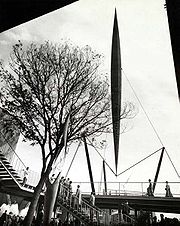
An unusual cigar-shaped aluminium-clad steel tower supported by cables, the Skylon
Skylon (tower)
The Skylon was a futuristic-looking, slender, vertical, cigar-shaped steel tensegrity structure located by the Thames in London, that apparently floated above the ground, built in 1951 for the Festival of Britain....
was the “Vertical Feature” that was an abiding symbol of the Festival of Britain. The base was nearly 15 metres (50 feet) from the ground, with the top nearly 90 metres (300 feet) high. The frame was clad in aluminium louvres lit from within at night. It was designed by Hidalgo Moya
Hidalgo Moya
John Hidalgo Moya , sometimes known as Jacko Moya, was a famous American-born architect who worked largely in England. Moya was a native of California where he was born to an English mother and Mexican father but lived in England since he was an infant. He formed the architectural practice Powell &...
, Philip Powell
Philip Powell (architect)
Sir Arnold Joseph Philip Powell , usually known as Philip Powell, was a ground-breaking English post-war architect.He was educated at Epsom College and then the Architectural Association....
and Felix Samuely
Felix Samuely
Felix James Samuely was a Structural engineer.Born in Vienna, he immigrated to Britain in 1933. Worked with Erich Mendelsohn on the De la Warr Pavilion, Bexhill-on-Sea , the British Pavilion for the Brussels World’s Fair and on various parts of the Festival of Britain. Published MARS plan for...
, and fabricated by Painter Brothers
Painter Brothers
Painter Brothers is a major British fabricator of structural steelwork and one of the leading producers of bolted lattice steelwork in the world.-History:Painter Brothers was founded at Hereford, England in 1920 and incorporated in 1929....
of Hereford
Hereford
Hereford is a cathedral city, civil parish and county town of Herefordshire, England. It lies on the River Wye, approximately east of the border with Wales, southwest of Worcester, and northwest of Gloucester...
, England
England
England is a country that is part of the United Kingdom. It shares land borders with Scotland to the north and Wales to the west; the Irish Sea is to the north west, the Celtic Sea to the south west, with the North Sea to the east and the English Channel to the south separating it from continental...
, between Westminster Bridge
Westminster Bridge
Westminster Bridge is a road and foot traffic bridge over the River Thames between Westminster on the north side and Lambeth on the south side, in London, England....
and Hungerford Bridge
Hungerford Bridge
The Hungerford Bridge crosses the River Thames in London, and lies between Waterloo Bridge and Westminster Bridge. It is a steel truss railway bridge—sometimes known as the Charing Cross Bridge—flanked by two more recent, cable-stayed, pedestrian bridges that share the railway bridge's...
. It had a steel latticework
Latticework
Latticework is a framework consisting of a criss-crossed pattern of strips of building material, typically wood or metal. The design is created by crossing the strips to form a network...
frame, pointed at both ends and supported on cables slung between three steel beams. The partially constructed Skylon was rigged vertically, then grew taller in situ. The architects' design was made possible by the engineer Felix Samuely who, at the time, was a lecturer at the Architectural Association School of Architecture in Bedford Square, Bloomsbury. The name and form of the Skylon may refer to the Trylon feature of the 1939 World's Fair. It was suggested by Mrs A G S Fidler, wife of the chief architect of the Crawley
Crawley
Crawley is a town and local government district with Borough status in West Sussex, England. It is south of Charing Cross, north of Brighton and Hove, and northeast of the county town of Chichester, covers an area of and had a population of 99,744 at the time of the 2001 Census.The area has...
Development Corporation, who said she derived it from "skyhook
Skyhook
Skyhook or sky hook may refer to:- Technology :* Skyhook , explanation of design complexity in the universe that does not build on lower, simpler layers* Skyhook , "hook" used to lift an object on a long cable hanging from the sky...
" and "nylon
Nylon
Nylon is a generic designation for a family of synthetic polymers known generically as polyamides, first produced on February 28, 1935, by Wallace Carothers at DuPont's research facility at the DuPont Experimental Station...
". The Skylon was scrapped in 1952 on the orders of Winston Churchill
Winston Churchill
Sir Winston Leonard Spencer-Churchill, was a predominantly Conservative British politician and statesman known for his leadership of the United Kingdom during the Second World War. He is widely regarded as one of the greatest wartime leaders of the century and served as Prime Minister twice...
, who saw it a symbol of the preceding Labour Government. It was demolished and sold for scrap after being toppled into the Thames.
Royal Festival Hall
Designed by Leslie MartinLeslie Martin
Sir John Leslie Martin KBE was an English Architect. A leading advocate of the International Style....
, Peter Moro and Robert Matthew
Robert Matthew
Sir Robert Hogg Matthew, OBE, FRIBA was a Scottish architect and a leading proponent of modernism.- Early life & studies :Robert Matthew was the son of John Matthew . He was born and brought up in Edinburgh, and attended the Edinburgh College of Art.- Career :Robert was apprenticed with his...
from the LCC's Architects' Department and built by Holland, Hannen & Cubitts
Holland, Hannen & Cubitts
Holland, Hannen & Cubitts was a major building firm responsible for many of the great buildings of London.-History:It was formed from the fusion of two well-established building houses that had competed throughout the later decades of the nineteenth century but came together in 1883: this was...
for London County Council
London County Council
London County Council was the principal local government body for the County of London, throughout its 1889–1965 existence, and the first London-wide general municipal authority to be directly elected. It covered the area today known as Inner London and was replaced by the Greater London Council...
. The foundation stone was laid by Clement Attlee, then Prime Minister, in 1949 on the site of the former Lion Brewery, built in 1837. Martin was 39 when he was appointed to lead the design team in late 1948. He designed the structure as an 'egg in a box', a term he used to describe the separation of the curved auditorium space from the surrounding building and the noise and vibration of the adjacent railway viaduct. Sir Thomas Beecham
Thomas Beecham
Sir Thomas Beecham, 2nd Baronet CH was an English conductor and impresario best known for his association with the London Philharmonic and the Royal Philharmonic orchestras. He was also closely associated with the Liverpool Philharmonic and Hallé orchestras...
used similar imagery, calling the building a 'giant chicken coop'. The building was officially opened on 3 May 1951. The original plan was that Arturo Toscanini
Arturo Toscanini
Arturo Toscanini was an Italian conductor. One of the most acclaimed musicians of the late 19th and 20th century, he was renowned for his intensity, his perfectionism, his ear for orchestral detail and sonority, and his photographic memory...
would conduct the opening concerts, but he was unwell, and the inaugural concerts were conducted by Sir Malcolm Sargent
Malcolm Sargent
Sir Harold Malcolm Watts Sargent was an English conductor, organist and composer widely regarded as Britain's leading conductor of choral works...
and Sir Adrian Boult
Adrian Boult
Sir Adrian Cedric Boult CH was an English conductor. Brought up in a prosperous mercantile family he followed musical studies in England and at Leipzig, Germany, with early conducting work in London for the Royal Opera House and Sergei Diaghilev's ballet company. His first prominent post was...
. In April 1988 it was designated a Grade I listed building, the first post-war building to become so protected.
Minor features
- The Festival Administration Building, by Maxwell FryMaxwell FryEdwin Maxwell Fry, CBE, RA, FRIBA, FRTPI, known as Maxwell Fry , was an English modernist architect of the middle and late 20th century, known for his buildings in Britain, Africa and India....
, Jane DrewJane DrewDame Jane Drew, DBE, FRIBA was an English modernist architect and town planner. She qualified at the AA School in London, and prior to World War II became one of the leading exponents of the Modern Movement in London....
and Edward Mills. - MuralsMuralA mural is any piece of artwork painted or applied directly on a wall, ceiling or other large permanent surface. A particularly distinguishing characteristic of mural painting is that the architectural elements of the given space are harmoniously incorporated into the picture.-History:Murals of...
by Victor PasmoreVictor PasmoreEdwin John Victor Pasmore was a British artist and architect. He pioneered the development of abstract art in Britain in the 1940s and 1950s.-Biography:...
, John TunnardJohn TunnardJohn Samuel Tunnard was an English Modernist designer and painter. He was the cousin of landscape architect Christopher Tunnard.-Life:...
, Feliks TopolskiFeliks TopolskiFeliks Topolski RA was a Polish-born British expressionist painter and draughtsman.- Life :Felix Topolski was born on 14 August 1907 in Warsaw...
and John PiperJohn PiperJohn Piper may refer to:* John Piper , 20th century English painter and printmaker* John Piper , 20th century BBC radio host* John Piper , 19th century lieutenant-governor of Norfolk Island...
. - Sculptures by Barbara HepworthBarbara HepworthDame Barbara Hepworth DBE was an English sculptor. Her work exemplifies Modernism, and with such contemporaries as Ivon Hitchens, Henry Moore, Ben Nicholson, Naum Gabo she helped to develop modern art in Britain.-Life and work:Jocelyn Barbara Hepworth was born on 10 January 1903 in Wakefield,...
, Henry MooreHenry MooreHenry Spencer Moore OM CH FBA was an English sculptor and artist. He was best known for his semi-abstract monumental bronze sculptures which are located around the world as public works of art....
, Lynn ChadwickLynn ChadwickLynn Russell Chadwick CBE was an English artist and sculptor trained as an architectural draughtsman,but began producing metal mobile sculpture during the 1940s. Chadwick was born in London and went to Merchant Taylor's School.Chadwick was commissioned to produce 3 works for the 1951 Festival of...
, Jacob EpsteinJacob EpsteinSir Jacob Epstein KBE was an American-born British sculptor who helped pioneer modern sculpture. He was born in the United States, and moved to Europe in 1902, becoming a British citizen in 1911. He often produced controversial works which challenged taboos on what was appropriate subject matter...
and Reg ButlerReg ButlerReginald Cotterell Butler was an English sculptor. He studied and lectured at the Architectural Association School of Architecture in London from 1937 to 1939. He was a conscientious objector during the Second World War, being exempted from military service conditional upon setting up a small...
.
Festival Pleasure Gardens
The Festival Pleasure Gardens were created as the lighter side of the Festival of Britain. They were put up in Battersea Park, a few miles from the South Bank Exhibition. They included "a 'West End' Restaurant with a terrace overlooking the river and facing Cheyne Walk; 'Foaming Fountains' (which have recently been restored), a wine garden surrounded by miniature pavilions; a wet weather pavilion with a stage facing two ways so that performances could also be done in the open air, with murals by the film set designer Ferdinand Bellan; a large Amphitheatre constructed of brick and seating some 1,250 people and featuring the well known music hall star Lupino LaneLupino Lane
Lupino Lane was an English actor and theatre manager, and a member of the famous Lupino family. Lane started out as a child performer, known as 'Little Nipper', and went on to appear in a wide range of theatrical, music hall and film performances...
and his company on its opening, although later being used as a circus; a miniature railway
Far Tottering and Oyster Creek Branch Railway
The Far Tottering and Oyster Creek Branch Railway was the inspiration of Roland Emett. A fictional narrow-gauge railway with a whimsical view of British rural life and embodying Emett's typical fanciful mechanics, it echoed the similar works of Heath Robinson and Rube Goldberg.The railway began as...
designed by Roland Emett which ran for nearly 500 yards along the south of the gardens and even had its own station near the south east entrance to the park and another station with snack bar at the western end of the line; and an amusement park which would eventually outlast all the other entertainments and later become 'Battersea Fun Fair', only closing in the mid 1970s. Most of the buildings and pavilions on the site were designed by John Piper
John Piper
John Piper may refer to:* John Piper , 20th century English painter and printmaker* John Piper , 20th century BBC radio host* John Piper , 19th century lieutenant-governor of Norfolk Island...
." There was also a "Guinness Festival Clock" The Pleasure Gardens received as many visitors as the South Bank Festival. They were managed by a specially-formed private company financed by loans from the Festival Office and the London County Council. As they failed to cover their costs, it was decided to keep them open after the rest of the Festival closed.
Live architecture
There was an exhibition about building research, town planning and architecture, the "Live architecture" exhibit of buildings, open spaces and streets in the Lansbury EstateLansbury Estate
The Lansbury Estate is a public housing estate in the Poplar area of the London Borough of Tower Hamlets named after George Lansbury, a Poplar councillor and Labour party MP.It is one of the largest such estates in London...
, Poplar
Poplar, London
Poplar is a historic, mainly residential area of the East End of London in the London Borough of Tower Hamlets. It is about east of Charing Cross. Historically a hamlet in the parish of Stepney, Middlesex, in 1817 Poplar became a civil parish. In 1855 the Poplar District of the Metropolis was...
(named after the former Labour Party leader George Lansbury
George Lansbury
George Lansbury was a British politician, socialist, Christian pacifist and newspaper editor. He was a Member of Parliament from 1910 to 1912 and from 1922 to 1940, and leader of the Labour Party from 1932 to 1935....
. Plans for social housing in the area had commenced in 1943. By the end of the war nearly a quarter of the buildings in the area had been destroyed or badly damaged. In 1948, the Architecture Council decided that the Poplar site would make a good exhibition partly because it was near to the other Festival exhibitions. Despite funding problems, work began in December 1949 and by May 1950 was well advanced. The wet winter of 1950–51 delayed work, but the first houses were completed and occupied by February 1951. The exhibition opened on 3 May 1951 along with the other Festival exhbitions. Visitors first went to the Building Research Pavilion, which displayed housing problems and their solutions, then to the Town Planning Pavilion, a large, red-and-white striped tent. The Town Planning Pavilion demonstrated the principles of town planning and the urgent need for new towns, including a mock up of an imaginary town called "Avoncaster". Visitors then saw the buildings of the Lansbury Estate.
Attendance was disappointing, only 86,426 people visiting, compared to 8 million who visited the South Bank exhibition. Reaction to the development by industry professionals was lukewarm, some criticising its small scale Subsequent local authorities concentrated on high rise, high density social housing rather than the Lansbury estate model.
The estate remains popular with residents. Among the remaining 1951 buildings are Trinity Independent Chapel
Trinity Independent Chapel
Now a Methodist chapel, the original Trinity Independent Chapel was designed in 1840-41 by William Hosking FSA, at Poplar, in the London Borough of Tower Hamlets, and built by John Jay....
, and The Festival Inn and Festive Briton (now Callaghans) pubs.
Science museum
A new wing was built for the Science MuseumScience museum
A science museum or a science centre is a museum devoted primarily to science. Older science museums tended to concentrate on static displays of objects related to natural history, paleontology, geology, industry and industrial machinery, etc. Modern trends in museology have broadened the range of...
to hold the Exhibition of Science. The first part of the exhibition showed the physical and chemical nature of matter and the behaviour of elements and molecules. The second part, "The Structure of Living Things", dealt with plants and animals. The third part, "Stop Press", showed some of the latest topics of research in science and their emergence from the ideas illustrated in the earlier sections of the exhibition. They included "the penetrating rays which reach us from outer space, what goes on in space and in the stars, and a range of subjects from the electronic brain to the processes and structures on which life is based."
Design
The South Bank Exhibition included a Design Review, that presented "an illustrated record of contemporary achievement in British industry", showing "the high standard of design and craftsmanship that has been reached in a wide range of British products." The exhibits were based on the stock list of the Council of Industrial Design (CoID), chosen for appearance, finish, workmanship, technical efficiency, fitness for purpose and economy of production. The Festival was an influential advocate of the concept of "Good Design", a rational approach to product design in accordance with the principles of the Modern Movement. Its advocacy had grown partly out of the standards of utility furnitureUtility furniture
Utility furniture refers to furniture produced in the United Kingdom during and just after World War II, under a Government scheme which was designed to cope with shortages of raw materials and rationing of consumption...
created during the war (Gordon Russell
Sydney Gordon Russell
Sir Gordon Russell was an English designer, craftsman and educationist.He came under the influence of the Arts and Crafts movement from 1904 after his father had moved to Broadway in the Cotswolds to be hotelier at the Lygon Arms, through the Guild of Handicraft, the community of metalworkers,...
, the Director of the CoID, had been Chairman of the Utility Furniture Design Panel) and partly out of the CoID's Britain Can Make It
Britain Can Make It
Britain Can Make It was an exhibition of industrial and product design held in London in 1946. It was organized by the Council of Industrial Design, later to become the Design Council....
exhibition of 1946. The CoiD's stock list was retained and inherited by its successor, the Design Council.
The Festival architects tried to show by the design and layout of the South Bank Festival what could be achieved by applying modern town planning ideas.A Tonic to the Nation Their influence was felt in the New Towns
New towns in the United Kingdom
Below is a list of some of the new towns in the United Kingdom created under the various New Town Acts of the 20th century. Some earlier towns were developed as Garden Cities or overspill estates early in the twentieth century. The New Towns proper were planned to disperse population following the...
, coffee bars and office blocks of the fifties. Harlow
Harlow
Harlow is a new town and local government district in Essex, England. It is located in the west of the county and on the border with Hertfordshire, on the Stort Valley, The town is near the M11 motorway and forms part of the London commuter belt.The district has a current population of 78,889...
new town and the rebuilding of Coventry
Coventry
Coventry is a city and metropolitan borough in the county of West Midlands in England. Coventry is the 9th largest city in England and the 11th largest in the United Kingdom. It is also the second largest city in the English Midlands, after Birmingham, with a population of 300,848, although...
city centre are said to show the influence of the Festival Style "in their light structures, picturesque layout and incorporation of works of art", and Coventry Cathedral
Coventry Cathedral
Coventry Cathedral, also known as St Michael's Cathedral, is the seat of the Bishop of Coventry and the Diocese of Coventry, in Coventry, West Midlands, England. The current bishop is the Right Revd Christopher Cocksworth....
(1962), designed by Basil Spence, one of the Festival architects, was dubbed "The Festival of Britain at Prayer".
Lettering and type design featured prominently in the graphic style of the Festival and was overseen by a typography panel including the lettering historian Nicolete Gray
Nicolete Gray
Nicolete Gray was an English art scholar, and exponent and scholar of calligraphy. She was the youngest daughter of the poet, dramatist and art scholar Laurence Binyon and his wife, writer, editor and translator Cicely Margaret Pryor Powell...
. A typeface for the Festival, Festival Titling, was specially commissioned and designed by Philip Boydell. It was based on condensed sans-serif
Sans-serif
In typography, a sans-serif, sans serif or san serif typeface is one that does not have the small projecting features called "serifs" at the end of strokes. The term comes from the French word sans, meaning "without"....
capitals and had a three dimensional form making it suitable for use in exhibition display typography
Typography
Typography is the art and technique of arranging type in order to make language visible. The arrangement of type involves the selection of typefaces, point size, line length, leading , adjusting the spaces between groups of letters and adjusting the space between pairs of letters...
. It has been said to bear "a vague resemblance to bunting". The lettering on the Royal Festival Hall and the temporary Festival building on the South Bank was a bold, sloping slab serif
Slab serif
In typography, a slab serif typeface is a type of serif typeface characterized by thick, block-like serifs. Serif terminals may be either blunt and angular , or rounded . Slab serif typefaces generally have no bracket...
letter form, determined by Gray and her colleagues, including Charles Hasler and Gordon Cullen
Gordon Cullen
Thomas Gordon Cullen was an influential English architect and urban designer who was a key motivator in the Townscape movement. He is best known for the book The Concise Townscape, first published in 1961.-Biography:Cullen was born in Calverley, Pudsey, near Leeds...
, illustrated in Gray’s Lettering on Buildings (1960). It has been described as a "turn to a jauntier and more decorative visual language" that was "part of a wider move towards the appreciation of vernacular arts and the peculiarities of English culture".
The Festival Style, combining modernism
Modernism
Modernism, in its broadest definition, is modern thought, character, or practice. More specifically, the term describes the modernist movement, its set of cultural tendencies and array of associated cultural movements, originally arising from wide-scale and far-reaching changes to Western society...
with whimsy and Englishness, influenced architecture, interior design, product design and typography in the 1950s. William Feaver describes the Festival Style as "Braced legs, indoor plants, lily-of-the valley sprays of lightbulbs, aluminium lattices, Costswold-type walling with picture windows, flying staircases, blond wood, the thorn, the spike, the molecule."
Misha Black, one of the Festival architects, said that the Festival created a wide audience for architectural modernism but that it was common currency among professional architects that the design of the Festival was not innovative. The design writer Reyner Banham
Reyner Banham
Peter Reyner Banham was a prolific architectural critic and writer best known for his 1960 theoretical treatise Theory and Design in the First Machine Age and for his 1971 book Los Angeles: The Architecture of Four Ecologies...
has questioned the originality and the Englishness of the Festival Style and indeed the extent of its influence.
Other Festival events
- The selection of TrowellTrowellTrowell is a village and civil parish in Nottinghamshire, England. It lies a few miles west of Nottingham, in the borough of Broxtowe on the border with Derbyshire. According to the 2001 census it had a population of 2,568....
, a NottinghamshireNottinghamshireNottinghamshire is a county in the East Midlands of England, bordering South Yorkshire to the north-west, Lincolnshire to the east, Leicestershire to the south, and Derbyshire to the west...
village in the middle of England, as the Festival Village. - Two exhibitions at the Whitechapel Art Gallery: "Black Eyes and Lemonade", about British vernacular art, curated by Barbara JonesBarbara Jones (artist)Barbara Mildred Jones was an English artist, writer and mural painter.- Biography :Barbara Jones was born in Croydon, Surrey...
; and "East End 1851", by arrangement with the Arts Council. - The re-design of Parliament SquareParliament SquareParliament Square is a square outside the northwest end of the Palace of Westminster in London. It features a large open green area in the middle, with a group of trees to its west. It contains statues of famous statesmen and is the scene of rallies and protests, as well as being a tourist...
by George Grey WornumGeorge Grey WornumGeorge Grey Wornum was a British architect.Grey Wornum was born in London and educated at Bradfield College and the Slade School of Art. He studied architecture under the guidance of his uncle, Ralph Selden Wornum...
in preparation for the Festival of Britain year. - The first performance of steelpanSteelpanSteelpans is a musical instrument originating from The Republic of Trinidad and Tobago...
music in Britain by the Trinidad All Steel Percussion OrchestraTASPO (Steelband)The Trinidad All Steel Percussion Orchestra was formed to participate in the Festival of Britain in 1951. The group presented the newly invented Steelpan to an international audience.-Members of TASPO:...
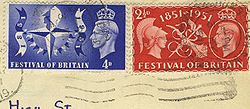
. - A commemorative crown coin and commemorative postage stamps.
- The first performance of Robert McLellanRobert McLellanRobert McLellan OBE was a Scottish dramatist and poet, mainly writing in the Scots language.-Early life and education:McLellan was born in 1907 at Linmill, a fruit farm in Kirkfieldbank in the Clyde valley, the home of his maternal grandparents. He was educated at Bearsden Academy in Glasgow...
's play Mary Stewart at the Glasgow Citizens Theatre. - An exhibition about Sherlock HolmesSherlock HolmesSherlock Holmes is a fictional detective created by Scottish author and physician Sir Arthur Conan Doyle. The fantastic London-based "consulting detective", Holmes is famous for his astute logical reasoning, his ability to take almost any disguise, and his use of forensic science skills to solve...
(part of which is now owned by Westminster Libraries and part by the Sherlock Holmes pub).
Attendance figures
There were over ten million admissions to the six main exhibitions over a period of five months:| Architecture Exhibition, Lansbury, Poplar (London) | 86,646 |
| Industrial Power Exhibition, Glasgow | 282,039 |
| Science Exhibition, South Kensington (London) | 213,744 |
| South Bank Exhibition, Waterloo (London) | 8,455,863 |
| - Visitors from London | 36.5% |
| - Outside London | 56% |
| 7.5% | |
| 15% | |
| - Commonwealth | 32% |
| 46% | |
| - Elsewhere | 7% |
| Land Travelling Exhibition | 462,289 |
| 114,183 | |
| - Leeds | 144,844 |
| - Birmingham | 76,357 |
| - Nottingham | 106,615 |
| Festival Ship "Campania" | 889,792 |
| - Southampton | 78,683 |
| - Dundee | 51,422 |
| - Newcastle | 169,511 |
| - Hull | 87,840 |
| - Plymouth | 50,120 |
| - Bristol (Avonmouth) | 78,219 |
| - Cardiff | 104,391 |
| - Belfast | 86,756 |
| - Birkenhead | 90,311 |
| - Glasgow | 93,539 |
| Festival Pleasure Gardens, Battersea (London) | 8,031,000 |
| - Visitors from London | 76%, |
| - Outside London | 22% |
| - Overseas | 2% |
| Ulster Farm & Factory Exhibition, Belfast | 156,760 |
| Living Traditions Exhibition, Edinburgh | 135,000 |
| Exhibition of Books, South Kensington (London) | 63,162 |
Political responses
The idea of holding the Festival became a party political issue. Although Herbert Morrison said that he did not want the Festival to be seen as a political venture, it became associated with the Labour Party, which had won the 1945 General ElectionUnited Kingdom general election, 1951
The 1951 United Kingdom general election was held eighteen months after the 1950 general election, which the Labour Party had won with a slim majority of just five seats...
, and it was opposed by the Conservative Party. Hugh Casson said that, "Churchill, like the rest of the Tory Party, was against the Festival which they (quite rightly) believed was the advanced guard of socialism." Churchill referred to the forthcoming Festival of Britain as "three-dimensional Socialist propaganda."
In an essay on the Festival, Michael Frayn
Michael Frayn
Michael J. Frayn is an English playwright and novelist. He is best known as the author of the farce Noises Off and the dramas Copenhagen and Democracy...
characterised it as an enterprise of "the radical middle-classes, the do-gooders; the readers of the News Chronicle, the Guardian
The Guardian
The Guardian, formerly known as The Manchester Guardian , is a British national daily newspaper in the Berliner format...
, and the Observer
The Observer
The Observer is a British newspaper, published on Sundays. In the same place on the political spectrum as its daily sister paper The Guardian, which acquired it in 1993, it takes a liberal or social democratic line on most issues. It is the world's oldest Sunday newspaper.-Origins:The first issue,...
; the signers of petitions; the backbone of the B.B.C.," whom he called "Herbivores". In Frayn's view, "The Festival was the last, and virtually the posthumous, work of the Herbivore Britain of the BBC News, the Crown Film Unit
Crown Film Unit
The Crown Film Unit was an organisation within the British Government's Ministry of Information during World War II. Formerly the GPO Film Unit it became the Crown Film Unit in 1940. Its remit was to make films for the general public in Britain and abroad...
, the sweet ration, the Ealing comedies
Ealing Comedies
For the film Ealing Comedy, see Ealing Comedy .The Ealing Comedies were a series of film comedies produced by Ealing Studios during the period 1947 to 1957....
, Uncle Mac, Sylvia Peters
Sylvia Peters
Sylvia Peters was a British actress, and from 1947 to 1958 was a continuity announcer for BBC Television.-Career:...
." In making the Festival the Herbivores "earned the contempt of the Carnivores - the readers of the Daily Express
Daily Express
The Daily Express switched from broadsheet to tabloid in 1977 and was bought by the construction company Trafalgar House in the same year. Its publishing company, Beaverbrook Newspapers, was renamed Express Newspapers...
; the Evelyn Waugh
Evelyn Waugh
Arthur Evelyn St. John Waugh , known as Evelyn Waugh, was an English writer of novels, travel books and biographies. He was also a prolific journalist and reviewer...
s; the cast of the Directory of Directors".
Some prominent members of the Labour government considered the Festival to be a Labour undertaking which would contribute to their future electoral success, and Clement Attlee
Clement Attlee
Clement Richard Attlee, 1st Earl Attlee, KG, OM, CH, PC, FRS was a British Labour politician who served as the Prime Minister of the United Kingdom from 1945 to 1951, and as the Leader of the Labour Party from 1935 to 1955...
, the Labour Leader, wrote to Morrison saying that an election in autumn 1951 would enable the Labour Party to benefit from its popularity. In the event, Labour lost the autumn election. Churchill's contempt for the Festival led him to make his first act as Prime Minister in October 1951 an instruction to clear the South Bank site.
Legacy
The Guide Book to the Festival described its legacy in these words: "It will leave behind not just a record of what we have thought of ourselves in the year 1951 but, in a fair community founded where once there was a slum, in an avenue of trees or in some work of art, a reminder of what we have done to write this single, adventurous year into our national and local history."As the Festival was conceived, the government and the London County Council were at the same time developing plans for the redevelopment of the South Bank, which was to include "a number of great buildings, which will form part of a co-ordinated design." The first of these was the Royal Festival Hall. The Festival hastened the reclamation of four and a half acres of land from the river, which "transformed the familiar patchwork of rubble and half-derelict buildings which had for so long monopolized the propect from the North Bank". The Festival site was, over the following thirty years, developed into the South Bank Centre
South Bank Centre
Southbank Centre is a complex of artistic venues in London, UK, on the South Bank of the River Thames between County Hall and Waterloo Bridge. It comprises three main buildings , and is Europe’s largest centre for the arts. It attracts more than three million visitors annually...
, an arts complex comprising the Royal Festival Hall, the National Film Theatre, the Queen Elizabeth Hall
Queen Elizabeth Hall
The Queen Elizabeth Hall is a music venue on the South Bank in London, United Kingdom that hosts daily classical, jazz, and avant-garde music and dance performances. The QEH forms part of Southbank Centre arts complex and stands alongside the Royal Festival Hall, which was built for the Festival...
, the Purcell Room
Purcell Room
The Purcell Room is a concert and performance venue which forms part of the Southbank Centre, one of central London's leading cultural complexes. It is named after the 17th century English composer Henry Purcell and has 370 seats....
and the National Theatre
National Theatre
National Theatre may refer to: -in Africa:*Kenya National Theatre in Nairobi, Kenya*National Theatre in Accra, Ghana-in Asia:*National Theater and Concert Hall, Republic of China in Taipei, Taiwan*National Theatre of Japan in Tokyo, Japan...
.
A 1951 office building at 219 Oxford Street, London, designed by Ronald Ward and Partners (now a Grade II* listed building), incorporates images of the Festival on its facade.
The net cost of the Festival, apart from the loans for the Festival Gardens, was just over £8 million pounds, about £35 million at 2010 prices.
Books
- Banham, Mary and Hillier, BevisBevis HillierBevis Hillier is an English art historian, author and journalist. He has written on Art Deco, and also a biography of Sir John Betjeman.-Life and work:...
, A Tonic to the Nation: The Festival of Britain 1951, London: Thames & Hudson, 1976 ISBN 0500270791 - Rennie, Paul, Festival of Britain 1951, London: Antique Collectors Club, Ltd., 2007 ISBN 9781851495337 ISBN 1851495339
External links
- George Simner, "Festival of Britain", The Observer
- Festival of Britain, e-learning module by the Design Council Archives
- The Festival of Britain
- Festival of Britain exhibit from the Museum of LondonMuseum of LondonThe Museum of London documents the history of London from the Prehistoric to the present day. The museum is located close to the Barbican Centre, as part of the striking Barbican complex of buildings created in the 1960s and 70s as an innovative approach to re-development within a bomb damaged...
- The Festival of Britain Society
- The Festival of Britain - Exploring 20th century London
- http://www.flickr.com/groups/southbankcentre/ (A Flickr group dedicated to pictures of the Southbank Centre)
- Video of a talk by Robert Anderson on the development of the Exhibition of Science as part of the Festival of Britain
- Internet ArchiveInternet ArchiveThe Internet Archive is a non-profit digital library with the stated mission of "universal access to all knowledge". It offers permanent storage and access to collections of digitized materials, including websites, music, moving images, and nearly 3 million public domain books. The Internet Archive...
Films: - History of the Royal Festival Hall
- Contemporary photos of the Festival Pleasure Gardens, Battersea
- 219 Oxford Street, with images of the Festival