


Metasomatism

Encyclopedia
Metasomatism is the chemical alteration of a rock
by hydrothermal and other fluids.
Metasomatism can occur via the action of hydrothermal fluids from an igneous or metamorphic
source.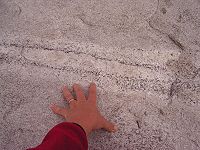 In the igneous
environment, metasomatism creates skarn
s, greisen
, and may affect hornfels
in the contact metamorphic aureole adjacent to an intrusive rock mass. In the metamorphic environment, metasomatism is created by mass transfer from a volume of metamorphic rock
at higher stress
and temperature
into a zone with lower stress and temperature, with metamorphic hydrothermal solutions acting as a solvent
. This can be envisaged as the metamorphic rocks within the deep crust
losing fluids and dissolved mineral
components as hydrous minerals break down, with this fluid percolating up into the shallow levels of the crust to chemically change and alter these rocks.
This mechanism implies that metasomatism is open system behaviour, which is different from classical metamorphism
which is the in-situ mineralogical change of a rock without appreciable change in the chemistry of the rock. Because metamorphism usually requires water
in order to facilitate metamorphic reactions, metasomatism and metamorphism nearly always occur together.
Further, because metasomatism is a mass transfer process, it is not restricted to the rocks which are changed by addition of chemical element
s and minerals or hydrous compound
s. In all cases, to produce a metasomatic rock some other rock is also metasomatised, if only by dehydration reactions with minimal chemical change. This is best illustrated by gold ore deposits
which are the product of focused concentration of fluids derived from many cubic kilometres of dehydrated crust
into thin, often highly metasomatised and altered shear zone
s and lode
s. The source region is often largely chemically unaffected compared to the highly hydrated, altered shear zones, but both must have undergone complementary metasomatism.
Metasomatism is more complicated in the Earth's mantle, because the composition of peridotite
at high temperatures can be changed by infiltration of carbonate
and silicate
melts and by carbon dioxide
-rich and water-rich fluids, as discussed by Luth (2003). Metasomatism is thought to be particularly important in changing the composition of mantle peridotite below island arc
s as water is driven out of ocean
lithosphere
during subduction
. Metasomatism has also been considered critical for enriching source regions of some silica-undersaturated
magma
s. Carbonatite
melts are often considered to have been responsible for enrichment of mantle peridotite in incompatible element
s.
In such cases, characterising alteration often requires microscope investigation of the mineral assemblage of the rocks to characterise the minerals, any additional mineral growth, changes in protolith minerals, and so on.
In some cases, geochemical evidence can be found of metasomatic alteration processes. This is usually in the form of mobile, soluble elements such as barium
, strontium
, rubidium
, calcium
and some rare earth elements. However, to characterise the alteration properly, it is necessary to compare altered with unaltered samples.
When the process becomes extremely advanced, typical metasomatites can include:
Effects of metasomatism in mantle peridotite can be either modal or cryptic. In cryptic metasomatism, mineral compositions are changed, or introduced elements are concentrated on grain boundaries and the peridotite mineralogy appears unchanged. In modal metasomatism, new minerals are formed.
Cryptic metasomatism may be caused as rising or percolating melts interact with surrounding peridotite, and compositions of both melts and peridotite are changed. At high mantle temperatures, solid-state diffusion
can also be effective in changing rock compositions over tens of centimeters adjacent to melt conduits: gradients in mineral composition adjacent to pyroxenite
dikes may preserve evidence of the process.
Modal metasomatism may result in formation of amphibole
and phlogopite
, and the presence of these minerals in peridotite xenolith
s has been considered strong evidence of metasomatic processes in the mantle. Formation of minerals less common in peridotite, such as dolomite
, calcite
, ilmenite
, rutile
, and armalcolite
, is also attributed to melt or fluid metasomatism.
Rarer types of hydrothermal fluids may include highly carbonic fluids, resulting in advanced carbonation reactions of the host rock typical of calc-silicates, and silica-hematite fluids resulting in production of jasperoid
s, manto ore deposits
and pervasive zones of silicification, typically in dolomite
formations.
Rock (geology)
In geology, rock or stone is a naturally occurring solid aggregate of minerals and/or mineraloids.The Earth's outer solid layer, the lithosphere, is made of rock. In general rocks are of three types, namely, igneous, sedimentary, and metamorphic...
by hydrothermal and other fluids.
Metasomatism can occur via the action of hydrothermal fluids from an igneous or metamorphic
Metamorphism
Metamorphism is the solid-state recrystallization of pre-existing rocks due to changes in physical and chemical conditions, primarily heat, pressure, and the introduction of chemically active fluids. Mineralogical, chemical and crystallographic changes can occur during this process...
source.
Igneous rock
Igneous rock is one of the three main rock types, the others being sedimentary and metamorphic rock. Igneous rock is formed through the cooling and solidification of magma or lava...
environment, metasomatism creates skarn
Skarn
Skarn is an old Swedish mining term originally used to describe a type of silicate gangue, or waste rock, associated with iron-ore bearing sulfide deposits apparently replacing Archean age limestones in Sweden's Persberg mining district. In modern usage the term "skarn" has been expanded to refer...
s, greisen
Greisen
Greisen is a highly altered granitic rock or pegmatite. Greisen is formed by autogenic alteration of a granite and is a class of endoskarn.Greisens appear as highly altered rocks, partly coarse, crystalline granite, partly vuggy with miarolitic cavities, disseminated halide minerals such as...
, and may affect hornfels
Hornfels
Hornfels is the group designation for a series of contact metamorphic rocks that have been baked and indurated by the heat of intrusive igneous masses and have been rendered...
in the contact metamorphic aureole adjacent to an intrusive rock mass. In the metamorphic environment, metasomatism is created by mass transfer from a volume of metamorphic rock
Metamorphic rock
Metamorphic rock is the transformation of an existing rock type, the protolith, in a process called metamorphism, which means "change in form". The protolith is subjected to heat and pressure causing profound physical and/or chemical change...
at higher stress
Stress (physics)
In continuum mechanics, stress is a measure of the internal forces acting within a deformable body. Quantitatively, it is a measure of the average force per unit area of a surface within the body on which internal forces act. These internal forces are a reaction to external forces applied on the body...
and temperature
Temperature
Temperature is a physical property of matter that quantitatively expresses the common notions of hot and cold. Objects of low temperature are cold, while various degrees of higher temperatures are referred to as warm or hot...
into a zone with lower stress and temperature, with metamorphic hydrothermal solutions acting as a solvent
Solvent
A solvent is a liquid, solid, or gas that dissolves another solid, liquid, or gaseous solute, resulting in a solution that is soluble in a certain volume of solvent at a specified temperature...
. This can be envisaged as the metamorphic rocks within the deep crust
Crust (geology)
In geology, the crust is the outermost solid shell of a rocky planet or natural satellite, which is chemically distinct from the underlying mantle...
losing fluids and dissolved mineral
Mineral
A mineral is a naturally occurring solid chemical substance formed through biogeochemical processes, having characteristic chemical composition, highly ordered atomic structure, and specific physical properties. By comparison, a rock is an aggregate of minerals and/or mineraloids and does not...
components as hydrous minerals break down, with this fluid percolating up into the shallow levels of the crust to chemically change and alter these rocks.
This mechanism implies that metasomatism is open system behaviour, which is different from classical metamorphism
Metamorphism
Metamorphism is the solid-state recrystallization of pre-existing rocks due to changes in physical and chemical conditions, primarily heat, pressure, and the introduction of chemically active fluids. Mineralogical, chemical and crystallographic changes can occur during this process...
which is the in-situ mineralogical change of a rock without appreciable change in the chemistry of the rock. Because metamorphism usually requires water
Water
Water is a chemical substance with the chemical formula H2O. A water molecule contains one oxygen and two hydrogen atoms connected by covalent bonds. Water is a liquid at ambient conditions, but it often co-exists on Earth with its solid state, ice, and gaseous state . Water also exists in a...
in order to facilitate metamorphic reactions, metasomatism and metamorphism nearly always occur together.
Further, because metasomatism is a mass transfer process, it is not restricted to the rocks which are changed by addition of chemical element
Chemical element
A chemical element is a pure chemical substance consisting of one type of atom distinguished by its atomic number, which is the number of protons in its nucleus. Familiar examples of elements include carbon, oxygen, aluminum, iron, copper, gold, mercury, and lead.As of November 2011, 118 elements...
s and minerals or hydrous compound
Chemical compound
A chemical compound is a pure chemical substance consisting of two or more different chemical elements that can be separated into simpler substances by chemical reactions. Chemical compounds have a unique and defined chemical structure; they consist of a fixed ratio of atoms that are held together...
s. In all cases, to produce a metasomatic rock some other rock is also metasomatised, if only by dehydration reactions with minimal chemical change. This is best illustrated by gold ore deposits
Ore genesis
The various theories of ore genesis explain how the various types of mineral deposits form within the Earth's crust. Ore genesis theories are very dependent on the mineral or commodity....
which are the product of focused concentration of fluids derived from many cubic kilometres of dehydrated crust
Crust (geology)
In geology, the crust is the outermost solid shell of a rocky planet or natural satellite, which is chemically distinct from the underlying mantle...
into thin, often highly metasomatised and altered shear zone
Shear zone
A shear zone is a very important structural discontinuity surface in the Earth's crust and upper mantle. It forms as a response to inhomogeneous deformation partitioning strain into planar or curviplanar high-strain zones. Intervening blocks stay relatively unaffected by the deformation...
s and lode
Lode
In geology, a lode is a deposit of metalliferous ore that fills or is embedded in a fissure in a rock formation or a vein of ore that is deposited or embedded between layers of rock....
s. The source region is often largely chemically unaffected compared to the highly hydrated, altered shear zones, but both must have undergone complementary metasomatism.
Metasomatism is more complicated in the Earth's mantle, because the composition of peridotite
Peridotite
A peridotite is a dense, coarse-grained igneous rock, consisting mostly of the minerals olivine and pyroxene. Peridotite is ultramafic, as the rock contains less than 45% silica. It is high in magnesium, reflecting the high proportions of magnesium-rich olivine, with appreciable iron...
at high temperatures can be changed by infiltration of carbonate
Carbonate
In chemistry, a carbonate is a salt of carbonic acid, characterized by the presence of the carbonate ion, . The name may also mean an ester of carbonic acid, an organic compound containing the carbonate group C2....
and silicate
Silicate
A silicate is a compound containing a silicon bearing anion. The great majority of silicates are oxides, but hexafluorosilicate and other anions are also included. This article focuses mainly on the Si-O anions. Silicates comprise the majority of the earth's crust, as well as the other...
melts and by carbon dioxide
Carbon dioxide
Carbon dioxide is a naturally occurring chemical compound composed of two oxygen atoms covalently bonded to a single carbon atom...
-rich and water-rich fluids, as discussed by Luth (2003). Metasomatism is thought to be particularly important in changing the composition of mantle peridotite below island arc
Island arc
An island arc is a type of archipelago composed of a chain of volcanoes which alignment is arc-shaped, and which are situated parallel and close to a boundary between two converging tectonic plates....
s as water is driven out of ocean
Ocean
An ocean is a major body of saline water, and a principal component of the hydrosphere. Approximately 71% of the Earth's surface is covered by ocean, a continuous body of water that is customarily divided into several principal oceans and smaller seas.More than half of this area is over 3,000...
lithosphere
Lithosphere
The lithosphere is the rigid outermost shell of a rocky planet. On Earth, it comprises the crust and the portion of the upper mantle that behaves elastically on time scales of thousands of years or greater.- Earth's lithosphere :...
during subduction
Subduction
In geology, subduction is the process that takes place at convergent boundaries by which one tectonic plate moves under another tectonic plate, sinking into the Earth's mantle, as the plates converge. These 3D regions of mantle downwellings are known as "Subduction Zones"...
. Metasomatism has also been considered critical for enriching source regions of some silica-undersaturated
Normative mineralogy
Normative mineralogy is a geochemical calculation of the whole rock geochemistry of a rock sample that estimates the idealised mineralogy of a rock according to the principles of geochemistry....
magma
Magma
Magma is a mixture of molten rock, volatiles and solids that is found beneath the surface of the Earth, and is expected to exist on other terrestrial planets. Besides molten rock, magma may also contain suspended crystals and dissolved gas and sometimes also gas bubbles. Magma often collects in...
s. Carbonatite
Carbonatite
Carbonatites are intrusive or extrusive igneous rocks defined by mineralogic composition consisting of greater than 50 percent carbonate minerals. Carbonatites may be confused with marble, and may require geochemical verification....
melts are often considered to have been responsible for enrichment of mantle peridotite in incompatible element
Incompatible element
An incompatible element is a term used in petrology and geochemistry to describe an element that is unsuitable in size and/or charge to the cation sites of the minerals, and is defined by the partition coefficient between rock-forming minerals and melt being much smaller than 1..During the...
s.
Types of metasomatites
Metasomatic rocks can be extremely varied. Often, metasomatised rocks are pervasively but weakly altered, such that the only evidence of alteration is bleaching, change in colour or change in the crystallinity of micaceous minerals.In such cases, characterising alteration often requires microscope investigation of the mineral assemblage of the rocks to characterise the minerals, any additional mineral growth, changes in protolith minerals, and so on.
In some cases, geochemical evidence can be found of metasomatic alteration processes. This is usually in the form of mobile, soluble elements such as barium
Barium
Barium is a chemical element with the symbol Ba and atomic number 56. It is the fifth element in Group 2, a soft silvery metallic alkaline earth metal. Barium is never found in nature in its pure form due to its reactivity with air. Its oxide is historically known as baryta but it reacts with...
, strontium
Strontium
Strontium is a chemical element with the symbol Sr and the atomic number 38. An alkaline earth metal, strontium is a soft silver-white or yellowish metallic element that is highly reactive chemically. The metal turns yellow when exposed to air. It occurs naturally in the minerals celestine and...
, rubidium
Rubidium
Rubidium is a chemical element with the symbol Rb and atomic number 37. Rubidium is a soft, silvery-white metallic element of the alkali metal group. Its atomic mass is 85.4678. Elemental rubidium is highly reactive, with properties similar to those of other elements in group 1, such as very rapid...
, calcium
Calcium
Calcium is the chemical element with the symbol Ca and atomic number 20. It has an atomic mass of 40.078 amu. Calcium is a soft gray alkaline earth metal, and is the fifth-most-abundant element by mass in the Earth's crust...
and some rare earth elements. However, to characterise the alteration properly, it is necessary to compare altered with unaltered samples.
When the process becomes extremely advanced, typical metasomatites can include:
- ChloriteChlorite groupThe chlorites are a group of phyllosilicate minerals. Chlorites can be described by the following four endmembers based on their chemistry via substitution of the following four elements in the silicate lattice; Mg, Fe, Ni, and Mn....
or micaMicaThe mica group of sheet silicate minerals includes several closely related materials having highly perfect basal cleavage. All are monoclinic, with a tendency towards pseudohexagonal crystals, and are similar in chemical composition...
whole-rock replacement in shear zones, resulting in rocks in which the existing mineralogy has been completely recrystallised and replaced by hydrated minerals such as chlorite, muscoviteMuscoviteMuscovite is a phyllosilicate mineral of aluminium and potassium with formula KAl22, or 236. It has a highly-perfect basal cleavage yielding remarkably-thin laminæ which are often highly elastic...
, and serpentine. - SkarnSkarnSkarn is an old Swedish mining term originally used to describe a type of silicate gangue, or waste rock, associated with iron-ore bearing sulfide deposits apparently replacing Archean age limestones in Sweden's Persberg mining district. In modern usage the term "skarn" has been expanded to refer...
and skarnoid rock types, typically adjacent to graniteGraniteGranite is a common and widely occurring type of intrusive, felsic, igneous rock. Granite usually has a medium- to coarse-grained texture. Occasionally some individual crystals are larger than the groundmass, in which case the texture is known as porphyritic. A granitic rock with a porphyritic...
intrusions and adjacent to reactive lithologies such as limestoneLimestoneLimestone is a sedimentary rock composed largely of the minerals calcite and aragonite, which are different crystal forms of calcium carbonate . Many limestones are composed from skeletal fragments of marine organisms such as coral or foraminifera....
, marlMarlMarl or marlstone is a calcium carbonate or lime-rich mud or mudstone which contains variable amounts of clays and aragonite. Marl was originally an old term loosely applied to a variety of materials, most of which occur as loose, earthy deposits consisting chiefly of an intimate mixture of clay...
and banded iron formationBanded iron formationBanded iron formations are distinctive units of sedimentary rock that are almost always of Precambrian age. A typical BIF consists of repeated, thin layers of iron oxides, either magnetite or hematite , alternating with bands of iron-poor shale and chert...
. - GreisenGreisenGreisen is a highly altered granitic rock or pegmatite. Greisen is formed by autogenic alteration of a granite and is a class of endoskarn.Greisens appear as highly altered rocks, partly coarse, crystalline granite, partly vuggy with miarolitic cavities, disseminated halide minerals such as...
deposits within graniteGraniteGranite is a common and widely occurring type of intrusive, felsic, igneous rock. Granite usually has a medium- to coarse-grained texture. Occasionally some individual crystals are larger than the groundmass, in which case the texture is known as porphyritic. A granitic rock with a porphyritic...
margins and cupolas.
Effects of metasomatism in mantle peridotite can be either modal or cryptic. In cryptic metasomatism, mineral compositions are changed, or introduced elements are concentrated on grain boundaries and the peridotite mineralogy appears unchanged. In modal metasomatism, new minerals are formed.
Cryptic metasomatism may be caused as rising or percolating melts interact with surrounding peridotite, and compositions of both melts and peridotite are changed. At high mantle temperatures, solid-state diffusion
Diffusion
Molecular diffusion, often called simply diffusion, is the thermal motion of all particles at temperatures above absolute zero. The rate of this movement is a function of temperature, viscosity of the fluid and the size of the particles...
can also be effective in changing rock compositions over tens of centimeters adjacent to melt conduits: gradients in mineral composition adjacent to pyroxenite
Pyroxenite
Pyroxenite is an ultramafic igneous rock consisting essentially of minerals of the pyroxene group, such as augite and diopside, hypersthene, bronzite or enstatite. They are classified into clinopyroxenites, orthopyroxenites, and the websterites which contain both pyroxenes...
dikes may preserve evidence of the process.
Modal metasomatism may result in formation of amphibole
Amphibole
Amphibole is the name of an important group of generally dark-colored rock-forming inosilicate minerals, composed of double chain tetrahedra, linked at the vertices and generally containing ions of iron and/or magnesium in their structures.-Mineralogy:...
and phlogopite
Phlogopite
Phlogopite is a yellow, greenish, or reddish-brown member of the mica family of phyllosilicates. It is also known as magnesium mica.Phlogopite is the magnesium endmember of the biotite solid solution series, with the chemical formula KMg3AlSi3O102. Iron substitutes for magnesium in variable amounts...
, and the presence of these minerals in peridotite xenolith
Xenolith
A xenolith is a rock fragment which becomes enveloped in a larger rock during the latter's development and hardening. In geology, the term xenolith is almost exclusively used to describe inclusions in igneous rock during magma emplacement and eruption...
s has been considered strong evidence of metasomatic processes in the mantle. Formation of minerals less common in peridotite, such as dolomite
Dolomite
Dolomite is a carbonate mineral composed of calcium magnesium carbonate CaMg2. The term is also used to describe the sedimentary carbonate rock dolostone....
, calcite
Calcite
Calcite is a carbonate mineral and the most stable polymorph of calcium carbonate . The other polymorphs are the minerals aragonite and vaterite. Aragonite will change to calcite at 380-470°C, and vaterite is even less stable.-Properties:...
, ilmenite
Ilmenite
Ilmenite is a weakly magnetic titanium-iron oxide mineral which is iron-black or steel-gray. It is a crystalline iron titanium oxide . It crystallizes in the trigonal system, and it has the same crystal structure as corundum and hematite....
, rutile
Rutile
Rutile is a mineral composed primarily of titanium dioxide, TiO2.Rutile is the most common natural form of TiO2. Two rarer polymorphs of TiO2 are known:...
, and armalcolite
Armalcolite
Armalcolite is a titanium-rich mineral with the chemical formula Ti2O5. It was first found at Tranquility Base on the Moon in 1969 and named for Armstrong, Aldrin and Collins, the three Apollo 11 astronauts. Together with tranquillityite and pyroxferroite, it is one of the three minerals which...
, is also attributed to melt or fluid metasomatism.
Alteration assemblages
Investigation of altered rocks in hydrothermal ore deposits has highlghted several ubiquitous types of alteration assemblages which create distinct groups of metasomatic alteration effects, textures and mineral assemblages.- Propylitic AlterationPropylitic alterationPropylitic alteration is the chemical alteration of a rock, caused by iron and magnesium hydrothermal fluids, altering e.g. biotite or amphibole groundmass material.It typically results in epidote–chlorite–albite alteration....
is caused by ironIronIron is a chemical element with the symbol Fe and atomic number 26. It is a metal in the first transition series. It is the most common element forming the planet Earth as a whole, forming much of Earth's outer and inner core. It is the fourth most common element in the Earth's crust...
and sulfurSulfurSulfur or sulphur is the chemical element with atomic number 16. In the periodic table it is represented by the symbol S. It is an abundant, multivalent non-metal. Under normal conditions, sulfur atoms form cyclic octatomic molecules with chemical formula S8. Elemental sulfur is a bright yellow...
-bearing hydrothermal fluids, and typically results in epidoteEpidoteEpidote is a calcium aluminium iron sorosilicate mineral, Ca2Al2O, crystallizing in the monoclinic system. Well-developed crystals are of frequent occurrence: they are commonly prismatic in habit, the direction of elongation being perpendicular to the single plane of symmetry. The faces are often...
-chloriteChloriteThe chlorite ion is ClO2−. A chlorite is a compound that contains this group,with chlorine in oxidation state +3. Chlorites are also known as salts of chlorous acid.-Oxidation states:...
-pyritePyriteThe mineral pyrite, or iron pyrite, is an iron sulfide with the formula FeS2. This mineral's metallic luster and pale-to-normal, brass-yellow hue have earned it the nickname fool's gold because of its resemblance to gold...
alteration, often with hematiteHematiteHematite, also spelled as haematite, is the mineral form of iron oxide , one of several iron oxides. Hematite crystallizes in the rhombohedral system, and it has the same crystal structure as ilmenite and corundum...
and magnetiteMagnetiteMagnetite is a ferrimagnetic mineral with chemical formula Fe3O4, one of several iron oxides and a member of the spinel group. The chemical IUPAC name is iron oxide and the common chemical name is ferrous-ferric oxide. The formula for magnetite may also be written as FeO·Fe2O3, which is one part...
facies - Albite-epidoteEpidoteEpidote is a calcium aluminium iron sorosilicate mineral, Ca2Al2O, crystallizing in the monoclinic system. Well-developed crystals are of frequent occurrence: they are commonly prismatic in habit, the direction of elongation being perpendicular to the single plane of symmetry. The faces are often...
alteration is caused by silica-bearing fluids rich in sodiumSodiumSodium is a chemical element with the symbol Na and atomic number 11. It is a soft, silvery-white, highly reactive metal and is a member of the alkali metals; its only stable isotope is 23Na. It is an abundant element that exists in numerous minerals, most commonly as sodium chloride...
and calciumCalciumCalcium is the chemical element with the symbol Ca and atomic number 20. It has an atomic mass of 40.078 amu. Calcium is a soft gray alkaline earth metal, and is the fifth-most-abundant element by mass in the Earth's crust...
, and typically results in weak albiteAlbiteAlbite is a plagioclase feldspar mineral. It is the sodium endmember of the plagioclase solid solution series. As such it represents a plagioclase with less than 10% anorthite content. The pure albite endmember has the formula NaAlSi3O8. It is a tectosilicate. Its color is usually pure white, hence...
-silica-epidoteEpidoteEpidote is a calcium aluminium iron sorosilicate mineral, Ca2Al2O, crystallizing in the monoclinic system. Well-developed crystals are of frequent occurrence: they are commonly prismatic in habit, the direction of elongation being perpendicular to the single plane of symmetry. The faces are often... - Potassic Alteration, typical of lode gold deposits, results in production of micaceous, potassicPotassiumPotassium is the chemical element with the symbol K and atomic number 19. Elemental potassium is a soft silvery-white alkali metal that oxidizes rapidly in air and is very reactive with water, generating sufficient heat to ignite the hydrogen emitted in the reaction.Potassium and sodium are...
minerals such as biotiteBiotiteBiotite is a common phyllosilicate mineral within the mica group, with the approximate chemical formula . More generally, it refers to the dark mica series, primarily a solid-solution series between the iron-endmember annite, and the magnesium-endmember phlogopite; more aluminous endmembers...
in iron-rich rocks, muscovite mica or sericiteSericiteSericite is a fine grained mica, similar to muscovite, illite, or paragonite. Sericite is a common alteration mineral of orthoclase or plagioclase feldspars in areas that have been subjected to hydrothermal alteration typically associated with copper, tin, or other hydrothermal ore deposits...
in felsic rocks, and orthoclaseOrthoclaseOrthoclase is an important tectosilicate mineral which forms igneous rock. The name is from the Greek for "straight fracture," because its two cleavage planes are at right angles to each other. Alternate names are alkali feldspar and potassium feldspar...
(adularia) alteration, often quite pervasive and producing distinct salmon-pink alteration vein selvages.
Rarer types of hydrothermal fluids may include highly carbonic fluids, resulting in advanced carbonation reactions of the host rock typical of calc-silicates, and silica-hematite fluids resulting in production of jasperoid
Jasperoid
Jasperoid is a rare, peculiar type of metasomatic alteration and occurs in two main forms; sulfidic jasperoids and hematitic jasperoids. True jasperoids are different from jaspillite, which is a form of metamorphosed chemical sedimentary rock, and from jasper which is a chemical sediment.Sulfidic...
s, manto ore deposits
Manto ore deposits
Manto orebodies are stratabound irregular to rod shaped ore occurrences usually horizontal or near horizontal in attitude.Manto deposits are an important source of copper, forming one of the world major copper resources in Chile and southern North America....
and pervasive zones of silicification, typically in dolomite
Dolomite
Dolomite is a carbonate mineral composed of calcium magnesium carbonate CaMg2. The term is also used to describe the sedimentary carbonate rock dolostone....
formations.