

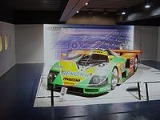
Mazda 787B

Encyclopedia
The Mazda 787 and its derivative 787B were Group C
sports prototype
racing cars
built by Mazda
for use in the World Sportscar Championship
, All Japan Sports Prototype Championship
, as well as the 24 Hours of Le Mans
from 1990 to 1991. Designed to combine a mixture of the Fédération Internationale du Sport Automobile
(FISA) Group C
regulations with the International Motor Sports Association
(IMSA) GTP
regulations, the 787s were the last Wankel rotary-powered
racing cars to compete in the World and Japanese championships, using Mazda's R26B engine.
Although the 787 and 787B lacked the single lap pace of World Championship competitors such as Mercedes-Benz
, Jaguar, and Porsche
, as well Japanese Championship competitors Nissan
and Toyota, the Mazdas had reliability which allowed them to contend for their respective championships. The reliability of the cars eventually paid off in 1991 when a 787B driven by Johnny Herbert
, Volker Weidler
, and Bertrand Gachot
went on to victory in the 1991 24 Hours of Le Mans
. This remains the only victory by a Japan
ese marque as well as the only victory by a car not using a reciprocating engine
design.
A total of two 787s were constructed in 1990, while three newer specification 787Bs were built in 1991.
and 767B designs that had been used by Mazda in 1988 and 1989. Many mechanical elements of the 767 were carried over by Nigel Stroud when he designed the 787, but with some notable exceptions. Foremost was the replacement of the 767's 13J Wankel rotary
engine. In its place, the brand new R26B was installed. The custom-built R26B featured a nearly identical layout and displacement
, but included new design elements such as continuously variable intakes and three spark plug
s per rotor instead of the 20B's two. This allowed for a maximum power output of 900 hp which was limited to 700 hp during the race for longevity. Porsche
's five-speed gearbox was retained.
Other modifications made to the 787's design included a relocation of the radiator
s. Initially placed beside the cockpit on the 767, a new single radiator was integrated into the nose of the 787. Air would flow from the blunt nose of the car, underneath the bodywork and through the radiator, before exiting at the top of the nose. A Gurney flap
was affixed to the radiator exit to increase front end downforce
. This new radiator location also meant a redesign of the doors of the car, where the old radiator design had been located. The intake in front of the door and exit behind were no longer necessary and were thus not included, giving the 787 a smoother bodywork design on top. To aid in rear engine and brake cooling, intakes were placed on the side bodywork, immediately above the exhaust cooling vents.
As before, Stroud's monocoque design was built from carbon
and kevlar
by Advanced Composite Technology in the United Kingdom. Carbon fiber body panels were affixed to the two initial chassis that were built in 1990.
controlled the action of the telescopic intake.
Three new 787Bs were built for 1991, while the two existing 787s were also upgraded with the new intakes.
(JSPC) season. For the Inter Challenge Fuji
1000 km, Mazdaspeed
entered their 787 alongside an older 767B chassis, with Yoshimi Katayama
, Dave Kennedy
, and Pierre Dieudonné in the new car. After Fuji, the second 787 chassis was completed, and the team departed for Europe to prepare for Le Mans. Tests were performed at the Silverstone Circuit
in Great Britain and Autódromo do Estoril
in Portugal to prepare the car's setups and test its endurance. A total of 2900 miles (4,667.1 km) were completed over the tests.
Former Le Mans-winner Jacky Ickx
was hired by Mazdaspeed in order to prepare the two 787s, as well as an older 767B, for the race. Driver Stefan Johansson
joined Kennedy and Dieudonné in the first car, while Bertrand Gachot
, Volker Weidler
, and Johnny Herbert
were hired for the second entry. The all-Japanese line-up of Katayama, Yojiro Terada
, and Takashi Yorino remained in the 767B. For qualifying the new 787s outpaced the older 767B, setting the 22nd and 23rd fastest lap times, ahead of the 767B's 34th fastest time.
The two 787s ran reliably for much of the race, lasting through the night until problems were encountered in the early hours of Sunday morning. While leading their GTP class, an oil leak on the #201 entry for Kennedy, Dieudonné, and Johansson forced the team to retire the car. Two hours later, the #202 787 was also retired after an electrical failure and fire. Heat from the 787's R26B powerplant would be blamed as the cause behind both failures. The sole remaining 767B, the only car remaining in its class, survived until the end of the race and earned a 20th place finish.
Following Le Mans, Mazdaspeed fully retired the remaining 767B from competition. Two 787s would be entered for the rest of the JSPC season, with the Japanese trio of drivers in one entry, and Kennedy and Dieudonné remaining in the other. Returning to Fuji, the 787s earned fifth and tenth place finishes in a 500 km event, although the fifth place finisher would later be disqualified due to a Fuel Cell which was too large. Tenth place would again be earned at the 1000 km of Suzuka, although the all-Japanese entry retired after an engine failure. A similar result occurred at Sugo
, except it was the Japanese squad which finished eleventh while the international squad had an engine failure.
To close out the season, Mazdaspeed brought a 767B out of retirement, and entered it alongside the two 787s for the final 1000 km of Fuji. The 767B was the victor of the trio, earning a sixth place finish ahead of a 787's seventh. Once again, the other 787 retired following a transmission failure. Mazdaspeed's Yoshimi Katayama earned 25th in the Driver's Championship, while Mazda itself earned fourth in the Constructor's Championship.
season for the first time, with drivers Dave Kennedy
, Maurizio Sandro-Sala, and Pierre Dieudonné assigned to the team. The French Oreca
team were put in charge of the World Championship campaign. Oreca and team consultant Jacky Ickx
were able to presuade FISA that the 787s should be allowed to run with less weight than their competitors, leading to FISA allowing the team to run the cars at 830 kg (1,830 lb) rather than the standard 1000 kg (2,205 lb) required for the C2 class.
Unlike the JSPC series, FISA had begun to integrate regulations for a new engine formula in the World Championship which required all teams to use 3500 cc engines by 1992. Cars which met these regulations in 1991 became the top C1 class, while cars with other engines, including the 787, were reclassified as C2. The C2 class cars also retained the fuel consumption formula that Group C had been founded on, while C1 cars no longer required it. This meant that Mazda now had to fight for class wins within their new class. In the JSPC however, Mazda's 787s remained in the GTP class, as the sole competitors in the category.
The year started in Japan, with Mazdaspeed entering two older 787s while the new 787Bs were being finalized. Both cars suffered problems and were uncompetitive. Attention then turned to the Suzuka Circuit
, where the debut race of the World Championship season was being run. The first new 787B chassis arrived alongside an older 787. The newer car, with Sandro-Sala and Kennedy, outqualified the older chassis driven by the all Japanese squad by only an eighth of a second, but the 787B was able to outlast several other competitors and finish in sixth overall, fourth in the C2 class, and earning Mazda points in the championship.
The 787B was retained in Japan while the European squad turned to Monza with an older 787. Yojiro Terada
and Takashi Yorino earned the new 787B another sixth place finish at the 1000 km of Fuji, while the European team finished seventh at Monza on the same day. A poor race at Silverstone added no points to Mazda's World Championship total before the team concentrated on Le Mans.
Following the team's Le Mans victory, Mazdaspeed returned to Fuji once more with a 787B, and improved their season results with a fourth place finish followed by another sixth at Suzuka A third 787B was completed by October, and the two cars finished in third and fourth places at the second 1000 km of Fuji. To end the season, the team finished in sixth at Sportsland SUGO
, earning Mazda fourth in the Consturctors' Championship, and Takashi Yorino fourteenth in the Drivers' Championship.
The European squad meanwhile continued to use the older 787, finishing in fifth at the Nürburgring
and seventh at Magny-Cours
. The Championship then flew to Mexico City where Mazda finished ninth, before the season ended back in Japan. The two 787Bs of the Japanese squad replaced the older 787, and the two cars finished in ninth and tenth places. Mazdaspeed finished fifth in the Teams' Championship, and Maurizio Sandro-Sala earned fifteenth place in the Drivers' Championship.
which was round 4 of the World Sportscar Championship
was the first time the race took place at the entirely new pit complex much to the pleasure of pit crews and drivers, after several years of having to use the notoriously cramped area, which became associated with the film of the same name
.
Mazdaspeed entered three cars and a spare, one of them was a 787 from the previous year, numbered #56, driven by Dieudonné, Yorino and Terada and two brand new 787B's. One of them was driven by Maurizio Sandro Sala who replaced the newly retired Katayama, Johansson and Kennedy numbered #18 (001) and the #55 (002) car of Weidler, Herbert and Gachot making its only appearance in its only race.
Unlike the other two cars which were painted in their standard blue stripes on white livery, #55 had an outrageous bright orange and green scheme in honour of a main sponsor, Renown, a Japanese clothing manufacturer who had been supporting the team since 1988 by providing all their clothing for the events.
The spare car was another 787 from the previous year and also qualified, but took no further part in the event.
Mazda was not the favorite to win, but the three Mazdas started on 19th (#55), 23rd (#18) and 30th (#56), despite being the 12th, 17th and 24th fastest qualifiers respectively. The new 3.5 litre cars were given the first grid positions, moving everyone else back by seven places. On the day before the race, team manager Ohashi decided to drop his usual conservative strategy and instructed the drivers of the #55 car to drive as if it were a short sprint race.
The decision was made based on the reliability of the cars demonstrated in the Paul Ricard
tests, as well as the car's exceptional fuel economy, which meant that the carefully learned driving techniques intended to preserve the fuel allowance were no longer a critical part of the team's strategy.
In the early stages of the race, the #55 car made its way to third place with the #18 car behind it 2 laps down. The #18 had a lower gear ratio setup meaning the car used less fuel but was 20 kilometre per hour slower. The #55 would by night, move into second place when the Mercedes-Benz C11
of Michael Schumacher
, Fritz Kreutzpointner
and Karl Wendlinger
spun off and later pitted with a gearbox problem. It soon became obvious that the leading car had slowed down to preserve its fuel allowance and an air of disbelief spread around the Mazda pit as it became obvious with six hours to run that there was a chance of victory.
At the 22nd hour, fate took a hand and the #55 car finally took the lead after the C11 of Alain Ferte
was forced to pit with mechanical problems. At the last pit-stop, Herbert asked to stay in the car, and went on to take the 787B across the finish line first, completing 362 laps and covering 4932.2 km ( both new records for the recently modified circuit ). The two other cars finished sixth (#18) and eighth (#56). Three Jaguar XJR-12
s and a sole Mercedes filled out positions two through five.
Herbert was so dehydrated that he had to be assisted out of the car and taken to the circuit's medical centre. As a result, he was unable to make it to the podium, leaving Weidler and Gatchot to take up the celebrations. He later commented in a magazine interview that some “dodgy” spaghetti he ate before his shift was the cause, but it is more likely that his drink bottle wasn't replenished when he chose to stay in the car for the remaining 40 minutes of the race. The replacement driver would normally carry his own bottle into the car during a changeover as they all had their own preferred drinks.
The winning car ran without a hitch apart from a blown headlamp bulb and a precautionary rear wheel bearing change on the driver's side of the car, when a regular check during a pit-stop showed it to be overheating slightly.
It seems logical that the secret behind the win was Mazda's commitment to and refinement of the same basic engine/chassis concept, including the drivers – whilst rivals Nissan and Toyota spent the era adopting and dropping new concepts, suppliers, engine configurations, drivers, and even teams.
At the end of the season, the Fédération Internationale de l'Automobile
(FIA) banned the use of Wankel-type rotary engines as a way to sway teams to the 3.5L Formula One
(F1) engines that had become their preferred platform. The 1991 24 Hours of Le Mans would be the last time the 787B would compete in international motor racing, and the last win for a car with Dunlop tires. The following year, Mazda entered the MXR-01, based on the Jaguar XJR-14
and powered by a Judd unit, without much success (placed 4th at Le Mans 1992).
Despite the success of the 787B and its Wankel powerplant, Mazda did not exploit its historic victory through marketing campaigns and advertising. However, it partially improved sales for Mazda's road cars. In the United Kingdom
, Mazda would release a special edition of its MX-5
with the racing color and also a BBR (Brodie Brittain Racing) turbo conversion; the car is one of the most sought after special edition cars of its model. Long a proponent of the rotary engine, Mazda has maintained a rotary-engined road car for many years, though sales of the Mazda RX-7
were stopped in most U.S. states in 1996 (and in Japan in 2002) until release of the 2003 Mazda RX-8
. The Mazda RX-8 utilized a new generation of the Mazda Wankel engine
, dubbed "Renesis" which uses side intake and exhaust ports.
Of the winning drivers, Herbert would have a successful career in Formula One
, notching up three wins before leaving the championship in 2000 and returning to sportscar racing. Gachot would go on to drive at Jordan Grand Prix
before being given an eighteen months prison sentence in August for a CS gas
attack on a taxi driver in London
; his place for the Belgian Grand Prix
was famously filled by newcomer Michael Schumacher. He was finally released after two months and had minor successes before retiring altogether. Weidler would compete in the Japanese Formula 3000
championship, only to have his career cut short when he was diagnosed with tinnitus
. It was recommended he should take time off to allow for an operation but he chose to retire from the sport and handed his seat over to Heinz-Harald Frentzen
. Of the non-winning drivers, Dieudonné would later hang up his helmet and become sporting director at Oreca, this time backed by Chrysler
to help the Dodge Viper
to score class wins at Le Mans by the late nineties and an overall win at the 24 Hours of Daytona
in 2000. Terada, a veteran of the race since 1974, continued to run his Autoexe tuning business. He still competed at Le Mans, although without factory backing but showing no signs of retiring. The former F1 driver, Johansson, would return to IndyCar duties frequently competing in the race before returning full time.
The R26B engine would be used by Mazda in its Mazda RX-792P
for its premier IMSA GTP
category with limited success. The engine continued to be used in the GTS category, for the spaceframe FD3S RX-7 which would return to Le Mans in 1994, backed by Mazdaspeed. The livery would return again in 1995, when a rotary powered Kudzu
, which was competing in IMSA’s WSC (World Sport Car), a category with different regulations than the FIA. This time they would start the race without the Renown sponsorship and in 1996 in the lower end LMP2 category which was the last time Mazda used the livery. Mazdaspeed would continue to compete in the race until 1999.
There are however many series that are not under the governance of the FIA, most notably Le Mans and the American Le Mans
(ALMS) and Le Mans Endurance (LMES) series. B-K Motorsport competed a Courage C65 LMP2 prototype in ALMS in 2005, powered by a Mazda tri-rotary; and painted in a yellow and blue version of the livery worn by the 787B.
Today the car is considered by Mazda and Rotary enthusiasts as one of the most iconic cars to come from Japan despite its non-Japanese origin. The 787B have been celebrated by every major toy and model company in and outside Japan. The 787B is considered as the most popular of the Group C cars and has appeared in several video games. Throughout the Gran Turismo series, the color scheme can be seen as a fictitious compilation of various Mazda paint schemes. In 2005, a factory-backed RX-8 used the Renown colors to compete in a 24 hour race at Silverstone
.
Mazda keeps the winning car at the Mazda Museum in Hiroshima
. At the same time, Mazda produced four replicas and gave one of them to the Le Mans Museum. The car usually makes appearances at the annual Sevenstock
shows, and has made two appearances at the Monterey Historics event in 1999 and 2004 and still bears a pair of small oval racing stickers behind the side windows, referring to its appearance at the 1999 Goodwood Festival of Speed
, when it was reunited and driven by Gachot.
After completing a lengthy restoration, the winning #55 787B was demonstrated during the pre-race of the 2011 24 Hours of Le Mans
. Winning driver Johnny Herbert took the 787B around the Circuit de La Sarthe for a demonstration lap.
From the Mazda Motor Museum website, it claims the engine has a maximum output of 930 hp, and a maximum redline of 10,500rpm. This setup was not used during racing for worries associated with reliability.
Group C
Group C was a category of motorsport, introduced by the FIA in 1982 for sports car racing, along with Group A for touring cars and Group B for GTs....
sports prototype
Sports prototype
A sports prototype, also referred to as simply a prototype, is a form of racing car that is used as a top category in sports car racing. These purpose-built racing cars differ from street-legal and production-based racing cars that also compete in sports car racing.Prototype racing cars have...
racing cars
Auto racing
Auto racing is a motorsport involving the racing of cars for competition. It is one of the world's most watched televised sports.-The beginning of racing:...
built by Mazda
Mazda
is a Japanese automotive manufacturer based in Fuchū, Aki District, Hiroshima Prefecture, Japan.In 2007, Mazda produced almost 1.3 million vehicles for global sales...
for use in the World Sportscar Championship
World Sportscar Championship
The World Sportscar Championship was the world series run for sports car racing by the FIA from 1953 to 1992.The championship evolved from a small collection of the most important sportscar, endurance and road racing events in Europe and North America with dozens of gentleman drivers at the grid,...
, All Japan Sports Prototype Championship
All Japan Sports Prototype Championship
The , abbreviated as JSPC, formed by the Japanese Automobile Federation, was a domestic championship which took place in Japan for Group C and IMSA GTP prototype cars and also featured cars that were eligible for touring car racing in its earlier years...
, as well as the 24 Hours of Le Mans
24 Hours of Le Mans
The 24 Hours of Le Mans is the world's oldest sports car race in endurance racing, held annually since near the town of Le Mans, France. Commonly known as the Grand Prix of Endurance and Efficiency, race teams have to balance speed against the cars' ability to run for 24 hours without sustaining...
from 1990 to 1991. Designed to combine a mixture of the Fédération Internationale du Sport Automobile
Fédération Internationale du Sport Automobile
The Fédération Internationale du Sport Automobile was the governing body for motor racing events. The organisation's origins date from 1922, when the Fédération Internationale de l'Automobile delegated the organisation of automobile racing to the CSI , an autonomous committee that would later...
(FISA) Group C
Group C
Group C was a category of motorsport, introduced by the FIA in 1982 for sports car racing, along with Group A for touring cars and Group B for GTs....
regulations with the International Motor Sports Association
International Motor Sports Association
The International Motor Sports Association is an American sports car auto racing sanctioning body based in Braselton, Georgia. It was started by John Bishop, a former employee of SCCA , and his wife Peggy in 1969 with help from Bill France, Sr...
(IMSA) GTP
IMSA GT Championship
IMSA GT was a sports car racing series organized by International Motor Sports Association. Races took place primarily in the United States and occasionally in Canada.-History:...
regulations, the 787s were the last Wankel rotary-powered
Wankel engine
The Wankel engine is a type of internal combustion engine using an eccentric rotary design to convert pressure into a rotating motion instead of using reciprocating pistons. Its four-stroke cycle takes place in a space between the inside of an oval-like epitrochoid-shaped housing and a rotor that...
racing cars to compete in the World and Japanese championships, using Mazda's R26B engine.
Although the 787 and 787B lacked the single lap pace of World Championship competitors such as Mercedes-Benz
Mercedes-Benz
Mercedes-Benz is a German manufacturer of automobiles, buses, coaches, and trucks. Mercedes-Benz is a division of its parent company, Daimler AG...
, Jaguar, and Porsche
Porsche
Porsche Automobil Holding SE, usually shortened to Porsche SE a Societas Europaea or European Public Company, is a German based holding company with investments in the automotive industry....
, as well Japanese Championship competitors Nissan
Nissan Motors
, usually shortened to Nissan , is a multinational automaker headquartered in Japan. It was a core member of the Nissan Group, but has become more independent after its restructuring under Carlos Ghosn ....
and Toyota, the Mazdas had reliability which allowed them to contend for their respective championships. The reliability of the cars eventually paid off in 1991 when a 787B driven by Johnny Herbert
Johnny Herbert
John Paul Herbert is a British racing driver from England. He competed in Formula One, winning three races, and also in sports cars winning the Le Mans 24 Hours in 1991 driving a Mazda 787B...
, Volker Weidler
Volker Weidler
Volker Weidler is a former racing driver from Germany, best known for winning the 24 Hours of Le Mans in 1991.-Formula racing:In 1985, he became German Formula Three champion....
, and Bertrand Gachot
Bertrand Gachot
Bertrand Gachot is a French-Belgian former racing driver.-Career:Gachot is the son of a French European Commission official. He began karting at the age of 15. In 1983 he attended Winfield School, a well-known racing-driving school in France. After this, he focused on his racing career, competing...
went on to victory in the 1991 24 Hours of Le Mans
1991 24 Hours of Le Mans
The 1991 24 Hours of Le Mans was the 59th Grand Prix of Endurance, and took place on June 22 and 23 1991. It was also the fourth round of the Sportscar World Championship.-Pre-race:...
. This remains the only victory by a Japan
Japan
Japan is an island nation in East Asia. Located in the Pacific Ocean, it lies to the east of the Sea of Japan, China, North Korea, South Korea and Russia, stretching from the Sea of Okhotsk in the north to the East China Sea and Taiwan in the south...
ese marque as well as the only victory by a car not using a reciprocating engine
Reciprocating engine
A reciprocating engine, also often known as a piston engine, is a heat engine that uses one or more reciprocating pistons to convert pressure into a rotating motion. This article describes the common features of all types...
design.
A total of two 787s were constructed in 1990, while three newer specification 787Bs were built in 1991.
Development
At its heart, the initial design of the 787 was an evolution of the 767Mazda 767
thumb|300px|right|Mazda 767B Central Circuit, Hyōgo PrefectureThe Mazda 767/767B were prototype racing cars built by Mazdaspeed for the 24 Hours of Le Mans running under the IMSA-spec GTP class...
and 767B designs that had been used by Mazda in 1988 and 1989. Many mechanical elements of the 767 were carried over by Nigel Stroud when he designed the 787, but with some notable exceptions. Foremost was the replacement of the 767's 13J Wankel rotary
Wankel engine
The Wankel engine is a type of internal combustion engine using an eccentric rotary design to convert pressure into a rotating motion instead of using reciprocating pistons. Its four-stroke cycle takes place in a space between the inside of an oval-like epitrochoid-shaped housing and a rotor that...
engine. In its place, the brand new R26B was installed. The custom-built R26B featured a nearly identical layout and displacement
Engine displacement
Engine displacement is the volume swept by all the pistons inside the cylinders of an internal combustion engine in a single movement from top dead centre to bottom dead centre . It is commonly specified in cubic centimeters , litres , or cubic inches...
, but included new design elements such as continuously variable intakes and three spark plug
Spark plug
A spark plug is an electrical device that fits into the cylinder head of some internal combustion engines and ignites compressed fuels such as aerosol, gasoline, ethanol, and liquefied petroleum gas by means of an electric spark.Spark plugs have an insulated central electrode which is connected by...
s per rotor instead of the 20B's two. This allowed for a maximum power output of 900 hp which was limited to 700 hp during the race for longevity. Porsche
Porsche
Porsche Automobil Holding SE, usually shortened to Porsche SE a Societas Europaea or European Public Company, is a German based holding company with investments in the automotive industry....
's five-speed gearbox was retained.
Other modifications made to the 787's design included a relocation of the radiator
Radiator (engine cooling)
Radiators are used for cooling internal combustion engines, mainly in automobiles but also in piston-engined aircraft, railway locomotives, motorcycles, stationary generating plant or any similar use of such an engine....
s. Initially placed beside the cockpit on the 767, a new single radiator was integrated into the nose of the 787. Air would flow from the blunt nose of the car, underneath the bodywork and through the radiator, before exiting at the top of the nose. A Gurney flap
Gurney flap
The Gurney Flap is a small flat tab projecting from the trailing edge of a wing. Typically it is set at a right angle to the pressure side surface of the airfoil,and projects 1% to 2% of the wing chord....
was affixed to the radiator exit to increase front end downforce
Downforce
Downforce is a downwards thrust created by the aerodynamic characteristics of a car. The purpose of downforce is to allow a car to travel faster through a corner by increasing the vertical force on the tires, thus creating more grip....
. This new radiator location also meant a redesign of the doors of the car, where the old radiator design had been located. The intake in front of the door and exit behind were no longer necessary and were thus not included, giving the 787 a smoother bodywork design on top. To aid in rear engine and brake cooling, intakes were placed on the side bodywork, immediately above the exhaust cooling vents.
As before, Stroud's monocoque design was built from carbon
Carbon fiber
Carbon fiber, alternatively graphite fiber, carbon graphite or CF, is a material consisting of fibers about 5–10 μm in diameter and composed mostly of carbon atoms. The carbon atoms are bonded together in crystals that are more or less aligned parallel to the long axis of the fiber...
and kevlar
Kevlar
Kevlar is the registered trademark for a para-aramid synthetic fiber, related to other aramids such as Nomex and Technora. Developed at DuPont in 1965, this high strength material was first commercially used in the early 1970s as a replacement for steel in racing tires...
by Advanced Composite Technology in the United Kingdom. Carbon fiber body panels were affixed to the two initial chassis that were built in 1990.
787B
Following the 1990 season, Mazda continued development of the 787 chassis in order to make improvements on its pace and reliability. One major development was the intake system for the rotaries. In the past, Mazda had developed variable length telescopic intake runners to optimize engine power and torque for varying rpms. For 1991, the system became continuously variable, rather than previous versions that had steps for different engine ranges. The 787B's onboard ECUElectronic control unit
In automotive electronics, electronic control unit is a generic term for any embedded system that controls one or more of the electrical systems or subsystems in a motor vehicle....
controlled the action of the telescopic intake.
Three new 787Bs were built for 1991, while the two existing 787s were also upgraded with the new intakes.
1990
The first 787 chassis made its competition debut in April 1990, at the second round of the All Japan Sports Prototype ChampionshipAll Japan Sports Prototype Championship
The , abbreviated as JSPC, formed by the Japanese Automobile Federation, was a domestic championship which took place in Japan for Group C and IMSA GTP prototype cars and also featured cars that were eligible for touring car racing in its earlier years...
(JSPC) season. For the Inter Challenge Fuji
Fuji Speedway
is a race track standing in the foothills of Mount Fuji, in Oyama, Suntō District, Shizuoka Prefecture, Japan. It was built in the early 1960s and hosted the first Formula One race in Japan in 1976. In the 1980s, Fuji Speedway was used for the FIA World Sportscar Championship and national racing...
1000 km, Mazdaspeed
Mazdaspeed
Mazdaspeed is Mazda's in-house race and street car tuning arm. It began in 1968 as "Mazda Sports Corner", a tuning and racing operation run by Takayoshi Ohashi, who also ran Mazda's Tokyo distributor...
entered their 787 alongside an older 767B chassis, with Yoshimi Katayama
Yoshimi Katayama
is a former Grand Prix motorcycle road racer from Japan. Katayama began his Grand Prix career in 1964 with Suzuki. He enjoyed his best season in 1967 when he won two races and finished the season in second place behind his Suzuki team-mate, Hans-Georg Anscheidt in the 50cc world championship. He...
, Dave Kennedy
Dave Kennedy
David Kennedy is a former racing driver from the Republic of Ireland. He was one of his country's first Grand Prix drivers, and is widely seen as having helped pioneer the Irish move into international racing....
, and Pierre Dieudonné in the new car. After Fuji, the second 787 chassis was completed, and the team departed for Europe to prepare for Le Mans. Tests were performed at the Silverstone Circuit
Silverstone Circuit
Silverstone Circuit is an English motor racing circuit next to the Northamptonshire villages of Silverstone and Whittlebury. The circuit straddles the Northamptonshire and Buckinghamshire border, with the current main circuit entry on the Buckinghamshire side...
in Great Britain and Autódromo do Estoril
Autódromo do Estoril
The Autódromo do Estoril is a race course in Portugal, owned by state-run holding management company Parpública. Its length is . It was the home of the Formula One Portuguese Grand Prix from 1984 to 1996....
in Portugal to prepare the car's setups and test its endurance. A total of 2900 miles (4,667.1 km) were completed over the tests.
Former Le Mans-winner Jacky Ickx
Jacky Ickx
Jacques Bernard "Jacky" Ickx is a Belgian former racing driver who achieved 25 podium finishes in Formula One and six wins in the 24 hours of Le Mans.- Racing career :...
was hired by Mazdaspeed in order to prepare the two 787s, as well as an older 767B, for the race. Driver Stefan Johansson
Stefan Johansson
Stefan Nils Edwin Johansson is a former Formula One driver from who drove for among others both Ferrari and McLaren during his Grand Prix career. Since leaving Formula One he has raced in a number of categories, including CART, various kinds of Sports car racing, and Grand Prix Masters...
joined Kennedy and Dieudonné in the first car, while Bertrand Gachot
Bertrand Gachot
Bertrand Gachot is a French-Belgian former racing driver.-Career:Gachot is the son of a French European Commission official. He began karting at the age of 15. In 1983 he attended Winfield School, a well-known racing-driving school in France. After this, he focused on his racing career, competing...
, Volker Weidler
Volker Weidler
Volker Weidler is a former racing driver from Germany, best known for winning the 24 Hours of Le Mans in 1991.-Formula racing:In 1985, he became German Formula Three champion....
, and Johnny Herbert
Johnny Herbert
John Paul Herbert is a British racing driver from England. He competed in Formula One, winning three races, and also in sports cars winning the Le Mans 24 Hours in 1991 driving a Mazda 787B...
were hired for the second entry. The all-Japanese line-up of Katayama, Yojiro Terada
Yojiro Terada
is a Japanese racing driver from Kobe, Hyogo Prefecture. He is known for holding the record for the most participations in the 24 Hours of Le Mans without winning, having run on 29 occasions since . He is also third behind Henri Pescarolo and Bob Wollek for the drivers with the most participations...
, and Takashi Yorino remained in the 767B. For qualifying the new 787s outpaced the older 767B, setting the 22nd and 23rd fastest lap times, ahead of the 767B's 34th fastest time.
The two 787s ran reliably for much of the race, lasting through the night until problems were encountered in the early hours of Sunday morning. While leading their GTP class, an oil leak on the #201 entry for Kennedy, Dieudonné, and Johansson forced the team to retire the car. Two hours later, the #202 787 was also retired after an electrical failure and fire. Heat from the 787's R26B powerplant would be blamed as the cause behind both failures. The sole remaining 767B, the only car remaining in its class, survived until the end of the race and earned a 20th place finish.
Following Le Mans, Mazdaspeed fully retired the remaining 767B from competition. Two 787s would be entered for the rest of the JSPC season, with the Japanese trio of drivers in one entry, and Kennedy and Dieudonné remaining in the other. Returning to Fuji, the 787s earned fifth and tenth place finishes in a 500 km event, although the fifth place finisher would later be disqualified due to a Fuel Cell which was too large. Tenth place would again be earned at the 1000 km of Suzuka, although the all-Japanese entry retired after an engine failure. A similar result occurred at Sugo
Sportsland SUGO
is a motorsports facility located in the town of Murata, Shibata District, Miyagi Prefecture, Japan. It opened in 1975 and is one of the largest motorsports facilities in Japan, with a total area of 2.1 million m²...
, except it was the Japanese squad which finished eleventh while the international squad had an engine failure.
To close out the season, Mazdaspeed brought a 767B out of retirement, and entered it alongside the two 787s for the final 1000 km of Fuji. The 767B was the victor of the trio, earning a sixth place finish ahead of a 787's seventh. Once again, the other 787 retired following a transmission failure. Mazdaspeed's Yoshimi Katayama earned 25th in the Driver's Championship, while Mazda itself earned fourth in the Constructor's Championship.
1991
For the 1991 season, Mazda expanded their efforts with the 787. Two cars were assigned to the JSPC series, while a third car ran the full Sportscar World ChampionshipWorld Sportscar Championship
The World Sportscar Championship was the world series run for sports car racing by the FIA from 1953 to 1992.The championship evolved from a small collection of the most important sportscar, endurance and road racing events in Europe and North America with dozens of gentleman drivers at the grid,...
season for the first time, with drivers Dave Kennedy
Dave Kennedy
David Kennedy is a former racing driver from the Republic of Ireland. He was one of his country's first Grand Prix drivers, and is widely seen as having helped pioneer the Irish move into international racing....
, Maurizio Sandro-Sala, and Pierre Dieudonné assigned to the team. The French Oreca
Oreca
Oreca is a French racing team, founded and run by Hugues de Chaunac, former team manager of F1 team AGS. Oreca has had success in many areas of motorsport including Formula Three where drivers including Alain Prost, Jacques Laffite and Jean Alesi have won the French Formula Three Championship for...
team were put in charge of the World Championship campaign. Oreca and team consultant Jacky Ickx
Jacky Ickx
Jacques Bernard "Jacky" Ickx is a Belgian former racing driver who achieved 25 podium finishes in Formula One and six wins in the 24 hours of Le Mans.- Racing career :...
were able to presuade FISA that the 787s should be allowed to run with less weight than their competitors, leading to FISA allowing the team to run the cars at 830 kg (1,830 lb) rather than the standard 1000 kg (2,205 lb) required for the C2 class.
Unlike the JSPC series, FISA had begun to integrate regulations for a new engine formula in the World Championship which required all teams to use 3500 cc engines by 1992. Cars which met these regulations in 1991 became the top C1 class, while cars with other engines, including the 787, were reclassified as C2. The C2 class cars also retained the fuel consumption formula that Group C had been founded on, while C1 cars no longer required it. This meant that Mazda now had to fight for class wins within their new class. In the JSPC however, Mazda's 787s remained in the GTP class, as the sole competitors in the category.
The year started in Japan, with Mazdaspeed entering two older 787s while the new 787Bs were being finalized. Both cars suffered problems and were uncompetitive. Attention then turned to the Suzuka Circuit
Suzuka Circuit
, Suzuka Circuit for short, is a motorsport race track located in Ino, Suzuka City, Mie Prefecture, Japan and operated by Mobilityland Corporation, the subsidiary of Honda Motor Co., Ltd..-Introduction:...
, where the debut race of the World Championship season was being run. The first new 787B chassis arrived alongside an older 787. The newer car, with Sandro-Sala and Kennedy, outqualified the older chassis driven by the all Japanese squad by only an eighth of a second, but the 787B was able to outlast several other competitors and finish in sixth overall, fourth in the C2 class, and earning Mazda points in the championship.
The 787B was retained in Japan while the European squad turned to Monza with an older 787. Yojiro Terada
Yojiro Terada
is a Japanese racing driver from Kobe, Hyogo Prefecture. He is known for holding the record for the most participations in the 24 Hours of Le Mans without winning, having run on 29 occasions since . He is also third behind Henri Pescarolo and Bob Wollek for the drivers with the most participations...
and Takashi Yorino earned the new 787B another sixth place finish at the 1000 km of Fuji, while the European team finished seventh at Monza on the same day. A poor race at Silverstone added no points to Mazda's World Championship total before the team concentrated on Le Mans.
Following the team's Le Mans victory, Mazdaspeed returned to Fuji once more with a 787B, and improved their season results with a fourth place finish followed by another sixth at Suzuka A third 787B was completed by October, and the two cars finished in third and fourth places at the second 1000 km of Fuji. To end the season, the team finished in sixth at Sportsland SUGO
Sportsland SUGO
is a motorsports facility located in the town of Murata, Shibata District, Miyagi Prefecture, Japan. It opened in 1975 and is one of the largest motorsports facilities in Japan, with a total area of 2.1 million m²...
, earning Mazda fourth in the Consturctors' Championship, and Takashi Yorino fourteenth in the Drivers' Championship.
The European squad meanwhile continued to use the older 787, finishing in fifth at the Nürburgring
Nürburgring
The Nürburgring is a motorsport complex around the village of Nürburg, Germany. It features a modern Grand Prix race track built in 1984, and a much longer old North loop track which was built in the 1920s around the village and medieval castle of Nürburg in the Eifel mountains. It is located about...
and seventh at Magny-Cours
Circuit de Nevers Magny-Cours
Circuit de Nevers Magny-Cours is a motor racing circuit located in central France, near the towns of Magny-Cours and Nevers, some 250 km from Paris...
. The Championship then flew to Mexico City where Mazda finished ninth, before the season ended back in Japan. The two 787Bs of the Japanese squad replaced the older 787, and the two cars finished in ninth and tenth places. Mazdaspeed finished fifth in the Teams' Championship, and Maurizio Sandro-Sala earned fifteenth place in the Drivers' Championship.
24 Hours of Le Mans
The 59th 24 Hours of Le Mans1991 24 Hours of Le Mans
The 1991 24 Hours of Le Mans was the 59th Grand Prix of Endurance, and took place on June 22 and 23 1991. It was also the fourth round of the Sportscar World Championship.-Pre-race:...
which was round 4 of the World Sportscar Championship
World Sportscar Championship
The World Sportscar Championship was the world series run for sports car racing by the FIA from 1953 to 1992.The championship evolved from a small collection of the most important sportscar, endurance and road racing events in Europe and North America with dozens of gentleman drivers at the grid,...
was the first time the race took place at the entirely new pit complex much to the pleasure of pit crews and drivers, after several years of having to use the notoriously cramped area, which became associated with the film of the same name
Le Mans (film)
Le Mans is a 1971 action film directed by Lee H. Katzin. Starring Steve McQueen, it features footage from the actual 1970 24 Hours of Le Mans auto race....
.
Mazdaspeed entered three cars and a spare, one of them was a 787 from the previous year, numbered #56, driven by Dieudonné, Yorino and Terada and two brand new 787B's. One of them was driven by Maurizio Sandro Sala who replaced the newly retired Katayama, Johansson and Kennedy numbered #18 (001) and the #55 (002) car of Weidler, Herbert and Gachot making its only appearance in its only race.
Unlike the other two cars which were painted in their standard blue stripes on white livery, #55 had an outrageous bright orange and green scheme in honour of a main sponsor, Renown, a Japanese clothing manufacturer who had been supporting the team since 1988 by providing all their clothing for the events.
The spare car was another 787 from the previous year and also qualified, but took no further part in the event.
Mazda was not the favorite to win, but the three Mazdas started on 19th (#55), 23rd (#18) and 30th (#56), despite being the 12th, 17th and 24th fastest qualifiers respectively. The new 3.5 litre cars were given the first grid positions, moving everyone else back by seven places. On the day before the race, team manager Ohashi decided to drop his usual conservative strategy and instructed the drivers of the #55 car to drive as if it were a short sprint race.
The decision was made based on the reliability of the cars demonstrated in the Paul Ricard
Paul Ricard
Paul Ricard was a French entrepreneur and founder of the eponymous company, which merged in 1975 with its competitor Pernod to become Pernod Ricard....
tests, as well as the car's exceptional fuel economy, which meant that the carefully learned driving techniques intended to preserve the fuel allowance were no longer a critical part of the team's strategy.
In the early stages of the race, the #55 car made its way to third place with the #18 car behind it 2 laps down. The #18 had a lower gear ratio setup meaning the car used less fuel but was 20 kilometre per hour slower. The #55 would by night, move into second place when the Mercedes-Benz C11
Mercedes-Benz C11
The Mercedes-Benz C11 was a Group C prototype race car introduced in 1990 for the World Sportscar Championship. Built by Sauber as a successor to the Sauber C9, the C11 used the same Mercedes-Benz M119 5.0L Turbocharged V8 from the C9...
of Michael Schumacher
Michael Schumacher
Michael Schumacher is a German Formula One racing driver for the Mercedes GP team. Famous for his eleven-year spell with Ferrari, Schumacher is a seven-time World Champion and is widely regarded as the greatest F1 driver of all time...
, Fritz Kreutzpointner
Fritz Kreutzpointner
Fritz Kreutzpointner is a German ex-racing driver who competed alongside Michael Schumacher and Karl Wendlinger in the 1991 24 Hours of Le Mans with Mercedes....
and Karl Wendlinger
Karl Wendlinger
Karl Wendlinger is an Austrian sportscar racing and former Formula One driver.- Mercedes Juniors :Wendlinger started his career in karting and in Formula Ford before entering the German Formula 3 Championship in 1988...
spun off and later pitted with a gearbox problem. It soon became obvious that the leading car had slowed down to preserve its fuel allowance and an air of disbelief spread around the Mazda pit as it became obvious with six hours to run that there was a chance of victory.
At the 22nd hour, fate took a hand and the #55 car finally took the lead after the C11 of Alain Ferte
Alain Ferté
Alain Ferté is a professional racing driver. He is the elder brother of Michel Ferté, who is also a professional racing driver.Alain Ferté competed five seasons in Formula 3000 1985-1989...
was forced to pit with mechanical problems. At the last pit-stop, Herbert asked to stay in the car, and went on to take the 787B across the finish line first, completing 362 laps and covering 4932.2 km ( both new records for the recently modified circuit ). The two other cars finished sixth (#18) and eighth (#56). Three Jaguar XJR-12
Jaguar XJR-12
The Jaguar XJR-12 is a sports-prototype race car built by Jaguar for both Group C and IMSA Camel GTP. The car is famous for winning the 1990 24 Hours of Le Mans....
s and a sole Mercedes filled out positions two through five.
Herbert was so dehydrated that he had to be assisted out of the car and taken to the circuit's medical centre. As a result, he was unable to make it to the podium, leaving Weidler and Gatchot to take up the celebrations. He later commented in a magazine interview that some “dodgy” spaghetti he ate before his shift was the cause, but it is more likely that his drink bottle wasn't replenished when he chose to stay in the car for the remaining 40 minutes of the race. The replacement driver would normally carry his own bottle into the car during a changeover as they all had their own preferred drinks.
The winning car ran without a hitch apart from a blown headlamp bulb and a precautionary rear wheel bearing change on the driver's side of the car, when a regular check during a pit-stop showed it to be overheating slightly.
It seems logical that the secret behind the win was Mazda's commitment to and refinement of the same basic engine/chassis concept, including the drivers – whilst rivals Nissan and Toyota spent the era adopting and dropping new concepts, suppliers, engine configurations, drivers, and even teams.
Life after Le Mans
After Le Mans, the winning car (787B-002) retired from duty while the other two cars (787B-001 and new 787B-003) continued to race. Mazda would go on to finish 4th and 5th in the Japanese and World championship respectively, with a season high (besides Le Mans) 3rd in the 1000 km Fuji race (a JSPC race). As Mazda used different drivers throughout the season, none of their drivers finished in the top 10 in points.At the end of the season, the Fédération Internationale de l'Automobile
Fédération Internationale de l'Automobile
The Fédération Internationale de l'Automobile is a non-profit association established as the Association Internationale des Automobile Clubs Reconnus on 20 June 1904 to represent the interests of motoring organisations and motor car users...
(FIA) banned the use of Wankel-type rotary engines as a way to sway teams to the 3.5L Formula One
Formula One
Formula One, also known as Formula 1 or F1 and referred to officially as the FIA Formula One World Championship, is the highest class of single seater auto racing sanctioned by the Fédération Internationale de l'Automobile . The "formula" designation in the name refers to a set of rules with which...
(F1) engines that had become their preferred platform. The 1991 24 Hours of Le Mans would be the last time the 787B would compete in international motor racing, and the last win for a car with Dunlop tires. The following year, Mazda entered the MXR-01, based on the Jaguar XJR-14
Jaguar XJR-14
The Jaguar XJR-14 was a sports-prototype racing car introduced for the 1991 World Sportscar Championship season.-Introduction:The 1991 season marked the introduction of the FIA’s new, and controversial, 3.5 Litre Formula which replaced the highly successful Group C category that had been used in...
and powered by a Judd unit, without much success (placed 4th at Le Mans 1992).
Despite the success of the 787B and its Wankel powerplant, Mazda did not exploit its historic victory through marketing campaigns and advertising. However, it partially improved sales for Mazda's road cars. In the United Kingdom
United Kingdom
The United Kingdom of Great Britain and Northern IrelandIn the United Kingdom and Dependencies, other languages have been officially recognised as legitimate autochthonous languages under the European Charter for Regional or Minority Languages...
, Mazda would release a special edition of its MX-5
Mazda MX-5
The MX-5, also known as Miata in North America and Eunos Roadster in Japan, is a lightweight two-seater roadster, of front-engine, rear-wheel drive layout, built by Mazda in Hiroshima, Japan. The model was introduced in 1989 at the Chicago Auto Show...
with the racing color and also a BBR (Brodie Brittain Racing) turbo conversion; the car is one of the most sought after special edition cars of its model. Long a proponent of the rotary engine, Mazda has maintained a rotary-engined road car for many years, though sales of the Mazda RX-7
Mazda RX-7
Series 1 is commonly referred to as the "SA22C" from the first alphanumerics of the vehicle identification number. This series of RX-7 had exposed steel bumpers and a high-mounted indentation-located license plate, called by Werner Buhrer of Road & Track magazine a "Baroque depression."In 1980...
were stopped in most U.S. states in 1996 (and in Japan in 2002) until release of the 2003 Mazda RX-8
Mazda RX-8
The Mazda RX-8 is a sports car manufactured by Mazda Motor Corporation. It first appeared in 2001 at the North American International Auto Show. It is the successor to the RX-7 and, like its predecessors in the RX range, it is powered by a Wankel engine. The RX-8 began North American sales in the...
. The Mazda RX-8 utilized a new generation of the Mazda Wankel engine
Mazda Wankel engine
The Mazda Wankel engines are family of car engines derived from experiments in the early 1960s by Felix Wankel, a German engineer...
, dubbed "Renesis" which uses side intake and exhaust ports.
Of the winning drivers, Herbert would have a successful career in Formula One
Formula One
Formula One, also known as Formula 1 or F1 and referred to officially as the FIA Formula One World Championship, is the highest class of single seater auto racing sanctioned by the Fédération Internationale de l'Automobile . The "formula" designation in the name refers to a set of rules with which...
, notching up three wins before leaving the championship in 2000 and returning to sportscar racing. Gachot would go on to drive at Jordan Grand Prix
Jordan Grand Prix
Jordan Grand Prix was a Formula One constructor that competed from 1991 to 2005. The team is named after Irish businessman and founder Eddie Jordan...
before being given an eighteen months prison sentence in August for a CS gas
CS gas
2-chlorobenzalmalononitrile is the defining component of a "tear gas" commonly referred to as CS gas, which is used as a riot control agent...
attack on a taxi driver in London
London
London is the capital city of :England and the :United Kingdom, the largest metropolitan area in the United Kingdom, and the largest urban zone in the European Union by most measures. Located on the River Thames, London has been a major settlement for two millennia, its history going back to its...
; his place for the Belgian Grand Prix
Belgian Grand Prix
The Belgian Grand Prix is an automobile race, part of the Formula One World Championship....
was famously filled by newcomer Michael Schumacher. He was finally released after two months and had minor successes before retiring altogether. Weidler would compete in the Japanese Formula 3000
Formula Nippon
Formula Nippon is a type of formula racing and the top level of single-seater racing in Japan.Formula Nippon evolved from the Japanese Formula 2000 series begun in 1973 by way of the Japanese Formula Two and Japanese Formula 3000 championships...
championship, only to have his career cut short when he was diagnosed with tinnitus
Tinnitus
Tinnitus |ringing]]") is the perception of sound within the human ear in the absence of corresponding external sound.Tinnitus is not a disease, but a symptom that can result from a wide range of underlying causes: abnormally loud sounds in the ear canal for even the briefest period , ear...
. It was recommended he should take time off to allow for an operation but he chose to retire from the sport and handed his seat over to Heinz-Harald Frentzen
Heinz-Harald Frentzen
Heinz-Harald Frentzen is a German racing driver most famous for his career in Formula One. At various times driving for Williams, Jordan, Sauber, Prost, and Arrows, he achieved three race wins before his retirement from F1 in 2003.-Early career:He was born in the West German city of...
. Of the non-winning drivers, Dieudonné would later hang up his helmet and become sporting director at Oreca, this time backed by Chrysler
Chrysler
Chrysler Group LLC is a multinational automaker headquartered in Auburn Hills, Michigan, USA. Chrysler was first organized as the Chrysler Corporation in 1925....
to help the Dodge Viper
Dodge Viper
The first prototype was tested in January 1989. It debuted in 1991 with two pre-production models as the pace car for the Indianapolis 500 when Dodge was forced to substitute it in place of the Japanese-built Stealth because of complaints from the United Auto Workers, and went on sale in January...
to score class wins at Le Mans by the late nineties and an overall win at the 24 Hours of Daytona
24 Hours of Daytona
The 24 Hours of Daytona, currently known as the Rolex 24 Daytona for sponsorship reasons, is a 24-hour sports car endurance race held annually at Daytona International Speedway in Daytona Beach, Florida. It is run on a combined road course, utilizing portions of the NASCAR tri-oval and an infield...
in 2000. Terada, a veteran of the race since 1974, continued to run his Autoexe tuning business. He still competed at Le Mans, although without factory backing but showing no signs of retiring. The former F1 driver, Johansson, would return to IndyCar duties frequently competing in the race before returning full time.
The R26B engine would be used by Mazda in its Mazda RX-792P
Mazda RX-792P
The Mazda RX-792P was a racing car built for the IMSA GT Championship's GTP category for Mazda. Its career was short lived, with only two cars running in 1992 before the project was abandoned....
for its premier IMSA GTP
International Motor Sports Association
The International Motor Sports Association is an American sports car auto racing sanctioning body based in Braselton, Georgia. It was started by John Bishop, a former employee of SCCA , and his wife Peggy in 1969 with help from Bill France, Sr...
category with limited success. The engine continued to be used in the GTS category, for the spaceframe FD3S RX-7 which would return to Le Mans in 1994, backed by Mazdaspeed. The livery would return again in 1995, when a rotary powered Kudzu
Kudzu
Kudzu is a plant in the genus Pueraria in the pea family Fabaceae, subfamily Faboideae. It is a climbing, coiling, and trailing vine native to southern Japan and southeast China. Its name comes from the Japanese name for the plant, . It is a weed that climbs over trees or shrubs and grows so...
, which was competing in IMSA’s WSC (World Sport Car), a category with different regulations than the FIA. This time they would start the race without the Renown sponsorship and in 1996 in the lower end LMP2 category which was the last time Mazda used the livery. Mazdaspeed would continue to compete in the race until 1999.
There are however many series that are not under the governance of the FIA, most notably Le Mans and the American Le Mans
American Le Mans Series
The American Le Mans Series presented by Tequila Patrón is a sports car racing series based in the United States and Canada. It consists of a series of endurance and sprint races, and was created in the spirit of the 24 Hours of Le Mans. Teams compete in one of five classes: LMP1, LMP2 and LMPC...
(ALMS) and Le Mans Endurance (LMES) series. B-K Motorsport competed a Courage C65 LMP2 prototype in ALMS in 2005, powered by a Mazda tri-rotary; and painted in a yellow and blue version of the livery worn by the 787B.
Today the car is considered by Mazda and Rotary enthusiasts as one of the most iconic cars to come from Japan despite its non-Japanese origin. The 787B have been celebrated by every major toy and model company in and outside Japan. The 787B is considered as the most popular of the Group C cars and has appeared in several video games. Throughout the Gran Turismo series, the color scheme can be seen as a fictitious compilation of various Mazda paint schemes. In 2005, a factory-backed RX-8 used the Renown colors to compete in a 24 hour race at Silverstone
Silverstone Circuit
Silverstone Circuit is an English motor racing circuit next to the Northamptonshire villages of Silverstone and Whittlebury. The circuit straddles the Northamptonshire and Buckinghamshire border, with the current main circuit entry on the Buckinghamshire side...
.
Mazda keeps the winning car at the Mazda Museum in Hiroshima
Hiroshima
is the capital of Hiroshima Prefecture, and the largest city in the Chūgoku region of western Honshu, the largest island of Japan. It became best known as the first city in history to be destroyed by a nuclear weapon when the United States Army Air Forces dropped an atomic bomb on it at 8:15 A.M...
. At the same time, Mazda produced four replicas and gave one of them to the Le Mans Museum. The car usually makes appearances at the annual Sevenstock
Sevenstock
Sevenstock is known as the largest annual gathering of Mazda rotary enthusiasts in the world. Attracting visitors from all over the globe to Southern California. The event is now held on-site at Mazda's corporate headquarters in Irvine, California...
shows, and has made two appearances at the Monterey Historics event in 1999 and 2004 and still bears a pair of small oval racing stickers behind the side windows, referring to its appearance at the 1999 Goodwood Festival of Speed
Goodwood Festival of Speed
The Goodwood Festival of Speed, commonly abbreviated as FoS and referred within the United Kingdom as simply the Festival of Speed, is an annual hill climb featuring historic motor racing vehicles that is held in the grounds of Goodwood House, West Sussex, England.Typically held in late June or...
, when it was reunited and driven by Gachot.
After completing a lengthy restoration, the winning #55 787B was demonstrated during the pre-race of the 2011 24 Hours of Le Mans
2011 24 Hours of Le Mans
The 2011 24 Hours of Le Mans was the 79th Grand Prix of Endurance, and took place on 11–12 June 2011 at the Circuit de la Sarthe, Le Mans, France, and organised by the Automobile Club de l'Ouest...
. Winning driver Johnny Herbert took the 787B around the Circuit de La Sarthe for a demonstration lap.
Chassis/Body
- Body construction: Kevlar/carbonfibre composite
- Wheels: 18 in x 12 in front/18 in x 14.75 in rear Volk Racing MagnesiumMagnesiumMagnesium is a chemical element with the symbol Mg, atomic number 12, and common oxidation number +2. It is an alkaline earth metal and the eighth most abundant element in the Earth's crust and ninth in the known universe as a whole...
AlloyAlloyAn alloy is a mixture or metallic solid solution composed of two or more elements. Complete solid solution alloys give single solid phase microstructure, while partial solutions give two or more phases that may or may not be homogeneous in distribution, depending on thermal history...
(17 in x 12 in front/17 in x 14.75 in rear) - Brakes: Carbon Industries outboard ventilated 14 inches (355.6 mm) carbon discs and calipers (BremboBremboBrembo S.p.A. is a manufacturer of automotive brake systems, especially for high-performance cars and motorcycles. It was established in Bergamo, Italy in 1961. Soon after the company was formed, it specialised in disc brakes, which were exclusively imported from the United Kingdom at the time...
steel) - Lighting: 2 Cibie headlights on each side
- Weight: c. 850 kg
Engine
- Spark plugs: 3 per rotor
- Rotors: 4
- Fuel system: Nippon Denso electronic fuel injection
- Battery: Pulsar
- Maximum Power: 700 hp/9000 rpm
- Maximum Torque: 448 ft·lbf (607.4 N·m)/6500 rpm
- Instrumentation and Telemetry System by Pi Research
From the Mazda Motor Museum website, it claims the engine has a maximum output of 930 hp, and a maximum redline of 10,500rpm. This setup was not used during racing for worries associated with reliability.