

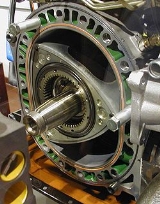
Mazda Wankel engine

Encyclopedia
The Mazda
Wankel engine
s (a type of rotary combustion engine) are family of car engines derived from experiments in the early 1960s by Felix Wankel
, a German engineer. Over the years, displacement has been increased and turbocharging has been added.
Wankel engines can be classified by their geometric size in terms of radius (rotor center to tip distance, also the median stator radius) and depth (rotor thickness), and offset (crank throw, eccentricity, also 1/4 the difference between stator's major and minor axes). These metrics function similarly to the bore and stroke
measurements of a piston engine. Displacement is 3√3radius·offset·depth, multiplied with the number of rotors (note that this only counts a single face of each rotor as the entire rotor's displacement, and is of course incorrect as there are three faces, equivalent to three piston faces, per rotor, i.e. equivalent to a three cylinder radial piston motor per rotor). Nearly all Mazda production Wankel engines share a single rotor radius, 105 mm (4.1 in), with a 15 mm (0.6 in) crankshaft
offset. The only engine to diverge from this formula was the rare 13A, which used a 120 mm (4.7 in) rotor radius and 17.5 mm (0.7 in) crankshaft offset.
Mazda rotary engines have a reputation for being relatively small and powerful at the expense of poor fuel efficiency. They are starting to become popular with kit car
builders, hot rod
ders and in light aircraft
because of their light weight, compact size, and tuning potential stemming from their inherently high power-to-weight ratio
.
In auto racing
, the displacement of a Wankel engine is usually doubled for classing purposes. This is of course a marketing ploy and wrong. Using only a single face per rotor instead of three results in the nominal displacement being a third of actual. For calculating taxes in Japan, the displacement of Wankel engines is defined as the equivalent of 1.5 times the nominal displacement, so the 1300 cc 13B engines are taxed as 1950 cc, whereas the actual displacement is 3900 cc.
When Wankel engines became commonplace in motor sport events, this created the problem of correcting the representation of each engine's displacement as provided by the manufacturer, for the benefit of competition. Rather than force the majority of participants (driving piston engine cars) to half their quoted displacement (likely resulting in confusion), most racing organizations simply decided to double the quoted displacement of Wankel engines.
KKM400. Although never produced in volume, the 40A was a valuable testbed for Mazda engineers, and quickly demonstrated two serious challenges to the feasibility of the design: "chatter marks" in the housing, and heavy oil consumption. The chatter marks, nicknamed "devil's fingernails", were caused by the tip-seal vibrating at its natural frequency. The oil consumption problem was addressed with heat-resistant rubber oil seals at the sides of the rotors. This early engine had a rotor radius of 90 mm (3.5 in), an offset of 14 mm (0.6 in), and a depth of 59 mm (2.3 in).
prototype used a 798 cc L8A two-rotor Wankel. The engine and car were both shown at the 1963 Tokyo Motor Show
. Hollow cast iron apex seals reduced vibration by changing their resonance frequency and thus eliminated chatter marks. It used dry-sump lubrication. Rotor radius was up from the 40A to 98 mm (3.9 in), but depth dropped to 56 mm (2.2 in).
One-, three-, and four-rotor derivatives of the L8A were also created for experimentation..
The rotor housing was made of sand-cast aluminum plated with chrome, while the aluminum sides were sprayed with molten carbon steel for strength. Cast iron was used for the rotors themselves, and their eccentric shafts were of expensive chrome-molybdenum steel. The addition of aluminum/carbon apex seals addressed the chatter mark problem.
The 10A featured twin side intake ports per rotor, each fed by a one of four carburetor
barrels. Only one port per rotor was used under low loads for added fuel economy. A single peripheral exhaust port routed hot gas through the coolest parts of the housing, and engine coolant flowed axially rather than the radial flow used by NSU. A bit of oil was mixed with the intake charge for lubrication.
The 0810 was modified for the racing Cosmos used at Nürburgring
. These engines had both side- and peripheral-located intake ports switched with a butterfly valve for low- and high-RPM use (respectively)
Applications:
Japanese-spec gross output was 100 hp (75 kW) at 7000 rpm and 133 Nm (98 ft·lbf) at 3500 rpm. The use of less-expensive components raised the weight of the engine from 102 kg (224 lb) to 122 kg (268 lb).
Applications:
Applications:
The 13A was used only in the 1969–1972 R130 Luce
, where it produced 126 hp (94 kW) and 172 Nm (126 ft·lbf). This was the end of the line for this engine design: the next Luce was rear wheel drive and Mazda never again made a front wheel drive rotary vehicle.
Applications:
.
In 1974, a new process was used to harden the rotor housing. The Sheet-metal Insert Process (SIP) used a sheet of steel much like a conventional piston engine cylinder liner with a chrome plated surface. The side housing coating was also changed to eliminate the troublesome sprayed metal. The new "REST" process created such a strong housing, the old carbon seals could be abandoned in favor of conventional cast iron.
Early 12A engines also feature a thermal reactor, similar to the 0866 10A, and some use an exhaust port insert to reduce exhaust noise. A lean-burn version was introduced in 1979 (in Japan) and 1980 (in America) which substituted a more-conventional catalytic converter
for this "afterburner". A major modification of the 12A architecture was the 6PI which featured variable induction ports.
Applications:
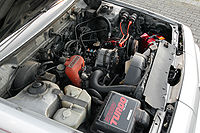 The ultimate 12A engine was the turbocharged and fuel injected engine used in the Japan-spec HB series Cosmo
, Luce
, and SA series RX-7
. In 1982 a 12A turbo powered Cosmo coupe was officially the fastest production car in Japan. It featured "semi-direct injection
" into both rotors at once, a technique that was much more successful than it would appear. A passive knock sensor was used to eliminate knocking
, and later models featured a specially-designed "Impact Turbo" which was tweaked for the unique exhaust signature of the Wankel engine for a 5 horsepower increase. The engine continued until 1989 in the HB Cosmo series but by that stage it had grown a reputation as a thirsty engine.
Output of the Impact Turbo version was 165 hp (123 kW) at 6000 rpm and 231 Nm (170 ft·lbf) at 4000 rpm.
Applications:
The improved 12B was quietly introduced in 1974.
Applications:
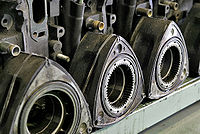 The 13B is the most widely produced engine. It was the basis for all future Mazda Wankel engines, and was produced for over 30 years. The 13B has no relation to the 13A. Instead, it is a lengthened version of the 12A, having 80 mm (3.1 in) thick rotors. Each rotor had a displacement of 654 cc, for a total of 1308 cc displacement in the engine.
In the United States, the 13B was available from 1974 through 1978 and was then retired until the 1984 RX-7 GSL-SE. It disappeared from the US market again in 1995, when the last US-spec RX-7s were sold. The engine was continually used in Japan from 1972's Mazda Luce
/RX-4
through 2002's RX-7.
Applications:
-like effect from the Helmholtz resonance
of the opening and closing intake ports. The RESI engine also featured Bosch
L-Jetronic fuel injection
. Output was much improved at 135 hp (101 kW) and 180 N·m (133 ft·lbf).
Applications:
. Total output is up to 146 hp (109 kW) at 6500 rpm and 187 N·m (138 ft·lbf) at 3500 rpm.
The 13B-DEI was turbocharged in 1986. It features the newer four-injector fuel injection
of the 6PI engine, but lacks that engine's eponymous variable intake system. In '86-'88 engines the twin-scroll turbocharger is fed using a two-stage mechanically actuated valve, however on '89-'91 engines a better turbo design was used with a divided manifold powering the twin-scroll configuration. For engines manufactured between '86-'88 output is rated at 185 hp (138 kW) at 6500 rpm and 248 N·m (183 ft·lbf) at 3500 rpm.
Applications:
Applications:
Compared to the twin turbos fitted to the 13B-REW on the FD RX-7, these sequential turbos received a large (HT-15) primary with a smaller (HT-10) secondary turbo. Injector sizes = 550cc PRI + SEC.
Approximately 5000 13B-RE optioned JC Cosmos were sold making this engine almost as hard to source as its rarer 20B-REW big-brother..
Applications:
A twin-turbocharged version of the 13B, the 13B-REW, became famous for its high output and low weight. The twin Hitachi HT-12 turbos were operated sequentially, with the primary providing boost until 4,500 rpm, and the secondary coming online afterwards. Output eventually reached, and may have exceeded, Japan's unofficial maximum of 280 DIN
hp (206 kW) for the final revision used in the series 8 Mazda RX-7.
Applications:
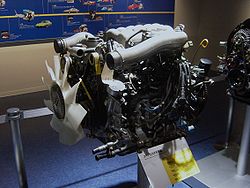
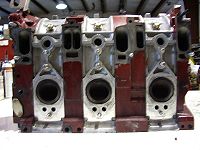 In Le Mans
racing, the first three-rotor engine used in the 757
was named the 13G.
The main difference between the 13G and 20B is that the 13G uses a factory peripheral intake port (used for racing) and the 20B (Three Rotor Engine) uses side intake ports.
It was renamed 20B after Mazda's naming convention for the 767
in November 1987.
The three-rotor 20B-REW was only used in the 1990-1995 Eunos Cosmo. It was the world's first volume production twin-turbo setup featured in both 13B-REW & 20B-REW form. It displaced 1962 cc (three 654 cc rotors) and used 0.7 bars (70 kPa) of turbo pressure to produce 300 hp and 407 newton metres (300 ft·lbf).
A version of the 20B known as the "R20B RENESIS 3 Rotor Engine" was built by Racing Beat in the U.S.A for the Mazda Furai concept car which was released on 27 December 2007. The engine was designed to run on E100 ethanol fuel.
Le Mans
Group C racers. This motor was poorly designed, and was replaced by the 26B.
and 787B
) in replacement of the older 13J. In 1991
the 26B-powered Mazda 787B became the first Japanese car and the first car with anything other than a reciprocating engine to win the 24 Hours of Le Mans
race outright. It is still so far the only car to hold these distinctions. The 26B engine displaced 2622 cc and developed 700 hp (522 kW) at 9000 rpm. The engine design utilizes peripheral intake ports, continually variable geometry intakes, and an additional (third) spark plug per rotor.
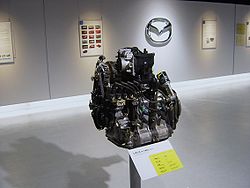 The Renesis engine – also 13B-MSP (Multi Side Port) – which first appeared in production in the 2004 Mazda RX-8
, is an evolution of the previous 13B. It was designed to reduce exhaust emission and improve fuel economy, which were two of the most recurrent drawbacks of rotary engines. Unlike its predecessors from the 13B range, it is naturally aspirated, and therefore less powerful than Mazda RX-7
's 13B-REW (280 hp), which is twin-turbocharged .
The Renesis design features two major changes from its predecessors. First, the exhaust ports are no longer peripheral but are located on the side of the housing, which eliminates overlap and allows redesign of the intake port area. This produced noticeably more power, thanks to a better compression ratio. Second, the rotors are shaped differently, especially their side seals and low-height apex seals, which offer optimized lubrication.
These and other innovative technologies allow the Renesis to achieve 49% higher output and dramatically reduced fuel consumption and emissions (the RX-8 meets LEV-II). It won International Engine of the Year
and Best New Engine awards 2003 and also holds the "2.5 to 3 liter" (note that the engine itself is 1.3 liter) size award for 2003 and 2004, where it is considered a 2.6 L engine. Finally, it was on the Ward's 10 Best Engines
list for 2004 and 2005.
The Renesis has also been adapted for a dual-fuel use, allowing it to run on gasoline or hydrogen.
All the Mazda rotary engines have been praised, because of their light weight. The unmodified 13B-MSP Renesis Engine has a weight of 122 kg (247 lbs), including all standard attachments (except airbox), but without engine fluids (such as coolant, oil, etc.).
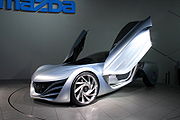 Also known as the Renesis (2), made its first (and so far only) appearance in the Mazda Taiki
concept car
at the 2007 Tokyo Auto Show, but has not been seen since then. It featured a lengthened stroke, reduced width rotor housing, direct injection, and aluminum side housings. The 16X Renesis rotary engine is said to be capable of up to 350 hp. Media reports say that the "16X" engine has been put aside because of engineering and budgetary reasons.
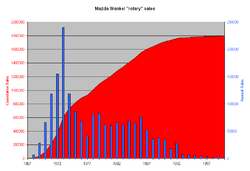 Mazda was fully committed to the Wankel engine just as the energy crisis
of the 1970s struck. The company had all but eliminated piston engines from its products in 1974, a decision that nearly led to the company's collapse. A switch to a three-prong approach (piston-gasoline, piston-Diesel
, and Wankel) for the 1980s relegated the Wankel to sports car
use (in the RX-7
and Cosmo
), severely limiting production volume. But the company had continued production continually since the mid-1960s, and was the only maker of Wankel-powered cars when (the RX-8
) was discontinued from production in August 2011.
Though not reflected in the graph at right, the RX-8 was a higher-volume car than its predecessors. Sales of the RX-8 peaked in 2004 at 23,690, but continued to decline through 2011, when less than 1000 were produced.
On October 7th, 2011 Mazda announced 2012 would be the final year of production of the rotary engine.
Mazda
is a Japanese automotive manufacturer based in Fuchū, Aki District, Hiroshima Prefecture, Japan.In 2007, Mazda produced almost 1.3 million vehicles for global sales...
Wankel engine
Wankel engine
The Wankel engine is a type of internal combustion engine using an eccentric rotary design to convert pressure into a rotating motion instead of using reciprocating pistons. Its four-stroke cycle takes place in a space between the inside of an oval-like epitrochoid-shaped housing and a rotor that...
s (a type of rotary combustion engine) are family of car engines derived from experiments in the early 1960s by Felix Wankel
Felix Wankel
Felix Heinrich Wankel was a German mechanical engineer and inventor after whom the Wankel engine was named. He is the only twentieth century engineer to have designed an internal combustion engine which went into production.-Early life:Wankel was born in Lahr, Baden, in the upper Rhine Valley...
, a German engineer. Over the years, displacement has been increased and turbocharging has been added.
Wankel engines can be classified by their geometric size in terms of radius (rotor center to tip distance, also the median stator radius) and depth (rotor thickness), and offset (crank throw, eccentricity, also 1/4 the difference between stator's major and minor axes). These metrics function similarly to the bore and stroke
Engine displacement
Engine displacement is the volume swept by all the pistons inside the cylinders of an internal combustion engine in a single movement from top dead centre to bottom dead centre . It is commonly specified in cubic centimeters , litres , or cubic inches...
measurements of a piston engine. Displacement is 3√3radius·offset·depth, multiplied with the number of rotors (note that this only counts a single face of each rotor as the entire rotor's displacement, and is of course incorrect as there are three faces, equivalent to three piston faces, per rotor, i.e. equivalent to a three cylinder radial piston motor per rotor). Nearly all Mazda production Wankel engines share a single rotor radius, 105 mm (4.1 in), with a 15 mm (0.6 in) crankshaft
Crankshaft
The crankshaft, sometimes casually abbreviated to crank, is the part of an engine which translates reciprocating linear piston motion into rotation...
offset. The only engine to diverge from this formula was the rare 13A, which used a 120 mm (4.7 in) rotor radius and 17.5 mm (0.7 in) crankshaft offset.
Mazda rotary engines have a reputation for being relatively small and powerful at the expense of poor fuel efficiency. They are starting to become popular with kit car
Kit car
A kit car, also known as a "component car", is an automobile that is available as a set of parts that a manufacturer sells and the buyer then either assembles into a car themselves, or retains a third party to do part or all of the work on their behalf...
builders, hot rod
Hot rod
Hot rods are typically American cars with large engines modified for linear speed. The origin of the term "hot rod" is unclear. One explanation is that the term is a contraction of "hot roadster," meaning a roadster that was modified for speed. Another possible origin includes modifications to or...
ders and in light aircraft
Light aircraft
A light aircraft is an aircraft that has a maximum gross take-off weight of or less.Many aircraft used commercially for freight, sightseeing, photography and scheduled flights are light aircraft.Examples of light aircraft include:...
because of their light weight, compact size, and tuning potential stemming from their inherently high power-to-weight ratio
Power-to-weight ratio
Power-to-weight ratio is a calculation commonly applied to engines and mobile power sources to enable the comparison of one unit or design to another. Power-to-weight ratio is a measurement of actual performance of any engine or power sources...
.
In auto racing
Auto racing
Auto racing is a motorsport involving the racing of cars for competition. It is one of the world's most watched televised sports.-The beginning of racing:...
, the displacement of a Wankel engine is usually doubled for classing purposes. This is of course a marketing ploy and wrong. Using only a single face per rotor instead of three results in the nominal displacement being a third of actual. For calculating taxes in Japan, the displacement of Wankel engines is defined as the equivalent of 1.5 times the nominal displacement, so the 1300 cc 13B engines are taxed as 1950 cc, whereas the actual displacement is 3900 cc.
When Wankel engines became commonplace in motor sport events, this created the problem of correcting the representation of each engine's displacement as provided by the manufacturer, for the benefit of competition. Rather than force the majority of participants (driving piston engine cars) to half their quoted displacement (likely resulting in confusion), most racing organizations simply decided to double the quoted displacement of Wankel engines.
40A
Mazda's first prototype Wankel was the 40A, a single-rotor engine very much like the NSUNSU Motorenwerke AG
NSU Motorenwerke AG, normally just NSU, was a German manufacturer of automobiles, motorcycles and pedal cycles, founded in 1873. It was acquired by Volkswagen Group in 1969...
KKM400. Although never produced in volume, the 40A was a valuable testbed for Mazda engineers, and quickly demonstrated two serious challenges to the feasibility of the design: "chatter marks" in the housing, and heavy oil consumption. The chatter marks, nicknamed "devil's fingernails", were caused by the tip-seal vibrating at its natural frequency. The oil consumption problem was addressed with heat-resistant rubber oil seals at the sides of the rotors. This early engine had a rotor radius of 90 mm (3.5 in), an offset of 14 mm (0.6 in), and a depth of 59 mm (2.3 in).
L8A
The very first Mazda CosmoMazda Cosmo
There have been four generations of Mazda automobiles which went by the name of Cosmo, although they are not all particularly related. All were Grand tourers, with the first proving a successful launch for the Mazda Wankel engine and acting as a "halo" vehicle for the new Mazda brand...
prototype used a 798 cc L8A two-rotor Wankel. The engine and car were both shown at the 1963 Tokyo Motor Show
Tokyo Motor Show
The is a biennial auto show held in October-November at the Makuhari Messe, Chiba City, Japan for cars, motorcycles and commercial vehicles. Hosted by the Japan Automobile Manufacturers Association , it is a recognized international show by the Organisation Internationale des Constructeurs...
. Hollow cast iron apex seals reduced vibration by changing their resonance frequency and thus eliminated chatter marks. It used dry-sump lubrication. Rotor radius was up from the 40A to 98 mm (3.9 in), but depth dropped to 56 mm (2.2 in).
One-, three-, and four-rotor derivatives of the L8A were also created for experimentation..
10A
The 10A series was Mazda's first production Wankel, appearing in 1965. It was a two-rotor design, with each displacing 491 cc for a total of 982 cc. These engine featured the mainstream rotor dimensions with a 60 mm (2.4 in) depth.The rotor housing was made of sand-cast aluminum plated with chrome, while the aluminum sides were sprayed with molten carbon steel for strength. Cast iron was used for the rotors themselves, and their eccentric shafts were of expensive chrome-molybdenum steel. The addition of aluminum/carbon apex seals addressed the chatter mark problem.
0810
The first 10A engine was the 0810, used in the Series I Cosmo from May, 1965 through July, 1968. These cars, and their revolutionary engine, were often called L10A models. Gross output was 110 hp (82 kW) at 7000 rpm and 130 Nm (96 ft·lbf) at 3500 rpm, but both numbers were probably optimistic.The 10A featured twin side intake ports per rotor, each fed by a one of four carburetor
Carburetor
A carburetor , carburettor, or carburetter is a device that blends air and fuel for an internal combustion engine. It is sometimes shortened to carb in North America and the United Kingdom....
barrels. Only one port per rotor was used under low loads for added fuel economy. A single peripheral exhaust port routed hot gas through the coolest parts of the housing, and engine coolant flowed axially rather than the radial flow used by NSU. A bit of oil was mixed with the intake charge for lubrication.
The 0810 was modified for the racing Cosmos used at Nürburgring
Nürburgring
The Nürburgring is a motorsport complex around the village of Nürburg, Germany. It features a modern Grand Prix race track built in 1984, and a much longer old North loop track which was built in the 1920s around the village and medieval castle of Nürburg in the Eifel mountains. It is located about...
. These engines had both side- and peripheral-located intake ports switched with a butterfly valve for low- and high-RPM use (respectively)
Applications:
- 1965–1968 Mazda Cosmo Series I/L10A
0813
The improved 0813 engine appeared in July, 1968 in the Series II/L10B Cosmo. Its construction was very similar to the 0810.Japanese-spec gross output was 100 hp (75 kW) at 7000 rpm and 133 Nm (98 ft·lbf) at 3500 rpm. The use of less-expensive components raised the weight of the engine from 102 kg (224 lb) to 122 kg (268 lb).
Applications:
- 1968–1973 Mazda R100/Familia RotaryMazda R100The Mazda R100 was the export name for the Mazda Familia Rotary Coupe, an automobile produced by Mazda in Japan from 1968 to 1973. It used the chassis from the Familia and the rotary 0820 engine similar to the one used in the Cosmo Sport Series II. It was a 2 door 2+2 coupé and was produced from...
0866
The final member of the 10A family was the 1971 0866. This variant featured a cast-iron thermal reactor to reduce exhaust emissions and re-tuned exhaust ports. The die-cast rotor housing was now coated with a new process: The new Transplant Coating Process (TCP) featured sprayed-on steel which is then coated with chrome. Gross output was 105 hp (78 kW) at 7000 rpm and 135 Nm (99.5 ft·lbf) at 3500 rpm.Applications:
- 1972–1974 Mazda RX-3Mazda RX-3The Mazda RX-3 is an automobile sold in the 1970s. It was intended to be smaller and sportier than its brother, the RX-2/Capella Rotary. In 1972 all rotary engines had their die-cast rotor housing coated with a new process: The new Transplant Coating Process featured sprayed-on steel which is...
(Japan-spec)
13A
The 13A was designed especially for front wheel drive applications. It had two 655 cc rotors for a total of 1310 cc. This was the only production Mazda Wankel with different rotor dimensions: Radius was 120 mm (4.7 in) and offset was 17.5 mm (0.7 in), but depth remained the same as the 10A at 60 mm (2.4 in). Another major difference from the previous engines was the integrated water-cooled oil cooler.The 13A was used only in the 1969–1972 R130 Luce
Mazda Luce
Mazda used the Luce name on its largest sedans in Japan from 1969 until 1990. These vehicles were exported under a variety of names, including RX-4, 929, and Cosmo. The Luce nameplate was replaced by the Mazda Sentia name in 1991...
, where it produced 126 hp (94 kW) and 172 Nm (126 ft·lbf). This was the end of the line for this engine design: the next Luce was rear wheel drive and Mazda never again made a front wheel drive rotary vehicle.
Applications:
- 1970–1972 Mazda R130
12A
The 12A is an "elongated" version of the 10A — the rotor radius was the same, but the depth was increased by 10 mm (0.4 in) to 70 mm (2.8 in). Each of its two rotors displaced 573 cc for a total of 1146 cc. The 12A series was produced for 15 years, from May 1970 through 1985. In 1974, a 12A became the first engine built outside of western Europe or the U.S to finish the 24 hours of Le Mans24 Hours of Le Mans
The 24 Hours of Le Mans is the world's oldest sports car race in endurance racing, held annually since near the town of Le Mans, France. Commonly known as the Grand Prix of Endurance and Efficiency, race teams have to balance speed against the cars' ability to run for 24 hours without sustaining...
.
In 1974, a new process was used to harden the rotor housing. The Sheet-metal Insert Process (SIP) used a sheet of steel much like a conventional piston engine cylinder liner with a chrome plated surface. The side housing coating was also changed to eliminate the troublesome sprayed metal. The new "REST" process created such a strong housing, the old carbon seals could be abandoned in favor of conventional cast iron.
Early 12A engines also feature a thermal reactor, similar to the 0866 10A, and some use an exhaust port insert to reduce exhaust noise. A lean-burn version was introduced in 1979 (in Japan) and 1980 (in America) which substituted a more-conventional catalytic converter
Catalytic converter
A catalytic converter is a device used to convert toxic exhaust emissions from an internal combustion engine into non-toxic substances. Inside a catalytic converter, a catalyst stimulates a chemical reaction in which noxious byproducts of combustion are converted to less toxic substances by dint...
for this "afterburner". A major modification of the 12A architecture was the 6PI which featured variable induction ports.
Applications:
- 1970–1972 Mazda R100Mazda R100The Mazda R100 was the export name for the Mazda Familia Rotary Coupe, an automobile produced by Mazda in Japan from 1968 to 1973. It used the chassis from the Familia and the rotary 0820 engine similar to the one used in the Cosmo Sport Series II. It was a 2 door 2+2 coupé and was produced from...
- 1970–1974 Mazda RX-2Mazda RX-2The Mazda RX-2 was a midsize car introduced in 1970 and sold through 1978. It used a rotary engine and shared a chassis with the piston-engined Mazda Capella/616/618....
, 130 hp (97 kW) and 156 Nm (115 ft·lbf) - 1972–1974 Mazda RX-3Mazda RX-3The Mazda RX-3 is an automobile sold in the 1970s. It was intended to be smaller and sportier than its brother, the RX-2/Capella Rotary. In 1972 all rotary engines had their die-cast rotor housing coated with a new process: The new Transplant Coating Process featured sprayed-on steel which is...
(Japan), 110 hp (82 kW) and 135 Nm (100 ft·lbf) - 1972–1974 Mazda RX-4Mazda RX-4The Mazda RX-4 is an automobile sold in the 1970s. It was a larger car than its rotary-powered contemporaries, the Capella-based RX-2 and Familia-based RX-3. It shared the Luce/929 chassis, replacing the R130 in October 1972, and was produced through October 1977...
- 1972–1980 Mazda LuceMazda LuceMazda used the Luce name on its largest sedans in Japan from 1969 until 1990. These vehicles were exported under a variety of names, including RX-4, 929, and Cosmo. The Luce nameplate was replaced by the Mazda Sentia name in 1991...
- 1978–1979 Mazda RX-7Mazda RX-7Series 1 is commonly referred to as the "SA22C" from the first alphanumerics of the vehicle identification number. This series of RX-7 had exposed steel bumpers and a high-mounted indentation-located license plate, called by Werner Buhrer of Road & Track magazine a "Baroque depression."In 1980...
, 100 hp (75 kW) - Lean-burn
- 1979–1985 Mazda RX-7Mazda RX-7Series 1 is commonly referred to as the "SA22C" from the first alphanumerics of the vehicle identification number. This series of RX-7 had exposed steel bumpers and a high-mounted indentation-located license plate, called by Werner Buhrer of Road & Track magazine a "Baroque depression."In 1980...
(Japan) - 1980–1985 Mazda RX-7Mazda RX-7Series 1 is commonly referred to as the "SA22C" from the first alphanumerics of the vehicle identification number. This series of RX-7 had exposed steel bumpers and a high-mounted indentation-located license plate, called by Werner Buhrer of Road & Track magazine a "Baroque depression."In 1980...
(USA)
- 1979–1985 Mazda RX-7
- 6PI
- 1981–1985 Mazda LuceMazda LuceMazda used the Luce name on its largest sedans in Japan from 1969 until 1990. These vehicles were exported under a variety of names, including RX-4, 929, and Cosmo. The Luce nameplate was replaced by the Mazda Sentia name in 1991...
- 1981–1985 Mazda CosmoMazda CosmoThere have been four generations of Mazda automobiles which went by the name of Cosmo, although they are not all particularly related. All were Grand tourers, with the first proving a successful launch for the Mazda Wankel engine and acting as a "halo" vehicle for the new Mazda brand...
- 1981–1985 Mazda Luce
Turbo
Mazda Cosmo
There have been four generations of Mazda automobiles which went by the name of Cosmo, although they are not all particularly related. All were Grand tourers, with the first proving a successful launch for the Mazda Wankel engine and acting as a "halo" vehicle for the new Mazda brand...
, Luce
Mazda Luce
Mazda used the Luce name on its largest sedans in Japan from 1969 until 1990. These vehicles were exported under a variety of names, including RX-4, 929, and Cosmo. The Luce nameplate was replaced by the Mazda Sentia name in 1991...
, and SA series RX-7
Mazda RX-7
Series 1 is commonly referred to as the "SA22C" from the first alphanumerics of the vehicle identification number. This series of RX-7 had exposed steel bumpers and a high-mounted indentation-located license plate, called by Werner Buhrer of Road & Track magazine a "Baroque depression."In 1980...
. In 1982 a 12A turbo powered Cosmo coupe was officially the fastest production car in Japan. It featured "semi-direct injection
Gasoline direct injection
In internal combustion engines, gasoline direct injection , also known as petrol direct injection or direct petrol injection, is a variant of fuel injection employed in modern two-stroke and four-stroke gasoline engines...
" into both rotors at once, a technique that was much more successful than it would appear. A passive knock sensor was used to eliminate knocking
Engine knocking
Knocking in spark-ignition internal combustion engines occurs when combustion of the air/fuel mixture in the cylinder starts off correctly in response to ignition by the spark plug, but one or more pockets of air/fuel mixture explode outside the envelope of the normal combustion front.The...
, and later models featured a specially-designed "Impact Turbo" which was tweaked for the unique exhaust signature of the Wankel engine for a 5 horsepower increase. The engine continued until 1989 in the HB Cosmo series but by that stage it had grown a reputation as a thirsty engine.
Output of the Impact Turbo version was 165 hp (123 kW) at 6000 rpm and 231 Nm (170 ft·lbf) at 4000 rpm.
Applications:
- 1982–1989 Mazda CosmoMazda CosmoThere have been four generations of Mazda automobiles which went by the name of Cosmo, although they are not all particularly related. All were Grand tourers, with the first proving a successful launch for the Mazda Wankel engine and acting as a "halo" vehicle for the new Mazda brand...
- 1982–1985 Mazda LuceMazda LuceMazda used the Luce name on its largest sedans in Japan from 1969 until 1990. These vehicles were exported under a variety of names, including RX-4, 929, and Cosmo. The Luce nameplate was replaced by the Mazda Sentia name in 1991...
- 1984–1985 Mazda RX-7Mazda RX-7Series 1 is commonly referred to as the "SA22C" from the first alphanumerics of the vehicle identification number. This series of RX-7 had exposed steel bumpers and a high-mounted indentation-located license plate, called by Werner Buhrer of Road & Track magazine a "Baroque depression."In 1980...
12B
The 12B was a short lived engine that was produced for the Mazda RX-2, and the RX-3. It had increased reliability from previous series, and it introduced a single distributor. This was the beginning of the single distributor rotary engines, before that, the 12A and 10A were both twin distributors wankels.The improved 12B was quietly introduced in 1974.
Applications:
- 1974–1978 Mazda RX-2Mazda RX-2The Mazda RX-2 was a midsize car introduced in 1970 and sold through 1978. It used a rotary engine and shared a chassis with the piston-engined Mazda Capella/616/618....
- 1974–1978 Mazda RX-3Mazda RX-3The Mazda RX-3 is an automobile sold in the 1970s. It was intended to be smaller and sportier than its brother, the RX-2/Capella Rotary. In 1972 all rotary engines had their die-cast rotor housing coated with a new process: The new Transplant Coating Process featured sprayed-on steel which is...
13B
In the United States, the 13B was available from 1974 through 1978 and was then retired until the 1984 RX-7 GSL-SE. It disappeared from the US market again in 1995, when the last US-spec RX-7s were sold. The engine was continually used in Japan from 1972's Mazda Luce
Mazda Luce
Mazda used the Luce name on its largest sedans in Japan from 1969 until 1990. These vehicles were exported under a variety of names, including RX-4, 929, and Cosmo. The Luce nameplate was replaced by the Mazda Sentia name in 1991...
/RX-4
Mazda RX-4
The Mazda RX-4 is an automobile sold in the 1970s. It was a larger car than its rotary-powered contemporaries, the Capella-based RX-2 and Familia-based RX-3. It shared the Luce/929 chassis, replacing the R130 in October 1972, and was produced through October 1977...
through 2002's RX-7.
AP
The 13B was designed with both high performance and low emissions in mind. Early vehicles using this engine used the AP name.Applications:
- 1975–1980 Mazda Cosmo APMazda CosmoThere have been four generations of Mazda automobiles which went by the name of Cosmo, although they are not all particularly related. All were Grand tourers, with the first proving a successful launch for the Mazda Wankel engine and acting as a "halo" vehicle for the new Mazda brand...
- 1974–1977 Mazda Rotary PickupMazda B-SeriesThe Mazda B-Series is a pickup truck, first manufactured in 1961 by Mazda Motor Corporation. From the first B-Series, Mazda has used the engine displacement to determine the name. Thus, the B1500 had a 1.5 L engine and the B2600 had a 2.6 L engine...
- 1975–1977 Mazda RoadpacerMazda RoadpacerThe Mazda Roadpacer AP is a full-size sedan that was sold by Mazda Motor Corp. of Japan between 1975 and 1977. It was based on the Australian Holden HJ and HX series Premier. Premiers were shipped to Japan without engines, and Mazda fitted a 1.3-liter 13B Wankel engine into the bay...
- 1973–1978 Mazda RX-4Mazda RX-4The Mazda RX-4 is an automobile sold in the 1970s. It was a larger car than its rotary-powered contemporaries, the Capella-based RX-2 and Familia-based RX-3. It shared the Luce/929 chassis, replacing the R130 in October 1972, and was produced through October 1977...
- 1975–1980 RX-5
13B-RESI
A tuned intake manifold was used in a Wankel engine for the first time with the 13B-RESI. RESI = Rotary Engine Super Injection. The so-called Dynamic Effect Intake featured a two-level intake box which derived a superchargerSupercharger
A supercharger is an air compressor used for forced induction of an internal combustion engine.The greater mass flow-rate provides more oxygen to support combustion than would be available in a naturally aspirated engine, which allows more fuel to be burned and more work to be done per cycle,...
-like effect from the Helmholtz resonance
Helmholtz resonance
Helmholtz resonance is the phenomenon of air resonance in a cavity, such as when one blows across the top of an empty bottle. The name comes from a device created in the 1850s by Hermann von Helmholtz, the "Helmholtz resonator", which he, the author of the classic study of acoustic science, used to...
of the opening and closing intake ports. The RESI engine also featured Bosch
Robert Bosch GmbH
Robert Bosch GmbH is a multinational engineering and electronics company headquartered in Gerlingen, near Stuttgart, Germany. It is the world's largest supplier of automotive components...
L-Jetronic fuel injection
Fuel injection
Fuel injection is a system for admitting fuel into an internal combustion engine. It has become the primary fuel delivery system used in automotive petrol engines, having almost completely replaced carburetors in the late 1980s....
. Output was much improved at 135 hp (101 kW) and 180 N·m (133 ft·lbf).
Applications:
- 1984–1985 Mazda HB LuceMazda LuceMazda used the Luce name on its largest sedans in Japan from 1969 until 1990. These vehicles were exported under a variety of names, including RX-4, 929, and Cosmo. The Luce nameplate was replaced by the Mazda Sentia name in 1991...
- 1984–1985 Mazda HB CosmoMazda CosmoThere have been four generations of Mazda automobiles which went by the name of Cosmo, although they are not all particularly related. All were Grand tourers, with the first proving a successful launch for the Mazda Wankel engine and acting as a "halo" vehicle for the new Mazda brand...
- 1984–1985 Mazda FB RX-7Mazda RX-7Series 1 is commonly referred to as the "SA22C" from the first alphanumerics of the vehicle identification number. This series of RX-7 had exposed steel bumpers and a high-mounted indentation-located license plate, called by Werner Buhrer of Road & Track magazine a "Baroque depression."In 1980...
GSL-SE
13B-DEI
Like the 12A-SIP, the second-generation RX-7 bowed with a variable-intake system. Dubbed DEI, the engine features both the 6PI and DEI systems, as well as four-injector electronic fuel injectionFuel injection
Fuel injection is a system for admitting fuel into an internal combustion engine. It has become the primary fuel delivery system used in automotive petrol engines, having almost completely replaced carburetors in the late 1980s....
. Total output is up to 146 hp (109 kW) at 6500 rpm and 187 N·m (138 ft·lbf) at 3500 rpm.
The 13B-DEI was turbocharged in 1986. It features the newer four-injector fuel injection
Fuel injection
Fuel injection is a system for admitting fuel into an internal combustion engine. It has become the primary fuel delivery system used in automotive petrol engines, having almost completely replaced carburetors in the late 1980s....
of the 6PI engine, but lacks that engine's eponymous variable intake system. In '86-'88 engines the twin-scroll turbocharger is fed using a two-stage mechanically actuated valve, however on '89-'91 engines a better turbo design was used with a divided manifold powering the twin-scroll configuration. For engines manufactured between '86-'88 output is rated at 185 hp (138 kW) at 6500 rpm and 248 N·m (183 ft·lbf) at 3500 rpm.
Applications:
- 1986–1988 Mazda FC3S S4 RX-7Mazda RX-7Series 1 is commonly referred to as the "SA22C" from the first alphanumerics of the vehicle identification number. This series of RX-7 had exposed steel bumpers and a high-mounted indentation-located license plate, called by Werner Buhrer of Road & Track magazine a "Baroque depression."In 1980...
, 146 hp (108 kW) - 1989–1991 Mazda FC3S S5 RX-7Mazda RX-7Series 1 is commonly referred to as the "SA22C" from the first alphanumerics of the vehicle identification number. This series of RX-7 had exposed steel bumpers and a high-mounted indentation-located license plate, called by Werner Buhrer of Road & Track magazine a "Baroque depression."In 1980...
, 160 hp (119 kW)
Applications:
- 1986–1991 Mazda HC LuceMazda LuceMazda used the Luce name on its largest sedans in Japan from 1969 until 1990. These vehicles were exported under a variety of names, including RX-4, 929, and Cosmo. The Luce nameplate was replaced by the Mazda Sentia name in 1991...
Turbo-II, 185 hp (138 kW) - 1986–1988 Mazda FC3S S4 Turbo RX-7Mazda RX-7Series 1 is commonly referred to as the "SA22C" from the first alphanumerics of the vehicle identification number. This series of RX-7 had exposed steel bumpers and a high-mounted indentation-located license plate, called by Werner Buhrer of Road & Track magazine a "Baroque depression."In 1980...
Turbo-II, 185 hp (138 kW) - 1989–1991 Mazda FC3S S5 Turbo RX-7Mazda RX-7Series 1 is commonly referred to as the "SA22C" from the first alphanumerics of the vehicle identification number. This series of RX-7 had exposed steel bumpers and a high-mounted indentation-located license plate, called by Werner Buhrer of Road & Track magazine a "Baroque depression."In 1980...
Turbo-II, 200 hp (147 kW)
13B-REW
The 13B-REW twin sequential turbo system was the only motor configuration offered for sale in third generation Mazda rx7's production dates ranged from 1991-2002 as 1992-2002 for international markets. The United states market received Third generations from 1992-1995 as 1993-1995 model years as well as very limited amount of 1996 models. The 13B-RE from the JC Cosmo series was a similar motor to the 13BREW but had a few key difference's namely it being endowed with the largest side ports of any later model rotary engine.Compared to the twin turbos fitted to the 13B-REW on the FD RX-7, these sequential turbos received a large (HT-15) primary with a smaller (HT-10) secondary turbo. Injector sizes = 550cc PRI + SEC.
Approximately 5000 13B-RE optioned JC Cosmos were sold making this engine almost as hard to source as its rarer 20B-REW big-brother..
Applications:
- 1990–1995 Eunos Cosmo, 235 hp (176 kW; 238 PS)
A twin-turbocharged version of the 13B, the 13B-REW, became famous for its high output and low weight. The twin Hitachi HT-12 turbos were operated sequentially, with the primary providing boost until 4,500 rpm, and the secondary coming online afterwards. Output eventually reached, and may have exceeded, Japan's unofficial maximum of 280 DIN
Din
DIN or Din or din can have several meanings:* A din is a loud noise.* Dīn, an Arabic term meaning "religion" or "way of life".* Din is one of the ten aspects of the Ein Sof in Kabbalah ....
hp (206 kW) for the final revision used in the series 8 Mazda RX-7.
Applications:
- 1992–1995 Mazda RX-7Mazda RX-7Series 1 is commonly referred to as the "SA22C" from the first alphanumerics of the vehicle identification number. This series of RX-7 had exposed steel bumpers and a high-mounted indentation-located license plate, called by Werner Buhrer of Road & Track magazine a "Baroque depression."In 1980...
, 255 hp (190 kW) - 1996–1998 Mazda RX-7Mazda RX-7Series 1 is commonly referred to as the "SA22C" from the first alphanumerics of the vehicle identification number. This series of RX-7 had exposed steel bumpers and a high-mounted indentation-located license plate, called by Werner Buhrer of Road & Track magazine a "Baroque depression."In 1980...
, 265 hp (197 kW) - 1999–2002 Mazda RX-7Mazda RX-7Series 1 is commonly referred to as the "SA22C" from the first alphanumerics of the vehicle identification number. This series of RX-7 had exposed steel bumpers and a high-mounted indentation-located license plate, called by Werner Buhrer of Road & Track magazine a "Baroque depression."In 1980...
, 280 hp (206 kW)
20B
24 Hours of Le Mans
The 24 Hours of Le Mans is the world's oldest sports car race in endurance racing, held annually since near the town of Le Mans, France. Commonly known as the Grand Prix of Endurance and Efficiency, race teams have to balance speed against the cars' ability to run for 24 hours without sustaining...
racing, the first three-rotor engine used in the 757
Mazda 757
The Mazda 757 was a prototype racing car built by Mazdaspeed for the 24 Hours of Le Mans running under the IMSA-spec GTP class. It replaced the previous lineage of Group C2 class cars which ended with the 737C and was the first chassis built entirely by Mazdaspeed and designed by Nigel Stroud...
was named the 13G.
The main difference between the 13G and 20B is that the 13G uses a factory peripheral intake port (used for racing) and the 20B (Three Rotor Engine) uses side intake ports.
It was renamed 20B after Mazda's naming convention for the 767
Mazda 767
thumb|300px|right|Mazda 767B Central Circuit, Hyōgo PrefectureThe Mazda 767/767B were prototype racing cars built by Mazdaspeed for the 24 Hours of Le Mans running under the IMSA-spec GTP class...
in November 1987.
The three-rotor 20B-REW was only used in the 1990-1995 Eunos Cosmo. It was the world's first volume production twin-turbo setup featured in both 13B-REW & 20B-REW form. It displaced 1962 cc (three 654 cc rotors) and used 0.7 bars (70 kPa) of turbo pressure to produce 300 hp and 407 newton metres (300 ft·lbf).
A version of the 20B known as the "R20B RENESIS 3 Rotor Engine" was built by Racing Beat in the U.S.A for the Mazda Furai concept car which was released on 27 December 2007. The engine was designed to run on E100 ethanol fuel.
13J
The first Mazda racing four-rotor engine was the 13J-M used in the 1988 and 1989 (13J-MM with two step induction pipe) 767Mazda 767
thumb|300px|right|Mazda 767B Central Circuit, Hyōgo PrefectureThe Mazda 767/767B were prototype racing cars built by Mazdaspeed for the 24 Hours of Le Mans running under the IMSA-spec GTP class...
Le Mans
24 Hours of Le Mans
The 24 Hours of Le Mans is the world's oldest sports car race in endurance racing, held annually since near the town of Le Mans, France. Commonly known as the Grand Prix of Endurance and Efficiency, race teams have to balance speed against the cars' ability to run for 24 hours without sustaining...
Group C racers. This motor was poorly designed, and was replaced by the 26B.
R26B
The most prominent 4-rotor engine from Mazda, the 26B, was used exclusively for various Mazda-built sports prototype cars (including the 767Mazda 767
thumb|300px|right|Mazda 767B Central Circuit, Hyōgo PrefectureThe Mazda 767/767B were prototype racing cars built by Mazdaspeed for the 24 Hours of Le Mans running under the IMSA-spec GTP class...
and 787B
Mazda 787B
The Mazda 787 and its derivative 787B were Group C sports prototype racing cars built by Mazda for use in the World Sportscar Championship, All Japan Sports Prototype Championship, as well as the 24 Hours of Le Mans from 1990 to 1991...
) in replacement of the older 13J. In 1991
1991 24 Hours of Le Mans
The 1991 24 Hours of Le Mans was the 59th Grand Prix of Endurance, and took place on June 22 and 23 1991. It was also the fourth round of the Sportscar World Championship.-Pre-race:...
the 26B-powered Mazda 787B became the first Japanese car and the first car with anything other than a reciprocating engine to win the 24 Hours of Le Mans
24 Hours of Le Mans
The 24 Hours of Le Mans is the world's oldest sports car race in endurance racing, held annually since near the town of Le Mans, France. Commonly known as the Grand Prix of Endurance and Efficiency, race teams have to balance speed against the cars' ability to run for 24 hours without sustaining...
race outright. It is still so far the only car to hold these distinctions. The 26B engine displaced 2622 cc and developed 700 hp (522 kW) at 9000 rpm. The engine design utilizes peripheral intake ports, continually variable geometry intakes, and an additional (third) spark plug per rotor.
13B-MSP Renesis
Mazda RX-8
The Mazda RX-8 is a sports car manufactured by Mazda Motor Corporation. It first appeared in 2001 at the North American International Auto Show. It is the successor to the RX-7 and, like its predecessors in the RX range, it is powered by a Wankel engine. The RX-8 began North American sales in the...
, is an evolution of the previous 13B. It was designed to reduce exhaust emission and improve fuel economy, which were two of the most recurrent drawbacks of rotary engines. Unlike its predecessors from the 13B range, it is naturally aspirated, and therefore less powerful than Mazda RX-7
Mazda RX-7
Series 1 is commonly referred to as the "SA22C" from the first alphanumerics of the vehicle identification number. This series of RX-7 had exposed steel bumpers and a high-mounted indentation-located license plate, called by Werner Buhrer of Road & Track magazine a "Baroque depression."In 1980...
's 13B-REW (280 hp), which is twin-turbocharged .
The Renesis design features two major changes from its predecessors. First, the exhaust ports are no longer peripheral but are located on the side of the housing, which eliminates overlap and allows redesign of the intake port area. This produced noticeably more power, thanks to a better compression ratio. Second, the rotors are shaped differently, especially their side seals and low-height apex seals, which offer optimized lubrication.
These and other innovative technologies allow the Renesis to achieve 49% higher output and dramatically reduced fuel consumption and emissions (the RX-8 meets LEV-II). It won International Engine of the Year
International Engine of the Year
The International Engine of the Year is an annual competition for automotive industry internal combustion engines, judged by a panel of automobile journalists from around the world. It is organised by the United Kingdom's largest technical motoring, aerospace and traffic management publication...
and Best New Engine awards 2003 and also holds the "2.5 to 3 liter" (note that the engine itself is 1.3 liter) size award for 2003 and 2004, where it is considered a 2.6 L engine. Finally, it was on the Ward's 10 Best Engines
Ward's 10 Best Engines
Ward's 10 Best Engines is an annual list of the ten "best" automobile engines available in the U.S. market, that are selected by Ward's AutoWorld magazine. The list was started in 1994, and has been drawn every year since then....
list for 2004 and 2005.
The Renesis has also been adapted for a dual-fuel use, allowing it to run on gasoline or hydrogen.
All the Mazda rotary engines have been praised, because of their light weight. The unmodified 13B-MSP Renesis Engine has a weight of 122 kg (247 lbs), including all standard attachments (except airbox), but without engine fluids (such as coolant, oil, etc.).
16X
Mazda Taiki
The Mazda Taiki is a one-off concept car produced by Mazda, and is the fourth car in Mazda's 'Nagare' design series. Mazda says the Taiki "reflects one possible direction for a future generation of Mazda sports cars aimed at helping to create a sustainable society".-Drivetrain:The Taiki uses a...
concept car
Concept car
A concept vehicle or show vehicle is a car made to showcase new styling and or new technology. They are often shown at motor shows to gauge customer reaction to new and radical designs which may or may not have a chance of being produced....
at the 2007 Tokyo Auto Show, but has not been seen since then. It featured a lengthened stroke, reduced width rotor housing, direct injection, and aluminum side housings. The 16X Renesis rotary engine is said to be capable of up to 350 hp. Media reports say that the "16X" engine has been put aside because of engineering and budgetary reasons.
Sales
Energy crisis
An energy crisis is any great bottleneck in the supply of energy resources to an economy. In popular literature though, it often refers to one of the energy sources used at a certain time and place, particularly those that supply national electricity grids or serve as fuel for vehicles...
of the 1970s struck. The company had all but eliminated piston engines from its products in 1974, a decision that nearly led to the company's collapse. A switch to a three-prong approach (piston-gasoline, piston-Diesel
Diesel engine
A diesel engine is an internal combustion engine that uses the heat of compression to initiate ignition to burn the fuel, which is injected into the combustion chamber...
, and Wankel) for the 1980s relegated the Wankel to sports car
Sports car
A sports car is a small, usually two seat, two door automobile designed for high speed driving and maneuverability....
use (in the RX-7
Mazda RX-7
Series 1 is commonly referred to as the "SA22C" from the first alphanumerics of the vehicle identification number. This series of RX-7 had exposed steel bumpers and a high-mounted indentation-located license plate, called by Werner Buhrer of Road & Track magazine a "Baroque depression."In 1980...
and Cosmo
Mazda Cosmo
There have been four generations of Mazda automobiles which went by the name of Cosmo, although they are not all particularly related. All were Grand tourers, with the first proving a successful launch for the Mazda Wankel engine and acting as a "halo" vehicle for the new Mazda brand...
), severely limiting production volume. But the company had continued production continually since the mid-1960s, and was the only maker of Wankel-powered cars when (the RX-8
Mazda RX-8
The Mazda RX-8 is a sports car manufactured by Mazda Motor Corporation. It first appeared in 2001 at the North American International Auto Show. It is the successor to the RX-7 and, like its predecessors in the RX range, it is powered by a Wankel engine. The RX-8 began North American sales in the...
) was discontinued from production in August 2011.
Though not reflected in the graph at right, the RX-8 was a higher-volume car than its predecessors. Sales of the RX-8 peaked in 2004 at 23,690, but continued to decline through 2011, when less than 1000 were produced.
On October 7th, 2011 Mazda announced 2012 would be the final year of production of the rotary engine.