

Parity bit

Encyclopedia
| 7 bits of data (number of 1s) |
8 bits including parity | |
|---|---|---|
| even | odd | |
| 0000000 (0) | 00000000 | 10000000 |
| 1010001 (3) | 11010001 | 01010001 |
| 1101001 (4) | 01101001 | 11101001 |
| 1111111 (7) | 11111111 | 01111111 |
A parity bit is a bit
Bit
A bit is the basic unit of information in computing and telecommunications; it is the amount of information stored by a digital device or other physical system that exists in one of two possible distinct states...
that is added to ensure that the number of bits with the value one in a set of bits is even or odd. Parity bits are used as the simplest form of error detecting code
Error detection and correction
In information theory and coding theory with applications in computer science and telecommunication, error detection and correction or error control are techniques that enable reliable delivery of digital data over unreliable communication channels...
.
There are two variants of parity bits: even parity bit and odd parity bit. When using even parity, the parity bit is set to 1 if the number of ones in a given set of bits (not including the parity bit) is odd, making the number of ones in the entire set of bits (including the parity bit) even. If the number of on-bits is already even, it is set to a 0. When using odd parity, the parity bit is set to 1 if the number of ones in a given set of bits (not including the parity bit) is even, keeping the number of ones in the entire set of bits (including the parity bit) odd. And when the number of set bits is already odd, the odd parity bit is set to 0. In other words, an even parity bit will be set to "1" if the number of 1's + 1 is even, and an odd parity bit will be set to "1" if the number of 1's +1 is odd.
Even parity is a special case of a cyclic redundancy check
Cyclic redundancy check
A cyclic redundancy check is an error-detecting code commonly used in digital networks and storage devices to detect accidental changes to raw data...
(CRC), where the 1-bit CRC is generated by the polynomial
Polynomial
In mathematics, a polynomial is an expression of finite length constructed from variables and constants, using only the operations of addition, subtraction, multiplication, and non-negative integer exponents...
x+1.
If the parity bit is present but not used, it may be referred to as mark parity (when the parity bit is always 1) or space parity (the bit is always 0).
Parity
In mathematics, parity refers to the evenness or oddness of an integer, which for a binary numberBinary numeral system
The binary numeral system, or base-2 number system, represents numeric values using two symbols, 0 and 1. More specifically, the usual base-2 system is a positional notation with a radix of 2...
is determined only by the least significant bit
Least significant bit
In computing, the least significant bit is the bit position in a binary integer giving the units value, that is, determining whether the number is even or odd. The lsb is sometimes referred to as the right-most bit, due to the convention in positional notation of writing less significant digits...
. In telecommunications and computing, parity refers to the evenness or oddness of the number of bits with value one within a given set of bits, and is thus determined by the value of all the bits. It can be calculated via an XOR sum of the bits, yielding 0 for even parity and 1 for odd parity. This property of being dependent upon all the bits and changing value if any one bit changes allows for its use in error detection schemes.
Error detection
If an odd number of bits (including the parity bit) are transmittedTransmission (telecommunications)
Transmission, in telecommunications, is the process of sending, propagating and receiving an analogue or digital information signal over a physical point-to-point or point-to-multipoint transmission medium, either wired, optical fiber or wireless...
incorrectly, the parity bit will be incorrect and thus indicates that an error occurred in transmission. The parity bit is only suitable for detecting errors; it cannot correct
Error detection and correction
In information theory and coding theory with applications in computer science and telecommunication, error detection and correction or error control are techniques that enable reliable delivery of digital data over unreliable communication channels...
any errors, as there is no way to determine which particular bit is corrupted. The data must be discarded entirely, and re-transmitted from scratch. On a noisy transmission medium, successful transmission can therefore take a long time, or even never occur. However, parity has the advantage that it uses only a single bit and requires only a number of XOR gate
XOR gate
The XOR gate is a digital logic gate that implements an exclusive or; that is, a true output results if one, and only one, of the inputs to the gate is true . If both inputs are false or both are true , a false output results. Its behavior is summarized in the truth table shown on the right...
s to generate. See Hamming code
Hamming code
In telecommunication, Hamming codes are a family of linear error-correcting codes that generalize the Hamming-code invented by Richard Hamming in 1950. Hamming codes can detect up to two and correct up to one bit errors. By contrast, the simple parity code cannot correct errors, and can detect only...
for an example of an error-correcting code.
Parity bit checking is used occasionally for transmitting ASCII characters, which have 7 bits, leaving the 8th bit as a parity bit.
For example, the parity bit can be computed as follows, assuming we are sending a simple 4-bit value 1001 with the parity bit following on the right, and with ^ denoting an XOR gate:
Transmission sent using even parity:
A wants to transmit: 1001
A computes parity bit value: 1^0^0^1 = 0
A adds parity bit and sends: 10010
B receives: 10010
B computes parity: 1^0^0^1^0 = 0
B reports correct transmission after observing expected even result.
Transmission sent using odd parity:
A wants to transmit: 1001
A computes parity bit value: ~(1^0^0^1) = 1
A adds parity bit and sends: 10011
B receives: 10011
B computes overall parity: 1^0^0^1^1 = 1
B reports correct transmission after observing expected odd result.
This mechanism enables the detection of single bit errors, because if one bit gets flipped due to line noise, there will be an incorrect number of ones in the received data. In the two examples above, B's calculated parity value matches the parity bit in its received value, indicating there are no single bit errors. Consider the following example with a transmission error in the second bit:
Transmission sent using even parity:
A wants to transmit: 1001
A computes parity bit value: 1^0^0^1 = 0
A adds parity bit and sends: 10010
*** TRANSMISSION ERROR ***
B receives: 11010
B computes overall parity: 1^1^0^1^0 = 1
B reports incorrect transmission after observing unexpected odd result.
B calculates an odd overall parity indicating the bit error. Here's the same example but now the parity bit itself gets corrupted:
A wants to transmit: 1001
A computes even parity value: 1^0^0^1 = 0
A sends: 10010
*** TRANSMISSION ERROR ***
B receives: 10011
B computes overall parity: 1^0^0^1^1 = 1
B reports incorrect transmission after observing unexpected odd result.
Once again, B computes an odd overall parity, indicating the bit error.
There is a limitation to parity schemes. A parity bit is only guaranteed to detect an odd number of bit errors. If an even number of bits have errors, the parity bit records the correct number of ones, even though the data is corrupt. (See also error detection and correction
Error detection and correction
In information theory and coding theory with applications in computer science and telecommunication, error detection and correction or error control are techniques that enable reliable delivery of digital data over unreliable communication channels...
.) Consider the same example as before with an even number of corrupted bits:
A wants to transmit: 1001
A computes even parity value: 1^0^0^1 = 0
A sends: 10010
*** TRANSMISSION ERROR ***
B receives: 11011
B computes overall parity: 1^1^0^1^1 = 0
B reports correct transmission though actually incorrect.
B observes even parity, as expected, thereby failing to catch the two bit errors.
Usage
Because of its simplicity, parity is used in many hardwareComputer hardware
Personal computer hardware are component devices which are typically installed into or peripheral to a computer case to create a personal computer upon which system software is installed including a firmware interface such as a BIOS and an operating system which supports application software that...
applications where an operation can be repeated in case of difficulty, or where simply detecting the error is helpful. For example, the SCSI
SCSI
Small Computer System Interface is a set of standards for physically connecting and transferring data between computers and peripheral devices. The SCSI standards define commands, protocols, and electrical and optical interfaces. SCSI is most commonly used for hard disks and tape drives, but it...
and PCI buses use parity to detect transmission errors, and many microprocessor
Microprocessor
A microprocessor incorporates the functions of a computer's central processing unit on a single integrated circuit, or at most a few integrated circuits. It is a multipurpose, programmable device that accepts digital data as input, processes it according to instructions stored in its memory, and...
instruction cache
Cache
In computer engineering, a cache is a component that transparently stores data so that future requests for that data can be served faster. The data that is stored within a cache might be values that have been computed earlier or duplicates of original values that are stored elsewhere...
s include parity protection. Because the I-cache data is just a copy of main memory, it can be disregarded and re-fetched if it is found to be corrupted.
In serial
Serial communications
In telecommunication and computer science, serial communication is the process of sending data one bit at a time, sequentially, over a communication channel or computer bus. This is in contrast to parallel communication, where several bits are sent as a whole, on a link with several parallel channels...
data transmission
Data transmission
Data transmission, digital transmission, or digital communications is the physical transfer of data over a point-to-point or point-to-multipoint communication channel. Examples of such channels are copper wires, optical fibres, wireless communication channels, and storage media...
, a common format is 7 data bit, an even parity bit, and one or two stop bits. This format neatly accommodates all the 7-bit ASCII
ASCII
The American Standard Code for Information Interchange is a character-encoding scheme based on the ordering of the English alphabet. ASCII codes represent text in computers, communications equipment, and other devices that use text...
characters in a convenient 8-bit byte. Other formats are possible; 8 bits of data plus a parity bit can convey all 8-bit byte values.
In serial communication contexts, parity is usually generated and checked by interface hardware (e.g., a UART) and, on reception, the result made available to the CPU (and so to, for instance, the operating system
Operating system
An operating system is a set of programs that manage computer hardware resources and provide common services for application software. The operating system is the most important type of system software in a computer system...
) via a status bit in a hardware register
Hardware register
In digital electronics, especially computing, a hardware register stores bits of information, in a way that all the bits can be written to or read out simultaneously.The hardware registers inside a central processing unit are called processor registers....
in the interface hardware. Recovery from the error is usually done by retransmitting the data, the details of which are usually handled by software (e.g., the operating system I/O routines).
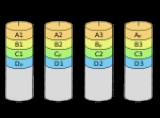
RAID
Parity data is used by some RAIDRAID
RAID is a storage technology that combines multiple disk drive components into a logical unit...
levels to achieve redundancy. If a drive in the array fails, remaining data on the other drives can be combined with the parity data (using the Boolean XOR function) to reconstruct the missing data.
For example, suppose two drives in a three-drive RAID 5 array contained the following data:
Drive 1: 01101101
Drive 2: 11010100
To calculate parity data for the two drives, an XOR is performed on their data:
01101101
XOR 11010100
_____________
10111001
The resulting parity data, 10111001, is then stored on Drive 3.
Should any of the three drives fail, the contents of the failed drive can be reconstructed on a replacement drive by subjecting the data from the remaining drives to the same XOR operation. If Drive 2 were to fail, its data could be rebuilt using the XOR results of the contents of the two remaining drives, Drive 1 and Drive 3:
Drive 1: 01101101
Drive 3: 10111001
as follows:
10111001
XOR 01101101
_____________
11010100
The result of that XOR calculation yields Drive 2's contents. 11010100 is then stored on Drive 2, fully repairing the array.
This same XOR concept applies similarly to larger arrays, using any number of disks. In the case of a RAID 3 array of 12 drives, 11 drives participate in the XOR calculation shown above and yield a value that is then stored on the dedicated parity drive.
History
A "parity track" was present on the first magnetic tape data storageMagnetic tape data storage
Magnetic tape data storage uses digital recording on to magnetic tape to store digital information. Modern magnetic tape is most commonly packaged in cartridges and cassettes. The device that performs actual writing or reading of data is a tape drive...
in 1951. Parity in this form, applied across multiple parallel signals, is known as a transverse redundancy check
Transverse redundancy check
In telecommunications, a transverse redundancy check or vertical redundancy check is a redundancy check for synchronized parallel bits applied once per bit time, across the bit streams...
. This can be combined with parity computed over multiple bits sent on a single signal, a longitudinal redundancy check
Longitudinal redundancy check
In telecommunication, a longitudinal redundancy check or horizontal redundancy check is a form of redundancy check that is applied independently to each of a parallel group of bit streams...
. In a parallel bus, there is one longitudinal redundancy check bit per parallel signal.
Parity was also used on at least some paper-tape (punched tape
Punched tape
Punched tape or paper tape is an obsolete form of data storage, consisting of a long strip of paper in which holes are punched to store data...
) data entry systems (which preceded magnetic tape systems). On the systems sold by British company ICL (formerly ICT) the 1 inches (25.4 mm) paper tape had 8 hole positions running across it, with the 8th being for parity. 7 positions were used for the data, e.g., 7-bit ASCII. The 8th position had a hole punched in it depending on the number of data holes punched.
For a contrary view, Seymour Cray
Seymour Cray
Seymour Roger Cray was an American electrical engineer and supercomputer architect who designed a series of computers that were the fastest in the world for decades, and founded Cray Research which would build many of these machines. Called "the father of supercomputing," Cray has been credited...
, premier designer of supercomputer
Supercomputer
A supercomputer is a computer at the frontline of current processing capacity, particularly speed of calculation.Supercomputers are used for highly calculation-intensive tasks such as problems including quantum physics, weather forecasting, climate research, molecular modeling A supercomputer is a...
s, held parity designs in contempt. He felt it showed poor design—if you designed your transmission paths to be reliable, you would not have to waste resources on parity. His famous quote on this (circa 1963) was "Parity is for farmers" (after the use of the term "parity" in the New Deal). After he later included parity bits on the CDC 7600, Cray reputedly said that "I learned that a lot of farmers buy computers."