

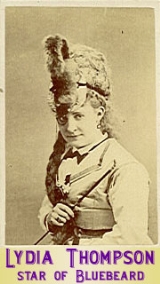
Lydia Thompson

Encyclopedia
Lydia Thompson, born Eliza Hodges Thompson (19 February 1838 – 17 November 1908), was an English
dancer, actress and theatrical producer.
After dancing in Britain as a teenager and then in Europe, she became a leading dancer and actress in burlesques on the London stage. She introduced burlesque to America in 1868 to great acclaim and notoriety.
, London
. Her father was Philip Thompson (c.1801–1842) and her mother was Eliza (née Cooper). Her father owned the Sheridan Knowles, a public house
. Thompson was the second of three surviving children, including actress Clara T. Bracy
. Her father died in 1842, and her mother remarried Edward Hodges. By the age of fourteen, Thompson had left home and joined the stage professionally as a dancer.
In 1852 she became a member of the corps de ballet
at Her Majesty's Theatre
. By the following year she was playing a solo role, Little Silverhair, in the pantomime
Harlequin and the Three Bears, or, Little Silverhair and the Fairies at the Haymarket Theatre
. In 1854 she danced at the old Globe Theatre in Blackfriars Road, in James Planché
's extravaganza
, Mr Buckstone's Voyage Round the Globe. She gained wider public attention later that year at the St James's Theatre
in The Spanish Dancers, a burletta
by Thomas Selby
, playing the famous dancer Señora Perea Nena. The Times
dismissed the piece but praised her performance highly: "It was no burlesque; it was one excellent dancer following in the steps of another, catching the spirit of her model, and rivalling her in the audacity of her execution. The youth and beauty of Miss Thompson gave an additional charm to her Andalusian feats."
There, she also played in the burlesque Ganem, the Slave of Love, and in the ballet-farce Magic Toys. These performances brought a period of prosperity to what had come to be regarded as one of the unluckiest theatres in London. She also appeared that year in The King's Rival by Tom Taylor
and Charles Reade
(J. L. Toole's first London role), Beauties of the Harem, and, again at the Haymarket, in the title role in the Christmas pantomime Little Bo Peep, or, Harlequin and the Girl who Lost her Sheep. She then returned to complete the season at the St James's in Cupid's Ladder and the fairy spectacle, The Swan and Edgar.
and Hornpipe
– as well
as the charms of her person and the vivacity of her character." She returned to England in the summer of 1859, by which time The Times
referred to her as "one of the most eminent of English dancers".
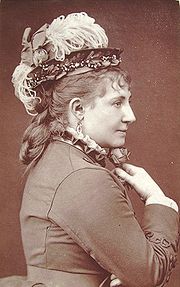 In the winter season of 1859–60 Thompson danced at the St James's in several pieces, including Virginius, or, The Trials of a Fond Papa, Lester Buckingham's burlesque Virginus, Valentine in Magic Toys, Dolly Mayflower in Black-Eyed Susan and Young Norval in the ballet-burlesque My Name is Norval. In 1860–1861, at the Lyceum Theatre, she played again in Magic Toys, as Morgiana in the Savage Club burlesque of The Forty Thieves
, in the farce The Middy Asthore, as Fanchette in George Loder's The Pets of the Parterre (Les Fleurs animées) and as Mephisto in the fairy extravaganza Chrystabelle, or the Rose Without a Thorn. She also played Norah in the first production of Edmund Falconer
's comedy Woman, or, Love Against the World, as Blondinette in Little Red Riding Hood and had a role in the William Brough burlesque of The Colleen Bawn
, called The Colleen Bawn Settled at Last.
Thompson married John Christian Tilbury, a riding-master, in 1863 and soon gave birth to a daughter. She soon returned to the stage in The Alabama at the Drury Lane Theatre
. Her husband died fifteen months after their marriage, in a steeplechasing accident in 1864, when he was rolled on by his horse. In the following years, she alternated between London and provincial tours, mixing dancing and acting in plays. In 1864, at the opening of the new Theatre Royal, Birkenhead
, managed by Alexander Henderson (1828–1886), she created the title role in a burlesque of Ixion
by Francis Burnand
. She joined Henderson's company at Prince of Wales's Theatre, Liverpool
, together with the rising young actors Squire Bancroft
, Marie Wilton and Henry Irving
. There, she played in Brough's Ernani (1865), as Max in a burlesque of Weber's Der Freischütz (1866), as Prince Buttercup in The White Fawn, as Massaroni in the burlesque The Brigand, and as Prince Florizel in another burlesque, Perdita. Thompson excelled as "principal boy" in burlesques: "She was charming to look at, a good singer, a really clever dancer, and the life and soul of the scene while on the stage." Other successful London runs from 1866–1868 included, at the Drury Lane, Sophonisba in Delibes' Wanted Husbands For Six (Six Demoiselles à marier) and at the Strand Theatre
, Blue-Beard (after Jacques Offenbach
's version) and Darnley in the very successful The Field of the Cloth of Gold.
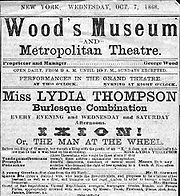
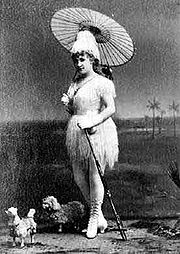 Thompson married Henderson, and the two sailed in August 1868 for America, heading a small theatrical troupe, adapting popular English burlesques for middle-class New York audiences by adding topical and local references and reworking the lyrics of popular songs, while preserving the rhymed couplets and comic puns of the burlesque form.
Thompson's troupe, called the "British Blondes", was the most popular entertainment in New York during the 1868–1869 theatrical season. "The eccentricities of pantomime and burlesque – with their curious combination of comedy, parody, satire, improvisation, song and dance, variety acts, cross-dressing, extravagant stage effects, risqué jokes and saucy costumes – while familiar enough to British audiences, took New York by storm." The six-month tour ran for almost six extremely profitable years, and during two subsequent tours, it drew huge crowds at leading theatres across the U.S. The troupe launched careers of several actresses, including Markham, Alice Burville
and Rose Coghlan
, and of comedian Willie Edouin
. It also drew fierce criticism from those who felt it transgressed the boundaries of propriety. Criticism reflecting on the virtue of her dancers by Wilbur F. Storey, the owner of the Chicago Times
, led Thompson and her troupe first to post notices calling Storey "a liar and a coward" and appealing for the sympathy of the people. Then, on 24 February 1870, Thompson, her husband and her colleague, Pauline Markham
, horsewhip
ped Storey at gunpoint, for which they were arrested and fined. Thompson told a reporter that Storey "had called her by the most odious epithet that could be applied to a woman, and she could stand it no longer. She was glad at what she had done." This resulted in more publicity and popularity for the troupe. Actress Olive Logan protested, "I cannot advise any woman to go upon the stage with the demoralizing influence which seems here to prevail more every day, when its greatest rewards are won by brazen-faced, stained, yellow-haired, padded-limbed creatures, while actresses of the old school – well trained, decent – cannot earn a living."
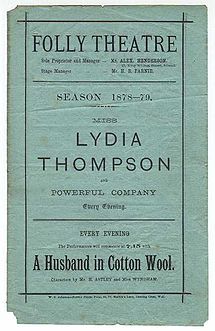 Thompson, Henderson and her troupe finally returned to England in 1874, and she resumed her starring roles in London and provincial productions, including H. B. Farnie's burlesques of Bluebeard (which she had already made a hit in America) and Robinson Crusoe, and Robert Reece
's Carmen, or, Sold for a Song, as well as Piff-Paff (Le Grand Duc de Matapa), Oxygen, The Lady of Lyons, Pluto!, and other burlesques. Henderson purchased the Folly Theatre
in 1876, and it became a burlesque house, with Thompson in the lead roles. The first piece was a production of Bluebeard. In the following years, Thompson returned to America several times, where she remained popular. Thompson separated from Herderson, but the two continued to work together into the 1880s. In 1881, after two years in retirement, she returned to the stage as Mrs Kingfisher in the farce Dust.
Thompson returned to New York following the death of Henderson in 1886 and again in the winter seasons of 1888 and 1891. In 1887 she opened at the Royal Strand Theatre
, London, under her own management
, in Alfred Cellier
's comic opera
, The Sultan of Mocha. She next starred in the French vaudeville-opérette Babette (1888, Antonio), but her voice was judged inadequate. After this, her career began to decline. Her last American performances were in 1894 in The Crust of Society in a supporting role. Back in London, George Edwardes
cast her briefly in the Edwardian musical comedy
An Artist's Model
(1895), but by 1899, she had depleted her funds. A London benefit night was held for her on 2 May 1899 at the Lyceum Theatre, when she performed in The Wedding March by W. S. Gilbert
. She also recited a rhymed "farewell address" written for her by Gilbert. Her final performances were in 1904, as the Duchesse du Albuquerque in A Queen's Romance.
Thompson died in London at the age of 70. She is buried in Kensal Green cemetery
. Her daughter, Zeffie Agnes Lydia Tilbury
, became an actress known first on the London stage and later for playing wise or evil older characters in films, such as Grandma in The Grapes of Wrath
(1940) and Grandma Lester in Tobacco Road
(1941).
English people
The English are a nation and ethnic group native to England, who speak English. The English identity is of early mediaeval origin, when they were known in Old English as the Anglecynn. England is now a country of the United Kingdom, and the majority of English people in England are British Citizens...
dancer, actress and theatrical producer.
After dancing in Britain as a teenager and then in Europe, she became a leading dancer and actress in burlesques on the London stage. She introduced burlesque to America in 1868 to great acclaim and notoriety.
Early years
Thompson was born in Brydges Street, Covent GardenCovent Garden
Covent Garden is a district in London on the eastern fringes of the West End, between St. Martin's Lane and Drury Lane. It is associated with the former fruit and vegetable market in the central square, now a popular shopping and tourist site, and the Royal Opera House, which is also known as...
, London
London
London is the capital city of :England and the :United Kingdom, the largest metropolitan area in the United Kingdom, and the largest urban zone in the European Union by most measures. Located on the River Thames, London has been a major settlement for two millennia, its history going back to its...
. Her father was Philip Thompson (c.1801–1842) and her mother was Eliza (née Cooper). Her father owned the Sheridan Knowles, a public house
Public house
A public house, informally known as a pub, is a drinking establishment fundamental to the culture of Britain, Ireland, Australia and New Zealand. There are approximately 53,500 public houses in the United Kingdom. This number has been declining every year, so that nearly half of the smaller...
. Thompson was the second of three surviving children, including actress Clara T. Bracy
Clara T. Bracy
Clara T. Bracy was an English stage and silent film actress.-Life and career:Bracy was born Clara Thompson in London, England. Her father was Philip Thompson , and her mother was Eliza . Her father owned the Sheridan Knowles, a public house in London...
. Her father died in 1842, and her mother remarried Edward Hodges. By the age of fourteen, Thompson had left home and joined the stage professionally as a dancer.
In 1852 she became a member of the corps de ballet
Corps de ballet
In ballet, the corps de ballet is the group of dancers who are not soloists. They are a permanent part of the ballet company and often work as a backdrop for the principal dancers. A corps de ballet works as one, with synchronized movements and corresponding positioning on the stage...
at Her Majesty's Theatre
Her Majesty's Theatre
Her Majesty's Theatre is a West End theatre, in Haymarket, City of Westminster, London. The present building was designed by Charles J. Phipps and was constructed in 1897 for actor-manager Herbert Beerbohm Tree, who established the Royal Academy of Dramatic Art at the theatre...
. By the following year she was playing a solo role, Little Silverhair, in the pantomime
Pantomime
Pantomime — not to be confused with a mime artist, a theatrical performer of mime—is a musical-comedy theatrical production traditionally found in the United Kingdom, Australia, New Zealand, Canada, Jamaica, South Africa, India, Ireland, Gibraltar and Malta, and is mostly performed during the...
Harlequin and the Three Bears, or, Little Silverhair and the Fairies at the Haymarket Theatre
Haymarket Theatre
The Theatre Royal Haymarket is a West End theatre in the Haymarket in the City of Westminster which dates back to 1720, making it the third-oldest London playhouse still in use...
. In 1854 she danced at the old Globe Theatre in Blackfriars Road, in James Planché
James Planche
James Robinson Planché was a British dramatist, antiquary and officer of arms. Over a period of approximately 60 years he wrote, adapted, or collaborated on 176 plays in a wide range of genres including extravaganza, farce, comedy, burletta, melodrama and opera...
's extravaganza
Extravaganza
An extravaganza is a literary or musical work characterized by freedom of style and structure and usually containing elements of burlesque, pantomime, music hall and parody. It sometimes also has elements of cabaret, circus, revue, variety, vaudeville and mime...
, Mr Buckstone's Voyage Round the Globe. She gained wider public attention later that year at the St James's Theatre
St James's Theatre
The St James's Theatre was a 1,200-seat theatre located in King Street, at Duke Street, St James's, London. The elaborate theatre was designed with a neo-classical exterior and a Louis XIV style interior by Samuel Beazley and built by the partnership of Peto & Grissell for the tenor and theatre...
in The Spanish Dancers, a burletta
Burletta
A burletta , also sometimes burla or burlettina, is a musical term generally denoting a brief comic Italian opera...
by Thomas Selby
Thomas Selby
Thomas Selby may refer to:* Thomas Selby , Kent cricketer* Thomas Selby , English cricketer for Derbyshire* Thomas Henry Selby , American politician, mayor of San Francisco...
, playing the famous dancer Señora Perea Nena. The Times
The Times
The Times is a British daily national newspaper, first published in London in 1785 under the title The Daily Universal Register . The Times and its sister paper The Sunday Times are published by Times Newspapers Limited, a subsidiary since 1981 of News International...
dismissed the piece but praised her performance highly: "It was no burlesque; it was one excellent dancer following in the steps of another, catching the spirit of her model, and rivalling her in the audacity of her execution. The youth and beauty of Miss Thompson gave an additional charm to her Andalusian feats."
There, she also played in the burlesque Ganem, the Slave of Love, and in the ballet-farce Magic Toys. These performances brought a period of prosperity to what had come to be regarded as one of the unluckiest theatres in London. She also appeared that year in The King's Rival by Tom Taylor
Tom Taylor
Tom Taylor was an English dramatist, critic, biographer, public servant, and editor of Punch magazine...
and Charles Reade
Charles Reade
Charles Reade was an English novelist and dramatist, best known for The Cloister and the Hearth.-Life:Charles Reade was born at Ipsden, Oxfordshire to John Reade and Anne Marie Scott-Waring; William Winwood Reade the influential historian , was his nephew. He studied at Magdalen College, Oxford,...
(J. L. Toole's first London role), Beauties of the Harem, and, again at the Haymarket, in the title role in the Christmas pantomime Little Bo Peep, or, Harlequin and the Girl who Lost her Sheep. She then returned to complete the season at the St James's in Cupid's Ladder and the fairy spectacle, The Swan and Edgar.
Star dancer
Still a teenager, Thompson then toured through Europe for over three years. She danced in Russia, Germany, Austria, France, Scandinavia and elsewhere, "winning acclaim for the dexterity of her dancing – which included the Highland FlingHighland Fling
This dance is now performed at dance competitions and events around the world. It is no longer danced on a shield, but it is still the goal of the dancer to stay in the same spot throughout the dance. The Highland Fling is danced at almost all competition levels, from Primary to Premier. It is also...
and Hornpipe
Hornpipe
The term hornpipe refers to any of several dance forms played and danced in Britain and elsewhere from the late 17th century until the present day. It is said that hornpipe as a dance began around the 16th century on English sailing vessels...
– as well
as the charms of her person and the vivacity of her character." She returned to England in the summer of 1859, by which time The Times
The Times
The Times is a British daily national newspaper, first published in London in 1785 under the title The Daily Universal Register . The Times and its sister paper The Sunday Times are published by Times Newspapers Limited, a subsidiary since 1981 of News International...
referred to her as "one of the most eminent of English dancers".
The Forty Thieves
The Forty Thieves is a "Pantomime Burlesque" written by Robert Reece, W. S. Gilbert, F. C. Burnand and Henry J. Byron, created in 1878 as an amateur production for the Beefsteak Club of London. The Beefsteak Club still meets in Irving Street, London. It was founded by actor John Lawrence Toole...
, in the farce The Middy Asthore, as Fanchette in George Loder's The Pets of the Parterre (Les Fleurs animées) and as Mephisto in the fairy extravaganza Chrystabelle, or the Rose Without a Thorn. She also played Norah in the first production of Edmund Falconer
Edmund Falconer
Edmund Falconer , also known as Edmund O'Rourke, was an Irish-born 19th century poet, actor, theatre manager, songwriter and playwright, known for his keen wit and outstanding acting skills.-Early life:...
's comedy Woman, or, Love Against the World, as Blondinette in Little Red Riding Hood and had a role in the William Brough burlesque of The Colleen Bawn
The Colleen Bawn
The Colleen Bawn, or The Brides of Garryowen is a melodramatic play written by Irish playwright Dion Boucicault. It was first performed at Miss Laura Keene's Theatre, New York, on 27 March 1860 with Laura Keene playing Anne Chute and Boucicault playing Myles na Coppaleen. It was most recently...
, called The Colleen Bawn Settled at Last.
Thompson married John Christian Tilbury, a riding-master, in 1863 and soon gave birth to a daughter. She soon returned to the stage in The Alabama at the Drury Lane Theatre
Theatre Royal, Drury Lane
The Theatre Royal, Drury Lane is a West End theatre in Covent Garden, in the City of Westminster, a borough of London. The building faces Catherine Street and backs onto Drury Lane. The building standing today is the most recent in a line of four theatres at the same location dating back to 1663,...
. Her husband died fifteen months after their marriage, in a steeplechasing accident in 1864, when he was rolled on by his horse. In the following years, she alternated between London and provincial tours, mixing dancing and acting in plays. In 1864, at the opening of the new Theatre Royal, Birkenhead
Birkenhead
Birkenhead is a town within the Metropolitan Borough of Wirral in Merseyside, England. It is on the Wirral Peninsula, along the west bank of the River Mersey, opposite the city of Liverpool...
, managed by Alexander Henderson (1828–1886), she created the title role in a burlesque of Ixion
Ixion
In Greek mythology, Ixion was king of the Lapiths, the most ancient tribe of Thessaly, and a son of Ares, or Leonteus, or Antion and Perimele, or the notorious evildoer Phlegyas, whose name connotes "fiery". Peirithoös was his son...
by Francis Burnand
Francis Burnand
Sir Francis Cowley Burnand , often credited as F. C. Burnand, was an English comic writer and dramatist....
. She joined Henderson's company at Prince of Wales's Theatre, Liverpool
Liverpool
Liverpool is a city and metropolitan borough of Merseyside, England, along the eastern side of the Mersey Estuary. It was founded as a borough in 1207 and was granted city status in 1880...
, together with the rising young actors Squire Bancroft
Squire Bancroft
Sir Squire Bancroft , born Squire White Butterfield, was an English actor-manager. He and his wife Effie Bancroft are considered to have instigated a new form of drama known as 'drawing-room comedy' or 'cup and saucer drama', owing to the realism of their stage sets.-Early life and career:Bancroft...
, Marie Wilton and Henry Irving
Henry Irving
Sir Henry Irving , born John Henry Brodribb, was an English stage actor in the Victorian era, known as an actor-manager because he took complete responsibility for season after season at the Lyceum Theatre, establishing himself and his company as...
. There, she played in Brough's Ernani (1865), as Max in a burlesque of Weber's Der Freischütz (1866), as Prince Buttercup in The White Fawn, as Massaroni in the burlesque The Brigand, and as Prince Florizel in another burlesque, Perdita. Thompson excelled as "principal boy" in burlesques: "She was charming to look at, a good singer, a really clever dancer, and the life and soul of the scene while on the stage." Other successful London runs from 1866–1868 included, at the Drury Lane, Sophonisba in Delibes' Wanted Husbands For Six (Six Demoiselles à marier) and at the Strand Theatre
Royal Strand Theatre
The Royal Strand Theatre was located in Strand in the City of Westminster. The theatre was built on the site of a panorama in 1832, and in 1882 was rebuilt by the prolific theatre architect Charles J. Phipps...
, Blue-Beard (after Jacques Offenbach
Jacques Offenbach
Jacques Offenbach was a Prussian-born French composer, cellist and impresario. He is remembered for his nearly 100 operettas of the 1850s–1870s and his uncompleted opera The Tales of Hoffmann. He was a powerful influence on later composers of the operetta genre, particularly Johann Strauss, Jr....
's version) and Darnley in the very successful The Field of the Cloth of Gold.
America and later years
Thompson's troupe, called the "British Blondes", was the most popular entertainment in New York during the 1868–1869 theatrical season. "The eccentricities of pantomime and burlesque – with their curious combination of comedy, parody, satire, improvisation, song and dance, variety acts, cross-dressing, extravagant stage effects, risqué jokes and saucy costumes – while familiar enough to British audiences, took New York by storm." The six-month tour ran for almost six extremely profitable years, and during two subsequent tours, it drew huge crowds at leading theatres across the U.S. The troupe launched careers of several actresses, including Markham, Alice Burville
Alice Burville
Alice Julia Burville was an English soprano and actress, best known for her performances in Gilbert and Sullivan operas and other operettas in the 1870s and 1880s....
and Rose Coghlan
Rose Coghlan
Rose Coghlan , English actress was the sister of Charles Francis Coghlan.She went to America in 1871 as part of Lydia Thompson's troupe touring the U.S.. She made her Broadway debut in 1872 in a musical. Coghlan was again in England from 1873 to 1877, playing with Barry Sullivan, and then returned...
, and of comedian Willie Edouin
Willie Edouin
Willie Edouin was an English comedian, actor, dancer, singer, writer, director and theatre manager.After performing as a child in England, Australia and elsewhere, Edouin moved to America, where he joined Lydia Thompson's burlesque troupe, performing with this company both in the U.S. and Britain...
. It also drew fierce criticism from those who felt it transgressed the boundaries of propriety. Criticism reflecting on the virtue of her dancers by Wilbur F. Storey, the owner of the Chicago Times
Chicago Times
The Chicago Times was a newspaper in Chicago from 1854 to 1895 when it merged with the Chicago Herald.The Times was founded in 1854, by James W. Sheahan, with the backing of Stephen Douglas, and was identified as a pro-slavery newspaper. In 1861, after the paper was purchased by Wilbur F...
, led Thompson and her troupe first to post notices calling Storey "a liar and a coward" and appealing for the sympathy of the people. Then, on 24 February 1870, Thompson, her husband and her colleague, Pauline Markham
Pauline Markham
Pauline Markham was a singer and burlesque dancer during the period of Civil War in the United States. She was a member of the Lydia Thompson troupe....
, horsewhip
Horsewhip
A horsewhip or horse whip is* a crop* a whip* a quirt* a tool used as an artificial riding aid* in zoology, the English name for a snake species Oxybelis aeneus...
ped Storey at gunpoint, for which they were arrested and fined. Thompson told a reporter that Storey "had called her by the most odious epithet that could be applied to a woman, and she could stand it no longer. She was glad at what she had done." This resulted in more publicity and popularity for the troupe. Actress Olive Logan protested, "I cannot advise any woman to go upon the stage with the demoralizing influence which seems here to prevail more every day, when its greatest rewards are won by brazen-faced, stained, yellow-haired, padded-limbed creatures, while actresses of the old school – well trained, decent – cannot earn a living."
Robert Reece
Robert Reece was a British comic playwright and librettist active in the Victorian era. He wrote many successful musical burlesques, comic operas, farces and adaptations from the French, including the English-language adaptation of the operetta Les cloches de Corneville, which became the...
's Carmen, or, Sold for a Song, as well as Piff-Paff (Le Grand Duc de Matapa), Oxygen, The Lady of Lyons, Pluto!, and other burlesques. Henderson purchased the Folly Theatre
Folly Theatre
The Folly Theatre was a London theatre of the late 19th century, in William IV Street, near Charing Cross, in the City of Westminster. It was converted from the house of a religious order, and became a small theatre, with a capacity of 900 seated and standing. The theatre specialised in presenting...
in 1876, and it became a burlesque house, with Thompson in the lead roles. The first piece was a production of Bluebeard. In the following years, Thompson returned to America several times, where she remained popular. Thompson separated from Herderson, but the two continued to work together into the 1880s. In 1881, after two years in retirement, she returned to the stage as Mrs Kingfisher in the farce Dust.
Thompson returned to New York following the death of Henderson in 1886 and again in the winter seasons of 1888 and 1891. In 1887 she opened at the Royal Strand Theatre
Royal Strand Theatre
The Royal Strand Theatre was located in Strand in the City of Westminster. The theatre was built on the site of a panorama in 1832, and in 1882 was rebuilt by the prolific theatre architect Charles J. Phipps...
, London, under her own management
Actor-manager
An actor-manager is a leading actor who sets up their own permanent theatrical company and manages the company's business and financial arrangements, sometimes taking over the management of a theatre, to perform plays of their own choice and in which they will usually star...
, in Alfred Cellier
Alfred Cellier
Alfred Cellier was an English composer, orchestrator and conductor.In addition to conducting and music directing the original productions of several of the most famous Gilbert and Sullivan works and writing the overtures to some of them, Cellier conducted at many theatres in London, New York and...
's comic opera
Comic opera
Comic opera denotes a sung dramatic work of a light or comic nature, usually with a happy ending.Forms of comic opera first developed in late 17th-century Italy. By the 1730s, a new operatic genre, opera buffa, emerged as an alternative to opera seria...
, The Sultan of Mocha. She next starred in the French vaudeville-opérette Babette (1888, Antonio), but her voice was judged inadequate. After this, her career began to decline. Her last American performances were in 1894 in The Crust of Society in a supporting role. Back in London, George Edwardes
George Edwardes
George Joseph Edwardes was an English theatre manager of Irish ancestry who brought a new era in musical theatre to the British stage and beyond....
cast her briefly in the Edwardian musical comedy
Edwardian Musical Comedy
Edwardian musical comedies were British musical theatre shows from the period between the early 1890s, when the Gilbert and Sullivan operas' dominance had ended, until the rise of the American musicals by Jerome Kern, Rodgers and Hart, George Gershwin and Cole Porter following World War I.Between...
An Artist's Model
An Artist's Model
An Artist's Model is a two-act musical by Owen Hall, with lyrics by Harry Greenbank and music by Sidney Jones, with additional songs by Joseph and Mary Watson, Paul Lincke, Frederick Ross, Henry Hamilton and Leopold Wenzel. It opened at Daly's Theatre in London, produced by George Edwardes and...
(1895), but by 1899, she had depleted her funds. A London benefit night was held for her on 2 May 1899 at the Lyceum Theatre, when she performed in The Wedding March by W. S. Gilbert
W. S. Gilbert
Sir William Schwenck Gilbert was an English dramatist, librettist, poet and illustrator best known for his fourteen comic operas produced in collaboration with the composer Sir Arthur Sullivan, of which the most famous include H.M.S...
. She also recited a rhymed "farewell address" written for her by Gilbert. Her final performances were in 1904, as the Duchesse du Albuquerque in A Queen's Romance.
Thompson died in London at the age of 70. She is buried in Kensal Green cemetery
Kensal Green Cemetery
Kensal Green Cemetery is a cemetery in Kensal Green, in the west of London, England. It was immortalised in the lines of G. K. Chesterton's poem The Rolling English Road from his book The Flying Inn: "For there is good news yet to hear and fine things to be seen; Before we go to Paradise by way of...
. Her daughter, Zeffie Agnes Lydia Tilbury
Zeffie Tilbury
Zeffie Agnes Lydia Tilbury was an English actress-Career:Born in Paddington, Middlesex, England Tilbury was known first on the London stage and later for playing wise or evil older characters in films, such as the distinguished lady gambler at dinner with Garbo in The Single Standard, as Grandma...
, became an actress known first on the London stage and later for playing wise or evil older characters in films, such as Grandma in The Grapes of Wrath
The Grapes of Wrath (film)
The Grapes of Wrath is a 1940 drama film directed by John Ford. It was based on John Steinbeck's Pulitzer Prize-winning novel of the same name. The screenplay was written by Nunnally Johnson and the executive producer was Darryl F...
(1940) and Grandma Lester in Tobacco Road
Tobacco Road (film)
Tobacco Road is a 1941 film directed by John Ford starring Charley Grapewin, Marjorie Rambeau, Gene Tierney, William Tracy and Dana Andrews. It was based on the novel of the same name by Erskine Caldwell, but the plot was rewritten for the film.-Cast:...
(1941).
External links
- Lydia Thompson photo gallery NYP Library