

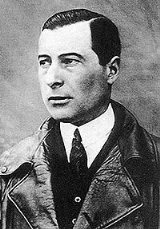
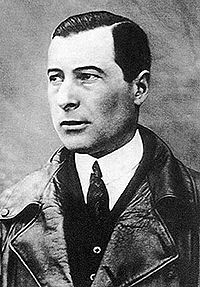
Ludwik Idzikowski

Encyclopedia
Poland
Poland , officially the Republic of Poland , is a country in Central Europe bordered by Germany to the west; the Czech Republic and Slovakia to the south; Ukraine, Belarus and Lithuania to the east; and the Baltic Sea and Kaliningrad Oblast, a Russian exclave, to the north...
military aviator. He died during a transatlantic flight
Transatlantic flight
Transatlantic flight is the flight of an aircraft across the Atlantic Ocean. A transatlantic flight may proceed east-to-west, originating in Europe or Africa and terminating in North America or South America, or it may go in the reverse direction, west-to-east...
trial.
Early life and service
Ludwik Idzikowski was born in WarsawWarsaw
Warsaw is the capital and largest city of Poland. It is located on the Vistula River, roughly from the Baltic Sea and from the Carpathian Mountains. Its population in 2010 was estimated at 1,716,855 residents with a greater metropolitan area of 2,631,902 residents, making Warsaw the 10th most...
. He started mining
Mining
Mining is the extraction of valuable minerals or other geological materials from the earth, from an ore body, vein or seam. The term also includes the removal of soil. Materials recovered by mining include base metals, precious metals, iron, uranium, coal, diamonds, limestone, oil shale, rock...
studies in Liege, Belgium
Belgium
Belgium , officially the Kingdom of Belgium, is a federal state in Western Europe. It is a founding member of the European Union and hosts the EU's headquarters, and those of several other major international organisations such as NATO.Belgium is also a member of, or affiliated to, many...
.
At the outbreak of World War I, he was conscripted into the Russian Army
Imperial Russian Army
The Imperial Russian Army was the land armed force of the Russian Empire, active from around 1721 to the Russian Revolution of 1917. In the early 1850s, the Russian army consisted of around 938,731 regular soldiers and 245,850 irregulars . Until the time of military reform of Dmitry Milyutin in...
. He completed aviation school in Sevastopol
Sevastopol
Sevastopol is a city on rights of administrative division of Ukraine, located on the Black Sea coast of the Crimea peninsula. It has a population of 342,451 . Sevastopol is the second largest port in Ukraine, after the Port of Odessa....
, and from 1916 served in air combat units as an officer pilot. After the October Revolution
October Revolution
The October Revolution , also known as the Great October Socialist Revolution , Red October, the October Uprising or the Bolshevik Revolution, was a political revolution and a part of the Russian Revolution of 1917...
he managed to return to Warsaw and in November 1918 Idzikowski joined the newly-born Polish Army, in the rank
Military rank
Military rank is a system of hierarchical relationships in armed forces or civil institutions organized along military lines. Usually, uniforms denote the bearer's rank by particular insignia affixed to the uniforms...
of podporucznik pilot (flying 2nd Lieutenant).
In 1919 he joined the Polish Air Force
Polish Air Force
The Polish Air Force is the military Air Force wing of the Polish Armed Forces. Until July 2004 it was officially known as Wojska Lotnicze i Obrony Powietrznej...
and during the Polish-Soviet War
Polish-Soviet War
The Polish–Soviet War was an armed conflict between Soviet Russia and Soviet Ukraine and the Second Polish Republic and the Ukrainian People's Republic—four states in post–World War I Europe...
, initially flew with the 7th fighter escadre ("Kościuszko Squadron"), crewed mostly by American
United States
The United States of America is a federal constitutional republic comprising fifty states and a federal district...
volunteers, then the 6th reconnaissance escadre. He took part, among others, in the defence of Lwów. After the war, from 1921–1923 he was an instructor, then commander of escadre training in an advanced flying school in Grudziądz
Grudziadz
Grudziądz is a city in northern Poland on the Vistula River, with 96 042 inhabitants . Situated in the Kuyavian-Pomeranian Voivodeship , the city was previously in the Toruń Voivodeship .- History :-Early history:...
. From 1924–1926 he commanded an escadre, then a squadron, in the 1st Aviation Regiment in Warsaw.
First transatlantic flight attempt
In April 1926, Idzikowski was sent to France with a Polish military mission, where he tested aircraft bought by the Polish government. It was then that he planned to make his first transatlantic flight, but in the more difficult and as yet, unsuccessfully attempted East-West direction. A French attempt had been made in May 1927 aboard The White BirdThe White Bird
The White Bird was a French biplane which disappeared in 1927, during an attempt to make the first non-stop transatlantic flight between Paris and New York...
(L'Oiseau Blanc), but the aircraft disappeared over the Atlantic. Two weeks later, the American Charles Lindbergh
Charles Lindbergh
Charles Augustus Lindbergh was an American aviator, author, inventor, explorer, and social activist.Lindbergh, a 25-year-old U.S...
made the first successful nonstop flight from New York to Paris.
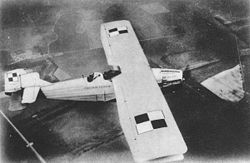
After considerable hesitation, the Polish authorities, urged on by the press, eventually succumbed and bought a special plane for a transatlantic flight from France. A long range variant of the latest bomber
Bomber
A bomber is a military aircraft designed to attack ground and sea targets, by dropping bombs on them, or – in recent years – by launching cruise missiles at them.-Classifications of bombers:...
Amiot 123, It was named Marszałek Piłsudski (Marshal Józef Piłsudski). On January 1, 1928, Idzikowski was promoted to Major
Major
Major is a rank of commissioned officer, with corresponding ranks existing in almost every military in the world.When used unhyphenated, in conjunction with no other indicator of rank, the term refers to the rank just senior to that of an Army captain and just below the rank of lieutenant colonel. ...
.
The second pilot and navigator chosen was Major Kazimierz Kubala. They commenced their first trials for the transatlantic flight on August 3, 1928, taking off at 4:45 a.m. from Paris Le Bourget
Le Bourget
Le Bourget is a commune in the northeastern suburbs of Paris, France. It is located from the center of Paris.A very small part of Le Bourget airport lies on the territory of the commune of Le Bourget, which nonetheless gave its name to the airport. Most of the airport lies on the territory of the...
airfield. However, after flying some 3,200 km and above the ocean, they noticed engine oil levels were falling, caused by a cracked oil tank. They decided to return to Europe, since it was more than half way to America and against the wind. After 31 hours of flight, oil depleted, Idzikowski decided to land on water by the German
Germany
Germany , officially the Federal Republic of Germany , is a federal parliamentary republic in Europe. The country consists of 16 states while the capital and largest city is Berlin. Germany covers an area of 357,021 km2 and has a largely temperate seasonal climate...
merchant ship Samos, about 70 km from the Spanish coast. The sailor
Sailor
A sailor, mariner, or seaman is a person who navigates water-borne vessels or assists in their operation, maintenance, or service. The term can apply to professional mariners, military personnel, and recreational sailors as well as a plethora of other uses...
s rescued the crew and pulled the aircraft from the water.
Second transatlantic flight attempt
Idzikowski and Kubala repeated a trial the next year. A second Amiot 123 was bought, since the old one was too badly damaged. It was named the White Eagle (according to some sources, it was named Marszałek Piłsudski as well). They took off on July 13, 1929, at 3:45 a.m. from Le Bourget. After flying 2140 km, over the ocean, about 5 p.m., an engine started to lose RPMRevolutions per minute
Revolutions per minute is a measure of the frequency of a rotation. It annotates the number of full rotations completed in one minute around a fixed axis...
and emit noise. They decided to land on Faial Island
Faial Island
Faial Island , also known in English as Fayal, is a Portuguese island of the Central Group of the Azores....
in the Azores
Azores
The Archipelago of the Azores is composed of nine volcanic islands situated in the middle of the North Atlantic Ocean, and is located about west from Lisbon and about east from the east coast of North America. The islands, and their economic exclusion zone, form the Autonomous Region of the...
. However, because of more irregular engine work, at 9 p.m. (7 p.m. local time), Idzikowski decided to make an emergency landing on a closer rocky island Graciosa
Graciosa
Graciosa Island is referred to as the White Island, the northernmost of the Central Group of islands in the Azores. The ovular Portuguese island has an area of 60.65 km², a length of 10 km and a width of 7 km...
. During a landing on a field, the plane hit a low stone wall and overturned, wheels up. In the crash, Ludwik Idzikowski was killed, while Kazimierz Kubala was slightly injured. During the rescue operation, the aircraft was wrecked and Idzikowski burned.
Idzikowski's body was returned to Poland by the sailing ship ORP Iskra and buried with honours on August 17, 1929. He was awarded the Silver Cross of the Virtuti Militari
Virtuti Militari
The Order Wojenny Virtuti Militari is Poland's highest military decoration for heroism and courage in the face of the enemy at war...
, Cross of Valour (Krzyz Walecznych) (three times), Gold Cross of Merit, and (posthumously) the Officer's Cross of the Polonia Restituta
Polonia Restituta
The Order of Polonia Restituta is one of Poland's highest Orders. The Order can be conferred for outstanding achievements in the fields of education, science, sport, culture, art, economics, defense of the country, social work, civil service, or for furthering good relations between countries...
. He also held the Field Pilot Badge.
See also
- Orteig PrizeOrteig PrizeThe Orteig Prize was a $25,000 reward offered on May 19, 1919, by New York hotel owner Raymond Orteig to the first allied aviator to fly non-stop from New York City to Paris or vice-versa. On offer for five years, it attracted no competitors...